Showing posts with label island. Show all posts

Monday, November 16, 2020

I admire the fine blue color of the cedar berries.


November 16


I now take notice of the green polypody on the rock. 

P. M. – To Nawshawtuct by boat with Sophia, up Assabet.

The river still higher than yesterday.

I paddled straight from the boat's place to the Island.

I now take notice of the green polypody on the rock and various other ferns, one the marginal (?) shield fern and one the terminal shield fern, and this other, here inserted, on the steep bank above the Hemlocks.

I admire the fine blue color of the cedar berries.

H. D. Thoreau, Journal, November 16, 1853

By boat with Sophia, up Assabet. 
See October 6, 1856 ("Carried Sophia and Aunt up the Assabet"); November 14, 1855 ("Up Assabet with Sophia. A clear, bright, warm afternoon.”)

The river still higher than yesterday.
See November 15, 1853 ("The river has risen yet higher than last night, so that I cut across Hubbard's meadow with ease."); See also November 14, 1855 ("The rain has raised the river an additional foot or more, and it is creeping over the meadows.")

I now take notice of the green polypody on the rock.  See October 23, 1857 ("The ferns which I can see on the bank, apparently all evergreens, are polypody at rock, marginal shield fern, terminal shield fern, and (I think it is) Aspidium spinulosum,. . .The above-named evergreen ferns are so much the more conspicuous on that pale-brown ground. They stand out all at once and are seen to be evergreen; their character appears.”);  November 17, 1858 ("The polypody on the rock is much shrivelled by the late cold") See also  November 2, 1857 (“My thoughts are with the polypody a long time after my body has passed. ”); November 5, 1857 ("At this season polypody is in the air. ") and A Book of the Seasons, by Henry Thoreau,  Polypody, Marginal Shield Fern, Terminal Shield Fern; A Book of the Seasons,  by Henry Thoreau, Polypody

The Rock. Likely Egg Rock / Island Rock, "The most forwrd point on the small area that Thoreau refers to as the Island,"  an outcrop at the confluence of the Assabet and Sudbury rivers where they form the Concord River.~ Ray Angelo,  Thoreau Place Names 74   See November 4, 1855 ("This forenoon the boys found a little black kitten about a third grown on the Island or Rock"); January 16, 1857 ("As I pass the Island (Egg Rock)"); June 9, 1855 (“Rhus Toxicodendron on Island Rock.”); August 9, 1856 ("I am surprised to see the Apocynum cannabinum close to the rock at the Island") 

I admire the fine blue color of the cedar berries.  See November 30, 1853 ("The twigs of young cedars with apparently staminate buds have even a strawberry-like fragrance, and what a heavenly blue have the berries! - a peculiar light blue, whose bloom rubs off, contrasting with the green or purplish-brown leaves."). Note Juniperus virginiana, sometimes known as red cedar, is a species of juniper. The berry-like female  seed cone  is dark purple-blue with a white wax cover giving an overall sky-blue color ~ wikipedia

I now take notice
of the green polypody
and the other ferns.


A Book of the Seasons,  by Henry Thoreau
"A book, each page written in its own season,
out-of-doors, in its own locality."
 ~edited, assembled and rewritten by zphx ©  2009-2025

https://tinyurl.com/hdt-531116

Wednesday, November 7, 2018

Now we are left to the hemlocks and pines with their silvery light, to the bare trees and withered grass.

November 7. 

P. M. — To Bateman’s Pond. 

November 7,, 2018

It cleared up this forenoon. I leave my boat opposite the Hemlocks. I see the cold sunlight from some glade between the clouds falling on distant oak woods, now nearly bare, and as I glance up the hill between them. seeing the bare but bright hillside beyond, I think, Now we are left to the hemlocks and pines with their silvery light, to the bare trees and withered grass. 

The very rocks and stones in the rocky roads (that beyond Farmer’s) look white in the clear November light, especially after the rain. We are left to the chickadee’s familiar notes, and the jay for trumpeter. What struck me was a certain emptiness beyond, between the hemlocks and the hill, in the cool, washed air, as if I appreciated even here the absence of insects from it. It suggested agreeably to me a mere space in which to walk briskly. The fields are bleak, and they are, as it were, vacated. 

The very earth is like a house shut up for the winter, and I go knocking about it in vain. But just then I heard a chickadee on a hemlock, and was inexpressibly cheered to find that an old acquaintance was yet stirring about the premises, and was, I was assured, to be there all winter. All that is evergreen in me revived at once.

The very moss, the little pine-tree moss, in Hosmer’s meadow is revealed by its greenness amid the withered grass and stubble.

Hard frosts have turned the cranberry vines to a dark purple. 

I hear one faint cricket’s chirp this afternoon. 

Going up the lane beyond Farmer’s, I was surprised to see fly up from the white, stony road, two snow buntings, which alighted again close by, one on a large rock, the other on the stony ground. They had pale-brown or tawny touches on the white breast, on each side of the head, and on the top of the head, in the last place with some darker color. Had light-yellowish bills. They sat quite motionless within two rods, and allowed me to approach within a rod, as if conscious that the white rocks,  etc., concealed them. It seemed as if they were attracted to surfaces of the same color with themselves, — white and black (or quite dark) and tawny. One squatted flat, if not both. Their soft rippling notes as they went off reminded me [of] the northeast snow-storms to which ere long they are to be an accompaniment.

I find in a swamp witch-hazel buds still opening, for here they are sheltered, but I can find no fringed gentian, blue, near Bateman’s Pond. But Aster undulatus and several golden rods, at least, may be found yet. I see Lycopodium dendroideum which has not yet shed pollen. 

In and about Fox Castle Swamp, lambkill is reddened about as much as ever. Round-leaved cornel is bare.

The nuthatch is another bird of the fall which I hear these days and for a long time, — apparently ever since the young birds grew up. 

The Cornus florida by the pond is quite bare; how long? (That at Island still thickly leaved.) So that I can only say that the sheltered C. florida change much later than the scarlet oak generally, and perhaps the former is to be considered later on the whole.

Methinks those scarlet oaks, those burning bushes, begin to be rare in the landscape. They are about Bateman’s Pond, at any rate.

My apple harvest! It is to glean after the husbandman and the cows, or to gather the crop of those wild trees far away on the edges of swamps which have es caped their notice. Now, when it is generally all fallen, if indeed any is left, though you would not suppose there were any on the first survey, nevertheless with experienced eyes I explore amid the clumps of alder (now bare) and in the crevices of the rocks full of leaves, and prying under the fallen and decaying ferns which, with apple and alder leaves, thickly strew the ground. From amid the leaves anywhere within the circumference of the tree, I draw forth the fruit, all wet and glossy, nibbled by rabbits and hollowed out by crickets, but still with the bloom on it and at least as ripe and well kept, if not better than those in barrels, while those which lay exposed are quite brown and rotten. Showing only a blooming cheek here and there between the wet leaves, or fallen into hollows long since and covered up with the leaves of the tree,— a proper kind of packing. I fill my pockets on each side, and as I retrace my steps, I eat one first from this side, and then from that, in order to preserve my balance. And here and there is one lodged as it fell between the bases of the suckers which spring thickly from a horizontal limb. In the midst of an alder clump, covered by leaves, there it lies, safe from cows which might smell it out and unobserved by the husbandman; reserved for me.

It is too late, generally, to look for the handsome ones now. The exposed are decayed or decaying.

Looking southwest toward the pond just before sunset, I saw against the light what I took to be a shad-bush in full bloom, but without a leafet. I was prepared for this sight after this very warm autumn, because this tree frequently puts forth new leaves in October. Or it might be a young wild apple. Hastening to it, I found it was only the feathery seeds of the virgin’s-bower, whose vine, so close to the branches, was not noticeable. They looked just like dense umbels of white flowers, and in this light, three or four rods off, were fully as white as white apple blossoms. 

It is singular how one thing thus puts on the semblance of another. I thought at first I had made a discovery more interesting than the blossoming of apple trees in the fall. This, I thought, which I never saw nor heard of before, must be the result of that wonderfully warm weather about the 19th and 20th of October. It carried me round to spring again, when the shad-bush, almost leafless, is seen waving its white blossoms amid the yet bare trees. The feathery masses at intervals along the twigs, just like umbels of apple bloom, so caught and reflected the western light.

The small beeches are still covered with withered leaves, but the larger are three-quarters bare. 

The Diplopappus linariifolius, which was yellow in the shade, in open and sunny places is purple.

I see the small botrychium leaf in Hosmer’s meadow still firm, but a reddish brown or leather-color. 

Rounding the Island just after sunset, I see not only the houses nearest the river but our own reflected in the river by the Island. From what various points of view and in what unsuspected lights and relations we sooner or later see the most familiar objects! I see houses reflected in the river which stand a mile from it, and whose inhabitants do not consider themselves near the shore.

I pass a musquash-house, apparently begun last night. The first mouthfuls of weeds were placed between some small button-bush stems which stood amid the pads and pontederia, for a support and to prevent their being washed away. Opposite, I see some half concealed amid the bleached phalaris grass (a tall coarse grass), or, in some places, the blue-joint.

H. D. Thoreau, Journal, November 7, 1858


Now we are left to the hemlocks and pines with their silvery light, to the bare trees and withered grass. We are left to the chickadee’s familiar notes. See November 7, 1853 (" The notes of one or two small birds, this cold morning, in the now comparatively leafless woods, sound like a nail dropped on an anvil.")

Their soft rippling notes as they went off reminded me [of] the northeast snow-storms to which ere long they are to be an ac
companiment. See January 2, 1856 ("They have come with this deeper snow and colder weather "); December 24, 1851 ("I see them so commonly when it is beginning to snow that I am inclined to regard them as a sign of a snow-storm.”) and note to November 29, 1859 ("Saw quite a flock of snow buntings not yet very white. They rose from the midst of a stubble-field unexpectedly. The moment they settled after wheeling around, they were perfectly concealed, though quite near, and I could only hear their rippling note from the earth from time to time.") . Also A Book of Seasons, by Henry Thoreau, the Snow Bunting

My apple harvest! See November 4, 1855 ("The winter is approaching. The birds are almost all gone. The note of the dee de de sounds now more distinct, prophetic of winter, as I go amid the wild apples on Nawshawtuct.");  November 11, 1850 ("Now is the time for wild apples")

Friday, June 15, 2018

The Osmunda regalis, growing in very handsome hollow circles.

June 15. 
June 15, 2018

Rains steadily again, and we have had no clear weather since the 11th. 

The river is remarkably high, far higher than before, this year, and is rising. I can paddle into and all about the willowy meadow southwest of Island. I had, indeed, anticipated this on account of the remarkable lowness of the river in the spring. 

That coarse grass in the Island meadow which grows in full circles, as on the Great Meadows, is wool-grass, though but little blooms. Some is now fairly in bloom and it has the dark bracts of what I observed on the Great Meadows. The peculiarly circular form of the patches, sometimes their projecting edges being the arcs of circles, is very obvious now that the lower and different grass around is under water. Many plants have a similar habit of growth. 

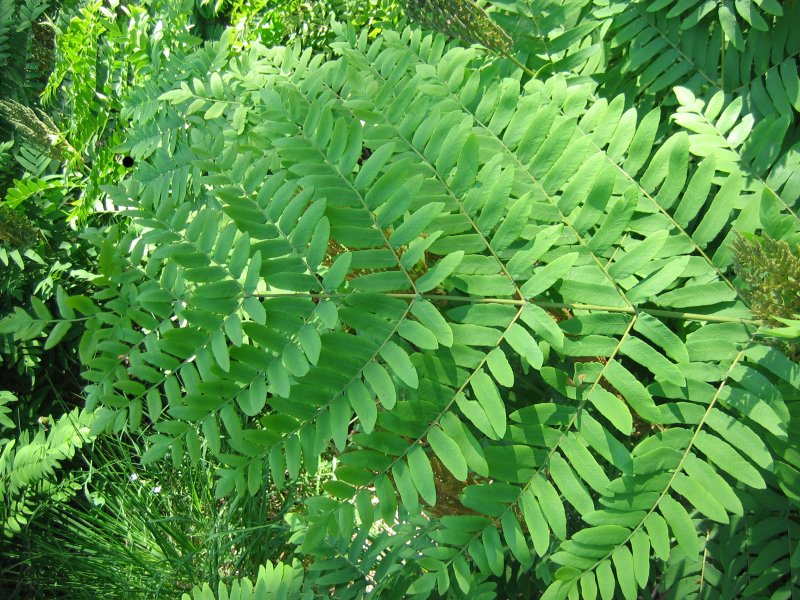
The Osmunda regalis, growing in very handsome hollow circles, or sometimes only crescents or arcs of circles, is now generally a peculiarly tender green, — its delicate fronds, – but some has begun to go to seed and look brown. Hollow circles, one or two feet to a rod in diameter. 

These two are more obvious when, as now, all the rest of the meadow is covered with water. 

That large grass, five feet high, of the river brink is now just begun. Can it be blue-joint, or Calamagrostis Canadensis? [Probably phalaris.]

H. D. Thoreau, Journal, June 15, 1858

That coarse grass in the Island meadow which grows in full circles, as on the Great Meadows, is wool-grass, sometimes their projecting edges being the arcs of circles.  June 27, 1857 ("southwest of Egg Rock, the coarse sedge [wool-grass] — I think the same with that in the Great Meadows — evidently grows in patches with a rounded outline; i.e., its edge is a succession of blunt, rounded capes, with a very distinct outline amid the other kinds of grass and weeds.")

The Osmunda regalis, growing in very handsome hollow circles, or sometimes only crescents or arcs of circles, is now generally a peculiarly tender green. See July 5, 1860 ("I notice of late the Osmunda regalis fully grown, fresh and handsome.")

Wednesday, June 6, 2018

Tp Painted-Cup Meadow via Assabet Bath.


June 6. 


June 6, 2018

P. M. – Cornus florida at Island well out, say the 3d. 

I hear of linnaea out in a pitcher and probably (?) in woods. 

Go to Painted-Cup Meadow via Assabet Bath. 

See three or four Emys insculpta about, making their holes in the gravelly bank south of Assabet Bath, and a few holes which must have been made a day or two, probably by the same. 

Golden senecio is not uncommon now. 

Am surprised to find that the buck bean flowers are withered, being killed by the recent frosts. 

Yellow Bethlehem-star.

Edith Emerson has found, in the field (Merriam’s) just south of the Beck Stow pine grove, Lepidium campestre, which may have been out ten days.

H. D. Thoreau, Journal , June 6, 1858

Cornus florida at Island well out, say the 3d. See June 4, 1858 ("I find the Cornus florida out in my pitcher when I get home June 4th, though it was not out on Island May 31st, and it is well out on Island when I look June 6th. I will say, therefore, that it opened June 3d."); See also May 25, 1855 ("Cornus florida, no bloom. Was there year before last? Does it not flower every other year?”); May 22, 1856("The Cornus florida does not bloom this year.")

Golden senecio is not uncommon now. See May 23, 1853 ("I am surprised by the dark orange-yellow of the senecio. At first we had the lighter, paler spring yellows of willows, dandelion, cinquefoil, then the darker and deeper yellow of the buttercup; and then this broad distinction between the buttercup and the senecio, as the seasons revolve toward July."); May 27, 1859 ("Golden senecio, at least to-morrow. ");May 29, 1856 (" Ride to Painted-Cup Meadow. . . . Golden senecio there, a day or two, at least"); June 9, 1853 ("The meadows are now yellow with the golden senecio, a more orange yellow, mingled with the light glossy yellow of the buttercup") See also A Book of the Seasons,  by Henry Thoreau, The Golden Senecio

Yellow Bethlehem-star. See June 5, 1855 ("Yellow Bethlehem-star in prime.")

Edith Emerson has found Lepidium campestre. See note to May 29, 1856 ("Found a painted-cup with more yellow than usual in it, and at length Edith found one perfectly yellow") [ Lepidium campestre--. Cow cress. See June 12, 1859, referring to  Lepidium campestre field.]

Thursday, May 31, 2018

A slight sea-turn, the wind coming cool and easterly this morning,

May 31. 


May 31,, 2018


A. M. – To Island.

Choke-cherry, a day or two.

Cornus florida, not yet for two or three days. I saw some in Connecticut with involucres much more rosaceous than ours.

A yellowbird’s nest of that grayish milkweed fibre, one egg, in alder by wall west of Indian burying(?)-ground.

P. M. — To Laurel Glen.

I see, running along on the flat side of a railroad rail on the causeway, a wild mouse with an exceedingly long tail. Perhaps it would be called the long-tailed meadow mouse. It has no white, only the feet are light flesh-color; but it is uniformly brown as far as I can see, — for it rests a long time on the rail within a rod, – but when I look at it from behind in the sun it is a very tawny almost golden brown, quite hand some. It finally runs, with a slight hop, — the tarsus of the hind legs being very long while the fore legs are short and its head accordingly low, – down the bank to the meadow.

I saw on the 29th white Viola pedata, and to-day a white V. cucullata.

There were severe frosts on the nights of the 28th and 29th, and now I see the hickories turned quite black, and in low ground the white oak shoots, though they do not show black in drying. Also many ferns are withered and black and some Prinos lavigatus tips, etc.

I find a chewink's nest with four eggs (fresh) on the side-hill at Jarvis’s wood-lot, twenty feet below wood-chuck’s hole at canoe birch. The nest is first of withered leaves, then stubble, thickly lined with withered grass and partly sheltered by dead leaves, shoved [?] up a huckleberry bush.

There was a slight sea-turn, the wind coming cool and easterly this morning, which at first I mistook for the newly leafing deciduous trees investing the evergreens, which is a kind of sea-turn in harmony with the other. I remember that the stage-drivers riding back and forth daily from Concord to Boston and becoming weather-wise perforce, often meeting the sea-breeze on its way into the country, were wont to show their weather wisdom by telling anxious travellers that it was nothing but a sea-turn.

At 5 P.M., go to see a gray squirrel's nest in the oak at the Island point. It is about fifteen feet from the ground, – the entrance, — where a limb has been broken off, and the tree is hollow above and below. One young one darted past downward under my face, with the speed of a bird. There is much short brown dung about, and a smell of urine, and the twigs around have been gnawed.

Does not the voice of the toad along the river sound differently now from what it did a month ago? I think it is much less sonorous and ringing, a more croaking and inquisitive or qui vive sound. Is it not less prolonged also?


H. D. Thoreau, Journal, May 31, 1858


Cornus florida, not yet.
See June 4, 1858 ("I find the Cornus florida out in my pitcher when I get home June 4th, though it was not out on Island May 31st, and it is well out on Island when I look June 6th. I will say, therefore, that it opened June 3d."); See also May 22, 1856 ("The Cornus florida does not bloom this year."); May 25, 1855 ("Cornus florida, no bloom. Was there year before last? Does it not flower every other year?”)

A yellowbird’s nest of that grayish milkweed fibre. See  May 31, 1855 ("See a yellowbird building a nest on a white oak on the Island. She goes to a fern for the wool."); See also January 19, 1856 ("Knocked down the bottom of that summer yellow bird’s nest made on the oak at the Island last summer. It is chiefly of fern wool and also, apparently, some sheep’s wool (?), with a fine green moss (apparently that which grows on button-bushes) inmixed, and some milkweed fibre, and all very firmly agglutinated together.") and A Book of the Seasons,  by Henry Thoreau The Summer Yellowbird

A wild mouse with an exceedingly long tail. Perhaps it would be called the long-tailed meadow mouse. [Likely the jumping mouse] See December 13, 1852 ("I observed a mouse . . . reddish brown above and cream-colored beneath . . . I think it must be the Gerbillus Canadensis, See also A Book of the Seasons, by Henry Thoreau, The Wild Mouse

I saw on the 29th white Viola pedata, and to-day a white V. cucullata.
See May 18, 1857 ("Pratt has found perfectly white Viola pedata behind Easterbrook place, and cultivated them, but now lost them.") A Book of the Seasons, by Henry Thoreau, the Violets

There were severe frosts on the nights of the 28th and 29th, and now I see the hickories turned quite black. See May 31, 1854 ("Cold weather. "); May 31, 1856 ("It has been very cold for two or three days, and to-night a frost is feared. The telegraph says it snowed in Bangor to-day. The hickory leaves are blackened by blowing in the cold wind.”); See also May 21, 1855 (“[C]old weather, indeed, from the 20th to 23d inclusive. Sit by fires, and sometimes wear a greatcoat and expect frosts.”); May 22, 1859 (“”I see that by the very severe frost of about the 15th, or full of the moon, a great many leaves were killed. . . which now show brown or blackish.")

I find a chewink's nest with four eggs.
See June 1, 1856 ("A chewink’s nest a rod and a half south of Walden road, opposite Goose Pond path, under a young oak, covered by overarching dry sedge; four eggs, pretty fresh. I am pretty sure the bird uttered the unusual hoarse and distressed note while I was looking at them. "); See also A Book of the Seasons, by Henry Thoreau, the Chewink (Rufous-sided Towhee)

There was a slight sea-turn, the wind coming cool and easterly this morning. See April 30, 1856 ("At one o’clock there was the usual fresh easterly wind and sea-turn , and before night it grew quite cold for the season. The regularity of the recurrence of this phenomenon is remarkable . . . Early in the afternoon, or between one and four, the wind changes . . . and a fresh cool wind from the sea produces a mist in the air.") See also A Book of the Seasons, by Henry Thoreau, the Sea-turn

Go to see a gray squirrel's nest See note to June 1, 1860 ("This makes three gray squirrels' nests that I have seen and heard of (seen two of them) this year, made thus of leaves and sticks open in the trees, and I hear of some more similar ones found in former years, so that I think this mode of nesting their young may be the rule with them here")

Does not the voice of the toad along the river sound differently now from what it did a month ago?
See May 31, 1860 ("Hear the sprayey note of toads now more than ever, after the rain."); See also  May 13, 1860 ("It is so warm that I hear the peculiar sprayey note of the toad generally at night."); May 16, 1853 ("Nature’appears to have passed a crisis. . . . The sprayey dream of the toad has a new sound."); May 19, 1854 ("I hear the sprayey-note frog now at sunset."); May 25, 1859 ("Hear within a day or two what I call the sprayey note of the toad, different and later than its early ring.") and A Book of the Seasons,  by Henry Thoreau, The Ring of Toads


May 31. See A Book of the Seasons, by Henry Thoreau, May 31

The voice of the toad
first heard a month ago sounds
differently now.

A Book of the Seasons, by Henry Thoreau, The voice of the toad
A Book of the Seasons, by Henry Thoreau
"A book, each page written in its own season,
out-of-doors, in its own locality.”
~edited, assembled and rewritten by zphx © 2009-2024


Wednesday, April 25, 2018

Goodwin says he heard a stake-driver several days ago.

April 25.


P. M. — To Assabet. 

Approaching the Island, I hear the phe phe, phe phe, phe phe, phe phe, phe, the sharp whistling note, of a fish hawk, and, looking round, see him just afterward launching away from one of the swamp white oaks southwest of the Island. 

There is about half a second between each note, and he utters them either while perched or while flying. He shows a great proportion of wing and some white on back. The wings are much curved. He sails along some eighty feet above the water’s edge, looking for fish, and alights again quite near. 

I see him an hour afterward about the same spot. 

See a barn swallow. Also see one myrtle-bird, and Goodwin says he heard a stake-driver several days ago.

H. D. Thoreau, Journal, April 25, 1858

Approaching the Island, I hear the phe phe, phe phe, phe phe, phe phe, phe, the sharp whistling note, of a fish hawk, and, looking round, see him just afterward launching away from one of the swamp white oaks. See April 28, 1858 (“ I see the fish hawk again . . . This bird goes fishing slowly down one side of the river and up again on the other, forty to sixty feet high, continually poising itself almost or quite stationary, with its head to the northwest wind and looking down, flapping its wings enough to keep its place, some times stationary for about a minute. It is not shy. This boisterous weather is the time to see it. ”) Compare April 15, 1855 ("Half a mile further we see another fish hawk upon a dead limb midway up a swamp white oak over the water. . . When he launches off, he utters a clear whistling note, — phe phe, phe phe, phe phe, — somewhat like that of a telltale, but more round and less shrill and rapid, and another, perhaps his mate, fifty rods off, joins him. "); April 16, 1856 ("As I walk along the bank of the Assabet, I hear the yeep yeep yeep yeeep yeeep yeep, or perhaps peop, of a fish hawk, repeated quite fast, but not so shrill and whistling as I think I have heard it, and directly I see his long curved wings undulating over Pinxter Swamp, now flooded.”) See also A Book of Seasons,  by Henry Thoreau, the Osprey (Fish Hawk)
Stake-Driver
Goodwin says he heard a stake-driver [the American Bittern]. See March 22, 1855 ("The river has skimmed over a rod in breadth along the sides. See a heavy-flapping, bittern-like bird flying northeast. It was small for a fish hawk. Can it be the stake-driver ? or a gull? "); April 24, 1854 ("A.M. — Up railroad. . . . As I stand still listening on the frosty sleepers at Wood's crossing by the lupines, I hear the loud and distinct pump-a-gor of a stake-driver. Thus he announces himself."); May 9, 1857 ("Hear stake-driver."); May 12, 1855 (“We sit about half an hour, and it is surprising what various distinct sounds we hear there deep in the wood, as if the aisles of the wood were so many ear trumpets,-- the cawing of crows, the peeping of hylas in the swamp and perhaps the croaking of a tree-toad, the oven-bird, the yorrick of Wilson’s thrush, a distant stake-driver, the night-warbler and black and white creeper, the lowing of cows, the late supper horn, the voices of boys, the singing of girls, -- not all together but separately, distinctly, and musically, from where the partridge and the red-tailed hawk and the screech owl sit on their nests.”) May 20, 1856 ("See and hear a stake-driver in the swamp. It took one short pull at its pump and stopped."); June 11, 1860 ("Just as we are shoving away from this isle, I hear a sound just like a small dog barking hoarsely, and, looking up, see it was made by a bittern (Ardea minor), a pair of which flap over the meadows and probably nest in some tussock thereabouts."); June 15, 1857 ("as I passed a swamp, a bittern boomed."); July 22, 1859 ("Heard from a bittern, a peculiar hoarse, grating note, lazily uttered as it flew over the meadows. A bittern's croak: a sound perfectly becoming the bird, as far as possible from music."); August 5, 1854 (Near Lee's (returning), see a large bittern, pursued by small birds, alight on the shorn meadow near the pickerel-weeds, but, though I row to the spot, he effectually conceals himself.); August 13, 1852 ("Saw the head and neck of a great bittern projecting above the meadow-grass, exactly like the point of a stump, only I knew there could be no stump there.")August 22, 1854 ("See a blue heron — apparently a young bird, of a brownish blue — fly up from one of these pools, and a stake-driver from another, and also see their great tracks on the mud, and the feathers they had shed,"); August 31, 1855 ("Passed in boat within fifteen feet of a great bittern, standing perfectly still in the water by the riverside, with the point of its bill directly up, as if it knew that from the color of its throat, etc., it was much less likely to be detected in that position, near weeds."); September 20, 1851 ("I scare up the great bittern in meadow by the Heywood Brook near the ivy. He rises buoyantly as he flies against the wind, and sweeps south over the willow with outstretched neck, surveying."); September 20, 1855 ("The great bittern, as it flies off from near the rail road bridge, filthily drops its dirt and utters a low hoarse kwa kwa; then runs and hides in the grass, and I land and search within ten feet of it before it rises. "); September 25, 1855 ("Scare up the usual great bittern above the railroad bridge, whose hoarse qua qua, as it flies heavily off, a pickerel-fisher on the bank imitates.");; October 26, 1858 ("[Minott] says that some call the stake-driver “'belcher squelcher,” and some, “wollerkertoot. ” I used to call them “pump-er-gor’. ” Some say “slug-toot.”) See also A Book of the Seasons,  by Henry Thoreau, American Bittern (the Stake-Diver)

Monday, September 25, 2017

The tree has its idea to be lived up to,


September 25


September 25, 2017

Friday. P. M. – To tupelo on Daniel B. Clark’s land.

Stopping in my boat under the Hemlocks, I hear singular bird-like chirruping from two red squirrels. One sits high on a hemlock bough with a nut in its paws. A squirrel seems always to have a nut at hand ready to twirl in its paws. Suddenly he dodges behind the trunk of the tree, and I hear some birds in the maples across the river utter a peculiar note of alarm of the same character with the hen’s (I think they were robins), and see them seeking a covert. Looking round, I see a marsh hawk beating the bushes on that side. 

You notice now the dark-blue dome of the soapwort gentian in cool and shady places under the bank. 

Pushing by Carter’s pasture, I see, deep under water covered by the rise of the river, the cooper’s poles a-soak, held down by planks and stones. 

Fasten to the white maple and go inland. Wherever you may land, it would be strange if there were not some alder clump at hand to hide your oars in till your return. 

The red maple has fairly begun to blush in some places by the river. I see one, by the canal behind Barrett’s mill, all aglow against the sun. These first trees that change are most interesting, since they are seen against others still freshly green, — such brilliant red on green. I go half a mile out of my way to examine such a red banner. A single tree becomes the crowning beauty of some meadowy vale and attracts the attention of the traveller from afar. 

At the eleventh hour of the year, some tree which has stood mute and inglorious in some distant vale thus proclaims its character as effectually as it stood by the highway-side, and it leads our thoughts away from the dusty road into those brave solitudes which it inhabits. The whole tree, thus ripening in advance of its fellows, attains a singular preéminence. I am thrilled at the sight of it, bearing aloft its scarlet standard for its regiment of green-clad foresters around. The forest is the more spirited.

I remember that brakes had begun to decay as much as six weeks ago. 

Dogwood (Rhus venenata) is yet but pale-scarlet or yellowish. The R. glabra is more generally turned. 

Stopped at Barrett's mill. He had a buttonwood log to saw. 

In an old grist-mill the festoons of cobwebs revealed by the white dust on them are an ornament. Looking over the shoulder of the miller, I drew his attention to a mouse running up a brace. 
“Oh, yes,” said he, “we have plenty of them. Many are brought to the mill in barrels of corn, and when the barrel is placed on the platform of the hopper they scamper away.” 
As I came round the island, I took notice of that little ash tree on the opposite shore. It has been cut or broken off about two feet from the ground, and seven small branches have shot up from its circumference, all together forming a perfectly regular oval head about twenty-five feet high and very beautiful. With what harmony they work and carry out the idea of the tree, one twig not straying farther on this side than its fellow on that! 

That the tree thus has its idea to be lived up to, and, as it were, fills an invisible mould in the air, is the more evident, because if you should cut away one or all but one, the remaining branch or branches would still in time form a head in the main similar to this. 

Brought home my first boat-load of wood.

H. D. Thoreau, Journal, September 25, 1857

You notice now the dark-blue dome of the soapwort gentian in cool and shady places under the bank. See September 6, 1857 ("Soapwort gentian, out not long"); September 8, 1852 ("Gentiana saponaria out."); September 19, 1852 ("The soapwort gentian cheers and surprises, -- solid bulbs of blue from the shade, the stale grown purplish. It abounds along the river, after so much has been mown"); September 22, 1852 ("The soapwort gentian the flower of the river-banks now.");  See alsoA Book of the Seasons, by Henry Thoreau, The Soapwort Gentian (Gentiana saponaria)


A single tree becomes the crowning beauty of some meadowy vale and attracts the attention of the traveller from afar. See September 26, 1854 ("Some single red maples are very splendid now, the whole tree bright-scarlet against the cold green pines; now, when very few trees are changed, a most remarkable object in the landscape; seen a mile off. "); September 27, 1855 ("Some single red maples now fairly make a show along the meadow. I see a blaze of red reflected from the troubled water.")

Brought home my first boat-load of wood. See September 26, 1855 (Go up Assabet for fuel"); September 24, 1855 ("Brought home quite a boat-load of fuel . . . It would be a triumph to get all my winter’s wood thus")

With what harmony they work and carry out the idea of the tree . . . has its idea to be lived up to, and, as it were, fills an invisible mould in the air. Compare February 12, 1859 ("You may account for that ash by the Rock having such a balanced and regular outline by the fact that in an open place their branches are equally drawn toward the light on all sides, and not because of a mutual understanding through the trunk.")

September 25. See A Book of the Seasons,  by Henry Thoreau, September 25


Invisible mold 

in the air filled by each tree -

idea of the tree.


A Book of the Seasons, by Henry Thoreau
"A book, each page written in its own season,
out-of-doors, in its own locality.”
~edited, assembled and rewritten by zphx © 2009-2025

Tuesday, August 9, 2016

A succession of thunder-storms merged into one long thunder-storm, lasting almost continuously two nights and two days.

August 9

Saturday. 

Notwithstanding the very copious rain, with lightning, on the night of August 5th and the deluge which fell yesterday, raising the river still higher, it rained again and again with very vivid lightning, more copiously than ever, last night, and without long intervals all this day.  Few, if any, can remember such a succession of thunder-storms merged into one long thunder-storm, lasting almost continuously (the storm does) two nights and two days. 

August 9, 2019

We are surprised to see that it can lighten just as vividly, thunder just as loud, rain just as copiously at last as at first. 

P. M. — Up Assabet. 

The river is raised about two feet! My boat is nearly even full, though under the willows. The water stands nearly a foot over the highest part of the large flat rock by Island. There is more current. The pads are drowned; hardly one to be seen afloat; the utmost length of their tethers does not permit them to come within a foot or ten inches of the surface. They lay smoothly on the top before, with considerable spare coil beneath; now they strain in vain toward the surface. All the Bidens Beckii is drowned too, and will be delayed, if not exterminated for this year. The water is cool to the bather after so much rain.

The notes of the wood pewee and warbling vireo are more prominent of late, and of the goldfinch twittering over. 

Does the last always utter his twitter when ascending? These are already feeding on the thistle seeds. 

Again I am surprised to see the Apocynum cannabinum close to the rock at the Island, several plants, apparently not more than ten days out; say July 25th, including the ones I saw before. The flowers of this are white, with divisions of the corolla erect or nearly so, corolla not one eighth of an inch wide, calyx-segments lanceolate, pointed, as long as the tube of the corolla. I now notice that all the branches are about equally upright, and hence the upper ones are much more upright than the upper ones of the A. andro-soemifolium. The plant is inclined to be taller and narrower than that, perhaps because it grows by water. The leaves are more oblong or lanceolate and pointed, the downiness and petioles about the same with that of the common; in this case, none heart-shaped. The one found the 5th was between this and the common, a rose-streaked one, in fact colored like the common; this, a white one with still longer calyx-segments and no heart-shaped leaves. This is rather smooth. Say, then, for that of the 5th and this, they are varieties of the A. cannabinum.

I scare up a couple of wood ducks separately, undoubtedly birds bred and dispersed about here. The rise of the river attracts them. 

What I have called Aster corymbosus out a day, above Hemlocks. It has eight to twelve white rays, smaller than those of the macrophyllus, and a dull-red stem commonly. It differs from Gray's corymbosus in the achenia being apparently not slender, not opening in July, and there being no need of distinguishing it from A. macrophyllus; from his cordifolius in the rays not being numerous, nor the panicled heads very numerous (sometimes pretty numerous), and the rays not pale-blue.

Perhaps I must call it A. cordifolius, yet the lower and principal petioles are naked (Gray makes them so commonly!), not at all winged, though the upper are. Found one individual at Miles Swamp whose lower petioles were winged. Its petioles (the lower) are only sometimes winged here. The flowers of A. macrophyllus are white with a very slight bluish tinge, in a coarse flat-topped corymb. Flowers nine to ten eighths of an inch in diameter. A. cordifolius flowers six eighths of an inch diameter.

H. D. Thoreau, Journal, August 9, 1856

Few, if any, can remember such a succession of thunder-storms. See  August 6, 1856 ("Copious and continuous rain in the night, deluging, soaking rain, with thunder and lightning, beating down the crops.");;August 8, 1856("Rain, lightning, and thunder all day long in torrents."). Compare September 6, 1854 ("There is now approaching from the west one of the heaviest thunder-showers (apparently) and with the most incessant flashes that I remember to have seen.")

 The water stands nearly a foot over the highest part of the large flat rock by Island. See March 17, 1859 ("Here is Mantatuket Rock, commonly a rocky peninsula with a low or swampy neck and all covered with wood. It is now a small rocky island, and not only the swampy neck but a considerable portion of the upland is blotted out by the flood, covered and concealed under water."); August 1, 1859 ("The west edge of the Rock above Island is eleven and a half inches above summer level . . . Is this rise owing to the water let on from various mill-ponds this Monday morning?")

All the Bidens Beckii is drowned too, and will be delayed, if not exterminated for this year. See September 18, 1856 ("On account of freshet I have seen no Bidens Beckii"); October 20, 1856 ("Owing to the great height of the river, there has been no Bidens Beckii . . . this year,")  See also August 11, 1853 ("The weeds still covered by the flood, so that we have no Bidens Beckii.");  September 12, 1859 ("Much of the Beckii was drowned by the rise of the river");  September 14, 1854 ("The Bidens Beckii is drowned or dried up,") and A Book of the Seasons, by Henry Thoreau, The Bidens Beckii

The notes of the wood pewee and warbling vireo are more prominent of late. See August 6, 1858 ("The note of the wood pewee is now more prominent, while birds generally are silent."); August 14, 1858 ("The more characteristic notes would appear to be the wood pewee’s and the goldfinch’s, with the squeal of young hawks. These might be called the pewee-days. "); August 18, 1860 ("The note of the wood pewee sounds prominent of late.”)

The goldfinch twittering over. . . already feeding on the thistle seeds. See August 6, 1852 (“With the goldenrod comes the goldfinch. About the time his cool twitter is heard, does not the bobolink, thrasher, catbird, oven-bird, veery, etc ., cease?”); August 7, 1853 (“The river is dark and smooth these days, reflecting no brightness but dark clouds, and the goldfinch is heard twittering over.”); August 10, 1854 (“The tinkling notes of goldfinches and bobolinks which we hear nowadays are of one character and peculiar to the season. They are nuts of sound, --ripened seeds of sound. . . like the sparkle on water.”); August 12, 1854 (“I see goldfinches nowadays on the lanceolate thistles, apparently after the seeds.”); August 15, 1854 (“On the top of the Hill I see the goldfinch eating the seeds of the Canada thistle. I rarely approach a bed of them or other thistles nowadays but I hear the cool twitter of the goldfinch about it.“); August 14, 1858 ("The Canada thistle down is now begun to fly, and I see the goldfinch upon it."); September 4, 1860 (“The goldfinch is very busy pulling the thistle to pieces.”) See also A Book of the Seasons,  by Henry Thoreau, the Goldfinch

Again I am surprised to see the 
Apocynum cannabinum close to the rock at the Island: See August 1, 1857 ("Small Apocynum cannabinum on the rocks.") July 11, 1857 ("Apocynum cannabinum, with its small white flowers and narrow sepals "); August 5, 1856 ("At the Assabet stone bridge, apparently freshly in flower . . . apparently the Apocynum cannabinum var. hypericifolium (?).”) and note to September 2, 1856 ("Some years ago I sought for Indian hemp (Apocynum cannabinum) hereabouts in vain, and concluded that it did not grow here. A month or two ago I read again, as many times before, that its blossoms were very small, scarcely a third as large as those of the common species, and for some unaccountable reason this distinction kept recurring to me, and I regarded the size of the flowers I saw, though I did not believe that it grew here; and in a day or two my eyes fell on it, aye, in three different places, and different varieties of it.") See also A Book of the Seasons,   by Henry Thoreau, Dogsbane and Indian hemp

Apocynum means "poisonous to dogs". All parts of the plant are poisonous and can cause cardiac arrest if ingested. The cannabinum in the scientific name and the common names Hemp Dogbane and Indian Hemp refer to its similarity to cannabis as a fiber plant.  ~ Wikipedia

I scare up a couple of wood ducks separately, undoubtedly birds bred and dispersed about here. See Auguat 3, 1856 ("Two small ducks (probably wood ducks) flying south. Already grown, and at least looking south! ! It reminds me of the swift revolution of the seasons.")

What I have called Aster corymbosus out a day, above Hemlocks. Perhaps I must call it A. cordifolius. See August 11, 1852 ("Aster corymbosus, path beyond Corner Spring and in Miles Swamp );  September 6, 1856 ("For the first time distinguish the Aster cordifolius, a prevailing one in B[rattleboro] and but just beginning to flower") September 22, 1858 [from Salem to Cape Ann on foot] ("I had seen in this day’s walk an abundance of Aster cordifolius . . . also saw A. corymbosus, which is a handsome white wood aster"); See also A Book of the Seasons,   by Henry Thoreau, Asters in August. Aster corymbosus and Aster cordifolius -- white and blue wood asters. Wood asters are now classified as genus Eurybia This genus’s species in New England:
August 9. See A Book of the Seasons,  by Henry Thoreau,  August 9

A succession of 
thunder-storms, vivid lightning 
and copious rain.  

A Book of the Seasons,  by Henry Thoreau
"A book, each page written in its own season,
out-of-doors, in its own locality.”
~edited, assembled and rewritten by zphx © 2009-2026

https://tinyurl.com/hdt-560809

Popular Posts Last 30 Days.

The week ahead in Henry’s journal

The week ahead in Henry’s journal
A journal, a book that shall contain a record of all your joy.
"A stone fruit. Each one yields me a thought." ~ H. D. Thoreau, March 28, 1859


I sit on this rock
wrestling with the melody
that possesses me.