Showing posts with label Pout's Nest. Show all posts

Monday, July 20, 2020

Great numbers of pollywogs have apparently just changed into frogs.


July 20.

2 P. M. – To Walden.

Warm weather, — 86 at 2 P. M. (not so warm for a good while).

Emerson’s lot that was burnt, between the railroad and the pond, has been cut off within the last three months, and I notice that the oak sprouts have commonly met with a check after growing one or two feet, and small reddish leafets have again put forth at the extremity within a week or so, as in the spring.

Some of the oak sprouts are five to six feet high already. On his hill near by, where the wood was cut about two years ago, this second growth of the oaks, especially white oaks, is much more obvious, and commenced longer ago.

The shoots of this year are generally about two feet long, but the first foot consists of large dark green leaves which expanded early, before the shoot met with a check.

This is surmounted by another foot of smaller yellowish-green leaves. This is very generally the case, and produces a marked contrast. Dark green bushes surmounted by a light or yellowish-green growth.

Sometimes, in the first-mentioned sprout-land, you see where the first shoot withered, as if frost-bitten at the end, and often only some large buds have formed there as yet.

Many of these sprouts, the rankest of them, are fated to fall, being but slightly joined to the stump, riddled by ants there; and others are already prostrated.

Bathing on the side of the deep cove, I noticed just below the high-water line (of rubbish) quite a number of little pines which have just sprung up amid the stones and sand and wreck, some with the seed atop.

This, then, is the state of their coming up naturally. They have evidently been either washed up, or have blown across the ice or snow to this shore. If pitch pine, they were probably blown across the pond, for I have often seen them on their way across.

Both Scirpus subterminalis and debilis are now in bloom at the Pout’s Nest, the former the longest time, the water being very low and separated from the pond. The former out for some time, the latter not long.

Great numbers of pollywogs have apparently just changed into frogs.

At the pondlet on Hubbard’s land, now separated from the main pond by a stony bar, hundreds of small frogs are out on the shore, enjoying their new state of existence, masses of them, which, with constant plashing, go hopping into the water a rod or more before me, where they are very swift to conceal themselves in the mud at the bottom. Their bodies may be one and a half inches long or more.

I have rarely seen so many frogs together. Yet I hardly see one pollywog left in this pool.

Yet at the shore against Pout’s Nest I see many pollywogs, and some, with hind legs well grown beside tails tails, lie up close to the shore on the sand with their heads out like frogs, apparently already breathing air before losing their tails. They squat and cower there as I come by, just like frogs.

H. D. Thoreau, Journal, July 20, 1860


Both Scirpus subterminalis [water bulrush]and debilis [weakstalk bulrush]are now in bloom at the Pout’s Nest.
 See July 19, 1859 ("Scirpus subterminalis, river off Hoar's and Cheney's, not long."); August 31,,1858 ("At the Pout’s Nest, Walden, I find the Scirpus debilis, apparently in prime, generally aslant");  September 15, 1858 ("I find, just rising above the target-weed at Pout’s Nest, Scirpus subterminalis, apparently recently out of bloom. The culms two to three feet along, appearing to rise half an inch above the spikes. The long, linear immersed leaves coming off and left below. ")

 "Pout’s Nest": HDT's name for Wyman's Meadow near Walden. See June 7, 1858 and note to July 26, 1860 (I see a bream swimming about in that smaller pool by Walden in Hubbard's Wood. . . So they may be well off in the Wyman meadow or Pout's Nest.") The pout referred to is the Brown Bullhead (Ameiurus nebulosus), also known as Horned Pout, Mud Pout or Mud Cat. See Place Names of Henry David Thoreau in Concord,

Tuesday, December 17, 2019

What a change there will be in a few years, this little forest of goldenrod giving place to a forest of pines!

December 17.

P. M. — To Walden.

The snow being some three or four inches deep, I see rising above it, generally, at my old bean-field, only my little white pines set last spring in the midst of an immense field of Solidago nemoralis, with a little sweet-fern (i.e. a large patch of it on the north side).

What a change there will be in a few years, this little forest of goldenrod giving place to a forest of pines!

By the side of the Pout's Nest, I see on the pure white snow what looks like dust for half a dozen inches under a twig. Looking closely, I find that the twig is hardhack and the dust its slender, light-brown, chaffy looking seed, which falls still in copious showers, dusting the snow, when I jar it; and here are the tracks of a sparrow which has jarred the twig and picked the minute seeds a long time, making quite a hole in the snow. The seeds are so fine that it must have got more snow than seed at each peck. But they probably look large to its microscopic eyes.

I see, when I jar it, that a meadow-sweet close by has quite similar, but larger, seeds.

This the reason, then, that these plants rise so high above the snow and retain their seed, dispersing it on the least jar over each successive layer of snow beneath them; or it is carried to a distance by the wind.

What abundance and what variety in the diet of these small granivorous birds, while I find only a few nuts still!

These stiff weeds which no snow can break down hold their provender. What the cereals are to men, these are to the sparrows. The only threshing they require is that the birds fly against their spikes or stalks.

A little further I see the seed-box (?) (Ludwigia) full of still smaller, yellowish seeds.

And on the ridge north is the track of a partridge amid the shrubs. It has hopped up to the low clusters of smooth sumach berries, sprinkled the snow with them, and eaten all but a few. Also, here only, or where it has evidently jarred them down — whether intentionally or not, I am not sure — are the large oval seeds of the stiff-stalked lespedeza, which I suspect it ate, with the sumach berries. There is much solid food in them. When the snow is deep the birds could easily pick the latter out of the heads as they stand on the snow.

I observe, then, eaten by birds to-day, the seed of hardhack and meadow-sweet, sumach, and probably lespedeza, and even seed-box.

Under the hill, on the southeast side of R. W. E.'s lot, where the hemlock stands, I see many tracks of squirrels. The dark, thick green of the hemlock (amid the pines) seems to attract them as a covert. The snow under the hemlock is strewn with the scales of its cones, which they (and perhaps birds?) have stripped off, and some of its little winged seeds. It is pleasant to see the tracks of these squirrels (I am not sure whether they are red or gray or both, for I see none) leading straight from the base of one tree to that of another, thus leaving untrodden triangles, squares, and polygons of every form, bounded by much trodden highways.

One, two, three, and the track is lost on the upright bole of a pine, — as if they had played at base-running from goal to goal, while pine cones were thrown at them on the way. The tracks of two or three suggest a multitude. You come thus on the tracks of these frisky and volatile (semivolitant) creatures in the midst of perfect stillness and solitude, as you might stand in a hall half an hour after the dancers had departed.

I see no nests in the trees, but numerous holes through the snow into the earth, whence they have emerged. They have loitered but little on the snow, spending their time chiefly on the trees, their castles, when abroad.

The snow is strewn not only with hemlock scales, but, under other trees, with the large white pine scales for rods together where there is no track, the wind having scattered them as they fell, and also the shells of hickory-nuts. It reminds me of the platform before a grocery where nuts are sold.

You see many places where they have probed the snow for these white pine cones, evidently those which they cut off green and which accordingly have not opened so as to drop the seeds. This was perhaps the design in cut ting them off so early, — thus to preserve them under the snow (not dispersed). Do they find them by the scent?

At any rate they will dig down through the snow and come right upon a pine cone or a hickory-nut or an acorn, which you and I cannot do.

Two or three acres of Walden, off the bar, not yet frozen.

Saw in [it] a good-sized black duck, which did not dive while I looked. I suspect it must have been a Fuligula, though I saw no white.

H. D. Thoreau, Journal, December 17, 1859

What abundance and what variety in the diet of these small granivorous birds. These stiff weeds which no snow can break down hold their provender.  See January 16, 1860 ("Though you may have never noticed this shrub, the tree sparrow comes from the north in the winter straight to it, and confidently shakes its panicle, and then feasts on the fine shower of seed that falls from it. The bird understands how to get its dinner perfectly.")

Two or three acres of Walden, off the bar, not yet frozen. Saw in it a good-sized black duck. See December 27, 1852 ("Not a particle of ice in Walden to-day. . . . A black and white duck on it, Flint's and Fair Haven being frozen up.")

Tuesday, December 11, 2018

Walden is about one-third skimmed over.

December 11. 

P. M. — To Walden. 

An overcast afternoon and rather warm. The snow on the ground in pastures brings out the warm red in leafy oak woodlands by contrast. These are what Thomson calls “the tawny copse.” So that they suggest both shelter and warmth. All browns, indeed, are warmer now than a week ago. These oak woodlands half a mile off, commonly with pines intermingled, look like warm coverts for birds and other wild animals. How much warmer our woodlands look and are for these withered leaves that still hang on! Without them the woods would be dreary, bleak, and wintry indeed.  Here is a manifest provision for the necessities of man and the brutes. These leaves remain to keep us warm, and to keep the earth warm about their roots. 

While the oak leaves look redder and warmer, the pines look much darker since the snow has fallen (the hemlocks darker still). A mile or two distant they are dark brown, or almost black, as, still further, is all woodland, and in the most distant horizon have a blue tinge like mountains, from the atmosphere. The boughs of old and bare oak woods are gray and in harmony with the white ground, looking as if snowed on. 

Already, in hollows in the woods and on the sheltered sides of hills, the fallen leaves are collected in small heaps on the snow-crust, simulating bare ground and helping to conceal the rabbit and partridge, etc. They are not equally diffused, but collected together here and there as if for the sake of society. 

I find at the Pout’s Nest, now quite frozen over, air-holes and all, twenty-two pollywogs frozen in and dead within a space of two and a half feet square, also a minnow — apparently a young shiner, but it has a dark longitudinal line along side (about an inch and a half long)—with the bream.

The terminal shoots of the small scarlet oaks are still distinctly red, though withered. 

A “swirl,” applied to leaves suddenly caught up by a sort of whirlwind, is a good word enough, methinks. 

Walden is about one-third skimmed over. It is frozen  nearly half the way out from the northerly shore, excepting a very broad open space on the northwest shore and a considerable space at the pines at the northeast end; but the ice, thin as it is, extends quite across from the northwest side to the southwest cape (west side of the railroad bay) by an isthmus only two or three rods wide in its narrowest part. 

It is evident that whether a pond shall freeze this side or that first depends much on the wind. If it is small and lies like Walden between hills, I should expect that in perfectly calm weather it would freeze soonest along the south shore, but in this case there was probably wind from the north or northwest, and the more sheltered and smooth north side froze first.

The warmth reflected from the pines at the northeast corner may account for the open water there, but I can not account for the open space of the northwest end. [It must be because it is there open to the rake of the north Wind. the shore being flat and gently sloping backward a long way, while the protection of Heywood‘s Peak may account for the ice isthmus being met by the break-wind of the west railroad cape.]

It is remarkable that the south edge of the ice projects southward in a cape corresponding to the deep triangular bay in the south side, though it is in the middle of the pond, and there is even a rude correspondence else where along the edge of the ice to the opposite shore.  This might seem to indicate that the ice to some extent formed first over deepest water. 

When the ice was melting and the trees dripping, on the morning of the 6th, I noticed that the snow was discolored, — stained yellow by this drip, — as if the trees were urinating. 

The large scarlet oak in the cemetery has leaves on the lower limbs near the trunk just like the large white oaks now. So has the largest black oak which I see. Others of both, and all, kinds are bare. 

Some, being offended, think sharp and satirical things, which yet they are not prepared consciously to utter. But in some unguarded moment these things escape from them, when they are as it were unconscious. They betray their thoughts, as it were by talking in their sleep, for the truth will out, under whatever veil of civility.

H.D. Thoreau, Journal, December 11, 1858


Already, in hollows in the woods and on the sheltered sides of hills, the fallen leaves are collected in small heaps on the snow-crust. See December 9, 1856 ("Coming through the Walden woods, I see already great heaps of oak leaves collected in certain places on the snow-crust by the roadside, where an eddy deposited them."); January 28, 1857 ("Notice many heaps of leaves on snow on the hillside southwest of the pond, as usual.");  February 4, 1856 ("The oak leaves which have blown over the snow are collected in dense heaps on the still side of the bays at Walden, where I suspect they make warm beds for the rabbits to squat on.").. Also  January 7, 1857 ("Though the rest of the broad path is else perfectly unspotted white, each track of the fox has proved a trap which has caught from three or four to eight or ten leaves each."); January 8, 1852 ("almost every track which I made yesterday in the snow - perhaps ten inches deep - has got a dead leaf in it, though none is to be seen on the snow around.")

Walden is about one-third skimmed over. See December 9, 1856 ("There is scarcely a particle of ice in Walden yet, and that close to the edge, apparently, on the west and northwest sides. . . .This is, no doubt, owing solely to the greater depth of Walden."); December 19,1856 ("Walden froze completely over last night.This is very sudden, for on the evening of the 15th there was not a particle of ice in it. In just three days, then, it has been completely frozen over, and the ice is now from two and a half to three inches thick, a transparent green ice, through which I see the bottom where it is seven or eight feet deep."); December 20, 1858 (“Walden is frozen over, except two small spots, less than half an acre in all, in middle.”) December 21, 1855 (“Walden is skimmed over, all but an acre, in my cove.”); December 21, 1854 (“Walden is frozen over, apparently about two inches thick.”)


It is evident that whether a pond shall freeze this side or that first depends much on the wind. See December 29, 1855 ("Am surprised to find eight or ten acres of Walden still open, notwithstanding the cold of the 26th, 27th, and 28th and of to-day. It must be owing to the wind partly."); December 30, 1853 ("The pond [Walden] not yet frozen entirely over; about six acres open, the wind blew so hard last night.");


Monday, December 3, 2018

I walk with unbuttoned coat, taking in the influences of the hour.

December 3

December 3, 2011

P. M. — To Walden. 

A deliciously mild afternoon, though the ground is covered with snow. The cocks crowed this morning as of yore.

I carry hatchet and rake in order to explore the Pout’s Nest for frogs and fish, —the pond not being frozen. A small part of that chink of the 26th is not yet frozen, and is crowded with pollywogs, mostly of large size, and very many have legs more or less developed. 

With my small iron rake, about a foot long by four inches wide, I jerk on to the ice at one jerk forty five pollywogs, and more than as many more fall into the water. Many of the smallest pollywogs have bright copper-red bellies, prettily spotted, while the large are commonly pale-yellow, either clear or spotted. Many are dying. They have crowded so thickly along the open chink three or four inches wide by the side of a boat in the ice that, when I accidentally rock it, about a hundred are washed out on to the ice. 

One salamander among them, and four of the new breams, much larger, darker, and richer-colored than any I had found. 

I have often seen pollywogs in small numbers in the winter, in spring-holes, etc., but never such crowding to air-holes in the ice. All that is peculiar in this case is that this small pond has recently been cut off from the main pond by the falling of the water and that it is crowded with vegetable matter, chiefly target-weed, so that apparently the stagnant water has not only killed the breams and perch (of which last I find three dead) but many pollywogs, and compels others to seek the surface. 

As I return home by the Shanty Field and the railroad, I cannot help contrasting this evening with the 30th (on Fair Haven Hill-side). Now there is a genial, soft air, and in the west many clouds of purplish dove color. I walk with unbuttoned coat, taking in the influences of the hour. Coming through the pitch pines east of the Shanty Field, I see the sun through the pines very yellow and warm-looking, and every twig of the pines and every weed is lit with yellow light (not silvery). 

The other night the few cloudy islets about [the] setting sun (where it had set) were glitteringly bright afar through the cold air. Now (when I get to the causeway) all the west is suffused with an extremely rich, warm purple or rose-color, while the edges of what were dove-colored clouds have a warm saffron glow, finally deepening to rose or damask when the sun has set. The other night there was no reddening of the clouds after sunset, no afterglow, but the glittering clouds were almost immediately snapped up in the crisped air. 

I improve every opportunity to go into a grist-mill, any excuse to see its cobweb-tapestry. I put questions to the miller as an excuse for staying, while my eye rests delighted on the cobwebs above his head and per chance on his hat. 

The salamander above named, found in the water of the Pout’s Nest, is the Salamandra symmetrica It is some three inches long, brown (not dark-brown) above and yellow with small dark spots beneath, and the same spots on the sides of the tail; a row of very minute vermilion spots, not detected but on a close examination, on each side of the back; the tail is waved on the edge (upper edge, at least); has a pretty, bright eye. Its tail, though narrower, reminds me of the pollywog. Why should not it lose its tail as well as that?

The largest of the four breams (vide November 26th) two and nine twentieths inches long, by one inch broad and nine twentieths thick. The back, sides forward, tail, and anal fin black or blackish or very dark; the transverse dark bars few and indistinct except in middle of fish; sides toward tail yellowish-Olive. Rear of abdomen has violet reflections (and about base of anal fin). Operculums tinged, streaked, and spotted with golden, coppery, greenish, and violet reflections. A vertical dark mark or line, corresponding to the stripes, through the eye. Iris copper-color or darker. 

The others, about two inches long, are differently colored, not so dark, more olive, and distinctly barred. The smallest are the lightest-colored, but the larger on the whole richer, as well as darker. The fins, especially the dorsal, caudal, and anal, are remarkably pretty, in color a fine network of light and dark. The lower jaw extends about three fortieths of an inch beyond the upper. The rich dark, almost black, back, with dark-barred sides alternating with yellowish olive, and the fine violet purple reflections from the sides of the abdomen, like the nacre of a shell, as coin-like they lie flat in a basin, — such jewels they swam between the stems (clothed in transparent jelly) of the target-weed. 

R. W. E. saw quite a flock of ducks in the pond (Walden) this afternoon;

H. D. Thoreau, Journal, December 3, 1858

I have often seen pollywogs in small numbers in the winter, in spring-holes, etc., but never such crowding to air-holes in the ice. See December 21, 1857 ("They appear to keep in motion in such muddy pond-holes, where a spring wells up from the bottom till midwinter, if not all winter.”)

Four of the new breams, much larger, darker, and richer-colored than any I had found. See November 26, 1858 (" a great many minnows about one inch long . . . shaped like bream, but had the transverse bars of perch.”); November 27, 1858 ("I got seventeen more of those little bream of yesterday. “); November 30, 1858 (“How wild it makes the pond and the township to find a new fish in it!”)

The 30th (on Fair Haven Hill-side). . . .there was no reddening of the clouds after sunset, no afterglow, but the glittering clouds were almost immediately snapped up in the crisped air. See December 2, 1858 ("[November 30th] was at the same time the most brilliant of sunsets, the clearest and crispiest of winter skies."); November 30, 1858 ("At sunset, we saw a large, long, dusky cloud in the northwest horizon, apparently just this side of Wachusett, or at least twenty miles off, which was snowing, when all the rest was clear sky ") 

All the west is suffused with an extremely rich, warm purple or rose-color, while the edges of what were dove-colored clouds have a warm saffron glow, finally deepening to rose or damask when the sun has set. See December 14, 1852 ("Ah, who can tell the serenity and clarity of a New England winter sunset?"); See also  A Book of the Seasons, by Henry Thoreau, Winter Sunsets

December 3.
See A Book of the Seasons, by Henry Thoreau, December 3

This mild afternoon
I walk with unbuttoned coat
taking in the the hour.


A Book of the Seasons
, by Henry Thoreau
"A book, each page written in its own season,
out-of-doors, in its own locality."
~edited, assembled and rewritten by zphx © 2009-2024

https://tinyurl.com/hdt-581203

Monday, November 26, 2018

A new species?

November 26


The various evergreens, large and small, may be said generally to turn green or to have turned reddish about the middle of November. 

Got in boat on account of Reynolds’s new fence going up (earlier than usual). 

A good many leaves of the sweet-fern, though withered now, still hold on; so that this shrub may be put with the oaks in this respect. So far as I remember, it is peculiar among shrubs in this.

Walden is very low, compared with itself for some years. The bar between pond and Hubbard’s pond hole is four feet wide, but the main bar is not bare. There is a shore at least six feet wide inside the alders at my old shore, and what is remarkable, I find that not only Goose Pond also has fallen correspondingly within a month, but even the smaller pond-holes only four or five rods over, such as Little Goose Pond, shallow as they are. 

I begin to suspect, therefore, that this rise and fall extending through a long series of years is not peculiar to the Walden system of ponds, but is true of ponds generally, and perhaps of rivers, though in their case it may be more difficult to detect. Even around Little Goose Pond the shore is laid bare for a space even wider than at Walden, it being less abrupt. The Pout’s Nest, also, has lost ten feet on all sides. 

Those pouts’ nests which I discovered in the spring are high and dry six feet from the water. I overhauled one, ripping up the frozen roof with my hands. The roof was only three inches thick, then a cavity and a bottom of wet mud. In this mud I found two small frogs, one apparently a Rana palustris less than an inch long, the other apparently a young R. pipiens an inch and a half long. They were quite sluggish and had evidently gone into winter quarters there, but probably some mink would have got them. 

The Pout’s Nest was frozen just enough to bear, with two or three breathing-places left. The principal of these was a narrow opening about a rod long by eighteen inches wide within six feet of the southwest side of the pond-hole, and the immediately adjacent ice was darker and thinner than the rest, having formed quite recently. 

I observed that the water at this breathing-chink was all alive with pollywogs, mostly of large size, though some were small, which apparently had collected there chiefly, as the water-surface was steadily contracted, for the sake of the air (?). There [were] more than a hundred of them there, or ten or a dozen in a square foot, and many more under the ice. 

I saw one firmly frozen in and dead. One had legs, and his tail was half eaten off by some creature, yet he was alive. There were also one or two frogs stirring among them. Here was evidently warmer water, probably a spring, and they had crowded to it. 

Looking more attentively, I detected also a great many minnows about one inch long either floating dead there or frozen into the ice,—at least fifty of them. They were shaped like bream, but had the transverse bars of perch. 

There were more pollywogs in other parts of the pond-hole, and at the north end I saw two perch about seven inches long, dead, close to the shore, and turned a bright green,— which are commonly yellow, — as if poisoned by the water or something they had eaten. Perhaps the fishes had suffered by the falling of this pond-hole and consequent isolation from the main pond, which has left this part still more shallow and stagnant than before. It is full of the target-weed. 

If the pond continues to fall, undoubtedly all the fishes thus landlocked will die. I noticed at the above-named chink tracks which looked like those of an otter, where some animal had entered and come out of the water, leaving weeds and fragments of ice at the edge of the hole. No doubt several creatures, like otter and mink and foxes, know where to resort for their food at this season. This is now a perfect otter’s or mink’s preserve. 

Perhaps such a mass of decaying weeds is fatal to the fishes here. It is evident that those frogs would have been frozen stiff the first colder night in such a shallow retreat. It is very likely that that hole (i. e. pout’s hole) was under water when they took refuge there, and, the water going down, they were chilled. In such cases, then, pollywogs and fishes, and even frogs, resort to the last part to freeze, the warmest water, where it is open longest. 

Examining those minnows by day, I find that they are one and one sixth inches long by two fifths of an inch wide (this my largest); in form like a bream; of a very pale golden like a perch, or more bluish. Have but one dorsal fin and, as near as I can count, rays, dorsal 19 (first, 9 stouter and stiff and more distinctly pointed, then 10 longer and flexible, whole fin about three times as long as average height), caudal 17 [?], anal 13 or 14, ventral 6, pectoral 10 (?). They have about seven transverse dusky bars like a perch! Yet, from their form and single dorsal fin, I think they are breams. Are they not a new species? Have young breams transverse bars? A little narrower than this.

H. D. Thoreau, Journal, November 26, 1858

Got in boat on account of Reynolds’s new fence going up (earlier than usual). See note to November 26, 1857 (“Got my boat up this afternoon. (It is Thanksgiving Day.) One end had frozen in. ”)

I find that not only Goose Pond also has fallen correspondingly within a month, but even the smaller pond-holes. See December 13, 1852 (“I judge from his account of the rise and fall of Flint's Pond that, allowing for the disturbance occasioned by its inlets and outlet, it sympathizes with Walden. “)

The Pout’s Nest was frozen just enough to bear, with two or three breathing-places left. "Pout’s Nest": HDT's name for Wyman's Meadow near Walden. See note to July 26, 1860 (I see a bream swimming about in that smaller pool by Walden in Hubbard's Wood. . . So they may be well off in the Wyman meadow or Pout's Nest."); also June 7, 1858 ("Where do the Walden pouts breed when they have not access to this meadow?")

If the pond continues to fall, undoubtedly all the fishes thus landlocked will die. See August 28, 1854 (“The meadow is drier than ever, and new pools are dried up. The breams, from one to two and a half inches long, lying on the sides and quirking from time to time, a dozen together where there is but a pint of water on the mud, are a handsome but sad sight, — pretty green jewels, dying in the sun. I saved a dozen or more by putting them in deeper pools.”)

A new species? See November 30, 1858 ("When my eyes first rested on Walden the striped bream was poised in it, though I did not see it...I can only poise my thought there by its side and try to think like a bream for a moment. I can only see the bream in its orbit, as I see a star...The bream, appreciated, floats in the pond as the centre of the system, another image of God. Its life no man can explain more than he can his own."). The fish shaped like a bream but with markings like a perch.is presented at the next meeting of the Boston Natural History Society an later ridentified as the Pomotis obesus Girard 1854 (banded sunfish).

Saturday, September 15, 2018

Southeast wind with clouds hummingbird in the garden I suspect a storm.


September 15.

September 15, 2018

I have not seen not heard a bobolink for some days at least, numerous as they were three weeks ago, and even fifteen days. They depart early. 

I hear a nuthatch occasionally, but it reminds me of winter. 

P. M. — To Walden. I paddle about the pond, for a rarity. 

The eriocaulon, still in bloom there, standing thinly about the edge, where it is stillest and shallowest, in the color of its stern and radical leaves is quite in harmony with the glaucous water. Its radical leaves and fine root-fibres form a peculiar loose but thick and continuous carpet or rug on the sandy bottom, which you can lift up in great flakes, exposing the fine white beaded root-fibres. This evidently affords retreats for the fishes, musquash, etc., etc., and you can see where it has been lifted up into galleries by them. 

I see one or two pickerel poised over it. They, too, are singularly greenish and transparent, so as not to be easily detected, only a little more yellowish than the water and the eriocaulon; ethereal fishes, not far from the general color of heart-leaf and target-weed, unlike the same fish out of water.  

I notice, as I push round the pond close to the shore, with a stick, that the weeds are eriocaulon, two or three kinds of potamogeton, — one with a leaf an inch or two long, one with a very small, floating leaf, a third all immersed, four or five inches high and yellowish-green (this (vide press) is apparently an immersed form of P. hybridus),— target-weed, heart-leaf, and a little callitriche. There is but little of any of them, however, in the pond itself. 

It is truly an ascetic pond, and lives very sparingly on vegetables at any rate. 

I gather quite a lot of perfectly fresh high blueberries overhanging the south side, and there are many green ones among them still. They are all shrivelled now in swamps commonly. 

The target-weed still blooms a little in the Pout’s Nest, though half the leaves have turned a reddish orange, are sadly eaten, and have lost nearly all their gelatinous coating. But perfect fresh green leaves have expanded and are still expanding in their midst. The whole pool is covered, as it were, with one vast shield of reddish and green scales. As these leaves change and decay, the firmer parts along the veins retain their life and color longest, as with the heart-leaf. The leaves are eaten in winding lines about a tenth of an inch wide, scoring them all over in a curious manner, and also in spots. These look dark or black because they rest on the dark water. 

Looking closely, I am surprised to find how many frogs, mostly small, are resting amid these target leaves,  with their green noses out. Their backs and noses are exactly the color of this weed. They retreat, when disturbed, under this close shield. It is a frog’s paradise. 

I see, in the paths, pitch pine twigs gnawed off, where no cones are left on the ground. Are they gnawed off in order to come at the cones better? 

I find, just rising above the target-weed at Pout’s Nest, Scirpus subterminalis, apparently recently out of bloom. The culms two to three feet along, appearing to rise half an inch above the spikes. The long, linear immersed leaves coming off and left below. 

At entrance of the path (on Brister’s Path) near Staples and Jarvis found, apparently the true Danthonia spicata, still green. It is generally long out of bloom and turned straw-color. I will call the other (which I had so named), of Hosmer’s meadow, for the present, meadow oat grass, as, indeed, I did at first. 

A hummingbird in the garden. There is a southeast wind, with clouds, and I suspect a storm brewing. It is very rare that the wind blows from this quarter.

H. D. Thoreau, Journal, September 15, 1858

I hear a nuthatch occasionally, but it reminds me of winter.  See October 20, 1856 (“Think I hear the very faint gnah of a nuthatch. Thus, of late, when the season is declining, many birds have departed, and our thoughts are turned towards winter . . . the nuthatch is heard again”); November 26, 1860 ("I hear the faint note of a nuthatch . . .a phenomenon of the late fall or early winter; for we do not hear them in summer that I remember. ...”); December 1, 1857 ("I thus always begin to hear this bird on the approach of winter, as if it did not breed here, but wintered here.”). See also A Book of the Seasons, by Henry Thoreau, The Nuthatch

I see one or two pickerel, singularly greenish and transparent ethereal fishes. See July 12, 1854 ("Observe a pickerel in the Assabet, about a foot long, headed up stream, quasi-transparent (such its color), with darker and lighter parts contrasted, very still while I float quite near ..”)   See also A Book of the Seasons, by Henry Thoreau, Pickerel

I gather quite a lot of perfectly fresh high blueberries overhanging the south side. See September 5, 1858  ("I find many high blueberries, quite fresh, overhanging the south shore of Walden.”)

A hummingbird in the garden. See September 5, 1854 ("A hummingbird about a cardinal-flower over the water’s edge.")

There is a southeast wind, with clouds, and I suspect a storm brewing. It is very rare that the wind blows from this quarter. See September, 16, 1858 ("A southeast storm. . . . The trees are unprepared to resist a wind from this quarter. "); see also March 24, 1860 ("During the year the wind [at Cambridge] was southwest 130 days, northwest 87, northeast 59, south 33, west 29, east 14, southeast 10, north 3 days.")

I hear a nuthatch 
occasionally but it 
 reminds of winter. 

A Book of the Seasons,  by Henry Thoreau
"A book, each page written in its own season,
out-of-doors, in its own locality.”
~edited, assembled and rewritten by zphx © 2009-2024

Friday, August 31, 2018

The smooth sumach’s lower leaves are bright-scarlet on dry hills.

August 31

P. M. — To Flint’s Pond. 

A hot afternoon. We have had but few warmer. 
wood aster
August 31, 2018
I hear and see but few bobolinks or blackbirds for several days past. The former, at least, must be withdrawing. I have not heard a seringo of late, but I see to-day one golden robin. 

The birches have lately lost a great many of their lower leaves, which now cover and yellow the ground. Also some chestnut leaves have fallen. Many brakes inthe woods are perfectly withered. 

At the Pout’s Nest, Walden, I find the Scirpus debilis, apparently in prime, generally aslant; also the Cyperus dentatus, with some spikes changed into leafy tufts; also here less advanced what I have called Juncus acuminatus

Ludwigia alternifolia still. Sericocarpus about done. 

High blackberries are abundant in Britton’s field. At a little distance you would not suspect that there were any, — even vines, — for the racemes are bent down out of sight, amid the dense sweet-ferns and sumachs, etc. The berries still not more than half black or ripe, keeping fresh in the shade. Those in the sun are a little wilted and insipid. 

The smooth sumach’s lower leaves are bright-scarlet on dry hills. 

Lobelia Dortmanna is not quite done. 

Some ground-nuts are washed out. 

The Flint’s Pond rush appears to be Cladium mariscoides, twig rush, or, in Bigelow, water bog rush, a good while out of bloom; style three-cleft. It is about three feet high. This, with Eleocharis palustris, which is nearest the shore, forms the dense rushy border of the pond. It extends along the whole of this end, at least about four rods wide, and almost every one of the now dry and brown flower-heads has a cobweb on it. I perceive that the slender semicircular branchlets so fit to the grooved or flattened culm as still, when pressed against it, to make it cylindrical! —very neatly. 

The monotropa is still pushing up. Red choke-berry, apparently not long. 

At Goose Pond I scare up a small green bittern. It plods along low, a few feet over the surface, with limping flight, and alights on a slender water-killed stump, and voids its excrement just as it starts again, as if to lighten itself. 

Edward Bartlett brings me a nest found three feet from the ground in an arbor-vitae, in the New Burying Ground, with one long-since addled egg in it. It is a very thick, substantial nest, five or six inches in diameter and rather deep; outwardly of much coarse stubble with its fine root-fibres attached, loose and dropping off, around a thin casing of withered leaves; then finer stubble within, and a lining of fine grass stems and horse hair. 

The nest is most like that found on Cardinal Shore with an addled pale-bluish egg, which I thought a wood thrush’s at first, except that that has no casing of leaves. It is somewhat like a very large purple finch’s nest, or perchance some red-wing’s with a hair lining. 

The egg is three quarters of an inch long, rather broad at one end (or for length), greenish-white with brown dashes or spots, becoming a large conspicuous purple-brown blotch at the large end; almost exactly like — but a little greener (or bluer) and a little smaller — the egg found on the ground in R. W. E.’s garden. 

Do the nest and egg belong together? Was not the egg dropped by a bird of passage in another’s nest? Can it be an indigo-bird’s nest? I take it to be too large.

H. D. Thoreau, Journal, August 31, 1858


The birches have lately lost a great many of their lower leaves, which now cover and yellow the ground.  See August 13, 1854 (“At Thrush Alley, I am surprised to behold how many birch leaves have turned yellow, — every other one, — while clear, fresh, leather-colored ones strew the ground with a pretty thick bed under each tree.”); August 31, 1856 (“The birches on Wheeler's meadow have begun to yellow, apparently owing to the [high] water.”)

High blackberries are abundant in Britton’s field. At a little distance you would not suspect that there were any. See note to August 31, 1857 (“An abundance of fine high blackberries behind Britton's old camp on the Lincoln road, now in their prime there, which have been overlooked.”)

Some ground-nuts are washed out. See August 31, 1857  (“Am surprised to see on the bottom and washing up on to the shore many little farinaceous roots or tubers like very small potatoes, in strings. . . . I never saw so many ground-nuts before.”)

A small green bittern plods along low, a few feet over the surface, with limping flight.
 See  May 16, 1855  ("A green bittern with its dark-green coat and crest, sitting watchful, goes off with a limping peetweet flight.”); August 2, 1856 ("A green bittern comes, noiselessly flapping, with stealthy and inquisitive looking to this side the stream and then that, thirty feet above the water.") and note to July 30, 1856 ("A green bittern. . .with heavy flapping flight, its legs dangling")

Thursday, June 7, 2018

A new season has arrived: heat, fireflies; mosquitoes; trumping bullfrogs

June 7

P. M. — To Walden. 
June 7, 2018
 (Avesong)
Warm weather has suddenly come, beginning yesterday. To-day it is yet warmer, 87° at 3 P. M., compelling me to put on a thin coat, and I see that a new season has arrived.

 June shadows are moving over waving grass-fields, the crickets chirp uninterruptedly, and I perceive the agreeable acid scent of high blueberry bushes in bloom. The trees having leaved out, you notice their rounded tops, suggesting shade. 

The nighthawk sparks and booms over arid hillsides and sprout-lands. 

It is evidence enough against crows and hawks and owls, proving their propensity to rob birds’ nests of eggs and young, that smaller birds pursue them so often. You do not need the testimony of so many farmers' boys when you can see and hear the small birds daily crying “Thief and murder” after these spoilers. 

What does it signify, the kingbird, black bird, swallow, etc., etc., pursuing a crow? They say plainly enough, “I know you of old, you villain; you want to devour my eggs or young. I have often caught you at it, and I’ll publish you now.” And probably the crow pursuing the fish hawk and eagle proves that the latter sometimes devour their young. 

The Salix tristis is now generally going or gone to seed.

Oxalis violacea in garden.

I see toads copulating and toad-spawn freshly laid in the Wyman meadow at Walden. 

Utricularia vulgaris out there. 

The water colored or dusted with the pollen of the pitch pine. 

As I was wading in this Wyman meadow, looking for bullfrog-spawn, I saw a hole at the bottom, where it was six or eight inches deep, by the side of a mass of mud and weeds which rose just to the surface three or four feet from the shore. It was about five inches in diameter, with some sand at the mouth, just like a musquash's hole. As I stood there within two feet, a pout put her head out, as if to see who was there, and directly came forth and disappeared under the target-weed; but as I stood perfectly still, waiting for the water which I had disturbed to settle about the hole, she circled round and round several times be tween me and the hole, cautiously, stealthily approaching the entrance but as often withdrawing, and at last mustered courage to enter it.

I then noticed another similar hole in the same mass, two or three feet from this. I thrust my arm into the first, running it in and downward about fifteen inches. It was a little more than a foot long and enlarged somewhat at the end, the bottom, also, being about a foot beneath the surface, — for it slanted downward, – but I felt nothing within; I only felt a pretty regular and rounded apartment with firm walls of weedy or fibrous mud. 

I then thrust my arm into the other hole, which was longer and deeper, but at first discovered nothing; but, trying again, I found that I had not reached the end, for it turned a little and descended more than I supposed. Here I felt a similar apartment or enlargement, some six inches in diameter horizontally but not quite so high nor nearly so wide at its throat.

 Here, to my surprise, I felt something soft, like a gelatinous mass of spawn, but, feeling a little further, felt the horns of a pout. I deliberately took hold of her by the head and lifted her out of the hole and the water, having run my arm in two thirds its length. She offered not the slightest resistance from first to last, even when I held her out of water before my face, and only darted away suddenly when I dropped her in the water. 

The entrance to her apartment was so narrow that she could hardly have escaped if I had tried to prevent her. Putting in my arm again, I felt, under where she had been, a flattish mass of ova, several inches in diameter, resting on the mud, and took out some. Feeling again in the first hole, I found as much more there. Though I had been stepping round and over the second nest for several minutes, I had not scared the pout.

 The ova of the first nest already contained white wiggling young. I saw no motion in the others. The ova in each case were dull-yellowish and the size of small buckshot. These nests did not communicate with each other and had no other outlet.

 Pouts, then, make their nests in shallow mud-holes or bays, in masses of weedy mud, or probably in the muddy bank; and the old pout hovers over the spawn or keeps guard at the entrance. Where do the Walden pouts breed when they have not access to this meadow?

 The first pout, whose eggs were most developed, was the largest and had some slight wounds on the back. The other may have been the male in the act of fertilizing the ova.

 I sit in my boat in the twilight by the edge of the river. Toads are now in full blast along the river. Some sit quite out at the edge of the pads, and hold up their heads so high when they ring, and make such a large bubble, that they look as if they would tumble over backward.

 Bullfrogs now are in full blast. I do not hear other frogs; their notes are probably drowned. I perceive that this generally is the rhythm of the bullfrog; er|er-r er-r-r| (growing fuller and fuller and more tremendous) and then doubling, er, er er, err er, er, er er, er, er and finally er, er, er, er er, er, er, er. Or I might write it oorar oorar oorar oorar-hah oorar-hah hah oorar hah hah hah.

Some of these great males are yellow or quite yellowish over the whole back. Are not the females oftenest white-throated?

 What lungs, what health, what terrenity (if not serenity) it suggests! 

At length I hear the faint stertoration of a Rana palustris (if not halecina).

Seeing a large head, with its prominent eyes, projecting above the middle of the river, I found it was a bullfrog coming across. It swam under water a  rod or two, and then came up to see where it was, or its way. It is thus they cross when sounds or sights attract them to more desirable shores. Probably they prefer the night for such excursions, for fear of large pickerel, etc.

 I thought its throat was not yellow nor baggy. Was it not the female attracted by the note of the male?

 Fireflies pretty numerous over the river, though we have had no thunder-showers of late.

 Mosquitoes quite troublesome here.

 The ledum is a very good plant to bloom in a pitcher, lasting a week or more.

H. D. Thoreau, Journal, June 7, 1858


87° at 3 P. M and i see that a new season has arrived.
. . .Fireflies pretty numerous over the river, though we have had no thunder-showers of late. Mosquitoes quite troublesome here. See  June 7, 1854 ("[M]osquitoes are very troublesome in the woods. . . .This muggy evening I see fireflies, the first I have seen"); See also June 16, 1860 ("It appears to me that these phenomena occur simultaneously, say June 12th, viz.: -
• Heat about. 85° at 2 P.M.
• Hylodes cease to peep.
• Purring frogs (Rana palustris) cease.
• Lightning-bugs first seen.
• Bullfrogs trump generally.
• Mosquitoes begin to be really troublesome.
• Afternoon thunder-showers almost regular.
• Sleep with open window.
• Turtles fairly and generally begun to lay.")
See also A Book of the Seasons,  by Henry Thoreau, Fireflies, winged sparks of fire!

The nighthawk sparks and booms over arid hillsides and sprout-lands. See June 7, 1853 ("Visit my nighthawk on her nest. . . . The sight of this creature sitting on its eggs impresses me with the venerableness of the globe.");  See also  May 25, 1852 ("First nighthawks squeak and boom")  and also A Book of Seasons,  by Henry Thoreau,, the Nighthawk

Oxalis violacea in garden. See June 7, 2057 ("Pratt has got the . . . Oxalis violacea, which he says began about last Sunday, or May 31st, larger and handsomer than the yellow, though it blossoms but sparingly.")

June 7. See A Book of the Seasons,  by Henry Thoreau, June 7


I sit in my boat
in the twilight by the
edge of the river.

At length I hear the 
faint stertoration of a 
Rana palustris
A Book of the Seasons,  by Henry Thoreau
"A book, each page written in its own season,
out-of-doors, in its own locality.”
~edited, assembled and rewritten by zphx © 2009-2021

Tuesday, August 17, 2010

Cooler nights.

August 17

We have cooler nights of late.

See at Pout’s Nest two solitary tattlers. They seem to like a muddier shore than the peetweet.

Hear a whip-poor-will sing to-night.

H. D. Thoreau, Journal, August 17, 1860

Pout’s Nest:  HDT's name for Wyman's Meadow near Walden. See note to July 26, 1860 (I see a bream swimming about in that smaller pool by Walden in Hubbard's Wood. . . So they may be well off in the Wyman meadow or Pout's Nest.")


Monday, July 26, 2010

To Walden

July 26. 

I see a bream swimming about in that smaller pool by Walden in Hubbard's Wood, though entirely cut off from the pond now. So they may be well off in the Wyman meadow or Pout's Nest.

H. D. Thoreau, Journal, July 26, 1860

I see a bream swimming about in that smaller pool by Walden in Hubbard's Wood. See June 21, 1854 ("In the little meadow pool, or bay, in Hubbard's shore, I see two old pouts tending their countless young close to the shore. . . . I think also that I see the young breams in schools hovering over their nests while the old are still protecting them.")

In November, 1858 Thoreau had discovered a new species of bream in Walden pond. See November 26, 1858 (" a great many minnows about one inch long . . . shaped like bream, but had the transverse bars of perch.”); November 27, 1858 ("I got seventeen more of those little bream of yesterday. “);November 30, 1858 (“How wild it makes the pond and the township to find a new fish in it!”)

So they may be well off in the Wyman meadow or Pout's Nest. ["Pout’s Nest": HDT's name for Wyman's Meadow near Walden. Place Names of Henry David Thoreau in Concord,] Complare June 7, 1858 ("Pouts, then, make their nests in shallow mud-holes or bays, in masses of weedy mud, or probably in the muddy bank; and the old pout hovers over the spawn or keeps guard at the entrance. Where do the Walden pouts breed when they have not access to this meadow?")

July 26. See A Book of the Seasons, by Henry Thoreau, July 26

A Book of the Seasons, by Henry Thoreau
"A book, each page written in its own season,
out-of-doors, in its own locality."
~edited, assembled and rewritten by zphx © 2009-2021

Saturday, June 13, 2009

Early Strawberries


June 14

P. M. — To Flint's Pond. 

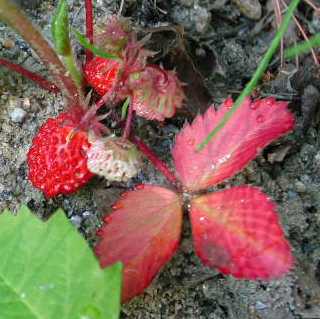
Early strawberries begin to be common. The lower leaves of the plant are red, concealing the fruit. 

Violets, especially of dry land, are scarce now. 

Eleocharis palustris abundant in Stow's meadow, by railroad. 

See a rose-bug. 

A pout's nest (at Pout's Nest) with a straight entrance some twenty inches long and a simple round nest at end. The young just hatched, all head, light-colored, under a mass of weedy hummock which is all under water. 

The common utricularia out. 

Hear the phebe note of a chickadee.

Cow-wheat, how long ? 

A rose-breasted grosbeak betrays itself by that peculiar squeak, on the Britton path. It is evident that many breed in the low woods by Flint's Pond. 

Catbird's nest with four eggs in a swamp-pink, three and a half feet up. 

The rose-breasted grosbeak is common now in the Flint's Pond woods. It is not at all shy, and our richest singer, perhaps, after the wood thrush. The rhythm is very like that of the tanager, but the strain is perfectly clear and sweet. 

One sits on the bare dead twig of a chestnut, high over the road, at Gourgas Wood, and over my head, and sings clear and loud at regular intervals, — the strain about ten or fifteen seconds long, rising and swelling to the end, with various modulations.

Another, singing in emulation, regularly answers it, alternating with it, from a distance, at least a quarter of a mile off. It sings thus long at a time, and I leave it singing there, regardless of me.

H.D. Thoreau, Journal, June 14, 1859

Early strawberries begin to be common
The lower leaves of the plant are red, concealing the fruit. See June 2, 1859 ("Strawberries reddening on some hills"}; June 10, 1856 ("Ripe strawberries . . . hard at first to detect amid the red radical leaves.”)

A rose-breasted grosbeak. It is evident that many breed in the low woods by Flint's Pond
See June 2, 1859 ("Found within three rods of Flint's Pond a rose-breasted grosbeak's nest.") See also A Book of Seasons,  by Henry Thoreau, , the Rose-breasted Grosbeak

A pout's nest (at Pout's Nest).The young just hatched. See April 25, 1859 ("Young Stewart tells me that he saw last year a pout's nest at Walden in the pond-hole by the big pond. The spawn lay on the mud quite open and uncovered, and the old fish was tending it. A few days after, he saw that it was hatched and little pouts were swimming about.") "Pout’s Nest": HDT's name for Wyman's Meadow near Walden. See note to July 26, 1860 (I see a bream swimming about in that smaller pool by Walden in Hubbard's Wood. . . So they may be well off in the Wyman meadow or Pout's Nest."); see also June 7, 1858 ("Pouts, then, make their nests in shallow mud-holes or bays, in masses of weedy mud, or probably in the muddy bank; and the old pout hovers over the spawn or keeps guard at the entrance.Where do the Walden pouts breed when they have not access to this meadow?")

Popular Posts Last 30 Days.

The week ahead in Henry’s journal

The week ahead in Henry’s journal
A journal, a book that shall contain a record of all your joy.
"A stone fruit. Each one yields me a thought." ~ H. D. Thoreau, March 28, 1859


I sit on this rock
wrestling with the melody
that possesses me.