Showing posts with label watermelon. Show all posts

Tuesday, August 8, 2023

Botonizing up the Railroad

August 8.

5 A.M.  -- Up railroad. The nabalus, which may have been out one week elsewhere.  

Also rough hawkweed, and that large asterlike flower Diplopappus umbellatus, a day or two. 

Smooth speedwell again. 

Erechthites. 

Columbine again. 

The first watermelon. 

Aster patens and Aster laevis, both a day or two.

H. D. Thoreau, Journal, August 8, 1853

The nabalus, which may have been out one week elsewhere. See note to September 13, 1857 ("The nabalus family generally, apparently now in prime")

Also rough hawkweed. See July 21, 1851 ("The rough hawkweed, too, resembling in its flower the autumnal dandelion.") See also A Book of the Seasons,  by Henry Thoreau, the Hawkweeds (hieracium)

That large asterlike flower Diplopappus. [Tall flat-top white aster] See August 1, 1856 ("Diplopappus umbellatus at Peter's wall."); August 24, 1853 ("D. umbellatus is conspicuous enough in some places (low grounds)"); August 24, 1859 ("Diplopappus umbellatus, how long?"); See August 31, 1853 ("The great white umbel-like tops of the Diplopappus umbellatus"); September 1, 1856 ("D. umbellatus, perhaps in prime or approaching it, but not much seen."); September 24, 1856 ("D. umbellatus, still abundant.")

Smooth speedwell again. See May 24, 1853 ("The smooth speedwell is in its prime now, whitening the sides of the back road . . . Its sweet little pansy like face looks up on all sides.")

Erechthites. See July 24, 1853 ("There is erechthites there [at Hubbard’s burnt meadow.], budded.") ; August 1, 1856 ("Erechthites, apparently two or three days, by Peter's Path, end of Cemetery, the middle flowers first.")

The first watermelon.
See August 11, 1852 ("We had a ripe watermelon on the 7th."); August 19, 1851 ("Gathered our first watermelon to-day."); August 28, 1856 ("First watermelon.")

Aster patens and Aster laevis, both a day or two. July 13, 1856 ("Am surprised to see an Aster laevis, out a day or two, in road on sandy bank.") See July 19, 1854 ("I am surprised to see at Walden a single Aster patens "); July 27, 1853 ("I notice to-day the first purplish aster... The afternoon of the year.”); August 10, 1853 (" I see again the Aster patens . . . though this has no branches nor minute leaves atop.") see also August 12, 1856 ("The Aster patens is very handsome by the side of Moore's Swamp on the bank, — large flowers, more or less purplish or violet, each commonly (four or five) at the end of a long peduncle, three to six inches long, at right angles with the stem, giving it an open look.”); August 21, 1856 ("The commonest asters now are, 1st, the Radula; 2d, dumosus; 3d, patens; 4th, say puniceus; 5th, cordtfolius; 6th, macrophyllus; (these two a good while); 7th, say Tradescanti ; 8th, miser; 9th, longifolius; (these three quite rare yet); 10th, probably acuminatus, some time (not seen); 11th, undulatus; 12th, loevis; (these two scarcely to be seen yet)."); September 18, 1857 ("Going along the low path under Bartlett's Cliff, the Aster laevis flowers, when seen toward the sun, are very handsome, having a purple or lilac tint.")

August 8.
See A Book of the Seasons, by Henry Thoreau, August 8
A Book of the Seasons by Henry Thoreau
 "A book, each page written in its own season, 
out-of-doors, in its own locality."  
 ~edited, assembled and rewritten by zphx ©  2009-2024

Tuesday, August 27, 2019

There are various ways in which you can tell if a watermelon is ripe

August 27

. .. I think that some summer squashes had turned yellow in our yard a fortnight or more ago . There are various ways in which you can tell if a watermelon is ripe . If you have had your eye on the patch much from the first , and so know which formed first , you may presume that these will ripen soonest ; or else you may incline to those which lie nearest the centre of the hill or root , as the oldest . Next the dull dead color and want of bloom are as good signs as any . Some look green and livid and have a very fog or mildew of bloom on them , like a fungus . These are as green as a leek through and through , and you'll find yourself in a pickle if you open one . Others have a dead dark green- ness , the circulations being less rapid in their cuticles and their blooming period passed , and these you may safely bet on . If the vine is quite green and lively , the death of the quirl at the root of the stem is almost a sure sign . For fear we should not discover it before , this is placed for a sign that there is redness and ripeness ( if not mealiness ) within . Of two otherwise similar , take that which yields the lowest tone when struck with your knuckles , i . e . , which is hollowest . The old or ripe ones sing base ; the young , tenor or falsetto . Some use the violent method of pressing to hear if they crack within , but this is not to be allowed . Above all no tapping on the vine is to be tolerated , suggestive of a greediness which defeats its own purpose . It is very childish . One man told me that he could n't raise melons because his children would cut them all up . I thought that he convicted himself out of his own mouth , and was not fit to be the ruler of a country according to Confucius ' . . .

See Late Blackberries

H. D. Thoreau, Journal, August 27, 1859

All our life is a persistent dreaming awake. See November 12, 1859 ("I do not know how to distinguish between our waking life and a dream. Are we not always living the life that we imagine we are?"); October 29, 1857 ("There are some things of which I cannot at once tell whether I have dreamed them or they are real"); August 8, 1852 ("When the play - it may be the tragedy of life - is over, the spectator goes his way. It was a kind of fiction, a work of the imagination only, so far as he was concerned.") May 24, 1851 ("I frequently awake with an atmosphere about me as if my unremembered dreams had been divine, as if my spirit had journeyed to its native place”).

I often see yarrow with a delicate pink tint.
See July 5, 1856 ("Pink-colored yarrow.")

The children have done bringing huckleberries to sell for nearly a week. See July 13, 1852 ("It is impossible to say what day — almost what week — the huckleberries begin to be ripe, unless you are acquainted with, and daily visit, every huckleberry bush in the town"); August 4, 1852 (“Most huckleberries and blueberries and low blackberries are in their prime now.”); August 4, 1854 ("On this hill (Smith's) the bushes are black with huckleberries. ...Now in their prime. Some glossy black, some dull black, some blue; and patches of Vaccinium vacillans inter mixed."); August 4. 1856 ("This favorable moist weather has expanded some of the huckleberries to the size of bullets"); August 28, 1856 ("Huckleberries are about given up")

Perfectly fresh and large low blackberries, peculiarly sweet and soft, in the shade of the pines at Thrush Alley,-- so much sweeter, tenderer, and larger. See July 31, 1856 (“How thick the berries — low blackberries, Vaccinium vacillans, and huckleberries — on the side of Fair Haven Hill! ”) August 4, 1852 (“Most huckleberries and blueberries and low blackberries are in their prime now.”); August 19, 1856 ("What countless varieties of low blackberries! Here, in this open pine grove, I pluck some large fresh and very sweet ones when they are mostly gone without. So they are continued a little longer to us"); August 28, 1856 (“low blackberries done, high blackberries still to be had.”); 

Elder-berry clusters swell and become heavy and therefore droop, bending the bushes down, just in proportion as they ripen. See   August 22, 1852 ("The elder bushes are weighed down with fruit partially turned, and are still in bloom at the extremities of their twigs."); August 23, 1856  ("Elder-berries, now looking purple, are weighing down the bushes along fences by their abundance."); August 29, 1854 ("The cymes of elder-berries, black with fruit, are now conspicuous.")


The children have done 
bringing huckleberries to sell 
for nearly a week.

Sunday, August 28, 2016

Has not the great world existed for them as much as for you?

August 28

First watermelon. 

P. M. — To tortoise eggs, Marlborough road. 

Potentilla Norvegica again. 

I go over linnaea sprout lands. 

The panicled cornel berries are whitening, but already mostly fallen. As usual the leaves of this shrub, though it is so wet, are rolled like corn, showing the paler under sides. At this season it would seem that rain, frost, and drought all produce similar effects. 

Now the black cherries in sprout-lands are in their  prime, and the black choke-berries just after huckleberries and blueberries. They are both very abundant this year. The branches droop with cherries. Those on some trees are very superior to others. 

The bushes are weighed down with choke-berries, which no creature appears to gather. This crop is as abundant as the huckleberries have been. They have a sweet and pleasant taste enough, but leave a mass of dry pulp in the mouth. But it is worth the while to see their profusion, if only to know what nature can do. 

Huckleberries are about given up, low blueberries more or less shrivelled, low blackberries done, high blackberries still to be had. Viburnum nudum berries are beginning; I already see a few shrivelled purple ones amid the light green. Poke berries also begun. 

A goldfinch twitters away from every thistle now, and soon returns to it when I am past. I see the ground strewn with the thistle-down they have scattered on every side. 

At Tarbell's andromeda swamp. A probable Bidens connata or small chrysanthemoides. 

I open the painted tortoise nest of June 10th, and find a young turtle partly out of his shell. He is roundish and the sternum clear uniform pink. The marks on the sides are pink. The upper shell is fifteen sixteenths of an inch plus by thirteen sixteenths. He is already wonderfully strong and precocious. Though those eyes never saw the light before, he watches me very warily, even at a distance. With what vigor he crawls out of the hole I have made, over opposing weeds! He struggles in my fingers with great strength; has none of the tenderness of infancy. His whole snout is convex, and curved like a beak. Having attained the surface, he pauses and warily watches me. In the meanwhile another has put his head out of his shell, but I bury the latter up and leave them. 

Meanwhile a striped squirrel sits on the wall across the road under a pine, eying me, with his cheek-pouches stuffed with nuts and puffed out ludicrously, as if he had the mumps, while the wall is strewn with the dry brown husks of hazelnuts he has stripped. A bird, perhaps a thrasher, in the pine close above him is hopping restlessly and scolding at him. 

June, July, and August, the tortoise eggs are hatching a few inches beneath the surface in sandy fields. You tell of active labors, of works of art, and wars the past summer; meanwhile the tortoise eggs underlie this turmoil. What events have transpired on the lit and airy surface three inches above them! Sumner knocked down; Kansas living an age of suspense. Think what is a summer to them! How many worthy men have died and had their funeral sermons preached since I saw the mother turtle bury her eggs here! They contained an undeveloped liquid then, they are now turtles. 

June, July, and August, — the livelong summer, — what are they with their heats and fevers but sufficient to hatch a tortoise in. Be not in haste; mind your private affairs. Consider the turtle. A whole summer — June, July, and August — is not too good nor too much to hatch a turtle in. 

Perchance you have worried yourself, despaired of the world, meditated the end of life, and all things seemed rushing to destruction; but nature has steadily and serenely advanced with a turtle's pace. 

The young turtle spends its infancy within its shell. It gets experience and learns the ways of the world through that wall. While it rests warily on the edge of its hole, rash schemes are undertaken by men and fail. Has not the tortoise also learned the true value of time? You go to India and back, and the turtle eggs in your field are still unhatched. French empires rise or fall, but the turtle is developed only so fast. 

What's a summer? Time for a turtle's eggs to hatch. So is the turtle developed, fitted to endure, for he outlives twenty French dynasties. One turtle knows several Napoleons. 

They have seen no berries, had no cares, yet has not the great world existed for them as much as for you?

Euphorbia hypericifolia, how long? It has pretty little white and also rose-colored petals, or, as they are now called, involucre. Stands six inches high, regularly curving, with large leaves prettily arranged at an angle with both a horizontal and perpendicular line. 

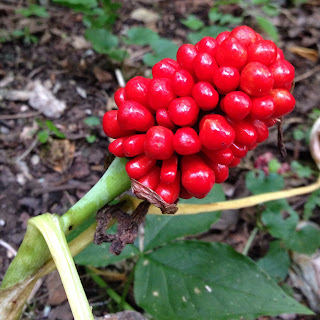
See the great oval masses of scarlet berries of the arum now in the meadows. Trillium fruit, long time.
August 28, 2014

The river being thus high, for ten days or more I have seen little parcels of shells left by the muskrats. So they eat them thus early. 

Peppermint, how long? May be earlier than I have thought, for the mowers clip it. 

The bright china-colored blue berries of the Cornus sericea begin to show themselves along the river, amid their red-brown leaves, — the kinnikinnic of the Indians. 

H. D. Thoreau, Journal, August 28, 1856

The panicled cornel berries are whitening . . .See August 15, 1854 ("Panicled cornel berries on College Road. “); August 22, 1852 ("The panicled cornel berries now white. “)

I open the painted tortoise nest of June 10th . . .See June 10, 1856 ("A painted tortoise laying her eggs ten feet from the wheel-track on the Marlborough road.”). See also August 26, 1854 ("Open one of my snapping turtle's eggs. . . .”)

Has not the great world existed for them as much as for you?
See September 9, 1854 ("Thus the earth is the mother of all creatures.”); August 26, 1854 ("I am convinced that there must be an irresistible necessity for mud turtles.”)

The bright china-colored blue berries of the Cornus sericea begin to show themselves along the river.
. .  See  August 28, 1852 ("Now the red osier berries are very handsome along the river, overhanging the water, for the most part pale blue mixed with whitish, -- part of the pendant jewelry of the season.”) See also August 24, 1852 ("Of

 cornels , have not seen the dwarf nor the dogwood berries . The alternate - leaved with red cymes 

and round dull ( ? ) blue berries appeared first ; then the red osier began to turn bright , glass - beady , amethystine ( ? ) blue , mixed with white , and is still for the most part green ; then the white - berried . But the round - leaved I have not seen .

 "); September 1, 1854 ("The Cornus sericea berries are now in prime, of different shades of blue, lighter or darker, and bluish white. . . .a great ornament to our causeways and riverside.”); September 3, 1856  (“The white berries of the panicled cornel, soon and apparently prematurely dropping from its pretty fingers, are very bitter. So also are those of the C. sericea. ”)

Sunday, September 14, 2014

A voyage up the Sudbury


September 14.

To opposite Pelham’s Pond by boat. Quite cool, with some wind from east and southeast. Took a watermelon for drink.

Now, instead of haying, they are raking cranberries all along the river. The raker moves slowly along with a basket before him, into which he rakes (hauling) the berries, and his wagon stands one side. It is now the middle of the cranberry season.

The river has risen about a foot within a week, and now the weeds in midstream have generally disappeared, washed away or drowned. Now our oars leave a broad wake of large bubbles, which are slow to burst.

This cooler morning methinks the jays are heard more. 

Now that the pontederias have mostly fallen, the polygonums are the most common and conspicuous flowers of the river.  I see a stream of small white insects in the air over the side of the river.

At a distance, entering the pond, we mistake some fine sparkles, probably of insects, for ducks in the water, they were so large, which when we are nearer, looking down at a greater angle with the surface, wholly disappear. 

Crossing Fair Haven, the reflections are very fine, prolonged by the ripples made by an east wind just risen. 

Bidens cernua

Large-flowered bidens,
or beggar-ticks,
or bur-marigold,
now abundant by riverside.

The Bidens Beckii is drowned or dried up, and has given place to the great bidens, the flower and ornament of the riversides at present, and now in its glory, especially at I. Rice’s shore, where there are dense beds. It is a splendid yellow — Channing says a lemon yellow — and looks larger than it is (two inches in diameter, more or less). 


Full of the sun. It needs a name.


We see half a dozen herons in this voyage. Their wings are so long in proportion to their bodies that there seems to be more than one undulation to a wing as they are disappearing in the distance, and so you can distinguish them. You see another begin before the first has ended. It is remarkable how common these birds are about our sluggish and marshy river.

A flock of thirteen tell tales, great yellow-legs, start up with their shrill whistle from the midst of the great Sudbury meadow, and away they sail in a flock,—a sailing (or skimming) flock, that is something rare methinks, — showing their white tails, to alight in a more distant place.

We went up thirteen or fourteen miles at least, and, as we stopped at Fair Haven Hill returning, rowed about twenty-five miles to-day.

H. D. Thoreau, Journal, September 14, 1854


To opposite Pelham’s Pond by boat. . . We went up thirteen or fourteen miles at least, and, . .rowed about twenty-five miles to-day.
See note to October 15, 1851 ("Up the river in a boat to Pelham's Pond . . . Rowed about twenty-four miles, going and coming. In a straight line it would be fifteen and one half." See also July 31, 1859 ("This sixteen miles up, added to eleven down, makes about twenty-seven that I have boated on this river, to which may be added five or six miles of the Assabet.")

Took a watermelon for drink. See August 12, 1853 ("Carry watermelons for drink. What more refreshing and convenient! This richest wine in a convenient cask, and so easily kept cool!")

It is now the middle of the cranberry season.
 See September 26, 1857 ("I see far off the various-colored gowns of cranberry pickers against the green of the meadow.")

Now the weeds in midstream have generally disappeared, washed away or drowned. See September 5, 1854 ("This is a fall phenomenon. The river weeds, becoming rotten, though many are still green, fall or are loosened, the water rises, the winds come, and they are drifted to the shore, and the water is cleared.")

Now our oars leave a broad wake of large bubbles See June 3, 1854 (“On the pond we make bubbles with our paddles on the smooth surface, in which little hemispherical cases we see ourselves and boat, small, black and distinct, with a fainter reflection on the opposite side of the bubble (head to head). These last sometimes a minute before they burst.”); June 7, 1857 (“Now I notice many bubbles left on the water in my wake, as if it were more sluggish or had more viscidity than earlier. Far behind me they rest without bursting.”)

This cooler morning methinks the jays are heard more.
 See September 21, 1854 ("I hear many jays since the frosts began."); September 21, 1859 ("Jays are more frequently heard of late, maybe because other birds are more silent") See also A Book of the Seasons, by Henry Thoreau, The Blue Jay

The polygonums are the most common and conspicuous flowers of the river. See September 18, 1858 ("The perfectly fresh spike of the Polygonum amphibium attracts every eye now. It is not past its prime. C. thinks it is exactly the color of some candy."); September 22, 1852 ("The Polygonum amphibium var. terrestre is a late flower, and now more common and the spikes larger, quite handsome and conspicuous, and more like a prince's-feather than any.");  September 27, 1858 ("The P. amphibium spikes still in prime. ")

We mistake some fine sparkles, probably of insects, for ducks in the water. See  September 20,1852 ("How sweet the phenomena of the lake! Everything that moves on its surface produces a sparkle.. . .The motion of an oar or an insect produces a flash of light;"); October 11, 1852 (" In this clear air and with this glassy surface the motion of every water-bug, ceaselessly progressing over the pond, was perceptible."); October 28, 1858 ("I can hardly distinguish the sparkle occasioned by an insect from the white breast of a duck")

The reflections are very fine, prolonged by the ripples.
See October 7, 1857 ("There being a slight ripple on the surface, these reflections . . .were extended downward . . .forming sharp pyramids of the several colors, gradually reduced to mere dusky points. The effect of this prolongation of the reflection was a very pleasing softening and blending of the colors . . .The color seems to be reflected and re-reflected from ripple to ripple, losing brightness each time by the softest possible gradation, and tapering toward the beholder, since he occupies a mere point of view. This is one of the prettiest effects of the autumnal change. . . .The ripples convey the reflection toward us."); November 1, 1858 ("The reflection of Flint’s white house in the river, prolonged by a slight ripple so as to reach the reflected cloud, was a very distinct and luminous light blue."); November 4, 1857 ("Its [Walden's] surface is slightly rippled, and dusky prolonged reflections of trees extend wholly across its length,")

Great bidens, the flower and ornament of the riversides at present ... ii needs a name.
See.September 12, 1859 ("The four kinds of bidens (frondosa, connata, cernua, and chrysanthemoides) abound now, but much of the Beckii was drowned by the rise of the river. Omitting this, the first two are inconspicuous flowers, cheap and ineffectual, commonly without petals, like the erechthites, but the third and fourth are conspicuous and interesting, expressing by their brilliant yellow the ripeness of the low grounds"); September 13, 1852 ("The great bidens in the sun in brooks affects me as the rose of the fall, the most flavid product of the water and the sun. They are low suns in the brook. The golden glow of autumn concentrated, more golden than the sun. How surely this yellow comes out along the brookss in autumn."); September 19, 1851 ("Large-flowered bidens,or beggar-ticks, or bur-marigold,now abundant by riverside")

Their wings are so long in proportion to their bodies that there seems to be more than one undulation to a wing as they are disappearing in the distance. See April 15, 1855 ("When the heron takes to flight, what a change in size and appearance! It is presto change! There go two great undulating wings pinned together, but the body and neck must have been left behind somewhere"); September 5, 1854 ("Now at sundown, a blue heron flaps away from his perch on an oak over the river before me, just above the rock."); November 1, 1855 ("I see the blue heron arise from the shore and disappear with heavily-flapping wings around a bend in front; the greatest of the bitterns, with heavily-undulating wings, low over the water, seen against the woods, just disappearing round a bend in front; with a great slate-colored expanse of wing, suited to the shadows of the stream, a tempered blue as of the sky and dark water commingled.") See also A Book of the Seasons, by Henry Thoreau, the Blue Heron

A flock of thirteen tell tales, great yellow-legs, start up with their shrill whistle. See May 31, 1854 ( It acts the part of a telltale."   "watchful, but not timid, ... while it stands on the lookout ... wades in the water to the middle of its yellow legs; goes off with a loud and sharp phe phe phe phe.";)  August 5, 1855 (" Hear a yellow-legs flying over,—phe' phe phe, phe' phe phe.” ); September 26, 1859 ("Hearing a sharp phe-phe and again phe-phe-phe, I look round and see two (probably larger) yellow-legs. . . their whole forms reflected in the water. They allow me to paddle past them, though on the alert."); October 20, 1859 ("Scare up a yellow-legs, apparently the larger, on the shore of Walden. It goes off with a sharp phe phe, phe phe.")

September 14.
See A Book of the Seasons, by Henry Thoreau, September 14

Along the river
they are raking cranberries
instead of haying.

Bidens in the sun –
the flower and ornament
of the riverside. 

With their shrill whistle
yellow-legs sail in a flock
showing their white tails.

A Book of the Seasons,  by Henry Thoreau
"A book, each page written in its own season,
out-of-doors, in its own locality.”
~edited, assembled and rewritten by zphx © 2009-2024

https://tinyurl.com/hdt-540914

Monday, August 12, 2013

Now at last, methinks, the most melting season of this year.

August 12


August 12, 2013

To Conantum by boat, berrying, with three ladies. You now see and hear no red-wings along the river as in spring. 

See the blue herons opposite Fair Haven Hill, as if they had bred here. 

This and the last day or two very hot. Now at last, methinks, the most melting season of this year, though I think it is hardly last year's bathing time, because the water is higher. There is very little air over the water, and when I dip my head in it for coolness, I do not feel any coolness.

Carry watermelons for drink. What more refreshing and convenient! This richest wine in a convenient cask, and so easily kept cool! No foreign wines could be so grateful. If you would cool a watermelon, do not put it in water, which keeps the heat in, but cut it open and set it in a cellar or in the shade. If you have carriage, carry these green bottles of wine.

H. D. Thoreau, Journal, August 12, 1853

To Conantum by boat, berrying, with three ladies. See August 4, 1856 ("Carried party a-berrying to Conantum in boat.")

See the blue herons opposite Fair Haven Hill, as if they had bred here. See August 24, 1854 ("See a blue heron standing on the meadow at Fair Haven Pond. "); and note to August 19, 1858 ("Blue herons, which have bred or been bred not far from us (plainly), are now at leisure, or are impelled to revisit our slow stream")

Popular Posts Last 30 Days.

The week ahead in Henry’s journal

The week ahead in Henry’s journal
A journal, a book that shall contain a record of all your joy.
"A stone fruit. Each one yields me a thought." ~ H. D. Thoreau, March 28, 1859


I sit on this rock
wrestling with the melody
that possesses me.