Showing posts with label buck-bean. Show all posts

Tuesday, May 11, 2021

The different moods or degrees of wildness and poetry of which the song of birds is the keynote


May 11.


5 A. M. -- In the morning and evening waters are still and smooth, and dimpled by innate currents only, not disturbed by foreign winds and currents of the air, and reflect more light than at noonday.

P. M. – To Corner Spring via Hubbard's Bathing Place.

The buck-bean is budded, but hard to find now.

The Viola lanceolata is now abundant thereabouts, me thinks larger and quite as fragrant (which is not saying much) as the blanda. How long has it been open? 

May 11, 2019


It is a warm afternoon, and great numbers of painted and spotted tortoises are lying in the sun in the meadow.

I notice that the thin scales are peeling off of one of the painted and curled up more than half an inch at the edges, and others look as if they had just lost them, the dividing-line being of a dull cream color.
Has this lying in the sun anything to do with it? 

I nearly stepped upon a song sparrow and a striped snake at the same time. The bird fluttered away almost as if detained. I thought it was a case of charming, without doubt, and should think so still if I had not found her nest with five eggs there, which will account for her being so near the snake that was about to devour her.

The amelanchier has a sickish fragrance.

It must be the myrtle-bird which is now so common in Hubbard's Meadow Woods or Swamp, with a note somewhat like a yellow bird's, striped olive-yellow and black on back or shoulders, light or white beneath, black dim; restless bird; sharp head.

The catbird has a squeaking and split note with some clear whistles.

The late pipes (limosum?), now nearly a foot high, are very handsome, like Oriental work, their encircled columns of some precious wood or gem, or like small bamboos, from Oriental jungles. Very much like art.

The gold-thread, apparently for a day or two, though few flowers compared with buds; not at once referred to its leaf, so distant on its thread-like peduncle.

The water-saxifrage also for a day or two in some places, on its tall, straight stem, rising from its whorl of leaves.

Sorrel now fairly out in some places. I will put it under May 8th.

A high blueberry by Potter's heater piece.

A yellow lily.

The red-eye at the spring; quite a woodland note.

The different moods or degrees of wildness and poetry of which the song of birds is the keynote. The wood thrush Mr. Barnum never hired nor can, though he could bribe Jenny Lind and put her into his cage.

How many little birds of the warbler family are busy now about the opening buds, while I sit by the spring! They are almost as much a part of the tree as its blossoms and leaves. They come and give it voice.  Its twigs feel with pleasure their little feet clasping them.

I hear the distant drumming of a partridge. Its beat, however distant and low, falls still with a remarkably forcible, almost painful, impulse on the ear, like veritable little drumsticks on our tympanum, as if it were a throbbing or fluttering in our veins or brows or the chambers of the ear, and belonging to ourselves, — as if it were produced by some little insect which had made its way up into the passages of the ear, so penetrating is it. It is as palpable to the ear as the sharpest note of a fife.

Of course, that bird can drum with its wings on a log which can go off with such a powerful whir, beating the air. I have seen a thoroughly frightened hen and cockerel fly almost as powerfully, but neither can sustain it long. Beginning slowly and deliberately, the partridge's beat sounds faster and faster from far away under the boughs and through the aisles of the wood until it becomes a regular roll, but is speedily concluded. 

How many things shall we not see and be and do, when we walk there where the partridge drums! 

As I stand by the river in the truly warm sun, I hear the low trump of a bullfrog, but half sounded, - doubting if it be really July, some bassoon sounds, as it were the tuning that precedes the summer's orchestra; and all is silent again.

How the air is saturated with sweetness on causeways these willowy days! The willow alone of trees as yet makes light, often rounded masses of verdure in large trees, stage above stage. But oftenest they are cut down at the height of four or five feet and spread out thence.

There appear to be most clouds in the horizon on (one) of these days of drifting downy clouds, because, when we look that way, more fall within our field of view, but when we look upward, overhead we see the true proportion of clear blue.

The mountains are something solid which is blue, a terra firma in the heavens; but in the heavens there is nothing but the air.

Blue is the color of the day, and the sky is blue by night as well as by day, because it knows no night.

H. D. Thoreau, Journal, May 11, 1853

May 11, See A Book of the Seasons, by Henry Thoreau, May 11


It is a warm afternoon, and great numbers of painted and spotted tortoises are lying in the sun in the meadow. See May 10, 1857 ("Now the Emys picta lie out in great numbers, this suddenly warm weather.")

I nearly stepped upon a song sparrow so near a snake that was about to devour her. See May 19, 1856 ("Saw a small striped snake in the act of swallowing a Rana palustris . . .. The snake, being frightened, released his hold, and the frog hopped off to the water. ")

The different moods or degrees of wildness and poetry of which the song of birds is the keynote. See May 11, 1854 ("The true poet will ever live aloof from society, wild to it, as the finest singer is the wood thrush, a forest bird.")

 How many little birds of the warbler family are busy now about the opening buds . . .  They are almost as much a part of the tree as its blossoms and leaves. They come and give it voice. See May 7, 1852 ("For now, before the leaves, they begin to people the trees in this warm weather."); (May 15, 1859 (“Now, when the warblers begin to come in numbers with the leafing of the trees, the woods are so open that you can easily see them. ”);May 15, 1860 ("Deciduous woods now swarm with migrating warblers, especially about swamps.”);May 18, 1856 ("The swamp is all alive with warblers about the hoary expanding buds of oaks, maples, etc., and amid the pine and spruce."); May 23, 1857("This is the time and place to hear the new-arriving warblers, the first fine days after the May storm. When the leaves generally are just fairly expanding,")

It must be the myrtle-bird which is now so common in Hubbard's Meadow Woods or Swamp. See May 1, 1855 ("The myrtle-bird is one of the commonest and tamest birds now. It catches insects like a pewee, darting off from its perch and returning to it, and sings something like a-chill chill, chill chill, chill chill, a-twear, twill twill twee,"); May 4, 1855 ("Myrtle-birds numerous, and sing their tea lee, tea lee in morning"); May 7, 1852 (" One or more little warblers in the woods this morning are new to the season, myrtlebirds among them.")

Beginning slowly and deliberately, the partridge's beat sounds faster and faster from far away under the boughs and through the aisles of the wood until it becomes a regular roll.  See April 19, 1860 ("You will hear at first a single beat or two far apart and have time to say, "There is a partridge," so distinct and deliberate is it often, before it becomes a rapid roll.");April 25, 1854 ("The first partridge drums in one or two places, as if the earth's pulse now beat audibly with the increased flow of life. It slightly flutters all Nature and makes her heart palpitate.")

The sky is blue by night as well as by day. See note to January 21, 1853 (''The blueness of the sky at night — the color it wears by day — is an everlasting surprise to me.")

A Book of the Seasons,  by Henry Thoreau
"A book, each page written in its own season,
out-of-doors, in its own locality."
 ~edited, assembled and rewritten by zphx ©  2009-2021

Tuesday, July 14, 2020

In Beck Stow’s Swamp to-day; approached and discovered the Andromeda Polifolia

July 14.

Heavy fog. 

I see a rose, now in its prime, by the river, in the water amid the willows and button-bushes, while others, lower on shore, are nearly out of bloom.

Is it not the R. Carolina?

Saw something blue, or glaucous, in Beck Stow’s Swamp to-day; approached and discovered the Andromeda Polifolia, in the midst of the swamp at the north end, not long since out of bloom. 

This is another instance of a common experience. When I am shown from abroad, or hear of, or in any [way] become interested in, some plant or other thing, I am pretty sure to find it soon. 

Within a week R. W. E. showed me a slip of this in a botany, as a great rarity which George Bradford brought from Watertown. I had long been interested in it by Linnæus’s account. I now find it in abundance. 


Andromeda Polifolia


It is a neat and tender-looking plant, with the pearly new shoots now half a dozen inches long and the singular narrow revolute leaves. I suspect the flower does not add much to it.

There is an abundance of the buck-bean there also. 

Holly berries are beginning to be ripe. 

The Polygonum Hydropiper, by to-morrow. 

Spergula arvensis gone to seed and in flower. 

A very tall ragged orchis by the Heywood Brook, two feet high, almost like a white fringed one. Lower ones I have seen some time. 

The clematis there (near the water-plantain) will open in a day or two.  

Mallows gone to seed and in bloom.

Erigeron Canadensis, butter-weed. 

 H. D. Thoreau, Journal, July 14, 1853

In Beck Stow’s Swamp to-day approached and discovered the Andromeda Polifolia. See February 17, 1854 ("In the open part of Gowing's Swamp I find the Andromeda Polifolia. Neither here nor in Beck Stow's does it grow very near the shore. . . . in the middle or deepest part will be an open space not yet quite given up to water, where the Andromeda calyculata and a few A. Polifolia reign almost alone. These are pleasing gardens.”); May 24, 1854 ("Surprised to find the Andromeda Polifolia in bloom and apparently past its prime. . .A timid botanist would never pluck it."); November 15,1857 ("At C. Miles Swamp [Ledum Swamp] [f]ind plenty of Andromeda Polifolia ... where you can walk dry-shod in the spruce wood”); See also February 12, 1858 ("There is, apparently, more of the Andromeda Polifolia in [C.Miles] swamp than anywhere else in Concord."); November 23, 1857 ("This [Gowing's] swamp appears not to have had any natural outlet, though an artificial one has been dug. The same is perhaps the case with the C. Miles Swamp. And is it so with Beck Stow's These three are the only places where I have found the Andromeda Polifolia."). See also  Vascular Flora of Concord, Massachusetts

This is another instance of a common experience. When I become interested in some plant or other thing, I am pretty sure to find it soon. See  May 31, 1853 ("The fact that a rare and beautiful flower which we never saw. . . may be found in our immediate neighborhood, is very suggestive."); August 23, 1854 (“I find a new cranberry on the sphagnum amid the A. calyculata, — V. Oxycoccus . . .It has small, now purplish-dotted fruit, flat on the sphagnum, some turned scarlet partly, on terminal peduncles, with slender, thread-like stems and small leaves strongly revolute on the edges.”); January 9, 1855 (“Make a splendid discovery this afternoon. Walking through Holden’s white spruce swamp, I see peeping above the snow-crust some slender delicate evergreen shoots very much like the Andromeda Polifolia, amid sphagnum, lambkill, Andromeda calyculata, blueberry bushes, etc., though there is very little to be seen above the snow. It is, I have little doubt, the Kalmia glauca var. rosmarinifolia.”); August 30, 1856 ("I have come out this afternoon a-cranberrying, chiefly to gather some of the small cranberry, Vaccinium Oxycoccus . . . “I noticed also a few small peculiar-looking huckleberries hanging on bushes amid the sphagnum, and, tasting, perceived that they were hispid, a new kind to me. Gaylussacia dumosa var. hirtella . . .. Has a small black hairy or hispid berry, shining but insipid and inedible, with a tough, hairy skin left in the mouth.”);  September 2, 1856 ("It commonly chances that I make my most interesting botanical discoveries when I am in a thrilled and expectant mood, perhaps wading in some remote swamp where I have just found something novel and feel more than usually remote from the town. Or some rare plant which for some reason has occupied a strangely prominent place in my thoughts for some time will present itself. My expectation ripens to discovery. I am prepared for strange things."); February 4, 1858 ("It is a remarkable fact that, in the case of the most interesting plants which I have discovered in this vicinity, I have anticipated finding them perhaps a year before the discovery.") November 4, 1858 ("We cannot see any thing until we are possessed with the idea of it, and then we can hardly see anything else. In my botanical rambles I find that first the idea, or image, of a plant occupies my thoughts, though it may at first seem very foreign to this locality, and for some weeks or months I go thinking of it and expecting it unconsciously, and at length I surely see it, and it is henceforth an actual neighbor of mine. This is the history of my finding a score or more of rare plants which I could name.”); August 22, 1860 ("I never find a remarkable Indian relic but I have first divined its existence, and planned the discovery of it. Frequently I have told myself distinctly what it was to be before I found it.") See also  January 27, 1857 ("The most poetic and truest account of objects is generally by those who first observe them, or the discoverers of them, whether a sharper perception and curiosity in them led to the discovery or the greater novelty more inspired their report.")

Beck Stow's Swamp. See July 17, 1852 ("Beck Stow's Swamp! What an incredible spot to think of in town or city! When life looks sandy and barren, is reduced to its lowest terms, we have no appetite, and it has no flavor, then let me visit such a swamp as this, deep and impenetrable, where the earth quakes for a rod around you at every step, with its open water where the swallows skim and twitter, its meadow and cotton-grass, its dense patches of dwarf andromeda, now brownish-green, with clumps of blue berry bushes, its spruces and its verdurous border of woods imbowering it on every side. ") A Book of the Seasons,  by Henry Thoreau,  at Beck Stow's Swamp

There is an abundance of the buck-bean there also See August 30, 1856 ("Consider how remote and novel that [Gowings] swamp. Beneath it is a quaking bed of sphagnum, and in it grow Andromeda Polifolia, Kalmia glauca, menyanthes (or buck -bean), Gaylussacia dumosa, Vaccinium Oxycoccus, — plants which scarcely a citizen of Concord ever sees.”) See also  May 29, 1856 (" Where you find a rare flower, expect to find more rare ones”)

A very tall ragged orchis by the Heywood Brook, two feet high, almost like a white fringed one. See July 21, 1851 ("The ragged orchis on Conantum."); July 13, 1856 ("Orchis lacera, apparently several days, lower part of spike, willow-row, Hubbard side, opposite Wheildon's land.")

Friday, July 26, 2019

Apple trees, square and round, in the northwest landscape.

July 26. 

P. M. — To Great Meadows.

July 26, 2019

I see in Clark's (?) land, behind Garfield's, a thick growth of white birches, apparently three years old, blown from the wood on the west and southwest.

Looking from Peter's, the meadows are somewhat glaucous, with a reddish border, or bank, by the river, where the red-top and Agrostis scabra grow, and a greener stream where the pipes are, in the lowest part, by the Holt, and in some places yellowish-green ferns and now brown-topped wool-grass. 

There is much of what I call Juncus scirpoides now in its prime in the wetter parts, as also the Eleocharis palustris, long done, and Rhyncospora alba lately begun. Also buck-bean by itself in very wet places which have lost their crust. 

Elodea, how long? 

Now observe the darker shades, and especially the apple trees, square and round, in the northwest landscape. 

Dogdayish. 

Methinks the hardhack leaves always stand up, for now they do, and have as soon as they blossomed at least.

July 26, 2019

H. D. Thoreau, Journal, July 26, 1859

I see in Clark's land, behind Garfield's, a thick growth of white birches, apparently three years old, blown from the wood on the west and southwest. See January 7, 1854 ("The bird-shaped scales of the white birch are blown more than twenty rods from the trees"); January 7, 1856 ("I see birch scales (bird-like) on the snow on the river more than twenty rods south of the nearest and only birch, and trace them north to it”);  March 25, 1858 ("Going across A. Clark's field behind Garfield’s, I see many fox-colored sparrows flitting past in a straggling manner into the birch and pitch pine woods on the left"); November 8, 1860 ("Also a wet and brushy meadow some forty rods in front of Garfield's is being rapidly filled with white pines whose seeds must have been blown  [fifty rods].").

July 26. See A Book of the Seasons, by Henry Thoreau, July 26

A Book of the Seasons, by Henry Thoreau
"A book, each page written in its own season,
out-of-doors, in its own locality."
~edited, assembled and rewritten by zphx © 2009-2021

Wednesday, June 6, 2018

Tp Painted-Cup Meadow via Assabet Bath.


June 6


June 6, 2018

P. M. – Cornus florida at Island well out, say the 3d. 

I hear of linnaea out in a pitcher and probably (?) in woods. 

Go to Painted-Cup Meadow via Assabet Bath. 

See three or four Emys insculpta about, making their holes in the gravelly bank south of Assabet Bath, and a few holes which must have been made a day or two, probably by the same. 

Golden senecio is not uncommon now. 

Am surprised to find that the buck bean flowers are withered, being killed by the recent frosts. 

Yellow Bethlehem-star.

Edith Emerson has found, in the field (Merriam’s) just south of the Beck Stow pine grove, Lepidium campestre, which may have been out ten days.

H. D. Thoreau, Journal , June 6, 1858

Cornus florida at Island well out, say the 3d. See June 4, 1858 ("I find the Cornus florida out in my pitcher when I get home June 4th, though it was not out on Island May 31st, and it is well out on Island when I look June 6th. I will say, therefore, that it opened June 3d."); See also May 25, 1855 ("Cornus florida, no bloom. Was there year before last? Does it not flower every other year?”); May 22, 1856("The Cornus florida does not bloom this year.")

Golden senecio is not uncommon now. See May 23, 1853 ("I am surprised by the dark orange-yellow of the senecio. At first we had the lighter, paler spring yellows of willows, dandelion, cinquefoil, then the darker and deeper yellow of the buttercup; and then this broad distinction between the buttercup and the senecio, as the seasons revolve toward July."); May 27, 1859 ("Golden senecio, at least to-morrow. ");May 29, 1856 (" Ride to Painted-Cup Meadow. . . . Golden senecio there, a day or two, at least"); June 9, 1853 ("The meadows are now yellow with the golden senecio, a more orange yellow, mingled with the light glossy yellow of the buttercup") See also A Book of the Seasons,  by Henry Thoreau, The Golden Senecio

Yellow Bethlehem-star. See June 5, 1855 ("Yellow Bethlehem-star in prime.")

Edith Emerson has found Lepidium campestre. See note to May 29, 1856 ("Found a painted-cup with more yellow than usual in it, and at length Edith found one perfectly yellow") [ Lepidium campestre--. Cow cress. See June 12, 1859, referring to  Lepidium campestre field.]

Saturday, May 19, 2018

Heard the night-warbler begin his strain just like an oven-bird!


May 19. 

A. M. – Surveying (by the eye) for Warner the meadow surveyed for John Hosmer in June, ’56. 

The black currant near southwest corner of his Saw Mill field (Ribes floridum) perfectly out; how long? 

P. M. – To Everett Spring.

May 19, 2019

There appears to be quite a variety in the colors of the Viola cucullata [blue marsh violet]. Some dark-blue, if not lilac (?), some with a very dark blue centre and whitish circum ference, others dark-blue within and dark without, others all very pale blue. 

May 19, 2019


Stellaria borealis well out, apparently several days. 

What I called the Ranunculus bulbosus there May 3d proves to be the R. repens. It would appear then to be the earliest ranunculus. It is a dense bed of yellow now. I am struck by the light spot in the sinuses of the leaves. 

The Equisetum sylvaticum there is now of a reddish cast. 

Starflower (Trientalis borealis)
May 19, 2023

R. W. E. says that Pratt found yesterday out the trientalis, Trillium cernuum, and Smilacina bifolia. 

Four rods plus south of the cross-fence over Everett's hill, on the west slope, I find the Ranunculus abortivus, two plants open only; but will not shed pollen till to-morrow. 

A rod or two further the Equisetum hyemale, apparently a little past bloom, or effete, all the heads open. 

Looking with my glass into the Gourgas pond-hole, I see three or four buck-bean blossoms. 

Two birds about the size and of the appearance of a pigeon or turtle dove start up with a loud alarm note from the shallow muddy flat there, — with a harsh shrill cry, phil phil phil or the like. At first I could not guess what they were, but since concluded that they were the larger yellow-legs. 

Could this bird have made the sound heard on the 15th? 

There remained feeding on the mud along the water's edge two peetweet-like birds, but apparently larger and less teetering. I thought they were T. solitaires. 

Heard the night-warbler begin his strain just like an oven-bird! I have noticed that when it drops down into the woods it darts suddenly one side to a perch when low.

H. D. Thoreau, Journal, May 19, 1858

Surveying for Warner the meadow surveyed for John Hosmer in June, ’56. See June 3, 1856 ("Surveying for John Hosmer beyond pail-factory”); June 4, 1856 (“Surveying for J. Hosmer . . .running a line on the west edge of Loring’s Pond, south of the brook.”).  Also  June 6, 1856 ("J. Hosmer, who is prosecuting Warner for flowing his land, says that the trees are not only broken off when young by weight of ice, but, being rubbed and barked by it, become warty or bulge out there.")

There appears to be quite a variety in the colors of the Viola cucullata. See May 15, 1856  ("Viola cucullata abundant now.”); May 20, 1852 ("The Viola ovata is of a deep purple blue, is darkest and has most of the red in it; the V. pedata is smooth and pale-blue, delicately tinged with purple reflections; the cucullata is more decidedly blue, slaty-blue, and darkly striated.")

Two birds start up with a loud alarm note from the shallow muddy flat with a harsh shrill cry, phil phil phil or the like The larger yellow-legs. See May 31, 1854 ( "It acts the part of a telltale." "watchful, but not timid, ... while it stands on the lookout ... wades in the water to the middle of its yellow legs; goes off with a loud and sharp phe phe phe phe. ...”); August 5, 1855 (" Hear a yellow-legs flying over,—phe' phe phe, phe' phe phe.”); September 14, 1854 ("A flock of thirteen tell tales, great yellow-legs, start up with their shrill whistle from the midst of the great Sudbury meadow, and away they sail in a flock. . .to alight in a more distant place.”)

Heard the night-warbler begin his strain just like an oven-bird!  Thoreau's night-warbler  is likely the oven-bird making its flight call. According to Emerson the night warbler is "a bird he had never identified, had been in search of twelve years, which always, when he saw it, was in the act of diving down into a tree or bush.” See  May 8, 1860 ("The night-warbler's note.");  May 9, 1852 ("Heard the night warbler.”); May 9, 1853 ("Again I think I heard the night-warbler.”); May 10, 1854 ("Heard the night-warbler. “);  May 12, 1857 ("A night-warbler, plainly light beneath. It always flies to a new perch immediately after its song");.  May 13, 1855 ("At 9.30 P.M. I hear from our gate my night-warbler. Never heard it in the village before.”); May 14, 1852 (“Most birds are silent in the storm.Hear the robin, oven-bird, night warbler, and [etc.]); May 16, 1858 ("Hear the night-warbler"); May 17, 1858 ("Just after hearing my night-warbler I see two birds on a tree. ...[One perhaps golden-crowned thrush. ]”); May 19, 1858 (“Heard the night-warbler begin his strain just like an oven-bird! I have noticed that when it drops down into the woods it darts suddenly one side to a perch when low."); May 28, 1854 ("The night-warbler, after his strain, drops down almost perpendicularly into a tree-top and is lost.”). See also May 12, 1855 (“We sit about half an hour, and it is surprising what various distinct sounds we hear there deep in the wood, as if the aisles of the wood were so many ear trumpets,-- the cawing of crows, the peeping of hylas in the swamp and perhaps the croaking of a tree-toad, the oven-bird, the yorrick of Wilson’s thrush, a distant stake-driver, the night-warbler and black and white creeper, the lowing of cows, the late supper horn, the voices of boys, the singing of girls, -- not all together but separately, distinctly, and musically, from where the partridge and the red-tailed hawk and the screech owl sit on their nests.”)

May 19.  See A Book of the Seasons, by Henry Thoreau, May 19

A Book of the Seasons, by Henry Thoreau
"A book, each page written in its own season,
out-of-doors, in its own locality.”
~edited, assembled and rewritten by zphx © 2009-2021

Saturday, May 21, 2016

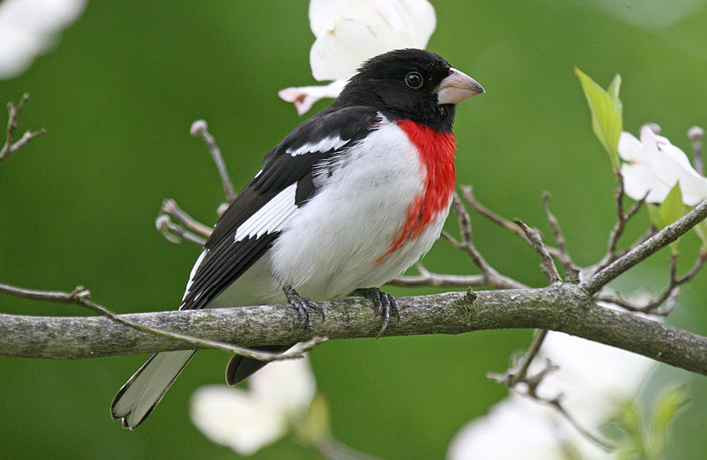
Two splendid rose-breasted grosbeaks.

May 21
Wednesday. P. M. — To Saw Mill Brook. 

Chelidonium.

Rubus triflorus abundantly out at the Saw Mill Brook; how long? 

A robin’s nest without mud, on a young white oak in woods, with three eggs. 

Saw two splendid rose-breasted grosbeaks with females in the young wood in Emerson’s lot. What strong colored fellows, black, white, and fiery rose-red breasts! Strong-natured, too, with their stout bills. A clear, sweet singer, like a tanager but hoarse somewhat, and not shy. 

The redstarts are inquisitive and hop near. 


solomon’s seal
May 21, 2016
The Polygonatum pubescens there, in shade, almost out; perhaps elsewhere already. 

At the trough near Turnpike, near Hosmer’s Spring, the (perhaps) Stellaria borealis of the 15th. I am still in doubt whether it is a stellaria or cerastium. This is quite smooth, four to five inches high, spreading and forking,with a single flower each fork, on a long peduncle; square-stemmed, oblong—lanceolate leaves, slightly ciliate and connate: ten stamens, five long, five short. Aspect of a smooth cerastium, but this has four to seven styles, oftenest perhaps five, all apetalous, except one petal shorter than the calyx; leaves one-nerved, sepals three-nerved! The bare and small plants are reddish stemmed. Can it be Stellaria longipes

The buck-bean in Everett’s Pool abundantly out, say four or five days. It is earlier than at B. Stow’s.

Myosotis laxa by Turnpike, near Hosmer Spring, may have been out several days; two or three at least.

H. D. Thoreau, Journal, May 21, 1856

The Polygonatum pubescens there, in shade, almost out; perhaps elsewhere already . See ; May 12, 1855 ("One flower of the Polygonatum pubescent open there [under Lee’s Cliff]; probably may shed pollen to-morrow.”);  May 22, 1856 ("Polygonatum pubescens at rock. "); May 25, 1852 ("Clustered Solomon's-seal, Polygonatum pubescens ready to bloom."); See also A Book of the Seasons,  by Henry Thoreau, Solomon's Seal


A clear, sweet singer . . . May 25, 1854 ("a handsome bird with a loud and very rich song, in character between that of a robin and a red-eye”)

Friday, May 20, 2016

The distant crashing of thunder.

May 20.

Fir-balsam (ours in grove) apparently two or three days, for it [is] almost entirely effete; cones white, one inch long nearly. 

Was awaked and put into sounder sleep than ever early this morning by the distant crashing of thunder, and now, — P. M. (to Beck Stow’s),— I hear it in mid-afternoon, muttering, crashing in the muggy air in mid-heaven, a little south of the village as I go through it, like the tumbling down of piles of boards, and get a few sprinkles in the sun. 

Nature has found her hoarse summer voice again, like the lowing of a cow let out to pasture. It is Nature’s rutting season. Even as the birds sing tumultuously and glance by with fresh and brilliant plumage, so now is Nature’s grandest voice heard, and her sharpest flashes seen. The air has resumed its voice, and the lightning, like a yellow spring flower, illumines the dark banks of the clouds. All the pregnant earth is bursting into life like a mildew, accompanied with noise and fire and tumult. Some oestrus stings her that she dashes headlong against the steeples and bellows hollowly, making the earth tremble. She comes dropping rain like a cow with overflowing udder. The winds drive her; the dry fields milk her. It is the familiar note of another warbler, just arrived, echoing amid the roofs.

I see, on a locust in the burying-ground, the Sylvia striata, or black-poll warbler, busily picking about the locust buds and twigs. Black head and above, with olive (green) wings and two white bars; white all beneath, with a very distinct black line from throat to shoulders; flesh-colored legs; bill, dark above, light beneath. Hear no note. Saw it well. 

At Moore’s Swamp on Bedford road, myriads of pollywogs half an inch long darken or blacken the shore, chiefly head as yet. 

Bank swallows are very lively about the low sand—bank just beyond, in which are fifty holes.


I now see distinctly the chestnut-sided warbler (of the 18th and 17th), by Beck Stow’s. It is very lively on the maples, birches, etc., over the edge of the swamp. Sings eech eech eech | wichy wichy | tchea or itch itch itch | witty witty |  tchea. Yet this note I represented on the 18th by tche tche tche | tchut tchutter we

The andromeda has apparently been out several days, but no buck-bean there yet, nor will for a day or two. 

See and hear a stake-driver in the swamp. It took one short pull at its pump and stopped. 

Two marsh hawks, male and female, flew about me a long time, screaming, the female largest, with ragged wings, as I stood on the neck of the peninsula. This induced me to climb four pines, but I tore my clothes, got pitched all over, and found only squirrel; yet they have, no doubt, a nest thereabouts. 

Haynes the carpenter calls that large glaucous puff that grows on the Andromeda paniculata, swamp-apple; says he has eaten as much as three bushels (!) of them when he was a boy, and likes them. That is what he was raised on. 

After I got him home, I observed a large leech on the upper shell of my great turtle. He stoutly resisted being turned over, by sinking his claws into the ground; was aware that that was his weak side, and, when turned, would instantly run out his head and turn himself back. No wonder the Orientals rested the world on such a broad back. 

Such broad health and strength underlies Nature.

H. D. Thoreau, Journal,  May 20, 1856

I hear it in mid-afternoon, muttering, crashing in the muggy air in mid-heaven. . . .Nature has found her hoarse summer voice again. Compare May 20, 1854 ("See the lightning, but can not hear the thunder.”);  May 17, 1853 ("Does not summer begin after the May storm?”)

At Moore’s Swamp on Bedford road, myriads of pollywogs . . .See note to May 19, 1857 ("See myriads of minute pollywogs, recently hatched, in the water of Moore's Swamp.”)

I see, on a locust in the burying-ground, the Sylvia striata, or black-poll warbler, busily picking about the locust buds and twigs. See  May 27, 1860 ("The Sylvia striata are the commonest bird in the street, as I go to the post-office, for several days past. I see six (four males, two females) on one of our little fir trees; are apparently as many more on another close by."); June 4,1860 ("The black-poll warblers (Sylvia striata) appear to have left, and some other warblers, if not generally, with this first clear and bright and warm, peculiarly June weather, immediately after the May rain. ") See also A Book of the Seasons, by Henry Thoreau, The Black-poll Warbler

The andromeda has apparently been out several days . . . .See May 24, 1854 ("Wade into Beck Stow's. . . . Surprised to find the Andromeda Polifolia in bloom and apparently past its prime at least a week or more.")

No wonder the Orientals rested the world on such a broad back. See May 4, 1852 ("...the Hindoos made the world rest on an elephant, and the elephant on a tortoise, and had nothing to put under the tortoise.")

Friday, May 15, 2015

An olive-sided flycatcher?

May 15


May 15.  P. M. —To Beck Stow’s. 

Suddenly very warm. 

Hear a hummingbird in the garden. Pear blossomed, -- some perhaps yesterday. Locust, black and scarlet oak, and some buttonwoods leaf. 

A yellow butterfly. 


I hear from the top of a pitch pine in the swamp that loud, clear, familiar whistle which I have sometimes wrongly referred to the wood pewee,  whip-ter-phe-ee. Is it the whip-tom-kelly note which Soane and Wilson gave to the red-eye, but which Nuttall says he never heard from it? Some times ter-phee-e. This is repeated at considerable intervals, the bird sitting quite still a long time. I saw it dart out once, catch an insect, and return to its perch muscicapa-like.  As near as I could see it had a white throat, was whitish, streaked with dark, beneath, darker tail and wings, and maybe olivaceous shoulders; bright yellow within bill. Probably M. Cooperi.

Andromeda calyculata begins to leaf -- separate twigs from blossoming ones. Andromeda Polifolia just open.

Buck-bean, apparently in three days (in house the 18th). 

The 13th, saw large water-bugs (Gyrinus) crawled up high on rocks. 

Watch a pine warbler on a pitch pine, slowly and faithfully searching it creeper-like. It encounters a black and white creeper on the same tree; they fly at each other, and the latter leaves, apparently driven off by the first. This warbler shuts its bill each time to produce its peculiar note. 

Rhodora will apparently open in two or three days. 

See and hear for a moment a small warbler-like bird in Nemopanthes Swamp which sings somewhat like tchut a-worieter-worieter-worieter-woo. 

The greater part of the large sugar maples on the Common leaf. Large red maples generally are late to leaf. 

H. D. Thoreau,  Journal, May 15, 1855

A white throat, was whitish, streaked with dark, beneath, darker tail and wings, and maybe olivaceous shoulders; bright yellow within bill. Probably M. Cooperi
. See  June 5, 1856. ("The Muscicapa Cooperi sings pe pe pe’, sitting on the top of a pine, and shows white rump”); June 8, 1856 ("At Cedar Swamp, saw the pe-pe catching flies like a wood pewee, darting from its perch on a dead cedar twig from time to time and returning to it. ...black crown with some crest, yellowish (?) bill, gray-brown back, black tail, two faint whitish bars on wings, a dirty cream-white throat, and a gray or ash white breast and beneath, whitest in middle"); June 10, 1855 ("Nuttall thus describes the Muscicapa Cooperi, olive sided flycatche  or pe - pe . . . head darker, without discolored spot ; sides olive grey; lateral space beneath the wing white; lower mandible purplish horn color; tail nearly even and extending but little beyond the closed wings. ” No white on tail") See also A Book of the Seasons,  by Henry Thoreau, the Olive-sided flycatcher or pe-pe

Monday, May 11, 2015

It is most impressive when you first detect the presence of the bird by its shadow.

May 11

A. M. —To Island. 

Only the lower limbs of bass begin to leaf yet, -- yesterday. 

A crow blackbird’s nest, about eight feet up a white maple over water, -- a large, loose nest without, some eight inches high, between a small twig and main trunk, composed of coarse bark shreds and dried last year’s grass, without mud; within deep and size of robin’s nest; with four pale-green eggs, streaked and blotched with black and brown. Took one. Young bird not begun to form. 

Hear and see yellow-throat vireo. 

See oat-seed spawn — a mass as big as fist —- on bottom; of brown jelly composed of smaller globules, each with a fish-like tadpole, color of a seed.

May 11, 2025

P. M. — To Andromeda Polifolia

Some young elms begin to leaf. Butternut leafs apparently to-morrow. Larger rock maples not yet begun to leaf, -- later considerably than large white maples, and somewhat than large red. 

Apparently andromeda will not open before the 15th or 16th, and the buck-bean, now just budded above the water, not before the 20th. 

Juniperus repens will not open, apparently, before the 14th or 15th. 

Canoe birch just sheds pollen. Very handsome drooping golden catkins, sometimes two or three together, some five and a quarter inches long. The leaves of some young sprouts already three-quarters inch over, but of the trees not started. 

The second amelanchier just sheds pollen, in a swamp. 

I trod on a large black snake, which, as soon as I stepped again, went off swiftly down the hill toward the swamp, with head erect like a racer. Looking closely, I found another left behind, partly concealed by the dry leaves. They were lying amid the leaves in this open wood east of Beck Stow’s, amid the sweet fem and huckleberry bushes. The remaining one ran out its tongue at me, and vibrated its tail swiftly, making quite a noise on the leaves; then darted forward, passed round an oak, and whipped itself straight down into a hole at its base one and a half inches over. After its head had entered, its tail was not long in following. 

You can hardly walk in a thick pine wood now, especially a swamp, but presently you will have a crow or two over your head, either silently flitting over, to spy what you would be at and if its nest is in danger, or angrily cawing. It is most impressive when, looking for their nests, you first detect the presence of the bird by its shadow. 

Was not that a bay-wing which I heard sing, — ah, twar twe twar, twit twit twit twit, twe?

Viola pedata sheds pollen,-- the first I have chanced to see. 

I hear some kind of owl partially hooting now at 4 P.M., I know not whether far off or near.

H. D. Thoreau, Journal, May 11, 1855

 Only the lower limbs of bass begin to leaf yet, -- yesterday. See May 13, 1854 ("The bass suddenly expanding its little round leaves."); May 13, 1855 ("The large bass trees now begin to leaf. ") See also  A Book of the Seasons, by Henry Thoreau, The Basswood

Hear and see yellow-throat vireo. See May 6, 1860 ('Hear probably a yellow-throated vireo in the woods."); May 6, 1859 ("Hear yellow-throat vireo, and probably some new warblers."); May 19, 1856 ("a yellow-throated vireo, . . . singing indolently, ullia — eelya, and sometimes varied to eelyee.”); May 27, 1854 ("I see and hear the yellow-throated vireo. It is somewhat similar (its strain) to that of the red eye, prelia pre-li-ay, with longer intervals."); May 29, 1855 ("Also the yellow-throated vireo—its head and shoulders as well as throat yellow (apparently olive-yellow above), and its strain but little varied and short, not continuous. It has dusky legs and two very distinct white bars on wings (the male) "); s. June 9, 1854 ("How prominent a place the vireos hold! It is probably the yellow-throated vireo I hear now . . .with its prelia — prelioit . . . invisible in the tops of the tree") See also A Book of the Seasons,  by Henry Thoreau, The Yellow-throated Vireo

It is most impressive when, looking for their nests, you first detect the presence of the bird by its shadow. See September 16, 1852("I detect the transit of the first [hawk] by his shadow on the rock, and look toward the sun for him. Though he is made light beneath to conceal him, his shadow betrays him.") See also May 5, 1855 ("A crow . . . directly over my head within thirty-five feet, caws angrily.") and note to  May 11, 1855 ("You can hardly walk in a thick pine wood now, especially a swamp, but presently you will have a crow or two over your head, either silently flitting over, to spy what you would be at and if its nest is in danger, or angrily cawing.")

Was not that a bay-wing which I heard sing.  See. April 13, 1855 (" See a sparrow without marks on throat or breast, running peculiarly in the dry grass in the open field beyond, and hear its song, and then see its white feathers in tail; the bay-wing"); May 12, 1857 ("I hear from across the fields the note of the bay-wing, Come here here there there quick quick quick or I'm gone. . .   As the bay-wing sang many a thousand years ago, so sang he to-night . . . [S]uddenly, in some fortunate moment, the voice of eternal wisdom reaches me even, in the strain of the sparrow, and liberates me, whets and clarifies my senses, makes me a competent witness.")

Viola pedata sheds pollen,-- the first I have chanced to see. See May 5, 1852 ("The Viola pedata budded, ready to blossom."); May 6, 1859 ("Viola pedata begins to be common about white pine woods there."); May 9, 1852 ("The first Viola pedata "); May 10, 1858 ("How much expression there is in the Viola pedata! I do not know on the whole but it is the handsomest of them all, it is so large and grows in such large masses."); May 17, 1853 ("The greatest array of blue of any flower as yet. The flowers are so raised above their leaves, and so close together, that they make a more indelible impression of blue on the eye; it is almost dazzling. I blink as I look at them, they seem to reflect the blue rays so forcibly, with a slight tinge of lilac."); May 18, 1854 ("The V. pedata beginning to be abundant."). May 20, 1852 ("the V. pedata is smooth and pale-blue, delicately tinged with purple reflections").  See also A Book of the Seasons, by Henry Thoreau, the Violets


Looking for nests, you
detect the presence of the
bird by its shadow.

                                     A Book of the Seasons, by Henry Thoreau
"A book, each page written in its own season,
out-of-doors, in its own locality.”
~edited, assembled and rewritten by zphx © 2009-2025

https://tinyurl.com/hdt-550511

Popular Posts Last 30 Days.

The week ahead in Henry’s journal

The week ahead in Henry’s journal
A journal, a book that shall contain a record of all your joy.
"A stone fruit. Each one yields me a thought." ~ H. D. Thoreau, March 28, 1859


I sit on this rock
wrestling with the melody
that possesses me.