Showing posts with label sparrows. Show all posts

Sunday, October 16, 2022

Sidewalks are covered with the impressions of leaves which fell yesterday.


October 16

Octobeer 16, 2022

Saturday.

The sidewalks are covered with the impressions of leaves which fell yesterday and were pressed into the soil by the feet of the passers, leaving a myriad dark spots -- like bird- tracks or hieroglyphics to a casual observer.

What are the sparrow-like birds with striped breasts and two triangular chestnut colored spots on the breasts which I have seen some time, picking the seeds of the weeds in the garden?

H. D. Thoreau, Journal, October 16, 1852

Tuesday, September 28, 2021

The white pines in Hubbard's Grove have now a pretty distinct parti-colored look.


September 28.

September 28, 2014

A considerable part of the last two nights and yesterday, a steady and rather warm rain, such as we have not had for a long time. This morning it is still completely overcast and drizzling a little.

Flocks of small birds — apparently sparrows, bobolinks (or some bird of equal size with a pencilled breast which makes a musical clucking), and piping goldfinches 


— are flitting about like leaves and hopping up on to the bent grass stems in the garden, letting themselves down to the heavy heads, either shaking or picking out a seed or two, then alighting to pick it up.

I am amused to see them hop up on to the slender, drooping grass stems; then slide down, or let themselves down, as it were foot over foot, with great fluttering, till they can pick at the head and release a few seeds; then alight to pick them up. They seem to prefer a coarse grass which grows like a weed in the garden between the potato-hills, also the amaranth.

It is an ill wind that blows nobody any good. They say that this has been a good year to raise turkeys, it has been so dry. So that we shall have something to be thankful for.


Hugh Miller, in his “Old Red Sandstone,” speaking of  “the consistency of style which obtains among the ichthyolites of this formation” and the “microscopic beauty of these ancient fishes,” says: 
“The artist who sculptured the cherry stone consigned it to a cabinet, and placed a microscope beside it; the microscopic beauty of these ancient fish was consigned to the twilight depths of a primeval ocean.

There is a feeling which at times grows upon the painter and the statuary, as if the perception and love of the beautiful had been sublimed into a kind of moral sense.

Art comes to be pursued for its own sake; the exquisite conception in the mind, or the elegant and elaborate model, becomes all in all to the worker, and the dread of criticism or the appetite of praise almost nothing.

And thus, through the influence of a power somewhat akin to conscience, but whose province is not the just and the good, but the fair, the refined, the exquisite, have works prosecuted in solitude, and never intended for the world, been found fraught with loveliness."

The hesitation with which this is said — to say nothing of its simplicity betrays a latent infidelity more fatal far than that of the “Vestiges of Creation,” which in another work this author endeavors to correct.

He describes that as an exception which is in fact the rule.

The supposed want of harmony between “the perception and love of the beautiful” and a delicate moral sense betrays what kind of beauty the writer has been conversant with. He speaks of his work becoming all in all to the worker, his rising above the dread of criticism and the appetite of praise, as if these were the very rare exceptions in a great artist's life, and not the very definition of it.


2 P. M. – To Conantum.

A warm, damp, mistling day, without much wind.

The white pines in Hubbard's Grove have now a pretty distinct parti-colored look, — green and yellow mottled, — reminding me of some plants like the milkweed, expanding with maturity and pushing off their downy seeds. They have a singularly soft look.

For a week or ten days I have ceased to look for new flowers or carry my botany in my pocket.

The fall dandelion is now very fresh and abundant in its prime.

I see where the squirrels have carried off the ears of corn more than twenty rods from the corn-field into the woods. A little further on, beyond Hubbard's Brook, I saw a gray squirrel with an ear of yellow corn a foot long sitting on the fence, fifteen rods from the field. He dropped the corn, but continued to sit on the rail, where I could hardly see him, it being of the same color with himself, which I have no doubt he was well aware of.

He next took to a red maple, where his policy was to conceal himself behind the stem, hanging perfectly still there till I passed, his fur being exactly the color of the bark. When I struck the tree and tried to frighten him, he knew better than to run to the next tree, there being no continuous row by which he might escape; but he merely fled higher up and put so many leaves between us that it was difficult to discover him.

When I threw up a stick to frighten him, he disappeared entirely, though I kept the best watch I could, and stood close to the foot of the tree.

They are wonderfully cunning.

The Eupatorium purpureum is early killed by frost and stands now all dry and brown by the sides of other herbs like the goldenrod and tansy, which are quite green and in blossom.
The railroads as much as anything appear to have unsettled the farmers. Our young Concord farmers and their young wives, hearing this bustle about them, seeing the world all going by as it were, — some daily to the cities about their business, some to California, — plainly cannot make up their minds to live the quiet, retired, old-fashioned, country-farmer's life. They are impatient if they live more than a mile from a railroad.

While all their neighbors are rushing to the road, there are few who have character or bravery enough to live off the road. He is too well aware what is going on in the world not to wish to take some part in it. I was reminded of this by meeting S. Tuttle in his wagon.


The pontederia, which apparently makes the mass of the weeds by the side of the river, is all dead and brown and has been for some time; the year is over for it.

The mist is so thin that it is like haze or smoke in the air, imparting a softness to the landscape.


Sitting by the spruce swamp in Conant's Grove, I am reminded that this is a perfect day to visit the swamps, with its damp, mistling, mildewy air, so solemnly still.  There are the spectre-like black spruces hanging with usnea moss, and in the rear rise the dark green pines and oaks on the hillside, touched here and there with livelier tints where a maple or birch may stand, this so luxuriant vegetation standing heavy, dark, sombre, like mould in a cellar. The peculiar tops of the spruce are seen against this.

I hear the barking of a red squirrel, who is alarmed at something, and a great scolding or ado among the jays, who make a great cry about nothing.

The swamp is bordered with the red-berried alder, or prinos, and the button-bush. The balls of the last appear not half grown this season,-probably on account of the drought, and now they are killed by frost.


This swamp contains beautiful specimens of the sidesaddle-flower (Sarracenia purpurea), better called pitcher-plant.  They ray out around the dry scape and flower, which still remain, resting on rich uneven beds of a coarse reddish moss, through which the small flowered andromeda puts up, presenting altogether a most rich and luxuriant appearance to the eye. 

Though the moss is comparatively dry, I cannot walk without upsetting the numerous pitchers, which are now full of water, and so wetting my feet. I once accidentally sat down on such a bed of pitcher-plants, and found an uncommonly wet seat where I expected a dry one. 

These leaves are of various colors from plain green to a rich striped yellow or deep red. No plants are more richly painted and streaked than the inside of the broad lips of these.  Old Josselyn called this "Hollow-leaved Lavender." No other plant, methinks, that we have is so remarkable and singular.


Here was a large hornets' nest, which when I went to take and first knocked on it to see if anybody was at home, out came the whole swarm upon me lively enough. I do not know why they should linger longer than their fellows whom I saw the other day, unless because the swamp is warmer. They were all within and not working, however.

I picked up two arrowheads in the field beyond.


What honest, homely, earth-loving, unaspiring houses they used to live in! Take that on Conantum for instance, so low you can put your hand on the eaves behind. There are few whose pride could stoop to enter such a house to-day. And then the broad chimney, built for comfort, not for beauty, with no coping of bricks to catch the eye, no alto or basso relievo.

The mist has now thickened into a fine rain, and I retreat.


H. D. Thoreau, Journal, September 28, 1851

The white pines in Hubbard's Grove have now a pretty distinct parti-colored look, — green and yellow mottled.  See September 28, 1854 ("R. W. E.’s pines are parti-colored, preparing to fall, some of them. ,")  See also September 29, 1857 ("Pines have begun to be parti-colored with yellow leaves."); October 1, 1857 ("The pines now half turned yellow, the needles of this year are so much the greener by contrast."); October 3, 1852 ("The pine fall, i.e. change, is commenced, and the trees are mottled green and yellowish."); October 3, 1856 ("The white pines are now getting to be pretty generally parti-colored, the lower yellowing needles ready to fall.") and also A Book of the Seasons, by Henry Thoreau, The October Pine Fall

The fall dandelion is now very fresh and abundant in its prime. See A Book of the Seasons, by Henry Thoreau, the Autumnal Dandelion

The pontederia is all dead and brown and has been for some time; the year is over for it. See August 22, 1860 ("Now, when the mikania is conspicuous, the bank is past prime, - for lilies are far gone the pontederia is past prime, willows and button-bushes begin to look the worse for the wear thus early"); September 2, 1859 ("The pontederia leaves are now decidedly brown or brownish"); September 5, 1860 ("The pontederia is extensively crisped and blackened"); September 13, 1859 ("The pontederia spike is now generally turned downward beneath the water"); September 17, 1852 ("The pontederia leaves are sere and brown along the river."); September 18, 1858 ("I see one pontederia spike rising blue above the surface. Elsewhere the dark withered pontederia leaves show themselves, and at a distance look like ducks,  and so help conceal them."); September 26, 1859 ("The pontederia is fast shedding its seeds of late. . . . Many are long since bare. "); October 16, 1859 ("This may not be an annual phenomenon to you.. . ., but it has an important place in my Kalendar. So surely as the sun appears to be in Libra or Scorpio, I see the conical winter lodges of the musquash rising above the withered pontederia")

I hear the barking of a red squirrel, who is alarmed at something, and a great scolding or ado among the jays.                                                 
The red squirrels scold
and the jays scream while you are
clubbing and shaking trees.
October 11, 1852

See also September 21, 1854 ("I hear many jays since the frosts began.”); September 24, 1857 ("A red squirrel chiding you from his concealment in some pine-top. It is the sound most native to the locality."); September 25, 1851 ("In these cooler, windier, crystal days the note of the jay sounds a little more native."); September 25, 1855 ("The scream of the jay is heard from the wood-side."); September 25, 1857 ("Stopping in my boat under the Hemlocks, I hear singular bird-like chirruping from two red squirrels."); October 5, 1857 ("I hear the alarum of a small red squirrel."); December 1, 1857 (" I hear a red squirrel barking at me amid the pine and oak tops, and now I see him coursing from tree to tree. ") and A Book of the Seasons, by Henry Thoreau, The Red Squirrel; A Book of the Seasons, by Henry Thoreau, The Blue Jay

The swamp is bordered with the red-berried alder, or prinos, See September 28, 1856 ("How many fruits are scarlet now! — barberries, prinos, etc."); See also August 20, 1854 ("Prinos berries have begun to redden."); August 23, 1853 ("Barberries have begun to redden, and the prinos, — some of the last quite red."); September 2, 1852 ("The red prinos berries ripe in sunny places.");September 5, 1858 ("To Walden. Prinos verticillatus berries reddening."); September 11, 1859 ("The prinos berries are now seen, red (or scarlet), clustered along the stems, amid the as yet green leaves. A cool red."); September 12, 1851 ("The prinos berries are pretty red."); September 21, 1856 ("Prinos berries."); September 23, 1854 ("Very brilliant and remarkable now are the prinos berries, so brilliant and fresh when most things -- flowers and berries -- have withered. "); September 25, 1859 ("Prinos berries are fairly ripe for a few days"); October 10, 1857 ("To Walden over Fair Haven Hill. Some Prinos verticillatus yellowing and browning at once, and in low ground just falling and leaving the bright berries bare");  October 23, 1853 ("The prinos is bare, leaving red berries."); November 2, 1853 ("The prinos berries are almost gone."); November 25, 1858 ("The prinos berries on their light-brown twigs are quite abundant and handsome.") and note to October 2, 1856 (“The prinos berries are in their prime.”):

The fresh bright scarlet
prinos berries seen in prime
amid fresh green leaves.
October 2, 1856

This swamp contains beautiful specimens of the sidesaddle-flower. See note to June 12, 1856 ("Sidesaddle flower numerously out now.")  See also e.g.  June 12, 1852 ("The petals of the sidesaddle-flower, fully expanded, hang down. How complex it is, what with flowers and leaves! It is a wholesome and interesting plant to me, the leaf especially."); September 11, 1851("We have had no rain for a week, and yet the pitcher-plants have water in them. Are they ever quite dry? Are they not replenished by the dews always, and, being shaded by the grass, saved from evaporation?"); November 11, 1858 (“In the meadows the pitcher-plants are bright-red. ); November 16, 1852 ("At Holden's Spruce Swamp. The water is frozen in the pitcher-plant leaf."). See also A Book of the Seasons,  by Henry Thoreau, The Purple Pitcher Plant

I do not know why they should linger longer than their fellows whom I saw the other day. See September 25, 1851 ("The hornets' nest not brown but gray, two shades, whitish and dark, alternating on the outer layers or the covering, giving it a waved appearance."); . October 4, 1858 ("Hornets are still at work in their nests") See also A Book of the Seasons, by Henry Thoreau. Wasps and Hornets

September 28.  See A Book of the Seasons, by Henry Thoreau, September 28


A Book of the Seasons, by Henry Thoreau, Scarlet berry season.
A Book of the Seasons, by Henry Thoreau
"A book, each page written in its own season,
out-of-doors, in its own locality.”
~edited, assembled and rewritten by zphx © 2009-2024


https://tinyurl.com/HDT510928

Thursday, September 23, 2021

I scare up large flocks of sparrows in the garden.


September 23

Notwithstanding the fog, the fences this morning are covered with so thick a frost that you can write your name anywhere with your nail.

The partridge and the rabbit, — they still are sure to thrive like true natives of the soil, whatever revolutions occur. If the forest is cut off, many bushes spring up which afford them concealment, and they become more numerous than ever.

The sumach are among the reddest leaves at present.

The telegraph harp sounds strongly to-day, in the midst of the rain. I put my ear to the trees and I hear it working terribly within, and anon it swells into a clear tone, which seems to concentrate in the core of the tree, for all the sound seems to proceed from the wood. It is if you had entered some world - famous cathedral, resounding to some vast organ.

The fibres of all things have their tension, and are strained like the strings of a lyre. I feel the very ground tremble under my feet as I stand near the post. This wire vibrates with great power, as if it would strain and rend the wood.

What an awful and fateful music it must be to the worms in the wood! No better vermifuge were needed. No danger that worms will attack this wood; such vibrating music would thrill them to death.

I scare up large flocks of sparrows in the garden.

H. D. Thoreau, Journal, September 23, 1851


The partridge and the rabbit, — they still are sure to thrive like true natives of the soil, whatever revolutions occur.
See  February 14, 1856 ("In all the little valleys in the woods and sprout-lands, and on the southeast sides of hills, the oak leaves which have blown over the crust are gathered in dry and warm-looking beds. . . No doubt they are of service to conceal and warm the rabbit and partridge and other beasts and birds."); March 17, 1860 ("The rabbit and partridge can eat wood; therefore they abound and can stay here all the year."); November 18, 1851 (".Here hawks also circle by day, and chickadees are heard, and rabbits and partridges abound. . . .You must be conversant with things for a long time to know much about them,. . . as the partridge and the rabbit are acquainted with the thickets and at length have acquired the color of the places they frequent."); Walden (" All day the sun has shone on the surface of some savage swamp, where the single spruce stands hung with usnea lichens, and small hawks circulate above, and the chickadee lisps amid the evergreens, and the partridge and rabbit skulk beneath”); December 1, 1856 ("Well named shrub oak. Low, robust, hardy, indigenous. Well known to the striped squirrel and the partridge and rabbit"); December 11, 1854 ("A gray rabbit scuds away over the crust in the swamp on the edge of the Great Meadows beyond Peter’s. A partridge goes off, and, coming up, I see where she struck the snow first with her wing,"); December 11, 1858 ("Already, in hollows in the woods and on the sheltered sides of hills, the fallen leaves are collected in small heaps on the snow-crust, simulating bare ground and helping to conceal the rabbit and partridge, etc"); December 31, 1855 ("I see many partridge-tracks in the light snow, where they have sunk deep amid the shrub oaks; also gray rabbit and deer mice tracks");
.
I scare up large flocks of sparrows in the garden. See August 25, 1859 ("I see, after the rain, when the leaves are rustling and glistening in the cooler breeze and clear air, quite a flock of (apparently) Fringilla socialis in the garden"); September 1, 1854 (" A still, cloudy, misty day, through which has fallen a very little rain this forenoon already. Now I notice a few faint-chipping sparrows, busily picking the seeds of weeds in the garden."); September 17, 1858 ("Methinks, too, that there are more sparrows in flocks now about in garden, etc");September 25, 1859 (" The very crab-grass in our garden is for the most part a light straw-color and withered. . . and hundreds of sparrows (chip-birds ?) find their food amid it. "); October 2, 1858 ("The garden is alive with migrating sparrows these mornings")

Saturday, October 3, 2020

Bay-wings about. Sparrows in flocks.


October 3

See Vanessa Antiopa.

The hard frost of September 28th, 29th, and 30th, and especially of October 1st, has suddenly killed, crisped, and caused to fall a great many leaves of ash, hickory, etc., etc. These ( and the locusts generally ) look shrivelled and hoary, and of course they will not ripen or be bright. They are killed and withered green, — all the more tender leaves. Has killed all the burdock flowers and no doubt many others.

Sam Barrett says that last May he waded across the Assabet River on the old dam in front of his house with out going over his india - rubber boots, which are sixteen and a half inches high. I do not believe you could have done better than this a hundred years ago, or before the canal dam was built.

Bay-wings about.

I have seen and heard sparrows in flocks, more as if flitting by, within a week, or since the frosts began.

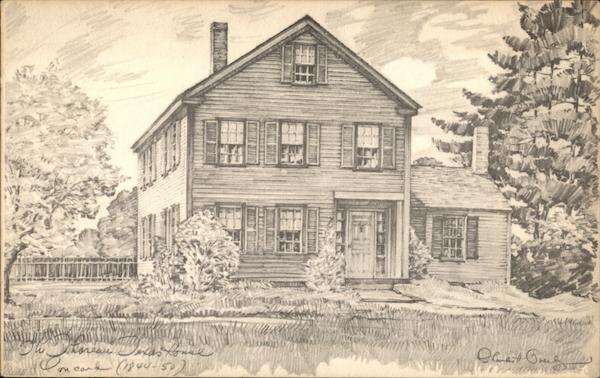
Gathered to-day my apples at the Texas house. I set out the trees, fourteen of them fourteen years ago and five of them several years later, and I now get between ten and eleven barrels of apples from them.

“Texas” House
(Thoreau Family Residence, 1844-1850)

H. D. Thoreau, Journal, October 3, 1860

See Vanessa Antiopa. See . April 17, 1860 (“It is unexpectedly very warm on lee side of hilltop just laid bare and covered with dry leaves and twigs. See my first Vanessa Antiopa”); October 1, 1860.(“C. saw the first Vanessa Antiopa since spring.”) See also A Book of the Seasons,  by Henry Thoreau, the Buff-edged Butterfly

The hard frost of September 28th, 29th, and 30th, and especially of October 1st. See October 1, 1860 ("Remarkable frost and ice this morning . . . I do not remember such cold at this season.").”); Compare October 3, 1856 (“The frost keeps off remarkably .” )

Sam Barrett says that last May he waded across the Assabet River on the old dam. See August 17, 1858 (“Being overtaken by a shower, we took refuge in the basement of Sam Barrett’s sawmill, where we spent an hour, and at length came home with a rainbow over arching the road before us”)

Bay-wings about. See April 15, 1859 (“The bay-wing now sings — the first I have been able to hear — . . . about the Texas house ”); October 9, 1858 (“Bay-wings flit along road.”); October 11, 1856 (“Bay-wing sparrows numerous.”); October 12, 1859 (“ I see scattered flocks of bay-wings amid the weeds and on the fences.”); October 16, 1855 ("I look at a grass-bird on a wall in the dry Great Fields. There is a dirty-white or cream-colored line above the eye and another from the angle of the mouth beneath it and a white ring close about the eye. The breast is streaked with this creamy white and dark brown in streams, as on the cover of a book.") See also A Book of the Seasons, by Henry Thoreau, the Bay-Wing Sparrow

I have seen and heard sparrows in flocks within a week. See September 17, 1858 (“Methinks, too, that there are more sparrows in flocks now about in garden”);  September 23, 1851 ("I scare up large flocks of sparrows in the garden.");September 26, 1858 (“Now is the time, too, when flocks of sparrows begin to scour over the weedy fields,”); September 27, 1858 ("What are those little birds in flocks in the garden and on the peach trees these mornings, about size of chip-birds, without distinct chestnut crowns?”); October 2, 1858 ("The garden is alive with migrating sparrows these mornings."); October 5, 1858 (“I still see large flocks, apparently of chip birds, on the weeds and ground in the yard.”); October 10, 1853 ("There are . . . large flocks of small sparrows,  which make a business of washing and pruning themselves in the puddles in the road, as if cleaning up after a long flight and the wind of yesterday.”)

October 3. See A Book of the Seasons, by Henry Thoreau,  October 3
See sparrows in flocks 
and have heard more flitting by 
since the frosts began.

A Book of the Seasons, by Henry Thoreau
"A book, each page written in its own season,
out-of-doors, in its own locality."
~edited, assembled and rewritten by zphx © 2009-2025
 

Friday, August 28, 2020

A cool, white, autumnal evening.


August 28. 

Sunday. P. M. – To Cliffs.

See many sparrows in flocks with a white feather in tail! 

The smooth sumach leaves are fast reddening. 

The berries of the dwarf sumach are not a brilliant crimson, but as yet, at least, a dull sort of dusty or mealy crimson. As they are later, so their leaves are more fresh and green than those of the smooth species. 

The acorns show now on the shrub oaks. 

A cool, white, autumnal evening.

H. D. Thoreau, Journal, August 28, 1853

See many sparrows in flocks with a white feather in tail! See August 19, 1852 ("The small fruits of most plants are now generally ripe or ripening, and this is coincident with the flying in flocks of such young birds now grown as feed on them."); September 3, 1857 ("A slate-colored snowbird back"); October 10, 1853 ("There are many small birds in flocks . . . and especially large flocks of small sparrows, which make a business of washing and pruning them selves in the puddles in the road, as if cleaning up after a long flight ");  October 12, 1859 ("I see scattered flocks of bay-wings amid the weeds and on the fences."); October 13, 1855 ("Larks in flocks in the meadows, showing the white in their tails as they fly, sing sweetly as in spring.")

The smooth sumach leaves are fast reddening. See August 27, 1852 ("Lower leaves of the smooth sumach are red."); August 31, 1858 ("The smooth sumach’s lower leaves are bright-scarlet on dry hills.")

The berries of the dwarf sumach are not a brilliant crimson. See August 25, 1851 ("Rhus copallina, mountain or dwarf sumach"); September 14, 1859 ("The mountain sumach . . . berries are a hoary crimson and not bright like those of the smooth."); October 2, 1856 ("The mountain sumach now a dark scarlet quite generally.")

The acorns show now on the shrub oaks. See September 13, 1859 ("I see some shrub oak acorns turned dark on the bushes and showing their meridian lines, but generally acorns of all kinds are green yet.") and note to October 21, 1859 ("A great many shrub oak acorns hold on, and are a darker brown than ever. ")

A cool, white, autumnal evening. See August 19, 1853 ("We have a cool, white, autumnal twilight, and as we pass the Hubbard Bridge, see the first stars."); September 11, 1854 ("This is a cold evening with a white twilight, and threatens frost, the first - in these respects- decidedly autumnal evening. It makes us think of wood for the winter."); September 29, 1854 ("This evening is quite cool and breezy, with a prolonged white twilight, quite Septemberish.")

Wednesday, October 23, 2019

It is the season of fuzzy seeds. On mountain path greeted by a wild violet.

October 23. 

Sunday. P. M. — Down railroad to chestnut wood on Pine Hill. 

October 23, 2022
A pleasant day, but breezy. 

I see a downy woodpecker tapping an apple tree, and hear, when I have passed, his sharp, metallic note.

 I notice these flowers still along the railroad causeway: 

  • fresh sprouts from the root of the Solidago nemoralis in bloom,
  • one or two fall dandelions,
  • red clover and white,
  • yarrow, 
  • Trifolium arvense (perhaps not fresh),
  • one small blue snapdragon,
  • fresh tansy in bloom on the sunny sand bank. 

There are green leaves on the ends of elder twigs; blackberry vines still red; apple trees yellow and brown and partly bare; white ash bare (nearly); golden willows yellow and brown; white birches, exposed, are nearly bare; some pines still parti-colored. 

White, black, and red oaks still hold most of their leaves. What a peculiar red has the white! And some black have now a rich brown. 

The Populus grandidentata near railroad, bare; the P. tremuloides, half bare.

The hickories are finely crisped, yellow, more or less browned. 

Several yellow butterflies in the meadow. 

And many birds flit before me along the railroad, with faint notes, too large for linarias. Can they be tree sparrows ? Some weeks. [Probably the white-in-tail [i. e. vesper sparrow, or grass finch].] 

Many phenomena remind me that now is to some extent a second spring, — not only the new-springing and blossoming of flowers, but the peeping of the hylodes for some time, and the faint warbling of their spring notes by many birds. 

Everywhere in the fields I see the white, hoary (ashy-colored) sceptres of the gray goldenrod. Others are slightly yellowish still. The yellow is gone out of them, as the last flake of sunshine disappears from a field when the clouds are gathering. But though their golden hue is gone, their reign is not over. Compact puffed masses of seeds ready to take wing. They will send out their ventures from hour to hour the winter through. 

October 23, 2016

The Viola pedata looking up from so low in the wood-path makes a singular impression. 

I go through Brooks's Hollow. 

The hazels bare, only here and there a few sere, curled leaves on them. 

The red cherry is bare. 

The blue flag seed-vessels at Walden are bursting, — six closely packed brown rows. 

I find my clothes all bristling as with a chevaux-de-frise of beggar-ticks, which hold on for many days. A storm of arrows these weeds have showered on me, as I went through their moats. How irksome the task to rid one's self of them! We are fain to let some adhere. Through thick and thin I wear some; hold on many days. In an instant a thousand seeds of the bidens fastened themselves firmly to my clothes, and  I carried them for miles, planting one here and another there. They are as thick on my clothes as the teeth of a comb. 

The prinos is bare, leaving red berries. 

The pond has gone down suddenly and surprisingly since I was here last, and this pool is left, cut off at a higher level, stagnant and drying up. This is its first decided going down since its going up a year or two ago. 

The red-looking water purslane is left bare, and the water-target leaves are turned brown and drying up on the bare mud. 

The clethra partly bare, crisped, yellowish and brown, with its fruit with persistent styles (?) in long racemes. 

Here are dense fields of light-colored rattlesnake grass drooping with the weight of their seeds. 

The high blueberries about the pond have still a few leaves left on, turned bright scarlet red. These it is adorn the shore so, seen at a distance, small but very bright. 

The panicled andromeda is thinly clad with yellow and brown leaves, not sere. 

Alders are green. 

Smooth sumach bare. 

Chestnuts commonly bare. 

I now notice the round red buds of the high blueberry. 

The blue-stemmed, and also the white, solidago on Walden bank. 

Small sassafras trees bare. 

The Aster undulatus is still quite abundant and fresh on this high, sunny bank, — far more so than the Solidago coesia, — and methinks it is the latest of our asters and is besides the most common or conspicuous flower now. It is in large, dense masses, two or three feet high, pale purple or whitish, and covered with humble- bees. The radical leaves, now hearted and crenatish, are lake beneath. 

Also a hieracium quite freshly bloomed, but with white, bristly leaves and smooth stem, about twenty-flowered; peduncles and involucres glandular-hairy. Is it Gronovii or veiny-leaved? Almost as slender as the panicled. (In press.) 

No gerardias. 

Strawberries are red and green. 

It is the season of fuzzy seeds, — goldenrods, everlasting, senecio, asters, epilobium, etc., etc. 

Viburnum Lentago, with ripe berries and dull-glossy red leaves; young black cherry, fresh green or yellow; mayweed. 

The chestnuts have mostly fallen. 

One Diplopappus linariifolius in bloom, its leaves all yellow or red. 

This and A. undulatus the asters seen to-day. 

The red oak now red, perhaps inclining to scarlet; the white, with that peculiar ingrained redness; the shrub oak, a clear thick leather-color; some dry black oak, darker brown; chestnut, light brown; hickory, yellow, turning brown. These the colors of some leaves I brought home.

H. D. Thoreau, Journal, October 23, 1853

I see a downy woodpecker tapping an apple tree, and hear, when I have passed, his sharp, metallic note.  See October 23, 1855 ("A downy woodpecker on an apple tree utters a sharp, shrill, rapid tea te t, t, t, t t t t t. "); December 5, 1853 ("See and hear a downy woodpecker on an apple tree. Have not many winter birds, like this and the chickadee, a sharp note like tinkling glass or icicles?") See also A Book of the Seasons, by Henry Thoreau, The Downy Woodpecker

The peeping of the hylodes for some time.  See   October 2, 1859 ("Hear a hylodes in the swamp."); October 3, 1852 (" I hear a hylodes (?) from time to time."); October 3, 1858 ("Hear a hylodes peeping on shore. ');  See also A Book of the Seasons,  by Henry Thoreau, Late Season Frogs and Toads

The Viola pedata looking up from so low in the wood-path makes a singular impression. See October 22, 1859 (" In the wood-path below the Cliffs I see perfectly fresh and fair Viola pedata flowers, as in the spring . . . No flower by its second blooming more perfectly brings back the spring to us"); See also May 21, 1852 ("Viola pedata along the woodland paths in high land.") and Basho:

On mountain path
greeted by
a wild violet.

The Populus grandidentata near railroad, bare; the P. tremuloides, half bare. See October 21, 1858 ("The Populus grandidentata is quite yellow and leafy yet. "); October 25, 1858 ("Aspens (tremuliformis) generally bare. ")

Is it Gronovii or veiny-leaved? See note to July 17, 1853 ("I think we have no Hieracium Gronoviis")

October 23.  See A Book of the Seasons,  by Henry Thoreau,  October 23

Low in the wood-path 
The Viola pedata 
makes an impression.

Flowers blossoming,
hylodes peeping, birds singing
like a second spring.

A Book of the Seasons,  by Henry Thoreau, greeted by a wild violet.
A Book of the Seasons,  by Henry Thoreau
 "A book, each page written in its own season,
out-of-doors, in its own locality."
 ~edited, assembled and rewritten by zphx © 2026 

tinyurl.com/HDT531023

Wednesday, September 25, 2019

Holding a white pine needle in my hand.


September 25. 

September 25, 2019


P. M. — To Emerson's Cliff. 

Holding a white pine needle in my hand, and turning it in a favorable light, as I sit upon this cliff, I perceive that each of its three edges is notched or serrated with minute forward-pointing bristles. 

So much does Nature avoid an unbroken line that even this slender leaf is serrated; though, to my surprise, neither Gray nor Bigelow mention it. Loudon, however, says, "Scabrous and inconspicuously serrated on the margin; spreading in summer, but in winter contracted, and lying close to the branches." 

Fine and smooth as it looks, it is serrated after all. This is its concealed wildness, by which it connects itself with the wilder oaks. 

Prinos berries are fairly ripe for a few days. 

Moles work in meadows.  

I see at Brister Spring Swamp the (apparently) Aspidium Noveboracense, more than half of it turned white. Also some dicksonia is about equally white. These especially are the white ones. There is another, largish, and more generally decayed than either of these, with large serrated segments, rather far apart, — perhaps the Asplenium Filix-foemina (?). The first may be called now the white fern, — with rather small entirish and flat segments close together. 

In shade is the laboratory of white. Color is produced in the sun. 

The cinnamon ferns are all a decaying brown there. The sober brown colors of those ferns are in harmony with the twilight of the swamp. 

The terminal shield fern and the Aspidium spinulosum (?) are still fresh and green, the first as much so as the polypody. 

At 2 p. m. the river is sixteen and three quarters inches above my hub[?] by boat. 

Nabalus albus still common, though much past prime. Though concealed amid trees, I find three humble-bees on one. As when Antaeus touched the earth, so when the mountaineer scents the fern, he bounds up like a chamois, or mountain goat, with renewed strength. There is no French perfumery about it. It has not been tampered with by any perfumer to their majesties. It is the fragrance of those plants whose impressions we see on our coal. Beware of the cultivation that eradicates it. 

The very crab-grass in our garden is for the most part a light straw-color and withered, probably by the frosts of the 15th and 16th, looking almost as white as the corn; and hundreds of sparrows (chip-birds ?) find their food amid it. The same frosts that kill and whiten the corn whiten many grasses thus.

H. D. Thoreau, Journal, September 25, 1859

I see at Brister Spring Swamp the (apparently) Aspidium Noveboracense, more than half of it turned white. Also some dicksonia...perhaps the Asplenium Filix-foemina. See July 17, 1857 ("Aspidium Noveboracense at Corner Spring, not yet brown; also Aspidium Filix-foemina (?), with lunar-shaped fruit, not yet brown; also apparently a chaffy-stemmed dicksonia, densely brown-fruited")

The sober brown colors of those ferns are in harmony with the twilight of the swamp. See note to September 24, 1859 ("The tufts of cinnamon fern, now a pale brown.") See also 
The terminal shield fern and the Aspidium spinulosum (?) are still fresh and green, the first as much so as the polypody. See September 30, 1859 ("The terminal shield fern is one of the handsomest. The most decidedly evergreen are the last, polypody, Aspidium marginale, and Aspidium spinulosum of Woodis Swamp and Brister's . . . Of the twenty-three ferns which I seem to know here, seven may be called evergreens."); October 23, 1857 ("The ferns which I can see on the bank, apparently all evergreens, are polypody at rock, marginal shield fern, terminal shield fern, and (I think it is) Aspidium spinulosum.. . .The above-named evergreen ferns are so much the more conspicuous on that pale-brown ground. They stand out all at once and are seen to be evergreen; their character appears.”); November 17, 1858 ("As for the evergreen ferns, I see now —
  • Common polypody (though shrivelled by cold where exposed).
  • Asplenium trichomanes.
  • A. ebeneum.
  • Aspidium spinulosum (?). large frond, small-fruited, in swamp southeast Brister’s Spring, on 16th.
  • A. cristatum (?), Grackle Swamp on the 15th, with oftener what I take to be the narrower and more open sterile frond.
  • A. marginale (common).
  • A. achrostichoides (terminal shield).
The first one and the last two are particularly handsome, the last especially, it has so thick a frond.") See also  A Book of the Seasons, by Henry Thoreau, The Evergreen Ferns, Part Three: Polypody, Marginal Shield Fern, Terminal Shield Fern andA Book of the Seasons, by Henry Thoreau, The Evergreen Ferns, Part Two: Aspidium spinulosum & Aspidium cristatum

 I sit on this cliff
 turning a white pine needle 
 in a favorable light.

Wednesday, March 20, 2019

the brightest object in the landscape these days.

March 20.  

7 a. m. — River no higher than three days ago, notwithstanding the rain of two days ago, the wind being southwest and very strong. 

P. M. — I see under the east side of the house amid the evergreens, where they were sheltered from the cold northwest wind, quite a parcel of sparrows, chiefly F. hyemalis, two or three tree sparrows, and one song sparrow, quietly feeding together. I watch them through a window within six or eight feet. They evidently love to be sheltered from the wind, and at least are not averse to each other's society. 

The tree sparrows sing a little. One perches on a bush to sing, while others are feeding on the ground, but he is very restless on his perch, hopping about and stooping as if dodging those that fly over. He must perch on some bit of stubble or twig to sing. They are evidently picking up the seeds of weeds which lie on the surface of the ground invisible to our eyes. They suffer their wings to hang rather loose. 

The F. hyemalis is the largest of the three. They have remarkably distinct light-colored bills, and when they stretch, show very distinct clear-white lateral tail-feathers. This stretching seems to be contagious among them, like yawning with us. They have considerable brown on the quill-feathers. 

The tree sparrows are much brighter brown and white than the song sparrow. 

The latter alone scratches once or twice, and is more inclined to hop or creep close to the ground, under the fallen weeds. Perhaps it deserves most to be called the ground-bird. 

P. M. — Up Assabet. 

Very strong northwest wind. 

When I get opposite the end of the willow-row, the sun comes out and they are very handsome, like a rosette, pale-tawny or fawn-colored at base and a rich yellow or orange yellow in the upper three or four feet. 

This is, methinks, the brightest object in the landscape these days. Nothing so betrays the spring sun. I am aware that the sun has come out of a cloud first by seeing it lighting up the osiers. Such a willow-row, cut off within a year or two, might be called a heliometer, or measure of the sun's brightness. 

The last year's shoots of many trees — as maples, both white and red — retain a permanent bright color, red or scarlet, all winter and spring, till new ones  grow. The top of the forest is thus very agreeably tinged. 

The river is so high that I leave it at Pinxter Swamp, and come into it again only at the swift narrow place above, near the road.

H. D. Thoreau, Journal, March 20, 1859

The F. hyemalis have remarkably distinct light-colored bills, and when they stretch, show very distinct clear-white lateral tail-feathers.. . . They have considerable brown on the quill-feathers 
See March 20, 1852 ("And now, within a day or two, I have noticed the chubby slate-colored snowbird (Fringilla hyemalis?), and I drive the flocks before me on the railroad causeway as I walk. It has two white feathers in its tail")'; March 20, 1855 ("At my landing I hear the F. hyemalis, in company with a few tree sparrows. They take refuge from the cold wind, half a dozen in all, behind an arbor-vitae hedge, and there plume themselves with puffed-up feathers."); March 20, 1858 ("The note of the F. hyemalis, or chill-lill, is a jingle, with also a shorter and drier crackling or shuffling chip as it flits by."); March 28, 1853 ("The woods ring with the cheerful jingle of the F. hyemalis. This is a very trig and compact little bird, and appears to be in good condition. The straight edge of slate on their breasts contrasts remarkably with the white from beneath ; the short, light-colored bill is also very conspicuous amid the dark slate ; and when they fly from you, the two white feathers in their tails are very distinct at a good distance. They are very lively, pursuing each other from bush to bush."). See also A Book of the Seasons, by Henry Thoreau, the Dark-eyed Junco.

The tree sparrows sing a little. See March 20, 1855 ("At my landing I hear the F. hyemalis, in company with a few tree sparrows. They take refuge from the cold wind, half a dozen in all, behind an arbor-vitae hedge, and there plume themselves with puffed-up feathers.");March 20, 1858 ("The tree sparrow is perhaps the sweetest and most melodious warbler at present and for some days."). See also A Book of the Seasons, by Henry Thoreau, The Tree Sparrow.

Tuesday, October 2, 2018

A dark and windy night .


October 2. 

A dark and windy night the last. It is a new value when darkness amounts to something positive. Each morning now, after rain and wind, is fresher and cooler, and leaves still green reflect a brighter sheen. 

Minott told me yesterday that he had never seen the seashore but once, and that was Noddle’s Island in the War of 1812. 

The garden is alive with migrating sparrows these mornings. The cat comes in from an early walk amid the weeds. She is full of sparrows and wants no more breakfast this morning, unless it be a saucer of milk, the dear creature. I saw her studying ornithology between the corn-rows.

As I approached Perch Pool the other day, half a dozen frogs leaped into it and buried themselves in the mass of callitriche at the bottom. I stood looking for perch a minute or two, when one after another up came the frogs from out the callitriche, just as a piece of cork would rise by mere buoyancy to the surface; and then, by a distinct effort, they let go all, drop anchor, elevate or let float up their heels, and lie spread out on the surface. They were probably Rana fontinalis.  

Sailed to Baker Farm with a strong northwest wind.

Got a peck of the small long-bunched grapes now turned purple under Lee’s Cliff. One or two vines bear very plentifully. The bunches are about six inches long by one and a half, and quite dense and cylindrical commonly. They are now apparently just in their prime, to judge from color. Considerably later than the Vitis Labrusca, but are not good. [Mother [made] a nice jelly of them afterward.] 

A large chocolate-colored puffball “smokes. ”

H. D. Thoreau, Journal, October 2, 1858

Each morning now, after rain and wind, is fresher and cooler, and leaves still green reflect a brighter sheen. See September 20, 1853 (It rained very hard while we were aboard the steamer."); September 20, 1854 ("Windy rain-storm last night"); September 20, 1856 ("Rain in afternoon. Rain again in the night, hard."); ; September 20, 1857 ("This is our first fall rain, and makes a dividing line between the summer and fall."); September 20, 1860 ("Rainy in forenoon.")


Minott told me yesterday that he had never seen the seashore but once in the War of 1812. . See March 23, 1854("Minott confesses to me to-day that he has not been to Boston since the last war, or 1815. Aunt said that he had not been ten miles from home since”)  January 8, 1857 ("Minott says he has lived where he now does as much as sixty years. He has not been up in town for three years, on account of his rheumatism ");  and note to October 4, 1851 ("Minott is, perhaps, the most poetical farmer — who most realizes to me the poetry of the farmer's life — that I know . . . He loves to walk in a swamp in windy weather and hear the wind groan through the pines.");

The garden is alive with migrating sparrows these mornings. See October 4, 1859 (“Birds are now seen more numerously than before, as if called out by the fine weather, probably many migrating birds from the north.”); October 8, 1855 ("Flocks of tree sparrows by river, slightly warbling. Hear a song sparrow sing. See apparently white-throated sparrows . . .”); October 8, 1856 (“The trees and weeds by the Turnpike are all alive this pleasant afternoon with twittering sparrows .”)

Popular Posts Last 30 Days.

The week ahead in Henry’s journal

The week ahead in Henry’s journal
A journal, a book that shall contain a record of all your joy.
"A stone fruit. Each one yields me a thought." ~ H. D. Thoreau, March 28, 1859


I sit on this rock
wrestling with the melody
that possesses me.