Showing posts with label bufflehead. Show all posts

Tuesday, December 14, 2021

A time to walk by the open river full of reflections in an icy frame.


December 14 

 P. M. -- With C. up north bank of Assabet to bridge.

Good sleighing still, with but little snow.

A warm, thawing day.

December 14, 2024

The river is open almost its whole length. It is a beautifully smooth mirror within an icy frame.

It is well to improve such a time to walk by it.

This strip of water of irregular width over the channel, between broad fields of ice, looks like a polished silver mirror, or like another surface of polished ice, and often is distinguished from the surrounding ice only by its reflections.

I have rarely seen any reflections --  of weeds, willows, and elms, and the houses of the village -- so distinct, the stems so black and distinct; for they contrast not with a green meadow but clear white ice, to say nothing of the silvery surface of the water.  Your eye slides first over a plane surface of smooth ice of one color to a water surface of silvery smoothness, like a gem set in ice, and reflecting the weeds and trees and houses and clouds with singular beauty.

The reflections are particularly simple and distinct. These twigs are not referred to and confounded with a broad green meadow from which they spring, as in summer, but, instead of that dark-green ground, absorbing the light, is this abrupt white field of ice.

We see so little open and smooth water at this season that I am inclined to improve such an opportunity to walk along the river, and moreover the meadows, being more or less frozen, make it more feasible than in summer.

I am singularly interested by the sight of the shrubs which grow along rivers, rising now above the snow, with buds and catkins,-- the willows, alders, sweetgale, etc.

At our old bathing-place on the Assabet, saw two ducks, which at length took to wing. They had large dark heads, dark wings, and clear white breasts. I think they were buffle-headed or spirit ducks. 

H. D. Thoreau, Journal, December 14, 1854

Large dark heads, dark wings, and clear white breasts. I think they were buffle-headed or spirit ducks. See January 7, 1853 ("He shows me the spirit duck of the Indians, of which Peabody says the Indians call it by a word meaning spirit, "because of the wonderful quickness with which it disappears at the twang of a bow.""); April 19, 1855 ('A little duck, asleep with its head in its back, exactly in the middle of the pond. It has a moderate-sized black head and neck, a white breast, and seems dark-brown above, with a white spot on the side of the head. . .and another, perhaps, on the end of the wing, with some black there.. . .I think it is the smallest duck I ever saw. Floating buoyantly asleep on the middle of Walden Pond. Is it not a female of the buffle-headed or spirit duck?"); April 22, 1861 (" [Mann] obtained to-day the buffle-headed duck, diving in the river near the Nine-Acre Corner bridge. I identify it at sight as my bird seen on Walden. ") See also J J Audubon (The bufflehead, being known in different districts by the names of Spirit Duck, Butter-box, Marrionette, Dipper, and Die-dipper,") Compare December 26, 1853 ("Saw in [Walden] a small diver, probably a grebe or dobchick, dipper, or what-not, ... It had a black head, a white ring about its neck, a white breast, black back, and apparently no tail.”); September 27, 1860 ("[The little dipper] has a dark bill and considerable white on the sides of the head or neck, with black between it, no tufts, and no observable white on back or tail.") See also A Book of the Seasons, by Henry Thoreau, The Little Dipper

I am singularly interested by the sight of the shrubs which grow along rivers, rising now above the snow. See December 14, 1850 ("I find a low, branching shrub frozen into the edge of the ice, with a fine spicy scent . . . When I rub the dry-looking fruit in my hands, it feels greasy and stains them a permanent yellow, which I cannot wash out. It lasts several days, and my fingers smell medicinal. I conclude that it is sweetgale, and we name the island Myrica Island.") See also  November 29, 1857 ("Going through a partly frozen meadow . . . scraping through the sweet-gale, I am pleasantly scented with its odoriferous fruit.");  December 5, 1858 ("On the causeway the yellowish bark of the willows gleams warmly through the ice."); December 19, 1850 ("On those unfrequented islands, too, I noticed the red osier or willow, that common hard-berried plant with small red buds . . . I find the sweet-gale (Myrica) by the river also."); December 19, 1850 ("The catkins of the alders are as tender and fresh-looking as ripe mulberries."); December 31, 1859 ("Sweet-gale grows along the wet edge of banks and the river and in open swamps."); January 10, 1858 ("If you are sick and despairing, go forth in winter and see the red alder catkins dangling at the extremities of the twigs, all in the wintry air.");  January 10, 1859 ("The alder is one of the prettiest of trees and shrubs in the. winter, it is evidently so full of life, with its conspicuous pretty red catkins dangling from it on all sides") 

I think they were buffle-headed or spirit ducks.  See December 26, 1853 ("Walden still open. Saw in it a small diver, probably a grebe or dobchick, dipper, or what-not . . . It had a black head, a white ring about its neck, a white breast, black back, and apparently no tail. It dove and swam a few rods under water, and, when on the surface, kept turning round and round warily and nodding its head the while. This being the only pond hereabouts that is open.") See also A Book of the Seasons, by Henry Thoreau, The Little Dipper


December 14. See A Book of the Seasons,  by Henry Thoreau  December 14

The open river –
 mirror in an icy frame
full of reflections.


A Book of the Seasons
,  by Henry Thoreau 
"A book, each page written in its own season,
out-of-doors, in its own locality.”
~edited, assembled and rewritten by zphx © 2009-2025

https://tinyurl.com/hdt-541214


Thursday, April 22, 2021

In the river near the Nine-Acre Corner bridge.


April 22

It was high water again about a week ago, Mann thinks within three or four inches as high as at end of winter.

He obtained to-day the buffle-headed duck, diving in the river near the Nine-Acre Corner bridge. I identify it at sight as my bird seen on Walden. 

I hear a chip-bird.

H. D. Thoreau, Journal, April 22, 1861

My bird seen on Walden. See December 26, 1853 ("Saw in [Walden] a small diver, probably a grebe or dobchick, dipper, or what-not, ... It had a black head, a white ring about its neck, a white breast, black back, and apparently no tail.”); April 19, 1855 ("A little duck, asleep with its head in its back, exactly in the middle of the pond. It has a moderate-sized black head and neck, a white breast, and seems dark-brown above, with a white spot on the side of the head, not reaching to the out side, from base of mandibles, and another, perhaps, on the end of the wing, with some black there. . . .I think it is the smallest duck I ever saw.); and note to September 27, 1860 ("Looking up, I see a little dipper . . in the middle of the river. . .. I sit down and watch it . . . soon the dipper is thus tolled along to within twenty feet of where I sit, and I can watch it at my leisure. It has a dark bill and considerable white on the sides of the head or neck, with black between it, no tufts, and no observable white on back or tail.") See also A Book of the Seasons, by Henry Thoreau, The Little Dipper

I hear a chip-bird. See April 9, 1853("The chipping sparrow, with its ashy-white breast and white streak over eye and undivided chestnut crown, holds up its head and pours forth its che che che che che che. " ); April 17, 1860 ("It perches on a cherry tree, perchance, near the house, and unseen, by its steady che-che-che-che-che che, affecting us often without our distinctly hearing it, it blends all the other and previous sounds of the season together. It invites us to walk in the yard and inspect the springing plants."") See also A Book of the Seasons, by Henry Thoreau The Chipping Sparrow (Fringilla socialis).)

Sunday, April 19, 2015

A little duck in the middle of the Pond.

April 19

5 A. M. — Up Assabet. 

Warm and still and somewhat cloudy. Am without greatcoat. 

The guns are firing and bells ringing. 

I hear a faint honk and, looking up, see going over the river, within fifty rods, thirty-two geese in the form of a hay-hook, only two in the hook, and they are at least six feet apart. Probably the whole line is twelve rods long. 

At least three hundred have passed over Concord, or rather within the breadth of a mile, this spring (perhaps twice as many); for I have seen or heard of a dozen flocks, and the two I counted had about thirty each. 

Many tortoises have their heads out. The river has fallen a little. Going up the Assabet, two or three tortoises roll down the steep bank with a rustle. One tumbles on its edge and rolls swiftly like a disk cast by a boy, with its back to me, from eight or ten feet into the water. 

I hear no concert of tree sparrows. Hear the tull-lull of the white-throated sparrow in street, and the jingle of the chip-bird. 

This forenoon, sit with open window. Now plowing and planting will begin generally. 

P. M. — To Walden.

Some golden willows will now just peel fairly, though on this one the buds have not started.  (Another sudden change in the wind to northeast and a freshness with some mist from the sea at 3.30 P. M.) These osiers to my eye have only a little more liquid green than a month ago. 

A shad frog on the dry grass. The wild red cherry will begin to leaf to-morrow. 

From Heywood’s Peak I think I see the head of a loon in the pond, thirty-five or forty rods distant. Bringing my glass to bear, it seems sunk very low in the water, — all the neck concealed, — but I can not tell which end was the bill. 

At length I discover that it is the whole body of a little duck, asleep with its head in its back, exactly in the middle of the pond. 

It has a moderate-sized black head and neck, a white breast, and seems dark-brown above, with a white spot on the side of the head, not reaching to the out side, from base of mandibles, and another, perhaps, on the end of the wing, with some black there. 

It sits drifting round a little, but with ever its breast toward the wind, and from time to time it raises its head and looks round to see if it is safe. 

I think it is the smallest duck I ever saw. Floating buoyantly asleep on the middle of Walden Pond. 

Is it not a female of the buffle-headed or spirit duck?


I believed the wings looked blacker when it flew, with some white beneath. It floated like a little casket, and at first I doubted a good while if it possessed life, until I saw it raise its head and look around. It chose a place for its nap exactly equidistant between the two shores there, and, with its breast to the wind, swung round only as much as a vessel held by its anchors in the stream. At length the cars scared it. 

Goodwin caught twenty-five pouts and one shiner at the Walden meadow, but no perch. 

Slippery elm in tumbler to-day; probably to-morrow at Cliffs.

A partridge drums.

H. D. Thoreau, Journal, April 19, 1855

The guns are firing and bells ringing. See April 19, 1852 ("The guns were fired and the bells rung to commemorate the anniversary of the birth of a nation's liberty. ")

At least three hundred have passed over Concord this spring. See April 19, 1852 ("How many there must be, that one or more flocks are seen to go over almost every farm in New England in the spring.”) See also April 8, 1855 (“This evening, about 9 P.M., I hear geese go over, now there in the south, now southeast, now east, now northeast, low over the village, but not seen. The first I have heard.”); April 9, 1855 ("Several flocks of geese went over this morning also. Now, then, the main body are moving. Now first are they generally seen and heard.”); April 17, 1855 ("Geese go over at noon, when warm and sunny. “); Also see A Book of the Seasons, by Henry Thoreau: Signs of Spring, Geese Overhead

A little duck, asleep with its head in its back, exactly in the middle of the pond.  See March 21, 1854 ("Look with glass and find more than thirty black ducks asleep with their heads in their backs, motionless, and thin ice formed about them."); March 31, 1858 ("I see about a dozen black ducks on Flint's Pond, asleep with their heads in their backs and drifting across the pond before the wind.")

Buffle headed or spirit duck. See January 7, 1853 ("He shows me the spirit duck of the Indians, of which Peabody says the Indians call it by a word meaning spirit, "because of the wonderful quickness with which it disappears at the twang of a bow." "); April 22, 1861 (" [Mann]obtained to-day the buffle-headed duck, diving in the river near the Nine-Acre Corner bridge. I identify it at sight as my bird seen on Walden. ") See also J J Audubon (The bufflehead, being known in different districts by the names of Spirit Duck, Butter-box, Marrionette, Dipper, and Die-dipper,") Compare December 14, 1854 ("At our old bathing-place on the Assabet, saw two ducks, which at length took to wing. They had large dark heads, dark wings, and clear white breasts. I think they were buffle-headed or spirit ducks. ") December 26, 1853 ("Saw in [Walden] a small diver, probably a grebe or dobchick, dipper, or what-not, ... It had a black head, a white ring about its neck, a white breast, black back, and apparently no tail.”); September 27, 1860 ("[The little dipper] has a dark bill and considerable white on the sides of the head or neck, with black between it, no tufts, and no observable white on back or tail.") See alsoA Book of the Seasons, by Henry Thoreau, The Little Dipper

Some golden willows will now just peel fairly. See April 19, 1853 ("Willow and bass strip freely."); see also April 9, 1855 ("The golden willow is, methinks, a little livelier green and begins to peel a little"); April 18, 1860 ("The Salix discolor peels well; also the aspen (early) has begun to peel.")

These osiers to my eye have only a little more liquid green than a month ago.  See February 24, 1855 ("You will often fancy that they look brighter before the spring has come, and when there has been no change in them"); March 24, 1855 (" I am not sure that the osiers are decidedly brighter yet"); See also A Book of the Seasons, by Henry Thoreau, the Osier in Winter and early Spring

Another sudden change in the wind to northeast and a freshness with some mist from the sea at 3.30 P. M. See April 18, 1855 ("I see suddenly all the southern horizon . . full of a mist, like a dust, already concealing the Lincoln hills and producing distinct wreaths of vapor, the rest of the horizon being clear. Evidently a sea-turn, — a wind from over the sea, condensing the moisture in our warm atmosphere and putting another aspect on the face of things."); April 29, 1856 (" about 3 P. M. I felt a fresh easterly wind, and saw quite a mist in the distance produced by it, a sea-turn. . . .. Your first warning of it may be the seeing a thick mist on all the hills and in the horizon. "); April 30, 1856 ("at one o’clock there was the usual fresh easterly wind and sea-turn . . .and a fresh cool wind from the sea produces a mist in the air.")

A partridge drums. See April 19, 1860 ('"You will hear at first a single beat or two far apart and have time to say, "There is a partridge," so distinct and deliberate is it often, before it becomes a rapid roll."); See also April 25, 1854 ("The first partridge drums in one or two places, as if the earth's pulse now beat audibly with the increased flow of life.”). and A Book of the Seasons, by Henry Thoreau  The Partridge.

April 19, 2015

Little duck asleep
in the middle of the pond –
its head in its back 


A Book of the Seasons,  by Henry Thoreau 
"A book, each page written in its own season,
out-of-doors, in its own locality.”
~edited, assembled and rewritten by zphx © 2009-2025

https://tinyurl.com/hdt-550419

Monday, September 27, 2010

A little dipper in middle of the river.

September 27

Looking up, I see a little dipper in the middle of the river, evidently attracted by tame ducks, as to a place of security.

I sit down and watch.

The tame ducks have paddled four or five rods down-stream along the shore. The dipper approaches them by diving, and, in fear, they all rush to the shore and come out. The dipper shows itself close to the shore, and, when they enter the water again, joins them within two feet, still diving from time to time and threatening to come up in their midst.

They return up-stream, more or less alarmed, pursued in this wise by the dipper, who does not know what to make of their fears. Soon the dipper is thus within twenty feet of where I sit, and I can watch it at my leisure.

It has a dark bill and considerable white on the sides of the head or neck, with black between it, no tufts, and no observable white on back or tail. 


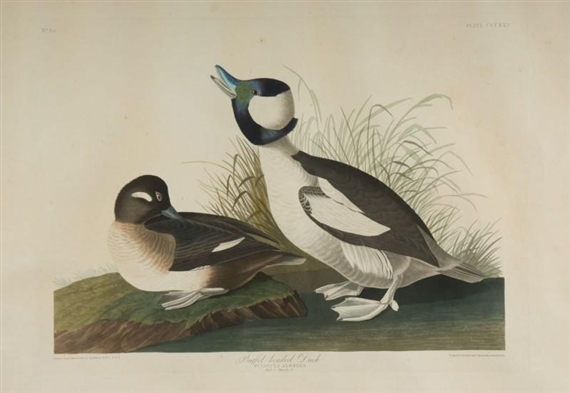
J J Audubon Fuligula albeola Buffle-headed Duck

When at last disturbed by me, it suddenly sinks all its body low in the water without diving.  Thus it can float at various heights.

H. D. Thoreau, Journal, September 27, 1860


A little dipper in the middle of the river.  See September 8, 1859 ("See the black head and neck of a little dipper in mid stream, a few rods before my boat. It disappears, and though I search carefully, I cannot detect it again."); September 9, 1858 ("At length the walker who sits meditating on a distant bank sees the little dipper sail out from amid the weeds and busily dive for its food along their edge: Yet ordinary eyes might range up and down the river all day and never detect its small black head above the water.");  September 30, 1858 ("I see undoubtedly the little dipper by the edge of the pads this afternoon . . . It is much smaller than I have seen this season, and is hard to detect even within four or five rods. It warily dives and comes up a rod or two further off amid the pads, scarcely disturbing the surface"); October 17, 1855  ("I see behind (or rather in front of) me as I row home a little dipper appear in mid-river, as if I had passed right over him. It dives while I look, and I do not see it come up anywhere."); November 21, 1858 ("See from Clamshell apparently two little dippers, one up-stream, the other down, swimming and diving in the perfectly smooth river this still, overcast day."); December 14, 1854 ("
 Two ducks, which at length took to wing. They had large dark heads, dark wings, and clear white breasts. I think they were buffle-headed or spirit ducks."); December 26, 1853 ("Saw in [Walden] a small diver, probably a grebe or dobchick, dipper, or what-not . . . It had a black head, a white ring about its neck, a white breast, black back, and apparently no tail.”); See also J J Audubon ("The bufflehead, being known in different districts by the names of Spirit Duck, Butter-box, Marrionette, Dipper, and Die-dipper, generally returns from the far north, where it is said to breed, about the beginning of September.") and A Book of the Seasons,  by Henry Thoreau, The Little Dipper

September 27. See A Book of the Seasons, by Henry Thoreau, September 27

A little dipper
in middle of the river –
I sit down and watch.

A Book of the Seasons, by Henry Thoreau
"A book, each page written in its own season,
out-of-doors, in its own locality.”
~edited, assembled and rewritten by zphx © 2009-2024

https://tinyurl.com/hdt-600927

Popular Posts Last 30 Days.

The week ahead in Henry’s journal

The week ahead in Henry’s journal
A journal, a book that shall contain a record of all your joy.
"A stone fruit. Each one yields me a thought." ~ H. D. Thoreau, March 28, 1859


I sit on this rock
wrestling with the melody
that possesses me.