Showing posts with label Osmunda. Show all posts

Wednesday, June 21, 2023

The summer culminates.

June 21. 

It is so hot I 
have to lift my hat to let 
the air cool my head.  

the summer culminates
June 21, 2023


4.30 A.M.––Up river for lilies

No dew even where I keep my boat. The driest night yet, threatening the sultriest day. Yet I see big crystalline drops at the tips or the bases of the pontederia leaves. 

The few lilies begin to open about 5.

The nest of a brown thrasher with three eggs, on some green-briar, perfectly concealed by a grape vine running over it; eggs greenish brown; nest of dry sticks, lined with fibres of grape bark and with roots. Bird  scolded me much.

Carpet weed out. 

I have got a pan full of lilies open.

We have not had rain, except a mere sprinkling in the night of the 17th, since the 26th of May. 

P.M. To Conantum. 

The warmest day yet. For the last two days I have worn nothing about my neck. This change or putting off of clothing is, methinks, as good an evidence of the increasing warmth of the weather as meteorological instruments. 

I thought it was hot weather perchance when a month ago, I slept with a window wide open and laid aside a comfortable, but by and by I found that I had got two windows open, and to-night two windows and the door are far from enough. 

Hypericum perforatum just out.

This year the time when the locust was first heard was the time to put on summer clothes.

Early on the morning of the 18th the river felt lukewarm to my fingers when my paddle dipped deeper than usual. 

The galium with three small white petals (G. trifidum) has been out some time, and I find that erectish, broad-leaved, three-nerved, green-flowered one, perhaps G. circazans at Corner Spring.  

Peltandra Virginica, perhaps a week, for many of its flowers are effete and curved downward .

The Hypericum ellipticum by the riverside.

The only violets I notice nowadays are a few white lanceolate ones in the meadows.

The river has got down quite low, and the muddy shores are covered here and there with a sort of dark brown paper, the dried filaments of confervæ which filled the water. Now is their fall.

The bright little flowers of the Ranunculus reptans var filiformis are seen peeping forth between its interstices. 

Calopogon out. I think it surpasses the pogonia, though the latter is sometimes high colored and is of a handsome form;  but it is inclined to be pale ,is sometimes even white. 

Now see many bright red amelanchier berries and some purple or dark-blue ones amid them. They are mostly injured by insects or apparently pecked and deformed by birds, but, from the few perfectly sound and ripe I have eaten to-day, I should pronounce them superior to either blueberries or huckleberries. Those of the Botryapium have a soft skin; of the shorter bush with a stiffer leaf, a tough skin.  This is a little before blueberries.  

The panicled cornel is the only one of the cornels or viburnums that now is noticed in flower , generally speaking.  The last of our cornels – the C. sericea I think it must be – is just beginning.

The farmers have commenced haying. With this the summer culminates. The most extended crop of all is ready for the harvesting.

Lint still comes off the leaves and shoots.

It is so hot I have to lift my hat to let the air cool my head. 

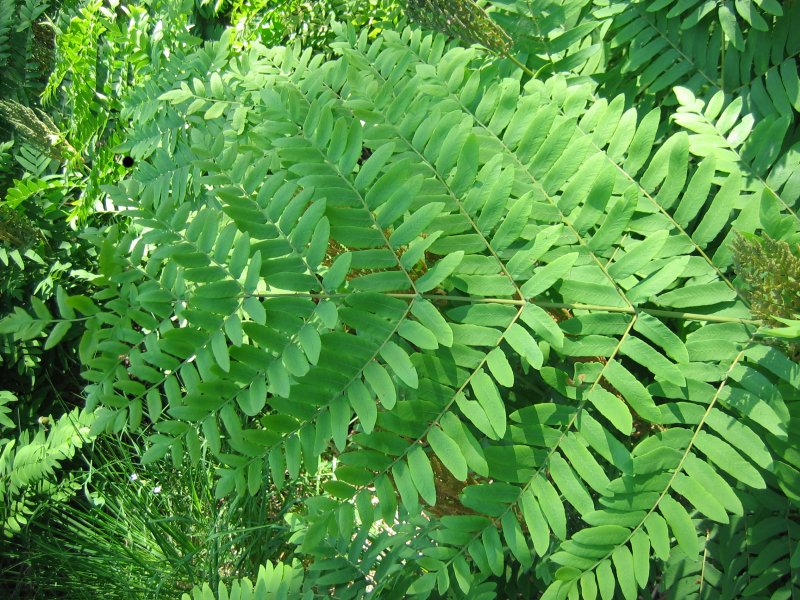
I notice that that low, rather rigid fern, about two feet high, on the Great Hubbard Meadow, which a month ago was yellow, but now is green and in fruit, and with a harsh-feeling fruit atop, is decidedly inclined to grow in hollow circles from one foot to six or eight feet in diameter.– often, it is true, imperfect on one side, or, if large, filled up in the middle. How to account for it? Can it have anything to do with the hummocks deposited on the meadow? Many small stems near together in circles i. e. not a single line. Is it the Osmunda spectabilis?

Now I hear the spotted (?) flies about my head,–- flies that settle and make themselves felt on the hand sometimes. 

The morning-glory still fresh at 3 P.M.  A fine, large, delicate bell with waved border, some pure white ,some reddened. The buds open perfectly in a vase I find them open when I wake at 4 A .M. Is not this one of the eras or culminating places in the flower season? Not this till the sultry mornings come.

Angelica,  perhaps a day or more. Elder just opening. 

The four leaved asclepias, probably some days, rather handsome flower, with the peculiar fragrance of the milkweeds. 

Observed three or four sweet-briar bushes with white flowers of the usual size, by the wall under Conantum Cliff,– very slightly tinted with red or rose. In the paucity and form of prickles at least I make them answer to the micrantha, but not else  Is it intermediate? Opened at home in a vase in the shade. They are more distinctly rose-tinted. Leaves and all together in the water, they have a strong spirituous or rummy scent. 

There are no flowers nor flower-buds on the bass this year, though it was so full last year.

Where the other day I saw a pigeon woodpecker tapping and enlarging a hole in the dead limb of an apple tree ,when as yet probably no egg was laid, to-day I see two well grown young woodpeckers about as big as the old looking out at the hole, showing their handsome spotted breasts and calling lustily for something to eat, or, it may be, suffering from the heat. Young birds in some situations must suffer greatly from heat these days, so closely packed in their nests and perhaps insufficiently shaded. It is a wonder they remain so long there patiently.

I saw a yellowbird's nest in the willows on the causeway this afternoon and three young birds nearly ready to fly, overflowing the nest ,all holding up their open bills and keeping them steadily open for a minute or more, on noise of my approach. 

Still see cherry-birds in flocks.

Dogsbane and Prinos verticillatus. 

My white lilies in the pan are mostly withering the first day, the weather is so warm.

At sunset to Island. 

The white anemone is withering with drought; else would probably have opened.  

Return while the sun is setting behind thunder clouds, which now shadow us.  Between the heavy masses of clouds, mouse colored, with dark blue bases, the patches of clear sky are a glorious cobalt blue, as Sophia calls it.  

How happens it that the sky never appears so intensely, brightly, memorably blue as when seen between clouds and, it may be, as now in the south at sunset?  This, too, is like the blue in snow. 

For the last two or three days it has taken me all the forenoon to wake up. 

H. D. Thoreau,  Journal, June 21, 1853

4.30 A.M.––Up river for lilies . . .The few lilies begin to open about 5. See July 26, 1856 ("At five [A.M.] the lilies had not opened, but began about 5.15 and were abundantly out at six") and note to July 17, 1854 ("I go to observe the lilies. ")

The summer culminates.  See A Book of the Seasons, by Henry Thoreau, Haymaking

Calopogon . . . surpasses the pogonia, See.June 23, 1853 ("Pogonias are now very abundant in the meadow-grass, and now and then a calopogon is mixed with them .The last is broader and of more singular form,  commonly with an unopened bud above on one side."); June 24, 1852 (""The calopogon is a more bluish purple than the pogonia.); July 5, 1852 (The calopogon, or grass-pink, now fully open, . . — its four or five open purple flowers — . . . makes a much greater show than the pogonia. It is of the same character with that and the arethusa. "); July 7, 1852 ("The Arethusa bulbosa, " crystalline purple;" Pogonia ophioglossoides, snake-mouthed arethusa, "pale purple;" and the Calopogon pulchellus, grass pink, "pink purple," make one family in my mind, — next to the purple orchis, or with it, — being flowers par excellence, all flower, all color, with inconspicuous leaves, naked flowers,")

Now see many bright red amelanchier berries and some purple or dark-blue ones amid them.  See June 25, 1853 (" An unusual quantity of amelanchier berries . . . I never saw nearly so many before. It is a very agreeable surprise") See also A Book of the Seasons, by Henry Thoreau, Shad-bush,Juneberry, or Service-berry (Amelanchier canadensis)

How happens it that the sky never appears so intensely, brightly, memorably blue as when seen between clouds and, it may be, as now in the south at sunset? See December 14. 1851 ("There is a beautifully pure greenish-blue sky under the clouds now in the southwest just before sunset."); January 11, 1852 ("The glory of these afternoons, . . . is in the ineffably clear blue, or else pale greenish-yellow, patches of sky in the west just before sunset "); January 17, 1852 ("Those western vistas through clouds to the sky show the clearest heavens, clearer and more elysian than if the whole sky is comparatively free from clouds.") See also A Book of the Seasons, by Henry Thoreau, the Western Sky

Monday, August 24, 2020

Goldenrods and asters.


August 24.

Another cool, autumn-like morning, also quite foggy.

Rains a little in the forenoon and cloudy the rest of the day.

P. M. – To Saw Mill Brook via Trillium Woods.

A cool breeze blows this cloudy afternoon, and I wear a thicker coat.

The mulgedium by railroad is seven feet high, with great panicles of a regular, somewhat elliptic-lanceolate (?) form, two and a half feet long by ten inches.

The Prinos lævigatus berries begin to redden.

The farmers are beginning to clear out their ditches now.

Blue-stemmed goldenrod, apparently a few days in some places.

The goldenrods which I have observed in bloom this year are (I do not remember the order exactly):

  • (1) stricta,
  • (2) lanceolata,
  • (3) arguta (?),
  • (4) nemoralis,
  • (5) bicolar,
  • (6) odora,
  • (7) altissima,
  • (8) ulmifolia (?),
  • (9) cæsia.
The 4th is the prevailing one and much the most abundant now.

The 1st perhaps next, though it may be getting old.

The altissima (7th) certainly next. It is just beginning to be abundant. Its tops a foot or more broad, with numerous recurved racemes on every side, with yellow and yellowing triangular points. It is the most conspicuous of all.

The bicolor (5th) next, though not conspicuous.

The 3d, 8th, 2d, and 6th perhaps never abundant.

The cæsia (9th) just begun. 


The asters and diplopappi are about in this order:

  • (1) Radula,
  • (2) D. cornifolius (?),
  • (3) A. corymbosus,
  • (4) patens,
  • (5) lævis,
  • (6) dumosus (?),
  • (7) miser,
  • (8) macrophyllus,
  • (9) D. umbellatus,
  • (10) A. acuminatus,
  • (11) puniceus.
The patens (4), of various forms, some lilac, is the prevailing blue or bluish one now, middle sized and very abundant on dry hillsides and by wood paths; the lævis next.

The 1st, or Radula, is not abundant.

(These three are all the distinctly blue ones yet.) 


The dumosus is the prevailing white one, very abundant; miser mixed with it.

D. umbellatus is conspicuous enough in some places (low grounds), and A. puniceus beginning to be so.

But D. cornifolius, A. corymbosus, macrophyllus, and acuminatus are confined to particular localities.

Dumosus and patens (and perhaps lævis, not common enough) are the prevailing asters now. 


The common large osmunda (?) is already consider ably imbrowned, but the odorous dicksonia (?), which, like most ferns, blossoms later, is quite fresh.

This thin, flat, beautiful fern it is which I see green under the snow.? I am inclined to call it the lace fern.

(Peaches fairly begun.) 

It is a triangular web of fine lace-work surpassing all the works of art.

Solidago latifolia not yet.

I see roundish silvery slate-colored spots, surrounded by a light ring, near the base of the leaves of an aster (miser ?), one beneath another like the dropping of a bird, or as if some tincture had fallen from above.

Some of the leaves of the A. patens are red.

The alternate cornel berries, which are particularly apt to drop off early, are a dark, dull blue, not china-like.

I see those of maple-leaved viburnum merely yellowish now.

There grows by Saw Mill Brook a long firmer, thimble-shaped high blackberry with small grains, with more green ones still on it, which I think like the New Hampshire kind.

I see some black and some greenish light slate-colored fungi. This certainly is the season for fungi.

I see on the shrub oaks now caterpillars an inch and a half or more long, black with yellowish stripes, lying along the petioles, — thick living petioles. They have stripped off the leaves, leaving the acorns bare.

The Ambrina (Chenopodium, Bigelow) Botrys, Jerusalem-oak, a worm-seed, by R. W. E.' s heater piece. The whole plant is densely branched — branches spike-like-and appears full of seed. Has a pleasant, more distinct wormwood-like odor.

In a dry sprout-land (Ministerial Lot), what I will call Solidago puberula  will open in a day or two, — upright and similar to stricta in leaves, with a purple stem and smooth leaves, entire above, and a regular oblong appressed panicle.

Bidens chrysanthemoides, of a small size and earlier, by Turn pike, now in prime there.

I see cattle coming down from up-country. Why?

Yellow Bethlehem-star still.

A. miser (?), with purplish disk and elliptic-lanceolate leaves, serrate in middle, may be as early as dumosuus.


H. D. Thoreau, Journal, August 24, 1853


The goldenrods which I have observed in bloom this year
.(1) stricta,(2) lanceolata,(3) arguta (?),(4) nemoralis etc. . . .The asters are about in this order:(1) Radula,(2) D. cornifolius (?), (3) A. corymbosus, etc.. Compare August 24, 1851 ("The autumnal flowers, — goldenrods, asters, and johnswort, — though they have made demonstrations, have not yet commenced to reign."):  August 21, 1856 ("The prevailing solidagos now are, lst, stricta. . .; 2d, the three-ribbed, of apparently several varieties, which I have called arguta or gigantea (apparently truly the last); 3d, altissima, though commonly only a part of its panicles; 4th, nemoralis, just beginning generally to bloom. . . .The commonest asters now are, 1st, the Radula; 2d, dumosus; 3d, patens etc. ); August 30, 1859 ("The prevailing flowers, considering both conspicuous-ness and numbers, at present time, as I think now: Solidagos, especially large three-ribbed, nemoralis, tall rough, etc.; Asters, especially Tradescanti, puniceus, corymbosus, dumosus, Diplopappus umbellatus")

This certainly is the season for fungi
.See September 10, 1854 ("Last year, for the last three weeks of August, the woods were filled with the strong musty scent of decaying fungi, but this year I have seen very few fungi and have not noticed that odor at all.") See also A Book of the Seasons, by Henry Thoreau, The Season for Fungi


The farmers are beginning to clear out their ditches now. See August 21, 1859 ("Many are ditching."); August 28, 1854 ("The farmers improve this dry spell to cut ditches and dig mud in the meadows and pond-holes. I see their black heaps in many places. ")

D. umbellatus is conspicuous enough in some places (low grounds), and A. puniceus beginning to be so. See August 24, 1859 ("Aster puniceus and Diplopappus umbellatus, how long? ")

A long firmer, thimble-shaped high blackberry with small grains. See August 24, 1859 ("The small sempervirens blackberry in prime in one place. ")  See also A Book of the Seasons,  by Henry Thoreau, Blackberries

I see cattle coming down from up-country. Why? See September 6, 1859 ("Hear the sounds nowadays — the lowing, tramp, and calls of the drivers — of cows coming down from up-country."); September 20, 1852 ("Droves of cattle have for some time been coming down from up-country"); October 28, 1858 ("Cattle coming down from up country.") See also note to April 30, 1860 ("Cattle begin to go up-country.")

Monday, September 30, 2019

The evergreen ferns by contrast are greener than ever

September 30
Deer Leap September 30, 2019

P. M. — Up Assabet.

Ever since the unusually early and severe frost of the 16th, the evergreen ferns have been growing more and more distinct amid the fading and decaying and withering ones, and the sight of those suggests a cooler season. They are greener than ever, by contrast. 

The terminal shield fern is one of the handsomest. The most decidedly evergreen are the last, polypody, Aspidium marginale, and Aspidium spinulosum of Woodis Swamp and Brister's. 

Asplenium Filix foemina (?) is decaying, maybe a little later than the dicksonia, — the largish fern with long, narrow pinnules deeply cut and toothed, and reniform fruit-dots. 

Of the twenty-three ferns which I seem to know here, seven may be called evergreens. 

As far as I know, the earliest to wither and fall are 
  • the brake (mostly fallen), 
  • the Osmunda cinnamomea (begun to be stripped of leaves), 
  • 0. Claytoniana, 
  • and 0. regalis (the above four generally a long time withered, or say since the 20th); 
  • also (5th), as soon, the exposed onoclea; 
  • then (6th) the dicksonia, 
  • (7th) Aspidium Noveboracense, 
  • (8th) Thelypteris, 
  • (9th) Filix-foemina (the last four now fully half faded or decayed or withered). 
Those not seen are Adiantum pedatum, Woodwardia Virginica, Asplenium thelypteroides, Woodsia Ilvensis, Aspidium cristatum, Lygodium palmatum, Botrychium Virginicum. 

Some acorns (swamp white oak) are browned on the trees, and some bass berries. Most shrub oak acorns browned. 

The wild rice is almost entirely fallen or eaten, apparently by some insect, but I see some green and also black grains left.

H. D. Thoreau, Journal, September 30, 1859

The evergreen ferns have been growing more and more distinct amid the fading and decaying and withering ones. The terminal shield fern is one of the handsomest. See September 25, 1859 ("The terminal shield fern and the Aspidium spinulosum (?) are still fresh and green, the first as much so as the polypody."); October 23, 1857 ("The ferns which I can see on the bank, apparently all evergreens, are polypody at rock, marginal shield fern, terminal shield fern, and (I think it is) Aspidium spinulosum, which I had not identified. . . .The above-named evergreen ferns are so much the more conspicuous on that pale-brown ground. They stand out all at once and are seen to be evergreen; their character appears.”); October 28, 1858 ("I now begin to notice the evergreen ferns, when the others are all withered or fallen."); October 29, 1858 (“Evergreen ferns, suddenly emerge as from obscurity . . . how much they require this brown and withered carpet to be spread under them for effect. Now, too, the light is let in to show them.”); October 31, 1857 (“I see two kinds of ferns still green and much in fruit, apparently the Aspidium spinulosum (?) and cristatum (?) . . . In the summer you might not have noticed them. Now they are conspicuous amid the withered leaves.”); November 5, 1857 ("The terminal shield fern is the handsomest and glossiest green.")

Of the twenty-three ferns which I seem to know here, seven may be called evergreens. See November 17, 1858 ("As for the evergreen ferns, I see now —
  • Common polypody (though shrivelled by cold where exposed).
  • Asplenium trichomanes.
  • A. ebeneum.
  • Aspidium spinulosum (?). large frond, small-fruited, in swamp southeast Brister’s Spring, on 16th.
  • A. cristatum (?), Grackle Swamp on the 15th, with oftener what I take to be the narrower and more open sterile frond.
  • A. marginale (common).
  • A. achrostichoides (terminal shield).
The first one and the last two are particularly handsome, the last especially, it has so thick a frond.") See also A Book of the Seasons, by Henry Thoreau, The Evergreen Ferns, Part One: Maidenhair and Ebony Spleenwort; A Book of the Seasons,  by Henry Thoreau, The Evergreen Ferns, Part Two: Aspidium spinulosum  & Aspidium cristatum;  A Book of the Seasons, by Henry Thoreau, The Evergreen Ferns, Part Three: Polypody, Marginal Shield Fern, Terminal Shield Fern

The wild rice is almost entirely fallen or eaten, but I see some green and also black grains left. See September 15, 1859 ("The grain of the wild rice is all green yet."); September 24, 1852 ("The zizania ripe, shining black, cylindrical kernels, five eighths of an inch long.")

Some acorns (swamp white oak) are browned on the trees, and some bass berries. Most shrub oak acorns browned.  See September 30, 1854 ("Acorns are generally now turned brown and fallen or falling; the ground is strewn with them and in paths they are crushed by feet and wheels. The white oak ones are dark and the most glossy.") See also September 13, 1859 ("I see some shrub oak acorns turned dark on the bushes and showing their meridian lines, but generally acorns of all kinds are green yet. "); September 21, 1859 ("Acorns have been falling very sparingly ever since September 1, but are mostly wormy. They are as interesting now on the shrub oak (green) as ever."); September 26, 1854 ("Many swamp white oak acorns have turned brown on the trees."); September 28, 1858 ("The small shrub oak . . . with its pretty acorns striped dark and light alternately."); September 29, 1854 ("Bass berries dry and brown"); October 1, 1859 ("The shrub oaks on this hill are now at their height, both with respect to their tints and their fruit. The . . . pretty fruit, varying in size, pointedness, and downiness, being now generally turned brown, with light, converging meridional lines . . . Now is the time for shrub oak acorns.")

Evergreen ferns by 
contrast greener than ever
since the severe frost.

Friday, October 12, 2018

Nature is confident.

October 12. 


October 12, 2018

P. M. — Up Assabet. 

Most exposed button-bushes and black willows are two thirds bare, and the leaves which remain on the former are for the most part brown and shrivelled. The balls stand out bare, ruddy or brown. The coarse grass of the riverside (Phalaris ?) is bleached as white as corn. 

The Cornus sericea begins to fall, though some of it is green; and the C. florida at Island shows some scarlet tints, but it is not much exposed. I believe that this was quite showy at Perth Amboy. 

There are many maple, birch, etc., leaves on the Assabet, in stiller places along the shore, but not yet a leaf harvest. Many swamp white oaks look crisp and brown. 

I land at Pinxter Swamp. The leaves of the azaleas are falling, mostly fallen, and revealing the large blossom-buds, so prepared are they for another year. 

With man all is uncertainty. He does not confidently look forward to another spring. But examine the root of the  savory-leaved aster, and you will find the new shoots, fair purple shoots, which are to curve upward and bear the next year’s flowers, already grown half an inch or more in earth. Nature is confident. 

The river is lower than before this year, or at least since spring, yet not remarkably low, and meadows and pools generally are drier. 

The oak leaves generally are duller than usual this year. I think it must be that they are killed by frost before they are ripe. 

Some small sugar maples are still as fair as ever. You will often see one, large or small, a brilliant and almost uniform scarlet, while another close to it will be perfectly green. 

The Osmunda regalis and some of the small or middle-sized ferns, not evergreens, in and about the swamps, are generally brown and withered, though with green ones intermixed. They are still, however, interesting, with their pale brown or cinnamon-color and decaying scent. 

Hickories are for the most part being rapidly browned and crisp. 

Of the oaks, the white is apparently the most generally red at present. I see a scarlet oak still quite green.

Brakes are fallen in the pastures. They lie flat, still attached to the ground by their stems, and in sandy places they blow about these and describe distinct and perfect circles there. The now fallen dark-brown brake lies on or across the old brake, which fell last year and is quite gray but remarkably conspicuous still. They have fallen in their ranks, as they stood, and lie as it were with a winding-sheet about them. 

Young sweet-fern, where it had been burned in the spring, is quite green. 

Exposed clethra is crisp and brown. 

Some bass trees are quite bare, others but partly. 

The hop hornbeam is in color and falling like the elm. 

Acorns, red and white (especially the first), appear to be fallen or falling. They are so fair and plump and glossy that I love to handle them, and am loath to throw away what I have in my hand. 

I land at Pinxter Swamp. The leaves of the azaleas are falling, mostly fallen, and revealing the large blossom-buds, so prepared are they for another year. 

With man all is uncertainty. He does not confidently look forward to another spring. But examine the root of the savory-leaved aster, and you will find the new shoots, fair purple shoots, which are to curve upward and bear the next year's flowers, already grown half an inch or more in earth. Nature is confident. 

I see a squirrel-nest of leaves, made now before the leaves are fallen. 

I have heard of judges, accidentally met at an evening party, discussing the efficacy of the laws and courts, and deciding that, with the aid of the jury system, “substantial justice was done.” But taking those cases in which honest men refrain from going to law, together with those in which men, honest and dishonest, do go to law, I think that the law is really a “humbug,” and a benefit principally to the lawyers.

This town has made a law recently against cattle going at large, and assigned a penalty of five dollars. I am troubled by an Irish neighbor’s cow and horse, and have threatened to have them put in the pound. But a lawyer tells me that these town laws are hard to put through, there are so many quibbles. He never knew the complainant to get his case if the defendant were a-mind to contend. However, the cattle were kept out several days, till a Sunday came, and then they were all in my grounds again, as I heard, but all my neighbors tell me that I cannot have them impounded on that day. Indeed, I observe that very many of my neighbors do for this reason regularly turn their cattle loose on Sundays. 

The judges may discuss the question of the courts and law over their nuts and raisins, and mumble forth the decision that “substantial justice is done,” but I must believe they mean that they do really get paid a “substantial” salary.

H. D. Thoreau, Journal, October 12, 1858


The large blossom-buds, so prepared are they for another year. See January 10, 1856 ("the great yellow and red forward-looking buds of the azalea")

Examine the root of the savory-leaved aster, and you will find the new shoots, fair purple shoots, which are to curve upward and bear the next year's flowers, already grown half an inch or more in earth.  See October 10, 1858 ("Pulling up some Diplopappus linariifolius, now done, I find many bright-purple shoots, a half to three quarters of an inch long, freshly put forth underground and ready to turn upward and form new plants in the spring.") See also A Book of the Seasons, by Henry Thoreau, Savory-leaved aster

Some bass trees are quite bare. See October 4, 1858 ("The bass is in the prime of its change, a mass of yellow."); October 9, 1853 ("The birch is yellow; the black willow brown; the elms sere, brown, and thin; the bass bare.");    October 13, 1855 ("The maples now stand like smoke along the meadows. The bass is bare"); October 18, 1857 ("The bass and the black ash are completely bare; how long?"); October 19, 1856 ("The bass has lost, apparently, more than half its leaves.")October 22, 1854 ("Bass trees are bare.”) See also A Book of Seasons, by Henry Thoreau, The Basswood

The Osmunda regalis . . . in and about the swamps, are generally brown and withered.  See   October 11, 1857 ("The osmunda ferns are generally withered and brown except where very much protected from frost. ")


OCTOBER 12, 2018


Thursday, October 4, 2018

Witch-hazel in prime – Yellow leaves by their color conceal the flowers.

October 4

October 4, 2018
 

P. M.  Paddled up the Assabet. Strong north wind, bringing down leaves. 

Many white and red maple, bass, elm, and black willow leaves are strewn over the surface of the water, light, crisp colored skiffs. The bass is in the prime of its change, a mass of yellow. 

See B a-fishing notwithstanding the wind. A man runs down, fails, loses self-respect, and goes a-fishing, though he were never seen on the river before. Yet methinks his “misfortune” is good for him, and he is the more mellow and humane. Perhaps he begins to perceive more clearly that the object of life is something else than acquiring property, and he really stands in a truer relation to his fellow-men than when he commanded a false respect of them. There he stands at length, per chance better employed than ever, holding communion with nature and himself and coming to understand his real position and relation to men in this world. It is better than a poor debtors’ prison, better than most successful money-getting. 

I see some rich-weed in the shade of the Hemlocks, for some time a clear, almost ivory, white, and the boehmeria is also whitish. 

Rhus Toxicodendron in the shade is a pure yellow; in the sun, more scarlet or reddish. 

Grape leaves apparently as yellow as ever.

Witch-hazel apparently at height of change, yellow below, green above, the yellow leaves by their color concealing the flowers. The flowers, too, are apparently in prime. The leaves are often richly spotted reddish and greenish brown. 

The white maples that changed first are about bare. 

The brownish-yellow clethra leaves thickly paint the bank. 

Salix lucida leaves are one third clear yellow. 

The Osmunda regalis is yellowed and partly crisp and withered, but a little later than the cinnamon, etc. 

Scare up two ducks, which go off with a sharp creaking ar-r-week, ar-r-week, ar-r-week. Is not this the note of the wood duck? 

Hornets are still at work in their nests. 

Ascend the hill. 

The cranberry meadows are a dull red. 

See crickets eating the election-cake toadstools.

The Great Meadows, where not mown, have long been brown with wool-grass. 

The hickories on the northwest side of this hill are in the prime of their color, of a rich orange; some intimately mixed with green, handsomer than those that are wholly changed. The outmost parts and edges of the foliage are orange, the recesses green, as if the outmost parts, being turned toward the sunny fire, were first baked by it.


Going by Dr. Barrett’s, just at the edge of evening, I saw on the sidewalk something bright like fire, as if molten lead were scattered along, and then I wondered if a drunkard’s spittle were luminous, and proceeded to poke it on to a leaf with a stick. It was rotten wood. I found that it came from the bottom of some old fence-posts which had just been dug up near by and there glowed for a foot or two, being quite rotten and soft, and it suggested that a lamp-post might be more luminous at bottom than at top. 

I cut out a handful and carried it about. It was quite soft and spongy and a very pale brown — some almost white — in the light, quite soft and flaky; and as I withdrew it gradually from the light, it began to glow with a distinctly blue fire in its recesses, becoming more universal and whiter as the darkness increased. Carried toward a candle, it is quite a blue light. 

One man whom I met in the street was able to tell the time by his watch, holding it over what was in my hand. 

The posts were oak, probably white. 

Mr. Melvin, the mason, told me that he heard his dog barking the other night, and, going out, found that it was at the bottom of an old post he had dug up during the day, which was all aglow.


H. D. Thoreau, Journal, October 4, 1858

Rhus Toxicodendron in the shade is a pure yellow; in the sun, more scarlet or reddish.
See September 30, 1857 (“Rhus Toxicodendron turned yellow and red, handsomely dotted with brown.”); October 3, 1857 ("The Rhus radicans also turns yellow and red or scarlet, like the Toxicodendron."); October 11, 1857 ("I see some fine clear yellows from the Rhus Toxicodendron on the bank by the hemlocks and beyond.")

Witch-hazel apparently at height of change, yellow below, green above, the yellow leaves by their color concealing the flowers. The flowers, too, are apparently in prime.  See September 24, 1853 ("Witch-hazel well out."); September 27, 1857 ("Witch-hazel two thirds yellowed. "); September 29, 1853 ("The witch-hazel . . .has but begun to blossom . . . Its leaves are yellowed."); October 9, 1851 ("The sunlight from over the top of the hill lights up its top-most sprays and yellow blossoms. Its spray, so jointed and angular, is not to be mistaken for any other. I lie on my back with joy under its bough. While its leaves fall, its blossoms spring.") See also A Book of the Seasons,  by Henry Thoreau, The Witch-Hazel

Osmunda regalis is yellowed and partly crisp and withered, but a little later than the cinnamon. See  October 1, 1858 ("The cinnamon ferns are crisp and sour in open grounds"); October 11, 1857 ("The osmunda ferns are generally withered and brown except where very much protected from frost. The O. regalis is the least generally withered of them"); October 12, 1858 ("The Osmunda regalis . . . in and about the swamps, are generally brown and withered, though with green ones intermixed. They are still, however, interesting, with their pale brown or cinnamon-color and decaying scent.")

Hornets are still at work in their nests. See October 24, 1858 ("That large hornets’ nest which I saw on the 4th is now deserted, and I bring it home. But in the evening, warmed by my fire, two or three come forth and crawl over it, and I make haste to throw it out the window.")

See crickets eating the election-cake toadstools. See October 2, 1859 ("Nowadays I see most of the election-cake fungi, with crickets and slugs eating them. ") See note to October 20, 1856 (“I notice, as elsewhere of late, a great many brownish-yellow (and some pink) election-cake fungi, eaten by crickets; about three inches in diameter.") See also note  to September 21, 1859 ("And now at last I see a few toadstools, — the election-cake (the yellowish, glazed over.")

Holding communion with nature and himself and coming to understand his real position and relation to men in this world. See June 26, 1853 ("They might go there a thousand times, perchance, before the sediment of fishing would sink to the bottom and leave their purpose pure, — before they began to angle for the pond itself."); December 2, 1856 ("There they sit, ever and anon scanning their reels to see if any have fallen, and, if not catching many fish, still getting what they went for, though they may not be aware of it, i. e. a wilder experience than the town affords.") 

The hickories on the northwest side of this hill are in the prime of their color, of a rich orange; some intimately mixed with green, handsomer than those that are wholly changed. See October 8, 1856 ("The hickory leaves are among the handsomest now, varying from green through yellow, more or less broadly green-striped on the principal veins, to pure yellow, at first almost lemon-yellow, at last browner and crisped. This mingling of yellow and green on the same leaf, the green next the veins where the life is most persistent, is very pleasing."); October 15, 1858 ("Small hickories are the clearest and most delicate yellow in the shade of the woods. ");  October 22, 1858 ("The leaves of the hickory are a very rich yellow, though they may be quite withered and fallen, but they become brown.");  October 24, 1853 ("Some hickories bare, some with rich golden-brown leaves. "); October 24, 1858 ("Hickories are two thirds fallen, at least."); November 13, 1858 ("One hickory at least (on the hill) has not lost its leaves yet, i. e., has a good many left. So they are a month falling.") See also AA Book of the Seasons,, by Henry Thoreau. The Hickory

I saw on the sidewalk something bright like fire.  See October 5, 1858 ("My phosphorescent wood of last night still glows somewhat, but I improve it much by putting it in water. The little chips which remain in the water or sink to the bottom are like so many stars in the sky."); October 6, 1858 ("My phosphorescent wood still glows a little, though it has lain on my stove all day, and, being wet, it is much improved still.") See also July 24, 1857 and The Maine Woods ("Getting up some time after midnight to collect the scattered brands together, while my companions were sound asleep, I observed, partly in the fire, which had ceased to blaze, a perfectly regular elliptical ring of light . . . phosphorescent wood, which I had so often heard of, but never chanced to see . . . I did not regret my not having seen this before, since I now saw it under circumstances so favorable. I was in just the frame of mind to see something wonderful, and this was a phenomenon adequate to my circumstances and expectation, and it put me on the alert to see more like it.")

October 4. See A Book of the Seasons,, by Henry Thoreau, October 4

Witch-hazel in prime –
Yellow leaves by their color
conceal the flowers.
A Book of the Seasons,  by Henry Thoreau
"A book, each page written in its own season,
out-of-doors, in its own locality.”
~edited, assembled and rewritten by zphx © 2009-2024

https://tinyurl.com/hdt-581004 


Friday, June 15, 2018

The Osmunda regalis, growing in very handsome hollow circles.

June 15. 
June 15, 2018

Rains steadily again, and we have had no clear weather since the 11th. 

The river is remarkably high, far higher than before, this year, and is rising. I can paddle into and all about the willowy meadow southwest of Island. I had, indeed, anticipated this on account of the remarkable lowness of the river in the spring. 

That coarse grass in the Island meadow which grows in full circles, as on the Great Meadows, is wool-grass, though but little blooms. Some is now fairly in bloom and it has the dark bracts of what I observed on the Great Meadows. The peculiarly circular form of the patches, sometimes their projecting edges being the arcs of circles, is very obvious now that the lower and different grass around is under water. Many plants have a similar habit of growth. 

The Osmunda regalis, growing in very handsome hollow circles, or sometimes only crescents or arcs of circles, is now generally a peculiarly tender green, — its delicate fronds, – but some has begun to go to seed and look brown. Hollow circles, one or two feet to a rod in diameter. 

These two are more obvious when, as now, all the rest of the meadow is covered with water. 

That large grass, five feet high, of the river brink is now just begun. Can it be blue-joint, or Calamagrostis Canadensis? [Probably phalaris.]

H. D. Thoreau, Journal, June 15, 1858

That coarse grass in the Island meadow which grows in full circles, as on the Great Meadows, is wool-grass, sometimes their projecting edges being the arcs of circles.  June 27, 1857 ("southwest of Egg Rock, the coarse sedge [wool-grass] — I think the same with that in the Great Meadows — evidently grows in patches with a rounded outline; i.e., its edge is a succession of blunt, rounded capes, with a very distinct outline amid the other kinds of grass and weeds.")

The Osmunda regalis, growing in very handsome hollow circles, or sometimes only crescents or arcs of circles, is now generally a peculiarly tender green. See July 5, 1860 ("I notice of late the Osmunda regalis fully grown, fresh and handsome.")

Wednesday, October 11, 2017

Harvest Days--the seventh day of glorious weather.


October 11.

Sunday. P. M. — Up Assabet.

River lower than before since winter at least; very low.

Another frost last night, although with fog, and this afternoon the maple and other leaves strew the water, and it is almost a leaf harvest.

I see some fine clear yellows from the Rhus Toxicodendron on the bank by the hemlocks and beyond.

The osmunda ferns are generally withered and brown except where very much protected from frost. The O. regalis is the least generally withered of them.

The onoclea is much later and still generally green along the bank, or faded white here and there.

Looking at the reflection of the bank by the Hemlocks, the reflected sun dazzles me, and I approach nearer to the bank in order to shut it out (of course it disappears sooner in the reflection than the substance, because every head is raised above the level of the water), and I see in the reflection the fine, slender grasses on the sharp or well-defined edge of the bank all glowing with silvery light, a singularly silvery light to be seen in the water, and whose substance I can not see to advantage with my head thus high, since the sun is in the way.

This is the seventh day of glorious weather. Perhaps, these might be called Harvest Days. Within the week most of the apples have been gathered; potatoes are being dug; corn is still left in the fields, though the stalks are being carried in.

Others are ditching and getting out mud and cutting up bushes along fences, – what is called “brushing up,” — burning brush, etc.

These are cricket days.

The river is so low that I run against several rocks, which I must have floated over three or four days ago, and I see many snags and water-logged trunks on the bottom or partly exposed, which were then invisible.

It is remarkable how many trees — maple and swamp white [oak], etc. — which stand on the bank of the river, being undermined by the water or broken off by the ice or other cause, fall into the stream and finally sink to the bottom and are half buried there for many years. A great deal of wood, especially of the kinds named, is thus lost. They last longer there probably than in favorable localities out of water. I see still the timber foundation of an old dam just above Spencer Brook, extending across the river on the bottom, though there has been nothing above water within my recollection. The large black oaks in front of Prescott Barrett's are one by one falling into the river, and there are none to succeed them. They were probably left to skirt the stream when the other wood was cut, and now, when they are undermined, there are none behind to supply their places.

Mr. Conant of Acton tells me that there was a grist mill built over the river there by Sam Barrett's grandfather, and that he remembers going to it when he was fourteen. He went in at the Lee house and crossed the river by a bridge at the mill. He says that it is as much as sixty years since the mill was standing. Minott thinks it is not quite so long since. He remembers the bridge there, not a town one, nor strong enough for a horse and cart. Thinks the mill was discontinued because Dr. Lee complained of its flowing his wood land. They used to stop with their carts this side and carry their bags back and forth over the bridge on their shoulders. Used a small and poor road across to Lee's farm.

H. D. Thoreau, Journal,  October 11, 1857

River lower than before since winter at least. See October 15, 1856 ("River lower than for some months")

Another frost last night, although with fog, and this afternoon the maple and other leaves strew the water, and it is almost a leaf harvest.. See October 12, 1855 ("The leaves fallen last night now lie thick on the water next the shore, concealing it, —fleets of dry boats . . ."); October 12, 1858 ("There are many maple, birch, etc., leaves on the Assabet, in stiller places along the shore, but not yet a leaf harvest"); October 13, 1860 ("Now, as soon as the frost strips the maples, and their leaves strew the swamp floor and conceal the pools, the note of the chickadee sounds cheerfully winteryish.")

The seventh day of glorious weather. See October 10, 1857 ("The sixth day of glorious weather, which I am tempted to call the finest in the year , so bright and serene the air and such a sheen from the earth, so brilliant the foliage, so pleasantly warm . . . Certainly these are .the most brilliant days in the year, ushered in, perhaps, by a frosty morning, as this."); October 10, 1856 (“”These are the finest days in the year, Indian summer.")

Monday, July 17, 2017

Botanizing Lee's Cliff, Bittern Cliff and Corner Spring

July 17.

P. M. — To Lee's Cliff. 

The young leaves of the slippery elm are a yellowish green and large, and the branches recurved or drooping. 

Hypericum corymbosum. 

Am caught in the rain and take shelter under the thick white pine by Lee's Cliff. 

I see thereunder an abundance of chimaphila in bloom. It is a beautiful flower, with its naked umbel of crystalline purplish-white flowers, their disks at an angle with the horizon. On its lower side a ring of purple (or crimson) scales at the base of its concave petals, around the large, green, sticky ovary. 

The Sagina procumbens continues to flower sparingly. It agrees with Gray's plate. 

I found yesterday, at and above the Hemlocks on the Assabet, the dicksonia, apparently in prime; Aspidium Noveboracense  Aspidium marginale, apparently in prime; Osmunda Claytoniana and cinnamomea, done. 

I find to-day, at Bittern Cliff and at Lee's, Asplenium ebeneum (the larger), apparently nearly in prime, and A. Trichomanes, apparently just begun. This very commonly occurs in tufts at the base of the last, like radical leaves to it. 


Rock Polypody & Maidenhair spleenwort
(Polypodium vulgare & AspidiumTrichomanes,)
September, 2018

At Lee's Cliff, Polypodium vulgare, not yet brown fruit. 

Aspidium Noveboracense at Corner Spring, not yet brown; also Aspidium Filix-foemina (?), with lunar-shaped fruit, not yet brown; also apparently a chaffy-stemmed dicksonia, densely brown-fruited; also an almost thrice pinnate fern with a very chaffy stipe, in prime, already yellowish above, somewhat A. cristatum-like, some of the dots confluent. 

 
Ampelopsis out of bloom at Lee's. 

Aralia racemosa, not in bloom, at Corner Spring.

H. D. Thoreau, Journal, July 17, 1857


Hypericum corymbosum. See July 21, 1856 ("Hypericum corymbosum, a day or two."); July 26, 1856 ("Arranged the hypericums in bottles this morning and watched their opening.") See also A Book of the Seasons,  by Henry Thoreau, St. Johns-wort (Hypericum)

The Sagina procumbens . . .agrees with Gray's plate. See Asa Gray, The Genera of the Plants of the United States

I see thereunder [Lee's Cliff] an abundance of chimaphila in bloom..See July 3, 1852 ("The Chimaphila umbellata, wintergreen, must have been in blossom some time.”); July 8, 1857 ("Chimaphila umbellata, apparently a day or two. ");   July 12, 1857 ("The Chimaphila umbellata flower-buds make a very pretty umbel, of half a dozen small purple balls surmounted by a green calyx. They contrast prettily with the glossy green leaves."); July 24, 1856 ("Chimaphila maculata, three flowers, apparently but few days, while the umbellatais quite done there. Leaves just shooting up.” ) ; November 16, 1858 (“Methinks the wintergreen, pipsissewa, is our handsomest evergreen, so liquid glossy green and dispersed almost all over the woods.”)

Asplenium ebeneum (the larger), apparently nearly in prime, and A. Trichomanes, apparently just begun. See April 6, 1858 (“The asplenium ferns of both species are very generally perfectly withered and shrivelled.”); August 30, 1853 (“The dwarf spleenwort grows in the sharp angles of the rocks in the side of Lee's Cliff, its small fronds spreading in curved rays, its matted roots coming away in triangular masses, moulded by the rock. The ebony spleenwort stands upright against the rocks.”); October 28, 1857 (“Both aspleniums and the small botrychium are still fresh, as if they were evergreen. The latter sheds pollen. The former are most fresh under the shelter of rocks.”); November 18, 1858 ("I go along under the east side of Lee's Cliff, looking at the evergreen ferns . . .    How pretty the smallest asplenium sometimes, in a recess under a shelving rock, as it were pinned on rosettewise, as if it were the head of a breastpin.") See also September 30, 1859 ("Of the twenty-three ferns which I seem to know here, seven may be called evergreens."); November 17, 1858 ("As for the evergreen ferns, I see now —Common polypody (though shrivelled by cold where exposed). Asplenium trichomanes. A. ebeneum. Aspidium spinulosum (?) large frond, small-fruited, in swamp southeast Brister’s Spring, on 16th. A. cristatum (?), Grackle Swamp on the 15th, with oftener what I take to be the narrower and more open sterile frond. A. marginale (common). A. achrostichoides (terminal shield).") See also A Book of the Seasons, by Henry Thoreau, The Evergreen Ferns, Part One: Maidenhair and Ebony Spleenwort

Aralia racemosa, not in bloom . . .See September 4, 1856  ("Aralia racemosa berries just ripe . . . not edible. ")

Popular Posts Last 30 Days.

The week ahead in Henry’s journal

The week ahead in Henry’s journal
A journal, a book that shall contain a record of all your joy.
"A stone fruit. Each one yields me a thought." ~ H. D. Thoreau, March 28, 1859


I sit on this rock
wrestling with the melody
that possesses me.