Showing posts with label october 3. Show all posts

Sunday, October 3, 2021

A Book of the Seasons: October 3 (the pine fall, autumnal tints, fall flowers)


The year is but a succession of days,
and I see that I could assign some office to each day
which, summed up, would be the history of the year.
Henry Thoreau, August 24, 1852 


A wild sound heard far,
suited to the wildest lake  – 
laughing of a loon.

These lit glowing leaves
by the dry stony shore of
this cool and deep well.

On the southwest side
black birches clear pale yellow–
maples of all tints. 

 Along the river
the red maples which changed first
now partly fallen.  

Cooler, autumnal - 
you incline to sit in a 
sunny, sheltered place.

See sparrows in flocks 
and have heard more flitting by 
since the frosts began. 
October 3, 1860
,

October 3, 2020

The pine fall, i.e. change, is commenced, and the trees are mottled green and yellowish. October 3, 1852

The white pines are now getting to be pretty generally parti-colored, the lower yellowing needles ready to fall. October 3, 1856

White pines fairly begin to change. October 3, 1858

The Rhus radicans also turns yellow and red or scarlet, like the Toxicodendron. October 3, 1857

The sumachs are generally crimson (darker than scarlet), and young trees and bushes by the water and meadows are generally beginning to glow red and yellow. October 3, 1856

The red maples which changed first, along the river, are now faded and partly fallen. They look more pink. But others are lit, and so there is more color than before. Some particular maple among a hundred will be of a peculiarly bright and pure scarlet, and, by its difference of tint and intenser color, attract our eyes even at a distance in the midst of the crowd. October 3, 1858

The maples about Walden are quite handsome now . . . About the pond I see maples of all their tints, and black birches (on the southwest side) clear pale yellow; and on the peak young chestnut clumps and walnuts are considerably yellowed. October 3, 1858

Especially the hillsides about Walden begin to wear these autumnal tints in the cooler air. These lit leaves, this glowing, bright-tinted shrubbery, is in singular harmony with the dry, stony shore of this cool and deep well. October 3, 1856

Looking all around Fair Haven Pond yesterday, where the maples were glowing amid the evergreens, my eyes invariably rested on a particular small maple of the purest and intensest scarlet. October 3, 1858

I see the ground strewn with Populus grandidentata leaves in one place on the old Carlisle road, where one third are fallen. These yellow leaves are all thickly brown-spotted and are very handsome. . .— they cover the still green sward by the roadside and the gray road thick as a pavement, each one worthy to be admired as a gem or work of Oriental art. October 3, 1859

The hard frost of September 28th, 29th, and 30th, and especially of October 1st, has suddenly killed, crisped, and caused to fall a great many leaves of ash, hickory, etc., etc. October 3, 1860

A great many leaves have fallen and the trees begin to look thin. You incline to sit in a sunny and sheltered place. This season, the fall which the have now entered on, commenced, I may say, as long ago as when the first frost was seen and felt in low ground in August. From that time, even, the year has been gradually winding up its accounts. October 3, 1859

Have noticed a very brilliant scarlet blackberry patch within a week. October 3, 1858

Many acorns strew the ground, and have fallen into the water. October 3, 1852

See Vanessa Antiopa. October 3, 1860

Hear the loud laughing of a loon on Flint's, apparently alone in the middle. A wild sound, heard far and suited to the wildest lake. October 3, 1852

Bay-wings about. October 3, 1860

I see on a wall a myrtle-bird in its October dress, looking very much like a small sparrow. October 3, 1859

I have seen and heard sparrows in flocks, more as if flitting by, within a week, or since the frosts began. October 3, 1860

Asters, and still more goldenrods, look quite rare now. October 3, 1857

The Aster undulates is common and fresh, also the Solidago nemoralis of Gray. October 3, 1852

Viola lanceolata in Moore's Swamp. October 3, 1853

A fringed gentian, plucked day before yesterday, at length, this forenoon, untwists and turns its petals partially, in my chamber. October 3, 1858


*****
October 3, 2020

*****


*****

October 3, 2025

September 12, 1854 ("White oak acorns have many of them fallen. . . .. Some black scrub oak acorns have fallen, and a few black oak acorns also have fallen. The red oak began to fall first.")  
September 17, 1858 (“Methinks, too, that there are more sparrows in flocks now about in garden”)
September 19, 1852 ("The Viola lanceolata has blossomed again, and the lambkill.");
September 20, 1852 ("The Viola sagittata has blossomed again.")
September 20, 1852 ("Aster undulatus, or variable aster, with a large head of middle-sized blue flowers.");
September 23, 1851 ("I scare up large flocks of sparrows in the garden.");
September 23, 1854 ("Low blackberry vines generally red. ")
September 25, 1854 ("I am detained by the very bright red blackberry leaves strewn along the sod")
September 25, 1857 (“A single tree becomes the crowning beauty of some meadowy vale and attracts the attention of the traveller from afar.”);
September 26, 1854 ("Some single red maples are very splendid now, the whole tree bright-scarlet against the cold green pines; now, when very few trees are changed, a most remarkable object in the landscape; seen a mile off. ")
September 26, 1858 (“Now is the time, too, when flocks of sparrows begin to scour over the weedy fields,”)
September 27, 1855 ("Some single red maples now fairly make a show along the meadow. I see a blaze of red reflected from the troubled water.")
September 27, 1857 (“At last, its labors for the year being consummated and every leaf ripened to its full, it flashes out conspicuous to the eye of the most casual observer, with all the virtue and beauty of a maple, – Acer rubrum.”)
September 27, 1858 ("What are those little birds in flocks in the garden and on the peach trees these mornings, about size of chip-birds, without distinct chestnut crowns?”)
September 28, 1852 (" I find the hood-leaved violet quite abundant in a meadow, and the pedata in the Boulder Field. I have now seen all but the blanda, palmata, and pubescens blooming again .. . This is the commencement, then, of the second spring")
September 28, 1853 ("Viola cucullata")
September 30, 1857 (“Rhus Toxicodendron turned yellow and red, handsomely dotted with brown.”)
September 30, 1854 ("Acorns are generally now turned brown and fallen or falling; the ground is strewn with them and in paths they are crushed by feet and wheels.");
October 1, 1859 ("The shrub oaks on this hill are now at their height, both with respect to their tints and their fruit . . . Now is the time for shrub oak acorns if not for others.");
October 1, 1860.(“C. saw the first Vanessa Antiopa since spring.”)
October 1, 1860 ("Remarkable frost and ice this morning . . . I do not remember such cold at this season.")
October 1, 1858 ("Viola lanceolata again.")
October 1, 1858 ("The fringed gentians are now in prime . . .They who see them closed, or in the afternoon only, do not suspect their beauty.")
October 1, 1852 ("The young and tender trees begin to assume the autumnal tints more generally,"); October 1, 1854 ("The young black birches about Walden, next the south shore, are now commonly clear pale yellow, very distinct at distance, like bright-yellow white birches, so slender amid the dense growth of oaks and evergreens on the steep shores. ")
October 2, 1851 ("Some of the white pines on Fair Haven Hill have just reached the acme of their fall; others have almost entirely shed their leaves, and they are scattered over the ground and the walls.")
October 2, 1852 ("How much more beautiful the lakes now, like Fair Haven, surrounded by the autumn-tinted woods and hills, as in an ornamented frame!")
October 2, 1852 ("Some maples in sprout-lands are of a delicate, pure, clear, unspotted red, inclining to crimson, surpassing most flowers. I would fain pluck the whole tree and carry it home for a nosegay.")
October 2, 1853 ("The smooth sumach is but a dull red. ")
October 2, 1856 ("Solidago bicolor considerably past prime")
October 2, 1856 ("The mountain sumach now a dark scarlet quite generally. )
October 2, 1857("A great many red maples are merely yellow; more, scarlet, in some cases deepening to crimson")
October 2, 1857 ("The fringed gentian at Hubbard's Close has been out some time, and most of it already withered")
.October 2, 1853 ("The gentian in Hubbard's Close is frost-bitten extensively")
October 2, 1858 ("The garden is alive with migrating sparrows these mornings.")
October 2, 1859 ("The A. undulatus looks fairer than ever, now that flowers are more scarce.")


October 4, 1853 ("Bumblebees are on the Aster undulatus")
October 5, 1858 (“I still see large flocks, apparently of chip birds, on the weeds and ground in the yard.”)
October 5, 1853 ("The howling of the wind about the house just before a storm to-night sounds like a loon on the pond. How fit”)
October 6, 1858 (“The Aster undulatus is now very fair and interesting. Generally a tall and slender plant with a very long panicle of middle-sized lilac or paler purple flowers, bent over to one side the path.")
October 7, 1860 ("I see one small but spreading white oak full of acorns just falling and ready to fall")
October 8, 1852 (“Nothing can exceed the brilliancy of some of the maples which stand by the shore and extend their red banners over the water.”)
October 8, 1852 ("As I was paddling along the north shore, after having looked in vain over the pond for a loon, suddenly a loon, sailing toward the middle, a few rods in front, set up his wild laugh and betrayed himself")
October 9, 1858 (“Bay-wings flit along road.”)
October 10, 1853 ("There are . . . large flocks of small sparrows, which make a business of washing and pruning themselves in the puddles in the road, as if cleaning up after a long flight and the wind of yesterday.”)
October 10, 1851 ("There are many things to indicate the renewing of spring at this season")
October 10, 1859 ("White-throated sparrows in yard and close up to house, together with myrtle-birds (which fly up against side of house and alight on window-sills)");
October 11, 1856 (“Bay-wing sparrows numerous.”)
October 11, 1860 ("There is a remarkably abundant crop of white oak acorns this fall, also a fair crop of red oak acorns; but not of scarlet and black, very few of them. The acorns are now in the very midst of their fall.")
October 12, 1859 (“I see scattered flocks of bay-wings amid the weeds and on the fences.”)
October 12, 1858 ("Acorns, red and white (especially the first), appear to be fallen or falling.").
October 12, 1857 ("The fringed gentian by the brook opposite is in its prime, and also along the north edge of the Painted-Cup Meadows")
October 13, 1859 ("I see no acorns on the trees. They appear to have all fallen before this.");
October 14, 1859 ("The ground is strewn also with red oak acorns now, and, as far as I can discover, acorns of all kinds have fallen.")
October 14, 1859 ("The shrub oak acorns are now all fallen, — only one or two left on,")
October 14, 1855 ("Some sparrow-like birds with yellow on rump flitting about our wood-pile. One flies up against the house and alights on the window-sill within a foot of me inside. Black bill and feet, yellow rump, brown above, yellowish-brown on head, cream-colored chin, two white bars on wings, tail black, edged with white, — the yellow-rump warbler or myrtle-bird without doubt. ")
October 15, 1859 ("I think I see myrtle-birds on white birches, and that they are the birds I saw on them a week or two ago, — apparently, or probably, after the birch lice.")
October 16, 1855 ("How evenly the freshly fallen pine-needles are spread on the ground! quite like a carpet.")
October 16, 1857("The large poplar (P. grandidentata) is now at the height of its change, – clear yellow, but many leaves have fallen.")
October 18, 1857 ("The fringed gentian closes every night and opens every morning in my pitcher.")
October 19, 1859 ("C. says that he saw a loon at Walden the 15th.")
October 19, 1856 ("See quite a flock of myrtle-birds, — which I might carelessly have mistaken for slate-colored snowbirds, — flitting about on the rocky hillside under Conantum Cliff. They show about three white or light-colored spots when they fly, commonly no bright yellow, though some are pretty bright.")
October 21, 1857 ("I see many myrtle-birds now about the house this forenoon, on the advent of cooler weather. They keep flying up against the house and the window and fluttering there, as if they would come in, or alight on the wood-pile or pump. They would commonly be mistaken for sparrows, but show more white when they fly, beside the yellow on the rump and sides of breast seen near to and two white bars on the wings.")
October 25, 1858 ("The leaves of the Populus grandidentata, though half fallen and turned a pure and handsome yellow, are still wagging as fast as ever. These do not lose their color and wither on the tree like oaks and beeches and some of their allies,...— but they are fresh and unwilted, full of sap and fair as ever when they are first strewn on the ground. I do not think of any tree whose leaves are so fresh and fair when they fall. ")
October 25, 1858 ("The Aster undulatus is now a dark purple (its leaves), with brighter purple or crimson under sides.")
October 28, 1858 ("How handsome the great red oak acorns now! I stand under the tree on Emerson’s lot. They are still falling. I heard one fall into the water ")
November 3, 1858 ("Aster undulatus is still freshly in bloom")
November 7, 1858 ("Aster undulatus and several goldenrods, at least, may be found yet.")
November 9, 1850 (" I expect to find that it is only for a few weeks in the fall after the new leaves have done growing that there are any yellow and falling, — that there is a season when we may say the old pine leaves are now yellow, and again, they are fallen.")

October 3, 2020

If you make the least correct 
observation of nature this year,
 you will have occasion to repeat it
 with illustrations the next, 
and the season and life itself is prolonged.

October 2 <<<<<<<<<  October 3 >>>>>>>>  October 4

A Book of the Seasons,  by Henry Thoreau
"A book, each page written in its own season,
out-of-doors, in its own locality.”
~edited, assembled and rewritten by zphx © 2009-2022


Viola lanceolata in Moore's Swamp


October 3.


Viola lanceolata
in Moore's Swamp.


H. D. Thoreau, Journal, October 3, 1853


Viola lanceolata in Moore's Swamp. See September 19, 1852 ("The Viola lanceolata has blossomed again, and the lambkill.");   September 20, 1852 ("The Viola sagittata has blossomed again."); September 28, 1852 (" I find the hood-leaved violet quite abundant in a meadow, and the pedata in the Boulder Field.  I have now seen all but the blanda, palmata, and pubescens blooming again .. . This is the commencement, then, of the second spring");  . September 28, 1853 ("Viola cucullata");October 1, 1858 ("Viola lanceolata again.");  October 10, 1851 ("There are many things to indicate the renewing of spring at this season");

Saturday, October 3, 2020

Bay-wings about. Sparrows in flocks.


October 3

See Vanessa Antiopa.

The hard frost of September 28th, 29th, and 30th, and especially of October 1st, has suddenly killed, crisped, and caused to fall a great many leaves of ash, hickory, etc., etc. These ( and the locusts generally ) look shrivelled and hoary, and of course they will not ripen or be bright. They are killed and withered green, — all the more tender leaves. Has killed all the burdock flowers and no doubt many others.

Sam Barrett says that last May he waded across the Assabet River on the old dam in front of his house with out going over his india - rubber boots, which are sixteen and a half inches high. I do not believe you could have done better than this a hundred years ago, or before the canal dam was built.

Bay-wings about.

I have seen and heard sparrows in flocks, more as if flitting by, within a week, or since the frosts began.

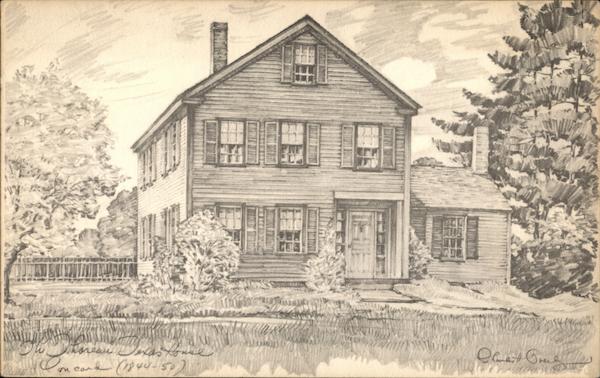
Gathered to-day my apples at the Texas house. I set out the trees, fourteen of them fourteen years ago and five of them several years later, and I now get between ten and eleven barrels of apples from them.

“Texas” House
(Thoreau Family Residence, 1844-1850)

H. D. Thoreau, Journal, October 3, 1860

See Vanessa Antiopa. See . April 17, 1860 (“It is unexpectedly very warm on lee side of hilltop just laid bare and covered with dry leaves and twigs. See my first Vanessa Antiopa”); October 1, 1860.(“C. saw the first Vanessa Antiopa since spring.”) See also A Book of the Seasons,  by Henry Thoreau, the Buff-edged Butterfly

The hard frost of September 28th, 29th, and 30th, and especially of October 1st. See October 1, 1860 ("Remarkable frost and ice this morning . . . I do not remember such cold at this season.").”); Compare October 3, 1856 (“The frost keeps off remarkably .” )

Sam Barrett says that last May he waded across the Assabet River on the old dam. See August 17, 1858 (“Being overtaken by a shower, we took refuge in the basement of Sam Barrett’s sawmill, where we spent an hour, and at length came home with a rainbow over arching the road before us”)

Bay-wings about. See April 15, 1859 (“The bay-wing now sings — the first I have been able to hear — . . . about the Texas house ”); October 9, 1858 (“Bay-wings flit along road.”); October 11, 1856 (“Bay-wing sparrows numerous.”); October 12, 1859 (“ I see scattered flocks of bay-wings amid the weeds and on the fences.”); October 16, 1855 ("I look at a grass-bird on a wall in the dry Great Fields. There is a dirty-white or cream-colored line above the eye and another from the angle of the mouth beneath it and a white ring close about the eye. The breast is streaked with this creamy white and dark brown in streams, as on the cover of a book.") See also A Book of the Seasons, by Henry Thoreau, the Bay-Wing Sparrow

I have seen and heard sparrows in flocks within a week. See September 17, 1858 (“Methinks, too, that there are more sparrows in flocks now about in garden”);  September 23, 1851 ("I scare up large flocks of sparrows in the garden.");September 26, 1858 (“Now is the time, too, when flocks of sparrows begin to scour over the weedy fields,”); September 27, 1858 ("What are those little birds in flocks in the garden and on the peach trees these mornings, about size of chip-birds, without distinct chestnut crowns?”); October 2, 1858 ("The garden is alive with migrating sparrows these mornings."); October 5, 1858 (“I still see large flocks, apparently of chip birds, on the weeds and ground in the yard.”); October 10, 1853 ("There are . . . large flocks of small sparrows,  which make a business of washing and pruning themselves in the puddles in the road, as if cleaning up after a long flight and the wind of yesterday.”)

October 3. See A Book of the Seasons, by Henry Thoreau,  October 3
See sparrows in flocks 
and have heard more flitting by 
since the frosts began.

A Book of the Seasons, by Henry Thoreau
"A book, each page written in its own season,
out-of-doors, in its own locality."
~edited, assembled and rewritten by zphx © 2009-2025
 

Wednesday, October 3, 2018

The maples about Walden are quite handsome now.

October 3

One brings me this morning a Carolina rail alive, this year’s bird evidently from its marks. He saved it from a cat in the road near'the Battle-Ground. On being taken up, it peeked a little at first, but was soon quiet. It staggers about as if weak on my window sill and pecks at the glass, or stands with its eyes shut, half asleep, and its back feathers hunched up. Possibly it is wounded. I suspect it may have been hatched here. Its feet are large and spreading, qualifying it to run on mud or pads. Its crown is black, but chin white, and its back feathers are distinctly edged with white in streaks. 

I compare my hazelnuts gathered some time ago. The beaked are pointed nuts, while the common are blunt; and the former are a much paler brown, also have a yellower and much sweeter meat. 

A fringed gentian, plucked day before yesterday, at length, this forenoon, untwists and turns its petals partially, in my chamber.

Have noticed a very brilliant scarlet blackberry patch within a week. 

The red maples which changed first, along the river, are now faded and partly fallen. They look more pink. But others are lit, and so there is more color than before. Some particular maple among a hundred will be of a peculiarly bright and pure scarlet, and, by its difference of tint and intenser color, attract our eyes even at a distance in the midst of the crowd. Looking all around Fair Haven Pond yesterday, where the maples were glowing amid the evergreens, my eyes invariably rested on a particular small maple of the purest and intensest scarlet. 

P. M. — Paddle about Walden. 

As I go through the Cut, I discover a new locality for the crotalaria, being attracted by the pretty blue-black pods, now ripe and dangling in profusion from these low plants, on the bare sandy and gravelly slope of the Cut. The vines or plants are but half a dozen times longer (or higher) than the pods. It was the contrast of these black pods with the yellowish sand which betrayed them.

How many men have a fatal excess of manner! There was one came to our house the other evening, and behaved very simply and well till the moment he was passing out the door. He then suddenly put on the airs of a well-bred man, and consciously described some are of beauty or other with his head or hand. It was but a slight flourish, but it has put me on the alert. 

It is interesting to consider how that crotalaria spreads itself, sure to find out the suitable soil. One year I find it on the Great Fields and think it rare; the next I find it in a new and unexpected place. It flits about like a flock of sparrows, from field to field. 

The maples about Walden are quite handsome now. Standing on the railroad, I look across the pond to Pine Hill, where the outside trees and the shrubs scattered generally through the wood glow through the green, yellow, and scarlet, like fires just kindled at the base of the trees, — a general conflagration just fairly under way, soon to envelop every tree. The hillside forest is all aglow along its edge and in all its cracks and fissures, and soon the flames will leap upward to the tops of the tallest trees. About the pond I see maples of all their tints, and black birches (on the southwest side) clear pale yellow; and on the peak young chestnut clumps and walnuts are considerably yellowed. 

I hear, out toward the middle, or a dozen rods from me, the plashing made apparently by the shiners, — for they look and shine like them, — leaping in schools on the surface. Many lift themselves quite out for a foot or two, but most rise only part way out, — twenty black points at once. There are several schools indulging in this sport from time to time as they swim slowly along. This I ascertain by paddling out to them. Perhaps they leap and dance in the water just as gnats dance in the air at present. I have seen it before in the fall. Is it peculiar to this season? 

Hear a hylodes peeping on shore. 

A general reddening now of young and scrub oaks. Some chinquapin bright-red. 

White pines fairly begin to change. 

The large leaves of some black oak sprouts are dark-purple, almost blackish, above, but greenish beneath. 

See locust leaves all crisped by frost in Laurel Glen Hollow, but only part way up the bank, as on the shore of a lake.

H. D. Thoreau, Journal, October 3, 1858

A Carolina rail alive. Its crown is black, but chin white, and its back feathers are distinctly edged with white in streaks. Compare September 18, 1858 ("In R. Virginianus. . . the crown and whole upper parts are black, streaked with brown; the throat, breast, and belly, orange-brown; sides and vent, black tipped with white; legs and feet, dark red-brown; none of which is true of the R. Carolinus.")

The beaked are pointed nuts, while the common are blunt. See September 9, 1858 ("I find an abundance of beaked hazelnuts at Blackberry Steep, one to three burs together, but, gathering them, I get my fingers full of fine shining bristles, while the common hazel burs are either smooth or covered with a softer glandular down; i. e., its horns are brazen tipped.")

A fringed gentian, plucked day before yesterday, at length, this forenoon, untwists and turns its petals partially, in my chamber.See October 1, 1858 ("The fringed gentians are now in prime. . . .They who see them closed, or in the afternoon only, do not suspect their beauty.")

Have noticed a very brilliant scarlet blackberry patch within a week. See September 23, 1854 ("Low blackberry vines generally red. "); September 25, 1854 ("I am detained by the very bright red blackberry leaves strewn along the sod")

Some particular maple among a hundred will be of a peculiarly bright and pure scarlet, and, by its difference of tint and intenser color, attract our eyes even at a distance in the midst of the crowd. See September 25, 1857 (“A single tree becomes the crowning beauty of some meadowy vale and attracts the attention of the traveller from afar.”); September 26, 1854 ("Some single red maples are very splendid now, the whole tree bright-scarlet against the cold green pines; now, when very few trees are changed, a most remarkable object in the landscape; seen a mile off. "); September 27, 1855 ("Some single red maples now fairly make a show along the meadow. I see a blaze of red reflected from the troubled water.");  September 27, 1857 (“At last, its labors for the year being consummated and every leaf ripened to its full, it flashes out conspicuous to the eye of the most casual observer, with all the virtue and beauty of a maple, – Acer rubrum.”); October 8, 1852 (“Nothing can exceed the brilliancy of some of the maples which stand by the shore and extend their red banners over the water.”);)

I discover a new locality for the crotalaria, being attracted by the pretty blue-black pods, now ripe and dangling in profusion from these low plants, on the bare sandy and gravelly slope of the Cut. See October 3, 1856 ("I detect the crotalaria behind the Wyman site, by hearing the now rattling seeds in its pods as I go through the grass, like the trinkets about an Indian's leggins, or a rattlesnake.")

Hear a hylodes peeping on shore. See October 3, 1852 ("I hear a hylodes (?) from time to time.")

 White pines fairly begin to change. See October 3, 1852 ("The pine fall, i.e. change, is commenced, and the trees are mottled green and yellowish."); October 3, 1856 ("The white pines are now getting to be pretty generally parti-colored, the lower yellowing needles ready to fall.") See also November 9, 1850 (" I expect to find that it is only for a few weeks in the fall after the new leaves have done growing that there are any yellow and falling, — that there is a season when we may say the old pine leaves are now yellow, and again, they are fallen."); See also A Book of the Seasons, by Henry Thoreau, The October Pine Fall


Tuesday, October 3, 2017

To sit under the face of an old clock that has been ticking one hundred and fifty years!

October 3

October 3, 2017
The Rhus radicans also turns yellow and red or scarlet, like the Toxicodendron. 

Asters, and still more goldenrods, look quite rare now. 

See a cowbird alone. 

Getting over the wall near Sam Barrett's the other day, I had gone a few rods in the road when I met Prescott Barrett, who observed, 
“Well, you take a walk round the square sometimes.” 
So little does he know of my habits. I go across lots over his grounds every three or four weeks, but I do not know that I ever walked round the square in my life. 

How much more agreeable to sit in the midst of old furniture like Minott's clock and secretary and looking-glass, which have come down from other generations, than in  that which was just brought from the cabinet-maker's and smells of varnish, like a coffin! To sit under the face of an old clock that has been ticking one hundred and fifty years, – there is something mortal, not to say immortal, about it! A clock that began to tick when Massachusetts was a province. Meanwhile John Beatton's heavy tombstone is cracked quite across and widely opened. [It has fallen also and has been set up.]

H. D. Thoreau, Journal, October 3, 1857

The Rhus radicans also turns yellow and red or scarlet, like the ToxicodendronRhus radicans. Poison ivy. Also known as Rhus toxicodendron or Toxicodendron radicans.  See  March 13, 1857 ("Elliott, the botanist, says . . . [of] Rhus Toxicodendron (page 363): 'The juice which exudes on plucking the leaf-stalks from the stem of the R. radicans is a good indelible dye for marking linen or cotton.'."); March 24, 1856 (“Cut a piece of Rhus Toxicodendron resting on rock at Egg Rock, five eighths of an inch in diameter, which had nineteen rings of annual growth. It is quite hard and stiff.”);   May 12, 1855 (“Rhus radicans leafed there a day or two.”); . June 9, 1855 (“Rhus Toxicodendron on Island Rock.”);  August 19, 1856 (“Ivy berries dry and apparently ripe on the rocks (Toxicodendron)”); August 24, 1857 (“There was a dead Rhus radicans on it [a large elm]  two inches in diameter.”); September 2, 1857 (“In the botrychium swamp. . . I see a Rhus radicans running up a buttonwood which is some forty feet high . . . It is a vine one and a half and two inches wide, somewhat flattened, clinging close and flat to the tree . . .. You can hardly tell if it is alive or dead without looking upward. ”); September 4, 1857 (“At the cleft rock by the hill just west of this swamp, — call it Cornel Rock, – I found . . . quite a collection of rare plants there, – petty morel, Thalictrum dioicum, witch hazel, etc., Rhus radicans . . .”); September 30, 1857 (“Rhus Toxicodendron turned yellow and red, handsomely dotted with brown.”)

Asters, and still more goldenrods, look quite rare now. Compare October 3, 1852 ("The Aster undulates is common and fresh, also the Solidago nemoralis of Gray.")

Minott's clock.. . .A clock that began to tick when Massachusetts was a province. See September 30, 1857 ("He says that that tall clock which still ticks in the corner belonged to old John Beatton, who died before he was born; thought it was two hundred years old!!")

Monday, October 3, 2016

Hillsides about Walden begin to wear autumnal tints in the cooler air.

October 3

The white pines are now getting to be pretty generally parti-colored, the lower yellowing needles ready to fall. 

The sumachs are generally crimson (darker than scarlet), and young trees and bushes by the water and meadows are generally beginning to glow red and yellow. 

Especially the hillsides about Walden begin to wear these autumnal tints in the cooler air. These lit leaves, this glowing, bright-tinted shrubbery, is in singular harmony with the dry, stony shore of this cool and deep well. 

The frost keeps off remarkably. I have seen none, though I hear that there was some two or three mornings ago. 

I detect the crotalaria behind the Wyman site, by hearing the now rattling seeds in its pods as I go through the grass, like the trinkets about an Indian's leggins, or a rattlesnake.

H. D. Thoreau, Journal, October 3, 1856

The white pines . . .parti-colored, the lower yellowing needles ready to fall. See October 3, 1852 ("The pine fall, i.e. change, is commenced, and the trees are mottled green and yellowish."); October 3, 1858 ("White pines fairly begin to change.")  See also November 9, 1850 (" I expect to find that it is only for a few weeks in the fall after the new leaves have done growing that there are any yellow and falling, — that there is a season when we may say the old pine leaves are now yellow, and again, they are fallen."); See also A Book of the Seasons, by Henry Thoreau, The October Pine Fall

Especially the hillsides about Walden begin to wear these autumnal tints in the cooler air.
See October 1, 1852 ("The young and tender trees begin to assume the autumnal tints more generally,"); October 1, 1854 ("The young black birches about Walden, next the south shore, are now commonly clear pale yellow, very distinct at distance, like bright-yellow white birches, so slender amid the dense growth of oaks and evergreens on the steep shores. ");  October 3, 1858 ("About the pond I see maples of all their tints, and black birches (on the southwest side) clear pale yellow; and on the peak young chestnut clumps and walnuts are considerably yellowed.")

The frost keeps off remarkably . . . Compare October 1, 1860 ("Remarkable frost and ice this morning . . . I do not remember such cold at this season.").

I detect the crotalaria . . . by hearing the now rattling seeds in its pods . See August 1, 1856 ("Crotalaria . . .out, and some pods fully grown."); October 3, 1858 ("As I go through the Cut, I discover a new locality for the crotalaria, being attracted by the pretty blue-black pods")

Saturday, October 3, 2015

Exploring New Bedford area.

October 3

Somewhat rainy. 

Walked along shore of Acushnet looking for shells. R. pointed out to me the edible mushroom, which he says he loves raw even. It is common. 

The shore was all alive with fiddler crabs, carrying their fiddles on one side, and their holes, nearly an inch over, were very common and earth heaped up.

Sailed back up the river in Arthur’s whale-boat with three sails. Her side drank water through a crack. He gave three dollars for her and spent ten more in repairs. Twenty feet long, and worth originally per haps $75. If I had stayed longer we should probably have gone to Cuttyhunk in this. 

P. M. — Rode to see some old houses in Fairhaven.

Visited the studio in Fairhaven of a young marine painter, built over the water, the dashing and gurgling of it coming up through a grating in the floor. He was out, but we found there painting Van Best, a well—known Dutch painter of marine pieces whom he has attracted to him. He talked and looked particularly Dutchman-like.

H. D. Thoreau Journal, October 3, 1855


A young marine painter.... This was the studio of William Bradford, later recognized as one of the world's most accomplished marine painters. Dutch artist Albert Van Beest, Bradford's mentor, was at that time more well known than his soon-to-be famous student. ~ source: Mapping Thoreau Country.

A Book of the Seasons: October 3.

October 3.

Hear the loud laughing of a loon on Flint's, apparently alone in the middle. A wild sound, heard far and suited to the wildest lake. October 3, 1852

A wild sound heard far,
suited to the wildest lake.
Laughing of a loon.
October 3, 1852

Especially the hillsides about Walden begin to wear these autumnal tints in the cooler air. These lit leaves, this glowing, bright-tinted shrubbery, is in singular harmony with the dry, stony shore of this cool and deep well. October 3, 1856

These lit glowing leaves
by the dry stony shore of
this cool and deep well.
October 3, 1856


The maples about Walden are quite handsome now. . . .About the pond I see maples of all their tints, and black birches (on the southwest side) clear pale yellow; and on the peak young chestnut clumps and walnuts are considerably yellowed. .October 3, 1858


Maples of all tints,
clear pale yellow black birches
on the southwest side.
October 3, 1858
,


See about the pond
clear pale yellow black birches,
maples of all tints.
October 3, 1858


Cooler, autumnal.
You incline to sit in a
sunny sheltered place.
October 3, 1859

Serene as the sky,
emulating nature with
calm and peaceful lives.
October 3, 1859


The pine fall, i.e. change, is commenced, and the trees are mottled green and yellowish. October 3, 1852


The white pines are now getting to be pretty generally parti-colored, the lower yellowing needles ready to fall. October 3, 1856
White pines fairly begin to change. October 3, 1858

The Rhus radicans also turns yellow and red or scarlet, like the Toxicodendron. October 3, 1857

The sumachs are generally crimson (darker than scarlet), and young trees and bushes by the water and meadows are generally beginning to glow red and yellow. October 3, 1856


The red maples which changed first, along the river, are now faded and partly fallen. They look more pink. But others are lit, and so there is more color than before. Some particular maple among a hundred will be of a peculiarly bright and pure scarlet, and, by its difference of tint and intenser color, attract our eyes even at a distance in the midst of the crowd. October 3, 1858


Looking all around Fair Haven Pond yesterday, where the maples were glowing amid the evergreens, my eyes invariably rested on a particular small maple of the purest and intensest scarlet. October 3, 1858


I see the ground strewn with Populus grandidentata leaves in one place on the old Carlisle road, where one third are fallen. These yellow leaves are all thickly brown-spotted and are very handsome. . .— they cover the still green sward by the roadside and the gray road thick as a pavement, each one worthy to be admired as a gem or work of Oriental art. October 3, 1859


The hard frost of September 28th, 29th, and 30th, and especially of October 1st, has suddenly killed, crisped, and caused to fall a great many leaves of ash, hickory, etc., etc. October 3, 1860


Many acorns strew the ground, and have fallen into the water. October 3, 1852


I have seen and heard sparrows in flocks, more as if flitting by, within a week, or since the frosts began. October 3, 1860


See sparrows in flocks and have heard more flitting by since the frosts began. HDT ~October 3, 1860


*****


A Book of the Seasons, by Henry Thoreau
"A book, each page written in its own season,
out-of-doors, in its own locality."
~edited, assembled and rewritten by zphx © 2009-2019

Thursday, October 2, 2014

A Book of the Seasons, The October Pine Fall

It is remarkable that 
the old leaves turn and fall 
in so short a time. 

Henry Thoreau, November 21, 1850


*****
How evenly the 
freshly fallen pine-needles
are spread on the ground! 

The ground is strewn with 
pine-needles as if sunlight –
the river dark blue. 

On a rounded rock
covered with fresh pine-needles
I see Wachusett.

This November light –
the trembling shimmer and gleam
of the pine-needles.

There is a season
when old pine leaves are yellow –
then they are fallen.

*****
September 3.  The narrow brown sheaths from the base of white pine leaves now strew the ground and are washed up on the edge of puddles after the rain. September 3, 1858

September 5.  I now see those brown shaving like stipules of the white pine leaves, which are falling, i.e. the stipules, and caught in cobwebs. September 5, 1857

September 10.  As I go up Fair Haven Hill, I see some signs of the approaching fall of the white pine. On some trees the old leaves are already somewhat reddish, though not enough to give the trees a parti-colored look, and they come off easily on being touched, - the old leaves on the lower part of the twigs. September 10, 1851

September 28.  R. W. E.’s pines are parti-colored, preparing to fall, some of them. September 28, 1854

September 29.  Pines have begun to be parti-colored with yellow leaves. September 29, 1857

October 1.   The pines now half turned yellow, the needles of this year are so much the greener by contrast.  October 1, 1857

October 2 The white pines have scarcely begun at all to change here, though a week ago last Wednesday they were fully changed at Bangor. October 2, 1853

October 3The pine fall, i.e. change, is commenced, and the trees are mottled green and yellowish. October 3, 1852

October 3The white pines are now getting to be pretty generally parti-colored, the lower yellowing needles ready to fall. October 3, 1856

October 3 White pines fairly begin to change.  October 3, 1858

October 5White pines in low ground and swamps are the first to change. Some of these have lost many needles. Some on dry ground have so far changed as to be quite handsome, but most only so far as to make the misty glaucous (green) leaves more soft and indefinite. October 5, 1858

October 8 The pines are still shedding their leaves. October 8, 1851

October 9.  On Lee's hillside by the pond, the old leaves of some pitch pines are almost of a golden-yellow hue, seen in the sunlight, a rich autumnal look. The green are, as it were, set in the yellow. October 9, 1851 

October 9In the swamp, some twenty-foot maples are already bare, and some white pines are as yellow as birches. October 9, 1857

October 10, 2018

October 11.  White pines are apparently ready to fall. Some are much paler brown than others. October 11, 1858

October 12.  A new carpet of pine leaves is forming in the woods. The forest is laying down her carpet for the winter. October 12, 1852

October 13.  A thick carpet of white pine needles lies now lightly, half an inch or more in thickness, above the dark-reddish ones of last year. October 13, 1854

October 13.  The pitch and white pines on the north of Sleepy Hollow. . . are at the height of their change, generally, though many needles fallen, carpeting the ground. October 13, 1857

October 14.   The pines are now two-colored, green and yellow, – the latter just below the ends of the boughs. October 14, 1852

October 14.   Pine-needles, just fallen, now make a thick carpet. October 14, 1856

October 15 White pines are in the midst of their fall. October 15, 1858

October 16 The pines, too, have fallen. October 16, 1854

October 16.  How evenly the freshly fallen pine-needles are spread on the ground! quite like a carpet. Throughout this grove no square foot is left bare. October 16, 1855

October 16 A great part of the pine-needles have just fallen.  October 16, 1857 

October 18.  In Lee's Wood, white pine leaves are now fairly fallen . . . These leaves, like other, broader ones, pass through various hues (or shades) from green to brown, — first yellow, giving the tree that parti-colored look, then pale brown when they fall, then reddish brown after lying on the ground, and then darker and darker brown when decaying. October 18, 1857

October 18.  As I come through Hubbard’s Woods I see the wintergreen, conspicuous now above the freshly fallen white pine needles. Their shining green is suddenly revealed above the pale-brown ground. I hail its cool unwithering green, one of the humbler allies by whose aid we are to face the winter. October 18, 1858

October 19.  I measure the depth of the needles under the pitch pines east of the railroad (behind the old shanties) . . . I think the thickness of the needles, old and new, is not more than one inch there on an average. October 19, 1855

October 19.  I return by the west side of Lee's Cliff hill, and sit on a rounded rock there, covered with fresh-fallen pine-needles, amid the woods, whence I see Wachusett . . . The rich sunny yellow of the old pitch pine needles, just ready to fall, contrasting with the new and unmixed masses above, makes a very pleasing impression. Occtober 19, 1856

October 22The pines, both white and pitch, have now shed their leaves, and the ground in the pine woods is strewn with the newly fallen needles. October 22, 1851

October 22White pines have for the most part fallen. All the underwood is hung with their brown fallen needles, giving to the woods an untidy appearance. October 22, 1858

October 23. The white pines have shed their leaves, making a yellow carpet on the grass, but the pitch pines are yet parti-colored. October 23, 1852 

October 23.  Some pines still parti-colored. October 23, 1853

October 23.  The fallen pine-needles, as well as other leaves, now actually paint the surface of the earth brown in the woods, covering the green and other colors, and the few evergreen plants on the forest floor stand out distinct and have a rare preeminence. October 23, 1857

October 25 The ground is strewn with pine-needles as sunlight. October 25, 1853

October 25 Now, especially, we notice not only the silvery leaves of the Salix alba but the silvery sheen of pine—needles; i. e., when its old leaves have fallen and trees generally are mostly bare, in the cool Novemberish air and light we observe and enjoy the trembling shimmer and gleam of the pine-needles. October 25, 1858

October 26. The hillside is slippery with new-fallen white pine leavesOctober 26, 1855 

October 26. The pitch pine leaves not yet quite fallen. October 26, 1857

October 28The white pine needles on the ground are already turned considerably redder. 
 The pitch pines, which are yellower than the white when they fall, are three quarters fallen. October 28, 1857

October 28.  Pitch pines are falling.  October 28, 1858

October 29  I see the white pines, a clear green, rising amid and above the pitch pines, which are parti-colored, glowing internally with the warm yellow of the old leaves. Of our Concord evergreens, only the white and pitch pines are interesting in their change, for only their leaves are bright and conspicuous enough. October 28, 1859


November 9 Just a month ago, I observed that the white pines were parti-colored, green and yellow, the needles of the previous year now falling. Now I do not observe any yellow ones, and I expect to find that it is only for a few weeks in the fall after the new leaves have done growing that there are any yellow and falling, — that there is a season when we may say the old pine leaves are now yellow, and again, they are fallen. The trees were not so tidy then; they are not so full now. They look best when contrasted with a field of snow. November 9, 1850

November 21.
  For a month past the grass under the pines has been covered with a new carpet of pine leaves. It is remarkable that the old leaves turn and fall in so short a time. November 21, 1850

December 24. I observe that there are many dead pine-needles sprinkled over the snow, which had not fallen before. December 24, 1850


A Book of the Seasons, by Henry Thoreau
"A book, each page written in its own season,
out-of-doors, in its own locality."
~edited, assembled and rewritten by zphx © 2009-2024

Popular Posts Last 30 Days.

The week ahead in Henry’s journal

The week ahead in Henry’s journal
A journal, a book that shall contain a record of all your joy.
"A stone fruit. Each one yields me a thought." ~ H. D. Thoreau, March 28, 1859


I sit on this rock
wrestling with the melody
that possesses me.