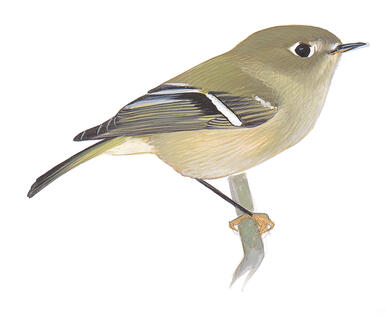
Showing posts with label ruby-crowned wren. Show all posts

Wednesday, May 1, 2019

As I sat in the woods admiring the beauty of the blue butterfly.

May 1

Hear the ruby-crowned wren. 

We accuse savages of worshipping only the bad spirit, or devil, though they may distinguish both a good and a bad; but they regard only that one which they fear and worship the devil only. We too are savages in this, doing precisely the same thing. 

This occurred to me yesterday as I sat in the woods admiring the beauty of the blue butterfly. 

We are not chiefly interested in birds and insects, for example, as they are ornamental to the earth and cheering to man, but we spare the lives of the former only on condition that they eat more grubs than they do cherries, and the only account of the insects which the State encourages is of the "Insects Injurious to Vegetation.” 

We too admit both a good and a bad spirit, but we worship chiefly the bad spirit, whom we fear. We do not think first of the good but of the harm things will do us. 

The catechism says that the chief end of man is to glorify God and enjoy him forever, which of course is applicable mainly to God as seen in his works. Yet the only account of its beautiful insects — butterflies, etc. — which God has made and set before us which the State ever thinks of spending any money on is the account of those which are injurious to vegetation!

This is the way we glorify God and enjoy him forever. Come out here and behold a thousand painted butterflies and other beautiful insects which people the air, then go to the libraries and see what kind of prayer and glorification of God is there recorded. Massachusetts has published her report on "Insects Injurious to Vegetation," and our neighbor the "Noxious Insects of New York.” 

We have attended to the evil and said nothing about the good. This is looking a gift horse in the mouth with a vengeance.

Children are attracted by the beauty of butterflies, but their parents and legislators deem it an idle pursuit. The parents remind me of the devil, but the children of God. Though God may have pronounced his work good, we ask, "Is it not poisonous?” 

Science is inhuman. Things seen with a microscope begin to be insignificant. So described, they are as monstrous as if they should be magnified a thousand diameters. Suppose I should see and describe men and houses and trees and birds as if they were a thousand times larger than they are! With our prying instruments we disturb the balance and harmony of nature.

P. M. — To Second Division. Very warm. 

Looking from Clamshell over Hosmer's meadow, about half covered with water, see hundreds of turtles, chiefly picta, now first lying out in numbers on the brown pieces of meadow which rise above the water. You see their black backs shine on these hummocks left by the ice, fifty to eighty rods off. They would rapidly tumble off if you went much nearer.

This heat and stillness draws them up. It is remarkable how surely they are advertised of the first warm and still days, and in an hour or two are sure to spread themselves over the hummocks. There is to-day a general resurrection of them, and there they bask in the sun. It is their sabbath. 

At this distance, if you are on the lookout, especially with a glass, you can discover what numbers of them there are, but they are shy and will drop into the water on a near approach. All up and down our river meadows their backs are shining in the sun to-day. It is a turtle day. 

As we sat on the steep hillside south of Nut Meadow Brook Crossing, we noticed a remarkable whirlwind on a small scale, which carried up the oak leaves from that Island copse in the meadow. The oak leaves now hang thinly and are very dry and light, and these small whirlwinds, which seem to be occasioned by the sudden hot and calm weather (like whirlpools or dimples in a smooth stream), wrench them off, and up they go, somewhat spirally, in countless flocks like birds, with a rustling sound; and higher and higher into the clear blue deeps they rise above our heads, till they are fairly lost to sight, looking, when last seen, mere light specks against the blue, like stars by day, in fact. I could distinguish some, I have no doubt, five or six hundred feet high at least, but if I looked aside a moment they were lost. The largest oak leaves looked not bigger than a five-cent-piece. These were drifting eastward, — to descend where? Methought that, instead of decaying on the earth or being consumed by fire, these were being translated and would soon be taken in at the windows of heaven. I had never observed this phenomenon so remarkable.

The flight of the leaves. 

This was quite local, and it was comparatively still where we sat a few rods on one side. Thousands went up together in a rustling flock. Many of the last oak leaves hang thus ready to go up. 

I noticed two or more similar whirlwinds in the woods elsewhere this afternoon. One took up small twigs and clusters of leaves from the ground, matted together. I could easily see where it ran along with its nose (or point of its tunnel) close to the ground, stirring up the leaves as it travelled, like the snout of some hunting or rooting animal. 

See and hear chewink. 

See a little snake on the dry twigs and chips in the sun, near the arbutus, uniformly brown (or reddish-brown) above except a yellowish ring on the occiput, the head also lighter than the body; beneath vermilion, with apparently a row of light dots along each side. It is apparently Coluber amamus (?), except that it has the yellowish ring. 

Luzula campestris. Also the Oryzopsis Canadensis by the Major Heywood path-side, say a day, or April 30th, six inches high or more, with fine bristle-like leaves. 

See a thrasher.

What is that rush at Second Division? It now forms a dense and very conspicuous mass some four rods long and one foot high. The top for three inches is red, and the impression at a little distance is like that made by sorrel. Certainly no plant of this character exhibits such a growth now, i. e. in the mass. It surprises you to see it, carries your thoughts on to June. 

The climbing fern is persistent, i. e. retains its greenness still, though now partly brown and withered.

H. D. Thoreau, Journal, May 1, 1859


The only account of the insects which the State encourages is of the "Insects Injurious to Vegetation.” See April 6, 1857 ("To New Bedford Library. . . Take out Emmons’s Report on the insects injurious to vegetation in New York.


See a plate of the Colias Philodice, or common sulphur-yellow butterfly, male and female of different tinge.”)

It is a turtle day.  See August 28, 1856 ("Has not the great world existed for them as much as for you?”) See also Book of the Seasons, by Henry Thoreau,  The Painted Turtle

A little snake uniformly brown (or reddish-brown) above except a yellowish ring on the occiput, the head also lighter than the body; beneath vermilion, with apparently a row of light dots along each side.  Probably the ring-neck snake (Coluber punctatus) -- slate gray, black or brown back with complete yellow ring just behind the head, bright yellow or rarely orange belly and occasionally small black spots. Snakes of Massachusetts ringneck snake. Compare HDT’s other "Coluber amaenus” snakes, conforming generally to the redbelly snake (Storeria occipitomaculata occipitomaculata):  October 11, 1856 (“It is apparently Coluber amaenus, the red snake. Brown above, light-red beneath, about eight inches long . . . It is a conspicuous light red beneath, then a bluish-gray line along the sides, and above this brown with a line of lighter or yellowish brown down the middle of the back.”); September 9, 1857 ("It was a dark ash-color above, with darker longitudinal lines, light brick-red beneath. There were three triangular buff spots just behind the head, one above and one each side. It is apparently Coluber amaenus”); April 29, 1858 (“A little brown snake with blackish marks along each side of back and a pink belly. Was it not the Coluber amaenus?”)  

The genus Storeria consists of five species, four of which are known as brown snakes, and the other of which is known as the redbelly snake. Most Storeria are a variant of brown in color. They sometimes have a lighter-colored stripe down the center of the back, and small black blotches along the body, and just behind the head. The underside is usually lighter brown-colored, yellow, or in the case of the redbelly snake, reddish in color. They rarely grow beyond 13 inches.

The climbing fern is persistent, i. e. retains its greenness still, though now partly brown and withered. CLIMBING FERN, or Hartford Fern (Lygodium palmatum) . A species of fern found, rarely, from Massachusetts to Kentucky and southward, remarkable for climbing or twining around weeds and shrubs ~ Wikisource. See October 2, 1859 (“The climbing fern is perfectly fresh, — and apparently therefore an evergreen, — the more easily found amid the withered cinnamon and flowering ferns.”); November 30, 1851 (“The Lygodium palmatum is quite abundant on that side of the swamp, twining round the goldenrods”)

I sat in the woods
admiring the beauty of
the blue butterfly. 

Saturday, April 20, 2019

My ruby-crowned or crested wren


April 20


Hear and see my ruby-crowned or crested wren singing at 6 a. m. on Wheildon's pines. 


Ruby-Crowned Wren on Kalmia Angustifollia


Setting pines all day.

H. D. Thoreau, Journal, April 20, 1859

Hear and see my ruby-crowned or crested wren singing. See April 25, 1854 (“A very interesting and active little fellow, darting about amid the tree-tops, and his song quite remarkable and rich and loud for his size. Begins with a very fine note, before its pipes are filled, not audible at a little distance, then woriter weter, etc., etc., winding up with teter teter, all clear and round. This was at 4 p. m., when most birds do not sing. I saw it yesterday, pluming itself and stretching its little wings. Our smallest bird, methinks, except the hummingbird.”); May 6, 1855 ("Hear at a distance a ruby(?)-crowned wren, so robin-like and spirited. After see one within ten or fifteen feet. Dark bill and legs, apparently dark olivaceous ashy head, a little whitish before and behind the full black eyes, ash breast, olive-yellow on primaries, with a white bar, dark tail and ends of wings, white belly and vent. Did not notice vermilion spot on hindhead. It darts off from apple tree for insects like a pewee, and returns to within ten feet of me as if curious. I think this the only Regulus I have ever seen.”);  May 7, 1855 (“Climbed to two crows’ nests . . . A ruby-crested wren is apparently attracted and eyes me.”); July 14, 1856 (“Saw apparently my little ruby(?)-crested wren(?) on the weeds there.”); April 30, 1857 (“Hear again the same bird heard at Conantum April 18th, which I think must be the ruby-crowned wren. ”); April 29, 1858  (“I Heard yesterday at Ledum Swamp the lively, sweet, yet somewhat whimsical note of the ruby crowned wren.");  April 26, 1860 ("Hear the ruby-crowned wren in the morning, near George Heywood’s.”). See also note to December 25, 1859 ("I hear a sharp fine screep from some bird,. . . I can see a brilliant crown. . . . It is evidently the golden-crested wren, which I have not made out before.”). and A Book of the Seasons, by Henry Thoreau: the ruby-crowned or crested wren.

Wheildon's pines. See December 21, 1855 (“ I hear and see tree sparrows on Wheildon’s pines,”); March 21, 1859 ("I see several white pine cones in the path by Wheildon's . . . Others still hold on.”) 

Setting pines all day. See April 19, 1859 ("Began to set white pines in R.W.E.'s Wyman lot."); April 21, 1859 (" Setting pines all day. This makes two and a half days, with two men and a horse and cart to help me. We have set some four hundred trees at fifteen feet apart diamondwise, covering some two acres. I set every one with my own hand") April 22, 1859 ("When setting the pines at Walden the last three days,I was sung to by the field sparrow. . . .As I planted there, wandering thoughts visited me, which I have now forgotten.")

See also  A Book of the Seasons,  by Henry Thoreau, April 20

A Book of the Seasons,  by Henry Thoreau
 "A book, each page written in its own season,
out-of-doors, in its own locality."
 ~edited, assembled and rewritten by zphx ©  2009-2023

Sunday, April 29, 2018

A little brown snake with blackish marks.

April 29

Storrow Higginson plucked the uva-ursi fully out the 25th; perhaps two or three days, for it was nearly out, he says, the 18th!!! By his account it was on Pine Hill.  

I heard yesterday at Ledum Swamp the lively, sweet, yet somewhat whimsical note of the ruby crowned wren, and had sight of him a moment. Did I not hear it there the 10th? 

Noticed a man killing, on the sidewalk by Minott's, a little brown snake with blackish marks along each side of back and a pink belly. Was it not the Coluber amaenus?

H. D. Thoreau, Journal, April 29, 1858

Heard yesterday at Ledum Swamp the lively, sweet, yet somewhat whimsical note of the ruby crowned wren.  See April 25, 1854 (“A very interesting and active little fellow, darting about amid the tree-tops, and his song quite remarkable and rich and loud for his size. Begins with a very fine note, before its pipes are filled, not audible at a little distance, then woriter weter, etc., etc., winding up with teter teter, all clear and round. (His song is comical and reminds me of the thrasher.)”);  May 6, 1855 ("Hear at a distance a ruby(?)-crowned wren, so robin-like and spirited.  . . . I think this the only Regulus I have ever seen.”); April 30, 1857 (“Hear again the same bird heard at Conantum April 18th, which I think must be the ruby-crowned wren. ”); April 26, 1860 ("Hear the ruby-crowned wren in the morning, near George Heywood’s.”). See also note to April 20, 1859 ("My ruby-crowned or crested wren”) and A Book of the Seasons, by Henry Thoreau: the ruby-crowned or crested wren.

A man killing a little brown snake with blackish marks along each side of back and a pink belly. See October 11, 1856 (“I find a little snake which somebody has killed with his heel. It is apparently Coluber amaenus, the red snake. Brown above, light-red beneath, about eight inches long . . . It is a conspicuous light red beneath, then a bluish-gray line along the sides, and above this brown with a line of lighter or yellowish brown down the middle of the back. ”); September 9, 1857 ("On my way home, caught one of those little red bellied snakes in the road, where it was rather slugish, as usual. Saw another in the road a week or two ago. The whole length was eight inches. . .It was a dark ash-color above, with darker longitudinal lines, light brick-red beneath. There were three triangular buff spots just behind the head, one above and one each side. It is apparently Coluber amaenus”). See also April 26, 1857 ("I have the same objection to killing a snake that I have to the killing of any other animal, yet the most humane man that I know never omits to kill one.”). Compare April 22, 1857 (“Near Tall's Island, rescue a little pale or yellowish brown snake that was coiled round a willow half a dozen rods from the shore and was apparently chilled by the cold. Was it not Storer's "little brown snake?”) ~ rebellied snake or worm snake or both?: Snakes of Massachusetts

Sunday, April 30, 2017

At Goose Pond.

April 30. 

Thursday. A. M. — Surveying for Farrar and Heywood by Walden. 

Hear a kingfisher at Goose Pond. 

Hear again the same bird heard at Conantum April 18th, which I think must be the ruby-crowned wren. 

As we stood looking for a bound by the edge of Goose Pond, a pretty large hawk alighted on an oak close by us. It probably has a nest near by and was concerned for its young. 

The larch plucked yesterday sheds pollen to-day in house, probably to-day abroad. 

Balm-of-Gilead plucked yesterday, not yet (nor on May 1st) in house.

H. D. Thoreau, Journal April 30, 1857

Hear a kingfisher at Goose Pond. See April 23, 1854 (“A kingfisher with his crack, — cr-r-r-rack.”); April 24, 1854 ("The kingfisher flies with a crack cr-r-r-ack and a limping or flitting flight from tree to tree before us ”) See also A Book of the Seasons, by Henry Thoreau. The Kingfisher

Hear again the same bird heard at Conantum April 18th, which I think must be the ruby-crowned wren. See April 26, 1860 ("Hear the ruby-crowned wren in the morning, near George Heywood’s.”); May 6, 1855 ("Hear at a distance a ruby(?)-crowned wren, so robin-like and spirited. After see one within ten . . . feet of me as if curious. I think this the only Regulus I have ever seen.”); see also note to April 20, 1859 ("My ruby-crowned or crested wren”).  See also A Book of the Seasons,  by Henry Thoreau: the ruby-crowned or crested wren. and  A Book of the Seasons,  by Henry Thoreau, Winter Birds

It probably has a nest near by . . . See note to April 30, 1855 ( It must have a nest there. “)

The larch plucked yesterday sheds pollen to-day See .
April 27, 1856 (The female flowers are now fully expanded and very pretty, but small. I think it will first scatter pollen to-morrow. ");April 29, 1855 ("The crimson female flowers are now handsome but small. ") and note to May 1, 1856 ("I judge that the larch blossomed ...”). See also A Book of Seasons, by Henry Thoreau, the Larch


Thursday, July 14, 2016

So the tree gets planted!

July 14

P. M. — To Muhlenbergii Brook. 

Anthony Wright found a lark's nest with fresh eggs on the 12th in E. Hubbard's meadow by ash tree, — two nests, probably one a second brood. 

Nasturtium hispidum (?), apparently three or four days. 

See and hear martins twittering on the elms by riverside. 

Bass out about two days at Island. 

There is a pyrus twenty feet high with small fruit at Assabet Spring. 

Noli-me-tangere already springs at Muhlenbergii Brook, some days. 

Saw apparently my little ruby(?)-crested wren(?) on the weeds there. 

Senecio long gone to seed and dispersed. 

Canada thistle some time on Huckleberry Pasture-side beyond. 

Ceratophyllum with a dense whorl of twelve little oval red-dotted apparent flower-buds (?) in an axil. 

While drinking at Assabet Spring in woods, noticed a cherry-stone on the bottom. A bird that came to drink must have brought it half a mile. So the tree gets planted!


H. D. Thoreau, Journal, July 14, 1856

A lark's nest with fresh eggs on the 12th. See July 11, 1857 ("And now the lark must look out for the mowers."); July 16, 1851 ("The lark sings in the meadow; the very essence of the afternoon is in his strain. This is a New England sound") July 26, 1856 ("I see young larks fly pretty well before me.")

Bass out about two days at Island. See July 17, 1856 ("Hear at distance the hum of bees from the bass with its drooping flowers at the Island, a few minutes only before sunset. It sounds like the rumbling of a distant train of cars"); July 18, 1854 ("We have very few bass trees in Concord, but walk near them at this season and they will be betrayed, though several rods off, by the wonderful susurrus of the bees, etc., which their flowers attract.") Compare July 3, 1853 ("There are no flowers on bass trees commonly this year."); June 3, 1857 ("The bass at the Island will not bloom this year. ") See also Book of the Seasons by Henry Thoreau, The Basswood

Noli-me-tangere already springs at Muhlenbergii Brook. See August 15, 1851 ("Impatiens, noli-me-tangere, or touch-me-not, with its dangling yellow pitchers or horns of plenty, which I have seen for a month by damp causeway thickets")

Saw apparently my little ruby-crested wren on the weeds there. See A Book of the Seasons, by Henry Thoreau: the ruby-crowned or crested wren.

Senecio long gone to seed and dispersed. See  June 12, 1852 ("The meadows are yellow with golden senecio."); See also A Book of the Seasons  by Henry Thoreau, The Golden Senecio

Canada thistle some time on Huckleberry Pasture-side beyond. See  July 15, 1859 ("To Ledum Swamp. First notice Canada thistle."); July 19, 1851 ("Here is the Canada thistle in bloom, visited by butterflies and bees.") See also A Book of the Seasons by Henry Thoreau, The Thistle and Thistle-down

Ceratophyllum [hornwort] with a dense whorl of twelve little oval red-dotted apparent flower-buds (?) in an axil. See July 27, 1856 ("Ceratophyllum is now apparently in bloom commonly, with its crimson-dotted involucre."); .July 30, 1856 ("The water is suddenly clear,. . . It assists me very much as I go looking for the ceratophyllum, potamogetons, etc. All the secrets of the river bottom are revealed. ")

While drinking at Assabet Spring. See May 2, 1855 ("Open the Assabet spring."); July 12, 1857 ("I drink at every cooler spring in my walk these afternoons."). See also A Book of the Seasonsby Henry Thoreau, At Assabet Spring

A bird that came to drink must have brought it half a mile. See September 1, 1860 ("How artfully the seed of a cherry is placed in order that a bird may be compelled to transport it . . . The bird is bribed with the pericarp to take the stone with it and do this little service for Nature. Thus a bird's wing is added to the cherry-stone which was wingless, and it does not wait for winds to transport it."); also September 21, 1860 ("I suspect that . . . those [seeds] the wind takes are less generally the food of birds and quadrupeds than the heavier and wingless seeds") and  August 19, 1852 ("The small fruits of most plants are now generally ripe or ripening, and this is coincident with the flying in flocks of such young birds now grown as feed on them.").

July 14.  See A Book of the Seasons,  by Henry Thoreau, July 14

A bird come to drink
must have brought this cherry-stone –
the tree gets planted.

A Book of the Seasons,  by Henry Thoreau
"A book, each page written in its own season,
out-of-doors, in its own locality." 
~edited, assembled and rewritten by zphx © 2009-2026

https://tinyurl.com/hdt-560714

Thursday, May 7, 2015

The gray squirrels, partridges, hawks, and owls, all together.

May 7

5 A.M. — To Island. 

Finger-cold and windy.

A crow’s nest near the top of a pitch pine about twenty feet high, just completed, betrayed by the birds’ cawing and alarm. As on the 5th, one came and sat on a bare oak within forty feet, cawed, reconnoitred; and then both flew off to a distance, while I discovered and climbed to the nest within a dozen rods. One comes near to spy you first. 

P. M. — To Lee’s Cliff 'via Hubbard’s Bath.

Climbed to two crows’ nests, - or maybe one of them a squirrel’s, - in Hubbard’s Grove. Do they not sometimes use a squirrel’s nest for a foundation? 

A ruby-crested wren is apparently attracted and eyes me. 

It is wrenching and fatiguing, as well as dirty, only dead twigs and stubs, to hold by. You must proceed with great deliberation and see well where you put your hands and your feet.

Scare up two gray squirrels in the Holden wood, which run glibly up the tallest trees on the opposite side to me, and leap across from the extremity of the branches to the next trees, and so on very fast ahead of me. Remembering—aye, aching with— my experience in climbing trees this afternoon and morning, I can not but admire their exploits. To see them travelling with so much swiftness and ease that road over which I climbed a few feet with such painful exertion!

A partridge flies up from within three or four feet of me with a loud whir, and betrays one cream-colored egg in a little hollow amid the leaves.

Hear the tweezer-bird. It looks like a bluish slate above, with a greenish (?) -yellow back and bright orange-yellow throat and breast, forked tail, two white bars on wings, whitish vent. Another, probably female, paler bluish, with fainter yellow and a conspicuous black crescent on breast. This is undoubtedly the part -colored warbler 
i. e. Brewer's blue yellow-back (Sylvia Americana of Latham and Audubon, pusilla of Wilson). Vide June 18th, 1854 and May 9th , 1853. 

I believe the yellow-rumped warbler has a note somewhat like the tweezer's. 

Climb a hemlock to a very large and complete, probably gray squirrel’s, nest, eighteen inches in diameter, - a foundation of twigs, on which a body of leaves and some bark fibres, lined with the last, and the whole covered with many fresh green hemlock twigs one foot or more long with the leaves on, -which had been gnawed off, - and many strewed the ground beneath, having fallen off. Entrance one side. 

A short distance beyond this and the hawk’s-nest pine, I observe a middling-sized red oak standing a little aslant on the side-hill over the swamp, with a pretty large hole in one side about fifteen feet from the ground, where apparently a limb on which a felled tree lodged had been cut some years before and so broke out a cavity. I think that such a hole was too good a one not to be improved by some inhabitant of the wood. 

I tap on it and put my ear to the trunk, but I hear nothing. Then I conclude to look into it. So I shin up, and when I reach up one hand to the hole to pull myself up by it, the thought passes through my mind perhaps something may take hold my fingers, but nothing does. 

The first limb is nearly opposite to the hole, and, resting on this, I look in, and, to my great surprise, there squats, filling the hole, which was about six inches deep and five to six wide, a salmon-brown bird not so big as a partridge, seemingly asleep within three inches of the top and close to my face. It was a minute or two before I made it out to be an owl.

In the meanwhile, the crows are making a great cawing amid and over the pine-tops beyond the swamp, and at intervals I hear the scream of a hawk, probably the surviving male hen-hawk, whom they were pestering (unless they had discovered the male screech owl), and a part of them came cawing about me. 

May 7, 1855

This is a very fit place for hawks and owls to dwell in, — the thick woods just over a white spruce swamp, in which the glaucous kalmia grows; the gray squirrels, partridges, hawks, and owls, all together. 

Returning by owl’s nest, about one hour before sunset, I climb up and look in again. The owl is gone, but there are four nearly round dirty brownish white eggs, quite warm, on nothing but the bits of rotten wood which made the bottom of the hole. Perhaps she heard me coming, and so left the nest.

H. D. Thoreau, Journal, May 7, 1855

As on the 5th, one came and sat on a bare oak within forty feet, cawed, reconnoitred; and then both flew off. See May 5, 1855 ("Perching on an oak directly over my head within thirty-five feet, caws angrily.  But suddenly, as if having taken a new resolution, it flits away, and is joined by its mate and two more, and they go off silently . . .  as if they had nothing to concern them in the wood.")

A ruby-crested wren is apparently attracted. See 
May 7, 1854 ("A chubby little bird  Saw its ruby crest aand heard its harsh note. (This was the same I have called golden-crowned . . . Have I seen the two?)"); and note to April 20, 1859 ("My ruby-crowned or crested wren”). See also A Book of the Seasons, by Henry Thoreau: the ruby-crowned or crested wren.

This is a very fit place for hawks and owls to dwell in . . . the gray squirrels, partridges, hawks, and owls, all together. See May 12, 1855 ("There deep in the woods . . . where the partridge and the red-tailed hawk and the screech owl sit on their nests.”)

A white spruce swamp in which the glaucous kalmia grows. See January 9, 1855 ("Make a splendid discovery this afternoon. Walking through Holden’s white spruce swamp, I see peeping above the snow-crust some slender delicate evergreen shoots ..., the Kalmia glauca var. rosmarinifolia.") [The Kalmia glauca var. rosmarinifolia is known as rosemary-leaf laurel  or alpine bog laurel (Andromeda Polifolia) H. Peter Loewer, Thoreau's Garden: Native Plants for the American Landscape 32-33]

A salmon-brown bird not so big as a partridge, seemingly asleep within three inches of the top and close to my face . . . there are four nearly round dirty brownish white eggs, quite warm, See  May 12, 1855 ("One of the three remaining eggs was hatched, and a little downy white young one, two or three times as long as an egg, lay helpless between the two remaining eggs . . . Wilson says of his red owl (Strix asio), — with which this apparently corresponds, and not with the mottled, though my egg is not "pure white,” – that “the young are at first covered with a whitish down."); The young owls are gone. June 10, 1855 (""); See also A Book of the Seasons, by Henry Thoreau, the Screech Owl

May 7.
 See 
A Book of Seasons, by Henry Thoreau, May 7

A fit place for owls,
thick woods over white spruce swamp
where bog laurel grows

A Book of the Seasons,  by Henry Thoreau 
"A book, each page written in its own season,
out-of-doors, in its own locality.”
~edited, assembled and rewritten by zphx © 2009-2025

https://tinyurl.com/hdt-550507

Wednesday, May 6, 2015

I perceive the general fragrance of the year.

May 6.

The young sugar maples leafing are more conspicuous now than any maples. Black oak buds are large and silvery. Peach leafed yesterday. 

P. M. -- To epigaea. 

Salix alba opened yesterday. Gilead not leafing yet, but perhaps to-morrow? 

A robin’s nest with two eggs, betrayed by peeping. 

On the 30th of April a phoebe flew out from under the arched bridge; probably building. 

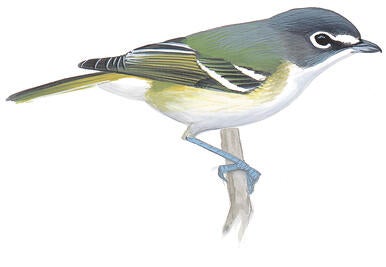
Vireo solitarius
Saw again a slender vireo-like bird (seen yesterday, near R. Brown’s); head somewhat crested behind; made me think of small pewee, —catches insects somewhat like it. As I remember, maybe ashy-white beneath, dusky-olive above, with two whitish bars on wings and dusky tail. Can it be the solitary vireo? 

Equisetum sylvaticum, probably yesterday or day before. Strawberry. That low sedge-like plant under Clamshell very common, with brownish, somewhat umbelled spikes, probably Luzula campestris (?), one of the wood rushes. 

Viola lanceolata, yesterday at least. High blackberry has begun to leaf; say two days. 


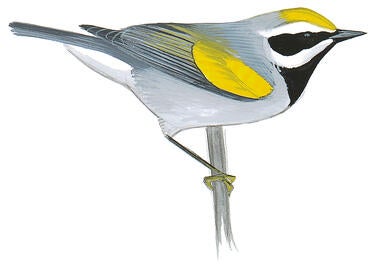
Vermivora chrysoptera
(golden-winged warbler)
Hear near Second Division the er er twe, ter ter twe, evergreen-forest note. Bright-yellow head and shoulders and beneath, and dark legs and bill catching insects along base of pitch pine plumes, some, what creeper-like; very active and restless, darting from tree to tree; darts at and drives off a chickadee. I find I have thus described its colors last year at various times, viz.: black throat, this often with dark and light beneath; again, black streak from eyes, slate-colored back (?), forked tail, white beneath (?); another bird with yellow throat near by, perhaps female; again, June 17 , black wings with white bars.  


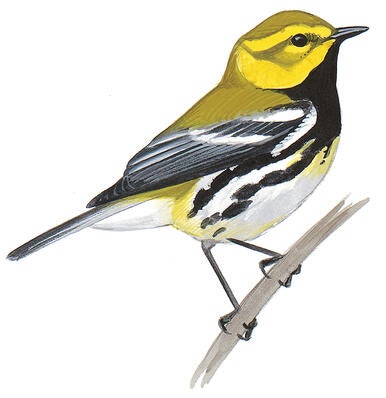
Setophaga virens
(black-throated green warbler)
Is it black throated green, or Latham’s yellow-fronted, or the golden-winged warbler? From Wilson I should think it the last, which he thinks the same with Pennant and Latham’s yellow-front.

The small juncus at Second Division shows a field of dark green with reddish top, the flower just beginning to peep out; this the earliest plant of this kind to make a show; more than a foot high. 


Trailing arbutus (epigaea) May 4, 2015
Epigaea in full bloom.

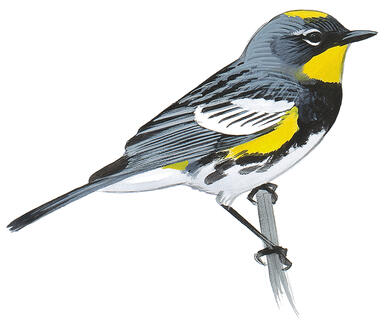
Setophaga coronata
(yellow-rumped warbler)
Myrtle-birds very numerous just beyond Second Division. They sing like an instrument, teee teee te, t t t, t t t, on very various keys; i.e. high or low, some times beginning like phe-be. As I sat by roadside one drew near, perched within ten feet, and dived once or twice with a curve to catch the little black flies about my head, coming once within three feet, not minding me much. I could not tell at first what attracted it toward me. It saw them from twenty-five feet off. There was a little swarm of small flies, regularly fly-like with large shoulders, about my head. 

Many white-throated sparrows there.

Road full of cattle going up country. 


Regulus calendula
Hear at a distance a ruby(?)-crowned wren, so robin-like and spirited. After see one within ten or fifteen feet. Dark bill and legs, apparently dark olivaceous ashy head, a little whitish before and behind the full black eyes, ash breast, olive-yellow on primaries, with a white bar, dark tail and ends of wings, white belly and vent. Did not notice vermilion spot on hindhead. It darts off from apple tree for insects like a pewee, and returns to within ten feet of me as if curious. I think this the only Regulus I have ever seen.

Near Jenny Dugan’s, perceive that unaccountable fugacious fragrance, as of all flowers, bursting forth in air, not near a meadow, which perhaps I first perceived on May 1st. It is the general fragrance of the year. I am almost afraid I shall trace it to some particular plant. It surpasses all particular fragrances. I am not sitting near any flower that I can perceive.

Two or three rods this side of John Hosmer’s pitch pines, beyond Clamshell, some white Viola ovata, some with a faint bluish tinge. 

A beautiful sunset, the sun behind a gilt-edged cloud, with a clear bright crimson space beneath.

H. D. Thoreau, Journal, May 6, 1855

The er er twe, ter ter twe, evergreen-forest note. See. May 12, 1854 (" Heard again the evergreen -forest note. It is a slender bird , about size of white-eyed vireo, with a black throat and I think some yellow above, with dark and light beneath , in the tops of pines and oaks. The only warblers at all like it are black-throated green, black-throated blue, black-poll, and golden winged, and maybe orange-crowned");.June 12, 1854 (" Hear the evergreen-forest note , and see the bird on the top of a white pine , somewhat creeper like , along the boughs , and golden head except a black streak from eyes , black throat , slate - colored back , forked tail , white beneath , er te , ter ter te . Another bird with yellow throat near by may have been the other sex . Is it the golden - winged warbler ?");  June 17, 1854 ("The evergreen - forest bird at old place in white pine and oak tops, top of Brister's Hill on right. I think it has black wings with white bars. Is it not the black-throated green warbler") See also May 11, 1854("Hear the evergreen-forest note"); June 1, 1854 ("Hear my evergreen-forest note, sounding rather raspingly as usual, where there are large oaks and pines mingled. It is very difficult to discover now that the leaves are grown, as it frequents the tops of the trees. But I get a glimpse of its black throat and, I think, yellow head "); July 10 1854 ("Evergreen-forest note, I think, still.") and May 30, 1855 ("In the thick of the wood between railroad and Turnpike, hear the evergreen forest note, and see probably the bird,-- black throat, greenish-yellow or yellowish-green head and back, light-slate (?) wings with two white bars. Is it not the black-throated green warbler?”) and A Book of the Seasons, by Henry Thoreau, The Black-throated Green Warbler

That unaccountable fugacious fragrance, as of all flowers, bursting forth in air, . . .the general fragrance of the year. See April 21, 1854 ("As I go up the hill beyond the brook, while the hylodes are heard behind, I perceive the faintest possible flower-like scent as from the earth, reminding me of anemonies and houstonias.”); May 16, 1854 ("The earth is all fragrant as one flower. And bobolinks tinkle in the air. Nature now is perfectly genial to man.”) May 16, 1852 (“The whole earth is fragrant as a bouquet held to your nose. A fine, delicious fragrance, which will come to the senses only when it will.”); June 5, 1853 (“The heavens and the earth are one flower. “).

Dark bill and legs, apparently dark olivaceous ashy head, a little whitish before and behind the full black eyes, ash breast, olive-yellow on primaries, with a white bar, dark tail and ends of wings, white belly and vent. Compare J. J. Audubon (“Bill black, yellow at the base of the lower, and on the edges of the upper mandible. Iris light brown. Feet yellowish-brown, the under parts yellow. The general colour of the upper parts is dull olivaceous ”) See note to April 20, 1859 ("My ruby-crowned or crested wren”)

I  think this the only Regulus I have ever seen.   See May 7, 1854  ("This was the same I have called golden-crowned . . . except that I saw its ruby crest. I didn't see the crest of the golden-crowned,  . . Have I seen the two?); May 11, 1854 (" I am in a little doubt about the wrens . . .  whether I have seen more than one. All that makes me doubt is that I saw a ruby, or perhaps it might be called fiery, crest on the last — not golden.”);  December 25, 1859 ("I can see a brilliant crown even . . . when I can detect no other part. It is evidently the golden-crested wren, which I have not made out before.”);


Friday, April 25, 2014

The first partridge drums.

April 25

Heard and saw my warbler (?) of the 23d and 24th on Mr. Emerson's  pines. It is the smallest bird I have seen this year. Sits still amid the pines not far below the top and sings very sweetly, loud and clear, and seems further off than it is, beginning first with very fine wiry notes and then increasing in volume and melody till it ends with tweeter tweeter tweeter ter twe. Some of it a martin-like warble. Has sometimes a harsh scolding note. 

It is all light, perhaps ashy-white, beneath; has a little narrow forked tail; ashy (?) under wings, which are considerably shorter than tail; and light above and below eye; perhaps a whitish bar on wings; olivaceous(?) above. 

I think it may be the golden-crested wren, though I hardly saw the upper parts, or possibly the small blue-gray flycatcher. 

I do not find the male blossoms of the red cedar open yet. 

P. M. — To Indian Cedar Hill. 

April 25, 2014

Quite warm and the frogs are snoring on the meadow. I swelter under my greatcoat.  

Many shad-flies in the air and alighting on my clothes. 

The summer approaches by almost insensibly increasing lieferungs of heat, each awakening some new bird or quadruped or reptile. 

At first we were compelled to take off our mittens, then to unbutton our greatcoat, and now, perhaps, to take it off occasionally (I have not left it at home yet), and wear thin boots. For some time we have done with little fire, nowadays let it go out in the afternoon. 

Each creature awaits with confidence its proper degree of heat.

The first partridge drums in one or two places, as if the earth's pulse now beat audibly with the increased flow of life. It slightly flutters all Nature and makes her heart palpitate. 

Saw a golden crested wren in the woods near Goose Pond. (This must be my warblers of April 18th, April 23d and 24th.) It sounded far off and like an imitation of a robin, (and of a golden robin, which later I often mistook for him) — a long strain and often repeated. 

I was quite near it before I was aware of it, it sounding still like a faint imitation of a robin. Some chickadees and yellow redpolls were first apparent, then my wren on the pitch pines and young oaks. 

He appeared curious to observe me. A very interesting and active little fellow, darting about amid the tree-tops, and his song quite remarkable and rich and loud for his size. 

Begins with a very fine note, before its pipes are filled, not audible at a little distance, then woriter weter, etc., etc., winding up with teter teter, all clear and round. His song is comical and reminds me of the thrasher. 

This was at 4 p. m., when most birds do not sing. I saw it yesterday, pluming itself and stretching its little wings. Our smallest bird, methinks, except the hummingbird.

As I stand listening for the wren, and sweltering in my greatcoat, I hear the woods filled with the hum of insects, as if my hearing were affected; and thus the summer's quire begins. The silent spaces have begun to be filled with notes of birds and insects and the peep and croak and snore of frogs, even as living green blades are everywhere pushing up amid the sere ones.

I heard that same snoring which I hear on the river meadows, on an inland meadow this afternoon, where I think no bullfrogs are. Are they not then the palustris, or else the shad frog? 

There are now many new insects in the air. 

Black ducks still on Flint's. 

The fertile fruit-stems of the sensitive fern by the side of the Flint's Pond path, more than a foot high, are a rich ornament to the ground, brown, four or five inches long, and turned to one side, contrasting with the lighter rachis (?). 

Saw my thrush of the 18th by the pond. It appears dark-olive, ferruginous on rump and tail, with a dark streak slanting from each cheek and flesh-colored legs. 

The red cedar has fairly begun to-day; maybe the first yesterday. Put the red yesterday and the white to-day. As I approach the red cedars now, I perceive a delicious strawberry-like fragrance in the air, like that from the arbor-vita. 

The creeping juniper apparently open, but not yet open. 

Though I see some amber on the sweet-fern, I am in doubt whether to say to-day or to-morrow. 

The wild red cherry (if that is one near Everett's), privet, and buckthorn are beginning to leaf out. 

The abele will probably blossom to-morrow. 

H. D. Thoreau,  Journal, April 25, 1854

The frogs are snoring on the meadow. See April 11, 1854 ("Hear a slight snoring of frogs on the bared meadows. Is it not the R. palustris?"); May 6, 1858 (“There was a universal snoring of the R. palustris all up and down the river on each side . . . and probably it began in earnest last evening on the river. It is a hard, dry, unmusical, fine watchman’s-rattle-like stertoration, swelling to a speedy conclusion, lasting say some four or five seconds usually . . . Each shore of the river now for its whole length is all alive with this stertorous purring. It is such a sound as I make in my throat when I imitate the growling of wild animals. I have heard a little of it at intervals for a week, in the warmest days, but now at night it [is] universal all along the river. If the note of the R. halecina, April 3d, was the first awakening of the river meadows, this is the second . . .Yet how few distinguished this sound at all, and I know not one who can tell what frog makes it, though it is almost as universal as the breeze itself.”) See also A Book of the Seasons, by Henry Thoreau, The Pickerel frog (Rana palustris) and A Book of Seasons, by Henry Thoreau, The first frogs to begin calling

I swelter under my greatcoat. . . .(I have not left it at home yet)
See April 26, 1854 (“It is now so warm that I go back to leave my greatcoat for the first time, and the cooler smell of possible rain is refreshing”; April 26, 1852 (“I begin now to leave off my greatcoat.”)

Many shad-flies in the air and alighting on my clothes.
See May 1, 1854 (“The water is strewn with myriads of wrecked shad-flies, erect on the surface, with their wings up like so many schooners all headed one way.”);May 1, 1858 (“Ephemerae quite common over the water. ”); See also A Book of the Seasons, by Henry Thoreau, Insect Hatches in Spring (millers, perla, shad-flies or ephemera)

Increasing lieferungs of heat, each awakening some new bird or quadruped or reptile. See April 6, 1860 (“Vegetation thus comes forward rather by fits and starts than by a steady progress. Some flowers would blossom tomorrow if it were as warm as to-day, but cold weather intervening may detain them a week or more. The spring thus advances and recedes repeatedly, — its pendulum oscillates, — while it is carried steadily forward. Animal life is to its extent subject to a similar law. It is in warm and calm days that most birds arrive and reptiles and insects and men come forth.”); April 7, 1860 (“This is the Rana halecina day, — awakening of the meadows, — though not very warm.. . .Probably, then, when it is about 50 at this season, the river being low, they are to be heard in calm places.”); April 9, 1856 (“It has probably been 70° or more; and the last two days have been nearly as warm. This degree of heat, then, brings the Fringilla juncorum and pine warbler and awakes the hyla. “) April 13, 1859 (“The hylodes and wood frogs are other degrees on the thermometer of the season, indicating that the weather has attained a higher temperature than before and winter fairly ended, but this note marks what you may call April heat (or spring heat).”);  May 6, 1858 (I think that the different epochs in the revolution of the seasons may perhaps be best marked by the notes of reptiles. They express, as it were, the very feelings of the earth or nature. They are perfect thermometers, hygrometers, and barometers.”)

I hear the woods filled with the hum of insects, as if my hearing were affected; and thus the summer's quire begins.
See  April 17, 1859 (“The air which was so lately void and silent begins to resound as it were with the breathing of a myriad fellow-creatures . . . gradually the spaces of the air are filled . . . we hear but little music in the world which charms us more than this sound produced by the vibration of an insect's wing and in some still and sunny nook in spring.”); April 28, 1860 ("I am advertised of the approach of a new season, as yesterday. The air is not only warmer and stiller, but has more of meaning or smothered voice to it, now that the hum of insects begins to be heard. You seem to have a great companion with you, are reassured by the scarcely audible hum, as if it were the noise of your own thinking”)

Even as living green blades are everywhere pushing up amid the sere ones.
See April 25, 1859 ("I got to-day and yesterday the first decided impression of greenness beginning to prevail, summer-like . .. I am suddenly advertised that a new season has arrived.") See also April 14, 1854 ("There is a general tinge of green now discernible through the russet on the bared meadows and the hills, the green blades just peeping forth amid the withered ones."); April 23, 1854 ("How thickly the green blades are starting up amid the russet! "); April 24, 1859 (“From the amid the withered blades spring up ranks of green life like a fire . . . the renewal of life.”); April 28, 1854 ("Perhaps the greenness of the landscape may be said to begin fairly now . . . during the last half of April the earth acquires a distinct tinge of green, which finally prevails over the russet.") and A Book of the Seasons, by Henry Thoreau, Brown Season

["Golden"- crested wren] .It is the smallest bird I have seen this year . . . Our smallest bird, methinks, except the hummingbird.  Note. Thoreau first misidentified the ruby-cowned as a warbler and also misidentiifed the ruby-crowned as the golden-crowned. He was put in doubt when he saw a red crest on what he had been calling the golden-crested wren, and did not truly identify a golden-crested wren until Christmas 1859. See note to December 25, 1859. See also See A Book of the Seasons, by Henry Thoreau: the ruby-crowned or crested wren.

This must be my warblers of April 18th, April 23d and 24th . . . I saw it yesterday. See April 18, 1854 ("Saw another warbler about the same size, in the same localities, somewhat creeper-like, very restless, more like the Tennessee warbler than any, methinks. Light-slate or bluish-slate head and shoulders, yellowish backward, all white beneath, and a distinct white spot on the wing; a harsh grating note[?]."); April 23, 1854 ("Had a glimpse of a very small warbler on a pitch pine, and heard a pleasant and unusual whistle from him."); April 24, 1854 ("Hear amid the white cedars the fine, clear singing warbler of yesterday, whose harsh note I may have heard the 18th, very clear and fast.")
 
Black ducks still on Flint's. See April 27, 1860 ("The hurry of the duck migration is, methinks, over"); See also A Book of the Seasons, by Henry Thoreau, the American Black Duck

The fertile fruit-stems of the sensitive fern by the side of the Flint's Pond path, more than a foot high. See  May 13, 1860 ("The sensitive fern is only six inches high. — apparently the latest of all")

Saw my thrush of the 18th by the pond. See April 18, 1854 ("Was surprised to see a wagtail thrush. . . which inquisitively followed me along the shore over the snow, hopping quite near.")

Put the red yesterday and the white to-day. See April 24, 1854 ("The white cedar female blossoms are open."); see also  April 24, 1855  ("The sprigs of red cedar, now full of the buff-colored staminate flowers, like fruit, are very rich. The next day they shed an abundance of pollen in the house. It is a clear buff color, while that of the white cedar is very different, being a faint salmon." )

The abele will probably blossom to-morrow. See April 26, 1855 ("The silvery abele, probably to-day or yesterday, but I do not see pollen.")

The first partridge drums in one or two places, as if the earth's pulse now beat audibly with the increased flow of life. It slightly flutters all Nature and makes her heart palpitate. See April 19, 1860 ("Toward night, hear a partridge drum. You will hear at first a single beat or two far apart and have time to say, "There is a partridge," so distinct and deliberate is it often, before it becomes a rapid roll.");  April 29, 1857 ("A partridge there drums incessantly. C. says it makes his heart beat with it, or he feels it in his breast."); June 22, 1851("My pulse must beat with Nature”). See also A Book of Seasons,  by Henry Thoreau, the Partridge.

April 25, 2014

The first partridge drums –
earth’s pulse now beats audibly
with the flow of life.

A Book of the Seasons,  by Henry Thoreau
 "A book, each page written in its own season,
out-of-doors, in its own locality."
 ~edited, assembled and rewritten by zphx ©  2009-2024
https://tinyurl.com/hdt-540425


Popular Posts Last 30 Days.

The week ahead in Henry’s journal

The week ahead in Henry’s journal
A journal, a book that shall contain a record of all your joy.
"A stone fruit. Each one yields me a thought." ~ H. D. Thoreau, March 28, 1859


I sit on this rock
wrestling with the melody
that possesses me.