Showing posts with label chestnut-sided warbler. Show all posts

Saturday, June 15, 2019

Willow gone to seed, its down covers the water – white amid the weeds.

June 15. 


5.30 a. m. — To Island and Hill. 

A young painted tortoise on the surface of the water, as big as a quarter of a dollar, with a reddish or orange sternum. 

I suppose that my skater insect is the hydrometer. 

Found a nest of tortoise eggs, apparently buried last night, which I brought home, ten in all, — one lying wholly on the surface, — and buried in the garden. 

The soil above a dark virgin mould about a stump was unexpectedly hard.

1 P. M. — Up Assabet to Garlic Wall. 

That tall grass opposite the Merrick Swimming-Place is getting up pretty well, and blossoming with a broad and regular spike, for some time. 

June 15, 2024

This is the third afternoon that we have had a rumbling thunder-cloud arise in the east, — not to mention the west, — but all signs have failed hitherto, and I resolve to proceed on my voyage, knowing that I have a tight [roof] in my boat turned up. 

The froth on the alders, andromeda, etc., — not to speak of the aphides, — dirties and apparently spots my clothes, so that it is a serious objection to walking amid these bushes these days. I am covered with this spittle-like froth. 

At the Assabet Spring I must have been near a black and white creeper's nest. It kept up a constant chipping. 
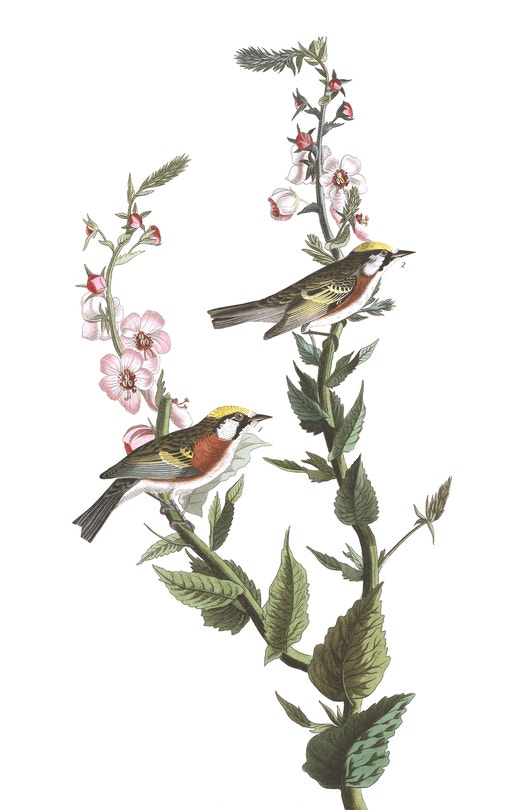


Saw there also, probably, a chestnut-sided warbler. A yellow crown, chestnut stripe on sides, white beneath, and two yellowish bars on wings. 

A red oak there has many large twigs drooping withered, apparently weakened by some insect. May it not be the locust of yesterday? 

Black willow is now gone to seed, and its down covers the water, white amid the weeds. 

The swamp-pink apparently two or even three days in one place. 

Saw a wood tortoise, about two inches and a half, with a black sternum and the skin, which becomes orange, now ochreous merely, or brown. The little painted tortoise of the morning was red beneath. Both these young tortoises have a distinct dorsal ridge. 

The garlic not in flower yet. 

I observed no Nuphar lutea var. Kalmiana on the Assabet. 

7 p. m. — To Cliff by railroad. 

Cranberry. Prinos Icevigatus, apparently two days.

Methinks the birds sing a little feebler nowadays. The note of the bobolink begins to sound somewhat rare. 

The sun has set, or is at least concealed in a low mist. 

As I go up Fair Haven Hill, I feel the leaves in the sprout-land oak, hickory, etc., cold and wet to my hand with the heavy dew that is falling. They look dry, but when I rub them with my hand, they show moist or wet at once. Probably I thus spread minute drops of dew or mist on their surface. It cannot be the warmth of my hand, for when I breathe on them it has no effect. 

I see one or two early blueberries prematurely turning. 

The Amelanchier Botryapium berries are already reddened two thirds over, and are somewhat palatable and soft, — some of them, — not fairly ripe.

H. D. Thoreau, Journal, June 15, 1854

A young painted tortoise . . . as big as a quarter of a dollar
. See April 21, 1855 ("Saw a painted turtle not two inches in diameter. This must be more than one year old."); April 24, 1856 ("A young Emys picta, one and five eighths inches long and one and a half wide. I think it must have been hatched year before last. "); August 28, 1856 ("I open the painted tortoise nest of June 10th, and find a young turtle partly out of his shell . . . The upper shell is fifteen sixteenths of an inch plus by thirteen sixteenths. He is already wonderfully strong and precocious."). See also A Book of the Seasons, by Henry Thoreau, the Painted Turtle (Emys picta)

Found a nest of tortoise eggs. . . which I brought home . . . and buried in the garden. See September 9, 1854 ("This morning I find a little hole, three quarters of an inch or an inch over, above my small tortoise eggs, and find a young tortoise coming out (apparently in the rainy night) just beneath. It is the Sternotherus odoratus"). See also A Book of the Seasons, by Henry Thoreau, the Musk Turtle (Sternothaerus odoratus)

This is the third afternoon that we have had a rumbling thunder-cloud arise in the east. . . I resolve to proceed on my voyage, knowing that I have a tight [roof] in my boat turned up. See June 13, 1854 (''I hear the muttering of thunder and see a dark cloud in the west-southwest horizon; am uncertain how far up-stream I shall get. An opposite cloud rises fast in the east-northeast, and now the lightning crinkles and I hear the heavy thunder. "); June 16, 1854 (" Three days in succession, — the 13th, 14th, and 15th, — thunder-clouds, with thunder and lightning, have risen high in the east, threatening instant rain, and yet each time it has failed to reach us. Thus it is almost invariably, methinks, with thunder-clouds which rise in the east; they do not reach us."). See also June 14, 1855 (" It suddenly begins to rain with great violence, and we in haste draw up our boat on the Clamshell shore, upset it, and get under, sitting on the paddles, and so are quite dry while our friends thought we were being wet to our skins. "); June 15, 1860 ("A thunder-shower in the north goes down the Merrimack. ");June 16, 1860  (" Thunder-showers show themselves about 2 P.M. in the west, but split at sight of Concord and go past on each side")

My skater insect. 
See March 25, 1858 ("Large skaters (Hydrometra) on a ditch"); March 29, 1853 (“Tried several times to catch a skater. Got my hand close to him; grasped at him as quick as possible; was sure I had got him this time; let the water run out between my fingers; hoped I had not crushed him; opened my hand; and lo! he was not there. I never succeeded in catching one.”); September 1, 1852 ("the surface of the pond is perfectly smooth except where the skaters dimple it, for at equal intervals they are scattered over its whole extent, and, looking west, they make a fine sparkle in the sun."); October 11, 1852 ("I could detect the progress of a water-bug over the smooth surface in almost any part of the pond, for they furrow the water slightly,. . . but the skaters slide over it without producing a perceptible ripple. ") See also A Book of the Seasons, by Henry Thoreau, the Water-bug (Gyrinus) and Skaters (Hydrometridae)

Saw probably, a chestnut-sided warbler. A yellow crown, chestnut stripe on sides, white beneath, and two yellowish bars on wings. See May 24, 1854 ("In woods the chestnut-sided warbler, with clear yellow crown and yellow on wings and chestnut sides. It is exploring low trees and bushes, often along stems about young leaves, and frequently or after short pauses utters its somewhat summer-yellowbird like note, say, tchip tchip, chip chip (quick), tche tche ter tchéa, —— sprayey and rasping and faint.”); May 20, 1856 ("I now see distinctly the chestnut-sided warbler (of the 18th and 17th), by Beck Stow’s. It is very lively on the maples, birches, etc., over the edge of the swamp. Sings eech eech eech | wichy wichy | tchea or itch itch itch | witty witty |tchea "); May 23, 1857 (“The chestnut-sided warbler . . .appears striped slate and black above, white beneath, yellow-crowned with black side-head, two yellow bars on wing, white side-head below the black, black bill, and long chestnut streak on side. Its song lively and rather long, about as the summer yellowbird, but not in two bars; tse tse tse \ te tsah tsah tsah \ te sak yer se is the rhythm.”)  See also A Book of the Seasons, by Henry Thoreau, the Chestnut-sided Warbler

Black willow is now gone to seed, and its down covers the water, white amid the weed.   See  June 10, 1853 ("The fuzzy seeds or down of the black (?) willows is filling the air over the river and, falling on the water, covers the surface.");   June 29, 1857  (""The river is now whitened with the down of the black willow, and I am surprised to see a minute plant abundantly springing from its midst and greening it,. . ., — like grass growing in cotton in a tumbler."); July 9, 1857 ("There is now but little black willow down left on the trees. . . . I think I see how this tree is propagated by its seeds." )See also A Book of the Seasons, by Henry Thoreau, the Propogation of the Willow.

The swamp-pink apparently two or even three days in one place. June 19, 1852 ("Is not this the carnival of the year when the swamp rose and wild pink are in bloom the last stage before blueberries come?") See also A Book of the Seasons, by Henry Thoreau, Swamp-pink

Methinks the birds sing a little feebler nowadays. See June 25, 1854 (“Through June the song of the birds is gradually growing fainter.”)

The note of the bobolink begins to sound somewhat rare.
See May 12, 1856 ("How much life the note of the bobolink imparts to the meadow! "); June 19, 1853 ("The strain of the bobolink now begins to sound a little rare. It never again fills the air as the first week after its arrival.") A Book of the Seasons,  by Henry Thoreau, the Bobolink

I see one or two early blueberries prematurely turning. The Amelanchier Botryapium berries are already red. See May 17, 1853 (“The petals have already fallen from the Amelanchier Botryapium, and young berries are plainly forming.”); May 30, 1854 (" I see now green high blueberries, and gooseberries in Hubbard's Close, as well as shad-bush berries and strawberries. "); June 7, 1854 ("I am surprised at the size of green berries. It is but a step from flowers to fruit.")

June 15. See A Book of the Seasons, by Henry Thoreau, June 15

Willow gone to seed
its down covers the water –
white amid the weeds.

A Book of the Seasons,  by Henry Thoreau 
 "A book, each page written in its own season, 
out-of-doors, in its own locality."
 ~edited, assembled and rewritten by zphx ©  2009-2024
https://tinyurl.com/hdt-540615

Tuesday, May 30, 2017

Meditations under a rock in a shower.

May 30. 

P. M. — To chestnut oaks. 

May 30, 2017

I think that there are many chestnut-sided warblers this season. They are pretty tame. One sits within six feet of me, though not still. He is much painted up. 

Blue-stemmed goldenrod is already a foot high. 

I see the geranium and two-leaved Solomon's-seal out, the last abundant. The red pyrus by the path, not yet, but probably the same elsewhere. 

The young black oak leafets are dark red or reddish, thick and downy; the scarlet oak also are somewhat reddish, thick and downy, or thin and green and little downy, like red oak, but rather more deeply cut; the red oak broad, thin, green and not downy; the white pink-red. 

Was it not a whip-poor-will I scared up at the base of a bush in the woods to-day, that went off with a clumsy flight? 

By the path near the northeast shore of Flint's Pond, just before reaching the wall by the brook, I see what I take to be an uncommonly large Uvularia sessilifolia flower, but, looking again, am surprised to find it the Uvularia perfoliata, which I have not found hereabouts before. It is a taller and much more erect plant than the other, with a larger flower, methinks. It is considerably past its prime and probably began with the other. 

Chestnut oak not yet in bloom, though the black and scarlet are well out in ordinary places. Its young leaves have a reddish-brown tinge. All the large trees are cut down. 

The white oak is not out. 

It is remarkable that many beach and chestnut oak leaves, which so recently expanded, have already attained their full size! How they launch themselves forth to the light! How suddenly Nature spreads her umbrellas! How little delay in expanding leaves! They seem to expand before our eyes, like the wings of moths just fallen from the cocoon. 

Buttercups thickly spot the churchyard. 

Perhaps I could write meditations under a rock in a shower. 

When first I had sheltered myself under the rock, I began at once to look out on the pond with new eyes, as from my house. I was at Lee's Cliff as I had never been there before, had taken up my residence there, as it were. Ordinarily we make haste away from all opportunities to be where we have instinctively endeavored to get. 

When the storm was over where I was, and only a few thin drops were falling around me, I plainly saw the rear of the rain withdrawing over the Lincoln woods south of the pond, and, above all, heard the grand rushing sound made by the rain falling on the freshly green forest, a very different sound when thus heard at a distance from what it is when we are in the midst of it. In the latter case we are soothed by a gentle pattering and do not suspect the noise which a rain storm makes. 

This Cliff thus became my house. I inhabited it. When, at length, it cleared up, it was unexpectedly early and light, and even the sun came out and shone warm on my back as I went home. Large puddles occupied the cart-paths and rose above the grass in the fields. 

In the midst of the shower, though it was not raining very hard, a black and white creeper came and in spected the limbs of a tree before my rock, in his usual zigzag, prying way, head downward often, and when it thundered loudest, heeded it not. Birds appear to be but little incommoded by the rain. Yet they do not often sing in it. 

The blue sky is never more celestial to our eyes than when it is first seen here and there between the clouds at the end of a storm, — a sign of speedy fair weather. I saw clear blue patches for twenty minutes or more in the southwest before I could leave my covert, for still I saw successive fine showers falling between me and the thick glaucous white pine beneath.

I think that such a projection as this, or a cave, is the only effectual protection that nature affords us against the storm. 

I sang "Tom Bowling" there in the midst of the rain, and the dampness seemed to be favorable to my voice. There was a slight rainbow on my way home. 

Met Conant riding home, who had been caught in town and detained, though he had an umbrella. 

Already a spider or other insect had drawn together the just expanded leaves of a hickory before my door with its web within them, making a close tent. This twig extended under my rocky roof and was quite dry. 

Probably a portion of the Cliff, being undermined by rain, had anciently fallen out and left this rocky roof above.

H. D. Thoreau, Journal, May 30, 1857

Buttercups thickly spot the churchyard. See May 27, 1853 ("The buttercups in the church-yard and on some hillsides are now looking more glossy and bright than ever after the rain.”); June 2, 1852 (“Buttercups now spot the churchyard.”)

Perhaps I could write meditations under a rock in a shower. See August 13, 1853 (“Could I not write meditations under a bridge at midsummer?”)

The blue sky is never more celestial to our eyes than when it is first seen here and there between the clouds at the end of a storm.
See January 7, 1851 ("The life, the joy, that is in blue sky after a storm!")

I began at once to look out on the pond with new eyes, as from my house. I was at Lee's Cliff as I had never been there before . . .See June 13, 1854 ("When I have stayed out thus late many miles from home, and have heard a cricket beginning to chirp louder near me in the grass I have felt that I was not far from home after all, -- began to be weaned from my village home."); May 23, 1853 ("[A] certain lateeness ... releases me from the obligation to return in any particular season. I have passed the Rubicon of staying out. ...I will wander further from what I have called my home - to the home which is forever inviting me. In such an hour the freedom of the woods is offered me")

May 30 See A Book of the Seasons, by Henry Thoreau, May 30


A Book of the Seasons,  by Henry Thoreau
"A book, each page written in its own season,
out-of-doors, in its own locality.”


~edited, assembled and rewritten by zphx © 2009-2021

Tuesday, May 23, 2017

This is the time and place to hear the new-arriving warblers, the first fine days after the May storm.

May 23
May 23, 2017
(avesong)
P. M. — To Holden Swamp by boat. 

River still high generally over the meadows. Can sail across the Hubbard meadow. 

Off Staples wood-lot, hear the ah tche tche chit-i-vet of the redstart. 

Tortoises out again abundantly. Each particularly warm and sunny day brings them out on to every floating rail and stump. I count a dozen within three or four feet on a rail. It is a tortoise day. 

I hear one regular bullfrog trump, and as I approach the edge of the Holden Swamp, the tree-toads. 

Hear the pepe there, and the redstarts, and the chestnut-sided warbler. It appears striped slate and black above, white beneath, yellow-crowned with black side-head, two yellow bars on wing, white side-head below the black, black bill, and long chestnut streak on side. Its song lively and rather long, about as the summer yellowbird, but not in two bars; tse tse tse \ te tsah tsah tsah \ te sak yer se is the rhythm. 

Kalmia glauca yesterday. Rhodora, on shore there, a little before it. 

Nemopanthes, a day or two. 

This is the time and place to hear the new-arriving warblers, the first fine days after the May storm. When the leaves generally are just fairly expanding, and the deciduous trees are hoary with them, — a silvery hoari-ness, — then, about the edges of the swamps in the woods, these birds are flitting about in the tree-tops like gnats, catching the insects about the expanding leaf-buds. 

I wade in the swamp for the kalmia, amid the water andromeda and the sphagnum, scratching my legs with the first and sinking deep in the last. The water is now gratefully cool to my legs, so far from being poisoned in the strong water of the swamp. It is a sort of baptism for which I had waited. 

At Miles Swamp, the carpinus sterile catkins, apparently a day or two, but I see no fertile ones, unless that is one (pressed) at the southeast edge of swamp near grafted apple, and its catkins are effete! 

Hear the first veery strain. 

The small twigs of the carpinus are singularly tough, as I find when I try to break off the flowers. They bend without breaking. 

Sand cherry at Lupine Bank, possibly a day. Sassafras, a day or two. Fringed polygala, I hear of.

The first goldfinch twitters over, and at evening I hear the spark of a nighthawk.

H. D. Thoreau, Journal, May 23, 1857

Off Staples wood-lot, hear the ah tche tche chit-i-vet of the redstart. See May 29, 1855 (“But what is that bird I hear much like the first part of the yellowbird’s strain, only two thirds as long and varied at end, and not so loud, — a-che che che, che-a, or tche tche tche, tche-a, or ah tche tche tche, chit-i-vet? ”); June 4, 1855 ("Redstarts still very common in the Trillium Woods (yesterday on Assabet also). Note tche, tche, tche vit, etc.”); June 6, 1855 ("On the Island I hear still the redstart—tsip tsip tsip tsip, tsit-i-yet, or sometimes tsip tsip tsip tsip, tse vet. A young male.”)  See also A Book of Seasons,  by Henry Thoreau, The American Redstart

The chestnut-sided warbler. See May 20, 1856 ("I now see distinctly the chestnut-sided warbler (of the 18th and 17th), by Beck Stow’s. It is very lively on the maples, birches, etc., over the edge of the swamp. Sings eech eech eech | wichy wichy | tchea or itch itch itch | witty witty | tchea  ");  May 24, 1854 ("In woods the chestnut-sided warbler, with clear yellow crown and yellow on wings and chestnut sides. It is exploring low trees and bushes, often along stems about young leaves, and frequently or after short pauses utters its somewhat summer-yellowbird like note, say, tchip tchip, chip chip (quick), tche tche ter tchéa, —— sprayey and rasping and faint.")

Kalmia glauca yesterday. Rhodora, on shore there, a little before it. See May 27, 1856 ("Kalmia in prime, and rhodora. . . ."); May 26, 1855 ("To my surprise the Kalmia glauca almost all out; perhaps began with rhodora. A very fine flower, the more interesting for being early."); January 9, 1855 ("Make a splendid discovery this afternoon. Walking through Holden’s white spruce swamp, I see peeping above the snow-crust some slender delicate evergreen shoots . . . the Kalmia glauca var.rosmarinifolia.") Note: the Kalmia glauca var. rosmarinifolia is known as rosemary-leaf laurel or alpine bog laurel (Andromeda Polifolia) H. Peter Loewer, Thoreau's Garden: Native Plants for the American Landscape 32-33

This is the time and place to hear the new-arriving warblers. See note to May 18, 1856  ("The swamp is all alive with warblers about the hoary expanding buds of oaks, maples, etc., and amid the pine and spruce. They swarm like gnats now. They fill the air with their little tshree tshree sprayey notes.")

I wade in the swamp for the kalmia, . . . a sort of baptism for which I had waited. Compare May 13, 1860 ("The swamp is so dry that I walk about it in my shoes").

The first goldfinch twitters over. See May 4, 1856 ("Hear and see a goldfinch, on the ground."); May 5, 1854 ("Hear what I should call the twitter and mew of a goldfinch and see the bird go over with ricochet flight"); May 13, 1854 ("Goldfinch heard pretty often."); May 17, 1856 ("A goldfinch twitters over. ")

See A Book of the Seasons, by Henry Thoreau May 23

A Book of the Seasons, by Henry Thoreau\
"A book, each page written in its own season,
out-of-doors, in its own locality.”

~edited, assembled and rewritten by zphx © 2009-2021

Friday, May 20, 2016

The distant crashing of thunder.

May 20

Fir-balsam (ours in grove) apparently two or three days, for it [is] almost entirely effete; cones white, one inch long nearly. 

Was awaked and put into sounder sleep than ever early this morning by the distant crashing of thunder, and now, — P. M. (to Beck Stow’s),— I hear it in mid-afternoon, muttering, crashing in the muggy air in mid-heaven, a little south of the village as I go through it, like the tumbling down of piles of boards, and get a few sprinkles in the sun. 

Nature has found her hoarse summer voice again, like the lowing of a cow let out to pasture. It is Nature’s rutting season. Even as the birds sing tumultuously and glance by with fresh and brilliant plumage, so now is Nature’s grandest voice heard, and her sharpest flashes seen. The air has resumed its voice, and the lightning, like a yellow spring flower, illumines the dark banks of the clouds. All the pregnant earth is bursting into life like a mildew, accompanied with noise and fire and tumult. Some oestrus stings her that she dashes headlong against the steeples and bellows hollowly, making the earth tremble. She comes dropping rain like a cow with overflowing udder. The winds drive her; the dry fields milk her. 

It is the familiar note of another warbler, just arrived, echoing amid the roofs. I see, on a locust in the burying-ground, the Sylvia striata, or black-poll warbler, busily picking about the locust buds and twigs. Black head and above, with olive (green) wings and two white bars; white all beneath, with a very distinct black line from throat to shoulders; flesh-colored legs; bill, dark above, light beneath. Hear no note. Saw it well. 

At Moore’s Swamp on Bedford road, myriads of pollywogs half an inch long darken or blacken the shore, chiefly head as yet. 

Bank swallows are very lively about the low sand-bank just beyond, in which are fifty holes.


I now see distinctly the chestnut-sided warbler (of the 18th and 17th), by Beck Stow’s. It is very lively on the maples, birches, etc., over the edge of the swamp. Sings eech eech eech | wichy wichy | tchea or itch itch itch | witty witty |  tchea. Yet this note I represented on the 18th by tche tche tche | tchut tchutter we

The andromeda has apparently been out several days, but no buck-bean there yet, nor will for a day or two. 

See and hear a stake-driver in the swamp. It took one short pull at its pump and stopped. 

Two marsh hawks, male and female, flew about me a long time, screaming, the female largest, with ragged wings, as I stood on the neck of the peninsula. This induced me to climb four pines, but I tore my clothes, got pitched all over, and found only squirrel; yet they have, no doubt, a nest thereabouts. 

Haynes the carpenter calls that large glaucous puff that grows on the Andromeda paniculata, swamp-apple; says he has eaten as much as three bushels (!) of them when he was a boy, and likes them. That is what he was raised on. 

After I got him home, I observed a large leech on the upper shell of my great turtle. He stoutly resisted being turned over, by sinking his claws into the ground; was aware that that was his weak side, and, when turned, would instantly run out his head and turn himself back. No wonder the Orientals rested the world on such a broad back. 

Such broad health and strength underlies Nature.

H. D. Thoreau, Journal,  May 20, 1856

I hear it in mid-afternoon, muttering, crashing in the muggy air in mid-heaven. . . .Nature has found her hoarse summer voice again. Compare May 20, 1854 ("See the lightning, but can not hear the thunder.”);  May 17, 1853 ("Does not summer begin after the May storm?”)

At Moore’s Swamp on Bedford road, myriads of pollywogs. See note to May 19, 1857 ("See myriads of minute pollywogs, recently hatched, in the water of Moore's Swamp.”)

I see, on a locust in the burying-ground, the Sylvia striata, or black-poll warbler, busily picking about the locust buds and twigs. See  May 27, 1860 ("The Sylvia striata are the commonest bird in the street, as I go to the post-office, for several days past. I see six (four males, two females) on one of our little fir trees; are apparently as many more on another close by."); June 4,1860 ("The black-poll warblers (Sylvia striata) appear to have left, and some other warblers, if not generally, with this first clear and bright and warm, peculiarly June weather, immediately after the May rain. ") See also A Book of the Seasons, by Henry Thoreau, The Black-poll Warbler

 Bank swallows are very lively about the low sand-bank just beyond, in which are fifty holes. See May 7, 1856 (“A hundred or more bank swallows at 2 P. M. (I suspect I have seen them for some time)”); May 11, 1856 ("There are many swallows circling low over the river behind Monroe’s, — bank swallows, barn, republican, chimney, and white-bellied. These are all circling together a foot or two over the water, passing within ten or twelve feet of me in my boat."); May 12, 1856 ("I see, in the road beyond Luther Hosmer’s, in different places, two bank swallows which were undoubtedly killed by the four days’ northeast rain we have just had."); May 13, 1856 ("In the swallows’ holes behind Dennis’s, I find two more dead bank swallows, and one on the sand beneath, and the feathers of two more which some creature has eaten. This makes at least seven dead bank swallows in consequence of the long, cold northeast rain.")

I now see distinctly the chestnut-sided warbler (of the 18th and 17th), by Beck Stow’s. See May 17, 1860 ("A chestnut - sided warbler , — the handsome bird , — with a bright-yellow crown and yellow and black striped back and bright-chestnut sides, not shy, busily picking about the expanding leaves of a white birch \"); May 18, 1856 (" Also another clear pure white beneath, and vent, and side-head; black above, finely marked with yellow; yellow bars on wings; and golden crown; black bill and legs; with a clear  sweet warble like tche tche tche , tchut tchutter we.  Can this be a chestnut-sided warbler, and I not see the chestnut? [It is. Vide 20th. Saw it also the 17th here.]") See also A Book of the Seasons, by Henry Thoreau, the Chestnut-sided Warbler

The andromeda has apparently been out several days. See May 24, 1854 ("Wade into Beck Stow's. . . . Surprised to find the Andromeda Polifolia in bloom and apparently past its prime at least a week or more.")

See and hear a stake-driver in the swamp. It took one short pull at its pump and stopped. See  April 24, 1854("I hear the loud and distinct pump-a-gor of a stake-driver. Thus he announces himself."); April, 25 1858 ("Goodwin says he heard a stake-driver several days ago."); May 9, 1853 ("At sundown paddled up the river. The pump-like note of a stake-driver from the fenny place across the Lee meadow."); May 9, 1857 (" Hear stake-driver."); June 15, 1851 ("The sound of the stake-driver at a distance, — like that made by a man pumping in a neighboring farmyard, watering his cattle, or like chopping wood before his door on a frosty morning, and I can imagine like driving a stake in a meadow. The pumper. . . .before I was further off than I thought, so now I was nearer than I thought"); October 26, 1858 ("[Minott] says that some call the stake-driver “'belcher squelcher,” and some, “wollerkertoot.” I used to call them “pump-er-gor’. ” Some say “slug-toot.”See also A Book of the Seasons,  by Henry Thoreau, American Bittern (the Stake-Diver)

Two marsh hawks, male and female, flew about me a long time, screaming . . . they have, no doubt, a nest thereabouts. See May 14, 1857 ("See a pair of marsh hawks, the smaller and lighter-colored male, with black tips to wings, and the large brown female, sailing low over J. Hosmer's sprout-land and screaming, apparently looking for frogs or the like. Or have they not a nest near? They hover very near me.") See also A Book of the Seasons, by Henry Thoreau,  the Marsh Hawk (Northern Harrier)

My great turtle . . . stoutly resisted being turned over, by sinking his claws into the ground. See May 18, 1856 ("He looked like an antediluvian under that green , shaggy shell , tougher than the rock you mistake it for . . . He was fourteen and one half inches long by twelve at the broadest places, and weighed twenty-five pounds and three ounces. The claws were an inch and a quarter long beyond the skin , and very stout. You had to exert yourself to turn him over on a plane surface, he held down so firmly with his claws, as if grown to it.")

No wonder the Orientals rested the world on such a broad back. See May 4, 1852 ("Hindoos made the world rest on an elephant, and the elephant on a tortoise, and had nothing to put under the tortoise.")

Such broad health and strength underlies Nature. See October 16, 1859 ("The snapping turtle, too, must find a place among the constellations, though . . . if there is no place for him overhead, he can serve us bravely underneath, supporting the earth.") ; See also  August 23, 1853 ("All Nature is doing her best each moment to make us well. She exists for no other end"); December 16, 1853 ("Would you be well, see that you are attuned to each mood of nature"); Walden ("Nature is as well adapted to our weakness as to our strength")

So now is Nature’s 
grandest voice heard, and her 
sharpest flashes seen.

A Book of the Seasons, by Henry Thoreau
"A book, each page written in its own season,
out-of-doors, in its own locality.”
~edited, assembled and rewritten by zphx © 2009-2026

https://tinyurl.com/hdt-560520


Wednesday, May 18, 2016

Kalmia swamp is all alive with warblers

May 18. 

MAY 18, 2016

Ed. Emerson says he saw at Medford yesterday many ground-birds’ nests and eggs under apple trees. R. W. E.’s black currant (which the wild Ribes floridum is said to be much like), maybe a day. R. W. E. says that Agassiz tells him he has had turtles six or seven years, which grew so little, compared with others of the same size killed at first, that he thinks they may live four or five hundred years.

P. M. — To Kalmia Swamp. 

Go across fields from R. W. E.’s to my boat at Cardinal Shore. 

In A. Wheeler’s stubble-field west of Deep Cut, a female (?) goldfinch on an oak, without any obvious black, is mewing incessantly, the note ending rather musically. When I get over the fence, a flock of twenty or more, male and female, rise from amid the stubble, and, alighting on the oaks, sing pleasantly all together, in a lively manner. 

Going along the Spring Path, hear an oft-repeated tchip tchar, tchip tchar, etc., or tchip tcharry (this is a common note with birds) from a large bird on a tree top, a sort of flaxen olive. Made me think of a female rose-breasted grosbeak, though we thought the beak more slender. 

On the surface of the water amid the maples, on the Holden Wood shore where I landed, I noticed some of the most splendid iridescence or opalescence from some oily matter, where the water was smooth amid the maples, that I ever saw. It was where some sucker or other fish, perchance, had decayed. 

The colors are intense blue and crimson, with dull golden. The whole at first covering seven or eight inches, but broken by the ripples I have made into polygonal figures like the fragments of a most wonderfully painted mirror. These fragments, drift and turn about, apparently, as stifily on the surface as if they were as thick and strong as glass. 

The colors are in many places sharply defined in fine lines, making unaccountable figures, as if they were produced by a sudden crystallization. How much color or expression can reside in so thin a substance! 

With such accompaniments does a sucker die and mix his juices with the river. This beauty like the rainbow and sunset sky marks the spot where his body has mingled with the elements. 

A somewhat similar beauty reappears painted on the clam’s shell. Even a dead sucker suggests a beauty and so a glory of its own. I leaned over the edge of my boat and admired it as much as ever I did a rainbow or sunset sky. The colors were not faint, but strong and fiery, if not angry. 

Found a young turtle about two inches long of a flat roundish form, with scales as rough as usual, but a dull reddish or yellowish spot in middle of each scale, and edges beneath were also a pinkish red. Can it be a young yellow-spot? 

I have not noticed a tree sparrow since December! 

A Sylvia Americana, — parti-colored warbler, — in the Holden Wood, sings a, tshrea tshrea tshrea, tshre’ tshritty tshrit’. 

One low Kalmia glauca, before any rhodora there-abouts. Several kalmias, no doubt, to-morrow. 

The rhodora there maybe to-morrow. Elsewhere I find it (on Hubbard’s meadow) to-day. 

The swamp is all alive with warblers about the hoary expanding buds of oaks, maples, etc., and amid the pine and spruce. They swarm like gnats now. They fill the air with their little tshree tshree sprayey notes. 

I see close by, hopping close up to the main stem of young white pines, what you would call a Maryland yellow-throat, but less chubby, yellow throat, beneath, and vent, and dark under tail, black side; but hear no note. 

Also another clear pure white beneath, and vent, and side—head; black above, finely marked with yellow; yellow bars on wings; and golden crown; black bill and legs; with a clear, sweet warble like take tche tche, tchut tch utter weCan this be a chestnut-sided warbler, and I not see the chestnut? Hopping amid oak twigs?

I think I hear a yellow-throated vireo. Hear a tree-toad. 

Sail back on Hubbard’s redstart path, and there see a mud turtle draw in his head, . . .

E. Emerson finds half a dozen yellow violets. A hair bird’s nest building. I hear whip-poor-wills about R. W. E.’s.

H. D. Thoreau, Journal, May 18, 1856

A female goldfinch on an oak . . . a flock of twenty or more, male and female, rise from amid the stubble, and, alighting on the oaks, sing pleasantly all together, in a lively manner. See May 13, 1854 ("Goldfinch heard pretty often "); May 17, 1856 ("A goldfinch twitters over."); May 23, 1857 ("The first goldfinch twitters over.");J une 9, 1853 ("Hear a goldfinch; this the second or third only that I have heard."); July 31, 1855 ("Have observed the twittering over of goldfinches for a week."); July 31, 1859 (" The goldfinch's note, the cool watery twitter, is more prominent now"); August 4, 1852 (" hear the singular watery twitter of the goldfinch . . . as it ricochets over, he and his russet female") See also A Book of the Seasons, by Henry Thoreau, the Goldfinch

With such accompaniments does a sucker die and mix his juices with the river. See March 28, 1857 ("When I realize that the mortality of suckers in the spring is as old a phenomenon, perchance, as the race of suckers itself, I contemplate it with serenity and joy even, as one of the signs of spring."); April 18, 1852 ("The sight of the sucker floating on the meadow at this season affects me singularly."); May 23, 1854 ("How many springs shall I continue to see the common sucker (Catostomus Bostoniensis) floating dead on our river!")

A somewhat similar beauty reappears painted on the clam’s shell. See December 3, 1853 ("When I see even these humble clamshells lying open along the riverside, displaying some blue, or violet, or rainbow tints, I am reminded that some pure serenity has occupied them.")

Found a young turtle about two inches long of a flat roundish form . . . Can it be a young yellow-spot?  See  June 3, 1856 (" Picked up a young wood tortoise . . .but there was no orange on it . . .So the one of similar rounded form and size and with distinct scales but faint yellow spots on back must have been a young spotted turtle, I think, after all.") See also A Book of the Seasons, by Henry Thoreau, The Yellow-Spotted Turtle (Emys guttata)

The rhodora there maybe to-morrow. See
 May 18, 1853 ("The rhodora is one of the very latest leafing shrubs, for its leaf-buds are but just expanding, making scarcely any show yet, but quite leafless amid the blossoms."); May 18, 1855 ("Rhodora; probably some yesterday.");  May 18, 1857 ("Pratt says he saw the first rhodora . . . out yesterday"); See also May 13, 1860 ("The rhodora on shore will apparently bloom to-morrow.");  May 15, 1855 ("Rhodora will apparently open in two or three days."); May 16, 1853 ("Rhodora, trillium, and yellow violets yesterday at least."); May 17, 1853 (“The rhodora is peculiar for being, like the peach, a profusion of pink blossoms on a leafless stem. This shrub is, then, a late one to leaf out.”);  May 17, 1856 ("The rhodora there[Kalmia Swamp] will open in a day or two."); May 17, 1858 ("Rhodora at Clamshell well out.”); May 19, 1854 ("The rhodora is late, and is naked flowering.")May 26, 1859 ("The rhodora at Ledum Swamp is now in its perfection, brilliant islands of color."); May 27, 1856 (“Kalmia in prime, and rhodora.”); May 31, 1857 (“Rhodora now in its prime.”)


The swamp is all alive with warblers . . . They fill the air with their little tshree tshree sprayey notes. See April 19, 1854 ("Within a few days the warblers have begun to come. They are of every hue. Nature made them to show her colors with. There are as many as there are colors and shades. "); May 7, 1852 ("For now, before the leaves, they begin to people the trees in this warm weather. The first wave of summer from the south."); May 15, 1860 ("Deciduous woods now swarm with migrating warblers, especially about swamps.”);  May 23, 1857 ("about the edges of the swamps in the woods, these birds are flitting about in the tree-tops like gnats, catching the insects about the expanding leaf-buds");May 28, 1855 ("I have seen within three or four days two or three new warblers “)

I think I hear a yellow-throated vireo. See May 19, 1856 ("Hear and see a yellow-throated vireo, which methinks I have heard before . . . singing indolently, ullia — eelya, and sometimes varied to eelyee.”); May 27, 1854 ("I see and hear the yellow-throated vireo. It is somewhat similar (its strain) to that of the red-eye, prelia pre-li-ay, with longer intervals and occasionally a whistle like tlea tlow, or chowy chow, or tully ho on a higher key. It flits about in the tops of the trees."); May 28, 1855 ("Do I not hear a short snappish, rasping note from a yellow-throat vireo?"); May 29, 1855 ( "Also the yellow-throated vireo—its head and shoulders as well as throat yellow (apparently olive-yellow above), and its strain but little varied and short, not continuous.”)  See also A Book of the Seasons,  by Henry Thoreau, The Yellow-throated Vireo

Beauty marks the spot 
where his body has mingled 
with the elements.

Popular Posts Last 30 Days.

The week ahead in Henry’s journal

The week ahead in Henry’s journal
A journal, a book that shall contain a record of all your joy.
"A stone fruit. Each one yields me a thought." ~ H. D. Thoreau, March 28, 1859


I sit on this rock
wrestling with the melody
that possesses me.