Showing posts with label Edward Hoar. Show all posts

Friday, March 27, 2020

Signs of Spring. Geese overhead.

March 27 and March 28. 

Surveying Ed. Hoar's farm in Lincoln. 

Fair, but windy and rather cool. 

March 27, 2020

Louis Minor tells me he saw some geese about the 23d.


If you scan the horizon at this season of the year
you are very likely to see
the undulating line
of migrating geese against the sky.

March 28, 1859

H. D. Thoreau, Journal, March 27 and 28, 1860


 Louis Minor tells me he saw some geese about the 23d. See March 23, 1856 ("I spend a considerable portion of my time observing the habits of the wild animals, my brute neighbors. By their various movements and migrations they fetch the year about to me. Very significant are the flight of geese"); March 24, 1859 ("C. sees geese go over again this afternoon. How commonly they are seen in still rainy weather like this! He says that when they had got far off they looked like a black ribbon almost perpendicular waving in the air"); March 27, 1857 (" Farmer says that he heard geese go over two or three nights ago."); March 28, 1858 ("After a cloudy morning, a warm and pleasant afternoon. I hear that a few geese were seen this morning. ") See also A Book of the Seasons, by Henry Thoreau, Signs of the Spring: Geese Overhead


Tuesday, September 25, 2018

Go a-graping up Assabet with some young ladies.


September 25. 

A smart white frost last night, which has killed the sweet potato vines and melons. 

P. M. — Go a-graping up Assabet with some young ladies. 

The zizania fruit is green yet, but mostly dropped or plucked. Does it fall, or do birds pluck it? 

The Gentiana Andrewsii are now in prime at Gentian Shore. Some are turned dark or reddish-purple with age. 

There is a very red osier-like cornel on the shore by the stone-heaps. 

Edward Hoar says he found last year Datum Stramomlum in their garden. Add it, then, to our plants. 

In the evening Mr. Warren brings me a snipe and a pectoral sandpiper. This last, which is a little less than the snipe but with a longer wing, must be much like T. solitarius, and I may have confounded them. The shaft of the first primary is conspicuously white above. 

The catbird still mews occasionally, and the chewink is heard faintly. 

Melvin says he has found the pigeon hawk’s nest here (distinct from partridge hawk’s); also that he sometimes sees the larger yellow-legs here. Goodwin also says the last.

H. D. Thoreau, Journal, September 25, 1858

Go a-graping up Assabet with some young ladies. See August 12, 1853 ("To Conantum by boat, berrying, with three ladies.")

The Gentiana Andrewsii are now in prime at Gentian Shore. See  August 29, 1858  ("Gentiana Andrewsii, one not quite shedding pollen.")

The catbird still mews occasionally, and the chewink is heard faintly. See October 4, 1857 ("Hear a catbird and chewink, both faint."); also September 21, 1854 ("Hear the chewink and the cluck of the thrasher.");  September 25, 1855 ("Meanwhile the catbird mews in the alders by my side"); September 21, 1856 ("I hear of late faint chewink notes in the shrubbery, as if they were meditating their strains in a subdued tone against another year."); ; September 19, 1858 ("Hear a chewink’s chewink. But how ineffectual is the note of a bird now! We hear it as if we heard it not, and forget it immediately.")

Melvin says that he sometimes sees the large yellow-legs here. See September 14, 1854 ("A flock of thirteen tell tales, great yellow-legs, start up with their shrill whistle from the midst of the great Sudbury meadow")

Monday, August 20, 2018

Preface to Autumn

August 20. 

Edward Hoar has found in his garden two or three specimens of what appears to be the Veronica Bumbaumii, which blossomed at least a month ago. Yet I should say the pods were turgid, and, though obcordate enough, I do not know in what sense they are “obcordate-triangular.” 

He found a Viburnum dentatum with leaves somewhat narrower than common and wedge shaped at base. He has also the Rudbeckia speciosa, cultivated in a Concord garden. 

Flannery tells me that at about four o’clock this morning he saw white frost on the grass in the low ground near Holbrook’s meadow. Up early enough to see a frost in August! 

P. M. — To Poplar Hill and the Great Fields. 

It is still cool weather with a northwest wind. This weather is a preface to autumn. There is more shadow in the landscape than a week ago, methinks, and the creak of the cricket sounds cool and steady. 

August 20, 2018

The grass and foliage and landscape generally are of a more thought-inspiring color, suggest what some perchance would call a pleasing melancholy. In some meadows, as I look southwesterly, the aftermath looks a bright yellowish-green in patches. 

Both willows and poplars have leaves of a light color, at least beneath, contrasting with most other trees.

Generally there has been no drought this year. Nothing in the landscape suggests it. Yet no doubt these leaves are, compared with themselves six or eight weeks ago, as usual, “horny and dry,” as one remarks by my side. 

You see them digging potatoes, with cart and barrels, in the fields on all hands, before they are fairly ripe, for fear of rot or a fall in the price, and I see the empty barrels coming back from market already. 

Polygonum dumetorum, how long?

H. D. Thoreau, Journal, August 20, 1858

There is more shadow in the landscape than a week ago, methinks, and the creak of the cricket sounds cool and steady. See August 20, 1853 ("I am struck by . . .  the darkness and heaviness of the shade."); August 20, 1851 ("The song of the crickets . . . fails not in its season"); See also A Book of the Seasons, by Henry Thoreau, the Cricket in August

The grass and foliage and landscape generally are of a more thought-inspiring color suggest what some perchance would call a pleasing melancholy. See August 18, 1856 ("I hear the steady shrilling of . . . the alder cricket, clear, loud, and autumnal, a season sound . . . It reminds me of past autumns and the lapse of time, suggests a pleasing, thoughtful melancholy,"); August 18, 1851 ("It plainly makes men sad to think. Hence pensiveness is akin to sadness"); see also August 17, 1851 ("I feel as if this coolness would do me good. If it only makes my life more pensive! Why should pensiveness be akin to sadness? There is a certain fertile sadness which I would not avoid, but rather earnestly seek. It is positively joyful to me.") and A Book of the Seasons,  by Henry Thoreau,  Moods and Seasons of the Mind.

In some meadows, as I look southwesterly, the aftermath looks a bright yellowish-green in patches
.See July 24, 1852 ("There is a short, fresh green on the shorn fields, the aftermath. When the first crop of grass is off, and the aftermath springs, the year has passed its culmination."); July 24, 1860 ("Many a field where the grass has been cut shows now a fresh and very lit-up light green as you look toward the sun."); July 28, 1852 ("There is a yellowish light now from a low, tufted, yellowish, broad-leaved grass, in fields that have been mown."); August 7, 1852 ("At this season we have gentle rain-storms, making the aftermath green . . . as if it were a second spring."); August 10, 1854 ("As I go along the railroad, I observe the darker green of early-mown fields."); August 17, 1858 ("The aftermath on early mown fields is a very beautiful green. "); August 21, 1851 ("Mowing to some extent improves the landscape to the eye of the walker. The aftermath, so fresh and green, begins now to recall the spring to my mind")

This weather is a preface to autumn.
See August 20, 1853 ("This day, too, has that autumnal character")

August 20. See A Book of the Seasons, by Henry Thoreau, August 20
 
More shadow in the 
landscape than a week ago –
preface to autumn.

A Book of the Seasons,  by Henry Thoreau. Preface to Autumn
A Book of the Seasons,  by Henry Thoreau. 
 "A book, each page written in its own season,
out-of-doors, in its own locality."
 ~edited, assembled and rewritten by zphx ©  2009-2024

Monday, July 2, 2018

Start for White Mountains

July 2. 

A. M. —Start for White Mountains in a private carriage with Edward Hoar. 

Notice in a shallow pool on a rock on a hilltop, in road in North Chelmsford, a rather peculiar-looking Alisma Plantago, with long reddish petioles, just budded. 

Spent the noon close by the old Dunstable graveyard, by a small stream north of it. Red lilies were abundantly in bloom in the burying-ground and by the river. Mr. Weld’s monument is a large, thick, naturally flat rock, lying flat over the grave. Noticed the monument of Josiah Willard, Esq., “Captain of Fort Dummer.” Died 1750, aged 58. 

Walked to and along the river and bathed in it. There were harebells, well out, and much Apocynum cannabinum, well out, apparently like ours, prevailing along the steep sandy and stony shore. A marked peculiarity in this species is that the upper branches rise above the flowers. Also get the A. androsoemifolium, quite downy beneath. 

The Smilacina stellata going to seed, quite common in the copse on top of the bank. 

What a relief and expansion of my thoughts when I come out from that inland position by the graveyard to this broad river’s shore! This vista was incredible there. Suddenly I see a broad reach of blue beneath, with its curves and headlands, liberating me from the. more terrene earth. What a difference it makes whether I spend my four hours’ nooning between the hills by yonder roadside, or on the brink of this fair river, within a quarter of a mile of that! Here the earth is fluid to my thought, the sky is reflected from beneath, and around yonder cape is the highway to other continents. This current allies me to all the world. Be careful to sit in an elevating and inspiring place. There my thoughts were confined and trivial, and I hid myself from the gaze of travellers. Here they are expanded and elevated, and I am charmed by the beautiful river reach. It is equal to a different season and country and creates a different mood. 

As you travel northward from Concord, probably the reaches of the Merrimack River, looking up or down them from the bank, will be the first inspiring sight. There is something in the scenery of a broad river equivalent to culture and civilization. Its channel conducts our thoughts as well as bodies to classic and famous ports, and allies us to all that is fair and great. I like to remember that at the end of half a day’s walk I can stand on the bank of the Merrimack. It is just wide enough to interrupt the land and lead my eye and thoughts down its channel to the sea. 

A river is superior to a lake in its liberating influence. It has motion and indefinite length. A river touching the back of a town is like a wing, it may be unused as yet, but ready to waft it over the world. With its rapid current it is a slightly fluttering wing. River towns are winged towns. 

I returned through the grass up the winding channel of our little brook to the camp again. Along the brook, in the rank grass and weeds, grew abundantly a slender umbelliferous plant mostly just out of bloom, one and a half to four feet high.

Either Thaspium aureum or Cryptotoenia Canadensis (Sison).

Saw also the scouring-rush, apparently just beginning to bloom! 

In the southern part of Merrimack, passed a singular “Horseshoe Pond” between the road and the river on the interval. Belknap says in his History, speaking of the changes in river-courses, “In some places these ancient channels are converted into ponds, which, from their curved form, are called horseshoe ponds.” 

Put up at tavern in Merrimack, some miles after passing over a pretty high, flat-topped hill in road, whence we saw the mountains (with a steep descent to the interval on right). 

7 P. M. — I walked by a path through the wood north east to the Merrimack, crossing two branches of Babboosuck Brook, on which were handsome rocky falls in the woods. 

The wood thrush sings almost wherever I go, eternally reconsecrating the world, morning and evening, for us. And again it seems habitable and more than habitable to us.

H. D. Thoreau, Journal, July 2, 1858

Noticed the monument of Josiah Willard, Esq., “Captain of Fort Dummer.” The headstone reads:
"Here lyes interred ye body of Josiah Willard, Captain of Fort Dummer, formerly of Lancaster, Lunenburg, and Winchester, and Colonel of Regiment of foot, who died here December ye 8, Anno Domini, 1750, in ye 58 year of his age."  

~ Findagrave. See also Brattleboro Reformer, 
The three commanding 'Willards' of Fort Dummer (Feb 9, 2024)

Apocynum cannabinum, well out, apparently like ours, prevailing along the steep sandy and stony shore. See July 11, 1857 ("Apocynum cannabinum, with its small white flowers and narrow sepals")\ and note to September 2, 1856 ("Some years ago I sought for Indian hemp (Apocynum cannabinum) hereabouts in vain, and concluded that it did not grow here. A month or two ago I read again, as many times before, that its blossoms were very small, scarcely a third as large as those of the common species, and for some unaccountable reason this distinction kept recurring to me, and I regarded the size of the flowers I saw, though I did not believe that it grew here; and in a day or two my eyes fell on it, aye, in three different places, and different varieties of it.")


The wood thrush sings almost wherever I go, eternally reconsecrating the world, morning and evening, for us. See  August 12, 1851 ( "The wood thrush, that beautiful singer, inviting the day once more to enter his pine woods.") See also May 10, 1858 ("Toward night wood thrush ennobles the wood and the world with his strain."); May 17, 1853 ("The wood thrush . . . touches a depth in me which no other bird's song does.."); June 22, 1853 ("I hear the wood thrush singing his evening lay. This is the only bird whose note affects me like music, affects the flow and tenor of my thought, my fancy and imagination."); July 5, 1852 ("The wood thrush's . . is not so much the composition as the strain, the tone, — cool bars of melody from the atmosphere of everlasting morning or evening").

Monday, June 11, 2018

A very earnest and pressing business.

June 11. 

P. M. — To Assabet Bath. 

The fertile Salix alba is conspicuous now at a distance, in fruit, being yellowish and drooping. 

Hear the parti-colored warbler. 


Sylvia Americana
[Sylvia Americana [or "parti-colored warbler,"]:
 J J. Audubon's blue yellow-backed warbler,
 now Northern Parula warbler (Setophaga americana )]

Examine the stone-heaps. One is now a foot above water and quite sharp. They contain, apparently freshly piled up, from a wheelbarrow to a cartload of stones; but I can find no ova in them. 

I see a musquash dive head foremost (as he is swimming) in the usual way, being scared by me, but without making any noise.

Saw a painted turtle on the gravelly bank just south of the bath-place, west side, and suspected that she had just laid (it was mid-afternoon). So, examining the ground, I found the surface covered with loose lichens, etc., about one foot behind her, and digging, found five eggs just laid one and a half or two inches deep, under one side. It is remarkable how firmly they are packed in the soil, rather hard to extract, though but just buried. 

I notice that turtles which have just commenced digging will void considerable water when you take them up. This they appear to have carried up to wet the ground with. 

Saw half a dozen Emys insculpta preparing to dig now at mid-afternoon, and one or two had begun at the most gravelly spot there; but they would not proceed while I watched, though I waited nearly half an hour, but either rested perfectly still with heads drawn partly in, or, when a little further off, stood warily looking about with their necks stretched out, turning their dark and anxious-looking heads about. 

It seems a very earnest and pressing business they are upon. They have but a short season to do it in, and they run many risks. 

Having succeeded in finding the E. picta’s eggs, I thought I would look for the E. insculpta's at Abel Hosmer's rye-field. So, looking carefully to see where the ground had been recently disturbed, I dug with my hand and could directly feel the passage to the eggs, and so discovered two or three nests with their large and long eggs, – five eggs in one of them. It seems, then, that if you look carefully soon after the eggs are laid in such a place, you can find the nests, though rain or even a dewy night might conceal the spot. I saw half a dozen E. insculpta digging at mid-afternoon. 

Near a wall thereabouts, saw a little woodchuck, about a third grown, resting still on the grass within a rod of me, as gray as the oldest are, but it soon ran into the wall. 

Edward Hoar has seen the triosteum out, and Euphorbia Cyparissias (how long?), and a Raphanus Rapha nistrum, the last at Waltham; also Eriophorum polystachyon.

H. D. Thoreau, Journal, June 11, 1858

The fertile Salix alba is conspicuous now at a distance, in fruit, being yellowish and drooping. See  May 10, 1854 ("I perceive the sweetness of the willows on the causeway."); May 10, 1858 ("For some days the Salix alba have shown their yellow wreaths here and there, suggesting the coming of the yellowbird, and now they are alive with them"); May 10, 1860 ("Salix alba flower in prime and resounding with the hum of bees.>".May 12, 1855 ("I perceive the fragrance of the Salix alba, now in bloom, more than an eighth of a mile distant. They now adorn the causeways with their yellow blossoms and resound with the hum of bumblebees,"); May 14, 1852 ("Going over the Corner causeway, the willow blossoms fill the air with a sweet fragrance, and I am ready to sing,")

The parti-colored warbler. See June 13, 1858 ("I hear and see the parti-colored warbler, blue yellow-backed, here on the spruce trees. It probably breeds here. [Ledum Swamp]"); June 22, 1856 ("The woods still resound with the note of my tweezer-bird, or Sylvia Americana.") See also A Book of the Seasons,  by Henry Thoreau, the parti-colored warbler (Sylvia Americana)

Examine the stone-heaps . . . but I can find no ova in them. See May 4, 1858 ("I asked [a fisherman] if he knew what fish made the stone-heaps in the river. He said the lamprey eel.”) May 8, 1858 ("Mr. Wright . . . an old fisherman, remembers the lamprey eels well, which he used to see in the Assabet there, but thinks that there have been none in the river for a dozen years and that the stone-heaps are not made by them . . .I saw one apparently just formed yesterday . . . I cannot detect any ova or young fishes or eels in the heap "); May 12, 1858 ("George, the carpenter, says that he used to see a great many stone-heaps in the Saco in Bartlett, near the White Mountains, like those in the Assabet, and that there were no lampreys there and they called them “snake-heaps.”)

I see a musquash dive head foremost (as he is swimming) in the usual way, being scared by me, but without making any noise. See August 13, 1853 ("Now and then a muskrat made the water boil , which dove or came up near by. They will move so suddenly in the water when alarmed as to make quite a report."); April 23, 1856 ("When near the Dove Rock saw a musquash crossing in front. He dived without noise in the middle of the river, and I saw by a bubble or two where he was crossing my course, a few feet before my boat. ") See also A Book of the Seasons, by Henry Thoreau, the Musquash

Saw a painted turtle on the gravelly bank just south of the bath-place, west side, and suspected that she had just laid. 
See June 10, 1858 ("A painted turtle digging her nest in the road at 5.45 P. M") See also A Book of the Seasons, by Henry Thoreau, The Painted Turtle

I thought I would look for the E. insculpta's at Abel Hosmer's rye-field. See June 10, 1858 ("One E. insculpta is digging there about 7 P. M. Another great place for the last-named turtle to lay her eggs is that rye-field of Abel Hosmer's just north of the stone bridge . . . Apparently the E. insculpta are in the very midst of their laying now. ") See also A Book of the Seasons, by Henry Thoreau The Wood Turtlw (Emys insculpta)

Monday, May 21, 2018

The propagation of birches by seed blown in winter.

May 21. 
May 21, 2018

P. M. – To Boulder Field. 

Horse-chestnut in bloom. 

Aetoea  spicata var. rubra will bloom, apparently, in four or five days. It is now fifteen inches high. 

Lilac in bloom. 

Pratt shows me what I take to be Genista tinctoria (not budded) from the Boulder Field. It has leafed; when? 

Also a ranunculus from his land, – which has been out how long?— which is very near to R. repens, but has small flowers, petals less than the calyx, and leaves, methinks, more divided, but I did not see it open. It may be a variety of repens. 

His daughter has found in bloom: huckleberry on the 19th; Viola pubescens, 16th; Geranium maculatum, 18th. 

I notice that the old indigo-bird path behind Pratt's is for some distance distinctly defined by young birches, three or four feet high, which are now clothed with tender leaves before the young oaks, etc., on each side. They are especially thick in the ruts, while there are but few here and there in the sprout-land generally. I suspect that the seed was blown and lodged there in the winter. 

E. Hoar saw Silene Pennsylvanica out in Lincoln to day, in a warm cleft of a rock; also Cerasus pumila between here and Newton.

H. D. Thoreau, Journal, May 21, 1858

Birches thick in the ruts, the seed was blown and lodged there in the winter. See March 2, 1856 ("Walking up the river by Prichard's, was surprised to see, on the snow over the river, a great many seeds and scales of birches, . . . A great proportion of the seed that was carried to a distance lodged in the hollow over the river, and when the river breaks up will be carried far away, to distant shores and meadows. "); May 12, 1858 (“I notice that birches near meadows,. . . grow in more or less parallel lines a foot or two apart, parallel with the shore, apparently the seed having been dropped there either by a freshet or else lodged in the parallel waving hollows of the snow.”)

Thursday, May 3, 2018

See and hear a new bird to me..

May 3


Vireo solitarius
(all about birds)

P. M. – Ride to Flint's Pond to look for Uvularia perfoliata. 

Salix purpurea in Monroe's garden effete. Apparently blooms with our early willows; say 10th of April? 

At Hosmer's medicinal (?) spring, Everett's farm, Ranunculus repens, abundantly out, apparently several days.

Hear of a peach out in Lincoln. 

Probably I heard the black and white creeper April 25th. I hear it and see it well to-day. 

Comptonia well out, how long? 

Viola cucullata, how long? 

Hear of robins' nests with four eggs. 

See no signs of the Uvularia perfoliata yet; apparently will not bloom within ten days. 

E. Hoar brings me a twig of a willow plucked in Newton, which was killed some weeks ago, when it had just begun to bloom. The catkins look peculiarly woolly, and the scales peculiarly rounded or blunt. Is it the eriocephala? 

Our earliest gooseberry not yet, perhaps because there will be but few blossoms on it this year. 

Partridges have been heard drumming. 

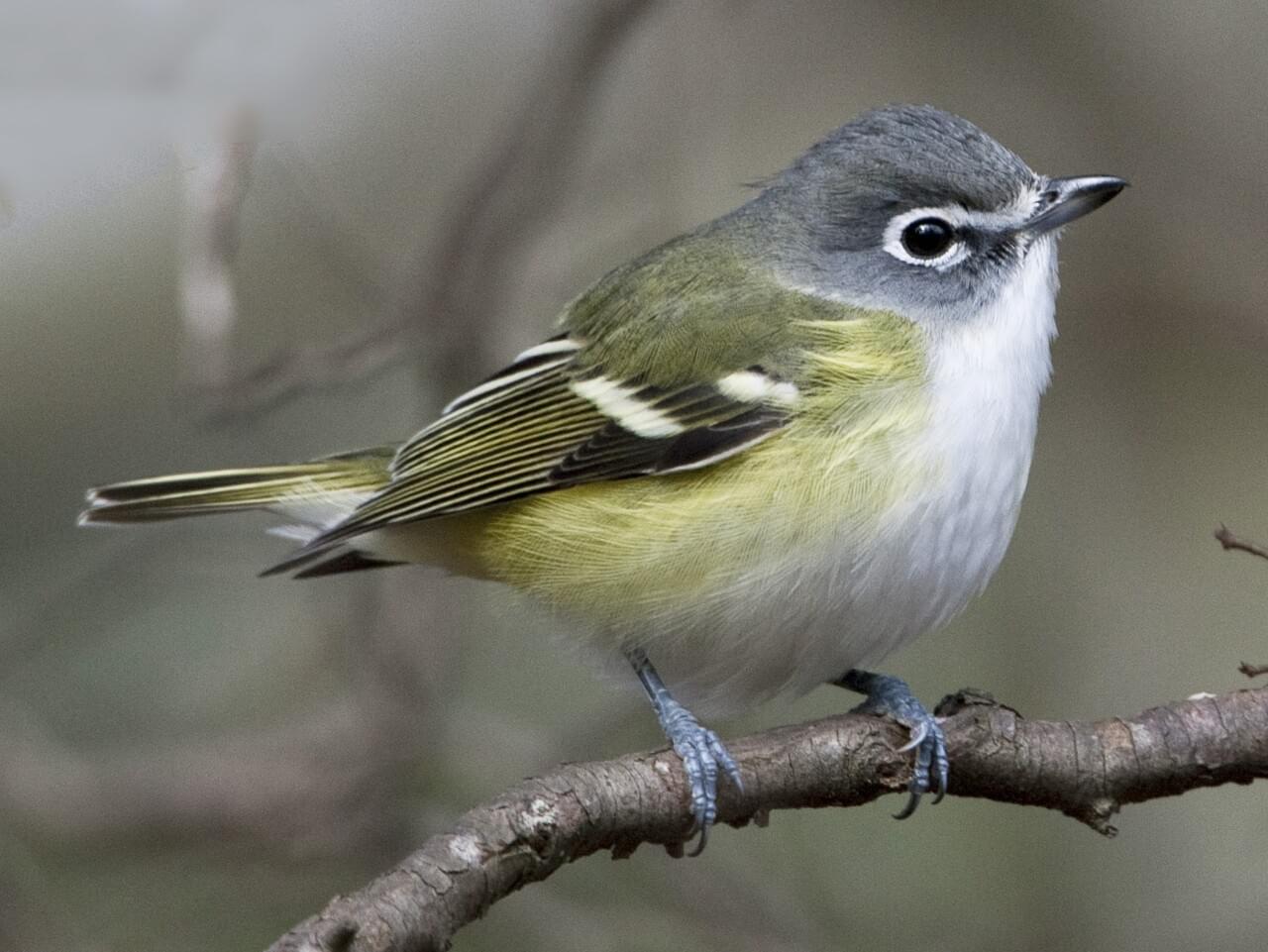
In the woods near the Uvularia perfoliata, see and hear a new bird to me. At first it was silent, and I took it for the common pewee, but, bringing my glass to bear on it, found it to be 
  • pure white throat and beneath, 
  • yellow on sides of body or wings, 
  • greenish-yellow back and shoulders, a white or whitish ring about eyes, 
  • and a light mark along side of head, 
  • two white bars on wings, 
  • apparently black bill and 
  • dark or perhaps slate-colored (?) wings and above tail. 
It surprised me by singing in a novel and powerful and rich strain. Yet it may be the white-eyed vireo (which I do not know), if it comes so early. Nuttall says it comes to Cambridge about the middle of April.

H. D. Thoreau, Journal, May 3, 1858

Ride to Flint's Pond to look for Uvularia perfoliata. ...  It apparently will not bloom within ten days
. See May 30, 1857 ("By the path near the northeast shore of Flint's Pond, just before reaching the wall by the brook, I . . .am surprised to find ... the Uvularia perfoliata, which I have not found hereabouts before. . . .. It is considerably past its prime “).  See also note to August 22, 1857 ("He says he found the Uvularia perfoliata on the Stow road, he thinks within Concord bounds.”) and A Book of the Seasons,  by Henry Thoreau, the Bellworts

Partridges have been heard drumming. See April 19, 1860 ("You will hear at first a single beat or two far apart and have time to say, "There is a partridge," so distinct and deliberate is it often, before it becomes a rapid roll."); April 25, 1854 ("The first partridge drums in one or two places, as if the earth's pulse now beat audibly with the increased flow of life. It slightly flutters all Nature and makes her heart palpitate."); April 29, 1857 ("C. says it makes his heart beat with it, or he feels it in his breast.")  See also A Book of Seasons,  by Henry Thoreau, the Partridge

Heard the black and white creeper April 25th. I hear it and see it well to-day. See April 28, 1856 ("I hear to-day frequently the seezer seezer seezer of the black and white creeper”);  May 3, 1852 ("That oven-birdish note which I heard here on May 1st I now find to have been uttered by the black and white warbler or creeper. He has a habit of looking under the branches."); May 4, 1858 ("I hear the weese wese wese of the creeper continually from the swamp. It is the prevailing note there.") See also A Book of the Seasons,   by Henry Thoreau, The Black and White Creeper

Comptonia well out, how long? See May 3, 1855 ("Sweet-fern opened apparently yesterday. "); See also A Book of the Seasons, by Henry Thoreau, The Sweet-Fern

It may be the white-eyed vireo. See May 9, 1858 ("I am now inclined to think it the solitary vireo. . .it had a blue-slate head, and, I note, a distinct yellowish vent, which none of the vireos are allowed to have!! The sides of the body are distinctly yellow, but there is none at all on the throat or breast.")

Saturday, April 21, 2018

The rocks on the east side of Bateman’s Pond.


April 21. 

April 21, 2018
George Melvin says that Joshua Haynes once saw a perch depositing her spawn and the male following behind and devouring it! (?) Garlick in his book on pisciculture says that the perch spawn in May. 

Melvin says that those short-nosed brook pickerel are caught in the river also, but rarely weigh more than two pounds. 

The puddles have dried off along the road and left thick deposits or water-lines of the dark-purple anthers of the elm, coloring the ground like sawdust. You could collect great quantities of them. 

The arbor-vitae is apparently effete already. 

Ed. Hoar says he heard a wood thrush the 18th. 

P. M. — To Easterbrooks’s and Bateman’s Pond. 

The benzoin yesterday and possibly the 19th, so much being killed. It might otherwise have been earlier yet. 

Populus grandidentata some days at least. 

The Cornus florida flower-buds are killed. 

The rocks on the east side of Bateman’s Pond are a very good place for ferns. I see some very large leather apron umbilicaria there. They are flaccid and unrolled now, showing most of the olivaceous-fuscous upper side. This side feels cold and damp, while the other, the black, is dry and warm, notwithstanding the warm air. This side, evidently, is not expanded by moisture. It is a little exciting even to meet with a rock covered with these livid (?) green aprons, betraying so much life. Some of them are three quarters of a foot in diameter. What a growth for a bare rock!

April 21, 2018

H. D. Thoreau, Journal, April 21, 1858

The dark-purple anthers of the elm, coloring the ground like sawdust. See  April 13, 1859 (“The streets are strewn with the bud-scales of the elm”); April 15, 1852 (“The broad flat brown buds on Mr. Cheney's elm, containing twenty or thirty yellowish-green threads, surmounted with little brownish-mulberry cups, which contain the stamens and the two styles, -- these are just expanding or blossoming now.”); April 15, 1854 ("The arrival of the purple finches appears to be coincident with the blossoming of the elm, on whose blossom it feeds.”); April 16, 1856 (“Cheney’s elm shows stamens on the warm side pretty numerously.”);  April 24, 1852 ("he elms are now fairly in blossom.")

The arbor-vitae is apparently effete already. See April 20, 1857 ("Arbor-vitae? apparently in full bloom.”) 

Ed. Hoar says he heard a wood thrush the 18th. See  April 21, 1855 (“I hear at a distance a wood thrush. It affects us as a part of our unfallen selves.”); April 20, 1860 ("C. sees . . . some kind of thrush to-day, size of wood thrush, — he thought probably hermit thrush."): see also May 22, 1852 ("On my way to Plymouth, looked at Audubon in the State-House. The female (and male?) wood thrush spotted the whole length of belly; the hermit thrush not so.”); A Book of the Seasons, by Henry Thoreau, Signs of Spring: The Arrival of the Hermit Thrush and note to April 24, 1856 ("Behold my hermit thrush, with one companion, flitting silently through the birches.”)

The rocks on the east side of Bateman’s Pond are a very good place for ferns. See September 4, 1857 (“The sides of Cornus florida Ravine at Bateman’s Pond are a good place for ferns. ”);  November 2, 1857 (“A patch of polypody . . . in abundance on hillside between Calla Swamp and Bateman’s Pond ”)

Saturday, April 14, 2018

I see the heart beating in the embryo fish.

April 14. 

Rains still, with one or two flashes of lightning, but soon over. 

The yew plucked yesterday blossoms in house to day. 

P. M. — Up Assabet. 

The river is a little higher on account of rain. 

I see much sweet flag six or eight inches long, floating, it having been cut up apparently by musquash. (The 17th I see much of the sparganium cut up close to the bottom along a musquash-path at the bottom of a meadow where there was one foot of water.) 

My Rana halecina spawn in tumbler is now flatted out and begins to betray the pollywog form. I had already noticed a little motion in it from time to time, but nothing like the incessant activity of the embryo fishes.  

I find no suckers’ nests yet. There has been no rise of the river of any consequence. 

At Ed. Hoar's in the evening. I look at one of his slides through a microscope, at the infusorial skeletons of the navicula and dumb-bell infusoria etc. etc. with his microscope I see the heart beating in the embryo fish and the circulations distinctly along the body.

H. D. Thoreau, Journal, April 14, 1858

The river is a little higher on account of rain. See April 14, 1855 (“The river has been steadily rising since the first of April.”)

My Rana halecina spawn in tumbler is now flatted out and begins to betray the pollywog form. See April 7, 1858 (“ Putting some of the Rana halecina spawn in a tumbler of water. . . .”); April 17, 1858 (“The Rana halecina spawn in tumbler begins to struggle free of the ova”); April 18, 1858 (“Put some R. halecina spawn which has flatted out in a ditch on Hubbard’s land.”);April 19, 1858 ("I find that my Rana halecina spawn in the house is considerably further advanced than that left in the meadows.")

I see the heart beating in the embryo fish and the circulations distinctly along the body. See April 7, 1858 (" I see the embryo, already fish-like (?), curved round the yolk, with a microscope"); April 16, 1858 (" For more than a week the embryos have been conspicuously active, as they lie curved in the egg. This morning I found that they were suddenly hatched, and more than half of them were free of the egg.")

.
 

Wednesday, December 13, 2017

What is lost in time is gained in power.

December 13. 

P. M. – To Goose Pond. 

This and the like ponds are just covered with virgin ice just thick enough to bear, though it cracks about the edges on the sunny sides. You may call it virgin ice as long as it is transparent. I see the water-target leaves frozen in under the ice in Little Goose Pond. 

I see those same two tortoises (of Dec. 2d), moving about in the same place under the ice, which I can not crack with my feet. The Emerson children see six under the ice of Goose Pond to-day. Apparently many winter in the mud of these ponds and pond-holes. 

In sickness and barrenness it is encouraging to believe that our life is dammed and is coming to a head, so that there seems to be no loss, for what is lost in time is gained in power. All at once, unaccountably, as we are walking in the woods or sitting in our chamber, after a worthless fortnight, we cease to feel mean and barren. 

I go this afternoon thinking I may find the stakes set for auction lots on the Ministerial Lot in December, '51. 

I find one white birch standing and two fallen. The latter were faced at one end, for the numbers, and at the other rotten and broken off as short, apparently, as if sawed, because the bark so tears. At first I did not know but they had been moved, but thinking that if they had fallen where they stood I should find some hole or looseness in the ground at the rotten end, I felt for it and in each case found it; in one, also, the rotten point of the stake. 

Thus in six years two out of three stout (two-and-a-half-inch) birch stakes were flat. The hickory stake I set on R. W. E.'s town line in March, ’50, was flat this last summer, or seven years, but a white stake set in ’49–50 on Moore and Hosmer's lot was standing aslant this month. 

A surveyor should know what stakes last longest. 

I hear a characteristic anecdote respecting Mrs. Hoar, from good authority. Her son Edward, who takes his father's place and attends to the same duties, asked his mother the other night, when about retiring, 


“Shall I put the cat down cellar?” 

“No,” said she, “you may put her outdoors.” 

The next night he asked, “Shall I put the cat outdoors?” 

“No,” answered she, “you may put her down cellar.”

The third night he asked, “Shall I put the cat down cellar or outdoors?” 

“Well,” said his mother, “you may open the cellar door and then open the front door, and let her go just which way she pleases.” 

Edward suggested that it was a cold night for the cat to be outdoors, but his mother said, 

“Who knows but she has a little kitten somewhere to look after?” 

Mrs. H. is a peculiar woman, who has her own opinion and way, a strong-willed, managing woman.

H. D. Thoreau, Journal, December 13, 1857

Water target
or water shield: an aquatic plant, Brasenia schreberi, of thewater lily family, having purple flowers, floating, elliptic leaves, and ajellylike coating on the underwater stems and roots.

I see those same two tortoises (of Dec. 2d).
See December 2, 1857 ("Measuring Little Goose Pond, I observed two painted tortoises moving about under the thin transparent ice.")

All at once, after a worthless fortnight, we cease to feel mean and barren. See December 13, 1851 ("By stepping aside from my chosen path so often, I see myself better and am enabled to criticise myself. Of this nature is the only true lapse of time.")


I go this afternoon thinking I may find the stakes set for auction lots on the Ministerial Lot in December, '51. See  November 14, 1851 ("Surveying the Ministerial Lot in the southwestern part of the town."); November 18, 1851 ("Surveying these days the Ministerial Lot."); November 24, 1851("Setting stakes in the swamp (Ministerial).")

Saturday, November 11, 2017

The Lincoln limestone dips east by north.

November 11. 

Clear and fine Indian-summer day. 

November 11, 2017

P. M. — To Lincoln limestone with E. Hoar. 

Hoar showed me last evening the large fossil tooth of a shark, such as figured in Hitchcock, which he bought at Gay Head the other day. He also bought one or more other species. 

I heard, day before yesterday, much firing of guns in the chestnut woods by Curly-pate Hill, probably at gray squirrels. George Buttrick says it is late for them; were thickest in chestnut time. 

That cellar-hole off northwest of Brooks Clark’s is where Boaz Brown used to live, and the andromeda swamp behind is “Boaz's (pronounced Boze's) meadow,” says Jacob Farmer, who has seen corn growing in the meadow. 

The Lincoln limestone dips east by north, strikes north by west; the hornblende slate (?) on Bare Hill, northeast and northwest.

H. D. Thoreau, Journal, November 11, 1857

Monday, August 28, 2017

An old man named McDonald

August 28.

August 28, 2017
Polygonum Pennsylvanicum by bank, how long? 

R. W. E. says that he saw Asclepias tuberosa abundant and in bloom on Naushon last week; also a sassafras stump three feet across. The deer escape by running to the mainland, and in winter cross on the ice. The last winter they lost about one hundred and fifty sheep, whose remains have never been found. Perhaps they were carried off on the ice by the sea. Looking through a glass, E. saw vessels sailing near Martha's Vineyard with full sails, yet the water about them appeared perfectly smooth, and reflected the vessels. They thought this reflection a mirage, i. e. from a haze. 

As we were riding by Deacon Farrar's lately, E. Hoar told me in answer to my questions, that both the young Mr. Farrars, who had now come to man’s estate, were excellent young men, — their father, an old man of about seventy, once cut and corded seven cords of wood in one day, and still cut a double swath at haying time, and was a man of great probity, — and to show the unusual purity of one of them, at least, he said that, his brother Frisbie, who had formerly lived there, inquiring what had become of a certain hired man whom he used to know, young Mr. Farrar told him that he was gone, “that the truth was he one day let drop a prophane word, and after that he thought that he could not have him about, and so he got rid of him.” It was as if he had dropped some filthy thing on the premises, an intolerable nuisance, only to be abated by removing the source of it. 

I should like to hear as good news of the New England farmers generally. It to some extent accounts for the vigor of the father and the successful farming of the sons. 

I read the other day in the Tribune that a man apparently about seventy, and smart at that, went to the police in New York and asked for a lodging, having been left by the cars or steamboat when on his way to Connecticut. When they asked his age, native place, etc., he said his name was McDonald; he was born in Scotland in 1745, came to Plymouth, Mass., in 1760, was in some battles in the Revolution, in which he lost an eye; had a son eighty-odd years old, etc.; but, seeing a reporter taking notes, he was silent. 

Since then I heard that an old man named McDonald, one hundred and twelve years old, had the day before passed through Concord and was walking to Lexington, and I said at once he must be a humbug.

When I went to the post office to-night (August 28), G. Brooks asked me if I saw him and said that he heard that he told a correct story, except he said that he remembered Braddock’s defeat! He had noticed that Dr. Heywood’s old house, the tavern, was gone since he was here in the Revolution. Just then Davis, the postmaster, asked us to look at a letter he had received. It was from a Dr. Curtis of Newton asking if this McDonald belonged about Concord as he said, and saying that his story appeared to be a correct one. Davis had never heard of him, and, as we presumed him to be a humbug, we advised Davis to write accordingly. 

But I afterward remembered reading nearly a year ago of a man of this name and age in St. Louis, who said he had married a wife in Concord before the Revolution, and then began to think that his story might be all true. So it seems that a veteran of a hundred and twelve, after an absence of eighty-seven years, may come back to the town where he married his wife in order to hunt up his relatives, and not only have no success, but be pronounced a humbug!

H. D. Thoreau, Journal, August 28, 1857


Naushon. See June 27, 1856 ("Saw all the Elizabeth Isles, going and coming. They are mostly bare, except the east end of Naushon. This island is some seven miles long, by one to two wide. I had some two and a half hours there. . . .Naushon is said to. . .belong to Mr. Swain of New Bedford and Forbes of Boston. . .")

Popular Posts Last 30 Days.

The week ahead in Henry’s journal

The week ahead in Henry’s journal
A journal, a book that shall contain a record of all your joy.
"A stone fruit. Each one yields me a thought." ~ H. D. Thoreau, March 28, 1859


I sit on this rock
wrestling with the melody
that possesses me.