Showing posts with label the year. Show all posts

Monday, April 25, 2022

The year is stretching itself, is waking up.


April 25.


1.30 P. M. — Up railroad, returning through Acton via powder-mills and Second Division.

The frogs peep at midday.

The bees are on the pistillate flowers of the early willows, – the honey-bee, a smaller, fly-like bee with very transparent wings and bright-yellow marks on the abdomen, and also a still smaller bee, more like the honey-bee. They all hum like summer.

The water in the meadow beyond J. Hosmer's is still and transparent, and I hear the more stertorous sound or croak of frogs from it, such as you associate with sunny, warmer, calm, placid spring weather.

The tortoises are out sunning. The painted tortoise on a tussock. A spotted tortoise on the rail road hisses when I touch it with my foot and draws its [head] in.

What is that bird on the willows, size of a vireo, yellow below, with darker lines, chestnut crown, whitish (?) line over eye, two white feathers in tail, yellow - olive back, darker tail?

Yarrow is started.

Saw the first kingfisher, and heard his most unmusical note.

That warmer, placid pool and stertorous sound of frogs must not be forgotten, - beneath the railroad causeway.

The bees hum on the early willows that grow in the sand.

They appear to have nearly stripped the sterile flowers of their pollen, and each has its little yellow parcel.

The year is stretching itself, is waking up.
. . .

What different tints of blue in the same sky! It requires to be parted by white clouds that the delicacy and depth of each part may appear.  Beyond a narrow wisp or feather of mist, how different the sky! Sometimes it is full of light, especially toward the horizon.

The sky is never seen to be of so deep and delicate a blue as when it is seen between downy clouds.


H. D. Thoreau, Journal, April 25, 1852

The year is stretching itself, is waking up. See April 25, 1854 ("I hear the woods filled with the hum of insects, as if my hearing were affected; and thus the summer's quire begins. The silent spaces have begun to be filled with notes of birds and insects and the peep and croak and snore of frogs, even as living green blades are everywhere pushing up amid the sere ones.")

Thursday, November 1, 2018

A new November evening come round again,


November 1.

November 1, 2018
P. M. — To Poplar Hill. 

Many black oaks are bare in Sleepy Hollow. 

Now you easily detect where larches grow, viz. in the swamp north of Sleepy Hollow. They are far more distinct than at any other season. They are very regular soft yellow pyramids, as I see them from the Poplar Hill. Unlike the pines there is no greenness left to alternate with their yellow, but they are a uniform yellow, and they differ from other yellow trees in the generally regular pyramidal outline, i. e. these middling-sized trees. These trees now cannot easily be mistaken for any other, be cause they are the only conspicuously yellow trees now left in the woods, except a very few aspens of both kinds, not one in a square mile, and these are of a very different hue as well as form, the birches, etc.,; having fallen. The larch, apparently, will soon be the only yellow tree left in the woods. It is almost quite alone now. But in the summer it is not easy to distinguish them either by their color or form at a distance. 

If you wish to count the scarlet oaks. do it now. Stand on a hilltop in the woods, when the sun is an hour high and the sky is clear, and every one within range of your vision will be revealed. You might live to the age of Methusaleh and never find a tithe of them otherwise.

We are not wont to see our dooryard as a part of the earth’s surface. The gardener does not perceive that some ridge or mound in his garden or lawn is related to yonder hill or the still more distant mountain in the horizon, is, perchance, a humble spur of the last. We are wont to look on the earth still as a sort of chaos, formless and lumpish. 

I notice from this height that the curving moraine forming the west side of Sleepy Hollow is one of several arms or fingers which stretch away from the hill range that runs down the north side of the Boston road, turning northward at the Court-House; that this finger-like moraine is continued northward by itself almost to the river, and points plainly enough to Ponkawtasset Hill on the other side, even if the Poplar Hill range itself did not indicate this connection; and so the sloping cemetery lots on the west of Sleepy Hollow are related to the distant Ponkawtasset. 

he smooth-shaven knoll in the lawn, on which the children swing, is, perchance, only a spur of some mountains of the moon, which no traveller has ever reached, heaved up by the same impulse. 

The hawthorn is but three-quarters fallen and is a greenish yellow or yellowish green. 

I hear in the fields just before sundown a shriller chirping of a few crickets, reminding me that their song is getting thin and will soon be quenched. 

As I stood on the south bank of the river a hundred rods southwest of John Flint’s, the sun being just about to enter a long and broad dark-blue or slate-colored cloud in the horizon, a cold, dark bank, I saw that the reflection of Flint’s white house in the river, prolonged by a slight ripple so as to reach the reflected cloud, was a very distinct and luminous light blue.

As the afternoons grow shorter, and the early evening drives us home to complete our chores, we are reminded of the shortness of life, and become more pensive, at least in this twilight of the year. We are prompted to make haste and finish our work before the night comes. 

I leaned over a rail in the twilight on the Walden road, waiting for the evening mail to be distributed, when such thoughts visited me. I seemed to recognize the November evening as a familiar thing come round again, and yet I could hardly tell whether I had ever known it or only divined it. The November twilights just begun! 

It appeared like a part of a panorama at which I sat spectator, a part with which I was perfectly familiar just coming into view, and I foresaw how it would look and roll along, and prepared to be pleased. Just such a piece of art merely, though infinitely sweet and grand, did it appear to me, and just as little were any active duties required of me. 

We are independent on all that we see. The hangman whom I have seen cannot hang me. The earth which I have seen cannot bury me. Such doubleness and distance does sight prove. Only the rich and such as are troubled with ennui are implicated in the maze of phenomena. You cannot see anything until you are clear of it. 

The long railroad causeway through the meadows west of me, the still twilight in which hardly a cricket was heard, the dark bank of clouds in the horizon long after sunset, the villagers crowding to the post-office, and the hastening home to supper by candle-light, had I not seen all this before! What new sweet was I to extract from it? Truly they mean that we shall learn our lesson well. Nature gets thumbed like an old spelling-book. 

The almshouse and Frederick were still as last November. I was no nearer, methinks, nor further off from my friends. Yet I sat the bench with perfect contentment, unwilling to exchange the familiar vision that was to be unrolled for any treasure or heaven that could be imagined. Sure to keep just so far apart in our orbits still, in obedience to the laws of attraction and repulsion, affording each other only steady but indispensable starlight. It was as if I was promised the greatest novelty the world has ever seen or shall see, though the utmost possible novelty would be the difference between me and myself a year ago. This alone encouraged me, and was my fuel for the approaching winter. That we may behold the panorama with this slight improvement or change, this is what we sustain life for with so much effort from year to year.

And yet there is no more tempting novelty than this new November. 

No going to Europe or another world is to be named with it. Give me the old familiar walk, post-office and all, with this ever new self, with this infinite expectation and faith, which does not know when it is beaten. We’ll go nutting once more. We'll pluck the nut of the world, and crack it in the winter evenings. Theatres and all other sightseeing are puppet-shows in comparison. I will take another walk to the Cliff, another row on the river, another skate on the meadow, be out in the first snow, and associate with the winter birds. Here I am at home. In the bare and bleached crust of the earth I recognize my friend.

One actual Frederick that you know is worth a million only read of. Pray, am I altogether a bachelor, or am I a widower, that I should go away and leave my bride? This Morrow that is ever knocking with irresistible force at our door, there is no such guest as that. I will stay at home and receive company.

I want nothing new, if I can have but a tithe of the old secured to me. I will spurn all wealth beside. Think of the consummate folly of attempting to go away from here! When the constant endeavor should be to get nearer and nearer here. 

Here are all the friends I ever had or shall have, and as friendly as ever. Why, I never  had any quarrel with a friend but it was just as sweet as unanimity could be. I do not think we budge an inch forward or backward in relation to our friends. How many things‘ can you go away from? They see the comet from the northwest coast just as plainly as we do, and the same stars through its tail. 

Take the shortest way round and stay at home. A man dwells in his native valley like a corolla in its calyx, like an acorn in its cup. Here, of course, is all that you love, all that you expect, all that you are. Here is your bride elect, as close to you as she can be got. Here is all the best and all the worst you can imagine. What more do you want? Bear here-away then! Foolish people imagine that what they imagine is somewhere else. That stuff is not made in any factory but their own.


H. D. Thoreau, Journal , November 1, 1858

Now you easily detect where larches grow. See October 24, 1852 (“The larches in the swamps are now conspicuously yellow and ready for their fall. They can now be distinguished at a distance.”);   October 27 1855 (“Larches are yellowing.”) and  note to November 1, 1857 ("The larches are at the height of their change.”)

We are reminded of the shortness of life, and become more pensive, at least in this twilight of the year. We are prompted to make haste and finish our work before the night comes. See August 18, 1853 ("The year is full of warnings of its shortness, as is life."); October 27, 1858 (“the cool, white twilights of that season which is itself the twilight of the year.”)

We are independent on all that we see. . .. You cannot see anything until you are clear of it. See August 8, 1852 ("[I]am sensible of a certain doubleness by which I can stand as remote from myself as from another. ")

Take the shortest way round and stay at home. See January 11, 1852 (But if I travel in a simple, primitive, original manner, standing in a truer relation to men and nature, . . . get some honest experience of life . . . then it becomes less important whither I go or how far."); May 6, 1854 ("It matters not where or how far you travel, — the farther commonly the worse, — but how much alive you are."); November 20, 1857 ("A man is worth most to himself and to others, whether as an observer, or poet, or neighbor, or friend, where he is most himself, most contented and at home.")


November 1.
 See A Book of the Seasons, by Henry Thoreau, November 1

\

A Book of the Seasons,  by Henry Thoreau, A  man will eat his heart,
A Book of the Seasons,  by Henry Thoreau
 "A book, each page written in its own season,
out-of-doors, in its own locality."

 ~edited, assembled and rewritten by zphx ©  2009-2024

Wednesday, October 24, 2018

As if the globe itself were a fruit on its stem, with ever one cheek toward the sun.

October 24.

A northeast storm, though not much rainfalls to-day, but a fine driving mizzle or “drisk.” 

This, as usual, brings the geese, and at 2.30 P. M. I see two flocks go over. I hear that some were seen two or three weeks ago (??), faintly honking. A great many must go over to-day and also alight in this neighborhood. This weather warns them of the approach of winter, and this wind speeds them on their way. Surely, then, while geese fly overhead we can live here as contentedly as they do at York Factory on Hudson’s Bay. We shall perchance be as well provisioned and have as good society as they. 

Let us be of good cheer, then, and expect the annual vessel which brings the spring to us without fail.

 P. M. — To Woodis Park over Hill. 

The celtis has just fallen. Its leaves were apparently a yellow green. 

The sassafras trees are bare, — how long ? — and the white ash apparently just bared. 

The locusts are bare except the tops, and in this respect those on the hills, at least, are as peculiar as birches. Some trees lose their lower leaves first, as birches and locusts; some the upper, as apples (though a few green leaves may remain on the very tips of the twigs) and generally maples, though the last fall fast. 

Hickories are two thirds fallen, at least. [Apparently mocker-nut later.]

This rain and wind too bring down the leaves very fast. The yard is strewn with the yellow leaves of the peach and the orange and scarlet ones of the cherry. You could not spread a cloth but it would soon be strewn with them. 

Thorns and balm-of-Gilead and red mulberries bare. 

The brilliant autumnal colors are red and yellow and the various tints, hues, and shades of these. Blue is reserved to be the color of the sky, but yellow and red are the colors of the earth flower. Every fruit, on ripening, and just before its fall, acquires a bright tint. So do the leaves; so the sky before the end of the day, and the year near its setting. October is the red sunset sky, November the later twilight. 

Color stands for all ripeness and success. We have dreamed that the hero should carry his color aloft, as a symbol of the ripeness of his virtue. The noblest feature, the eye, is the fairest colored, the jewel of the body. The warrior’s flag is the flower which precedes his fruit. He unfurls his flag to the breeze with such confidence and brag as the flower its petals. Now we shall see what kind of fruit will succeed.

The very forest and herbage, the pellicle of the earth as it were, must acquire a bright color, an evidence of its ripeness, as if the globe itself were a fruit on its stem, with ever one cheek toward the sun. Our appetites have commonly confined our views of ripeness and its phenomena — color and mellowness and perfectness — to the fruits which we eat, and we are wont to forget that an immense harvest which we do not eat, hardly use at all, is annually ripened by nature. At our annual cattle-shows and horticultural exhibitions we make, as we think, a great show of fair fruits, destined, however, to a rather ignoble fate, fruits not worshipped for this chiefly; but round about and within our towns there is annually another show of fruits, on an infinitely grander scale, fruits which address our taste for beauty alone. 

The scarlet oak, which was quite green the 12th, is now completely scarlet and apparently has been so a few days. This alone of our indigenous deciduous trees (the pitch pine is with it) is now in its glory. 

(I have not seen the beech, but suppose it past. The Populus grandidentata and sugar maple come nearest to it, but they have lost the greater part of their leaves.)

Look at one, completely changed from green to bright dark-scarlet, every leaf, as if it had been dipped into a scarlet dye, between you and the sun. Was not this worth waiting for? Little did you think ten days ago that that cold green tree could assume such color as this. Its leaves still firmly attached While those of other trees are falling around it. I am the last to blush, but I blush deeper than any of ye. I bring up the rear in my red coat. The scarlet oaks, alone of oaks, have not given up the fight. Perchance their leaves, so finely cut, are longer preserved partly because they present less surface to the elements, and for a long time, if I remember rightly, some scarlet oak leaves will “hold out to burn.”   

Now in huckleberry pastures you see only here and there a few bright scarlet or crimson (for they vary) leaves amid or above the bare reddish stems, burning as if with condensed brightness, — as if the few that remained burned with the condensed brightness of all that have fallen. 

In sheltered woods you [see] some dicksonia still straw-color or pale-yellow. Some thoroughwort the same color. In the shade generally you find paler and more delicate tints, fading to straw-color and white.

The deep reds and scarlets and purples show exposure to the sun. I see an intensely scarlet high blueberry— but where one leaf has overlapped another it is yellow — with a regular outline. 

That large hornets’ nest which I saw on the 4th is now deserted, and I bring it home. But in the evening, warmed by my fire, two or three come forth and crawl over it, and I make haste to throw it out the window.

H. D. Thoreau, Journal, October 24, 1858

I see two flocks go over. I hear that some were seen two or three weeks ago.  See note to October 23, 1858 ("One tells me that he saw geese go over Wayland the 17th") and October 27, 1857 ("I hear that Sammy Hoar saw geese go over to-day. The fall (strictly speaking) is approaching an end in this probably annual northeast storm"); November 13, 1858 ("A large flock of geese go over just before night. "); November 20, 1853 ("Methinks the geese are wont to go south just before a storm, and, in the spring, to go north just after one, say at the end of a long April storm. ") See also A Book of Seasons, by Henry Thoreau, Geese in Autumn

This rain and wind too bring down the leaves very fast. Compare  October 24, 1855 ("The gentle touch of the rain brings down more leaves than the wind."); October 24, 1853 ("Just after dark, high southerly winds arise, but very warm, blowing the rain against the windows and roof and shaking the house.")

October is the red sunset sky, November the later twilight. See November 14, 1853 ("October is the month of painted leaves, of ripe leaves, when all the earth, not merely flowers, but fruits and leaves, are ripe. With respect to its colors and its season, it is the sunset month of the year, when the earth is painted like the sunset sky. This rich glow flashes round the world. This light fades into the clear, white, leafless twilight of November."); August 31, 1852 ("The evening of the year is colored like the sunset."); November 2, 1853 ("We come home in the autumn twilight, which lasts long and is remarkably light, the air being purer, — clear white light, which penetrates the woods"). Also Autumnal Tints ("October is the month for painted leaves. Their rich glow now flashes round the world. As fruits and leaves and the day itself acquire a bright tint just before they fall, so the year near its setting. October is its sunset sky ; November the later twilight.") and note to October 28, 1852 ("Suddenly the light of the setting sun yellows and warms all the landscape.")

That large hornets’ nest which I saw on the 4th is now deserted. See October 4, 1858 ("Hornets are still at work in their nests."); October 15, 1855 ("The hornets’ nests are exposed, the maples being bare, but the hornets are gone"); October 22, 1858 ("Hornets’ nests are now being exposed, deserted by the hornets") ; October 25, 1854 ("The maples being bare, the great hornet nests are exposed."); See also September 25, 1851 ("The hornets' nest not brown but gray, two shades, whitish and dark, alternating on the outer layers or the covering, giving it a waved appearance."). See also A Book of the Seasons, by Henry Thoreau. Wasps and Hornets

October is the
red sunset sky – November
the later twilight. 

Wednesday, October 17, 2018

Both by sounds and sights I am reminded that I am in the very midst of the fall.

October 17


October 17, 1858

 P. M. — Up Assabet. 

There are many crisped but colored leaves resting on the smooth surface of the Assabet, which for the most part is not stirred by a breath; but in some places, where the middle is rippled by a slight breeze, no leaves are seen, while the broad and perfectly smooth portions next the shore will be covered with them, as if by a current they were prevented from falling on the other parts. These leaves are chiefly of the red maple, with some white maple, etc. To be sure, they hardly begin to conceal the river, unless in some quiet coves, yet they remind me of ditches in swamps, whose surfaces are often quite concealed by leaves now. The waves made by my boat cause them to rustle, and both by sounds and sights I am reminded that I am in the very midst of the fall. 

Methinks the reflections are never purer and more distinct than now at the season of the fall of the leaf, just before the cool twilight has come, when the air has a finer grain. Just as our mental reflections are more distinct at this season of the year, when the evenings grow cool and lengthen and our winter evenings with their brighter fires may be said to begin. And painted ducks, too, often come and sail or float amid the painted leaves. 

Cattle are seen these days turned into the river meadows and straying far and wide. They have at length reached those “ pastures new” they dreamed of. 

I see one or two large white maples quite bare. 

Some late red maples are unexpectedly as fair and bright as ever, both scarlet and yellow, and still distance all competitors. There is no brighter and purer scarlet (often running into crimson) and no softer and clearer yellow than theirs now, though the greater part have quite lost their leaves. The fires I thought dulled, if not put out, a week ago seem to have burst forth again. This accounts for those red maples which were seen to be green while all around them were scarlet. They but bided their time. They were not so easily affected. 

I distinguish one large red oak — the most advanced one — from black ones, by its red brown, though some others are yellow-brown and greenish. The large red oaks are about in their prime. Some are a handsome light scarlet, with yellow and green.

The Cornus sericea is a very dark crimson, though it has lost some leaves. 

The Salix lucida lower leaves are all fallen (the rest are yellow). So, too, it is the. lower leaves of the willows generally which have fallen first. 

Saw a small hawk come flying over the Assabet, which at first I mistook for a dove, though it was smaller. It was blunt or round-shouldered like a dove. It alighted on a small elm and did not mind a wagon passing near by. Seen through my glass twenty rods off, it had a very distinct black head, with apparently a yellowish-brown , breast and beneath and a brown back, — both, however, quite light, — and a yellowish tail with a distinct broad black band at the tip. This I saw when, in pruning itself, it was tilted or flirted up. Could it have been a sparrow hawk?

One reason why I associate perfect reflections from still water with this and a later season may be that now, by the fall of the leaves, so much more light is let in to the water. The river reflects more light, therefore, in this twilight of the year, as it were an afterglow.

H. D. Thoreau, Journal, October 17, 1858

There are many crisped but colored leaves resting on the smooth surface of the Assabet,.Methinks the reflections are never purer and more distinct than now at the season of the fall of the leaf. See October 15, 1856 ("The water is very calm and full of reflections. Large fleets of maple and other leaves are floating on its surface as I go up the Assabet, leaves which apparently came down in a shower with yesterday morning's frost."); October 22,1854 ("Pretty hard frosts these nights. Many leaves fell last night, and the Assabet is covered with their fleets”)


The waves made by my boat cause them to rustle. See October 19, 1853 ("The leaves have fallen so plentifully that they quite conceal the water along the shore, and rustle pleasantly when the wave which the boat creates strikes them."); October 17, 1856 ("Countless leafy skiffs are floating on pools and lakes and rivers and in the swamps and meadows, often concealing the water quite from foot and eye."); October 17, 1857 ("The swamp floor is covered with red maple leaves, many yellow with bright-scarlet spots or streaks. Small brooks are almost concealed by them")

I see one or two large white maples quite bare. See note to October 14, 1858 ("The white maples are now apparently in their autumnal dress")

Could it have been a sparrow hawk? See May 4, 1855 (“ I think that what I have called the sparrow hawk falsely, and latterly pigeon hawk, is also the sharp-shinned")

By the fall of the leaves, so much more light is let in to the water. The river reflects more light, therefore, in this twilight of the year, as it were an afterglow. See August 19, 1853 ("As toward the evening of the day the lakes and streams are smooth, so in the fall, the evening of the year, the waters are smoothed more perfectly than at any other season. The day is an epitome of the year."); August 31, 1852 ("The evening of the year is colored like the sunset."); November 14, 1853 ("October is the month of painted leaves, . . .it is the sunset month of the year, when the earth is painted like the sunset sky. . . .This light fades into the clear, white, leafless twilight of November, and what ever more glowing sunset or Indian summer we have then is the afterglow of the year.”)

What an ample share
of the light of heaven each
pond and lake enjoys!

tinyurl.com/HDT581017

Saturday, September 29, 2018

What astronomer can calculate the orbit of my thistle-down?


September 29

Fine weather. P. M. — To White Pond. 

September 29, 2018

One or two myrtle-birds in their fall dress, with brown head and shoulders, two whitish bars on wings, and bright-yellow rump. 

Sit on Clamshell, looking up the smooth stream. Two blue herons, or “herns,” as Goodwin calls them, fly sluggishly up the stream. Interesting even is a stake, with its reflection, left standing in the still river by some fisherman. 

Again we have smooth waters, yellow foliage, and faint warbling birds, etc., as in spring. The year thus repeats itself. 

Catch some of those little fuzzy gnats dancing in the air there over the shelly bank, and these are black, with black plumes, unlike those last seen over the Cassandra Pond. 

Brushed a spectrum, ghost-horse, off my face in a birch wood, by the J. P. Brown cold Heart-Leaf Pond. Head somewhat like a striped snake. 

That pond is drier than I ever saw it, perhaps [No, have seen it so before.]—all but a couple of square rods in the middle, —and now covered with cyperus, etc. The mud is cracked into large polygonal figures of four to six sides and six to twelve inches across, with cracks a half to three quarters of an inch wide.

See what must be a solitary tattler feeding by the water’s edge, and it has tracked the mud all about. It cannot be the Tringa pectoralis, for it has no conspicuous white chin, nor black dashes on the throat, nor brown on the back and wings, and I think I see the round white spots on its wings. It has not the white on wing of the peetweet, yet utters the peetweet note!— short and faint, not protracted, and not the “sharp whistle” that Wilson speaks of. 

The lespedeza leaves are all withered and ready to fall in the frosty hollows near Nut Meadow, and [in] the swamps the ground is already strewn with the first maple leaves, concealing the springiness of the soil, and many plants are prostrate there, November-like.

High up in Nut Meadow, the very brook — push aside the half-withered grass which (the farmer disdaining to cut it) conceals it — is as cool as a spring, being near its sources. 

Take perhaps our last bath in White Pond for the year. Half a dozen F. hyemalis about. 

Looking toward the sun, some fields reflect a light sheen from low webs of gossamer which thickly cover the stubble and grass. 

On our way, near the Hosmer moraine, let off some pasture thistle-down. One steadily rose from my hand, freighted with its seed, till it was several hundred feet high, and then passed out of sight eastward. Its down was particularly spreading or open. Is not here a hint to balloonists? 

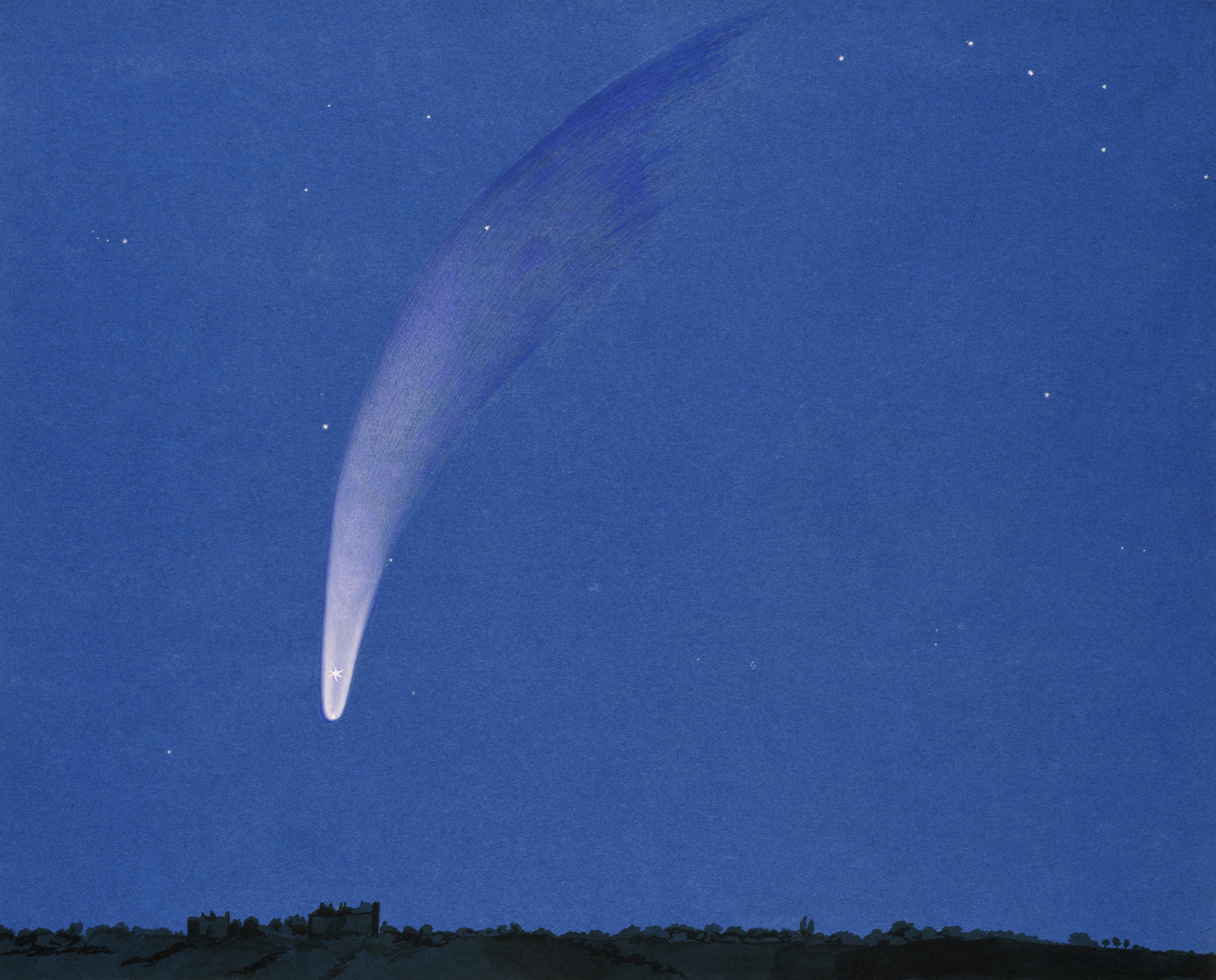
Astronomers can calculate the orbit of that thistle-down called the comet, now in the northwest sky, conveying its nucleus, which may not be so solid as a thistle’s seed, some whither, but what astronomer can calculate the orbit of my thistle-down and tell where it will deposit its precious freight at last? It may still be travelling when I am sleeping. 

Donati’s Comet 1858

Some Lobelia inflata leaves peculiar hoary-white.

September 29, 2018

H. D. Thoreau,  Journal, September 29, 1858

One or two myrtle-birds in their fall dress, with brown head and shoulders, two whitish bars on wings, and bright-yellow rump. See September 23, 1855 (“A little wren-like (or female goldfinch) bird on a.willow at Hubbard’s Causeway, eating a miller: with bright-yellow rump when wings open, and white on tail. Could it have been a yellow-rump warbler?”); October 14, 1855 ("Black bill and feet, yellow rump, brown above, yellowish-brown on head, cream-colored chin, two white bars on wings, tail black, edged with white, — the yellow-rump warbler or myrtle-bird without doubt.”)

Half a dozen F. hyemalis about. See  September 29, 1854 ("I hear a very pleasant and now unusual strain on the sunny side of an oak wood from many — I think F. hyemalis, though I do not get a clear view of them. Even their slight jingling strain is remarkable at this still season.") See also September 24, 1854 (" Do I see an F. hyemalis in the Deep Cut? It is a month earlier than last yea"); October 5, 1857 ("It is evident that some phenomena which belong only to spring and autumn here . . . the myrtle-bird and F. hyemalis which breed there, but only transiently visit us in spring and fall.") 

The year thus repeats itself. See May 5, 1860 ("It takes us many years to find out that Nature repeats herself annually”)

Brushed a spectrum, ghost-horse, off my face in a birch wood. See ;  August 29, 1858 (“The ghost-horse (Spectrum) is seen nowadays, — several of them.”)

Take perhaps our last bath in White Pond for the year. See September 27, 1856 ("Bathed at Hubbard's Bath, but found the water very cold. Bathing about over”) See also A Book of the Seasons, by Henry Thoreau, The Luxury of Bathing

The comet, now in the northwest sky. See September 23 , 1858 (Saw the comet very bright in the northwest. "); October 5, 1858 ("The comet makes a great show these nights.")

Thistle-down See September 1, 1852 ("These white faery vessels are annually wafted over the cope of their sky. Bethink thyself, O man, when the first thistle-down is in the air. Buoyantly it floated high in air over hills and fields all day, and now, weighed down with evening dews, perchance, it sinks gently to the surface of the lake. Nothing can stay the thistle-down, but with September winds it unfailingly sets sail. The irresistible revolution of time. It but comes down upon the sea in its ship, and is still perchance wafted to the shore with its delicate sails. The thistle-down is in the air. Tell me, is thy fruit also there? Dost thou approach maturity? ") See also A Book of the Seasons,  by Henry Thoreau, the Thistles

What astronomer
can calculate the orbit 
of my thistle-down?


A Book of the Seasons,  by Henry Thoreau
 "A book, each page written in its own season,
out-of-doors, in its own locality."
 ~edited, assembled and rewritten by zphx ©  2009-2025

tinyurl.com/HDT580929

Tuesday, October 10, 2017

This is the end of the sixth day of glorious weather, which I am tempted to call the finest in the year

October 10
October 10, 2017

P. M. — To Walden over Fair Haven Hill. 

Some Prinos verticillatus yellowing and browning at once, and in low ground just falling and leaving the bright berries bare. 

From the upper side of Wheeler's clearing on Fair Haven Hill, I see five smokes, now at 3.30 P. M., – one toward Lexington, one over Bedford, one over Billerica, one, very copious, as much further north, and one over Carlisle. These are all dark, seen against the sky and from the sun, and, except the first, apparently beyond the respective towns. Going over to the southwest side of the hill, I see one large widespread smoke toward Wachusett and rising against it, apparently beyond the height of land between the Concord and Nashua, and another much nearer, toward Stow. These two are light, or smoke-colored, because seen more toward the sun, perhaps; or is it solely because seen against the mountain and woods? There is another, the eighth, a little south of west, nearly under the sun, but this, being very distant and seen against the sky, is dusky. I could not see south and southwest. 

I think that these smokes are the most distant sign of the presence of man on the globe that I detect with my unarmed eye, – of man's cohabitancy. I see the evidence that so many farmers with their hired men and boys are at work in their clearings from five to fifteen miles off. I see this smoky telegraph for hours marking the locality and occupation of some farmer and suggesting peaceful rural enterprises and improvements which I may yet see described in the agricultural reports, though I may never have seen, and perhaps never shall see, that farm or farmer. Considering the slight evidence I have of their existence, they are as far away as if in another quarter of the globe. Some times the smoke is seen beyond a distant range of hills, spreading along, low and bluish, seen against a more distant hill or mountain; at others it is a column faintly and dimly seen against the horizon, but more distinctly revealed by a dusky but cloud-like expansion above. It may be a dusky almost level bar, slanting upward a little, like a narrow banner. 

The smokes from a dozen clearings far and wide, from a portion of the earth thirty miles or more in diameter, reveal the employment of many husbandmen at this season. Thus I see the woods burned up from year to year. The telltale smokes reveal it. The smokes will become rarer and thinner year by year, till I shall detect only a mere feathery film and there is no more brush to be burned. 

Generally speaking, the autumnal tints affect the color of the landscape for only two or three miles, but I distinguish maples by their color half a mile north of Brooks Clark’s, or some three miles distant, from this hill, — one further east very bright. Also I see them in the northeast, or on or near, apparently, a road between Bedford and Billerica, at least four or five miles distant!! This is the furthest I can see them. 

Descend from Fair Haven Hill through Stow's sprout-land to railroad. 

See chincapin oaks in frosty places sere brown and ready to fall, while in others they are still green, in woods. They turn of various colors, some quite handsome clear scarlet or red. Many young white oaks in similar frosty places are all withered and shrivelled. 

I see in the woods some Smilacina racemosa leaves, – which are usually a uniform pale-brown, — very wildly and remarkably marked, – weirdly. They are pale-brown, almost white, and somewhat curled, varied with rectilinear broad black (brown, seen close to) marks along the veins, say one inch, more or less, long by one tenth inch wide, with square corners. (Suppose you were to have a neckerchief after this pattern!) The whole plant gracefully bent almost horizontally with the weight of its dense raceme of bright cherry-red berries at the end. 

Generally speaking, chestnuts, hickories, aspens, and some other trees attain a fair clear yellow only in small specimens in the woods or sprout-lands, or in their lower leaves. 

You see now in sprout-lands young scarlet oaks of every degree of brightness from green to dark scarlet. It is a beautifully formed leaf, with its broad, free, open sinuses, - worthy to be copied in sculpture. A very agreeable form, a bold, deep scallop, as if the material were cheap. Like tracery. The color is more mingled with light than in the less deeply scalloped oak leaves. It is a less simple form. Though the connected outline is a broad oval, it is much improved by deep bays of light, as a simple oval pond would be improved by four or five broad, rounded promontories extending far into it on different sides, while the watery bays, instead of being rounded at bottom, extended far inland in sharp friths. The leaf suggests a lavish expense in the creation of those deep scallops, as if so much material had been cut out and thrown away. 

This is the end of the sixth day of glorious weather, which I am tempted to call the finest in the year, so bright and serene the air and such a sheen from the earth, so brilliant the foliage, so pleasantly warm (except, perhaps, this day, which is cooler), too warm for a thick coat, — yet not sultry nor oppressive, -so ripe the season and our thoughts. Certainly these are the most brilliant days in the year, ushered in, perhaps, by a frosty morning, as this. As a dewy morning in the summer compared with a parched and sultry, languid one, so a frosty morning at this season compared with a merely dry or foggy one. These days you may say the year is ripened like a fruit by frost, and puts on brilliant tints of maturity but not yet of decay. It is not sere and withered as in November. 

See the heaps of apples in the fields and at the cider mill, of pumpkins in the fields, and the stacks of corn stalks and the standing corn. Such is the season. The morning frosts have left a silvery hue on the fine pasture grasses. They have faded to a kindred color.

H. D. Thoreau, Journal, October 10, 1857

The smokes from a dozen clearings far and wide, from a portion of the earth thirty miles or more in diameter, reveal the employment of many husbandmen at this season. See September 3, 1860 (" Here is a beautiful, and perhaps first decidedly autumnal, day . . .We see the smokes of burnings on various sides."); September 25, 1854 ("I see several smokes in the distance, of burning brush. . . . I now smell strongly the smoke of this burning half a mile off, though it is scarcely perceptible in the air."); October 13, 1852 ("Far amid the western hills there rises a pure white smoke. There is no disturbing sound.");

I see in the woods some Smilacina racemosa  leaves [false solomon's seal] . . . The whole plant gracefully bent almost horizontally with the weight of its dense raceme of bright cherry-red berries at the end. See September 18, 1856 ("Smilacina berries of both kinds now commonly ripe");September 1, 1856 ("The very dense clusters of the smilacina berries, finely purple-dotted on a pearly ground"); and note to June 19, 1856 ("Looked at a collection of the rarer plants made by Higginson and placed at the Natural History Rooms.)

This is the end of the sixth day of glorious weather, which I am tempted to call the finest in the year, so bright and serene the air and such a sheen from the earth, so brilliant the foliage, so pleasantly warm . . . so ripe the season and our thoughts. Certainly these are the most brilliant days in the year. See  note to October 10, 1856 ("These are the finest days in the year, Indian Summer.") See also December 21, 1854 (“We are tempted to call these the finest days of the year ,ushered in, perhaps, by a frosty morning.”) and September 20, 1851 ("This week we have had most glorious autumnal weather, - cool and cloudless, bright days, filled with the fragrance of ripe grapes, preceded by frosty mornings.")

October 10. See A Book of the Seasons,  by Henry Thoreau,  October 10

The most brilliant days
in the year ushered in by
these frosty mornings.

Monday, October 10, 2016

These are the finest days in the year

October 10

These are the finest days in the year, Indian summer. 


October 10, 2016


This afternoon it is 80°, between three and four, and at 6.30 this evening my chamber is oppressively sultry, and the thermometer on the north side of the house is at 64°. I lie with window wide open under a single sheet most of the night. But I anticipate. 

The phebe note of the chickadee is now often heard in the yards, and the very Indian summer itself is a similar renewal of the year, with the faint warbling of birds and second blossoming of flowers. 

Going to E. Hosmer's by boat, see quite a flock of wild ducks in front of his house, close by the bridge. 

While moving the fence to-day, dug up a large reddish, mummy-like chrysalid or nymph of the sphinx moth.

H. D. Thoreau, Journal, October 10, 1856

These are the finest days in the year,  See October 10, 1857 ("The sixth day of glorious weather, which I am tempted to call the finest in the year"). See also July 22, 1851 ("These are our fairest days, which are born in a fog."); May 5, 1852 ("Every part of the world is beautiful today."); May 18, 1852 (The world can never be more beautiful than now”);  May 21, 1854 (“The finest days of the year, days long enough and fair enough for the worthiest deeds.”); August 19, 1853 (“A glorious and ever-memorable day.”); September 18, 1860 ("If you are not happy to-day you will hardly be so to-morrow."); December 10, 1853 ("These are among the finest days in the year”); December 21, 1854 (“We are tempted to call these the finest days of the year.”) See also A Book of the Seasons, by Henry Thoreau, The world can never be more beautiful than now.

The phebe note of the chickadee is now often heard in the yards. See October 10, 1851 ("The chickadee, sounding all alone, now that birds are getting scarce, reminds me of the winter, in which it almost alone is heard.") See also October 5, 1858 ("Phebe note of Chickadee often these days"); October 6, 1856 ("The common notes of the chickadee, so rarely heard for a long time, and also one phebe strain from it, amid the Leaning Hemlocks, remind me of pleasant winter days, when they are more commonly seen. ") and  A Book of the Seasons, by Henry Thoreau, the Chickadee in Winter

A renewal of the year, with the faint warbling of birds and second blossoming of flowers. See October 10, 1851 ("There are many things to indicate the renewing of spring at this season");  October 10, 1853 ("The faint suppressed warbling of the robins sounds like a reminiscence of the spring."); See also September 10, 1857 ("I see lambkill ready to bloom a second time.”); September 16, 1852 (“Some birds, like some flowers, begin to sing again in the fall.”); September 26, 1859 ("So it is with flowers, birds, and frogs a renewal of spring."); October 3, 1858 ("Hear a hylodes peeping on shore."); October 22, 1859 (" I see perfectly fresh and fair Viola pedata flowers, as in the spring, though but few together. No flower by its second blooming more perfectly brings back the spring to us.");   October 23, 1853 ("Many phenomena remind me that now is to some extent a second spring, — not only the new-springing and blossoming of flowers, but the peeping of the hylodes for some time, and the faint warbling of their spring notes by many birds.")

I lie with window wide open. See  October 31, 1854 ("[W]e have had remarkably warm and pleasant Indian summer, with frequent frosts in the morning. Sat with open window for a week."); November 8, 1855 ("I can sit with my window open and no fire.”)

Going to E. Hosmer's by boat, see quite a flock of wild ducks in front of his house, close by the bridge. See October 10, 1855 ("A young man has just shown me a small duck which he shot in the river from my boat."); October 10, 1858 ("Leaves now have fairly begun to rustle under foot in wood-paths, especially in chestnut woods, scaring the ducks as you approach the ponds."); October 10, 1858 ("The leaves . . . are the greater part fallen, letting in the autumn light to the water, and the ducks have less shelter and concealment.") See also September 18, 1858 ("For the ducks are now back again in numbers,"); October 6, 1858 ("Leaves now have fairly begun to rustle under foot in wood-paths, especially in chestnut woods, scaring the ducks as you approach the ponds"); October 9, 1860 ("Wood ducks are about now, amid the painted leaves."); October 14, 1857 ("Approaching White Pond by the path, I see on its perfectly smooth surface what I at first mistake for a large raft of dead and black logs and limbs, but it soon elevates itself in the form of a large flock of black ducks, which go off with a loud quacking."); October 17, 1858 ("And painted ducks, too, often come and sail or float amid the painted leaves."); October 20, 1853 ("I hear a rush of wings, look up, and see three dusky ducks swiftly circling over the small water."); October 21, 1852 ("Some birds are leaving us, others, like ducks, are just arriving from the north.");  October 22, 1857 (“As I go through the woods now, so many oak and other leaves have fallen the rustling noise somewhat disturbs my musing. However, Nature in this may have intended some kindness to the ducks, which are now loitering hereabouts on their migration southward, mostly young and inexperienced birds, for, as they are feeding [in] Goose Pond, for instance, the rustling of the leaves betrays the approach of the sports man and his dog, or other foe.");  October 22, 1858 ("You get very near wood ducks with a boat nowadays.");  October 30, 1857 ("Near the island, in my boat, I scare up . . . half a dozen ducks, probably summer ducks.")

Dug up a large reddish, mummy-like chrysalid or nymph of the sphinx moth. See May 5, 1857 ("Have dug up in the garden this season half a dozen of those great leather-colored pupae (with the tongue-case bent round to breast like a long urn-handle) of the sphinx moth. First potato-worm."); September 14, 1858 ("Picked eleven of those great potato worms, caterpillars of the sphinx moth, off our privet")

October 10. See A Book of the Seasons,  by Henry Thoreau,  October 10

The phebe note of 
the chickadee is often 
heard now in the yards.

Faint warbling of birds, 
flowers' second blossoming – 
renewal of the year.

Dug up a reddish 
mummy-like chrysalid or 
nymph of the sphinx moth.

Window wide open, 
I lie under a single 
sheet most of the night.


 A Book of the Seasons, by Henry Thoreau
"A book, each page written in its own season,
out-of-doors, in its own locality."
 ~edited, assembled and rewritten by zphx ©  2009-2026

https://tinyurl.com/hdt-561010

Popular Posts Last 30 Days.

The week ahead in Henry’s journal

The week ahead in Henry’s journal
A journal, a book that shall contain a record of all your joy.
"A stone fruit. Each one yields me a thought." ~ H. D. Thoreau, March 28, 1859


I sit on this rock
wrestling with the melody
that possesses me.