Showing posts with label upland plover. Show all posts

Friday, September 22, 2017

The lover alone perceives and dwells in a certain human fragrance


September 22

Sophia has in her herbarium and has found in Concord these which I have not seen this summer :  

  • Pogonia verticillata, Hubbard's Second Wood. Bigelow says July. 
  • Trillium erythrocarpum, Bigelow says May and June. 
  • Uvularia perfoliata, Bigelow says May.
September 22, 2017
P. M. — On river. 

The Polygonum amphibium var. terrestre is a late flower, and now more common and the spikes larger, quite handsome and conspicuous, and more like a prince's-feather than any. 

Large woolly aphides are now clustered close together on the alder stems. 

Some of those I see are probably the sharp-shinned hawk. 

When was it I heard the upland plover? 

Has been a great flight of blue-winged teal this season. 

The soapwort gentian the flower of the river-banks now. 

In love we impart, each to each, in subtlest immaterial form of thought or atmosphere, the best of ourselves, such as commonly vanishes or evaporates in aspirations, and mutually enrich each other. The lover alone perceives and dwells in a certain human fragrance. To him humanity is not only a flower, but an aroma and a flavor also.

H. D. Thoreau, Journal, September 22, 1852

Sophia has in her herbarium and has found in Concord these which I have not seen this summer ...Uvularia perfoliata. See note to August 22, 1857 ("[Edward Hoar] says he found the Uvularia perfoliata on the Stow road, he thinks within Concord bounds.")

Probably the sharp-shinned hawk.  See   March 28, 1854 (“See a small slate-colored hawk, with wings transversely mottled beneath, — probably the sharp-shinned hawk.”); April 3, 1859 ("Near to the pond I see a small hawk, larger than a pigeon hawk, fly past, — a deep brown with a light spot on the side. I think it probable it was a sharp- shinned hawk."); April 7, 1853 ("  A hawk above Ball’s Hill which, though with a distinct white rump, I think was not the harrier but sharp-shinned, from its broadish, mothlike form, light and slightly spotted beneath, with head bent downward, watching for prey"); April 16, 1855 ( "What I call a pigeon hawk, probably sharp-shinned.”); May 4, 1855 (“Sitting in Abel Brooks’s Hollow, see a small hawk go over high in the air, with a long tail and distinct from wings. It advanced by a sort of limping flight yet rapidly, not circling nor tacking, but flapping briskly at intervals and then gliding straight ahead with rapidity, controlling itself with its tail. It seemed to be going a journey. Was it not the sharp-shinned, or Falco fuscus?  I think that what I have called the sparrow hawk falsely, and latterly pigeon hawk, is also the sharp-shinned.") A Book of the Seasons, by Henry Thoreau, The Sharp-shinned Hawk

When was it I heard the upland plover? See  September 19, 1854 ("An upland plover goes off from Conantum top (though with a white belly), uttering a sharp white, tu white. "); July 12, 1855 ("The upland plover begins with a quivering note somewhat like a tree-toad and ends with a long, clear, somewhat plaintive or melodious hawk-like scream.. . ."); June 16, 1857 ("From time to time, summer and winter and far inland, I call to mind that peculiar prolonged cry of the upland plover on the bare heaths of Truro in July, heard from sea to sea . . .")

Has been a great flight of blue-winged teal this season.   See September 20, 1856 ("Melvin says that there are many teal about the river now.")

The soapwort gentian the flower of the river-banks now. See  September 6, 1857 ("Soapwort gentian, out not long"); September 8, 1852 ("Gentiana saponaria out."); September 19, 1852 ("The soapwort gentian cheers and surprises, -- solid bulbs of blue from the shade, the stale grown purplish. It abounds along the river, after so much has been mown"); September 22, 1852 ("The soapwort gentian the flower of the river-banks now."); September 25, 1857 ("You notice now the dark-blue dome of the soapwort gentian in cool and shady places under the bank") See also A Book of the Seasons, by Henry Thoreau, The Soapwort Gentian (Gentiana saponaria)

Friday, June 16, 2017

I have found the compass and chart safer guides than the inhabitants

June 16 (continued from June 15)
June 16, 2017
Keeseville lights float over Lake Champlain


 --- he gave thanks that we "of all the pale faces were preserved alive." He was probably a Methodist. 

But the worst of it is that these evidences of "religion" are no evidence to the traveller of hospitality or generosity. Though he hears the sound of family prayer and sees sanctified faces and a greasy Bible or prayer-book, he feels not the less that he is in the hands of the Philistines, and perceives not the less the greasy and musty scent of a household whose single purpose is to scrape more pennies together, when it has already more than enough for its uses, and it is to be preserved and abetted in this enterprise that they pray. 

What's the use of ushering the day with prayer, if it is thus consecrated to turning a few more pennies merely? 

All genuine goodness is original and as free from cant and tradition as the air. It is heathen in its liberality and independence on tradition. The accepted or established church is in alliance with the graveyards. 

7 a. m. — I go along the sandy road through a region of small hills about half a mile from the sea, between slight gray fences, either post and rail, or slanting rails, a foot apart, resting on two crossed stakes, the rails of unequal length, looking agreeably loose and irregular. 

Within half a mile I come to the house of an Indian, a gray one-storied cottage, and there were two or three more beyond. They were just beginning to build a meeting-house to-day! Mrs. Ellis had told me that they were worthy people, especially such a family, that were members of the church, and the others were decent people, though they were not "professors of religion," — as if they were consequently less trustworthy. Ellis thought that if they should get angry with you they wouldn't make anything of taking your life. He had seen it in their eyes. 

The usual suspicion. 

I asked the way of an Indian whom I met in the road, a respectable-looking young man not darker than a sunburnt white man, with black eyes and the usual straight black hair of his race. He was apparently of mixed race, however. When I observed to him that he was one of the aboriginal stock, he answered, "I suppose so." We could see even to Sandwich Meeting house as we stood in the road, and he showed me where to turn up from the shore to go to Scusset. 

I turned off to the seashore at his house, going down through shrubbery enlivened by the strain of the yellow-throat (or black-throat bunting ?). The seringo and bay-wing were also very common near the sea to-day and yesterday. The shore between Manomet and Sandwich has in it two or three rocky capes, which interrupt the view along it, but are not very obvious on the map, between which are successive curving sandy beaches, Bays of Naples of the approved pattern. 

Swallows have their nests in the high bank from time to time, as at Cape Cod. Crows are seen lazily flapping away from the shore on your approach. Even a robin was seeking its food there. 

The piping plover, as it runs half invisible on the sand before you, utters a shrill peep on an elevated key (different birds on different keys), as if to indicate its locality from time to time to its kind, or it utters a succession of short notes as it flies low over the sand or water. Ever and anon stands still tremblingly, or teeter-ingly, wagtail-like, turning this way and that. 

Now and then a rock or two occurs on the sandy shore left by the undermining of the bank, even as on our Assabet, and I used one to-day (as yesterday) in my bathing. 

From time to time, summer and winter and far inland, I call to mind that peculiar prolonged cry of the upland plover on the bare heaths of Truro in July, heard from sea to sea, though you cannot guess how far the bird may be, as if it were a characteristic sound of the Cape. In a genuine Cape Cod road you see simple dents in the sand, but cannot tell by what kind of foot they were made, the sand is so light and flowing. The whole length of the Cape the beach-flea is skipping and the plover piping. 

Where I turned up to go to Scusset village I saw some handsome patches of Hudsonia tomentosa (not yet had seen the ericoides), its fine bright-yellow flowers open chiefly about the edges of the hemispherical mounds. 

About 11 a. m. take the cars from Scusset to Sandwich. 

See in the marshes by the railroad the Potentilla anserina, now apparently in prime, like a buttercup. 

Stopped on the northwest edge of Yarmouth and in quired of the ticket-master the way to Friends Village in the southeast part of the town. He never heard of it. A stage-driver said it was five miles, and both directed me first northerly a quarter of a mile to the main street and then down that easterly some two miles before I turned off; and when I declared it must be nearer to go across lots, the driver said he would rather go round than get over the fences. 

Thus it is commonly; the landlords and stage-drivers are bent on making you walk the whole length of their main street first, wherever you are going. They know no road but such as is fit for a coach and four. I looked despairingly at this straggling village whose street I must run the gantlet of, — so much time and distance lost. 

Nevertheless, I turned off earlier than they directed, and found that, as usual, I might have taken a shorter route across the fields and avoided the town altogether. 

With my chart and compass I can generally find a shorter way than the inhabitants can tell me. I stop at a depot a little one side of a village and ask the way to some place I am bound to. The landlords and stage-drivers would fain persuade me to go first down on to the main street and follow that a piece; and when I show them a shorter way on the map, which leaves their village on one side, they shrug their shoulders, and say they would rather go round than get over the fences. 

I have found the compass and chart safer guides than the inhabitants, though the latter universally abuse the maps. 

I do not love to go through a village street any more than a cottage yard. I feel that I am there only by sufferance; but I love to go by the villages by my own road, seeing them from one side, as I do theoretically. When I go through a village, my legs ache at the prospect of the hard gravelled walk. I go by the tavern with its porch full of gazers, and meet a miss taking a walk or the doctor in his sulky, and for half an hour I feel as strange as if I were in a town in China; but soon I am at home in the wide world again, and my feet rebound from the yielding turf. 

I followed a retired road across the Cape diagonally some five miles to Friends Village, the southeast part of the town, on Bass River, over at first bare upland with pine plantations, gradually at last rising a low but very broad and flat-backed hill (German's?) in the woods. The pine and oak woods were quite extensive, but the trees small. See the Hudsonia ericoides, with a peduncle. 

The road ran directly through woods the last half the way. Passed Long Pond just before reaching Friends Village. Passed through the latter and crossed Bass River by a toll-bridge, and so on through Crowell Village, Grand Cove, to Isaiah Baker's in West Harwich, some eight miles from Yarmouth Depot. 

Just after crossing Bass River, plucked a plant in the marsh by the roadside like (if not) mullein pink. 

At Swan Pond River in Dennis, where they were just completing a new bridge, plucked the Potentilla anserina, now apparently in prime, with a handsome leaf, silvery beneath, in the marsh. 

From near Long Pond, Friends Village, thus far, and also the two miles further that I walked due east the next day, or for five miles at least, it was a continuous street, without a distinct village, the houses but a few rods apart all the way on each side. A sandy road, small houses, with small pine and oak wood close bordering the road, making the soil appear more fertile than in reality it is. 

As in Canada along the St. Lawrence, you never got out of the village, only came to a meeting-house now and then. And they told me there was another similar street parallel with this further north. 

But all this street had a peculiarly Sabbath-day appearance, for there was scarcely an inhabitant to be seen, and they were commonly women or young children, for the greater part of the able-bodied men were gone to sea, as usual. This makes them very quiet towns. Baker said that half or three quarters of the men were gone. 

This afternoon it mizzled a little. 

At the supper-table there was a youngish man who, looking very serious, at length observed to me, "Your countenance is very familiar to me, sir." "Where do you think you have seen me?" I asked. "It seems to me that I have been consigned to you," said he. This was said with such a serious tone and look that the suspicion crossed my mind that he meant spiritually, but I soon remembered where I was and the employment of the inhabitants. 

Herring River was near by, and Baker sent a little boy to set an eel-pot for eels for breakfast. We had some of the herring for supper. He said that the eels went down the river in the spring, and up in the fall! That last winter many were found in holes under the ice (where passers broke through), left dry by the tide. He said it was a consideration with poor men who talked of migrating West that here shellfish and eels were abundant and easily obtained. 

Spoke of the large tract of wood running down the centre of the Cape from Sandwich, three miles wide and thirty long, and he declared repeatedly, since I looked surprised, that there was more wood in Barnstable County than in Ohio County. His father-in-law owned $75,000 worth thereabouts. Wood was worth six dollars per cord.

H. D. Thoreau, Journal, June 16, 1857

June 16. See A Book of the Seasons, by Henry Thoreau, June 16
A Book of the Seasons,  by Henry Thoreau
"A book, each page written in its own season,
out-of-doors, in its own locality."
 ~edited, assembled and rewritten by zphx ©  2009-2021

Sunday, July 12, 2015

(Cape Cod) Fog wets your beard and papers


July 12

I measure a horseshoe on the back side twenty-two inches by eleven. 

The low sand-downs between East Harbor head and sea are thinly covered with beach-grass, seaside goldenrod, and beach pea. 

Fog wets your beard till twelve o’clock.

Long slender seaside plantain leaf at East Harbor head. Solanum (with white flowers) nigrum in marsh. Spergularia rubra var. marina

Great many little shells by edge of marsh - Auricula bidentata and Succinea avara

Great variety of beetles, dor-bugs, etc., on beach. I have one green shining one. Also butterflies over bank. 

I was surprised to see great spider-holes in pure sand and gravel, with a firm edge, where man could not make a hole without the sand sliding in, —in tunnel form.

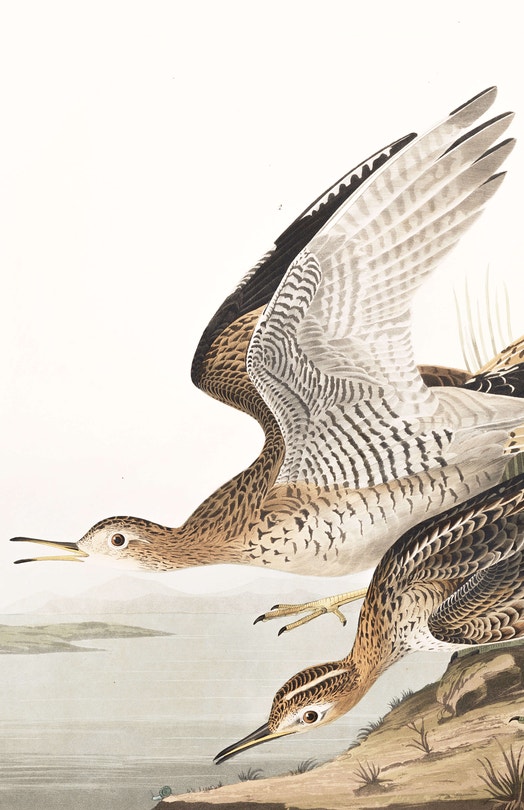
 "In Massachusetts, and to the eastward of that state, 
this species is best known by the name of 'Upland Plover,'” 
  ~ J. J. Audubon 

The upland plover begins with a quivering note somewhat like a tree-toad and ends with a long, clear, somewhat plaintive or melodious hawk-like scream. I never heard this very near to me, and when I asked the inhabitants about it they did not know what I meant.* It hovers on quivering wing, and alights by a steep dive.

My paper so damp in this house I can’t press flowers without mildew, nor dry my towel for a week.

H. D. Thoreau, Journal, July 12, 1855


*Frank Forester, in “Manual for Young Sportsmen,” 1856, page 308, says, 
“This bird has a soft plaintive call or whistle of two notes, which have something of a ventriloquial character and possess this peculiarity, that when uttered close to the ear, they appear to come from a distance, and when the bird is really two or three fields distant, sound as if near at hand.”
Upland ploever  See  Augusst (?), 1850 ("As I was stalking over the surface of this planet in the dark to-night, I started a plover resting on the ground and heard him go off with whistling wings."); June 15, 1860 ("I heard the familiar willet note of the upland plover and  looking up, saw one standing erect — like a large tell tale, or chicken with its head stretched up — on the rail fence. After a while it flew off southwest and l , then wheeled and went a little higher down the river . Of pigeon size, but quick quivering wings. Finally rose higher and flew more or less zigzag, as if uncertain where it would alight, and at last, when almost out of sight  it pitched down into a field near Cyrus Hubbard's. It was the same note I heard so well on Cape Cod in July, '55")

Thoreau's  Upland Plover is the Upland Sandpiper (Bartramia longicauda).His Peetweet  is the Spotted Sandpiper  (Actitis macularia). He also observed the Lesser Golden-Plover (Pluvialis dominica ) and Piping Plover (Charadrius melodus) See Thoreau's Birds

July 12. See A Book of the Seasons,  by Henry Thoreau, July 12

The upland plover
hovers on quivering wing –
 alights by steep dive.

A Book of the Seasons,  by Henry Thoreau
"A book, each page written in its own season,
out-of-doors, in its own locality.”
~edited, assembled and rewritten by zphx © 2009-2021 

Saturday, July 11, 2015

A walk on the beach

July 11


See young piping plover running in a troop on the beach like peetweets.

Patches of shrub oaks, bayberry, beach plum, and early wild roses, overrun with woodbine. What a splendid show of wild roses, whose sweetness is mingled with the aroma of the bayberry! 

A bar wholly made within three months; first exposed about first of May; as I paced, now seventy five rods long and six or eight rods wide at high water, and bay within six rods wide. The bay has extended twice as far, but is filled up. 

upland plover 

The upland plover hovers almost stationary in the air with a quivering note of alarm. Above, dark-brown interspersed with white, darkest in rear; gray-spotted breast, white beneath; bill dark above, yellowish at base beneath, and legs yellowish. 

July 11, 2015

Bank at lighthouse one hundred and seventy feet on the slope, perpendicular one hundred and ten; say shelf slopes four and ordinary tide-fall is nine, makes one hundred and twenty-three in all. Saw sand bank south fifteen to twenty-five feet higher. 

Mackerel-fishing not healthy like cod-fishing; hard work packing the mackerel, stooping over.

H. D. Thoreau, Journal, July 11, 1855

Upland plover. "In Massachusetts, and to the eastward of that state, this species is best known by the name of 'Upland Plover,'”   ~ J. J. Audubon  [Bertram’s sandpiper (Bartramia longicauda),  now known as the Upland Sandpiper.]

July 11. See A Book of the Seasons, by Henry Thoreau, July 11

A Book of the Seasons, by Henry Thoreau
"A book, each page written in its own season,
out-of-doors, in its own locality.”
~edited, assembled and rewritten by zphx © 2009-2021

Monday, July 6, 2015

Walked from post-office to lighthouse. Fog till eight or nine, and short grass very wet.

July 6.

Rode to North Truro very early in the stage or covered wagon, on the new road, which is just finished as far as East Harbor Creek. 

Blackfish on the shore. 

Walked from post-office to lighthouse. Fog till eight or nine, and short grass very wet. 

Board at James Small’s, the lighthouse, at $3.50 the week. 

Polygala polygama well out, flat, ray-wise, all over the fields. Cakile Americana, sea-rocket, the large weed of the beach, some time and going to seed, on beach. Pasture thistle (Cirsium pumilum), out some time. A great many white ones. 

The boy, Isaac Small, got eighty bank swallows’ eggs out of the clay-bank, i. e. above the clay. Small says there are a few great gulls here in summer.

I see small (?) yellow-legs. Many crow blackbirds in the dry fields hopping about. 

Upland plover near the lighthouse breeding. Small once cut off one’s wing when mowing in the field next the lighthouse as she sat on her eggs.

Many seringo-birds, apparently like ours. 

They say mackerel have just left the Bay, and fishermen have gone to the eastward for them. Some, however, are catching cod and halibut on the back side. 

Cape measures two miles in width here on the great chart.

H. D. Thoreau, Journal, July 6, 1855

Board at James Small’s, the lighthouse, at $3.50 the week. See June 18, 1857 ("Small says that the lighthouse was built about sixty years ago.")

Friday, September 19, 2014

Like light reflected from a fog-bank. A season of prolonged youth.


September 19

September 19, 2014

Viburnum Lentago berries now perhaps in prime, though there are but few blue ones.

Thinking this afternoon of the prospect of my writing lectures and going abroad to read them the next winter, I realize how incomparably great the advantages of obscurity and poverty which I have enjoyed so long (and may still perhaps enjoy). I think with what more than princely, with what poetical, leisure I have spent my years hitherto, without care or engagement, fancy-free. 

I have given myself up to nature; I have lived so many springs and summers and autumns and winters as if I had nothing else to do but live them, and imbibe whatever nutriment they had for me; I have spent a couple of years, for instance, with the flowers chiefly, having none other so binding engagement as to observe when they opened; I could have afforded to spend a whole fall observing the changing tints of the foliage. Ah, how I have thriven on solitude and poverty! 

I cannot overstate this advantage. I do not see how I could have enjoyed it, if the public had been expecting as much of me as there is danger now that they will. If I go abroad lecturing, how shall I ever recover the lost winter?

It has been my vacation, my season of growth and expansion, a prolonged youth.

An upland plover goes off from Conantum top (though with a white belly), uttering a sharp white, tu white

That drought was so severe that a few trees here and there—birch, maple, chestnut, apple, oak—have lost nearly all their leaves. 

I see large flocks of robins with a few flickers, the former keeping up their familiar peeping and chirping. 

Many pignuts have fallen. 

Hardhack is very commonly putting forth new leaves where it has lost the old. They are half an inch or three quarters long, and green the stems well. 

The stone-crop fruit has for a week or more had a purplish or pinkish tinge by the roadside. Fallen acorns in a few days acquire that wholesome shining dark chestnut color. 

Did I see a returned yellow redpoll fly by? 

I saw, some nights ago, a great deal of light reflected from a fog-bank over the river upon Monroe’s white fence, making it conspicuous almost as by moonlight from my window. 

September 19, 2014
(And in the distance
a maple by the water, 
beginning to blush.)

H. D. Thoreau, Journal, September 19, 1854

I see large flocks of robins with a few flickers, the former keeping up their familiar peeping and chirping.
See August 21, 1854 ("I see robins in small flocks and pigeon woodpeckers with them."); September 21, 1853 ("[Near Bangor] saw robins in flocks going south.")


tinyurl.com/HDTFOG

Tuesday, September 7, 2010

Signs of Fall


September 4.

It is cooler these days and nights, and I move into an eastern chamber in the morning, that I may sit in the sun.

The water, too, is cooler when I bathe in it, and I am reminded that this recreation has its period. I feel like a melon or other fruit laid in the sun to ripen. I grow, not gray, but yellow.

Saw flocks of pigeons the 2d and 3d. On Conantum an upland plover. The goldfinch is very busy pulling the thistle to pieces.

H. D. Thoreau, Journal, September 4, 1860


I move into an eastern chamber in the morning, that I may sit in the sun.
 See August 29, 1859 ("It is so cool a morning that for the first time I move into the entry to sit in the sun"); September 17, 1858 (“Cooler weather now for two or three days, so that I am glad to sit in the sun on the east side of the house mornings.”); September 18, 1852 ("In the forenoons I move into a chamber on the east side of the house, and so follow the sun round.”)


The goldfinch is very busy pulling the thistle to pieces.
See August 9, 1856 (“These are already feeding on the thistle seeds.”); September 4, 1859 ("Three kinds of thistles are commonly out now, — the pasture, lanceolate, and swamp") See also A Book of the Seasons, by Henry Thoreau, the Thistles
and A Book of the Seasons, by Henry Thoreau the Goldfinch

Popular Posts Last 30 Days.

The week ahead in Henry’s journal

The week ahead in Henry’s journal
A journal, a book that shall contain a record of all your joy.
"A stone fruit. Each one yields me a thought." ~ H. D. Thoreau, March 28, 1859


I sit on this rock
wrestling with the melody
that possesses me.