Showing posts with label kingbird. Show all posts

Monday, June 2, 2025

A Book of the Seasons: The Eastern Kingbird


 For the first time I perceive this spring
that the year is a circle.  
I would make a chart of our life,
know why just this circle of creatures completes the world.
Henry Thoreau, April 18, 1852

Are these not kingbird days,
when, in clearer first June days full of light,
this aerial, twittering bird flutters from willow to willow
and swings on the twigs,
showing his white-edged tail?
June 2, 1854

That aerial and spirited bird
loves best, methinks,
to fly where the sky is reflected beneath him.
  August 5, 1858
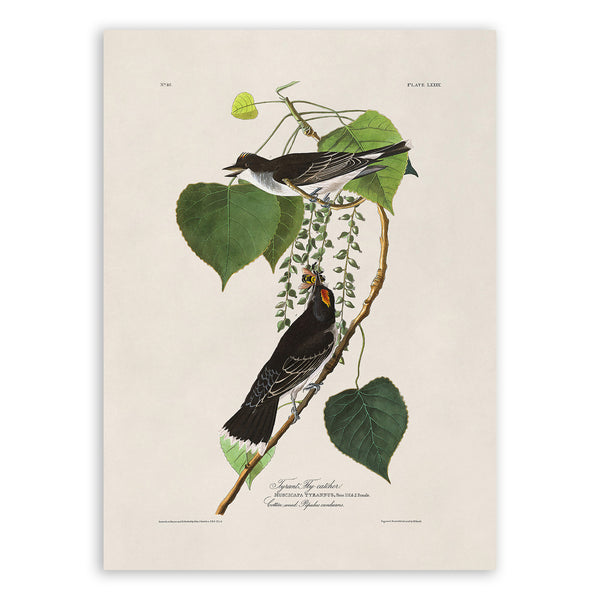

May 9.  Kingbird. May 9, 1857

May 10.   See a kingbird, looking like a large phoebe, on a willow by the river, and hear higher the clear whistle of the oriole. New days, then, have come, ushered in by the warbling vireo, yellowbird, Maryland yellow-throat, and small pewee, and now made perfect by the twittering of the kingbird and the whistle of the oriole amid the elms . . .  if not already the bobolink. May 10, 1853  

May 10.  It is remarkable that I saw this morning for the first time the bobolink, gold robin, and kingbird, - May 10, 1853

May 11.  I see the kingbird. May 11, 1854

May 11.  Now, some time after sunset, the robins scold and sing, the Maryland yellow-throat is heard amid the alders and willows by the waterside, and the peetweet and black birds, and sometimes a kingbird, and the tree-toad. May 11, 1854

May 12. Is not this the first day of summer, when first I sit with the window open and forget fire? and hear the golden robin and kingbird, etc., etc.? not to mention the bobolink, vireo, yellowbird, etc., and the trump of bullfrogs heard last evening. May 12, 1854

May 14.  First kingbird. Its voice and flight relate it to the swallow. May 14, 1852 

May 14.  The still dead-looking willows and button-bushes are alive with red-wings . . .The yellowbird, kingbird, and pewee, beside many swallows, are also seen. But the rich colors and the rich and varied notes of the blackbirds surpass them all. May 14, 1853

May 14.  A kingbird.  May 14, 1858

May 16.  Hear a bobolink and kingbird, and find sparrows' nests on the ground. May 16, 1859

May 17.  Kingbird.  May 17, 1856

May 29. How still the hot noon; people have retired behind blinds. Yet the kingbird — lively bird, with white belly and tail edged with white, and with its lively twittering— stirs and keeps the air brisk. May 29, 1853

June 2. Are these not kingbird days, when, in clearer first June days full of light, this aerial, twittering bird flutters from willow to willow and swings on the twigs, showing his white-edged tail? June 2, 1854

June 2. Bats go over, and a kingbird, very late. June 2, 1860

June 3.  A very warm day, without a breeze. A kingbird's nest in a fork of a black willow. June 3, 1854 

June 5. I see at a distance a kingbird or blackbird pursuing a crow lower down the hill, like a satellite revolving about a black planet.  June 5, 1854

June 5.  The Muscicapa Cooperi sings pe pe pe', sitting on the top of a pine, and shows white rump ( ? ) , etc. , unlike kingbird. June 5, 1856 

June 6.  A kingbird's nest, with two of its large handsome eggs, very loosely set over the fork of a horizontal willow by river, with dried everlasting of last year, as usual, just below Garfield's boat. Another in black willow south of long cove (east side, north of Hubbard's Grove) and another north of said cove.   June 6, 1857 

June 6.  As the light is obscured after sunset, the birds rapidly cease their songs, and the swallows cease to flit over the river. And soon the bats are seen taking the places of the swallows and flying back and forth like them, and commonly a late kingbird will be heard twittering still in the air.  June 6, 1860

June 7.  What does it signify, the kingbird, black bird, swallow, etc., etc., pursuing a crow? June 7, 1858 

June 7.  It is evidence enough against crows and hawks and owls, proving their propensity to rob birds’ nests of eggs and young, that smaller birds pursue them so often. You do not need the testimony of so many farmers' boys when you can see and hear the small birds daily crying “Thief and murder” after these spoilers.  June 7, 1858 

June 8.  A kingbird’s nest on a black cherry, above Barbarea Shore. loosely constructed, with some long white rags dangling; one egg. June 8, 1856 

June 8.   The marsh hawk's eggs are not yet hatched. She rises when I get within a rod and . . . keeps circling over the nest and repeatedly stoops within a rod of my head in an angry manner.  . . . A red-wing and a kingbird are soon in pursuit of the hawk, which proves, I think, that she meddles with their nests or themselves.  She circles over me, scolding, as far as the edge of the wood, or fifteen rods. June 8, 1858

June 8.    A kingbird's nest with three eggs, lined with some hair, in a fork — or against upright part — of a willow, just above near stone bridge. June 8, 1858 

Kingbird's nest with eggs
in a fork of a willow
above near stone bridge.

June 9.   I have come with a spy-glass to look at the hawks.  . . . Now and then pursued by a kingbird or a blackbird, who appear merely to annoy it by dashing down at its back. June 9, 1853

June 9.  A kingbird's nest and one egg.  June 9, 1860

June 11.  See many small blue devil's-needles to-day, but no mates with them, and is it not they that the kingbird stoops to snap up, striking the water each time?  June 11, 1860 

June 13.    The kingbird's eggs are not yet hatched. June 13, 1854

June 13.  Two kingbirds’ nests with eggs in an apple and in a willow by riverside.  June 13, 1855

June 14.  A kingbird’s nest with four eggs on a large horizontal stem or trunk of a black willow, four feet high, over the edge of the river, amid small shoots from the willow; outside of mikania, roots, and knotty sedge, well lined with root fibres and wiry weeds. June 14, 1855 

June 16.  Examined a kingbird’s nest found before (13th) in a black willow over edge of river, four feet from ground. Two eggs. West of oak in Hubbard’s meadow. June 16, 1855 

June 24.  A kingbird’s nest just completed in an apple tree. June 24, 1856 

July 5.  Borrowed Witherell’s boat and paddled over Loring’s Pond. A kingbird’s nest in fork of a button—bush five feet high on shore (not saddled on); three young just hatched and one egg.  July 5, 1856 

July 9. Paddle up river and sound a little above Fair Haven Pond. See young kingbirds which have lately flown perched in a family on the willows, — the airy bird, lively, twittering. July 9, 1859

July 10.  Kingbird lively. July 10, 1854

July 10.  Hearing a noise, I look up and see a pigeon woodpecker pursued by a kingbird, and the former utters loud shrieks with fear. July 10, 1859

July 10. See many young birds now, —  blackbirds, swallows, kingbirds, etc., in the air. July 10, 1859

July 10. The singing birds at present are: —Rural: Song sparrow, seringos, flicker, kingbird, goldfinch, link of bobolink, cherry-bird. July 10, 1854

July 17. The birds are quite lively at this hour of noon, — the robin, red - eye, wood pewee  martins, and kingbirds, etc. July 17, 1854

July 18.  5 A. M.  Whence these fogs and this increase of moisture in the air? The kingbird, song sparrows, and quail are lively. July 18, 1854

July 28. P. M. – Up Assabet. The kingbirds eat currants.  July 28, 1859

August 1.  I see a kingbird hovering within six inches above the potamogetons, front of Cheney's, and repeatedly snapping up some insects, perhaps a devil's-needle. [Often afterward for weeks; stoops from the willows]  August 1, 1859

August 5.  [Black willows] resound still with the sprightly twitter of the kingbird, that aerial and spirited bird hovering over them, swallow-like, which loves best, methinks, to fly where the sky is reflected beneath him. Also now from time to time you hear the chattering of young blackbirds or the link of bobolinks there, or see the great bittem flap slowly away.  The kingbird, by his activity and lively note and his white breast, keeps the air sweet. He sits now on a dead willow twig, akin to the flecks of mackerel sky, or its reflection in the water, or the white clamshell, wrong side out, opened by a musquash, or the fine particles of white quartz that may be found in the muddy river’s sand.  He is here to give a voice to all these.  The willow’s dead twig is aerial perch enough for him.  August 5, 1858

His activity
and lively note and his white
breast keeps the air sweet.

August 6.  If our sluggish river, choked with potamogeton, might seem to have the slow-flying bittern for its peculiar genius, it has also the sprightly and aerial kingbird to twitter over and lift our thoughts to clouds as white as its own breast  August 6, 1858 

August 7.  The sprightly kingbird glances and twitters above the glossy leaves of the swamp white oak. Perchance this tree, with its leaves glossy above and whitish beneath, best expresses the life of the kingbird and is its own tree. August 7, 1858

The sprightly kingbird
twitters above glossy leaves
of the swamp white oak.

August 12.  It is surprising how young birds, especially sparrows of all kinds, abound now, and bobolinks and wood pewees and kingbirds.  August12, 1858

August 14.  To speak from recollection, the birds which I have chanced to hear of late are (running over the whole list):  . . .The twitter of the kingbird, pretty often.  August 14, 1858

August 17.  Some days ago I saw a kingbird twice stoop to the water from an overhanging oak and pick an insect from the surface.  August 17, 1858

August 19.  Flocks of bobolinks go tinkling along about the low willows, and swallows twitter, and a kingbird hovers almost stationary in the air, a foot above the water.  August 19, 1853

August 23.  I see to-day — and may add to yesterday's list — the blue heron launch off from an oak by the river and flap or sail away with lumbering flight; also kingbirds and crows. August 23, 1853

August 29.  Many birds nowadays resort to the wild black cherry tree, as here front of Tarbell's. I see them continually coming and going directly from and to a great distance, — cherry birds, robins, and kingbirds. August 29, 1854 

September 1.  Now see many birds about E. Hubbard's elder hedge, —  bobolinks, kingbirds, pigeon woodpeckers, — and not elsewhere. September 1, 1860

December 22. In a (apparently kingbird's?) nest on this island I saw three cherry-stones, as if it had carried home this fruit to its young. It was, outside, of gnaphalium and saddled on a low limb. Could it have been a cherry-bird? December 22. 1859

See also

 A Book of the Seasons, by Henry Thoreau
"A book, each page written in its own season,
out-of-doors, in its own locality.”
~edited, assembled and rewritten by zphx © 2009-2025

Monday, July 11, 2022

Now is the time for meadow walking.

July 11. 

July 11, 2015

4.30 A. M. -To the river.

The shore is strewn with quite a long grove of young red maples two inches high, with the samaræ attached. So they are dispersed.

The heart-leaf flower is abundant more than ever, but shut up at this hour.

The first lily I noticed opened about half an hour after sunrise, or at 5 o'clock.

The Polygonum hydropiperoides, I think it is, now in blossom in the mud by the river.

Morning-glories are in perfection now, some dense masses of this vine with very red flowers, very attractive and cool-looking in dry mornings. They are very tender and soon defaced in a nosegay.

The large orange lily with sword-shaped leaves, strayed from cultivation, by the roadside beyond the stone bridge.

It is a sufficient reason for walking in the forenoon sometimes that some flowers shut up at noon and do not open again during the day, thus showing a preference for that portion of the day.

P. M. — To Conantum.

The wind makes it rather more comfortable to-day.

That small globose white flower with glossy radical leaves is common now on the muddy shore of the river.

The fishes' nests are left high and dry, and I perceive that they are distinctly hollowed, five or six inches deep, in the sand, i. e. below the surrounding surface.

Here are some which still contain their panful of water, but are no longer connected with the river. They have a distinct raised edge of sand about one and a half inches high and three or four wide.

The lilies I have tried in water this warmest weather have wilted the first day. Only the water can produce and sustain such flowers. Those which are left high and dry, or even in very shallow water, are wont to have a dwarfed growth.

The Victoria lily is a water flower.

The river is low. 

Now is the time for meadow walking. (I am in the meadow north of Hubbard's Bridge.) You go dry-shod now through meadows which were comparatively impassable before, —- those western reserves which you had not explored. We are thankful that the water has preserved them inviolate so long.

There is a cheerful light reflected from the undersides of the ferns in the drier meadows now, and has been for some time, especially in breezy weather.

It was so in June.

The dusty roads and roadsides begin to show the effects of drouth.

The corn rolls.

The bass on Conantum is now well in blossom. It probably commenced about the 9th. Its flowers are conspicuous for a tree, and a rather agreeable odor fills the air. The tree resounds with the hum of bees on the flowers. On the whole it is a rich sight.

Is it not later than the chestnut?

The elder is a very conspicuous and prevalent flower now, with its large flat cymes.

Pogonias and calopogons are very abundant in the meadows. They are interesting, if only for their high color.

Any redness is, after all, rare and precious. It is the color of our blood. The rose owes its preëminence in great measure to its color. It is said to be from the Celtic rhos, red. It is nature's most precious color.

Impatiens fulva, by Corner Spring.

I hear often nowadays the kingbird's chattering twitter.

As you walk under oaks, you perceive from time to time a considerable twig come gently falling to the ground, whose stem has been weakened by a worm, and here and there lie similar twigs whose leaves are now withered and changed.

How valuable and significant is shade now! Trees appear valuable for shade mainly, and we observe their shadows as much as their form and foliage.

The waving of the meadow-grass near Fair Haven Isle is very agreeable and refreshing to one looking down from an elevation. It appears not merely like a waving or undulation, but a progress, a creeping, as of an invisible army, over it, its flat curly head.

The grass appears tufted, watered.

On the river the ripple is continued into the pads, where it is smoother,-- a longer undulation.

Pines or evergreens do not attract so much attention now. They have retired on the laurels of the winter campaign.

What is called genius is the abundance of life or health, so that whatever addresses the senses, as the flavor of these berries, or the lowing of that cow, which sounds as if it echoed along a cool mountain-side just before night, where odoriferous dews perfume the air and there is everlasting vigor, serenity, and expectation of perpetual untarnished morning, — each sight and sound and scent and flavor, 
— intoxicates with a healthy intoxication.  The shrunken stream of life overflows its banks, makes and fertilizes broad intervals, from which generations derive their sustenances.

This is the true overflowing of the Nile. 

So exquisitely sensitive are we, it makes us embrace our fates, and, instead of suffering or indifference, we enjoy and bless. If we have not dissipated the vital, the divine, fluids, there is, then, a circulation of vitality beyond our bodies. The cow is nothing. Heaven is not there, but in the condition of the hearer.

I am thrilled to think that I owe a perception to the commonly gross sense of taste, that I have been inspired through the palate, that these berries have fed my brain. After I had been eating these simple, wholesome, ambrosial fruits on this high hillside, I found my senses whetted, I was young again, and whether I stood or sat I was not the same creature.

The yellow lily is not open-petalled like the red, nor is its flower upright, but drooping. On the whole I am most attracted by the red. They both make freckles beautiful.

Fragrances must not be overpowering, however sweet. I love the sweet fragrance of melilot.

The Circæa alpina, enchanter's-nightshade, by Corner Spring, low, weed-like, somewhat like touch-me-not leaves. Was it not the C. Lutetiana (a larger plant) that I found at Saw Mill Brook?


H. D. Thoreau, Journal, July 11, 1852

The shore is strewn with quite a long grove of young red maples two inches high, with the samaræ attached. See A Book of the Seasons, by Henry Thoreau, The Maple Keys

It is a sufficient reason for walking in the forenoon sometimes that some flowers shut up at noon and do not open again during the day. See June 20, 1853 (" Coming home at twelve, I see that the white lilies are nearly shut."); July 1, 1852 ("After eating our luncheon I can not find one open anywhere for the rest of the day.")

The bass on Conantum is now well in blossom. See July 16, 1852 ("The bass on Conantum is a very rich sight now, . . . The tree resounds with the hum of bees, — bumblebees and honey-bees ; rose-bugs and butterflies, also, are here, — a perfect susurrus, a sound, as C. says, unlike any other in nature, — not like the wind, as that is like the sea. . . . The air is full of sweetness. The tree is full of poetry.");. July 17, 1854 ("I was surprised by the loud humming of bees, etc., etc., in the bass tree; thought it was a wind rising at first. Methinks none of our trees attract so many"); . July 17, 1856 ("Hear at distance the hum of bees from the bass with its drooping flowers at the Island, a few minutes only before sunset. It sounds like the rumbling of a distant train of cars"); July 18, 1854 (" We have very few bass trees in Concord, but walk near them at this season and they will be betrayed, though several rods off, by the wonderful susurrus of the bees, etc., which their flowers attract. It is worth going a long way to hear. ") Compare June 3, 1857 (“The bass at the Island will not bloom this year. (?)”); June 21, 1853 (There are no flowers nor flower-buds on the bass this year, though it was so full last year.""); June 30, 1852 ("The bass tree is budded"); July 3, 1853("There are no flowers on bass trees commonly this year."); July 4, 1853 ("The bass appears now — or a few trees — to have bloomed here and there prematurely."); July 9, 1857 (“I see no flowers on the bass trees by this river this year, nor at Conantum.”); and see also A Book of Seasons, by Henry Thoreau, The Basswood

Now is the time for meadow walking. See August 22, 1854 ("I go again to the Great Meadows, to improve this remarkably dry season and walk where in ordinary times I cannot go."); August 21, 1859 ("There is quite a drought, and I can walk almost anywhere over these meadows without wetting my feet.."); June 26, 1860 ("You cross the meadows dry-shod by following the winding lead of the blue-eyed grass, which grows only on the firmer, more elevated, and drier parts.") Compare July 10, 1852 (“I make quite an excursion up and down the river in the water, a fluvial, a water walk. It seems the properest highway for this weather."); January 20, 1856 ("Here, where you cannot walk at all in the summer, is better walking than elsewhere in the winter.")

Whatever addresses the senses . . . each sight and sound and scent and flavor, — intoxicates with a healthy intoxication. See  July 16, 1851 ("To have such sweet impressions made on us,. . . This is a pleasure, a joy, an existence which I have not procured myself.");   August 3, 1852 ("By some fortunate coincidence of thought or circumstance I am attuned to the universe, I am fitted to hear, my being moves in a sphere of melody."); December 11, 1855 ("My body is all sentient. As I go here or there, I am tickled by this or that I come in contact with, as if I touched the wires of a battery."); See also A Book of the Seasons, by Henry Thoreau, A body awake in the world; Walden (“To him whose elastic and vigorous thought keeps pace with the sun, the day is a perpetual morning. It matters not what the clocks say . . . Morning is when I am awake and there is a dawn in me.”)

Thursday, August 1, 2019

Low-water plants.

August 1. 
August 1, 2019

6 a.m. — River is at summer level. 

This being Monday morning, the river is probably lower than at any other time in the week. 

Am surprised to see in water opposite between Monroe's and Dodd's the Myriophyllum ambiguum var. natans, amid the Bidens Beckii. It must have been out (under water) a fortnight. A pretty sprig of pectinate leafets above the capillary-leafed and slimy mass. 

The B. Beckii (just beginning to bloom) just shows a few green leafets above its dark and muddy masses, now that the river is low. 

Evidently the above two and lilies, cardinal-flowers, etc., depend on the state of the river in June. After a very wet June I think there is less bloom on them. Some years the first two are not noticed at all. 

We have now got down to the water milfoil and the B. Beckii. These might be called low-water plants

The bottom is occasionally — though quite rarely in Concord — of soft shifting sand, ripple-marked, in which the paddle sinks, under four or five feet of water (as below the ash tree hole), and few weeds grow on such a shallow. 

Evidently the hill at Hemlocks would be a flowing sand-hill, if it were not held together by the hemlocks.  

The common cat-tail (about five feet high by rail road, beyond the South Bridge) has no interval between the two kinds of flowers, but mine of yesterday has, and yet it is much larger than the common. Can it, then, be the Typha angustifolia, which is described as smaller and rare? 

I see a kingbird hovering within six inches above the potamogetons, front of Cheney's, and repeatedly snapping up some insects, perhaps a devil's-needle.

The west edge of the Rock above Island is eleven and a half inches above summer level. Now, at 5 P. M., the river has risen an inch and a half since 6 A. M., though we have not had a drop of rain for three days, and then but a few drops, and it fell three quarters of an inch between yesterday (Sunday) morning and this morning. Is this rise owing to the water let on from various mill-ponds this Monday morning?

H. D. Thoreau, Journal, August 1, 1859

The B. Beckii (just beginning to bloom) just shows a few green leafets above its dark and muddy masses, now that the river is low. See August 2, 1856 ("Very common now are the few green emerald leafets of the Bidens Beckii, which will ere long yellow the shallow parts.")

The common cat-tail has no interval between the two kinds of flowers, but mine of yesterday has, and yet it is much larger than the common See July 31, 1859 ("Above the Sudbury causeway, I notice again that remarkable large and tall typha, apparently T. latifolia (yet there is at least more than an inch interval between the two kinds of flowers, judging from the stump of the sterile bud left on).")

I see a kingbird hovering within six inches above the potamogetons, front of Cheney's, and repeatedly snapping up some insects, perhaps a devil's-needle. See August 6, 1858 ("If our sluggish river, choked with potamogeton, might seem to have the slow-flying bittern for its peculiar genius, it has also the sprightly and aerial kingbird to twitter over and lift our thoughts to clouds as white as its own breast.")

Thursday, May 16, 2019

Hear a tanager to-day, and one was seen yesterday.

May 16 

Monday. 

Surveying Damon's farm and factory lot. 

Our corydalis was out the 13th. 

Hear a tanager to-day, and one was seen yesterday. 

Sand cherry out. 

Ranunculus abortivus well out (when?), southwest angle of Damon's farm. 

Hear a bobolink and kingbird, and find sparrows' nests on the ground. 

At eve the first spark of a nighthawk.

H. D. Thoreau, Journal, May 16, 1859

Our corydalis was out the 13th. See May 3, 1857 ("Corydalis glauca is five inches high. "); May 20, 1857 ("I find that the corydalis sprig which I brought home five days ago keeps fresh and blossoms remarkably well in water, — its delicate bright flesh-colored or pink flowers and glaucous leaves!");; July 11, 1857 ("There is an abundance of corydalis on the top of the Cliffs, but most of it is generally out of bloom"); May 29, 1858 ("Cannot find any large corydalis plants where it has been very plenty.")

Hear a tanager to-day, and one was seen yesterday.  See May 13, 1853 (“Methinks I hear and see the tanager now.”); May 15, 1856 ("As I sat by the Riordan crossing, thought it was the tanager I heard?"); May 18, 1851("The scarlet tanagers are come.”). May 19, 1856 (“The tanager is now heard plainly and frequently.”) See also A Book of Seasons,  by Henry Thoreau, the Scarlet Tanager

Sand cherry out. See May 4, 1855 ("Sand cherry yesterday leafs"); May 23, 1857 ("Sand cherry at Lupine Bank, possibly a day. “)

Hear a bobolink and kingbird.  See May 16, 1854 ("The earth is all fragrant as one flower. And bobolinks tinkle in the air.”) See also  May 10, 1853 ("New days, then, have come. . . now made perfect by the twittering of the kingbird and the whistle of the oriole amid the elms,, - if not already the bobolink.")

At eve the first spark of a nighthawk. See May 17, 1853 ("I hear the first unquestionable nighthawk squeak and see him circling far off high above the earth. It is now about 5 o'clock p. m");; May 23, 1857 ("and at evening I hear the spark of a nighthawk.");  May 25, 1852 ("First nighthawks squeak and boom.");   See also A Book of Seasons,  by Henry Thoreau,the Nighthawk

Friday, June 8, 2018

The bream is steadily poised over her treasures..

June 8
June 8, 2018
P. M. — To marsh hawk's nest near Hubbard’s Bath. 


June 8, 2018

I see many breams' nests made, and in one or two in which I look, I find, on taking out the stones and the gravel, the small yellowish ova about one twentieth of an inch in diameter. This is not, at least ordinarily, visible now as you look down on the nest, but, on taking up portions of the bottom of the concave nest, you find it scattered (not crowded) over the sand, stones, clam shells, weeds, etc., which form the bottom of the nest. It studs the little gray and brown stones, rather scatteredly, like some kind of gem adhering pretty firmly, and the bream is steadily poised over her treasures. 

You see the bream poised over her large concave nest in the sand, and, taking up a part of the bottom, as some brown stone, you find it studded with the small gem-like ova, loosely dispersed. Apparently it has not been laid long. 

The Salix nigra is still in bloom. 

I see red-wing blackbirds hatched. 

In several places I see where dead suckers have been at last partly devoured by some animal, and their great bladders are seen floating off. Thomas Bell, in his “British Reptiles,” says of “the Terrapene Europaea, the common lacustrine tortoise of the Continent,” “As they live principally upon small fish, the air-bags of which they reject, it is said that the people are wont to judge of the quantity of tortoises to be found in a lake or pond, by the number of air-bags which are seen swimming on the surface of the water.” 

The marsh hawk's eggs are not yet hatched. She rises when I get within a rod and utters that peculiar cackling or scolding note, much like, but distinct from, that of the pigeon woodpecker. She keeps circling over the nest and repeatedly stoops within a rod of my head in an angry manner. She is not so large as a hen-hawk, and is much more slender. She will come sailing swiftly and low over the tops of the trees and bushes, etc., and then stoop as near to my head as she dares, in order to scare me away. The primaries, of which I count but five, are very long and loose, or distant, like fingers with which she takes hold of the air, and form a very distinct part of the wing, making an angle with the rest. Yet they are not broad and give to the wing a long and slender appearance. The legs are stretched straight back under the tail. I see nothing of the male, nor did I before. 

A red-wing and a kingbird are soon in pursuit of the hawk, which proves, I think, that she meddles with their nests or themselves. She circles over me, scolding, as far as the edge of the wood, or fifteen rods. 

The early potentilla is now in some places erect. 

The sidesaddle-flower is out, — how long? — and the sweet flag, how long? 

I see quite common, on the surface in deep water wherever there are weeds, misty white strings of spawn, reminding one of toad-spawn without the ova, only whiter, or more opaque. But these strings turn on themselves, forming small masses four to eight inches long, attached to the weeds, – Ranunculus Purshii, potamogeton, etc., etc. These strings are full of minute ova, like seeds, pale-brown, oval or elliptical, about one fiftieth of an inch long. 

I perceive distinctly to-day that there is no articular line along the sides of the back of the bullfrog, but that there is one along the back of that bullfrog-like, smaller, widely dispersed and early frog so common about fountains, brooks, ditches, and the river, of which I probably have one small one bottled and have heard the croak (vide April 5th, 1858). 

That pale-brown or oat spawn must belong, then, I think, to the Rana fontinalis

A kingbird's nest with three eggs, lined with some hair, in a fork — or against upright part — of a willow, just above near stone bridge. 

Is that small spiked rush from a few inches to a foot or more in height Eleocharis palustris? or tenuis
In early aster meadow and else where common, along meadow-paths. 

Whiteweed is getting to be common.

H. D. Thoreau, Journal, June 8, 1858

June 8, 2018

And the bream is steadily poised over her treasures. See November 30, 1858 ("I can only poise my thought there by its side and try to think like a bream for a moment. I can only see the bream in its orbit, as I see a star. The bream, appreciated, floats in the pond as the centre of the system, another image of God. Its life no man can explain more than he can his own.")

The marsh hawk's eggs are not yet hatched. She rises when I get within a rod and utters that peculiar cackling or scolding note, much like, but distinct from, that of the pigeon woodpecker. See May 30, 1858 ("The hawk rises when we approach and circles about over the wood, uttering a note singularly like the common one of the flicker. . . . There are two dirty, or rather dirtied, white eggs left (of four that were),”);  June 17, 1858 (“One egg is hatched since the 8th, and the young bird, all down, with a tinge of fawn or cinnamon, lies motionless on its breast with its head down and is already about four inches long!”);  June 20, 1858 (“Got the marsh hawk's egg, which was addled. I noticed on the 17th that the hawk (my marsh hawk) was off her nest and soaring above the wood late in the afternoon, as I was returning.”); July 22, 1858 (“The nest of the marsh hawk is empty. It has probably flown.”);; August 2, 1858 (“I see there what I take to be a marsh hawk of this year, hunting by itself. It has not learned to be very shy yet, so that we repeatedly get near it. What a rich brown bird! almost, methinks, with purple reflections.”)

A red-wing and a kingbird are soon in pursuit of the hawk. See June 5, 1854 ("I see at a distance a kingbird or blackbird pursuing a crow lower down the hill, like a satellite revolving about a black planet."); June 7, 1858 ("It is evidence enough against crows and hawks and owls, proving their propensity to rob birds’ nests of eggs and young, that smaller birds pursue them so often.") See also A Book of the Seasons,  by Henry Thoreau, the Eastern Kingbird

A kingbird's nest with three eggs, lined with some hair, in a fork — or against upright part — of a willow. See June 8, 1856 ("A kingbird’s nest on a black cherry, above Barbarea Shore. loosely constructed, with some long white rags dangling; one egg."); see also June 3, 1854 ("A kingbird's nest in a fork of a black willow"); June 6, 1857 ("A kingbird's nest, with two of its large handsome eggs, very loosely set over the fork of a horizontal willow by river, with dried everlasting of last year, as usual, just below Garfield's boat. Another in black willow south of long cove (east side, north of Hubbard's Grove) and another north of said cove.");  June 3, 1854 ("A kingbird's nest in a fork of a black willow. "); June 13, 1855 ("Two kingbirds’ nests with eggs in an apple and in a willow by riverside."); June 14, 1855 ("A kingbird’s nest with four eggs on a large horizontal stem or trunk of a black willow, four feet high, over the edge of the river, amid small shoots from the willow; outside of mikania, roots, and knotty sedge, well lined with root fibres and wiry weeds"); June 16, 1855 ("Examined a kingbird’s nest found before (13th) in a black willow over edge of river, four feet from ground. Two eggs."); June 24, 1856 ("A kingbird’s nest just completed in an apple tree. "); July 5, 1856 ("A kingbird’s nest in fork of a button-bush five feet high on shore (not saddled on); three young just hatched and one egg.")   See also A Book of the Seasons,  by Henry Thoreau, the Eastern Kingbird

The sidesaddle-flower is out. [Sarracenia purpurea, also known as the purple pitcherplant or northern pitcher plant, the only pitcherplant native to New England. ]See June 8, 1854 ("Sidesaddle, apparently to-morrow (?)") and note to June 12, 1856 ("Sidesaddle flower numerously out now.") See also A Book of the Seasons,   by Henry Thoreau, The Purple Pitcher Plant

June 8. See A Book of the Seasons, by Henry Thoreau, June 8

A Book of the Seasons,  by Henry Thoreau
"A book, each page written in its own season,
out-of-doors, in its own locality."
 ~edited, assembled and rewritten by zphx ©  2009-2025

Popular Posts Last 30 Days.

The week ahead in Henry’s journal

The week ahead in Henry’s journal
A journal, a book that shall contain a record of all your joy.
"A stone fruit. Each one yields me a thought." ~ H. D. Thoreau, March 28, 1859


I sit on this rock
wrestling with the melody
that possesses me.