Showing posts with label Painted-Cup Meadow. Show all posts

Thursday, September 13, 2018

Many yellow butterflies in road and fields all the country over.

September 13

P. M._—To Annursnack.


September 13, 2018
 Solidago puberula, apparently in prime and handsome, roadside, Colburn’s Hill. 

I noticed the black willows quite imbrowned on the 10th, and the button-bushes beginning to look yellowish. 

A. Hosmer is pleased because from the cupola of his new barn he can see a new round-topped mountain in the northwest. Is curious to know what one it is. Says that if he lived as near Annursnack as Heywood does, he should go up it once a week, but he supposes that Heywood does not go up it more than once a year. 

What is that grass still in bloom a foot or more in height in Heywood’s potato-field, some fifty rods west of house leek? It is somewhat like what I have wrongly called Danthonia spicata, but with a longer and a round spike, etc., etc. Vide press. 

There is a man there mowing the Panicum Crus-galli, which is exceedingly rank and dense, completely concealing the potatoes, which have never been hoed, it was so wet. He saves this grass and says the cattle like it well. 

I notice that the large ant-hills, though they prevent bushes and ferns from growing where they are built, keeping open a space four to seven feet wide in their midst, do not keep out grass, but they are commonly little grassy mounds with bare tops. 

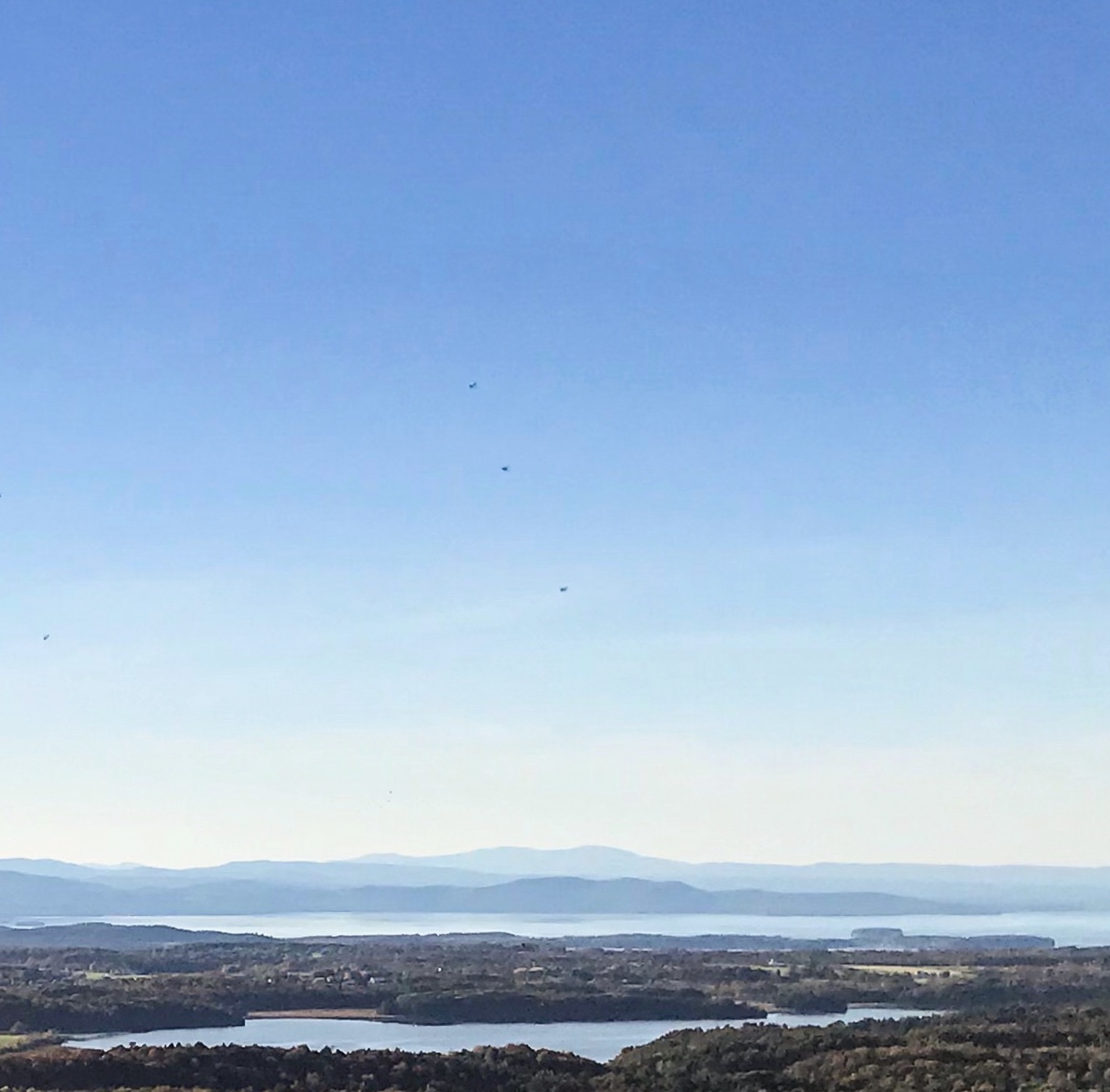
Looking from the top of Annursnack, the aspect of the earth generally is still a fresh green, especially the woods, but many dry fields, where apparently the June-grass has withered uncut, are a very pale tawny or lighter still. It is fit that some animals should be nearly of this color. The cougar would hardly be observed stealing across these plains. In one place I still detect the ruddiness of sorrel. 

Euphorbia hypericifolia still, and gone to seed, on the top of Annursnack. 

From many a barn these days I hear the sound of the flail. For how many generations this sound will continue to be heard here! At least until they discover a new way of separating the chaff from the wheat.

Saw one raking cranberries on the 10th; rather early.

A small dense flock of wild pigeons dashes by over the side of the hill, from west to east, — perhaps from Wetherbee’s to Brooks’s, for I see the latter’s pigeon place. They make a dark slate-gray impression. 

Fringed gentian out well, on easternmost edge of the Painted-Cup Meadows, by wall.[Caroline Pratt tells me the 20th that her father found it out full a fortnight before that date!]

Saw a striped snake run into the wall, and just before it disappeared heard a loud sound like a hiss! I think it could hardly have been made by its tail among leaves. 

The squirrels know better than to open unsound hazelnuts. At most they only peep into them. I see some on the walls with a little hole gnawed in them, enough to show that they are empty. 

Muskmelons and squashes are turning yellow in the ‘  gardens, and ferns in the swamps. 

Hear many warbling vireos these mornings.

Many yellow butterflies in road and fields all the country over.

H. D. Thoreau, Journal, September 13, 1858

Fringed gentian out well, on easternmost edge of the Painted-Cup Meadows, by wall. See October 12, 1857 ("To Annursnack. . . .The fringed gentian by the brook opposite is in its prime, and also along the north edge of the Painted-Cup Meadows")

Many yellow butterflies in road and fields all the country over. See September 4, 1856 ("Butterflies in road a day or two. "); September 3, 1854 (“I see some fleets of yellow butterflies in the damp road after the rain, as earlier.”); September 11, 1852 ("I see some yellow butterflies and others occasionally and singly only."); September 17, 1852 ("Still the oxalis blows, and yellow butterflies are on the flowers"); September 19, 1859 (" See many yellow butterflies in the road this very pleasant day after the rain of yesterday. One flutters across between the horse and the wagon safely enough, though it looks as if it would be run down.")

Wednesday, June 6, 2018

Tp Painted-Cup Meadow via Assabet Bath.


June 6


June 6, 2018

P. M. – Cornus florida at Island well out, say the 3d. 

I hear of linnaea out in a pitcher and probably (?) in woods. 

Go to Painted-Cup Meadow via Assabet Bath. 

See three or four Emys insculpta about, making their holes in the gravelly bank south of Assabet Bath, and a few holes which must have been made a day or two, probably by the same. 

Golden senecio is not uncommon now. 

Am surprised to find that the buck bean flowers are withered, being killed by the recent frosts. 

Yellow Bethlehem-star.

Edith Emerson has found, in the field (Merriam’s) just south of the Beck Stow pine grove, Lepidium campestre, which may have been out ten days.

H. D. Thoreau, Journal , June 6, 1858

Cornus florida at Island well out, say the 3d. See June 4, 1858 ("I find the Cornus florida out in my pitcher when I get home June 4th, though it was not out on Island May 31st, and it is well out on Island when I look June 6th. I will say, therefore, that it opened June 3d."); See also May 25, 1855 ("Cornus florida, no bloom. Was there year before last? Does it not flower every other year?”); May 22, 1856("The Cornus florida does not bloom this year.")

Golden senecio is not uncommon now. See May 23, 1853 ("I am surprised by the dark orange-yellow of the senecio. At first we had the lighter, paler spring yellows of willows, dandelion, cinquefoil, then the darker and deeper yellow of the buttercup; and then this broad distinction between the buttercup and the senecio, as the seasons revolve toward July."); May 27, 1859 ("Golden senecio, at least to-morrow. ");May 29, 1856 (" Ride to Painted-Cup Meadow. . . . Golden senecio there, a day or two, at least"); June 9, 1853 ("The meadows are now yellow with the golden senecio, a more orange yellow, mingled with the light glossy yellow of the buttercup") See also A Book of the Seasons,  by Henry Thoreau, The Golden Senecio

Yellow Bethlehem-star. See June 5, 1855 ("Yellow Bethlehem-star in prime.")

Edith Emerson has found Lepidium campestre. See note to May 29, 1856 ("Found a painted-cup with more yellow than usual in it, and at length Edith found one perfectly yellow") [ Lepidium campestre--. Cow cress. See June 12, 1859, referring to  Lepidium campestre field.]

Thursday, October 12, 2017

Distant elms seen from the hilltops.

October 12
October 12, 2017
October 12, 2017

P. M. – To Annursnack. 

The eighth fine day, warmer than the last two. 

I find one or two house-leek blossoms even yet fresh, and all the rest crisp. 

The fringed gentian by the brook opposite is in its prime, and also along the north edge of the Painted-Cup Meadows. 

The stems of the blue vervain, whose flowers and leaves are withered and brown, are nearly as handsome and clear a purple as those of the poke have been, from top to bottom. 

Looking from the Hill. 


October 12, 2017
The autumnal tints generally are much duller now than three or four days ago, or before the last two frosts. I am not sure but the yellow now prevails over the red in the landscape, and even over the green. The general color of the landscape from this hill is now russet, i.e. red, yellow, etc., mingled. The maple fires are generally about burnt out. Yet I can see very plainly the colors of the sproutland, chiefly oak, on Fair Haven Hill, about four miles distant, and also yellows on Mt. Misery, five miles off, also on Pine Hill, and even on Mt. Tabor, indistinctly. 

Eastward, I distinguish red or yellow in the woods as far as the horizon, and it is most distant on that side, — six miles, at least. - The huckleberries on Nagog Hill are very red. The smaller and tenderer weeds were in their prime, me thinks, some weeks ago. They have felt the frosts earlier than the maples and other trees, and are now withered generally. 

I see a very distant mountain house in a direction a little to the west of Carlisle, and two elms in the horizon on the right of it. Measuring carefully on the map of the county, I think it must be the Baptist Church in North Tewksbury, within a small fraction of fourteen miles from me. I think that this is the greatest distance at which I have seen an elm without a glass. There is another elm in the horizon nearly north, but not so far. It looks very much larger than it is. Perhaps it looms a little. 

The elm, I think, can be distinguished further than any other tree, and, however faintly seen in the distant horizon, its little dark dome, which the thickness of my nail will conceal, just rising above the line of the horizon, apparently not so big as a prominence on an orange, it suggests ever the same quiet rural and domestic life passing beneath it. 

It is the vignette to an unseen idyllic poem. Though that little prominence appears so dark there, I know that it is now a rich brownish-yellow canopy of rustling leaves, whose harvest-time is already come, sending down its showers from time to time. 

Homestead telegraphs to homestead through these distant elms seen from the hilltops. I fancy I hear the house-dog’s bark and lowing of the cows asking admittance to their yard beneath it. The tea-table is spread; the master and mistress and the hired men now have just sat down in their shirt-sleeves. 

Some are so lifted up in the horizon that they seem like portions of the earth detached and floating off by themselves into space. Their dark masses against the sky can be seen as far, at least, as a white spire, though it may be taller. Some of these trees, seen through a glass, are not so large.

. . . 

This was what those scamps did in California. The trees were so grand and venerable that they could not afford to let them grow a hair's breadth bigger, or live a moment longer to reproach themselves. They were so big that they resolved they should never be bigger. They were so venerable that they cut them right down. It was not for the sake of the wood; it was only because they were very grand and venerable.

H. D. Thoreau, Journal, October 12, 1857

The fringed gentian by the brook opposite is in its prime, and also along the north edge of the Painted-Cup Meadows. See October 2, 1857 ("The fringed gentian at Hubbard's Close has been out some time, and most of it already withered. ") October 19, 1852 ("It is too remarkable a flower not to be sought out and admired each year, however rare. It is one of the errands of the walker, as well as of the bees, for it yields him a more celestial nectar still. It is a very singular and agreeable surprise to come upon this conspicuous and handsome and withal blue flower at this season, when flowers have passed out of our minds and memories; the latest of all to begin to bloom ..."). See also A Book of the Seasons by Henry Thoreau, The Fringed Gentian

Friday, June 2, 2017

The grass is flaming up through the shallow water on the meadows.

June 2. 

Sterile buttonwood, not yet generally, but some apparently several days at least. 

It was a portion of the natural surface of the earth itself which jutted out and became my roof the other day. How fit that Nature should thus shelter her own children! The first drops were dimpling the pond even as the fishes had done. 

June 2, 2017
The grass is flaming up through the shallow water on the meadows. 

It is very warm till 3 p. m., and then a washing breeze arises, and before night probably distant thunder-showers have cooled the air, for after dark we see the flashes called heat lightning in the north, and hear the distant thunder. 

Geraniums bring thunder. 

That bobolink's song affected me as if one were endeavoring to keep down globes of melody within a vase full of liquid, but some bubbled up irrepressible, — kept thrusting them down with a stick, but they slipped and came up one side. 

A young sparrow already flies. 

Drove this afternoon to Painted-Cup Meadow. 

A tanager yesterday.

H. D. Thoreau, Journal , June 2, 1857

It was a portion of the natural surface of the earth itself which jutted out and became my roof the other day. See May 29, 1857 (“The drops fall thicker, and I seek a shelter under the Cliffs. ”); May 30, 1857 (“When first I had sheltered myself under the rock, I began at once to look out on the pond with new eyes,”)

Heat lightning in the north, and hear the distant thunder. See June 16, 1852 (“Heat lightning in the horizon. A sultry night. A flute from some villager.”)

That bobolink's song affected me. See June 1, 1857 (“I hear the note of a bobolink concealed in the top of an apple tree behind me. . . . Methinks they are the most liquidly sweet and melodious sounds I ever heard.”); May 16, 1854 ("The earth is all fragrant as one flower. And bobolinks tinkle in the air. Nature now is perfectly genial to man.”) and note to May 12, 1856 (“We hear the first bobolink. . . How much life the note of the bobolink imparts to the meadow! ”) See also A Book of the Seasons by Henry Thoreau, the Bobolink


June 2. See A Book of the Seasons, by Henry Thoreau, June 2

A Book of the Seasons,  by Henry Thoreau
"A book, each page written in its own season,
out-of-doors, in its own locality.”

~edited, assembled and rewritten by zphx © 2009-2021

Sunday, May 29, 2016

Where you find a rare flower, expect to find more . . .


May 29

P. M. — Ride to Painted-Cup Meadow. 


Dragon mouth
 (Arethusa bulbosa) orchid
Two Arethusa bulbosa at Hubbard’s Close apparently a day or two.

Golden senecio there, a day or two, at least. White clover. Ranunculus repens (sepals not recurved and leaves a spotted look), apparently a day. Geum rivale, well out. Common crataegus, apparently some days. Juniperus communis, a day or two at least, probably more. 

To return to Painted-Cup Meadow, I do not perceive the rank odor of Thalictrum Cornuti expanding leaves to-day. How more than fugacious it is! Evidently this odor is emitted only at particular times. 

A cuckoo’s note, loud and hollow, from a wood-side.

Found a painted-cup with more yellow than usual in it, and at length Edith found one perfectly yellow. 

What a flowery place, a vale of Enna, is that meadow!
Painted Cup, Erigeron bellidifolius, Thalictrum dioicum, Viola Muhlenbergii, fringed polygala, buck-bean, pedicularis, orobanche, etc., etc.

Where you find a rare flower, expect to find more rare ones. 

Saw sanicle well flower-budded. Cherry-birds on the apple trees. Blue-eyed grass, probably to-morrow.

H. D. Thoreau, Journal, May 29, 1856

Ride to Painted-Cup Meadow . . . What a flowery place. See note to June 3, 1853 ("The painted-cup is in its prime. It reddens the meadow, – Painted-Cup Meadow. ")

Arethusa bulbosa at Hubbard’s Close apparently a day or two. . . . See May 28, 1853 ("The bulbous arethusa out a day or two — probably yesterday. Though in a measure prepared for it, still its beauty surprised me; it is by far the highest and richest color yet. Its intense color in the midst of the green meadow made it look twice as large as reality; it looks very foreign in the midst of our plants - its richly speckled, curled, and bearded lip."); May 29, 1858 ("Arethusa bulbosa, well out."); May 30, 1854 ("I am surprised to find arethusas abundantly out in Hubbard's Close, maybe two or three days ... This high-colored plant shoots up suddenly, all flower, in meadows where it is wet walking. A superb flower.”); June 1, 1855 (“Arethusa out at Hubbard’s Close; say two or three days at a venture, there being considerable.“); June 10, 1854 (“The fragrance of the arethusa is like that of the lady's-slipper, or pleasanter.”)

I do not perceive the rank odor of Thalictrum Cornuti. See May 28, 1856 ("I think it was a mass of young Thalictrum Cornuti leaves which had that rank, dog-like scent.")

Found a painted-cup with more yellow than usual in it, and at length Edith found one perfectly yellow. . . . See May 5, 1853  ("The Emerson children found blue and white violets May 1st at Hubbard's Close, . . .  but I have not been able to find any yet.”)  See also June 6, 1858 ("Edith Emerson has found, in the field (Merriam’s) just south of the Beck Stow pine grove, Lepidium campestre"); August 9, 1858 ("Edith Emerson gives me an Asclepias tuberosa from Naushon, which she thinks is now in its prime there.”); July 8, 1857 ("Edith Emerson shows me Oldenlandia purpurea var. longifolia, which she saw very abundantly in bloom on the Blue Hills.”); September 28, 1853 ("The fringed gentian was out before Sunday; was (some of it) withered then, says Edith Emerson.”)

Where you find a rare flower, expect to find more. See April 24, 1854 ("Go to new trees. . . and you hear new birds."); July 2, 1857 (“Having found this in one place, I now find it in another.”); July 31, 1859 ("Where there are rare, wild, rank plants, there too some wild bird will be found.")

May 29. See A Book of the Seasons, by Henry Thoreau, May 29

Painted-Cup Meadow –
where you find a rare flower 
expect to find more.

A Book of the Seasons
,  by Henry Thoreau, 
Where you find a rare flower
 A Book of the Seasons, by Henry Thoreau
"A book, each page written in its own season,
out-of-doors, in its own locality.”
~edited, assembled and rewritten by zphx © 2009-2026

https://tinyurl.com/hdt-560529

Dusk. We go out after the rain to find the Lady's slipper.  The woods are dripping wet, the hemlocks' bright new growth just beginning to show. Along the cliff edge three Lady's slippers bloom.  The hermit thrush sings. 


Lady-slippers bloom 
in the damp evening woods . . .
the hermit thrush sings.

May 29, 2016
zphx


Saturday, May 28, 2016

In Painted-Cup Meadow.

May 28 

Rainy. To Painted-Cup Meadow. 

Potentilla argentea, maybe several days. 


Trifolium pratense.

A seringo or yellow-browed (?) sparrow’s nest about ten or twelve rods southwest of house-leek rock, between two rocks which are several rods apart northwest and southeast; four eggs. The nest of coarse grass stubble, lined with fine grass, and is two thirds at least covered by a jutting sod. Egg, bluish-white ground, thickly blotched with brown, yet most like a small ground bird’s egg, rather broad at one end, pretty fresh.

A cricket creaks. 

Hypoxis erecta, maybe a day or two. 

Thalictrum dioicum [early meadow-rue]abundantly out, apparently in prime, male and female, some effete, perhaps a week, near wall in Painted-Cup Meadow, fifteen to eighteen inches high. I think it was a mass of young Thalictrum Cornuti leaves which had that rank, dog-like scent.

Painted-cup pollen a good while ago. 

Saw, under an apple tree, nearly half a pint of some white grub with a light reddish head, like a small potato-worm, one inch long, and part of a snake-skin, making the greater part of the faeces of some animal, — chiefly the grubs, — a formless soft mass. Skunk?

H. D. Thoreau, Journal, May 28, 1856

May 28, 2026

Painted-Cup Meadow. See May 29, 1856 ("What a flowery place, a vale of Enna, is that  meadow! Painted Cup, Erigeron bellidifolius, Thalictrum dioicum, Viola Muhlenbergii, fringed polygala, buck-bean, pedicularis, orobanche, etc., etc. Where you find a rare flower, expect to find more rare ones”) June 3, 1853 (“A large meadow full of [painted-cup], and yet very few in the town have ever seen it.”);

Trifolium pratense. See May 28, 1854 ("Red clover at Clamshell, a day or two.”) 

A seringo or yellow-browed (?) sparrow’s nest . . . Egg, bluish-white ground, thickly blotched with brown. See April 22, 1856 ("The seringo . . . with a very distinct yellow line over the eye,_and the rhythm of its strain is ker chick | ker che | ker-char—r-r-r-r | chick, the last two bars being the part chiefly heard."); June 26, 1856 ("Saw, apparently, the F. Savanna near their nests (my seringo note), restlessly flitting about me from rock to rock within a rod. Distinctly yellow-browed and spotted breast . . . Audubon says that the eggs of the Savannah sparrow “are of a pale bluish color, softly mottled with purplish brown,”. . . apparently my seringo’s egg of  May 28th.”)See also Guide to Thoreau’s Birds ("Thoreau frequently called the Savannah Sparrow . . .  the seringo or seringo-bird, but he also applied the name to other small birds.")

 A cricket creaks. See  May 22, 1854 ("First observe the creak of crickets . . . Their strain is unvaried as Truth. Only in their saner moments do men hear the crickets.");  May 24, 1857 ("Hear the first cricket as I go through a warm hollow, bringing round the summer with his everlasting strain"); May 26, 1852 ("To-night I hear many crickets. They have commenced their song. They bring in the summer"); May 27, 1859 (" A peculiarity of these days is the first hearing of the crickets' creak, suggesting philosophy and thought. No greater event transpires now."); May 30, 1855 ("Is it not summer now when the creak of the crickets begins to be general?") See also A Book of the Seasons, by Henry Thoreau, The Cricket in Spring

Hypoxis erecta, maybe a day or two. See  June 15, 1851 ("The Hypoxis erecta, yellow Bethlehem-star, where there is a thick, wiry grass in open path; should be called yellow-eyed grass, methinks."); A Book of the Seasons, by Henry Thoreau, Yellow Bethlehem-star

Thalictrum dioicum abundantly out, apparently in prime, male and female, some effete. See May 15, 1858 ("Thalictrum dioicum abundant, apparently in prime; how long? It is a very interesting, graceful, and delicate plant, especially the sterile, with its pretty, commonly purple, petal-like sepals, and its conspicuous long yellow anthers in little bare clusters (?), trembling over the meadow.")

I think it was a mass of young Thalictrum Cornuti leaves which had that rank, dog-like scent. See May 29, 1856 ("To return to Painted-Cup Meadow, I do not perceive the rank odor of Thalictrum Cornuti expanding leaves to-day. How more than fugacious it is! Evidently this odor is emitted only at particular times.")

Painted-cup pollen a good while ago. See May 8, 1853 ("Surprised by the brilliant pale scarlet flowers of the painted-cup (Castilleja coccinea) just coming into bloom . . .the most high-colored and brilliant flower yet, not excepting the columbine . . . It is all the more interesting for being a painted leaf and not petal . . . It is a flaming leaf. The very leaf has flowered; not the ripe tints of autumn, but the rose in the cheek of infancy; a more positive flowering."); May 29, 1856 ("Found a painted-cup with more yellow than usual in it, and at length Edith found one perfectly yellow.”) June 3, 1853 ("The painted-cup is in its prime. It reddens the meadow, – Painted-Cup Meadow. It is a splendid show of brilliant scarlet. . . might be called flame-flower, or scarlet-tip. Here is a large meadow full of it, and yet very few in the town have ever seen it") [Scarlet painted-cup (Castilleja coccinea) is an annual herb that is hemiparasitic . . . formerly found in several New England states, but is now apparently restricted to Connecticut, where only a small handful of populations remain. GoBotany]

The faeces of some animal. . . Skunk? See  January 24, 1860 ("The droppings of a skunk left on a rock, perhaps at the beginning of winter, were full of grasshoppers' legs.");  March 28, 1855 (" I see where a skunk (apparently) has been probing the sod. . . I dig up there a frozen and dead white grub, the large potato grub; this I think he was after.");   April 15, 1856 ("Near the water are many recent skunk probings, as if a drove of pigs had passed along last night, death to many beetles and grubs."); May 4, 1855 ("See where a skunk has probed last night, and large black dung with apparently large ants’ heads and earth or sand and stubble or insects’ wings in it; probably had been probing a large ants’ hill") See also A Book of the Seasons,  by Henry Thoreau, The Skunk

May 28. See A Book of the Seasons, by Henry Thoreau, May 28

A Book of the Seasons,  by Henry Thoreau
"A book, each page written in its own season,
out-of-doors, in its own locality."
 ~edited, assembled and rewritten by zphx ©  2009-2026

Monday, June 3, 2013

Painted-Cup Meadow


June 3

Friday. P. M. - To Annursnack. By way of the linnæa, which I find is not yet out. That thick pine wood is full of birds. 

Castilleja coccinea
(Masebrock, Public domain, via Wikimedia Commons)

The painted-cup is in its prime. It reddens the meadow, – Painted-Cup Meadow. 

It is a splendid show of brilliant scarlet, the color of the cardinal flower, and surpassing it in mass and profusion. They first appear on the side of the hill in drier ground, half a dozen inches high, and their color is most striking then, when it is most rare and precious; but they now cover the meadow, mingled with buttercups, etc., and many are more than eighteen inches high. It reminds me of a flame when it first appears. It might be called flame-flower, or scarlet-tip. Here is a large meadow full of it, and yet very few in the town have ever seen it.

The song of the robin and the chirp (?) of the chip-bird now begin prominently to usher in and to conclude the day. The robin's song seems not so loud as in the early spring, perhaps because there are so many other sounds at present. 

H. D. Thoreau, Journal, June 3, 1853

To Annursnack. By way of the linnæa, which I find is not yet out. See June 6, 1853 ("To Linnæa Woods . . . The linnæa just out."); See also A Book of the Seasons, by Henry Thoreau, Linnaea borealis (Twinflower) [At 365 feet, Annursnack is the highest elevation in Concord; its name derives from an Algonquian word meaning “lookout place.” ~  Ray Angelo, Place Names of Henry David Thoreau in Concord

Painted Cup Meadow.  See May 15, 1853 ("The tall buttercup on the west edge of Painted-Cup Meadow for a day or two at least, and the fringed polygala as long.");  May 28, 1856 ("To Painted-Cup Meadow. Potentilla argentea, maybe several days. Trifolium pratense."); May 29, 1856 ("Ride to Painted-Cup Meadow . . . Found a painted-cup with more yellow than usual in it  and at length Edith found one perfectly yellow. What a flowery place, a vale of Enna, is that meadow! Painted-cup, Erigeron bellidifolius, Thalictrum dioicum, Viola Muhlenbergii, fringed polygala, buck-bean, pedicularis, orobanche, etc., etc. Where you find a rare flower, expect to find more rare ones."); June 2, 1854 ("The Painted-Cup Meadow is all lit up with ferns, on its springy slopes."); June 10, 1860 ("There is much handsome interrupted fern in the Painted-Cup Meadow."); July 28, 1860 ("Holcus lanatus long done; very abundant on the west and northwest side of Painted-Cup Meadow."); September 2, 1856 ("In Painted- Cup Meadow the ferns are yellowing, imbrowned, and crisped, as if touched by frost (?), yet it may be owing to the rains."); October 12, 1857 ("The fringed gentian . . . along the north edge of the Painted-Cup Meadows."); September 13, 1858 ("Fringed gentian out well, on easternmost edge of the Painted- Cup Meadows, by wall.") 

The painted-cup is in its prime. It reddens the meadow . . . yet very few in the town have ever seen it. See May 8, 1853 ("At the foot of Annursnack, rising from the Jesse Hosmer meadow, was surprised by the brilliant pale scarlet flowers of the painted-cup (Castilleja coccinea) just coming into bloom. Some may have been out a day or two. Methinks this the most high-colored and brilliant flower yet, not excepting the columbine . . .  In color it matches Sophia's cactus blossoms exactly. It is all the more interesting for being a painted leaf and not petal . . . It is now from three to six inches high, rising from the moist base of the hill. It is wonderful what a variety of flowers may grow within the range of a walk, and how long some very conspicuous ones may escape the most diligent walker. if you do not chance to visit their localities the right week or fortnight, when their signs are out. It is a flaming leaf. The very leaf has flowered; not the ripe tints of autumn, but the rose in the cheek of infancy; a more positive flowering."); May 9, 1855 ("Castilleja show red, one, but will not bloom under a week probably."); May 29, 1856 ("Found a painted-cup with more yellow than usual in it, and at length Edith found one perfectly yellow. What a flowery place, a vale of Enna, is that meadow!”)

[Scarlet painted-cup [Castilleja coccinea] is an annual herb that is hemiparasitic . . . formerly found in several New England states, but is now apparently restricted to Connecticut, where only a small handful of populations remain. GoBotany]

The song of the robin and the chirp of the chip-bird now begin prominently to usher in and to conclude the day. See June 2, 1853 ("3.30 A.M.- When I awake I hear the low universal chirping or twittering of the chip-birds, like the bursting bead on the surface of the uncorked day."); June 16, 1853 ("Before 4 A.M., or sunrise, the sound of chip-birds and robins and bluebirds, etc., fills the air and is incessant.")

June 3. See  A Book of the Seasons,  by Henry Thoreau, June 3

It might be called flame-
flower or scarlet tip – few 
have ever seen it.

 A Book of the Seasons, by Henry Thoreau
"A book, each page written in its own season,
out-of-doors, in its own locality.”
~edited, assembled and rewritten by zphx © 2009-2025

https://tinyurl.com/hdt-530603

Thursday, June 10, 2010

A red bat

 
Another showery day, or rather shower threatening. A very cold day at this season. Yet I do not need fire in the house.

This violent and cool wind must seriously injure the just developed tender leaves. I never observed so much harm of this kind done. Leaves of all kinds are blown off and torn by it, as oak, maple, birch, etc.
  
As I sit under a white oak, I see the fragments torn off — a quarter or half the leaf — filling the air and showering down at each ruder blast, and the ground is spotted green with them. There are not many whole leaves of the white oak blown off, but these torn fragments rather.


At the Assabet stone bridge, the water along the shore is lined with a broad green mass of them, which have been blown into it, three or four feet wide, washed against the shore. Such a wind makes tearing work with them, now that they are so tender.

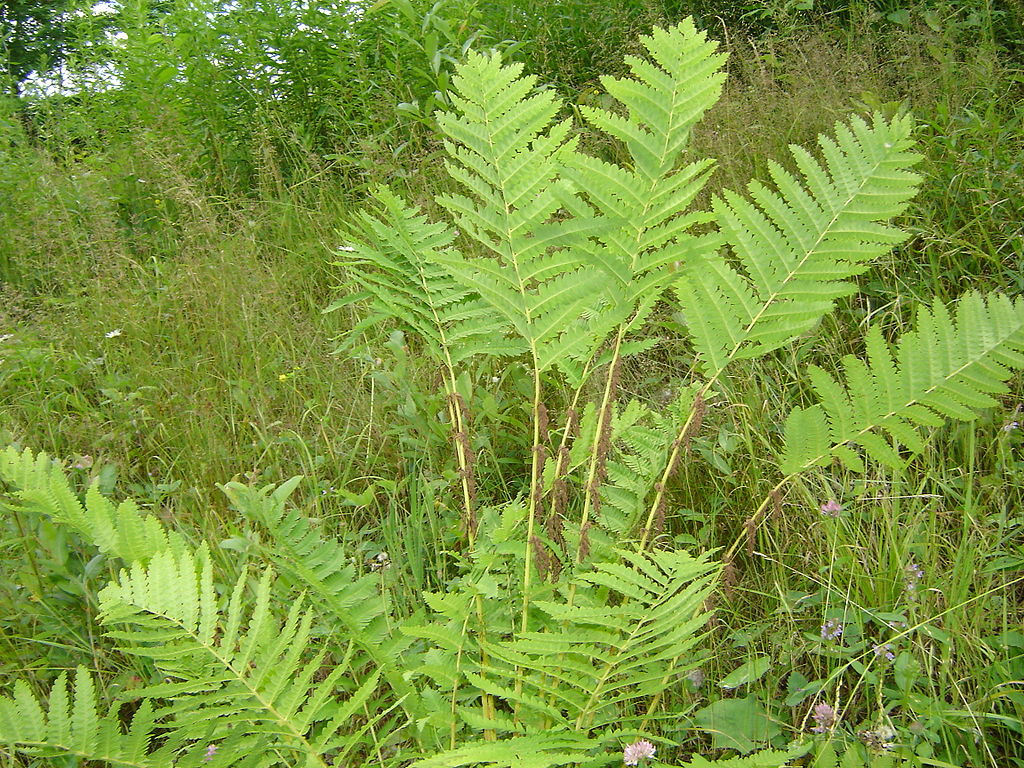
There is much handsome interrupted fern in the Painted-Cup Meadow, and near the top of one of the clumps we notice something like a large cocoon, the color of the rusty cinnamon fern wool. 

It is a red bat, the New York bat, so called. It hangs suspended, head directly downward, with its little sharp claws or hooks caught through one of the divisions at the base of one of the pinnae, above the fructification.  Its wings are very compactly folded up, the principal bones (darker-reddish) lying flat along the under side of its body, and a hook on each meeting its opposite under the chin of the creature. It does not look like fur, but more like the plush of the ripe cat-tail head, all trembling in the wind and with the pulsations of the animal.

I cannot but think that its instinct taught it to cling to the interrupted fern, since it might readily be mistaken for a mass of its fruit.

H.D. Thoreau, Journal, June 10, 1860

Another showery day, or rather shower threatening. 2 P.M. — To Annursnack.
A very strong northwest wind, and cold. At 6 P.M. it was 58º. This, with wind, makes a very cold day at this season. Yet I do not need fire in the house.


There is much handsome interrupted fern in the Painted-Cup Meadow, and near the top of one of the clumps we noticed something like a large cocoon, the color of the rusty cinnamon fern wool.

It was a red bat, the New York bat, so called. It hung suspended, head directly downward, with its little sharp claws or hooks caught through one of the divisions at the base of one of the pinnæ, above the fructification.

It was a delicate rusty brown in color, very like the wool of the cinnamon fern, with the whiter bare spaces seen through it early in the season. I thought at first glance it was a broad brown cocoon, then that it was the plump body of a monstrous emperor moth.

It was rusty or reddish brown, white or hoary within or beneath the tips, with a white apparently triangular spot beneath, about the insertion of the wings.

Its wings were very compactly folded up, the principal bones (darker-reddish) lying flat along the underside of its body, and a hook on each meeting its opposite under the chin of the creature.

It did not look like fur, but more like the plush of the ripe cat-tail head, though more loose, — all trembling in the wind and with the pulsations of the animal.

I broke off the top of the fern and let the bat lie on its back in my hand. I held it and turned it about for ten or fifteen minutes, but it did not awake. Once or twice it opened its eyes a little, and even it raised its head, opened its mouth, but soon drowsily dropped its head and fell.

It was more attentive to sounds than to motions.  Finally, by shaking it, and especially by hissing or whistling, I thoroughly awakened it, and it fluttered off twenty or thirty rods to the woods.

I cannot but think that its instinct taught it to cling to the interrupted fern, since it might readily be mistaken for a mass of its fruit.

Raised its old-haggish head.


Unless it showed its head wide awake, it looked like a tender infant.

Popular Posts Last 30 Days.

The week ahead in Henry’s journal

The week ahead in Henry’s journal
A journal, a book that shall contain a record of all your joy.
"A stone fruit. Each one yields me a thought." ~ H. D. Thoreau, March 28, 1859


I sit on this rock
wrestling with the melody
that possesses me.