Showing posts with label Mill Brook. Show all posts

Thursday, February 11, 2021

The other day, behind Simon Brown's house I heard a remarkable echo.


February 11. 

Friday. 

While surveying for J. Moore to day, saw a large wood tortoise stirring in the Mill Brook, and several bodies of frogs  without their hind legs. But Sunday it snowed about a foot deep, — our second, only, important snow this winter, — and now the brook is not only frozen over, but almost completely concealed under drifts, and that reminiscence or prophecy of spring is also buried up. 

While surveying on the Hunt farm the other day, behind Simon Brown's house I heard a remarkable echo. In the course of surveying, being obliged to call aloud to my assistant from every side and almost every part of a farm in succession, and at various hours of a day, I am pretty sure to discover an echo if any exists, and the other day it was encouraging and soothing to hear it. After so many days of comparatively insignificant drudgery with stupid companions, this leisure, this sportiveness, this generosity in nature, sympathizing with the better part of me; somebody I could talk with, — one degree, at least, better than talking with one's self. 

Ah! Simon Brown's premises harbor a hired man and a hired maid he wots not of. Some voice of somebody I pined to hear, with whom I could form a community. I did wish, rather, to linger there and call all day to the air and hear my words repeated, but a vulgar necessity dragged me along round the bounds of the farm, to hear only the stale answers of my chain-man shouted back to me. I am surprised that we make no more ado about echoes. 

They are almost the only kindred voices that I hear. I wonder that the traveller does not oftener remark upon a remarkable echo, — he who observes so many things. There needs some actual doubleness like this in nature, for if the voices which we commonly hear were all that we ever heard, what then? Has it to do with the season of the year?

 I have since heard an echo on Moore's farm. It was the memorable event of the day, that echo I heard, not anything my companions said, or the travelers whom I met, or my thoughts, for they were all mere repetitions or echoes in the worst sense of what I had heard and thought before many times; but this echo was accompanied with novelty, and by its repetition of my voice it did more than double that. 

It was a profounder Socratic method of suggesting thoughts unutterable to me the speaker. There was one I heartily loved to talk with. Under such favorable auspices I could converse with myself, could reflect; the hour, the atmosphere, and the conformation of the ground permitted it.

H. D. Thoreau, Journal, February 11, 1853

Saw a large wood tortoise stirring in the Mill Brook. See  March 27. 1855 ("See a wood tortoise in the brook. ")

Sunday it snowed about a foot deep, — our second, only, important snow this winter. See January 14, 1853 ("Snows all day.”)

While surveying on the Hunt farm the other day. See February 1, 1853 (“Surveying the Hunt farm. ”)

That reminiscence or prophecy of spring is also buried up. See February 9, 1854 ("February [belongs] to the spring; it is a snowy March.")

I am pretty sure to discover an echo if any exists. See October 6, 1851 ("In the middle of the pond we tried the echo again.")

There needs some actual doubleness like this in nature, for under such favorable auspices I could converse with myself, See August 8, 1852 ("[I]am sensible of a certain doubleness by which I can stand as remote from myself as from another.")

Monday, January 13, 2020

The thin ice of the Mill Brook sides at the Turnpike bridge is sprinkled over with large crystals.


January 13

January 13, 2020

Tuttle was saying to-day that he did remember a certain man's living with him once, from something that occurred. It was this: The man was about starting for Boston market for Tuttle, and Mrs. Tuttle had been telling him what to get for her. The man inquired if that was all, and Mrs. Tuttle said no, she wanted some nutmegs. "How many," he asked. Tuttle, coming along just then, said, "Get a bushel." 

When the man came home he said that he had had a good deal of trouble about the nutmegs. He could not find so many as were wanted, and, besides, they told him that they did not sell them by the bushel. But he said that he would take a bushel by the weight. Finally he made out to get a peck of them, which he brought home. It chanced that nutmegs were very high just then, so Tuttle, after selecting a few for his own use, brought the remainder up to town and succeeded in disposing of them at the stores for just what he gave for them. 

One man at the post-office said that a crow would drive a fox. He had seen three crows pursue a fox that was crossing the Great Meadows, and he fairly ran from [them] and took refuge in the woods. 

Farmer says that he remembers his father's saying that as he stood in a field once, he saw a hawk soaring above and eying something on the ground. Looking round, he saw a weasel there eying the hawk. Just then the hawk stooped, and the weasel at the same instant sprang upon him, and up went the hawk with the weasel; but by and by the hawk began to come down as fast as he went up, rolling over and over, till he struck the ground. His father, going up, raised him up, when out hopped the weasel from under his wing and ran off none the worse for his fall. 

The surface of the snow, now that the sun has shone on it so long, is not so light and downy, almost impalpable, as it was yesterday, but is somewhat flattened down and looks even as if [it] had had a skim-coat of some whitewash. I can see sparkles on it, but they are finer than at first and therefore less dazzling. 

The thin ice of the Mill Brook sides at the Turnpike bridge is sprinkled over with large crystals which look like asbestos or a coarse grain. This is no doubt the vapor of last evening crystallized. I see vapor rising from and curling along the open brook and also rising from the end of a plank in the sun, which is wet with melted snow, though the thermometer was 16° only when I left the house. 

I see in low grounds numerous heads of bidens, with their seeds still. 

I see under some sizable white pines in E. Hubbard's wood, where red squirrels have run about much since this snow. They have run chiefly, perhaps, under the surface of the snow, so that it is very much under mined by their paths under these trees, and every now and then they have come to the surface, or the surface has fallen into their gallery. They seem to burrow under the snow about as readily as a meadow mouse. There are also paths raying out on every side from the base of the trees. And you see many holes through the snow into the ground where they now are, and other holes where they have probed for cones and nuts. The scales of the white pine cones are scattered about here and there. They seek a dry place to open them, — a fallen limb that rises above the snow, or often a lower dead stub projecting from the trunk of the tree.

H. D. Thoreau, Journal, January 13, 1860

The scales of the white pine cones are scattered about here and there. See October 6 1857 ("Going through Ebby Hubbard's woods, I see thousands of white pine cones on the ground, fresh light brown, which lately opened and shed their seeds and lie curled up on the ground.")


A Book of the Seasons,  by Henry Thoreau
"A book, each page written in its own season,
out-of-doors, in its own locality.”
~edited, assembled and rewritten by zphx © 2009-2022

Sunday, December 22, 2019

Another fine winter day.

December 22.

Another fine winter day. 

December 22, 2019

P. M. — To Flint's Pond. 

C. is inclined to walk in the road, it being better walking there, and says: "You don't wish to see any thing but the sky to-day and breathe this air. You could walk in the city to-day, just as well as in the country. You only wish to be out." This was because I inclined to walk in the woods or by the river.

As we passed under the elm beyond George Heywood's, I looked up and saw a fiery hangbird's nest dangling over the road. What a reminiscence of summer, a fiery hangbird's nest dangling from an elm over the road when perhaps the thermometer is down to -20 (?), and the traveller goes beating his arms beneath it! It is hard to recall the strain of that bird then.

We pause and gaze into the Mill Brook on the Turnpike bridge. C. says that in Persia they call the ripple- marks on sandy bottoms "chains" or "chain-work." 

I see a good deal of cress there, on the bottom, for a rod or two, the only green thing to be seen. No more slimy than it usually is beneath the water in summer. Is not this the plant which most, or most conspicuously, preserves its greenness in the winter? Is it not now most completely in its summer state of any plant? So far as the water and the mud and the cress go, it is a summer scene. It is green as ever, and waving in the stream as in summer.

How nicely is Nature adjusted! The least disturbance of her equilibrium is betrayed and corrects itself.

As I looked down on the surface of the brook, I was surprised to see a leaf floating, as I thought, up the stream, but I was mistaken. The motion of a particle of dust on the surface of any brook far inland shows which way the earth declines toward the sea, which way lies the constantly descending route, and the only one.

I see in the chestnut woods near Flint's Pond where squirrels have collected the small chestnut burs left the trunks on the snow. These are, I think, all small and imperfect burs, which do not so much as open in the fall and are rejected then, but, hanging on the tree, they have this use at least, as the squirrels' winter food.

Three men are fishing on Flint's Pond, where the ice is seven or eight inches thick.

I look back to the wharf rock shore and see that rush (cladium I have called it), the warmest object in the landscape, — a narrow line of warm yellow rushes — for they reflect the western light, — along the edge of the somewhat snowy pond and next the snow-clad and wooded shore. This rush, which is comparatively inconspicuous in the summer, becomes thus in the winter afternoons a conspicuous and interesting object, lit up by the westering sun.

The fisherman stands erect and still on the ice, awaiting our approach, as usual forward to say that he has had no luck. He has been here since early morning, and for some reason or other the fishes won't bite. You won't catch him here again in a hurry. They all tell the same story. The amount of it is he has had "fisherman's luck," and if you walk that way you may find him at his old post to-morrow. It is hard, to be sure, — four little fishes to be divided between three men, and two and a half miles to walk; and you have only got a more ravenous appetite for the supper which you have not earned. However, the pond floor is not a bad place to spend a winter day. 

On what I will call Sassafras Island, in this pond, I notice the largest and handsomest high blueberry at the ground into four stems, all very large and the largest three inches in diameter (one way) at three feet high, and at the ground, where they seem to form one trunk (at least grown together), nine inches in diameter. These stems rise upward, spreading a little in their usual somewhat zigzag manner, and are very handsomely clothed with large gray and yellow lichens with intervals of the (smoothish? and) finely divided bark. The bark is quite reddish near the ground. The top, which is spreading and somewhat flattish or corymbose, consists of a great many fine twigs, which give it a thick and dark appearance against the sky compared with the more open portion beneath. It was perfectly sound and vigorous.

In a (apparently kingbird's?) nest on this island I saw three cherry-stones, as if it had carried home this fruit to its young. It was, outside, of gnaphalium and saddled on a low limb. Could it have been a cherry-bird? 

The cladium (?) retains its seeds over the ice, little conical, sharp-pointed, flat-based, dark-brown, shining seeds. 

I notice some seeds left on a large dock, but see none of parsnips or other umbelliferous plants.

The furrows in the snow on the hillsides look somewhat like this: —

H. D. Thoreau, Journal, December 22, 1859

Another fine winter day. See ; December 21, 1859 ("A fine winter day"); . December 23, 1859 ("The third fine, clear, bright, and rather mild winter day") See also A Book of the Seasons, by Henry Thoreau, The world can never be more beautiful than now.May 18, 1852 (The world can never be more beautiful than now.); December 10, 1856 ("A warm, clear, glorious winter day."); December 10, 1853 ("These are among the finest days in the year.”); December, 20, 1854 ("It has been a glorious winter day") December 21, 1854 ("We are tempted to call these the finest days of the year.")

I was surprised to see a leaf floating, as I thought, up the stream, but I was mistaken. See April 11, 1856 ("The current of the Assabet is so much swifter, and its channel so much steeper than that of the main stream, that, while a stranger frequently cannot tell which way the latter flows by his eye, you can perceive the declination of the channel of the former within a very short distance, even between one side of a tree and another")

I see in the chestnut woods near Flint's Pond where squirrels have collected the small chestnut burs left the trunks on the snow. See December 22, 1850 ("Here is a stump on which a squirrel has sat and stripped the pine cones of a neighboring tree . . . He has long been a close observer of Nature; opens her caskets.")

However, the pond floor is not a bad place to spend a winter day. See January 12, 1855 ("On Flint’s Pond I find Nat Rice fishing. He has not caught one. I asked him what he thought the best time to fish. He said, “When the wind first comes south after a cold spell, on a bright morning.”"); December 28, 1856 (". . .  if not catching many fish, still getting what they went for, though they may not be aware of it, i. e. a wilder experience than the town affords."); June 26, 1853 ("Many of my fellow-citizens might go fishing a thousand times, perchance, before the sediment of fishing would sink to the bottom and leave their purpose pure, -- before they began to angle for the pond itself.”); January 1, 1856 ("Here are two fishermen, and one has preceded them. They have not had a bite, and know not why. It has been a clear winter day.")

On what I will call Sassafras Island, in this pond, I notice the largest and handsomest high blueberry.  See September 12, 1851 ("I go to Flint's Pond also to see a rippling lake and a reedy island in its midst, — Reed Island. "); April 1, 1852 ("I see that there is about an acre of open water, perhaps, over Bush Island in the middle of the pond, and there are some water-fowl there.); December 24, 1859 ("I measure the blueberry bushes on Flint's Pond Island. . . .This island appears to be a mere stony ridge three or four feet high, with a very low wet shore on each side, ") See also February 8, 1858 ("I walked about Goose Pond, looking for the large blueberry bushes.")

A narrow line of warm yellow rushes — for they reflect the western light, — along the edge of the somewhat snowy pond and next the snow-clad and wooded shore. The cladium retains its seeds over the ice, little conical, sharp-pointed, flat-based, dark-brown, shining seeds. See August 31, 1858 ("The Flint’s Pond rush appears to be Cladium mariscoides, twig rush.")

However, the pond 
floor is not a bad place to 
spend a winter day. 

Wednesday, May 2, 2018

I too have been looking for frogs. If I were to be a frog hawk for a month I should soon know some things.

May 2.
Hepatica, May 2, 2018
Sit without fire to-day and yesterday.

I compare the three Rana palustris caught yesterday with the male and female of April 23d

The males agree very well. What I have regarded as the groundwork varies from pale brown to dusky brown, even in the same specimen at different times. 

The present female is larger than that of April 23d, more than half an inch longer than her male, and she has the round dark spots on the orbits and one in front on head and also oblong-square spots on back. She is also dusky-brown like male. 

None of all have any green. 

I at last hear the note, for two are coupled in a firkin in my chamber, under my face. It is made by the male alone, and is, as I supposed, the sound of April 30th and May 1st, — the tut tut tut, more or less rapidly repeated, and a frequent querulous or inquisitive cr-r-rack, half a second long. 

It makes these sounds only when I excite it by putting others of its kind near it. Its pouches are distended laterally, apparently beneath and behind the eye, and not very conspicuous. Close by, it sounds like a dry belching sound, the bursting of little bubbles more or less rapidly, and the querulous note may be the same very rapidly repeated. 

I doubt if I have heard any sound from a bullfrog in river yet. 

P. M. — Down river. 

The Salix Babylonica (fertile) behind Dodd's is more forward than the alba by my boat. Put it just before it. See stake-driver. 

At mouth of the Mill Brook, I hear, I should say, the true R. halecina croak, i. e. with the faint bullfrog-like er-er-er intermixed. Are they still breeding? 

Peetweet on a rock. 

See and hear the red-wings in flocks yet, making a great noise. 

If I were to be a frog hawk for a month I should soon know some things about the frogs. How patiently they skim the meadows, occasionally alighting, and fluttering as if it were difficult ever to stand still on the ground. I have seen more of them than usual since I too have been looking for frogs. 

Hear a tree-toad.

H. D. Thoreau, Journal, May 2, 1858

Sit without fire to-day and yesterday. See May 3, 1857 (“”To-day we sit without fire")
I compare the three Rana palustris caught yesterday with the male and female of April 23d. See April 24, 1858 ("I go at 8 A.M. to catch frogs to compare with the R. palustris and bull frog which I have, but I find it too cold for them")

At mouth of the Mill Brook, I hear, I should say, the true R. halecina croak, i. e. with the faint bullfrog-like er-er-er intermixed. See note to  April 3, 1858 ("Their note is a hard dry tut tut tut tut, . . .  and from time to time one makes that faint somewhat bullfrog-like er er er. Both these sounds, then, are made by one frog, ")


If I were to be a frog hawk for a month I should soon know some things about the frogs. See March 27, 1855 (“See my frog hawk. . . .It is the hen-barrier, i.e. marsh hawk, male. Slate-colored; beating the bush; black tips to wings and white rump. "); March 29, 1854 (See two marsh hawks, white on rump."); March 30, 1856 ("May have been a marsh hawk or harrier.");  April 5, 1854  ("These days . . . bring out the butterflies and the frogs, and the marsh hawks which prey on the last. Just so simple is every year.”); April 8, 1856 ("Marsh hawks circling low shows that frogs must be out."); April 19, 1858 ("He skims along exactly over the edge of the water, on the meadowy side, not more than three or four feet from the ground and winding with the shore, looking for frogs.."); April 22, 1856 (“A marsh hawk, in the midst of the rain, is skimming along the shore of the meadow, close to the ground, . . . It is looking for frogs.”); May 2, 1855 ("Was that a harrier seen at first skimming low then seating and circling, with a broad whiteness on the wings beneath?” ~~ What HDT calls the "frog/marsh hawk/hen harrier" is the northern harrier.

Thursday, April 5, 2018

A pair of wood frogs in captivity.

April 5.  
April 5, 2018

What I call the young bullfrog, about two and a half inches long, — though it has no yellow on throat. It has a bright-golden ring outside of the iris as far as I can see round it. Is this the case with the bullfrog? May it not be a young Rana fontinalis? No yellow to throat. I found it on the shore of the Clamshell Hill ditch. Can jump much better than the others, and easily gets out of the deep pan.

Those to whom I showed the two R. sylvatica could not believe that they were one species, but this morning, on taking them out of the water to examine minutely, they changed so rapidly, chameleon-like, that I could only describe their first appearance from memory. The male grew a lighter brown and the female darker, till in ten minutes there was but a slight shade of difference, and their whole aspect, but especially that of the male, seemed altered also, so that it was not easy to distinguish them. Yet they would readily be recognized for rather dark-colored wood frogs, the posterior extremities of both having distinct dark bars. 

The female was two and one tenth inches long, the male one and four fifths inches long. The female was (apparently involuntarily) dropping a little spawn in the pan this morning, and the black core was as big as the head of a pin when it issued from the body. The only difference in color that I now noticed, except that the male was a shade the darkest (both a pale brown), was that there was a very distinct dark mark on the front side at the base of the anterior extremities of the female, while there was but the slightest trace of it in the male. 

Also the female was more green on the flanks and abdomen; also she had some dusky spots beneath. What is described as a yellow line along the lower edge of the dark one through the eyes, i.e. along the upper jaw, and which I observed to be such last spring, was in both these at all times a broad silvery or bright cream-colored line. 

Putting them into the water, after an hour they again acquired distinct colors, but not quite so distinct at first. It is singular that at the breeding-season, at least, though both are immersed in water, they are of a totally different color, -- the male a very dark brown for a frog, darker than the ordinary color of any Massachusetts frog, without distinct bars to his posterior extremities or a distinct dark line along the snout, while the female is a light reddish brown or lively dead-leaf color, — and that, taken out of water, they rapidly approximate each other till there is only a shade of difference if any. 

At their breeding-season, then, the colors of the male are not livelier, as in the case of birds, but darker and more sombre. 

Considering how few of these or of the R. halecina you meet with in the summer, it is surprising how many are now collected in the pools and meadows. The woods resound with the one, and the meadows day and night with the other, so that it amounts to a general awakening of the pools and meadows. 

I hear this morning the seringo sparrow. 

In the proceedings of the Natural History Society for December, 1856, there were presented by Dr. H. R. Storer, “a globular concretion of grass said to have been formed by the action of waves upon the seashore.” Were not these some obtained by the Hoars or Emersons from Flint's Pond?

P. M. – I go to the meadow at the mouth of the Mill Brook to find the spawn of the R. halecina. 

They are croaking and coupling there by thousands, as before, though there is a raw east wind to-day. I see them coupled merely, in a few instances, but no such balls or masses of them about one female as in the case of the R. sylvatica, though this may occur. 

You can easily get close to them and catch them by wading. The first lagoon within the meadow was not a foot deep anywhere, and I found the spawn where it was about eight inches deep, with a grassy and mossy bottom. It was principally in two collections, which were near together and each about a yard in diameter. The separate masses of this were from two to six, or commonly three or four, inches in diameter, and generally looked quite black and dense or fine-egged in the water. But it really on a closer inspection presented quite an interesting variety of appearances. 

The black core is about the size of a pin-head, and one half of it is white. It commonly lies with the black side up, and when you look directly down on it, has a rich, very dark blue-purple appearance. When with the white or wrong side up, it looks like a mass of small silvery points or bubbles, and you do not notice the jelly. But it lies also at all intermediate angles, and so presents a variety of appearances. 

It is attached pretty firmly to the grass and rises just to the surface. There are very fine froth-like bubbles more or less mingled with it. I am not sure that I can distinguish it from that of the R. sylvatica

I caught several of the first. The dark blotches on the back were generally more or less roundish with a crenate edge. There were distinct, raised, light bronze colored ridges from the snout along the side-head and body, which were conspicuous at a distance. They were, all that I caught, distinctly yellow-white beneath, and some had green buttocks. 

And now, standing over them, I saw that there were considerable lateral  bubbles formed when they croaked, i. e., the throat was puffed out on each side quite far behind the snout. The tympanum was very convex and prominent. 

At evening I find that the male R. sylvatica couples with or fastens himself to the back of the young bull frog (?)*, or whatever it is, and the latter meanwhile croaks, in short croaks four or five times repeated, much like the R. sylvatica, methinks. 

I hear the hylodes peeping now at evening, being at home, though I have not chanced to hear any during the day. They prefer the evening.

H. D. Thoreau, Journal, April 5, 1858


May it not be a young Rana fontinalis? No yellow to throat. See A Book of Seasons,  by Henry Thoreau, Identifying the Green Frog in Spring (Rana Fontinalis)

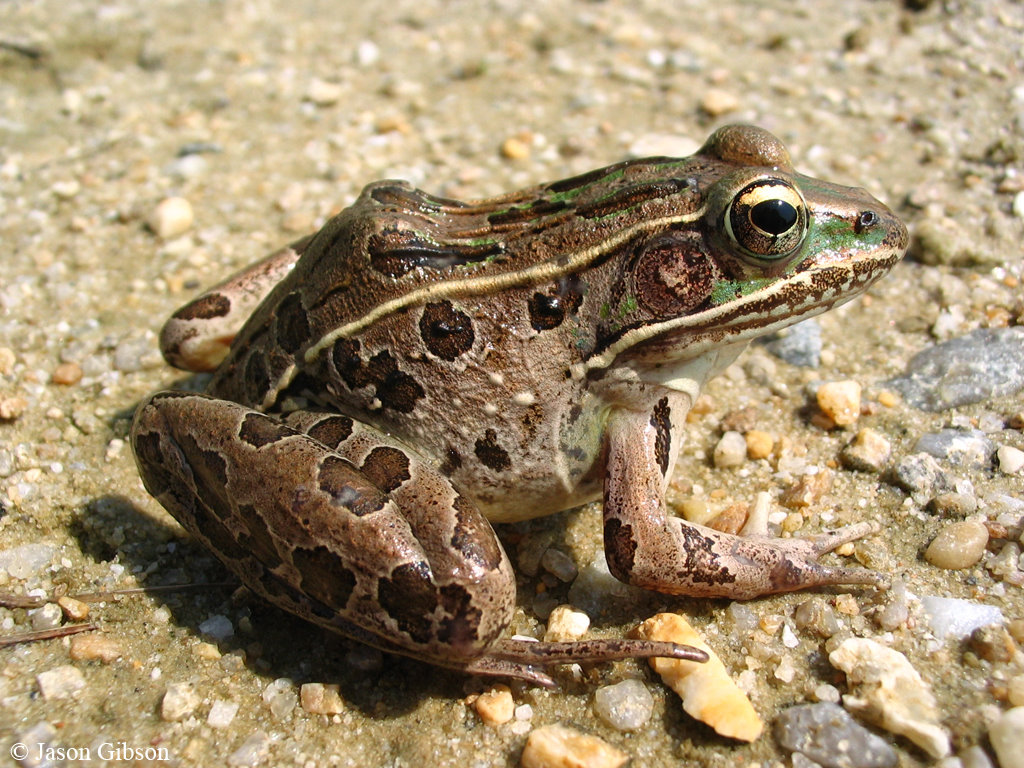
The woods resound with the one [R. sylvatica], and the meadows day and night with the other [R. halecina], so that it amounts to a general awakening of the pools and meadowsSee April 5, 1855  ("Hear from one half-flooded meadow that low, general, hard, stuttering tut tut tut of frogs,—the awakening of the meadow. "); April 5, 1857 (“I hear the croaking frogs at 9.30 P. M.”); and note to April 3, 1858 (“the Day of the Snoring Frogs, or the Awakening of the Meadows.”) See also A Book of the Seasons,  by Henry Thoreau, The first frogs to begin calling. See also A Book of the Seasons,  by Henry Thoreau, The  Wood Frog (Rana sylvatica) and A Book of the Seasons,  by Henry Thoreau,  the Leopard Frog (Rana Halecina) in Spring 

The black core is about the size of a pin-head, and one half of it is white. See April 4, 1857 ("Caught a croaking frog . . .. Nearby was its spawn, in very handsome spherical masses of transparent jelly. . . consisting of globules. . . with a black or dark centre as big as a large shot."); April 4, 1858 ("There was a good deal of spawn firmly attached to the brush close to the surface, and, as usual, in some lights you could not see the jelly, only the core.")

 I hear the hylodes peeping now at evening,  though I have not chanced to hear any during the day. See note to April 5, 1854 ("Hark! while I write down this field note, the shrill peep of the hylodes is borne to me from afar through the woods"); See also April 1, 1860 ("I hear the first hylodes by chance, but no doubt they have been heard some time.") and A Book of the Seasons, by Henry Thoreau, The Spring Peeper

*According to Maine Department of Inland Fisheries and Wildlife male wood frogs search for a mate by hugging other frogs until they find one who is round enough to be carrying eggs.

The pools and meadows
general awakening –
wood and leopard frogs.

Tuesday, April 3, 2018

The Day of the Snoring Frogs, or the Awakening of the Meadows.

April 3. 

Going down-town this morning, I am surprised by the rich strain of the purple finch from the elms. Three or four have arrived and lodged against the elms of our street, which runs east and west across their course, and they are now mingling their loud and rich strains with that of the tree sparrows, robins, bluebirds, etc. 

The hearing of this note implies some improvement in the acoustics of the air. It reminds me of that genial state of the air when the elms are in bloom. 

They sit still over the street and make a business of warbling. They advertise me surely of some additional warmth and serenity. How their note rings over the roofs of the village! You wonder that even the sleepers are not awakened by it to inquire who is there, and yet probably not another than myself in all the town observes their coming, and not half a dozen ever distinguished them in their lives. And yet the very mob of the town know the hard names of Germanians or Swiss families which once sang here or elsewhere. 

About 9 A. M., C. and I paddle down the river. 

It is a remarkably warm and pleasant day. The shore is alive with tree sparrows sweetly warbling, also black birds, etc. The crow blackbirds which I saw last night are hoarsely clucking from time to time. 

Approaching the island, we hear the air full of the hum of bees, which at first we refer to the near trees. It comes from the white maples across the North Branch, fifteen rods off. We hear it from time to time, as we paddle along all day, down to the Bedford line. There is no pause to the hum of the bees all this warm day. It is a very simple but pleasing and soothing sound, this susurrus, thus early in the spring. 

When off the mouth of the Mill Brook, we hear the stertorous tut tut tut of frogs from the meadow, with an occasional faint bullfrog-like er er er intermingled. I land there to reconnoitre. 

The river is remarkably low, quite down to summer level, and there is but very little water anywhere on the meadows. I see some shallow lagoons (west of the brook), whence the sound comes. 

There, too, are countless painted turtles out, around on the banks and hummocks left by the ice. Their black and muddy backs shine afar in the sun, and though now fifteen to twenty rods off, I see through my glass that they are already alarmed, have their necks stretched out and are beginning to slip into the  water, where many heads are seen. 

Resolved to identify this frog, one or two of whose heads I could already see above the surface with my glass, I picked my way to the nearest pool. Close where I landed, an R. halecina lay out on some sedge. In went all the turtles immediately, and soon after the frogs sank to the bottom, and their note was heard only from more distant pools. 

I stood perfectly still, and ere long they began to reappear one by one, and spread themselves out on the surface. They were the R. halecina. I could see very plainly the two very prominent yellow lines along the sides of the head and the large dark ocellated marks, even under water, on the thighs, etc. Gradually they begin to recover their voices, but it is hard to say at first which one of the dozen within twenty feet is speaking. They begin to swim and hop along the surface toward each other. Their note is a hard dry tut tut tut tut, not at all ringing like the toad’s, and produced with very little swelling or motion of the throat, but as much trembling of the whole body; and from time to time one makes that faint somewhat bullfrog-like er er er. Both these sounds, then, are made by one frog, and what I have formerly thought an early bullfrog note was this. 

This, I think, is the first frog sound I have heard from the river meadows or anywhere, except the croaking leaf-pool frogs and the hylodes. They are evidently breeding now like toads, and probably are about the water as exclusively as the toads will soon be. 

This sound we continue to hear all day long, especially from the broad meadows in Bedford. Close at hand a single one does not sound loud, yet it is surprising how far a hundred or thousand croaking ( ? ) at once can be heard. It comes borne on the breeze from north over the Bedford meadows a quarter of a mile off, filling the air. It is like the rattling of a wagon along some highway, or more like a distant train on a railroad, or else of many rills emptying in, or more yet like the sound of a factory, and it comes with an echo which makes it seem yet more distant and universal. At this distance it is a soft and almost purring sound, yet with the above-named bullfrog-like variation in it. 

Sometimes the meadow will be almost still; then they will begin in earnest, and plainly excite one an other into a general snoring or eructation over a quarter of a mile of meadow. It is unusually early to hear them so numerously, and by day, but the water, being so very low and shallow on the meadows, is unusually warm this pleasant day. This might be called the Day of the Snoring Frogs, or the Awakening of the Meadows. 

Probably the frost is out of the meadows very early this year. It is a remarkable spring for reptile life. 

It remains now to detect the note of the palustris, wood frog, and fontinalis. I am not sure but I heard one kind of bullfrog’s note along the river once or twice. I saw several middle-sized frogs with green noses and dark bodies, small, bullfrog-like (? ?), sitting along the shore. 

At what perhaps is called the Holt just below N. Barrett’s, many grackles and red-wings together flit along the willows by our side, or a little ahead, keeping up a great chattering, while countless painted turtles are as steadily rustling and dropping into the water from the willows, etc., just ahead. 

We land at Ball's Hill and eat our dinners. It is so warm we would fain bathe. We seek some shade and cannot easily find it. You wonder that all birds and insects are not out at once in such a heat. We find it delicious to take off our shoes and stockings and wade far through the shallows on the meadow to the Bedford shore, to let our legs drink air. 

How pretty the white fibrous roots of the eriocaulon, floating in tufts on the meadow, like beaded chains! 

In the hazy atmosphere yesterday we could hardly see Garfield's old unpainted farmhouse. It was only betrayed by its elms. This would be the right color for painters to imitate. When the sun went into a cloud we detected the outlines of the windows only. 

When returning, we discovered, on the south side of the river, just at the old crossing-place from the Great Meadows, north of the ludwigia pool, a curious kind of spawn. It was white, each ovum about as big as a robin-shot or larger, with mostly a very minute white core, no black core, and these were agglutinated together in the form of zigzag hollow cylinders, two or three inches in diameter and one or two feet long, looking like a lady's ruff or other muslin work, on the bottom or on roots and twigs of willow and button-bush, where the water was two or three feet deep. The greater part lay on the bottom, looking like a film, these cylinders being somewhat coiled about there. When you took it up, the two sides fell together, and it was flat in your hand like the leg of a stocking. In one place there were a dozen very large red-bellied and brown-backed leeches in it, evidently battening on it. This must be frog or fish spawn. 

If frog-spawn, I think it must be that of the Rana halecina [No. Vide April 5th. Is it not fish-spawn?], the only ones fairly awake along the river; but how are leeches propagated? There was a great abundance of it, many bushels, for at least a dozen rods along the shore, and it must afford food to many creatures. The consistency of a jelly we eat. We saw one perch there. Some on the ruts was quite up to the surface, but most lower. When you had taken up a handful and broken it, on dropping it into the water it recovered its form for the most part. I noticed that the fine willow root-fibres and weeds, potamogeton, etc., there were thickly covered with a whitish film or fuzz, an eighth to a quarter of an inch deep, or long, apparently connected with this spawn, which made them look like plants covered with frost in a winter morning, though it was a duller white; but out of water you did not perceive anything. Probably this was the milt. 

When I have been out thus the whole day and spend the whole afternoon returning, it seems to me pitiful and ineffectual to be out as usual only in the afternoon, – as if you had come late to a feast, after your betters had done. The afternoon seems coarse and reversed, or at best a long twilight, after the fresh and bright forenoon. 

The gregariousness of men is their most contemptible and discouraging aspect. See how they follow each other like sheep, not knowing why. Day & Martin's   blacking was preferred by the last generation, and also is by this. They have not so good a reason for preferring this or that religion as in this case even. Apparently in ancient times several parties were nearly equally matched. They appointed a committee and made a compromise, agreeing to vote or believe so and so, and they still helplessly abide by that. Men are the inveterate foes of all improvement. Generally speaking, they think more of their hen-houses than of any desirable heaven. If you aspire to anything better than politics, expect no cooperation from men. They will not further anything good. You must prevail of your own force, as a plant springs and grows by its own vitality. 

Hear the Rana halecina in the evening also, from my window.


Rana halecina

I could see very plainly the two very prominent yellow lines along the sides of the head
and the large dark ocellated marks, even under water, on the thighs, etc.

H. D. Thoreau, Journal, April 3, 1858

We hear the air full of the hum of bees, which . . .comes from the white maples across the North Branch, fifteen rods off. . .It is a very simple but pleasing and soothing sound, this susurrus, thus early in the spring. See April 6, 1854 ("I am surprised to find so much of the white maples already out. . . . They resound with the hum of honey-bees, heard a dozen rods off, and you see thousands of them about the flowers against the sky. . . .This susurrus carries me forward some months toward summer --"); April 6, 1853 ("Notice a white maple with almost all the staminate flowers above or on the top, most of the stamens now withered, before the red maple has blossomed. Another maple, all or nearly all female. The staminiferous flowers look light yellowish, the female dark crimson”); April 6,1855 ("A very few white maple stamens stand out already loosely enough to blow in the wind.") White maple stamens stand out already loosely enough to blow in the wind.");  April 7, 1861 (" The white maple at the bridge not quite out.”); April 8, 1855 (I find some anthers effete and dark, and others still mealy with pollen. There are many in this condition. The crimson female stigmas also peeping forth. It evidently began to shed pollen yesterday.”); April 9, 1852 ("The maple by the bridge in bloom”);


This might be called the Day of the Snoring Frogs, or the Awakening of the Meadows. See April 5, 1855 ("Hear from one half-flooded meadow that low, general, hard, stuttering tut tut tut of frogs,—the awakening of the meadow.”);   April 5, 1858 ("The woods resound with the one [R. sylvatica], and the meadows day and night with the other [R. halecina], so that it amounts to a general awakening of the pools and meadows. "); April 5, 1860 (" a very faint distant ring of toads.");  April 9, 1853 (“The whole meadow resounds, probably from one end of the river to the other, this evening, with this faint, stertorous breathing. It is the waking up of the meadows."); 

Rana halecina (Lithobates pipiens) – Northern Leopard Frog. See  April 8, 1852 ("To-day I hear the croak of frogs in small pond-holes in the woods"); August 22, 1854 ("There are now hopping all over this meadow small Rana palustris, and also some more beautifully spotted halecina or shad frogs.");April 13, 1855 ("The small croaking frogs are now generally heard in all those stagnant ponds or pools in woods floored with leaves, which are mainly dried up in the summer.");  April 15, 1855 ("That general tut tut tut tut, or snoring, of frogs on the shallow meadow heard first slightly the 5th. There is a very faint er er er now and then mixed with it."); April 13, 1856 ("As I go by the Andromeda Ponds, I hear the tut tut of a few croaking frogs. . ."); June 17, 1856 ("Went to Rev. Horace James’s reptiles (Orthodox). . . . He distinguished the Rana halecina in the alcohol by more squarish (?) spots.");  March 31,1857 ("The dry croaking and tut tut of the frogs"); April 4, 1857 ("Caught a croaking frog in some smooth water in the railroad gutter. Above it was a uniform (perhaps olive?) brown, without green, and a yellowish line along the edge of the lower jaws.. . .What frog can it be?"); September 6, 1857 ("I observe to-day, away at the south end of our dry garden, a moist and handsome Rana halecina. It is the only frog that I ever see in such localities. He is quite a traveller."); April 1, 1858 ("A Rana halecina on the bank"); April 2, 1858 ("I catch a large Rana halecina, which puffs itself up “); April 5, 1858 (“I go to the meadow at the mouth of the Mill Brook to find the spawn of the R. halecina. They are croaking and coupling there by thousands")

We could hardly see Garfield's old unpainted farmhouse. See August 26, 1858 ("A weather-painted house and barn, with an orchard by its side, in midst of a sandy field surrounded by green woods, with a small blue lake on one side. A sympathy between the color of the weather-painted house and that of the lake and sky. . . .The weather-painted house. This is the New England color.")


April 3. See A Book of the Seasons, by Henry Thoreau, April 3

A Book of the Seasons, by Henry Thoreau
"A book, each page written in its own season,
out-of-doors, in its own locality.”
~edited, assembled and rewritten by zphx © 2009-2022


Monday, February 29, 2016

When Mill Brook had more water

February 29.

Minott told me this afternoon of his catching a pickerel in the Mill Brook once, — before the pond was drawn off, when the brook had four or five times as much water as now, — which weighed four pounds. Says they stayed in it all winter in those days. This was near his land up the brook. He loves to recall his hunting days and adventures, and I willingly listen to the stories he has told me half a dozen times already. 

H. D. Thoreau, Journal, February 29, 1856

The stories he has told me half a dozen times already. See October 2, 1857 (The chief incidents in Minott's life must be more distinct and interesting to him now than immediately after they occurred, for he has recalled and related them so often that they are stereotyped in his mind.”)

Friday, June 12, 2015

Eight more birds' nests and a ventriloquist toad.


June 12.

Down river to swamp east of Poplar Hill. 

I hear the toad, which I have called “spray frog” falsely, still. He sits close to the edge of the water and is hard to find—hard to tell the direction, though you may be within three feet. I detect him chiefly by the motion of the great swelling bubble in his throat. A peculiarly rich, sprayey dreamer, now at 2 P. M.! How serenely it ripples over the water! What a luxury life is to him! I have to use a little geometry to detect him. Am surprised at my discovery at last, while C. sits by incredulous. Had turned our prow to shore to search. This rich, sprayey note possesses all the shore. It diffuses itself far and wide over the water and enters into every crevice of the noon, and you cannot tell whence it proceeds. 

Young red-wings now begin to fly feebly amid the button-bushes, and the old ones chatter their anxiety. At mouth of Mill Brook, a red-wing’s nest tied on to that thick, high grass and some low willow, eighteen inches from ground, with four eggs variously marked, full of young. 

In a hedge thicket by meadow near Peter’s Path, a catbird’s nest, one egg; as usual in a high blueberry, in the thickest and darkest of the hedge, and very loosely built beneath on joggle-sticks. 

In the thick swamp behind the hill I look at the vireo’s nest which C. found on the 10th, within reach on a red maple forked twig, eight feet from ground. He took one cowbird’s egg from it, and I now take the other, which he left. There is no vireo’s egg, and it is said they always desert their nest when there are two cowbird’s eggs laid in it. I saw a red-eye lurking near. Have the nest. 

Near by, in a part of the swamp which had been cleared and then burnt apparently by accident, we find the nest of a veery on a tussock eight inches high, which like those around has been burnt all off close and black. The nest is directly in the top, the outside burnt. It contains three eggs, which have been scorched, discolored, and cooked, — one cracked by the heat, though fresh. Some of the sedge has since sprung up green, eight inches high, around here and there. All the lower part of the nest is left, an inch thick with dead leaves, —maple, etc., —and well lined with moss stems (?). It is a dry swamp. 

In a high blueberry bush, on the Poplar Hill-side, four feet from ground, a catbird’s nest with four eggs, forty feet high up the hill. They even follow the blue berry up-hill. 

A field sparrow’s nest with three young, on a Vaccinium vacillans, rose, and grass, six inches from ground, made of grass and hair. 

A Carya tomentosa hickory on the hill well out, and froth on the nuts, almost all out and black; perhaps three or four days. 

A hawthorn grows near by, just out of bloom, twelve feet high — Crataegus Oxyacantha

A veronica at Peet weet Rock; forget which kind. 

A crow blackbird’s nest high in an elm by riverside just below the Island. C. climbed to it and got it. I have it. There were eggs. Bottom of mud and coarse grass and sedge, lined with finer grass and dry weed stems. 

Another in an elm rear of Loring’s, in a recess where a limb was once broken off, open on one side, eighteen feet high. Young with heads out almost ready to fly. 

H. D. Thoreau, Journal, June 12, 1855

This rich, sprayed note . . . diffuses itself far . . . and you cannot tell whence it proceeds. See April 5, 1860. ("a very faint distant ring of toads, which, though I walk and walk all the afternoon, I never come nearer to.”); compare May 3, 1857 ("A clear, ringing note with a bubbling trill. It takes complete possession of you, for you vibrate to it, and can hear nothing else."

Monday, January 12, 2015

I am part of one great creature.

January 12

January 12, 2019

After a spitting of snow in the forenoon, I see the blue sky here and there, and the sun is coming out. It is still and warm. The earth is two thirds bare. I walk along the Mill Brook below Emerson’s, looking into it for some life.

Perhaps what most moves us in winter is some reminiscence of far-off summer. How we leap by the side of the open brooks! What beauty in the running brooks! What life! What society! The cold is merely superficial; it is summer still at the core, far, far within. 

It is in the cawing of the crow, the crowing of the cock, the warmth of the sun on our backs. I hear faintly the cawing of a crow far, far away, echoing from some unseen wood-side. What a delicious sound! It is not merely crow calling to crow, for it speaks to me too. I am part of one great creature with him; if he has voice, I have ears. I can hear when he calls. Ah, bless the Lord, O my soul! bless him for wildness, for crows that will not alight within gunshot! and bless him for hens, too, that croak and cackle in the yard!

Where are the shiners now, and the trout? I see none in the brook. Have the former descended to the deep water of the river? Ah, may I be there to see when they go down! Why can they not tell me? Or gone into the mud? There are few or no insects for them now. 

The strong scent of this red oak, just split and corded, is a slight compensation for the loss of the tree. 

How cheering the sight of the evergreens now, on the forest floor, the various pyrolas, etc., fresh as in summer! 

What is that mint whose seed-vessels rubbed are so spicy to smell—minty—at the further end of the pond by the Gourgas wood-lot? 

On Flint’s Pond I find Nat Rice fishing. He has not caught one. I asked him what he thought the best time to fish. He said, “When the wind first comes south after a cold spell, on a bright morning.”

Well may the tender buds attract us at this season, no less than partridges, for they are the hope of the year, the spring rolled up. The summer is all packed in them.

H. D. Thoreau, Journal, January 12, 1855


Perhaps what most moves us in winter is some reminiscence of far-off summer. See October 26, 1853 ("It is surprising how any reminiscence of a different season of the year affects us. You only need to make a faithful record of an average summer day's experience and summer mood, and read it in the winter, and it will carry you back to more than that summer day alone could show") See also 

The warmth of the sun on our backs. See January 31, 1854 ("The wind is more southerly, and now the warmth of the sun prevails, and is felt on the back.”); July 21, 1853 ("The sun is now warm on my back, and when I turn round I have to shade my face with my hands")

I hear faintly the cawing of a crow far, far away, echoing from some unseen wood-side. See November 11, 1853 ("I hear the cawing of crows toward the distant wood.”); February 12, 1855 ("As usual in this state of the air, the cawing of crows at a distance. “) See also  A Book of the Seasons, by Henry Thoreau, Signs of the Spring:  The crowing of cocks, the cawing of crows

I am part of one great creature with him; if he has voice, I have ears. I can hear when he calls. See February 20, 1857 ("What is the relation between a bird and the ear that appreciates its melody, to whom, perchance, it is more charming and significant than to any else? Certainly they are intimately related, and the one was made for the other. . . . I see that one could not be completely described without describing the other. “);  May 12, 1857 ("As the bay-wing sang many a thousand years ago, so sang he to-night.  . . .  One with the rocks and with us.”); August 3, 1852 (“By some fortunate coincidence of thought or circumstance I am attuned to the universe, I am fitted to hear, ”)

The tender buds attract us at this season, no less than partridges, for they are the hope of the year, the spring rolled up. The summer is all packed in them. See January 31, 1854 ("In the winter, when there are no flowers and leaves are rare, even large buds are interesting and somewhat exciting. I go a-budding like a partridge. I am always attracted at this season by the buds of the swamp-pink, the poplars, and the sweet-gale.");  January 10, 1856 ("We are reduced to admire buds, even like the partridges, and bark, like the rabbits and mice, —the great yellow and red forward-looking buds of the azalea, the plump red ones of the blueberry, and the fine sharp red ones of the panicled andromeda, sleeping along its stem, the speckled black alder, the rapid-growing dogwood, the pale-brown and cracked blueberry. Even a little shining bud which lies sleeping behind its twig and dreaming of spring, perhaps half concealed by ice, is object enough."); January 25, 1858 ("What a rich book might be made about buds, including, perhaps, sprouts! — the impregnable, vivacious willow catkins, but half asleep under the armor of their black scales, sleeping along the twigs; the birch and oak sprouts, and the rank and lusty dogwood sprouts; the round red buds of the blueberries; the small pointed red buds, close to the twig, of the panicled andromeda; the large yellowish buds of the swamp pink, etc.")

January 12.  See A Book of the Seasons,  by Henry Thoreau, by Henry Thoreau, January 12


I see the blue sky
and the sun is coming out. 
It is still and warm.

The tender buds are 
spring rolled up packed with summer –
the hope of the year.

A Book of the Seasons,  by Henry Thoreau,
 "A book, each page written in its own season, 
out-of-doors, in its own locality."
 ~edited, assembled and rewritten by zphx ©  2009-2025

https://tinyurl.com/hdt-550112

Popular Posts Last 30 Days.

The week ahead in Henry’s journal

The week ahead in Henry’s journal
A journal, a book that shall contain a record of all your joy.
"A stone fruit. Each one yields me a thought." ~ H. D. Thoreau, March 28, 1859


I sit on this rock
wrestling with the melody
that possesses me.