Showing posts with label full moon. Show all posts

Tuesday, July 2, 2024

This is my year of observation.


July 2. 

July 2, 2014


Bigelow tells me that saddlers sometimes use the excrescence, the whitish fungus, on the birch to stick their awls in. Men find a use for everything at last. I saw one nailed up in his shop with an awl in it. 

Last night, as I lay awake, I dreamed of the muddy and weedy river on which I had been paddling, and I seemed to derive some vigor from my day's experience like the lilies which have their roots at the bottom. 

I have plucked a white lily bud just ready to expand, and, after keeping it in water for two days,  have turned back its sepals with my hand and touched the lapped points of the petals, when they sprang open and rapidly expanded in my hand into a perfect blossom, with the petals as perfectly disposed at equal intervals as on their native lakes, and in this case, of course, untouched by an insect. 

I cut its stem short and placed it in a broad dish of water, where it sailed about under the breath of the beholder with a slight undulatory motion. The breeze of his half-suppressed admiration it was that filled its sail. 

It was a rare-tinted one. A kind of popular aura that may be trusted, methinks. Men will travel to the Nile to see the lotus flower  who have never seen in their glory the lotuses of their native streams. 

The Mollugo verticillata, carpet-weed, is just beginning in the garden, and the Polygonum convolvulus, black bindweed. 

The spikes of the pale lobelia, some  blue, some white, passing insensibly from one to the other, and especially hard to distinguish in the twilight, are quite handsome now in moist ground, rising above the grass. 

The prunella has various tints in various lights, now blue, now lilac. As the twilight deepens into night, its color changes. It always suggests freshness and coolness, from the places where it grows. 

I see the downy heads of the senecio gone to seed, thistle-like but small. 

The gnaphaliums and this are among the earliest to present this appearance. 

On my way to the Hubbard Bathing-Place, at sun-down. 

The blue-eyed grass shuts up before night, and me-thinks it does not open very early the next morning. 

The Cornus stolonifera, red osier, osier rouge, well out, and probably has been a day or two. I have got the order of the cornels, I think, pretty well. 

I see plenty of the Peltandra Virginica coming forward in Hubbard's meadow, and its lobes are more blunt than the sagittaria. 

Pogonias are very common in the meadows now. 

The seed-vessels of the Iris Virginica are formed. 

At the bathing-place there is [a] hummock which was floated on to the meadow some springs ago, now densely covered with the handsome red-stemmed wild rose, a full but irregular clump, from the ground, showing no bare stems below, but a dense mass of shining leaves and small red stems above in their midst, and on every side now, in the twilight, more than usually beautiful they appear. Countless roses, partly closed, of a very deep rich color, as if the rays of the departed sun still shone through them; a more spiritual rose this hour, beautifully blushing; and then the unspeakable beauty and promise of those fair swollen buds that spot the mass, which will blossom to-morrow, and the more distant promise of the handsomely formed green ones, which yet show no red, for few things are handsomer than a rosebud in any stage; these mingled with a few pure white elder blossoms and some rosaceous or pinkish meadow-sweet heads. I am confident that there can be nothing so beautiful in any cultivated garden, with all their varieties, as this wild clump. 

I afterwards found a similar though not so large and dense a clump of sweetbriars. Methinks their flowers are not so fragrant, and perhaps never of so deep a red. Perhaps they are more sure to open in a pitcher than the last. 

It is starlight. Near woods the veery is a steady singer at this hour. 

I notice that the lowest leaves of my potamogeton are pellucid and wavy, which  combined with their purplish tinge on the surface, makes me doubt if it be not the pulcher. 

Do the hardhack leaves stand up and hug the stem at night, that they show their under sides so? 

Nature is reported not by him who goes forth consciously as an observer, but in the fullness of life. To such a one she rushes to make her report. To the full heart she is all but a figure of speech. This is my year of observation and I fancy that my friends are also more devoted to outward observation than ever before, as if it were an epidemic. 

I cross the brook by Hubbard's little bridge. 

Now nothing but the cool invigorating scent which is perceived at night in these low meadowy places where the alder and ferns grow can restore my spirits. (I made it an object to find a new Parmelia caperata in fruit in each walk.) 

At this season, methinks, we do not regard the larger features of the landscape, as in the spring, but are absorbed in details. 

Then, when the meadows were flooded, I looked far over them to the distant woods and the outlines of hills, which were more distinct. I should not have so much to say of extensive water or landscapes at this season. 

You are a little bewildered by the variety of objects. There must be a certain meagreness of details and nakedness for wide views. (The obtuse galium shows its minute white flowers in the meadows.) 

If I remember, the early part of June was cool, as also the latter, though we had some hot weather, perhaps, toward the middle. 

The clover heads are drying up except in meadows. 

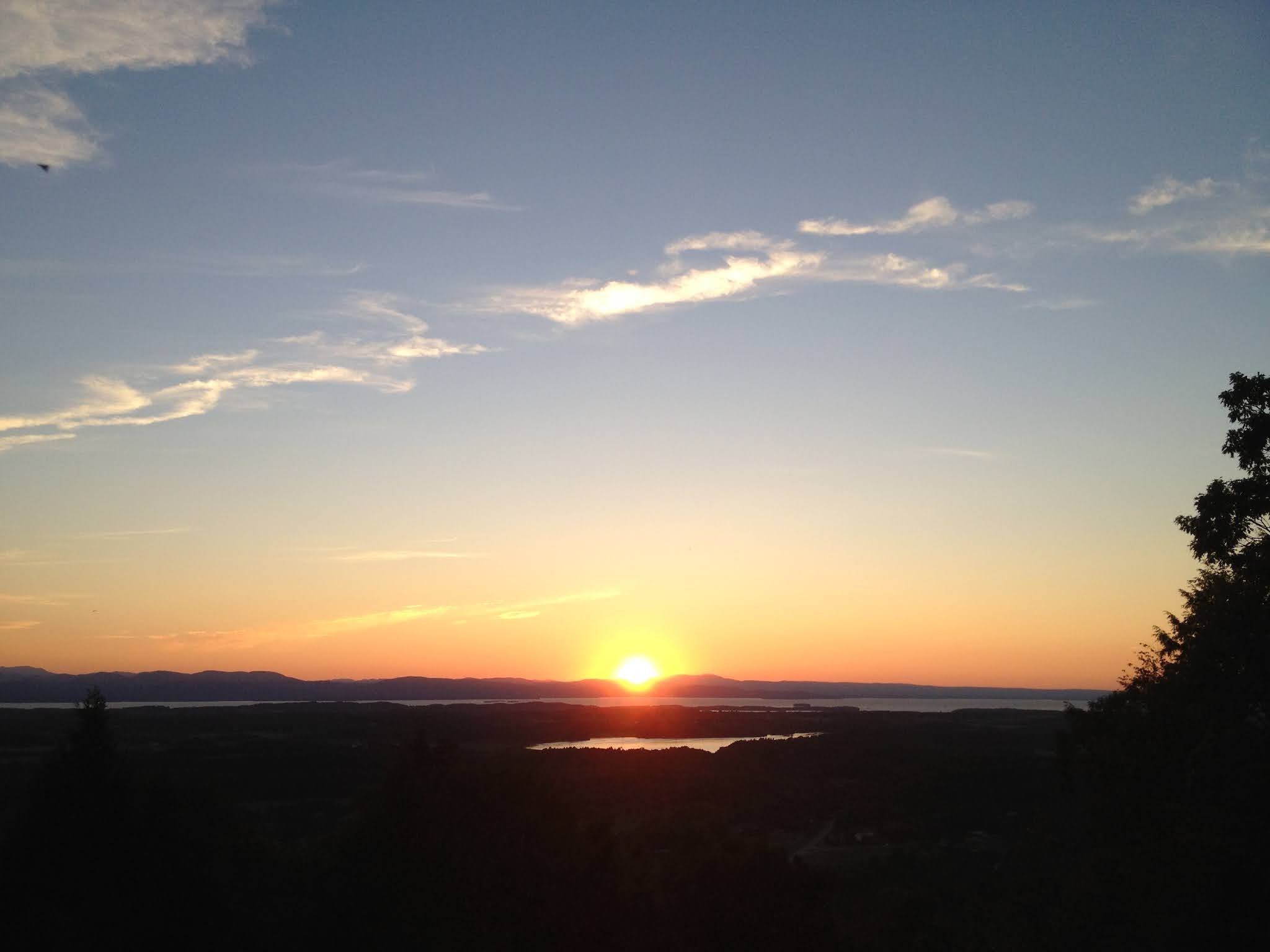
9 o'clock. The full moon rising (or full last night) is revealed first by some slight clouds above the eastern horizon looking white, the first indication that she is about to rise, the traces of day not yet gone in the west . In the west, similar clouds, seen against a lighter sky, look dark and heavy. Now a lower cloud in the east reflects a more yellowish light. The moon, far over the round globe travelling this way, sends her light forward to yonder cloud, from which the news of her coming is reflected to us. 

The moon's aurora! it is without redness or fulgidness, like the dawn of philosophy, and its noon, too. At her dawning no cocks crow. How few creatures to hail her rising! Only some belated travellers that may be abroad this night. 

What graduated information of her coming! More and more yellow glows the low cloud, with concentrating light, and now the moon's edge suddenly appears above a low bank of cloud not seen before, and she seems to come forward apace without introduction, after all; and the steadiness with which she rises with undisturbed serenity, like a queen who has learned to walk before her court, is glorious, and she soon reaches the open sea of the heavens. She seems to advance (so, perchance, flows the blood in the veins of the beholder) by graceful sallying essays, trailing her garment up the sky.

H. D. Thoreau, Journal, July 2, 1852

Nature is reported not by him who goes forth consciously as an observer, but in the fullness of life.
See September 13, 1852 ("I must walk more with free senses. I must let my senses wander as my thoughts, my eyes see without looking. Carlyle said that how to observe was to look, but I say that it is rather to see, and the more you look the less you will observe. Be not preoccupied with looking. Go not to the object; let it come to you."); May 10, 1853 ("He is the richest who has most use for nature as raw material of tropes and symbols with which to describe his life. . . .I pray for such inward experience as will make nature significant."); May 6, 1854 ("There is no such thing as pure objective observation. Your observation, to be interesting, i. e. to be significant, must be subjective."


I have plucked a white lily bud just ready to expand, and, after keeping it in water for two days, have turned back its sepals with my hand and touched the lapped points of the petals, when they sprang open and rapidly expanded in my hand into a perfect blossom. See July 4, 1852 ("I bring home a dozen perfect lily buds. . .which have never yet opened; I prepare a large pan of water; I cut their stems quite short; I turn back their calyx-leaves with my fingers, so that they may float upright; I touch the points of their petals, and breathe or blow on them, and toss them in. They spring open rapidly, or gradually expand in the course of an hour.")


It is starlight. Near woods the veery is a steady singer at this hour.
See June 28,1852 ("When I get nearer the wood, the veery is heard."). See also A Book of the Seasons,  by Henry Thoreau, The Veery

Sunday, November 7, 2021

It must be the largest lake in Middlesex.


November 7. 


8 A. M. – To Long Pond with W. E. C. . . .

Close by we found Long Pond, in Wayland, Framingham, and Natick, a great body of water with singularly sandy, shelving, caving, undermined banks; and there we ate our luncheon.

The mayflower leaves we saw there, and the Viola pedata in blossom.

We went down it a mile or two on the east side through the woods on its high bank, and then dined, looking far down to what seemed the Boston outlet (opposite to its natural outlet), where a solitary building stood on the shore.

It is a wild and stretching loch, where yachts might sail, — Cochituate.

It was not only larger but wilder and more novel than I had expected.

In some respects unlike New England.

I could hardly have told in what part of the world I was, if I had been carried there blindfolded.

Yet some features, at least the composition of the soil, were familiar.

The glorious sandy banks far and near, caving and sliding, — far sandy slopes, the forts of the land, where you see  the naked flesh of New England, her garment being blown aside like that of the priests (of the Levites?) when they ascend to the altar.

Seen through this November sky, these sands are dear to me, worth all the gold of California, suggesting Pactolus, while the Saxonville, factory-bell sounds o'er the woods.

That sound perchance it is that whets my vision. . . .

Dear to me to lie in, this sand; fit to preserve the bones of a race for thousands of years to come. And this is my home, my native soil; and I am a New-Englander. Of thee, O earth, are my bone and sinew made; to thee, O sun, am I brother. It must be the largest lake in Middlesex. To this dust my body will gladly return as to its origin. Here have I my habitat I am of thee.

Dear to me to lie in, this sand;
fit to preserve the bones of a race
for thousands of years to come.

And this is my home,
my native soil; and I am
a New-Englander.

Of thee, O earth,
are my bone
and sinew made.

To thee,
O sun,
am I brother.

To this dust
my body will gladly return
as to its origin.

Here have I
my habitat
I am of thee.

Returned by the south side of Dudley Pond, which looked fairer than ever, though smaller, - now so still, the afternoon somewhat advanced, Nobscot in the west in a purplish light . . .

At Nonesuch Pond, in Natick, we saw a boulder some thirty-two feet square by sixteen high, with a large rock leaning against it, -- under which we walked, -- forming a triangular frame, through which we beheld the picture of the pond. How many white Indians have passed under it! Boulder Pond!

Thence across lots by the Weston elm, to the bounds of Lincoln at the railroad.

Saw a delicate fringed purple flower, Gentiana crinita, between those Weston hills, in a meadow, and after on higher land.
. . .

The sun sets while we are perched on a high rock in the north of Weston.  It soon grows finger cold.

At Walden are three reflections of the bright full (or nearly) moon, one moon and two sheens further off.

H. D. Thoreau, Journal, November 7, 1851


It is a wild and stretching loch, where yachts might sail, —Cochituate. See August 24, 1857 ("B. says . . . that Cochituate Pond is only between three and four miles long, or five including the meadows that are flowed, yet it has been called even ten miles long.")

Lake Cochituate was created by the construction, beginning in 1846, of a dam to raise Long Pond, as it was then called , nine feet to create the first public drinking water reservoir for Boston. The Lake consists of three linked kettle ponds in "the Great Sand Plain of Framingham" having a general north and south direction, within the Middlesex County towns of Framingham, Wayland and Natick. The Pond is nearly three and one half miles long , and its greatest breadth about eighteen hundred feet. It naturally discharges into the Sudbury River about 14 miles above Concord where the Sudbury or North River joins the Assabet to form the Concord River. See Annual Report of the Cochituate Water Board For 1851.

And this is my home, my native soil; and I am a New-Englander. See November 8, 1851 ("When I saw the bare sand at Cochituate I felt my relation to the soil. These are my sands not yet run out. Not yet will the fates turn the glass. This air have I title to taint with my decay. In this clean sand my bones will gladly lie. Like Viola pedata, I shall be ready to bloom again here in my Indian summer days. Here ever springing, never dying, with perennial root I stand; for the winter of the land is warm to me. While the flowers bloom again as in the spring, shall I pine? When I see her sands exposed, thrown up from beneath the surface, it touches me inwardly, it reminds me of my origin; for I am such a plant, so native to New England, me thinks, as springs from the sand cast up from below")

The Weston elm. See October 24, 1852 ("There is an agreeable prospect from near the post-office in the northwest of Sudbury. The southeast (?) horizon is very distant. . .extending to the Weston elm in the horizon. You are more impressed with the extent of earth overlooked than if the view were bounded by mountains.")

Three reflections of the bright full (or nearly) moon. See October 8, 1851 ("The sun set red in haze,. . .and the moon rose in like manner at the same time. . . . The moon is full."); February 3, 1852 ("The moon is nearly full tonight,"); March 7, 1852 ("To the woods by the full moon."); April 3, 1852 ("I came out mainly to see the light of the moon reflected from the meadowy flood. It is a pathway of light, of sheeny ripples, extending across the meadow toward the moon, consisting of a myriad little bent and broken moons.")

Friday, October 8, 2021

Milkweed seeds carry far


October 8

Wednesday.

A slight wind now fills the air with elm leaves.

The nights have been cool of late, so that a fire has been comfortable, but the last was quite warm.

October 8, 2020

2 P. M.-To the Marlborough road.

This day is very warm, yet not bright like the last, but hazy.

Picked up an Indian gouge on Dennis's Hill.

The foliage has lost its very bright tints now; it is more dull, looks dry, or as if burnt, even.

The very ground or grass is crisped with drought, and yields a crispy sound to my feet.

The woods are brownish, reddish, yellowish merely, excepting of course the evergreens.

It is so warm that I am obliged to take off my neck-handkerchief and laborers complain of the heat.

By the side of J. P. Brown's grain-field I picked up some white oak acorns in the path by the wood-side, which I found to be unexpectedly sweet and palatable, the bitterness being scarcely perceptible. To my taste they are quite as good as chestnuts. No wonder the first men lived on acorns. 

Such as these are no mean food, such as they are represented to be. Their sweetness is like the sweetness of bread, and to have discovered this palatableness in this neglected nut, the whole world is to me the sweeter for it. I am related again to the first men.

What can be handsomer, wear better to the eye, than the color of the acorn, like the leaves on which they fall polished, or varnished? To find that acorns are edible, -- it is a greater addition to one's stock of life than would be imagined. I should be at least equally pleased if I were to find that the grass tasted sweet and nutritious. It increases the number of my friends; it diminishes the number of my foes.

How easily at this season I could feed myself in the woods! There is mast for me too, as well as for the pigeon and the squirrel. This Dodonean fruit.


The goldfinches are in the air.

I hear a blackbird also, and see a downy woodpecker, and see and hear a hairy one.

The seeds of the pasture thistle are not so buoyed up by their down as the milkweed.

In the forenoon commonly I see nature only through a window; in the afternoon my study or apartment in which I sit is a vale.

The farmers are ditching,-redeeming more meadow, – getting corn, collecting their apples, threshing, etc.

I cannot but believe that acorns were intended to be the food of man.
They are agreeable to the palate, as the mother's milk to the babe. The sweet acorn tree is famous and well known to the boys. There can be no question respecting the wholesomeness of this diet.

This warm day is a godsend to the wasps. I see them buzzing about the broken windows of deserted buildings, as Jenny Dugan's, -- the yellow-knotted.

I smell the dry leaves like hay from the woods.

Some elms are already bare.

The basswood here is quite sere.

The pines are still shedding their leaves.

This brook by Jenny's is always a pleasant sight and sound to me. In the spring I saw the sucker here. It is remarkable through what narrow and shallow brooks a sucker will be seen to dart, and a trout.

I perceive that some white oaks are quite red. The black oaks are yellowish. I know not surely whether the brighter red and more divided leaf is that of the red or the scarlet oak.

The jointed polygonum in the Marlborough road is an interesting flower, it is so late, so bright a red, — though inobvious from its minuteness, 
—  without leaves, above the sand like sorrel, mixed with other minute flowers and the empty chalices of the trichostema.

I saw one blue curl still adhering.

The puffballs are split open and rayed out on the sand like five or ten (!) fingers.

The milkweed seeds must be carried far, for it is only when a strong wind is blowing that they are loosened from their pods.

An arrowhead at the desert.

Spergula arvensis
--  corn-spurry (some call it tares) -- at the acorn tree.

Filled my pockets with acorns.

Found another gouge on Dennis's Hill. To have found the Indian gouges and tasted sweet acorns, is it not enough for one afternoon?

The sun set red in haze, visible fifteen minutes before setting, and the moon rose in like manner at the same time.

This evening, I am obliged to sit with my door and window open, in a thin coat, which I have not done for three weeks at least. A warm night like this at this season produces its effect on the village.

The boys are heard at play in the street now, at 9 o'clock, in greater force and with more noise than usual. My neighbor has got out his flute.

There is more fog than usual.

The moon is full.

The tops of the woods in the horizon seen above the fog look exactly like long, low black clouds, the fog being the color of the sky.

H. D. Thoreau, Journal, October 8, 1851

This brook by Jenny's is always a pleasant sight and sound to me. See December 28, 1851 ("Some one has cut a hole in the ice at Jenny's Brook, and set a steel trap under water"), March 25, 1855 ("Was it not a sucker I saw dart along the brook beyond Jenny’s?")

I picked up some white oak acorns in the path by the wood-side, which I found to be unexpectedly sweet and palatable, the bitterness being scarcely perceptible. See November 24, 1860 ("The bitter-sweet of a white oak acorn which you nibble in a bleak November walk over the tawny earth is more to me than a slice of imported pineapple.");  September 11, 1859 ("No fruit is handsomer than the acorn . . .Very pretty, especially, are the white oak acorns, three raying from one centre.") See also October 11, 1860 ("There is a remarkably abundant crop of white oak acorns this fall, also a fair crop of red oak acorns; but not of scarlet and black, very few of them. The acorns are now in the very midst of their fall."); October 12, 1858 ("Acorns, red and white (especially the first), appear to be fallen or falling. They are so fair and plump and glossy that I love to handle them, and am loath to throw away what I have in my hand."); October 13, 1859 ("I see no acorns on the trees. They appear to have all fallen before this.")

The milkweed seeds must be carried far, for it is only when a strong wind is blowing that they are loosened from their pods. See  October 23, 1852  ("The seeds spring out on the least jar, or when dried by the sun, and form a little fluctuating white silky mass or tuft, each held by the extremities of the fine threads, until a stronger puff of wind sets them free. ") See alsoA Book of the Seasons,  by Henry Thoreau,  Milkweed.

The moon is full. See  October 10, 1851 ("The elms in the village have lost many of their leaves, and their shadows by moonlight are not so heavy as last month"); See alsoA Book of the Seasons,  by Henry Thoreau, October Nights and Moonlight


October 8.
 See A Book of the Seasons, by Henry Thoreau, October 8


The white oak acorns
are unexpectedly sweet
and platable. 

Milkweed seeds loosen 
only when a strong wind blows –
they must carry far.

The sun setting red
in haze at the same time as
the full moon rises.

A Book of the Seasons, by Henry Thoreau
"A book, each page written in its own season,
out-of-doors, in its own locality.”
~edited, assembled and rewritten by zphx © 2009-2025

Tuesday, July 20, 2021

The midsummer night's moon.


July 20.

 
July 20, 2012

To Nawshawtuct at moonrise with Sophia, by boat.

Moon apparently fulled yesterday.

A low mist in crusts the meadow, -- not so perceptible when we are on the water. Now we row through a thin low mist about as high as one's head, now we come to a place where there is no mist on the river or meadow, apparently where a slight wind stirs.

The gentle susurrus from the leaves of the trees on shore is very enlivening, as if Nature were freshening, awakening to some enterprise. There is but little wind, but its sound, incessantly stirring the leaves at a little distance along the shore, heard not seen, is very inspiriting. It is like an everlasting dawn or awakening of nature to some great purpose.

As we go up the hill we smell the sweet briar.

The trees are now heavy, dark masses without tracery, not as in spring or early in June; but I forgot to say that the moon was at first eclipsed by a vast black bank of cloud in the east horizon, which seemed to rise faster than it, and threatened to obscure it all the night.

But suddenly she rose above it, and when, a few moments after, we thought to look again for the threatening cloud-bank, it had vanished, or a mere filmy outline could be faintly traced beneath her.

It was the eclipse of her light behind it that made this evil look so huge and threatening, but now she had triumphed over it and eclipsed it with her light.

It had vanished, like an ugly dream.

So is it ever with evils triumphed over, which we have put behind us.

What was at first a huge dark cloud in the east which threatened to eclipse the moon the livelong night is now suddenly become a filmy vapor, not easy to be detected in the sky, lit by her rays.

She comes on thus, magnifying her dangers by her light, at first displaying, revealing them in all their hugeness and blackness, exaggerating, then casting them behind her into the light concealed.

She goes on her way triumphing through the clear sky like a moon which was threatened by dark clouds at her rising but rose above them. That black, impenetrable bank which threatened to be the ruin of all our hopes is now a filmy dash of vapor with a faint-purplish tinge, far in the orient sky.

From the hilltop we see a few distant lights in farmhouses down below, hard to tell where they are, yet better revealing where they are than the sun does.  But cottage lights are not conspicuous now as in the autumn.

As we looked, a bird flew across the disk of the moon.

Saw two skunks carrying their tails about some rocks. Singular that, of all the animated creation, chiefly these skunks should be abroad in this moonlight.

This is the midsummer night's moon.

We have come round the east side of the hill to see the moon from amid the trees. I like best to see its light falling far in amid the trees and along the ground before me, while itself is hidden behind them or one side.

It is cool, methinks with a peculiar coolness, as it were from the luxuriance of the foliage, as never in June. At any rate we have had no such sultry nights this month as in June.

There is a greater contrast between night and day now, reminding me that even in Hindostan they freeze ice in shallow vessels at night in summer (?).

There is a mist very generally dispersed, which gives a certain mellowness to the light, a wavingness apparently, a creaminess.

Yet the light of the moon is a cold, almost frosty light, white on the ground.

There are a few fireflies about. Green, their light looks sometimes, and crickets are heard.

You are pretty sure also to hear some human music, vocal or instrumental, far or near.

The masses of the trees and bushes would be called black, if our knowledge that they are leaves did not make us call them dark - green.

Here is the Pycnanthemum lanceolatum near the boat's place, which I scent in the dark. It has been out some days, for some flowers are quite withered.

I hear from the copses or bushes along the shore, returning, a faint everlasting fine song from some small cricket, or rather locust, which it required the stillness of night to reveal.

A bat hovers about us.

How oily smooth the water in this moonlight! And the apparent depth where stars are reflected frightens Sophia.

These Yankee houses and gardens seen rising beyond this oily moonlit water, on whose surface the circling insects are like sparks of fire, are like Italian dwellings on the shores of Italian lakes.

When we have left the boat and the river, we are surprised, looking back from the bank, to see that the water is wholly concealed under a white mist, though it was scarcely perceptible when we were in its midst.

The few bullfrogs are the chief music.

I do not know but walnuts are peculiarly handsome by moonlight, -- seeing the moon rising through them, and the form of their leaves.

I felt some nuts. They have already their size and that bracing, aromatic scent.


H. D. Thoreau, Journal, July 20, 1853

The moon was at first eclipsed by a vast black bank of cloud in the east horizon, which threatened to obscure it all the night  See June 1, 1852 ("The moving clouds are the drama of the moonlight nights")

Singular that, of all the animated creation, chiefly these skunks should be abroad in this moonlight. See June 20, 1853 (“ The moon full. . . . Saw a little skunk coming up the river-bank in the woods at the White Oak.”); July 12, 1851 ("I see a skunk on Bear Garden Hill stealing noiselessly away from me, while the moon shines over the pitch pines")

There are a few fireflies about.
See July 20, 1852 ("The stars are few and distant; the fireflies fewer still.") See also A Book of the Seasons, by Henry Thoreau, Fireflies

You are pretty sure also to hear some human music, vocal or instrumental, far or near. See June 14, 1851 ("How sweet and encouraging it is to hear the sound of some artificial music from the midst of woods or from the top of a hill at night, borne on the breeze from some distant farmhouse, — the human voice or a flute!"); July 12, 1851 ("I hear a human voice,"); August 5, 1851 ("I hear now from Bear Garden Hill — I rarely walk by moonlight without hearing — the sound of a flute, or a horn, or a human voice")

Monday, July 12, 2021

The moon is full, and I walk alone.


July 12.

July 12, 2012

8 P. M. Now at least the moon is full, and I walk alone, which is best by night, if not by day always.

Your companion must sympathize with the present mood. The conversation must be located where the walkers are, and vary exactly with the scene and events and the contour of the ground. 

Farewell to those who will talk of nature unnaturally, whose presence is an interruption. I know but one with whom I can walk. I might as well be sitting in a bar-room with them as walk and talk with most. We are never side by side in our thoughts, and we cannot hear each other's silence. Indeed, we cannot be silent. We are forever breaking silence, that is all, and mending nothing.

How can they keep together who are going different ways! 

I start a sparrow from her three eggs in the grass, where she had settled for the night.

The earliest corn is beginning to show its tassels now, and I scent it as I walk, — its peculiar dry scent.

(This afternoon I gathered ripe blackberries, and felt as if the autumn had commenced. )

Now perchance many sounds and sights only remind me that they once said something to me, and are so by association interesting. I go forth to be reminded of a previous state of existence, if perchance any memento of it is to be met with hereabouts.

I have no doubt that Nature preserves her integrity. Nature is in as rude health as when Homer sang. We may at last by our sympathies be well.

I see a skunk on Bear Garden Hill stealing noiselessly away from me, while the moon shines over the pitch pines, which send long shadows down the hill.  Now, looking back, I see it shining on the south side of farmhouses and barns with a weird light, for I pass here half an hour later than last night.

I smell the huckleberry bushes.

I hear a human voice, 
— some laborer singing after his day's toil, which I do not often hear.  Loud it must be, for it is far away. Methinks I should know it for a white man's voice.

Some strains have the melody of an instrument.

Now I hear the sound of a bugle in the Corner,  reminding me of poetic wars; a few flourishes and the bugler has gone to rest.

At the foot of the Cliff hill I hear the sound of the clock striking nine, as distinctly as within a quarter of a mile usually, though there is no wind.

The moonlight is more perfect than last night; hardly a cloud in the sky, — only a few fleecy ones. There is more serenity and more light.

I hear that sort of throttled or chuckling note as of a bird flying high, now from this side, then from that.

Methinks when I turn my head I see Wachusett from the side of the hill.

I smell the butter-and-eggs as I walk.

I am startled by the rapid transit of some wild animal across my path, a rabbit or a fox, 
— or you hardly know, if it be not a bird.

Looking down from the cliffs, the leaves of the tree-tops shine more than ever by day.

Here and there a lightning-bug shows his greenish light over the tops of the trees.

As I return through the orchard, a foolish robin bursts away from his perch unnaturally, with the habits of man.

The air is remarkably still and unobjectionable on the hilltop, and the whole world below is covered as with a gossamer blanket of moonlight. 
It is just about as yellow as a blanket. It is a great dimly burnished shield with darker blotches on its surface. You have lost some light, it is true, but you have got this simple and magnificent stillness, brooding like genius.

H. D. Thoreau, Journal, July 12, 1851


The moon is full, and I walk alone.
See July 16, 1850 ("Many men walk by day; few walk by night. It is a very different season. Instead of the sun, there are the moon and stars; instead of the wood thrush, there is the whip-poor-will; instead of butterflies, fireflies, winged sparks of fire!"); August  31?, 1850 ("My friends wonder that I love to walk alone in solitary fields and woods by night . ")

I pass here half an hour later than last night. See July 11, 1851 ("We go toward Bear Garden Hill. The sun is setting. . . . The moon is silvery still, not yet inaugurated.")

(This afternoon I gathered ripe blackberries, and felt as if the autumn had commenced.) See August 18, 1856 ("As I go along the hillsides in sprout-lands, amid the Solidago stricta, looking for the blackberries left after the rain, the sun warm as ever, but the air cool nevertheless, I hear the steady (not intermittent) shrilling of apparently the alder cricket, clear, loud, and autumnal, a season sound. Hear it, but see it not. It reminds me of past autumns and the lapse of time, suggests a pleasing, thoughtful melancholy, like the sound of the flail. Such preparation, such an outfit has our life, and so little brought to pass.")

I smell the huckleberry bushes. See August 12, 1851 ("How wholesome the taste of huckleberries, when now by moonlight I feel for them amid the bushes!")

I hear a human voice, — some laborer singing after his day's toil. See August 15, 1851 ("I hear now from Bear Garden Hill — I rarely walk by moonlight without hearing — the sound of a flute, or a horn, or a human voice.")

Here and there a lightning-bug shows his greenish light over the tops of the trees. See August 5, 1851 ("I see a solitary firefly over the woods".)

July 12. See A Book of the Seasons,  by Henry Thoreau, July 12

Now at least the moon 
is full, and I walk alone, 
which is best by night.

A Book of the Seasons,  by Henry Thoreau
"A book, each page written in its own season,
out-of-doors, in its own locality.”
~edited, assembled and rewritten by zphx © 2009-2021

Monday, June 14, 2021

An evening for poets to describe.


June 14.

Saturday.

Full moon last night.

Set out on a walk to Conantum at 7 P. M. A serene evening, the sun going down behind clouds, a few white or slightly shaded piles of clouds floating in the eastern sky, but a broad, clear, mellow cope left for the moon to rise into. An evening for poets to describe.

Met a man driving home his cow from pasture and stopping to chat with his neighbor; then a boy, who had set down his pail in the road to stone a bird most perseveringly, whom I heard afterward behind me telling his pail to be quiet in a tone of assumed anger, because it squeaked under his arm.

As I proceed along the back road I hear the lark still singing in the meadow, and the bobolink, and the gold robin on the elms, and the swallows twittering about the barns.

A small bird chasing a crow high in the air, who is going home at night.

All nature is in an expectant attitude.

Before Goodwin's house, at the opening of the Sudbury road, the swallows are diving at a tortoise-shell cat, who curvets and frisks rather awkwardly, as if she did not know whether to be scared or not.

And now, having proceeded a little way down this road, the sun having buried himself in the low cloud in the west and hung out his crimson curtains,  I hear, while sitting by the wall, the sound of the stake-driver at a distance, — like that made by a man pumping in a neighboring farmyard, watering his cattle, or like chopping wood before his door on a frosty morning, and I can imagine like driving a stake in a meadow.

The pumper.


I immediately went in search of the bird, but, after going a third of a mile, it did not sound much nearer, and the two parts of the sound did not appear to proceed from the same place.  What is the peculiarity of these sounds which penetrate so far on the keynote of nature? At last I got near to the brook in the meadow behind Hubbard's wood, but I could not tell if were further or nearer than that. When I got within half a dozen rods of the brook, it ceased, and I heard it no I suppose that I scared it.  As before I was further off than I thought, so now I was nearer than I thought.  It is not easy to understand how so small a creature can make so loud a sound by merely sucking in or throwing out water with pump-like lungs.

As yet no moon, but downy piles of cloud scattered here and there in the expectant sky.

Saw a blue flag blossom in the meadow while waiting for the stake-driver. 

It was a sound as of gulping water.

Where my path crosses the brook in the meadow there is a singularly sweet scent in the heavy air bathing the brakes, where the brakes grow, — the fragrance of the earth, as if the dew were a distillation of the fragrant essences of nature.

When I reach the road, the farmer going home from town invites me to ride in his high set wagon, not thinking why I walk, nor can I shortly explain. He remarks on the coolness of the weather.

The angelica is budded, a handsome luxuriant plant.

And now my senses are captivated again by a sweet fragrance as I enter the embowered willow causeway, and I know not if it be from a particular plant or all together, 
— sweet-scented vernal grass or sweet-briar.

Now the sun is fairly gone, I hear the dreaming frog, [toad?] and the whip-poor-will from some darker wood, — it is not far from eight,
— and the cuckoo. The song sparrows sing quite briskly among the willows, as if it were spring again, and the blackbird's harsher note resounds over the meadows, and the veery's comes up from the wood.

Fishes are dimpling the surface of the river, seizing the insects which alight.

A solitary fisherman in his boat inhabits the scene.

As I rose the hill beyond the bridge, I found myself in a cool, fragrant, dewy, up-country, mountain morning air, a new region. When I had issued from the willows on to the bridge, it was like coming out of night into twilight, the river reflected so much light.)

The moon was now seen rising over Fair Haven and at the same time reflected in the river, pale and white like a silvery cloud, barred with a cloud, not promising how it will shine anon.

Now I meet an acquaintance coming from a remote field in his hay-rigging, with a jag of wood; who reins up to show me how large a woodchuck he has killed, which he found eating his clover. But now he must drive on, for behind comes a boy taking up the whole road with a huge roller drawn by a horse, which goes lumbering and bouncing along, getting out of the way of night,
— while the sun has gone the other way, — and making such a noise as if it had the contents of a tinker's shop in its bowels, and rolls the whole road smooth like a newly sown grain-field.

In Conant's orchard I hear the faint cricket-like song of a sparrow saying its vespers, as if it were a link between the cricket and the bird. The robin sings now, though the moon shines silverly, and the veery jingles its trill.

I hear the fresh and refreshing sound of falling water, as I have heard it in New Hampshire. It is a sound we do not commonly hear.

I see that the whiteweed is in blossom, which, as I had not walked by day for some time, I had not seen before.

How moderate, deliberate, is Nature!
How gradually the shades of night gather and deepen, giving man ample leisure to bid farewell to-day, conclude his day's affairs, and prepare for slumber!

The twilight seems out of proportion to the length of the day. Perchance it saves our eyes.

Now for some hours the farmers have been getting home. Since the alarm about mad dogs a couple of years ago there are comparatively few left to bark at the traveller and bay the moon. All nature is abandoned to me.

You feel yourself — your body, your legs, — more at night, for there is less beside to be distinctly known, and hence perhaps you think yourself more tired than you are.

I see indistinctly oxen asleep in the fields, silent in majestic slumber, like the sphinx, — statuesque, Egyptian, reclining. What solid rest! How their heads are supported! 

A sparrow or a cricket makes more noise.

From Conant's summit I hear as many as fifteen whip poor-wills — or whip-or-I-wills — at once, the succeeding cluck sounding strangely foreign, like a hewer at work elsewhere.

The moon is accumulating yellow light and triumphing over the clouds, but still the west is suffused here and there with a slight red tinge, marking the path of the day. Though inexperienced ones might call it night, it is not yet.

Dark, heavy clouds lie along the western horizon, exhibiting the forms of animals and men, while the moon is behind a cloud. Why do we detect these forms so readily? — whales or giants reclining, busts of heroes, Michael-Angelic.

There is the gallery of statuary, the picture gallery of man, — not a board upon an Italian's head, but these dark figures along the horizon, the board some Titan carries on his head. What firm and heavy outlines for such soft and light material!

How sweet and encouraging it is to hear the sound of some artificial music from the midst of woods or from the top of a hill at night, borne on the breeze from some distant farmhouse, — the human voice or a flute! That is a civilization one can endure, worth having. I could go about the world listening for the strains of music: Men use this gift but sparingly, methinks.

What should we think of a bird which had the gift of song but used it only once in a dozen years, like the tree which blossoms only once in a century?

Now the dorbug comes humming by, the first I have heard this year.

In three months it will be the Harvest Moon. I cannot easily believe it. Why not call this the Traveller's Moon?  It would be as true to call the last (the May) the Planter's Moon as it is to call September's the Harvest Moon, for the farmers use one about as little as the other.

Perhaps this is the Whip-poor-will's Moon.

The bullfrog now, which I have not heard before, this evening.

It is nearly nine.

They are much less common and their note more intermittent than that of the dreamers.

I scared up a bird on a low bush, perchance on its nest. It is rare that you start them at night from such places.

Peabody says that the nighthawk retires to rest about the time the whip-poor-will begins its song. The whip poor-will begins now at 7.30. I hear the nighthawk after 9 o'clock.

He says it flies low in the evening, but it also flies high, as it must needs do to make the booming sound.

I hear the lowing of cows occasionally, and the barking of dogs.

The pond by moonlight, which may make the object in a walk, suggests little to be said.

Where there was only one firefly in a dozen rods, I hastily ran to one which had crawled up to the top of a grass head and exhibited its light, and instantly another sailed in to it, showing its light also; but my presence made them extinguish their lights. The latter retreated, and the former crawled slowly down the stem.

It appeared to me that the first was a female who thus revealed her place to the male, who was also making known his neighborhood as he hovered about, both showing their lights that they might come together.  It was like a mistress who had climbed to the turrets of her castle and exhibited there a blazing taper for a signal, while her lover had displayed his light on the plain. If perchance she might have any lovers abroad.

Not much before 10 o'clock does the moonlight night begin.

When man is asleep and day fairly forgotten, then is the beauty of moonlight seen over lonely pastures where cattle are silently feeding.

Then let me walk in a diversified country, of hill and dale, with heavy woods one side, and copses and scattered trees and bushes enough to give me shadows.

Returning, a mist is on the river. The river is taken into the womb of Nature again.

Now is the clover month, but haying is not yet begun.


Evening. — Went to Nawshawtuct by North Branch. 

Overtaken by a slight shower. The same increased fragrance from the ground-sweet-fern, etc.-as in the night, and for the like reason probably.

The houstonias still blossom freshly, as I believe they continue to do all summer.

The fever-root in blossom; pictured in Bigelow's “Medical Botany."

Triosteum perfoliatum
, near the top of Hill, under the wall, looks somewhat like a milkweed.

The Viburnum dentatum, very regularly toothed, just ready to blossom; sometimes called arrow-wood.

Nature seems not [to] have designed that man should be much abroad by night, and in the moon proportioned the light fitly. By the faintness and rareness of the light compared with that of the sun, she expresses her intention with regard to him.


H. D. Thoreau, Journal, June 14, 1851

I hear, while sitting by the wall, the sound of the stake-driver at a distance,. . . .  The pumper. See April 24, 1854 ("I hear the loud and distinct pump-a-gor of a stake-driver. Thus he announces himself.”); May 9, 1853 ("The pump-like note of a stake-driver from the fenny place across the Lee meadow."); May 20, 1856 ("See and hear a stake-driver in the swamp. It took one short pull at its pump and stopped."); October 26, 1858 ("[Minott] says that some call the stake-driver “'belcher squelcher,” and some, “wollerkertoot. ” I used to call them “pump-er-gor’. ” Some say “slug-toot.”)


And now my senses are captivated again by a sweet fragrance as I enter the embowered willow causeway, and I know not if it be from a particular plant or all together. See June 20, 1853 ("Walking amid the bushes and the ferns just after moonrise, I am refreshed with many sweet scents which I cannot trace to their source.")

Fishes are dimpling the surface of the river, seizing the insects which alight. See June 9, 1854 ("The fishes continue to leap by moonlight. A full moon."); June 2, 1860 ("Water-bugs dimple the surface now quite across the river, in the moonlight, for it is a full moon.")

As yet no moon, but downy piles of cloud scattered here and there in the expectant sky. See Basho: 

how many rising clouds
collapse and fall on
this moonlit mountain


The moon was now seen rising and at the same time reflected in the river, pale and white like a silvery cloud. See June 30, 1852 ("Moon nearly full; rose a little before sunset. . . . At first a mere white cloud,"); April 30, 1852 ("Then when I turned, I saw in the east, just over the woods, the modest, pale, cloud-like moon, two thirds full, looking spirit-like on these daylight scenes.")  See also May 28, 1853 ("Last night in the dark [the lupines]were all a pale, whitish color like the moon by day — a mere dull luminousness, as if they reflected light absorbed by day. ")

The moon is accumulating yellow light and triumphing over the clouds. See June 1, 1852 ("You can never foretell the fate of the moon, -- whether she will prevail over or be obscured by the clouds half an hour hence. The traveller's sympathy with the moon makes the drama of the shifting clouds interesting.")

And now my senses 
are captivated again 
by a sweet fragrance.

How gradually
the shades of night deepen to
bid farewell to-day.

As yet no moon but
downy piles of scattered cloud
in expectant sky.

The moon reflected
in the river, pale and white,
a silvery cloud.


Sunday, May 16, 2021

Myself, a pine tree, and the moon.


May 16, 2019


Heard the whip- poor-will this evening. 

A splendid full moon to - night. 

Walked from 6. 30 to 10 P M. 

Lay on a rock near a meadow, which had absorbed and retained much heat, so that I could warm my back on it, it being a cold night. 

I found that the side of the sand-hill was cold on the surface, but warm two or three inches beneath. 

If there is a more splendid moonlight than usual, only the belated traveller observes it. 

When I am outside, on the outskirts of the town, enjoying the still majesty of the moon, I am wont to think that all men are aware of this miracle, that they too are silently worshipping this manifestation of divinity elsewhere. 

But when I go into the house I am undeceived; they are absorbed in checkers or chess or novel, though they may have been advertised of the brightness through the shutters. 

In the moonlight night what intervals are created! 

The rising moon is related to the near pine tree which rises above the forest, and we get a juster notion of distance. 

The moon is only somewhat further off and on one side. 

There may be only three objects, — myself, a pine tree, and the moon, nearly equidistant. 

Talk of demonstrating the rotation of the earth on its axis, — see the moon rise, or the sun! 

The moonlight reveals the beauty of trees. 

By day it is so light and in this climate so cold commonly, that we do not perceive their shade. 

We do not know when we are beneath them. 

H. D. Thoreau, Journal, May 16, 1851

Saturday, April 3, 2021

There always appears to be something phosphorescent in moonlight reflected from water.


April 3.

April 3, 2021

They call that northernmost sea, thought to be free from ice, “Polina," — whither the musk oxen migrate. The coldest natures, persevere with them, go far enough, are found to have open sea in the highest latitudes.

It is a clear day with a cold westerly wind, the snow of yesterday being melted.

When the sun shines unobstructedly the landscape is full of light, for it is reflected from the withered fawn-colored grass, as it can not be from the green grass of summer. (On the back of the hill behind Gourgas'.)

The bluebird carries the sky on his back.

I am going over the hills in the rear of the windmill site and along Peter's path. This path through the rolling stubble-fields, with the woods rather distant and the horizon distant in front on account of the intervention of the river and meadow, reminds me a little of the downs of Cape Cod, of the Plains of Nauset. This is the only walk of the kind that we have in Concord. Perhaps it should be called Cæsar's Path.

The maple at the brook by this path has not expanded its buds, though that by the Red Bridge had so long ago. What the cause? Are they different species? 

I have observed much snow lately on the north slopes where shrub oaks grow; where probably the ground is frozen, more snow, I think, than lies in the woods in such positions. It is even two or three feet deep in many such places, though few villagers would believe it.

One side of the village street, which runs east and west, appears a month in advance of the other. I go down the street on the wintry side; I return through summer.

How agreeable the contrasts of light and shade, especially when the successive swells of a hill side produce the shade!

The clouds are important to-day for their shadows. If it were not for them, the landscape would be one glare of light without variety. By their motion they still more vary the scene.

Man's eye is so placed as to look straight forward on a level best, or rather down than up. His eye demands the sober colors of the earth for its daily diet. He does not look up at a great angle but with an effort.

Many clouds go over without our noticing them, for it would not profit us much to notice it, but few cattle pass by in the street or the field without our knowing it.

The moon appears to be full to-night.

About 8.30 P. M. I walked to the Clamshell Hill. It is very cold and windy, and I miss my gloves, left at home. Colder than the last moon.

The sky is two-thirds covered with great four or more sided downy clouds, drifting from the north or northwest, with dark-blue partitions between them. The moon, with a small brassy halo, seems travelling ever through them toward the north.

The water is dull and dark, except close to the windward shore, where there is a smooth strip a rod or more in width protected from the wind, which reflects a faint light. When the moon reaches a clear space, the water is suddenly lit up quite across the meadows, for half a mile in length and several rods in width, while the woods beyond are thrown more into the shade, or seen more in a mass and indistinctly, than before.

The ripples on the river, seen in the moonlight, those between the sunken willow lines, have the arc of a circle, as if their extremities were retarded by the friction of the banks.

I noticed this afternoon that bank below Cæsar's, now partially flooded, higher than the neighboring meadow, so that sometimes you can walk down on it a mile dry shod with water on both sides of you. Like the banks of the Mississippi.

There always appears to be something phosphorescent in moonlight reflected from water.

Venus is very bright now in the west, and Orion is there, too, now.

I came out mainly to see the light of the moon reflected from the meadowy flood. It is a pathway of light, of sheeny ripples, extending across the meadow toward the moon, consisting of a myriad little bent and broken moons.

I hear one faint peep bird on its roost.

The clouds are travelling very fast into the south. I would not have believed the heavens could be cleared so soon. They consist of irregularly margined, wide whitish bars, apparently converging, rendezvousing, toward one point far in the south horizon. Like the columns of a host in the sky, each being conducted by its own leader to one rendezvous in the southern heavens.

Such is the illusion, for we are deceived when we look up at this concave sphere, as when we look on a plane map representing the convex globe, --not by Mercator's projection.

But what a grand incident of the night — though hardly a night passes without many such — that, between the hours of nine and ten, a battalion of downy clouds many miles in length and several in width were observed sailing noiselessly like a fleet from north to south over land and water, town and cottage, at the height of half a dozen miles above the earth! Over woods and over villages they swept along, intercepting the light of the moon, and yet perchance no man observed them.

Now they are all gone.

The sky is left clear and cold and but thinly peopled at this season. It is of a very light blue in all the horizon, but darker in the zenith, darkest of all in the crevice between two downy clouds. It is particularly light in the western horizon. Who knows but light is reflected from snow lying on the ground further inland? 

The water, as I look at it in the north or northeast, is a very dark blue, the moon being on my right; afterwards, crossing the railroad bridge, is a deep sea-green.

The evenings are now much shortened, suggesting that ours is to be henceforth a daylight life.


H. D. Thoreau, Journal, April 3, 1852


There always appears to be something phosphorescent in moonlight reflected from water.
See June 13, 2011 ("I am startled to see midway in the dark water a bright flame-like, more than phosphorescent light crowning the crests of the wavelets. Though one would have said they were of an intenser light than the moon herself, . . . I see this is so many broken reflections of the moon's disk.")

A pathway of light, of sheeny ripples, extending across the meadow toward the moon, consisting of a myriad little bent and broken moons. See June 13, 1851 ("I see the moon's inverted pyramid of light shimmering on its surface.. . . which, in fact, is made up of a myriad little mirrors reflecting the disk of the moon.")  See also  Dogen:
~  Enlightenment is like the moon reflected on the water. The moon does not get wet, nor is the water broken Although its light is wide and great, the moon is reflected even in a puddle an inch wide. The whole moon and the entire sky are reflected in dewdrops on the grass, or even in one drop of water. Enlightenment does not divide you, just as the moon does not break the water. You cannot hinder enlightenment, just as a drop of water does not hinder the moon in the sky. The depth of the drop is the height of the moon. Each reflection, however long or short its duration, manifests the vastness of the dewdrop, and realizes the limitlessness of the moonlight in the sky . ~


What a grand incident of the night — a battalion of downy clouds sailing noiselessly like a fleet from north to south over land and water, intercepting the light of the moon. See August 12, 1851 ("He rejoices when the moon comes forth from the squadrons of the clouds unscathed and there are no more any obstructions in her path,"); June 1, 1852 ("The moving clouds are the drama of the moonlight nights"); July 27, 1852 ("Just before the earliest star I turn round, and there shines the moon, silvering the small clouds which have gathered.”); November 12, 1853 ("The moon is wading slowly through broad squadrons of clouds, with a small coppery halo.")

The sky is of a very light blue in all the horizon, but darker in the zenith, See February 4, 1852 ("Coming home through the village by this full moonlight, . . . the sky is the most glorious blue I ever beheld, even a light blue on some sides, as if I actually saw into day.")

The water, as I look at it in the north or northeast, is a very dark blue, afterwards, crossing the railroad bridge, is a deep sea-green. See April 3, 1853 ("Looking up the river yesterday, in a direction opposite to the sun, not long before it set, the water was of a rich, dark blue — while looking at it in a direction diagonal to this, i. e. northeast, it was nearly slate-colored.")


April 3. See A Book of the Seasons, by Henry Thoreau, April 3


Very cold and windy
I miss my gloves left at home
the full moon to-night.

A Book of the Seasons, by Henry Thoreau
"A book, each page written in its own season,
out-of-doors, in its own locality.”
~edited, assembled and rewritten by zphx © 2009-2022

Popular Posts Last 30 Days.

The week ahead in Henry’s journal

The week ahead in Henry’s journal
A journal, a book that shall contain a record of all your joy.
"A stone fruit. Each one yields me a thought." ~ H. D. Thoreau, March 28, 1859


I sit on this rock
wrestling with the melody
that possesses me.