Showing posts with label blackberry. Show all posts

Sunday, September 19, 2021

And in the distance a maple by the water beginning to blush.


September 19


And in the distance a maple by the water beginning to blush
September 19, 2014

P. M. - To Great Meadows.

The red capsules of the sarothra.

Many large crickets about on the sand.

Observe the effects of frost in particular places.

Some blackberry vines are very red.

I see the oxalis and the tree primrose and the Norway cinquefoil and the prenanthes and the Epilobium coloratum and the cardinal-flower and the small hypericum and yarrow, and I think it is the Ranunculus repens, between Ripley Hill and river, with spotted leaves lingering still.

The soapwort gentian cheers and surprises, - solid bulbs of blue from the shade, the stale grown purplish. It abounds along the river, after so much has been mown.

The polygala and the purple gerardia are still common and attract by their high color.

The small-flowering Bidens cernua (?) and the fall dandelion and the fragrant everlasting abound.

The Viola lanceolata has blossomed again, and the lambkill.

What pretty six-fingered leaves the three oxalis leafets make! 

I see the effects of frost on the Salix Purshiana, imbrowning their masses; and in the distance is a maple or two by the water, beginning to blush.

That small, slender-leaved, rose-tinted (white petals, red calyx) polygonum by the river is perhaps in its prime now; slender spikes and slender lanceolate sessile leaves, with rent hairy and ciliate sheaths, eight stamens, and three styles united in middle. Not biting. I cannot find it described.

Cicuta maculata

And what is that white flower which I should call Cicuta maculata, except that the veins do not terminate in the sinuses?

H. D. Thoreau, Journal, September 19, 1852


The soapwort gentian cheers and surprises,  September 19, 1851 ("The soapwort gentian now."); See also September 8, 1852 ("Gentiana saponaria out."); September 19, 1851 ("The soapwort gentian now."); .("September 22, 1852 ("The soapwort gentian the flower of the river-banks now.") September 25, 1857 ("You notice now the dark-blue dome of the soapwort gentian in cool and shady places under the bank.") See also A Book of the Seasons, by Henry Thoreau, The Soapwort Gentian (Gentiana saponaria)

The red capsules of the sarothra. See August 3, 1852 ("The Hypericum Sarothra appears to be out.."); August 3, 1856 ("Sarothra apparently now in prime."); August 12, 1856 (“The sarothra — as well as small hypericums generally — has a lemon scent.”); August 19, 1856 ("The small hypericums have a peculiar smart, somewhat lemon-like fragrance, but bee-like. ); August 30, 1856 ("The sarothra is now apparently in prime on the Great Fields, and comes near being open now, at 3 p. m. Bruised, it has the fragrance of sorrel and lemon, rather pungent or stinging, like a bee.”); September 2, 1859 ("The sarothra grows thickly, and is now abundantly in bloom, on denuded places, i.e., where the sod and more or less soil has been removed, by sandy roadsides. "); September 23, 1852 ("The sarothra in bloom");   See also A Book of the Seasons,  by Henry Thoreau, St. Johns-wort (Hypericum)

The Norway cinquefoil. See August 30, 1851 ("I perceive in the Norway cinquefoil (Potentilla Norvegica), now nearly out of blossom, that the alternate five leaves of the calyx are closing over the seeds to protect them. There is one door closed, of the closing year.")

The purple gerardia are still common and attract by their high color.
See August 12, 1856 ("Gerardia purpurea, two or three days."); August 20, 1852 ("The purple gerardia is very beautiful now in green grass."); August 21, 1851 ("The purple gerardia now."); September 11, 1852 ("How much fresher some flowers look in rainy weather! When I thought they were about done, they appear to revive, and moreover their beauty is enhanced, as if by the contrast of the louring atmosphere with their bright colors. Such are the purple gerardia and the Bidens cernua.")

The small-flowering Bidens cernua (?) and the fall dandelion and the fragrant everlasting abound. See September 19, 1851 ("Large-flowered bidens, or beggar-ticks, or bur-marigold, now abundant by riverside."); . September 13, 1856 ("Surprised at the profusion of autumnal dandelions in their prime on the top of the hill, about the oaks. Never saw them thicker in a meadow. A cool, spring-suggesting yellow. They reserve their force till this season, though they begin so early. Cool to the eye, as the creak of the cricket to the ear. "); August 29, 1856 ("Fragrant everlasting in prime and very abundant")

The Viola lanceolata has blossomed again. See September 28, 1852 ("I have now seen all but the blanda, palmata, and pubescens blooming again .. . This is the commencement, then, of the second spring"). See also A Book of the Seasons, by Henry Thoreau, the Violets

And in the distance is a maple or two by the water, beginning to blush. See  September 12, 1858 ("Some small red maples by water begun to redden."); September 18, 1858 ("Many red maples are now partly turned dark crimson along the meadow-edge."); September 18, 1860 ("The first autumnal tints (of red maples) are now generally noticed"); September 20, 1857 ("A great many small red maples in Beck Stow's Swamp are turned quite crimson, when all the trees around are still perfectly green. It looks like a gala day there."); September 21, 1854 ("The red maples, especially at a distance, begin to light their fires, some turning yellow, "); September 24, 1851 ("I notice one red tree, a red maple, against the green woodside in Conant's meadow. It is a far brighter red than the blossoms of any tree in summer and more conspicuous."); September 24, 1855 ("the maples are but just beginning to blush"); September 25, 1857 ("The whole tree, thus ripening in advance of its fellows, attains a singular preéminence"); September 25, 1857 ("The red maple has fairly begun to blush in some places by the river. I see one, by the canal behind Barrett’s mill, all aglow against the sun."); September 25, 1857 ("A single tree becomes the crowning beauty of some meadowy vale and attracts the attention of the traveller from afar."); September 26, 1854 ("Some single red maples are very splendid now, the whole tree bright-scarlet against the cold green pines; now, when very few trees are changed, a most remarkable object in the landscape; seen a mile off."); September 27, 1855 ("Some single red maples now fairly make a show along the meadow. I see a blaze of red reflected from the troubled water."); September 27, 1857 ("At last, its labors for the year being consummated and every leaf ripened to its full, it flashes out conspicuous to the eye of the most casual observer, with all the virtue and beauty of a maple, – Acer rubrum."); September 29, 1851 ("The intense brilliancy of the red-ripe maples scattered here and there in the midst of the green oaks and hickories on its hilly shore is quite charming. They are unexpectedly and incredibly brilliant, especially on the western shore and close to the water's edge, where, alternating with yellow birches and poplars and green oaks, they remind me of a line of soldiers, redcoats and riflemen in green mixed together."); September 30, 1854 ("I am surprised to see that some red maples, which were so brilliant a day or two ago, have already shed their leaves, and they cover the land and the water quite thickly."); October 3, 1858 ("Some particular maple among a hundred will be of a peculiarly bright and pure scarlet, and, by its difference of tint and intenser color, attract our eyes even at a distance in the midst of the crowd"); October 8, 1852 (“Nothing can exceed the brilliancy of some of the maples which stand by the shore and extend their red banners over the water.”)

And what is that white flower which I should call Cicuta maculata? See June 6, 1851 ("Gathered to-night the Cicuta maculata, American hemlock, the veins of the leaflets ending in the notches and the root fasciculated."); August 20, 1851 ("Sium lineare, a kind of water-parsnip, whose blossom resembles the Cicuta maculata.") August 29, 1858 ("Cicuta maculata, apparently generally done."); August 30, 1857 ("The flower of Cicuta maculata smells like the leaves of the golden senecio.."); October 2, 1859 ("The Cicuta maculata, for instance, the concave umbel is so well spaced, the different um-bellets (?) like so many constellations or separate systems in the firmament.") Note. Cicuta maculata is a highly poisonous species of flowering plant in the carrot family known by several common names, including spotted water hemlock, spotted parsley, spotted cowbane, and suicide root. It is considered to be North America's most toxic plant.Wikipedia

September 19. See A Book of the Seasons, by Henry Thoreau, September 19

And in the distance
a maple by the water
beginning to blush.

A Book of the Seasons, by Henry Thoreau
"A book, each page written in its own season,
out-of-doors, in its own locality.”
~edited, assembled and rewritten by zphx © 2009-2024


https://tinyurl.com/hdt-520919 

Monday, October 14, 2019

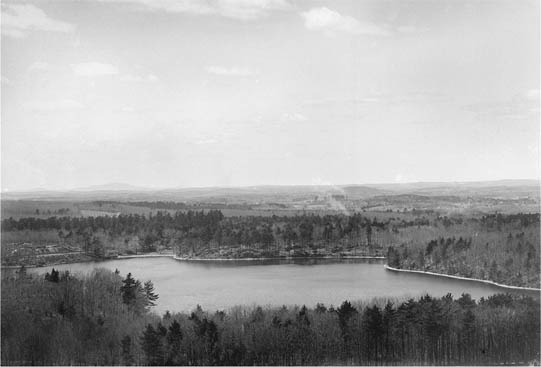
We sit on the rock on Pine Hill overlooking Walden.


October 14. 

9 a. m. — To and around Flint's Pond with Blake. 

A fine Indian-summer day. 

The 6th and 10th were quite cool, and any particularly warm days since may be called Indian summer (?), I think. 

We sit on the rock on Pine Hill overlooking Walden.


Overlooking Walden Pond from Pine Hill
April 28, 1906
There is a thick haze almost entirely concealing the mountains. There is wind enough to raise waves on the pond and make it bluer. What strikes me in the scenery here now is the contrast of the unusually blue water with the brilliant-tinted woods around it. 

The tints generally may be about at their height. The earth appears like a great inverted shield painted yellow and red, or with imbricated scales of that color, and a blue navel in the middle where the pond lies, and a distant circumference of whitish haze. 

The nearer woods, where chestnuts grow, are a mass of warm, glowing [yellow] (though the larger chestnuts have lost the greater part of their leaves and generally you wade through rustling chestnut leaves in the woods), but on other sides the red and yellow are intermixed. The red, probably of scarlet oaks on the south of Fair Haven Hill, is very fair. The beech tree at Baker's fence is past prime and many leaves fallen. 

The shrub oak acorns are now all fallen, — only one or two left on, — and their cups, which are still left on, are apparently somewhat incurved at the edge as they have dried, so that probably they would not hold the acorn now. 

The ground is strewn also with red oak acorns now, and, as far as I can discover, acorns of all kinds have fallen. 

At Baker's wall two of the walnut trees are bare but full of green nuts (in their green cases), which make a very pretty sight as they wave in the wind. So distinct you could count every one against the sky, for there is not a leaf on these trees, but other walnuts near by are yet full of leaves. You have the green nut contrasted with the clean gray trunks and limbs. These are pig nut-shaped. 

The chestnuts generally have not yet fallen, though many have. I find under one tree a great many burs, apparently not cast down by squirrels — for I see no marks of their teeth — and not yet so opened that any of the nuts fall out. They do not all wait till frosts open the burs before they fall, then. 

I see a black snake, and also a striped snake, out this warm day.

***
Some Rhus radicans was leafless on the 13th, and some tupelos bare maybe a week or more, and button-bushes nearly bare. 

My little white pines by Walden are now conspicuous in their rows, the grass, etc., having withered to tawny and the blackberry turned to scarlet. They have been almost inobvious through the summer. 

The dark evergreen leaves of the checkerberry also attract us now amid the shrub oaks, as on the southwest of Pine Hill.

I hear a man laughed at because he went to Europe twice in search of an imaginary wife who, he thought, was there, though he had never seen nor heard of her. But the majority have gone further while they stayed in America, have actually allied themselves to one whom they thought their wife and found out their mistake too late to mend it. It would be cruel to laugh at these. 

Wise, the balloonist, says that he lost a balloon "in a juniper bog in the State of Maine," which he mistook for a "prairie." Does he mean a larch swamp? 

Balloonists speak of hearing dogs bark at night and wagons rumbling over bridges.

Arbor-vitae falling (seeds), how long?

H. D. Thoreau, Journal, October 14, 1859

A fine Indian-summer day. See October 14, 1853 ("Fine, clear Indian-summer weather.")

We sit on the rock on Pine Hill overlooking Walden. See October 1, 1859 ("Looking down from Pine Hill, I see a fish hawk over Walden."); October 22, 1852 ("Looking over the forest on Pine Hill, I can hardly tell which trees are lit up by the sunshine and which are the yellow chestnut-tops."); October 20, 1852 (“Picking chestnuts on Pine Hill. . . . I see the mountains in sunshine, all the more attractive from the cold I feel here, with a tinge of purple on them”); October 25, 1858 ("Returning in an old wood-path from top of Pine Hill to Goose Pond, I see many goldenrods turned purple"); November 4, 1857 ("I climb Pine Hill just as the sun is setting, this cool evening. Sitting with my back to a thick oak sprout whose leaves still glow with life, Walden lies an oblong square endwise to, beneath me. Its surface is slightly rippled, and dusky prolonged reflections of trees extend wholly across its length, or half a mile, — I sit high."); November 5, 1857 ("I shiver about awhile on Pine Hill, waiting for the sun to set."); November 30, 1852 ("From Pine Hill, Wachusett is seen over Walden. The country seems to slope up from the west end of Walden to the mountain"); February 29, 1852 ("The ice on Walden is of a dull white as I look directly down on it, but not half a dozen rods distant on every side it is a light-blue color.From Pine Hill, looking westward, I see the snowcrust shine in the sun as far as the eye can reach. . ."); April 27, 1859 ("Through the cemetery, and over Pine Hill, where I heard a strange warbler, methought, a dark-colored, perhaps reddish-headed bird"); May 15, 1856 (“Checker-berries very abundant on south side of Pine Hill, by pitch pine wood. Now is probably best time to gather them.”); June 12, 1853 ("Going up Pine Hill, disturbed a partridge and her brood. She ran indeshabille directly to me, within four feet, while her young, not larger than a chicken just hatched, dispersed. "); July 29, 1858 ("To Pine Hill, looking for the Vaccinium Pennsylvanicum berries. I find plenty of bushes, but these bear very sparingly. They appear to bear but one or two years before they are overgrown."); August 27, 1854 ("I am surprised to see the top of Pine Hill wearing its October aspect, — yellow with changed maples and here and there faintly blushing with changed red maples. . . .. As I go up Pine Hill, gather the shrivelled Vaccinium vacillans berries, many as hard as if dried on a pan. They are very sweet and good."); September 12, 1851 ("Found a violet, apparently Viola cucullata, or hood-leaved violet, in bloom in Baker's Meadow beyond Pine Hill.")

The earth appears like a great inverted shield painted yellow and red. . .and a blue navel in the middle where the pond lies, and a distant circumference of whitish haze. See October 13, 1852 (" The water or lake from however distant a point seen is always the centre of the landscape. The pond is now most beautifully framed with the autumn-tinted woods and hills.");  November 4, 1857 ("I climb Pine Hill just as the sun is setting. . . Walden lies an oblong square endwise to, beneath me. Its surface is slightly rippled, and dusky prolonged reflections of trees extend wholly across its length");See also June 3, 1850 ("The landscape is a vast amphitheatre rising to its rim in the horizon."): June 25, 1852 ("The earth appears like a vast saucer sloping upward to its sharp mountain rim.")

The ground is strewn also with red oak acorns now, and, as far as I can discover, acorns of all kinds have fallen. See September 12, 1854 ("White oak acorns have many of them fallen. . . .. Some black scrub oak acorns have fallen, and a few black oak acorns also have fallen. The red oak began to fall first."); September 30, 1854 ("Acorns are generally now turned brown and fallen or falling; the ground is strewn with them and in paths they are crushed by feet and wheels."); October 1, 1859 ("The shrub oaks on this hill are now at their height, both with respect to their tints and their fruit. . . .Now is the time for shrub oak acorns if not for others."); October 11, 1860 ("There is a remarkably abundant crop of white oak acorns this fall, also a fair crop of red oak acorns; but not of scarlet and black, very few of them. The acorns are now in the very midst of their fall."); October 12, 1858 ("Acorns, red and white (especially the first), appear to be fallen or falling. They are so fair and plump and glossy that I love to handle them, and am loath to throw away what I have in my hand."); October 13, 1859 ("I see no acorns on the trees. They appear to have all fallen before this."); October 13, 1860 ("This is a white oak year, . . . I should think that there might be a bushel or two of acorns on and under some single trees.")

Some tupelos bare maybe a week or more. Compare October 14, 1857 ("Near by is a tupelo which is all a distinct yellow with a little green. ")

Saturday, August 24, 2019

Corner road, by brook.

August 24.

P. M. — To Conantum.

The small sempervirens blackberry in prime in one place. 

Aster puniceus and Diplopappus umbellatus, how long? 

Calamagrostis coarctata not quite, end of Hubbard's meadow wood-path. 

Panicum virgatum, say two or three weeks. 

Leersia, or cut-grass, some time, roadside, Corner road, by brook.

H. D. Thoreau, Journal, August 24, 1859


The small sempervirens blackberry in prime in one place.
August 15, 1852 ("The swamp blackberry begins."); August 23, 1856 ("At the Lincoln bound hollow, Walden, there is a dense bed of the Rubus hispidus, matting the ground seven or eight inches deep, and full of the small black fruit, now in its prime. It is especially abundant where the vines lie over a stump. Has a peculiar, hardly agreeable acid."); September 7, 1858 ("J. Farmer calls those Rubus sempervirens berries, now abundant, 'snake blackberries.'") See also A Book of the Seasons,  by Henry Thoreau, Blackberries

Aster puniceus how long? See August 11, 1856 ("Aster puniceus a day or more."); August 30, 1856 (" The Aster puniceus is hardly yet in prime; its great umbel-shaped tops not yet fully out."); October 7, 1857 ("Crossing Depot Brook, I see many yellow butterflies fluttering about the Aster puniceus, still abundantly in bloom there.”); November 5. 1855 ("Crossing the Depot Field Brook, I observe the downy, fuzzy globular tops of the Aster puniceus. They are slightly tinged with yellow, compared with the hoary gray of the goldenrod.")

Calamagrostis coarctata not quite, end of Hubbard's meadow wood-path. See August 13, 1860 ("Calamagrostis coarctata, not quite.")

Panicum virgatum, say two or three weeks. See September 7, 1858 ("In Shad-bush Meadow the prevailing grasses (not sedges) now are the slender Panicum clandestinum, whose seeds are generally dropped now, Panicum virgatum, in large tufts, and blue-joint")

Leersia, or cut-grass, some time, roadside, Corner road, by brook. See September 1, 1858 ("At the pool by the oaks behind Pratt’s . . . Leersia oryzoides, false rice, or rice cut-grass, is abundant and in prime on the shore there. Also find it on the shore of Merrick’s pasture. It has very rough sheaths.")

Popular Posts Last 30 Days.

The week ahead in Henry’s journal

The week ahead in Henry’s journal
A journal, a book that shall contain a record of all your joy.
"A stone fruit. Each one yields me a thought." ~ H. D. Thoreau, March 28, 1859


I sit on this rock
wrestling with the melody
that possesses me.