Showing posts with label Cambridge. Show all posts

Tuesday, February 9, 2021

Saw the grizzly bear near the Haymarket to-day.

February 9.

 At Cambridge to-day.

Dr. Harris thinks the Indians had no real hemp but their apocynum, and, he thinks, a kind of nettle, and an asclepias, etc.

He doubts if the dog was indigenous among them. Finds nothing to convince him in the history of New England.

Thinks that the potato which is said to have been carried from Virginia by Raleigh was the ground-nut (which is described, I perceived, in Debry (Heriot?) among the fruits of Virginia), the potato not being indigenous in North America, and the ground-nut having been called wild potato in New England, the north part of Virginia, and not being found in England.

Yet he allows that Raleigh cultivated the potato in Ireland.

Saw the grizzly bear near the Haymarket to-day, said (?) to weigh nineteen hundred, — apparently too much. He looked four feet and a few inches in height, by as much in length, not including his great head, and his tail, which was invisible.

He looked gentle, and continually sucked his claws and cleaned between them with his tongue. Small eyes and funny little ears; perfectly bearish, with a strong wild-beast scent; fed on Indian meal and water.

Hind paws a foot long. Lying down, with his feet up against the bars; often sitting up in the corner on his hind quarters.

Two sables also, that would not be waked up by day, with their faces in each other's fur.

An American chinchilla, and a silver lioness said to be from California.


H. D. Thoreau, Journal, February 9, 1853


Dr. Harris ( the librarian of Harvard University and one of Thoreau's professors) See Clark A. Elliott, Thaddeus William Harris 1795-1856: Nature, Science, and Society in the Life of an American Naturalist . See also note to January 1, 1853 ("Agassiz told him that Harris was the greatest entomologist in the world.")

Indians had no real hemp but their apocynum, and, he thinks, a kind of nettle, and an asclepias.See note to September 2, 1856 ("Some years ago I sought for Indian hemp (Apocynum cannabinum) hereabouts in vain . . .”); January 19, 1856 ("Probably both the Indian and the bird discovered for themselves this same (so to call it) wild hemp. [milkweed fibre]")

February 9.  See A Book of the Seasons,  by Henry Thoreau,  February 9

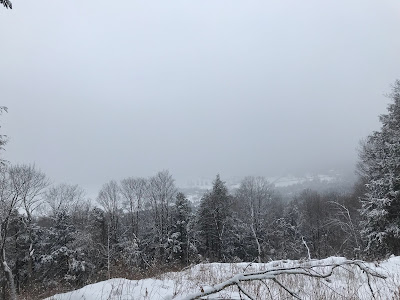
Snowing all day but
just beginning to clear up –
blue sky visible.
February 9, 2021

A Book of the Seasons,  by Henry Thoreau
 "A book, each page written in its own season, 
out-of-doors, in its own locality."
 ~edited, assembled and rewritten by zphx ©  2009-2023

Tuesday, January 26, 2021

All day at court at Cambridge


January 26. 


All day at court at Cambridge.


H. D. Thoreau, Journal, January 26, 1854

See Letters to Blake, January 21, 1854 ("I have just returned from court at Cambridge, whither I was called as a witness, having surveyed a water-privilege, about which there is a dispute.")

Saturday, January 16, 2021

The ant-lion is found at Burlington, Vermont


January 16


To Cambridge and Boston.

Carried to Harris the worms -- brown, light-striped-and fuzzy black caterpillars (he calls the first also caterpillars); also two black beetles; all which I have found within a week or two on ice and snow; thickest in a thaw.

Showed me, in a German work, plates of the larvæ of dragon-flies and ephemeræ, such as I see or their cases on rushes, etc., over water.


Says the ant-lion is found at Burlington, Vermont, and may be at Concord.

I can buy Indian coats in Milk Street from three and a half to six dollars, depending on the length; also leggins from $1.50 to three or more dollars, also depending on the length.

Saw a Nantucket man, who said that their waters were not so good as the south side of Long Island to steer in by sounding. Off Long Island it deepened a mile every fathom for at least forty miles, as he had proved, — perhaps eighty; but at Barnegat it was not so

H. D. Thoreau, Journal, January 16, 1855

Harris. See note to January 1, 1853 ("Sibley told me that Agassiz told him that Harris was the greatest entomologist in the world, and gave him permission to repeat his remark")

[Harris] Showed me, in a German work, plates of the larvæ of dragon-flies and ephemeræ, such as I see or their cases on rushes, etc., over water. See  May 9, 1854 ("That early narrow curved-winged insect on ice and river which I thought an ephemera he  [Professor Harris ] says is a Sialis, or maybe rather a Perla. . . .  Says the shad-flies (with streamers and erect wings ) are ephemeræ."); See also A Book of the Seasons,  by Henry Thoreau, Insect Hatches in Spring (millers, perla, shad-flies or ephemera)

Caterpillars which I have found within a week or two on ice and snow. See January 8, 1855 ("I see various caterpillars and grubs on the snow and in one place a reddish ant about a third of an inch long walking off."); January 11, 1855 ("There were many of those grubs and caterpillars on the ice half a dozen rods from shore, some sunk deep into it. ") See also  January 5, 1858 ("I see one of those fuzzy winter caterpillars, black at the two ends and brown-red in middle, crawling on a rock by the Hunt's Bridge causeway. "); January 8, 1857 ("I picked up on the bare ice of the river, opposite the oak in Shattuck's land, on a small space blown bare of snow, a fuzzy caterpillar, black at the two ends and red-brown in the middle, rolled into a ball.”); January 22, 1859 ("Four kinds of caterpillars, and also the glow-worm-like creature so common, grasshoppers, crickets, and many bugs, not to mention the mosquito like insects which the warm weather has called forth (flying feebly just over the ice and snow a foot or two), spiders, and snow-fleas"); January 24, 1858 (" I see two of those black and red-brown fuzzy caterpillars");  January 24, 1859 ("I see an abundance of caterpillars of various kinds on the ice of the meadows . . . Many of them are frozen in yet, some for two thirds their length, yet all are alive.")  and  A Book of the Seasons,   by Henry Thoreau, Signs of the Spring: insects and worms come forth and are active

Saw a Nantucket man, who said that their waters were not so good . . . to steer in by sounding
. See December 29, 1854 ("Nantucket . . . 
The fog was so thick that we were lost on the water; stopped and sounded many times. The clerk said the depth varied from three to eight fathoms between the island and Cape.")

January 16  See A Book of the Seasons, by Henry Thoreau, January 16

Cambridge and Boston –
The ant-lion is found at
Burlington, Vermont.

 "A book, each page written in its own season, 
out-of-doors, in its own locality."
 ~edited, assembled and rewritten by zphx ©  2009-2025

https://tinyurl.com/hdt-550116

Saturday, November 7, 2020

To Cambridge and Boston.


November 7.

To Cambridge and Boston.

H. D Thoreau, Journal, November 7, 1860

See July 26, 1852 ("Went to Cambridge and Boston to-day. Dr. Harris says that my great moth is the Attacus luna"); December 25, 1853 ("When I go to Boston, I go naturally straight through the city down to the end of Long Wharf and look off"); December 22, 1856 ("To Boston and Cambridge."); 
January 26, 1857 ("At Cambridge and Boston. Saw Boston Harbor frozen over."); March 16, 1857 ("To Cambridge and Boston."); May 3, 1860 ("To Cambridge and Boston. I see at the Aquarium many of my little striped or barred breams.")
 

Thursday, July 9, 2020

The naked eye still retains some importance in the estimation of astronomers.


July 9.

When I got out of the cars at Porter’s, Cambridge, this morning, I was pleased to see the handsome blue flowers of the succory or endive (Cichorium Intybus), which reminded me that within the hour I had been whirled into a new botanical region.

They must be extremely rare, if they occur at all, in Concord. This weed is handsomer than most garden flowers.

Saw there also the Cucubalus Behen, or bladder campion, also the autumnal dandelion (Apargia autumnalis).

Visited the Observatory.

Bond said they were cataloguing the stars at Washington (?), or trying to. They do not at Cambridge; of no use with their force. Have not force enough now to make mag[netic] obs[ervations].

When I asked if an observer with the small telescope could find employment, he said, Oh yes, there was employment enough for observation with the naked eye, observing the changes in the brilliancy of stars, etc., etc., if they could only get some good observers.

One is glad to hear that the naked eye still retains some importance in the estimation of astronomers.

Coming out of town, — willingly as usual, — when I saw that reach of Charles River just above the depot, the fair, still water this cloudy evening suggesting the way to eternal peace and beauty, whence it flows, the placid, lake-like fresh water, so unlike the salt brine, affected me not a little.

I was reminded of the way in which Wordsworth so coldly speaks of some natural visions or scenes "giving him pleasure."

This is perhaps the first vision of elysium on this route from Boston.

And just then I saw an encampment of Penobscots, their wigwams appearing above the railroad fence, they, too, looking up the river as they sat on the ground, and enjoying the scene.

What can be more impressive than to look up a noble river just at evening, – one, perchance, which you have never explored, — and behold its placid waters, reflecting the woods and sky, lapsing inaudibly toward the ocean; to behold as a lake, but know it as a river, tempting the beholder to explore it and his own destiny at once? Haunt of waterfowl.

This was above the factories, — all that I saw. That water could never have flowed under a factory. How then could it have reflected the sky?

H. D. Thoreau, Journal, July 9, 1851


One is glad to hear that the naked eye still retains some importance in the estimation of astronomers. See July 7, 1851 ("I have been to-night with Anthony Wright to look through Perez Blood's telescope a second time. . . . I am still contented to see the stars with my naked eye ."); October 20, 1852 ("Many a man, when I tell him that I have been on to a mountain, asks if I took a glass with me. No doubt, I could have seen further with a glass, and particular objects more distinctly, - could have counted more meeting-houses; but this has nothing to do with the peculiar beauty and grandeur of the view which an elevated position affords. It was not to see a few particular objects, as if they were near at hand, as I had been accustomed to see them, that I ascended the mountain, but to see an infinite variety far and near in their relation to each other, thus reduced to a single picture."); September 29, 1854 (“ When I look at the stars, nothing which the astronomers have said attaches to them . . . One might say that all views through a telescope or microscope were purely visionary, for it is only by his eye and not by any other sense —not by his whole man —that the beholder is there where he is presumed to be. It is a disruptive mode of viewing as far as the beholder is concerned.”); March 28, 1858 (" . . . the “naked eye,” as if the eye which is not covered with a spy glass should properly be called naked.") See also note to March 13, 1854 ("Bought a telescope to-day for eight dollars.")

.
What can be more impressive than to look up a noble river just at evening, – one, perchance, which you have never explored, — and behold its placid waters, reflecting the woods and sky, lapsing inaudibly toward the ocean; to behold as a lake, but know it as a river, tempting the beholder to explore it and his own destiny at once? See March 31, 1853 (" It is affecting to see a distant mountain-top, like the summits of Uncanoonuc, well seen from this hill, whereon you camped for a night in your youth, which you have never revisited, still as blue and ethereal to your eyes as is your memory of it")

July 9. See A Book of the Seasons, by Henry Thoreau, July 9

A Book of the Seasons, by Henry Thoreau
"A book, each page written in its own season,
out-of-doors, in its own locality.”
~edited, assembled and rewritten by zphx © 2009-2021

Monday, March 16, 2020

The Library a wilderness of books.


March 16. 

Before sunrise. 

With what infinite and unwearied expectation and proclamation the cocks usher in every dawn, as if there had never been one before! And the dogs bark still, and the thallus of lichens springs, so tenacious of life is nature. 

Spent the day in Cambridge Library. 

Walden is not yet melted round the edge. 

It is, perhaps, more suddenly warm this spring than usual. 

Mr. Bull thinks that the pine grosbeaks, which have been unusually numerous the past winter, have killed many branches of his elms by budding them, and that they will die and the wind bring them down, as heretofore. 

Saw a large flock of geese go over Cambridge and heard the robins in the College Yard. 

The Library a wilderness of books. 

Looking over books on Canada written within the last three hundred years, could see how one had been built upon another, each author consulting and referring to his predecessors. You could read most of them without changing your leg on the steps.

It is necessary to find out exactly what books to read on a given subject. Though there may be a thousand books written upon it, it is only important to read three or four; they will contain all that is essential, and a few pages will show which they are. Books which are books are all that you want, and there are but half a dozen in any thousand. 

I saw that while we are clearing the forest in our westward progress, we are accumulating a forest of books in our rear, as wild and unexplored as any of nature's primitive wildernesses. 

The volumes of the Fifteenth, Sixteenth, and Seventeenth Centuries, which lie so near on the shelf, are rarely opened, are effectually forgotten and not implied by our literature and newspapers. 

When I looked into Purchas's Pilgrims, it affected me like looking into an impassable swamp, ten feet deep with sphagnum, where the monarchs of the forest, covered with mosses and stretched along the ground, were making haste to become peat. 

Those old books suggested a  certain fertility, an Ohio soil, as if they were making a humus for new literatures to spring in. I heard the bellowing of bullfrogs and the hum of mosquitoes reverberating through the thick embossed covers when I had closed the book. 

Decayed literature makes the richest of all soils.

H. D. Thoreau, Journal, March 16, 1852

Saw a large flock of geese go over Cambridge and heard the robins in the College Yard. See March 14, 1854 ("From within the house at 5.30 p. m. I hear the loud honking of geese, throw up the window, and see a large flock in disordered harrow flying more directly north or even northwest than usual. Raw, thick, misty weather"). See also A Book of the Seasons, by Henry Thoreau, Signs of the Spring; Geese Overhead

Walden is not yet melted round the edge
.  See March 14, 1852 ("The ice on Walden has now for some days looked white like snow, the surface being softened by the sun.");  Journal, March 18, 1852("The pond is still very little melted around the shore.");  April 1, 1852 ("Walden is all white ice, but little melted about the shores."); April 14. 1852 (" Walden is only melted two or three rods from the north shore yet."); April 19, 1852 (" Walden is clear of ice. The ice left it yesterday, then, the 18th. ");Walden. ("In 1845 Walden was first completely open on the 1st of April; in '46, the 25th of March; in '47, the 8th of April;  in '51, the 28th of March; in '52, the 18th of April; in '53, the 23rd of March;  in '54, about the 7th of April.")

Thursday, February 6, 2020

A rainy day.


February 6

To Cambridge. A rainy day.

February 6, 2020


H. D. Thoreau, Journal, February 6, 1860


Compare   February 6, 1855 ("The coldest morning this winter. Our thermometer stands at -14° at 9 A.M . . .At 9 o’clock P.M., thermometer at -16°. They say it did not rise above -6° to-day"); February 7, 1856 ("Begins to snow at 8 A.M.; turns to rain at noon, and clears off, or rather ceased raining, at night, with some glaze on the trees. This the first thawing, though slight, since the 25th of December.")

February  6. See A Book of the Seasons, by Henry Thoreau, February 6


A Book of the Seasons,  by Henry Thoreau
"A book, each page written in its own season,
out-of-doors, in its own locality.”
~edited, assembled and rewritten by zphx © 2009-2022

Sunday, January 19, 2020

Identifying the Attacus cecropia

January 19. 

Went to Cambridge to court. 

Dr. Harris says that my cocoons found in Lincoln in December are of the Attacus cecropia, the largest of our emperor moths. He made this drawing of the four kinds of emperor moths which he says we have.
Attacus cecropia
The cecropia is the largest. The cocoon must be right end uppermost when they are ready to come out. The A. Promethea is the only moth whose cocoon has a fastening wound round the petiole of the leaf, and round the shoot, the leaf partly folded round it. 


That spider whose hole I found, and which I carried him, he is pretty sure is the Lycosa fatifera. 

In a large and splendid work on the insects of Georgia, by Edwards and Smith (?), near end of last century, up-stairs, I found plates of the above moths, called not Attacus but Phaloena, and other species of Phaloena. 

He thinks that small beetle, slightly metallic, which I saw with grubs, etc., on the yellow lily roots last fall was a Donax or one of the Donasia (?).

In Josselyn's account of his voyage from London to Boston in 1638, he says, " June the first day in the afternoon, very thick foggie weather, we sailed by an enchanted island," etc. This kind of remark, to be found in so many accounts of voyages, appears to be a fragment of tradition come down from the earliest ac count of Atlantis and its disappearance. 

Varro, having enumerated certain writers on agriculture, says accidentally [sic] that they wrote soluta ratione, i.e. in prose. 

This suggests the difference between the looseness of prose and the precision of poetry. A perfect expression requires a particular rhythm or measure for which no other can be substituted. The prosaic is always a loose expression. 

Varro divides fences into four kinds, — unum naturale, alterum agreste, tertium militare, quartum fabrile. (Many kinds of each.) The first is the living hedge. One kind of sepes agrestis is our rail fence, and our other dead wooden farm fences would come under this head. The military sepes consists of a ditch and rampart; is common along highways; sometimes a rampart alone. The fourth is the mason's fence of stone or brick (burnt or unburnt), or stone and earth together.

H. D. Thoreau, Journal, January 19, 1854

My cocoons found in Lincoln in December are of the Attacus cecropia, the largest of our emperor moths.
See December 17, 1853 ("While surveying for Daniel Weston in Lincoln to-day, see a great many — maybe a hundred — silvery-brown cocoons, wrinkled and flattish, on young alders in a meadow, three or four inches long, fastened to the main stem and branches at same time, with dry alder and fragments of fern leaves attached to and partially concealing them; of some great moth.")

Thursday, June 21, 2018

In the Natural History Rooms talking of the myrtle-bird.

June 21. 
June 21, 2018
Vide at Cambridge, apparently in prime, Silene inflata; also, in a rich grass-field on Sacramento Street, what may be Turritis glabra (?), also in prime, the last three or four feet high. Both pressed. 

Talked with Mr. Bryant at the Natural History Rooms. He agrees with Kneeland in thinking that what I call the myrtle-bird’s is the white-throat sparrow’s note. Bryant killed one Down East in summer of ’56. He has lived the last fifteen years at Cohasset, and also knows the birds of Cambridge, but talks of several birds as rare which are common in Concord, such as the stake-driver, marsh hawk (have neither of their eggs in the collection), Savannah sparrow, the passerina much rarer, and I think purple finch, etc. Never heard the tea-lee note of myrtle-bird ( ?) in this State. 

Their large hawk is the red-shouldered, not hen-hawk. 

He thinks that the sheldrake of the Maine lakes is the merganser, the serrator belonging rather to the sea coast. 

Of the two little dippers or grebes, he thought the white-breasted one would be the commonest, which has also a slender bill, while the other has a brownish breast and a much thicker bill. 

The egg of the Turdus solitarius in the collection is longer, but marked very much like the tanager’s, only paler-brown. They have also the egg of the T. brunneus, the other hermit thrush, not common here.

H. D. Thoreau, Journal, June 21, 1858

Mr. Bryant at the Natural History Rooms agrees with Kneeland in thinking that what I call the myrtle-bird’s is the white-throat sparrow’s note. See January 15, 1858 ("At Natural History Rooms, Boston. . . . Talked with Dr. Kneeland. . . . Speaking to him of my night warbler, he asked if it uttered such a note, making the note of the myrtle-bird, ah, te-te-te te-te-te te-te-te, exactly, and said that that was the note of the white throated sparrow, which he heard at Lake Superior, at night as well as by day.”)

The egg of the Turdus solitarius in the collection. See June 12, 1857 (“The egg of the Turdus solitarius is lettered "Swamp Robin."”)

Sunday, May 27, 2018

To measure the egg.

May 27. 


May 27, 2018

At Boston, Cambridge, and Concord. 

De Kay describes the Esox fasciatus, which is apparently mine of May 11th. As I count, the rays are the same in number, viz. “P. 13, V. 9, D. 14, A. 13, C. 20.” He says it is from six to eight inches long and abundant in New York; among other things is distinguished by “a muddy tinge of the roundish pectoral, abdominal, and ventral fins; and by a broad concave or lunated tail.” I do not observe the peculiarity in the tail in mine, now it is in spirits. 

Ed. Emerson shows me an egg of a bittern (Ardea minor) from a nest in the midst of the Great Meadows, which four boys found, scaring up the bird, last Monday, the 24th. It was about a foot wide on the top of a tussock, where the water around was about one foot deep. I will measure the egg. They were a little developed. It is clay-colored, one and seven eighths inches long by one and nine sixteenths, about the same size at each end.  

Also an egg of a turtle dove, one of two in a nest in a pitch pine, about six feet from the ground, in Sleepy Hollow Cemetery, by the side of a frequented walk, on a fork on a nearly horizontal limb. The egg is milk-white, elliptical, one and three sixteenths inches long by seven eighths wide.

H. D. Thoreau, Journal, May 27, 1858

De Kay describes the Esox fasciatus., which is apparently mine of May 11th. See May 11, 1858 (“the little brook (?) pickerel, of Hubbard's ditches, . . . I caught two directly. ”) See also Proceedings of the Boston Society of Natural History ("[Mr. Putnam] exhibited specimens of the young and adult pickerel, to show that the "short-nosed pickerel " is specifically distinct from the "long-nosed " — the Esox reticulatus — and said that the " short-nosed " species is the Esox fasciatus of Dekay, which is not the young of the Esox reticulates”)   See also A Book of the Seasons, by Henry Thoreau, Pickerel

A nest of a bittern (Ardea minor) in the midst of the Great Meadows about a foot wide on the top of a tussock. See  June 11, 1860 ("I hear a sound just like a small dog barking hoarsely, and, looking up, see it was made by a bittern  (Ardea minor), a pair of which flap over the meadows and probably nest in some tussock thereabouts.”)

Thursday, February 15, 2018

A tuft of hair on each ear and a ruff under the throat.

February 15. 

To Cambridge and Boston. 

Saw, at a menagerie, a Canada lynx, said to have been taken at the White Mountains. It looked much like a monstrous gray cat standing on stilts, with its tail cut down to five inches, a tuft of hair on each ear and a ruff under the throat.

H. D. Thoreau, Journal, February 15, 1858


Saw, at a menagerie, a Canada lynx . . .with its tail cut down to five inches, a tuft of hair on each ear and a ruff under the throat. 
See September 29, 1856 ("Dr. Reynolds told me the other day of a Canada lynx (?) killed in Andover, in a swamp, some years ago."); October 20, 1857 ("It is worth the while to have a Skinner in the town; else we should not know that we had wildcats."); September 11, 1860 ("George Melvin came to tell me this forenoon that a strange animal was killed on Sunday. . . From his description I judged it to be a Canada lynx . . . I measured the stuffed skin carefully . . . Tail stout and black at the abrupt end, 5 inches . . . tuft on ear ( black and thin ) , 1½ inches . . .Ears, without  broadly edged with black half an inch or more wide  the rest being a triangular white. There was but a small muffler, chiefly a triangular whitish and blackish tuft on the sides of the face or neck, not noticeably under the chin."); September 13, 1860 ("They who have seen this generally suppose that it got out of a menagerie; others that it strayed down from far north. They call it Canada lynx."); October 17, 1860 ("While the man that killed my lynx (and many others) thinks it came out of a menagerie, and the naturalists call it the Canada lynx, and at the White Mountains they call it the Siberian lynx, - in each case forgetting, or ignoring ,that it belongs here, - I call it the Concord lynx.") 

Friday, April 21, 2017

If it did not melt so fast, would be a foot deep.


April 21. 

Tuesday. 

Mr. Loomis writes me that he saw two barn swallows in Cambridge April 1st! 

I have the Corema conradii from Plymouth, in bloom. 

It snows hard all day. If it did not melt so fast, would be a foot deep. As it is, is about three inches on a level.

H. D. Thoreau, Journal,  April 21, 1857


It snows hard all day. If it did not melt so fast, would be a foot deep.
 See April 22, 1857 ("All the shores have the aspect of winter, covered several inches deep with snow, and we see the shadows on the snow as in winter") and note to April 2, 1861 ("A drifting snow-storm, perhaps a foot deep on an average.”)

Friday at dusk we walk to the view in a drizzle the trails are wet and muddy. Jane is unable to find the bloodroot  she saw the other day in bloom on the ledge on the way up. The hermit thrush loudly sounds it's vreeen  note but does not sing Sitting at the view I notice lights, seemingly like streetlights, along S. Dorset St. But as I watch they all go out at once. After a few minutes I look back and they are back on. They are not along the street as I now see the street is marked  beyond by cars headlights. The hammock is broken loose from one of its trees and is caught in the branches of another. I untangle it and hook it back up to a rope  already tied around the tree. I help hang a windchime that fell.  There must have been a big breeze here. We go down the ridge trail longer and steeper than I remember to the head of the Moosetrail where we walk back into our land. The stream from our middle wetland is flowing down the trail. All the streams look beautiful in the dark under the headlamp. We go back up Beech Lane then over the "saddle" and eventually bushwhack to the head of the rocky trail seen in the distance by the light there.  She tells me the light can be seen farther away than expected. Down the hill trying to avoid slipping in the mud or stepping in the water the endorphins kick in at the main trail and we walk home elated in the rain

At the main trail walk
home elated in the rain,
endorphins kicked in.
20170421

Thursday, March 2, 2017

Very gusty day.

March 2

At Cambridge. Very gusty day. An inch or two of snow falls, — all day about it, — and strangely blown away.

H. D. Thoreau, Journal, March 2, 1857

An inch or two of snow falls.
 See March 2, 1858 ("Snowed last night and this morning, about seven inches deep."); March 2, 1856 ("Has snowed three or four inches —very damp snow — in the night;")

March 2.  See A Book of the Seasons, by Henry Thoreau, March 2

Very gusty day. 
An inch or two of snow falls, — 
strangely blown away.

A Book of the Seasons,  by Henry Thoreau,  Very gusty day. 

A Book of the Seasons,  by Henry Thoreau
 "A book, each page written in its own season,
out-of-doors, in its own locality."
 ~edited, assembled and rewritten by zphx ©  2009-2025

Thursday, December 22, 2016

Saturday, March 26, 2016

So many purposes left unaccomplished.


March 26.

March 26, 2016

To Cambridge. 

They are just beginning to use wheels in Concord, but only in the middle of the town, where the snow is at length worn and melted down to bare ground in the middle of the road, from two to ten feet wide. Sleighs are far the most common, even here. 

In Cambridge there is no sleighing. For the most part, the middle of the road from Porter’s to the College is bare and even dusty for twenty to thirty feet in width. The College Yard is one half bare. So, if they have had more snow than we, as some say: it has melted much faster.

There is also less in the towns between us and Cambridge than in Concord. The snow lies longer on the low, level plain surrounded by hills in which Concord is situated. I am struck by the more wintry aspect — almost entirely uninterrupted snow-fields — on coming into Concord in the cars. 

I am sometimes affected by the consideration that a man may spend the whole of his life after boyhood in accomplishing a particular design; as if he were put to a special and petty use, without taking time to look around him and appreciate the phenomenon of his existence. If so many purposes are thus necessarily left unaccomplished, perhaps unthought of, we are reminded of the transient interest we have in this life. 

Our interest in our country, in the spread of liberty, etc., strong and, as it were, innate as it is, cannot be as transient as our present existence here. It cannot be that all those patriots who die in the midst of their career have no further connection with the career of their country.

H. D. Thoreau, Journal, March 26, 1856


They are just beginning to use wheels in Concord.
See March 25, 1860 ("When March arrives, a tolerably calm, clear, sunny, spring like day, the snow is so far gone that sleighing ends and our compassion is excited by the sight of horses laboriously dragging wheeled vehicles through mud and water and slosh. We shall no longer hear the jingling of sleigh bells.")

Popular Posts Last 30 Days.

The week ahead in Henry’s journal

The week ahead in Henry’s journal
A journal, a book that shall contain a record of all your joy.
"A stone fruit. Each one yields me a thought." ~ H. D. Thoreau, March 28, 1859


I sit on this rock
wrestling with the melody
that possesses me.