Showing posts with label Hubbard's Causeway. Show all posts

Wednesday, November 18, 2015

The stubble and numerous withered weeds rising above the snow.

November 18

About an inch of snow fell last night, but the ground was not at all frozen or prepared for it. A little greener grass and stubble here and there seems to burn its way through it this forenoon. 

As I sit in the house, I am struck with the brightness and heat of the sun reflected from this our first snow. There is an intenser light in the house, and I feel an uncommon heat from the sun’s rays on my back. 

It clears up at noon, and at 2 P. M. I go to Fair Haven Hill via Hubbard’s Grove. The air is very clear, and the sky heavenly, with a few floating downy clouds. 

I am prepared to hear sharp, screaming notes rending the air, from the winter birds. I do, in fact, hear many jays, and the tinkling, like rattling glass, from chickadees and tree sparrows. 

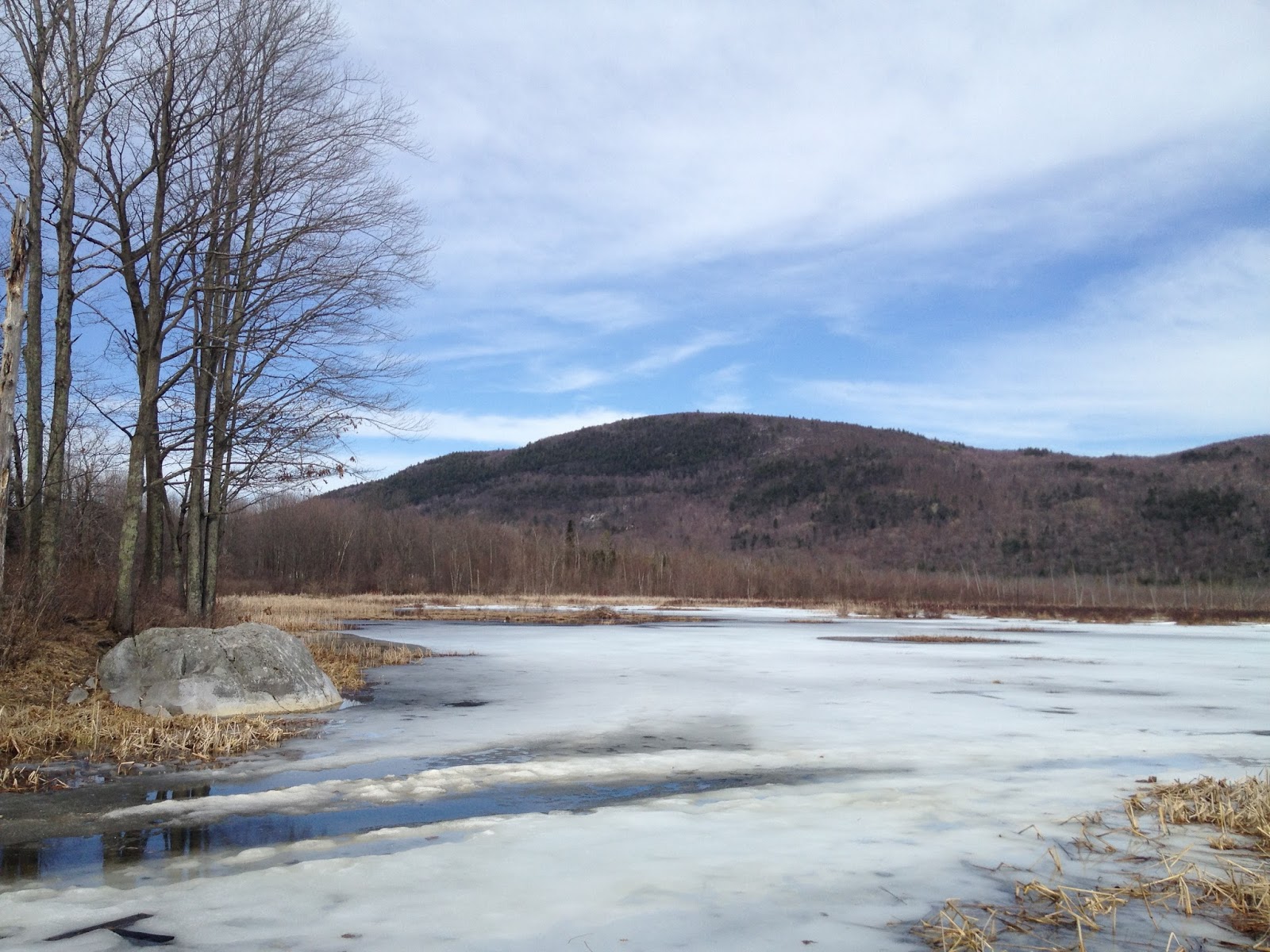
I do not detect any peculiar brightness whatever in the osiers on the Hubbard causeway; they are scarcely, if at all, brighter than the tops of the trees.

Now first mark the stubble and numerous withered weeds rising above the snow. They have suddenly acquired a new character. 

Yarrow
Tansy still shows its yellow disks, but yarrow is particularly fresh and perfect, cold and chaste, with its pretty little dry-looking rounded white petals and green leaves. Its very color gives it a right to bloom above the snow, —as level as a snow-crust on the top white ruff. 

The snow is the great track-revealer. I come across the tracks of persons who, at a different hour from myself, have crossed, and perhaps often cross, some remote field on their errands, when I had not suspected a predecessor; and the track of the dog or staff are seen too. The cattle have tracked their whole pasture over, as if there had been a thousand. I have this silent but unerring evidence of any who have crossed the fields since last night. It is pleasant to see tracks leading towards the woods, - to be reminded that any have engagements there. 

Yet for the most part the snow is quite untrodden. Most fields have no track of man in them. I only see where a squirrel has leaped from the wall. 

The perfectly leafless alder thickets are much darker than the maples, now that the ground is whitened. The pasture directly under my face is white, but, seen aslant a few rods off, mostly russet. 

I was so warmed in spirit in getting my wood that the heat it finally yielded when burnt was coldness in comparison. That first is a warmth which you cannot buy. 

Gather a bagful of fair apples on Fair Haven, showing their red cheeks above the snow. These apples which I get nowadays —russets and Baldwins — are the ripest of all, being acted on by the frost and partly left because they were slightly over ripe for keeping. I come home with a heavy bagful and rob no one. 

H. D. Thoreau, Journal, November 18, 1855

The snow is the great track-revealer. See December 4, 1856 ("How many thousand acres are there now of pitchered blue-curls and ragged wormwood rising above the shallow snow? . . .the first snow comes and reveals them.") December 8, 1855 ("Let a snow come and clothe the ground and trees, and I shall see the tracks of many inhabitants now unsuspected"); December 12, 1859 ("The snow having come, we see where is the path of the partridge, — his comings and goings from copse to copse, — and now first, as it were, we have the fox for our nightly neighbor, and countless tiny deer mice."); December 22, 1852 ("The squirrel, rabbit, fox tracks, etc., attract the attention in the new-fallen snow . . . You cannot go out so early but you will find the track of some wild creature."): December 31, 1853 ("This animal probably I should never see the least trace of, were it not for the snow, the great revealer."); January 4, 1860 ("Again see what the snow reveals . . . that the woods are nightly thronged with little creatures which most have never seen"); January 5, 1860 ("How much the snow reveals!"); February 16, 1854 ("Snow is a great revealer not only of tracks made in itself, but even in the earth before it fell.")

I do not detect any peculiar brightness whatever in the osiers. See November 18, 1858 ("Notice the short bright-yellow willow twigs on Hubbard’s Causeway.") See also A Book of the Seasons,  by Henry Thoreau,  the Osier in Winter and early Spring

Now first mark the stubble and numerous withered weeds rising above the snow. See December 26,1853 ("All weeds, with their seeds, rising dark above the snow, are now remarkably conspicuous, which before were not observed against the dark earth.”) See note to November 29, 1856 ("Begins to snow this morning and snows slowly and interruptedly with a little fine hail all day till it is several inches deep. This the first snow I have seen.")

Tansy still shows its yellow disks, but yarrow is particularly fresh and perfect, cold and chaste. See November 18, 1852 ("Yarrow and tansy still. These are cold, gray days.”); See also  November 3, 1853 ("To-day I see yarrow, very bright"); 
; November 22, 1853 ("Yarrow is particularly fresh and innocent") and A Book of the Seasons, by Henry Thoreau, Yarrow and Tansy in Autumn

November 18. See A Book of the Seasons,  by Henry Thoreau, November 18

Rounded white petals 
of yarrow above the snow –
perfect, cold and chaste.
 "A book, each page written in its own season, 
out-of-doors, in its own locality."
 ~edited, assembled and rewritten by zphx ©  2009-2025

https://tinyurl.com/hdt-551118

Wednesday, September 23, 2015

A screech owl in moonlight/confusing fall warblers


September 23


Small sparrows, with yellow on one side above eye in front and white belly, erectile (?) crown divided by a light line. 

Those weeds, etc., on the bared meadow come up spontaneously. 

8 P. M. — I hear from my chamber a screech owl about Monroe’s house this bright moonlight night, — a loud, piercing scream, much like the whinny of a colt perchance, a rapid trill, then subdued or smothered a note or two. 

A little wren-like (or female goldfinch) bird on a willow at Hubbard’s Causeway, eating a miller: with bright-yellow rump when wings open, and white on tail. Could it have been a yellow-rump warbler?

H. D. Thoreau, Journal, September 23, 1855

I hear from my chamber a screech owl — a loud, piercing scream, much like the whinny of a colt. See   June 2, 1860 ("I soon hear its mournful scream. . . not loud now but, though within twenty or thirty rods, sounding a mile off.”); June 25, 1860 ("At evening up the Assabet hear four or five screech owls on different sides of the river, uttering those peculiar low screwing or working, ventriloquial sounds.”); August 14, 1854 (“I hear the tremulous squealing scream of a screech owl in the Holden Woods.”); October 9, 1851 ("Heard two screech owls in the night")

Friday, April 3, 2015

A very large hawk

April 3,  2015

April 3


It is somewhat warmer, but still windy, and I go to sail down to the Island and up to Hubbard’s Causeway.


Most would call it cold to-day. I paddle without gloves. It is a coolness like that of March 29th and 30th, pleasant to breathe, and, perhaps, like that, presaging decidedly warmer weather. It is an amelioration, as nature does nothing suddenly.

The shores are lined with frozen spray-like foam, with an abrupt edge, a foot high often on the waterside. Occasionally where there are twigs there is a nest of those short, thick bulls’-horn icicles, pointing in every direction.

I see many hens feeding close to the river’s edge, like the crows, - and robins and blackbirds later, - and I have no doubt they are attracted by a like cause. The ground being first thawed there, not only worms but other insect and vegetable life is accessible there sooner than elsewhere.

See several pairs of ducks, mostly black.

Returning, when off the hill am attracted by the noise of crows, which betray to me a very large hawk, large enough for an eagle, sitting on a maple beneath them. Now and then they dive at him, and at last he sails away low round the hill, as if hunting.

The hillside is alive with sparrows, red-wings, and the first grackles 
[rusty grackles, or rusty blackbirds.] I have seen.  
I detected them first by their more rasping note . . . after a short stuttering, then a fine, clear whistle. 

H. D. Thoreau, Journal, April 3, 1855

Most would call it cold to-day. I paddle without gloves. Compare April 3, 1852 ("It is very cold and windy, and I miss my gloves, left at home. Colder than the last moon"); See March 20, 1855 (“It is remarkable by what a gradation of days which we call pleasant and warm . . . At first a sunny, calm, serene winter day is pronounced spring, or reminds us of it; and then the first pleasant spring day perhaps we walk with our greatcoat buttoned up and gloves on.”);  April 26, 1860 ("To-day it is 53° at 2 P. M., yet cold, such a difference is there in our feelings. What we should have called a warm day in March is a cold one at this date in April. It is the northwest wind makes it cold.")

A coolness like that of March 29th and 30th. See March 29, 1855 ("I inhale with pleasure the cold but wholesome air . . . This, which is a chilling wind to my fellow, is decidedly refreshing to me."); March 30, 1855 ("To-day and yesterday have been bright, windy days. —west wind, cool, yet, compared with the previous colder ones, pleasantly, gratefully cool to me on my cheek.")

Nature does nothing suddenly. See September 17, 1839 ("Nature never makes haste; her systems revolve at an even pace."); June 14, 1851 ("How moderate, deliberate, is Nature! "); January 26, 1858 ("Nature loves gradation.");  November 17, 1858 ("Nature is moderate and loves degrees.");  January 14, 1861 ("Nature is slow but sure; she works no faster than need be.")

Those short, thick bulls’-horn icicles, pointing in every direction. See April 2, 1855 ("The wind is still very strong and cold from the north west . . . blowing the water . . . over the rocks and bushes along the shore, where it freezes in the shape of bulls’ horns.")

See several pairs of ducks, mostly black. See April 7, 1853 ("We cross the Great Meadows, scaring up many ducks at a great distance, some partly white, some apparently black, some brownish (?).  It is Fast-Day, and many gunners are about the shore, which makes them shy. I never cross the meadow at this season without seeing ducks. "); See also A Book of the Seasons, by Henry Thoreau, the American Black Duck

The noise of crows . . . betray to me a very large hawk, large enough for an eagle. See April 6, 1856 ("The crows had betrayed to me some large bird of the hawk kind which they were buffeting.); April 8, 1854 ("It sailed and circled along over the low cliff, and the crows dived at it in the field of my glass . . . It was undoubtedly a white-headed eagle.") See also A Book of the Seasons, by Henry Thoreau, the American Crow

Rusty grackles, or rusty blackbirds . . . after a short stuttering, then a fine, clear whistle. See April 9, 1855 ("Wilson says that the only note of the rusty grackle is a chuck, though he is told that at Hudson’s Bay, at the breeding-time, they sing with a fine note. Here they utter not only a chuck, but a fine shrill whistle."); April 11, 1856 (" See a male and female rusty grackle alight on an oak near me, the latter apparently a flaxen brown, with a black tail. She looks like a different species of bird. Wilson had heard only a tchuck from the grackle, but this male, who was courting his mate, broke into incipient warbles, like a bubble burst.");  April 14, 1855 ("I see half a dozen crow blackbirds uttering their coarse rasping char char. . . They also attain to a clear whistle with some effort, but seem to have some difficulty in their throats yet."): March 29, 1853 ("It would be worth the while to attend more to the different notes of the blackbirds.");March 29, 1858 ("I see what I suppose is the female rusty grackle; black body with green reflections and purplish-brown head and neck, but I notice no light iris. ") See also A Book of the Seasons,  by Henry Thoreau, Signs of the Spring: The grackle arrives.

April 3. See A Book of the Seasons, by Henry Thoreau, April 3

A very large hawk
large enough for an eagle
mobbed by noisy crows.

A Book of the Seasons, by Henry Thoreau
"A book, each page written in its own season,
out-of-doors, in its own locality.”
~edited, assembled and rewritten by zphx © 2009-2025

https://tinyurl.com/hdt-550403

Popular Posts Last 30 Days.

The week ahead in Henry’s journal

The week ahead in Henry’s journal
A journal, a book that shall contain a record of all your joy.
"A stone fruit. Each one yields me a thought." ~ H. D. Thoreau, March 28, 1859


I sit on this rock
wrestling with the melody
that possesses me.