Showing posts with label blue vervain. Show all posts

Tuesday, September 6, 2022

From Strawberry Hill the first glimpse of Nagog Pond.


September 6

September 6, 2022


2 P. M. — To Hapgood's in Acton direct, returning via Strawberry Hill and Smith's Road.

The ripening grapes begin to fill the air with their fragrance.

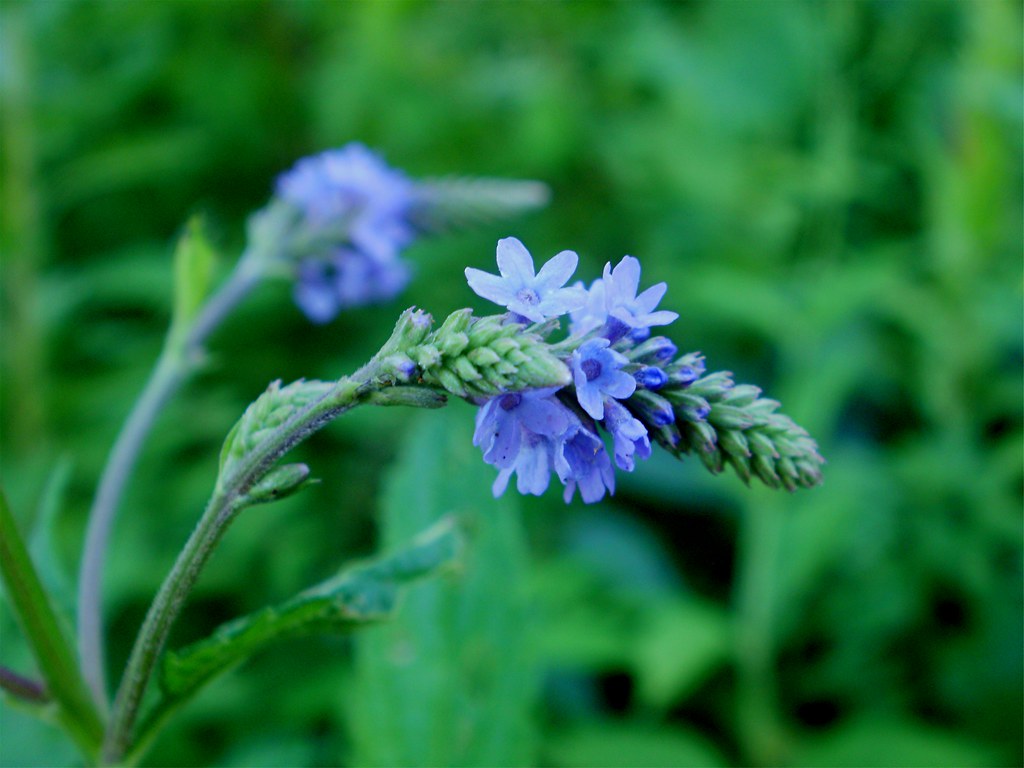
The vervain will hardly do for a clock, for I perceive that some later and smaller specimens have not much more than begun to blossom, while most have done.

Saw a tall pear tree by the roadside beyond Harris's in front of Hapgood's.

Saw the lambkill (Kalmia angustifolia) in blossom – a few fresh blossoms at the ends of the fresh twigs-on Strawberry Hill, beautiful bright flowers. Apparently a new spring with it, while seed vessels apparently of this year, hung dry below.

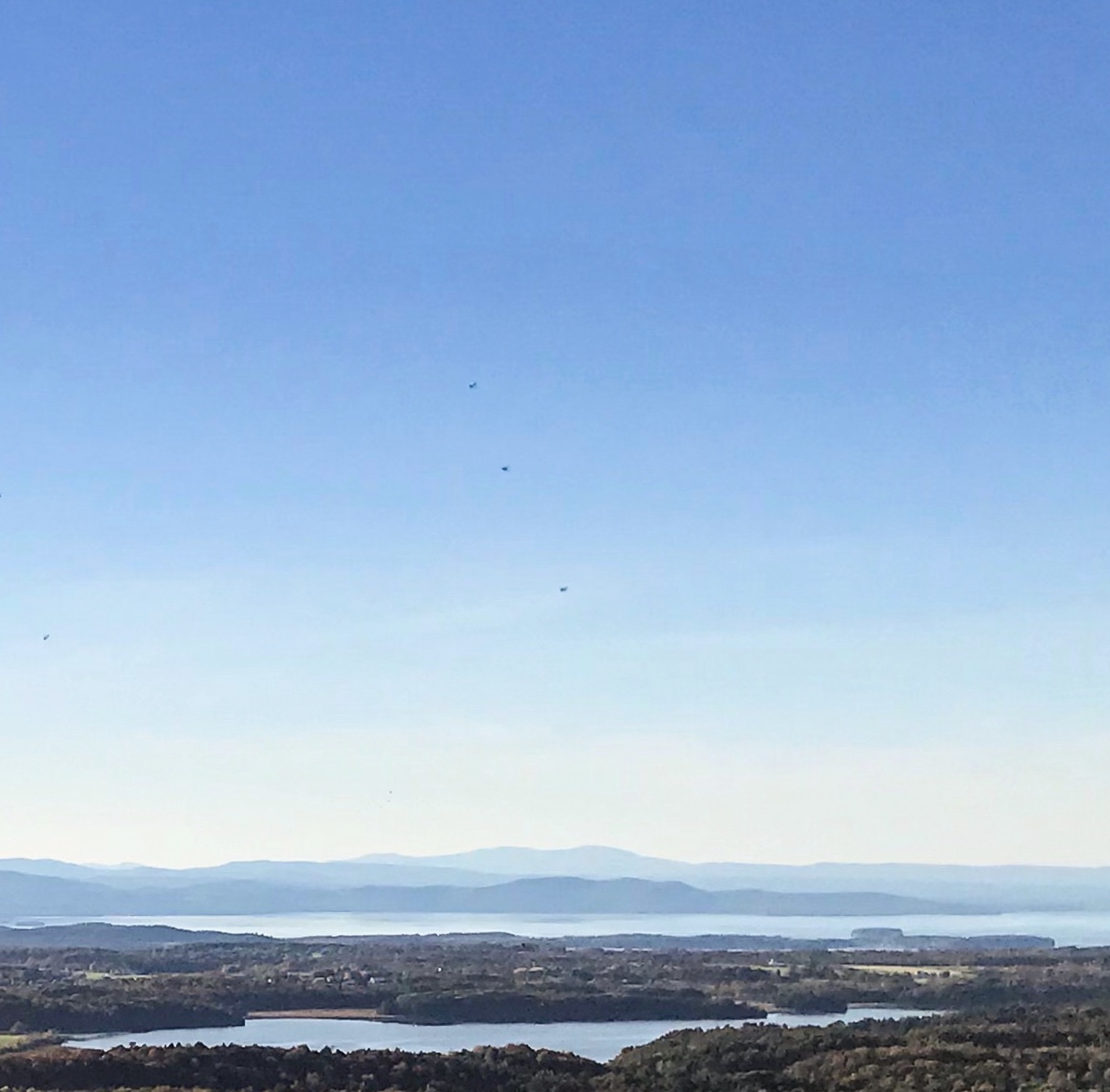
From Strawberry Hill the first, but a very slight, glimpse of Nagog Pond by standing up on the wall. That is enough to relate of a hill, methinks, that its elevation gives you the first sight of some distant lake.

The horizon is remarkably blue with mist this afternoon. Looking from this hill over Acton, successive valleys filled with blue mist appear, and divided by darker lines of wooded hills.

The shadows of the elms are deepened, as if the whole atmosphere were permeated by floods of ether.

Annursnack never looked so well as now seen from this hill.

The ether gives a velvet softness to the whole landscape. The hills float in it. A blue veil is drawn over the earth.

The elecampane (Inula Helenium) with its broad leaves wrinkled underneath and the remains of sunflower-like blossoms, in front of Nathan Brooks's, Acton, and near J. H. Wheeler's.

Prenanthes alba; this Gray calls Nabalus albus, white lettuce or rattlesnake-root. Also I seem (?) to have found Nabalus Fraseri, or lion's foot.

Every morning for a week there has been a fog which all disappeared by seven or eight o'clock.

A large field of sunflowers for hens now in full bloom at Temple's, surrounding the house, and now, at 6 o'clock P. M., facing the east.

The larches in the front yards, both Scotch and American, have turned red. Their fall has come.

H. D. Thoreau, Journal, September 6, 1851

The ripening grapes begin to fill the air with their fragrance. See August 29, 1853 ("Walking down the street in the evening, I detect my neighbor’s ripening grapes by the scent twenty rods off"); August 29, 1859 ("The very earliest ripe grapes begin to be scented in the cool nights "); September 8, 1854 (I bring home a half-bushel of grapes to scent my chamber with"; September 8, 1858 (“Gather half my grapes, which for some time have perfumed the house.”)

The vervain will hardly do for a clock
. Compare August 21, 1851 ("It is very pleasant to measure the progress of the season by this and similar clocks. So you get, not the absolute time, but the true time of the season.") See also A Book of the Seasons, by Henry Thoreau, the Blue Vervain

Saw the lambkill (Kalmia angustifolia) in blossom. See September 10, 1857 ("I see lambkill ready to bloom a second time. Saw it out on the 20th; how long?"); September 19, 1852 ("The Viola lanceolata has blossomed again, and the lambkill. "); September 28, 1852 ("This is the commencement, then, of the second spring. Violets, Potentilla Canadensis, lambkill, wild rose, yellow lily, etc., etc., begin again"); September 29, 1853 ("Lambkill blossoms again.") See also A Book of the Seasons, by Henry Thoreau, Lambkill (Kalmia augustifolia)

Nabalus albus, white lettuce or rattlesnake-root. Also I seem (?) to have found Nabalus Fraseri, or lion's foot. See August 27, 1858 ("The Nabalus albus has been out some ten days, but N. Fraseri at Walden road will not open, apparently, for some days yet."); September 13, 1857 ("Nabalus Fraseri, top of Cliffs, — a new plant, — yet in prime and not long out. The nabalus family generally, apparently now in prime")

From Strawberry Hill the first, but a very slight, glimpse of Nagog Pond . See July 6, 1851 ("The distant hills look unusually near in this atmosphere. Acton meeting-houses seen to stand on the side of some hills, Nagog or Nashoba, beyond, as never before."); August 15, 1854 ("Cross from top of Annursnack to top of Strawberry Hill. The locomotive whistle, far southwest, sounds like a bell. From Strawberry Hill we steer northeast . . . We are completely lost, and see not one familiar object. At length see steeples which we think Westford, but the monument proves it Acton."); January 30, 1860 ("I see, when I look over our landscape from any eminence as far as the horizon, certain rounded hills, amid the plains and ridges and cliffs, which have a marked family likeness, like eggs that belong to one nest though scattered. They suggest a relation geologically. Such are, for instance, Nashoba, Annursnack, Nawshawtuct, and Ponkawtasset, all which have Indian names, as if the Indian, too, had regarded them as peculiarly distinct. There is also Round Hill in Sudbury, and perhaps a hill in Acton")

Looking from this hill over Acton, successive valleys filled with blue mist appear, and divided by darker lines of wooded hills. See November 9, 1851 ("To-day the mountains seen from the pasture above are dark blue, so dark that they look like new mountains and make a new impression, and the intervening town of Acton is seen against them in a new relation, a new neighborhood.")

The shadows of the elms are deepened. See June 2, 1852 ("The elms now hold a good deal of shade and look rich and heavy with foliage. You see darkness in them.")

Friday, August 27, 2021

The cross-leaved polygala, has a very sweet but intermittent fragrance, as of checkerberry and mayflowers combined


August 27. 

I see the volumes of smoke-not quite the blaze — from burning brush, as I suppose, far in the western horizon.  I believe it is at this season of the year chiefly that you see this sight.  It is always a question with some whether it is not a fire in the woods, or some building. It is an interesting feature in the scenery at this season.

The farmer's simple enterprises.

The vervain which I examined by the railroad the other day has still a quarter of an inch to the top of its spikes.

Hawkweed groundsel (Senecio hieracifolius) (fireweed).

Rubus sempervirens, evergreen raspberry, the small low blackberry, is now in fruit.

The Medeola Virginica, cucumber-root, the whorl-leaved plant, is now in green fruit.

Polygala cruciata, cross-leaved polygala, in the meadow between Trillium Woods and railroad. This is rare and new to me. It has a very sweet, but as it were intermittent, fragrance, as of checkerberry and mayflowers combined. The handsome calyx-leaves
.


H. D. Thoreau, Journal, August 27, 1851

The vervain which I examined by the railroad the other day has still a quarter of an inch to the top of its spikes. See August 20, 1851 ("The flowers of the blue vervain have now nearly reached the summit of their spikes");  August 21, 1851 ("they are all within about half an inch of the top of the spikes");  August 23, 1851 ("The Verbena hastata at the pond has reached the top of its spike,. . . only one or two flowers are adhering."); August 22, 1859 ("T he circles of the blue vervain flowers, now risen near to the top, show how far advanced the season") See also A Book of the Seasons,  by Henry Thoreau,  the Blue Vervain

Rubus sempervirens, evergreen raspberry, the small low blackberry, is now in fruit.  See August 24, 1859 ("  The small sempervirens blackberry in prime in one place.");  September 7, 1858 ("J. Farmer calls those Rubus sempervirens berries, now abundant, “snake blackberries.”")  See also A Book of the Seasons,  by Henry Thoreau, Blackberries

Polygala cruciata, cross-leaved polygala, has  a very sweet but intermittent  fragrance, as of checkerberry and mayflowers combined.  See  July 10, 1854 ("Polygala cruciata, Hubbard's Close, two or three days "); July 13, 1852 ("The Polygala sanguinea and P. cruciata in Blister's meadow, both numerous and well out. The last has a fugacious (?) spicy scent, in which, methinks, I detect the scent of nutmegs. Afterward I find that it is the lower part of the stem and root which is most highly scented, like checkerberry, and not fugacious"); September 13, 1851("The cross-leaved polygala emits its fragrance as if at will. You are quite sure you smelled it and are ravished with its sweet fragrance, but now it has no smell. You must not hold it too near, but hold it on all sides and at all distances, and there will perchance be wafted to you sooner or later a very sweet and penetrating fragrance. What it is like you cannot surely tell, for you do not enjoy it long enough nor in volume enough to compare it. It is very likely that you will not discover any fragrance while you are rudely smelling at it; you can only remember that you once perceived it. Both this and the caducous polygala are now some what faded.") See also August 13, 1856 ("The root of the Polygala verticillata also has the checkerberry odor.") and   A Book of the Seasons, by Henry Thoreau,The Polygala

Monday, August 23, 2021

A Book of the Seasons, the Blue Vervain


I would make a chart of our life, know how its shores trend,
know why just this circle of creatures completes the world,
what kinds of birds come with what flowers.
Henry Thoreau, April 18, 1852

Methinks blue
attracts us in a flower.
The sight of it is more affecting
than I can describe or account for.

The progress of the
blue vervain measures the true
time of the season.
August 21, 1851


Blue vervain (Verbena hastata)

February 8.  Mrs. Monroe says that her mother respected my grandfather very much, because he was a religious man. She remembers his calling one day and inquiring where blue vervain grew, which he wanted, to make a syrup for his cough, and she, a girl, happening to know, ran and gathered some. February 8, 1858

July 17. Verbena hastata, blue vervain. July 17, 1852

July 18.  Blue vervain, apparently a day; one circle is open a little below the top.  July 18, 1854

July 21. That was probably the Verbena hastata, or common blue vervain, which I found the other day by Walden Pond. July 21, 1851

July 21. Verbena hastata, apparently several days.  July 21, 1856

July 23. Blue vervain out some days. July 23, 1853

August 6. Blue vervain is now very attractive to me, and then there is that interesting progressive history in its rising ring of blossoms. It has a story. August 6, 1852

August 20. The flowers of the blue vervain have now nearly reached the summit of their spikes. August 20, 1851

August 21. Bigelow, speaking of the spikes of the blue vervain (Verbena hastata), says, “The flowering commences at their base and is long in reaching their summit.” I perceive that only one circle of buds, about half a dozen, blossoms at a time, -- and there are about thirty circles in the space of three inches -- while the next circle of buds above at the same time shows the blue. Thus this triumphant blossoming circle travels upward, driving the remaining buds off into space. I think it was the 16th of July when I first noticed them (on another plant), and now they are all within about half an inch of the top of the spikes. Yet the blossoms have got no nearer the top on long spikes, which had many buds, than on short ones only an inch long. Perhaps the blossoming commenced enough earlier on the long ones to make up for the difference in length. It is very pleasant to measure the progress of the season by this and similar clocks. So you get, not the absolute time, but the true time of the season. August 21, 1851

August 22. The circles of the blue vervain flowers, now risen near to the top, show how far advanced the season is. August 22, 1859

August 23. The Verbena hastata at the pond has reached the top of its spike, a little in advance of what I noticed yesterday; only one or two flowers are adhering. August 23, 1851

September 14. Blue vervain still. September 14, 1852

October 12. The stems of the blue vervain, whose flowers and leaves are withered and brown, are nearly as handsome and clear a purple as those of the poke have been, from top to bottom. October 12, 1857

January 24. The blue vervain stands stiffly and abundant in one place, with much rather large brown seed in it. It is in good condition.  January 24, 1860

See also:


A Book of the Seasons, by Henry Thoreau
"A book, each page written in its own season,
out-of-doors, in its own locality.” 
~edited, assembled and rewritten by zphx © 2009-2025

https://tinyurl.com/hdt-vervain 


Sunday, August 23, 2020

A man in a boat in the sun, just disappearing in the distance round a bend.


August 23.

Saturday.

To Walden to bathe at 5.30 A. M.

Traces of the heavy rains in the night. The sand and gravel are beaten hard by them. Three or four showers in succession.

But the grass is not so wet as after an ordinary dew.

The Verbena hastata at the pond has reached the top of its spike, a little in advance of what I noticed yesterday; only one or two flowers are adhering.

At the commencement of my walk I saw no traces of fog, but after detected fogs over particular meadows and high up some brooks’valleys, and far in the Deep Cut the wood fog.

First muskmelon this morning.

I rarely pass the shanty in the woods, where human beings are lodged, literally, no better than pigs in a sty, — little children, a grown man and his wife, and an aged grandmother living this squalid life, squatting on the ground, — but I wonder if it can be indeed true that little Julia Riordan calls this place home, comes here to rest at night and for her daily food, — in whom ladies and gentlemen in the village take an interest.

Of what significance are charity and almshouses? That there they live unmolested! in one sense so many degrees below the almshouse! beneath charity!

It is admirable, — Nature against almshouses.

A certain the wealth of nature, not poverty, it suggests.

Not to identify health and contentment, aye, and independence, with the possession of this world’s goods!

It is not wise to waste compassion on them.

As I go through the Deep Cut, I hear one or two early humblebees, come out on the damp sandy bank, whose low hum sounds like distant horns from far in the horizon over the woods. It was long before I detected the bees that made it, so far away and musical it sounded, like the shepherds in some distant eastern vale greeting the king of day.

The farmers now carry — those who have got them — their early potatoes and onions to market, starting away early in the morning or at midnight. I see them returning in the afternoon with the empty barrels.

Perchance the copious rain of last night will trouble those who had not been so provident as to get their hay from the Great Meadows, where it is often lost.

P. M. – Walk to Annursnack and back over stone bridge.

I sometimes reproach myself because I do not find anything attractive in certain mere trivial employments of men, — that I skip men so commonly, and their affairs, — the professions and the trades, — do not elevate them at least in my thought and get some material for poetry out of them directly. I will not avoid, then, to go by where these men are repairing the stone bridge, — see if I cannot see poetry in that, if that will not yield me a reflection.

It is narrow to be confined to woods and fields and grand aspects of nature only. The greatest and wisest will still be related to men.

Why not see men standing in the sun and casting a shadow, even as trees? May not some light be reflected from them as from the stems of trees? I will try to enjoy them as animals, at least.

They are perhaps better animals than men.

Do not neglect to speak of men’s low life and affairs with sympathy, though you ever so speak as to suggest a contrast between them and the ideal and divine. You may be excused if you are always pathetic, but do not refuse to recognize.

Resolve to read no book, to take no walk, to undertake no enterprise, but such as you can endure to give an account of to yourself. Live thus deliberately for the most part.

When I stopped to gather some blueberries by the roadside this afternoon, I heard the shrilling of a cricket or a grasshopper close to me, quite clear, almost like a bell, a stridulous sound, a clear ring, incessant, not intermittent, like the song of the black fellow I caught the other day, and not suggesting the night, but belonging to day.

It was long before I could find him, though all the while within a foot or two. I did not know whether to search amid the grass and stones or amid the leaves. At last, by accident I saw him, he shrilling all the while under an alder leaf two feet from the ground, - a slender green fellow with long feelers and transparent wings.

When he shrilled, his wings, which opened on each other in the form of a heart perpendicularly to his body like the wings of fairies, vibrated swiftly on each other. The apparently wingless female, as I thought, was near.

We experience pleasure when an elevated field or even road in which we may be walking holds its level toward the horizon at a tangent to the earth, is not convex with the earth’s surface, but an absolute level.

On or under east side of Annursnack, Epilobium coloratum, colored willow-herb, near the spring.

Also Polygonum sagittatum, scratch-grass.

The Price Farm road, one of those everlasting roads which the sun delights to shine along in an August afternoon, playing truant; which seem to stretch themselves with terrene jest as the weary traveller journeys on; where there are three white sandy furrows (lira), two for the wheels and one between them for the horse, with endless green grass borders between and room on each side for huckleberries and birches; where the walls indulge in freaks, not always parallel to the ruts, and goldenrod yellows all the path; which some elms began to border and shade once, but left off in despair, it was so long; from no point on which can you be said to be at any definite distance from a town.

I associate the beauty of Quebec with the steel-like and flashing air.


Our little river reaches are not to be forgotten. I noticed that seen northward on the Assabet from the Causeway Bridge near the second stone bridge.

There was [a] man in a boat in the sun, just disappearing in the distance round a bend, lifting high his arms and dipping his paddle as if he were a vision bound to land of the blessed, — far off, as in picture.

When I see Concord to purpose, I see it as if it were not real but painted, and what wonder if I do not speak to thee? 

I saw a snake by the roadside and touched him with my foot to see if he were alive.

He had a toad in his jaws, which he was preparing to swallow with his jaws distended to three times his width, but he relinquished his prey in haste and fled; and I thought, as the toad jumped leisurely away with his slime-covered hind-quarters glistening in the sun, as if I, his deliverer, wished to interrupt his meditations, — without a shriek or fainting, — I thought what a healthy indifference he manifested. Is not this the broad earth still? he said.


H. D. Thoreau, Journal, August 23, 1851


The Verbena hastata at the pond has reached the top of its spike, a little in advance of what I noticed yesterday; only one or two flowers are adhering. See  August 6, 1852 ("Blue vervain is now very attractive to me, and then there is that interesting progressive history in its rising ring of blossoms. It has a story."); August 20, 1851 ("The flowers of the blue vervain have now nearly reached the summit of their spikes."); August 21, 1851 (" It is very pleasant to measure the progress of the season by this and similar clocks. So you get, not the absolute time, but the true time of the season."); August 22, 1859 The circles of the blue vervain flowers, now risen near to the top, show how far advanced the season is.") See also  A Book of the Seasons,  by Henry Thoreau,  the Blue Vervain

He had a toad in his jaws, which he was preparing to swallow with his jaws distended to three times his width, but he relinquished his prey in haste and fled. See May 19, 1856 ("saw a small striped snake in the act of swallowing a Rana palustris, within three feet of the water. The snake, being frightened, released his hold, and the frog hopped off to the water. "); April 16, 1861 ("Horace Mann says that he killed a bullfrog in Walden Pond which had swallowed and contained a common striped snake")

 Account to yourself –
always resolve to live 
deliberately.

HDT ~ August 23, 1851

Thursday, July 23, 2020

The rhexia is seen afar on the islets.


July 23.

P. M. – To P. Hutchinson's.

I cannot find a single crotalaria pod there this year.

Stone-crop is abundant and has now for some time been out at R. Brown's watering-place; also the water plantain, which is abundant there.

About the water further north the elodea is very common, and there, too, 
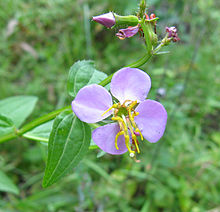
the rhexia is seen afar on the islets, — its brilliant red like a rose. It is fitly called meadow-beauty. Is it not the handsomest and most striking and brilliant flower since roses and lilies began? 

rhexia virginica

Blue vervain out some days. 

blue vervain

Bathing yesterday in the Assabet, I saw that many breams, apparently an old one with her young of various sizes, followed my steps and found their food in the water which I had muddied. The old one pulled lustily at a Potamogeton hybridus, drawing it off one side horizontally with her mouth full, and then swallowed what she tore off.

The young pouts were two and a half inches long in Flint's Pond the 17th.

H. D. Thoreau, Journal, July 23, 1853


I cannot find a single crotalaria pod there this year. See October 3, 1858 ("It is interesting to consider how that crotalaria spreads itself, sure to find out the suitable soil. One year I find it on the Great Fields and think it rare; the next I find it in a new and unexpected place. It flits about like a flock of sparrows, from field to field.")

Water plantain, abundant. See July 19, 1853 ("The alisma will open to-morrow or next day")

About the water further north the elodea is very common.  See July 22, 1853 ("The elodea out."): see also June 13, 1858 ("One of the prevailing front-rank plants [in Ledump Swmp], standing in the sphagnum and water, is the elodea. "); July 31, 1856 ("Elodea two and a half feet high, how long? The flowers at 3 p. m. nearly shut, cloudy as it is. Yet the next day, later, I saw some open, I think"); August 11, 1858 ("Saw the elodea (not long) . . . at Beck Stow’s")


The rhexia is seen afar on the islets.
See July 18, 1852 ("The petals of the rhexia have a beautiful clear purple with a violet tinge."); August 1, 1856 (" They make a splendid show, these brilliant rose-colored patches . .  Yet few ever see them in this perfection, unless the haymaker who levels them, or the birds that fly over the meadow. Far in the broad wet meadows, on the hummocks and ridges, these bright beds of rhexia turn their faces to the heavens, seen only by the bitterns and other meadow birds that fly over. We, dwelling and walking on the dry upland, do not suspect their existence..") See also   A Book of the Seasons, by Henry Thoreau, Rhexia Virginica (meadow-beauty)

Blue vervain. See August 6, 1852 ("Blue vervain is now very attractive to me, and then there is that interesting progressive history in its rising ring of blossoms. It has a story.")

An old bream with her young of various sizes, followed my steps and found their food in the water. See November 30, 1858 ("The bream, appreciated, floats in the pond as the centre of the system, another image of God. Its life no man can explain more than he can his own.")

The young pouts were two and a half inches long. 
See July 15, 1856 ("wading into the shallow entrance of the meadow, I saw a school of a thousand little pouts about three quarters of an inch long")

July 23. See A Book of the Seasons, by Henry Thoreau, July 23

A Book of the Seasons, by Henry Thoreau
"A book, each page written in its own season,
out-of-doors, in its own locality.” 
~edited, assembled and rewritten by zphx © 2009-2021

Saturday, January 25, 2020

"And the voice of the turtle is heard in our land."


January 24


bobcat, January 24,2020

2 p. m. — To Tarbell, river, via railroad. 

Thermometer 46. Sky thinly overcast, growing thicker at last as if it would rain. Wind northwest. 

See a large flock of lesser redpolls, eating the seeds of the birch (and perhaps alder) in Dennis Swamp by railroad. They are distinct enough from the goldfinch, their note more shelly and general as they fly, and they are whiter, without the black wings, beside that some have the crimson head or head and breast. They alight on the birches, then swarm on the snow beneath, busily picking up the seed in the copse. 

The Assabet is open above Derby's Bridge as far as I go or see, probably to the factory, and I know not how far below Derby's. It opens up here sooner than below the Assabet Bath to its mouth. 

The blue vervain stands stiffly and abundant in one place, with much rather large brown seed in it. It is in good condition. 

Scare a shrike from an apple tree. He flies low over the meadow, somewhat like a woodpecker, and alights near the top twig of another apple tree. 

See a hawk sail over meadow and woods; not a hen-hawk; possibly a marsh hawk. 

A grasshopper on the snow. 

The droppings of a skunk left on a rock, perhaps at the beginning of winter, were full of grasshoppers' legs. 

As I stand at the south end of J. P. B.'s moraine, I watch six tree sparrows, which come from the wood and alight and feed on the ground, which is there bare. They are only two or three rods from me, and are incessantly picking and eating an abundance of the fine grass (short-cropped pasture grass) on that knoll, as a hen or goose does. I see the stubble an inch or two long in their bills, and how they stuff it down. Perhaps they select chiefly the green parts. So they vary their fare and there is no danger of their starving. 

These six hopped round for five minutes over a space a rod square before I put them to flight, and then I noticed, in a space only some four feet square in that rod, at least eighteen droppings (white at one end, the rest more slate-colored). So wonderfully active are they in their movements, both external and internal. They do not suffer for want of a good digestion, surely. No doubt they eat some earth or gravel too. So do partridges eat a great deal. 

These birds, though they have bright brown and buff backs, hop about amid the little inequalities of the pasture almost unnoticed, such is their color and so humble are they. 

Solomon thus describes the return of Spring (Song of Solomon, ii, 10-12) : — 


"Rise up, my love, my fair one, and come away.
"For, lo, the winter is past, the rain is over and gone;
"The flowers appear on the earth; the time of the singing of birds is come, and the voice of the turtle is heard in our land."
JANUARY 24, 2020


H. D. Thoreau, Journal, January 24, 1860

See a large flock of lesser redpolls, eating the seeds of the birch (and perhaps alder) in Dennis Swamp by railroad. See January 20, 1857 ("Heard, in the Dennis swamp by the railroad this afternoon, the peculiar goldfinch-like mew — also like some canaries — of, I think, the lesser redpoll (?). Saw several. Heard the same a week or more ago. "); January 8, 1860 ("Hear the goldfinch notes (they may be linarias), and see a few on the top of a small black birch by the pond-shore, of course eating the seed. Thus they distinguish its fruit from afar. When I heard their note, I looked to find them on a birch, and lo, it was a black birch! [Were they not linarias? Vide Jan. 24]")

A grasshopper on the snow. See January 24, 1859 ("I also see a great many of those little brown grasshoppers and one perfectly green one, some of them frozen in")

The droppings of a skunk left on a rock, perhaps at the beginning of winter, were full of grasshoppers' legs. See February 24, 1854 "The other day I thought that I smelled a fox very strongly, and went a little further and found that it was a skunk.”);February 24, 1857 ("I have seen the probings of skunks for a week or more. “); February 26, 1860 ("They appear to come out commonly in the warmer weather in the latter part of February.”)

Six tree sparrows come from the wood and alight and feed on the ground. See  January 16, 1860 ("I see a flock of tree sparrows busily picking something from the surface of the snow amid some bushes. . . . the tree sparrow comes from the north in the winter . . . The bird understands how to get its dinner perfectly.


A Book of the Seasons, by Henry Thoreau,  "And the voice of the turtle is heard in our land."
A Book of the Seasons,  by Henry Thoreau 
"A book, each page written in its own season,
out-of-doors, in its own locality.”
~edited, assembled and rewritten by zphx © 2009-2025

Thursday, August 22, 2019

It is very dry now.

August 22. 

Monday. 

The circles of the blue vervain flowers, now risen near to the top, show how far advanced the season is. 


Blue vervain (Verbena hastata)

The savory-leaved aster (Diplopappus linariifolius) out; how long? 


WOOD ASTER AUGUST 20, 2017

Saw the Aster corymbosus on the 19th. 

Have seen where squirrels have eaten, i.e. stripped, many white pine cones, for a week past, though quite green. 

That young pitch pine whose buds the crossbills (?) plucked has put out shoots close by them, but they are rather feeble and late. 

Riding to the factory, I see the leaves of corn, planted thick for fodder, so rolled by the drought that I mistook one row in grass for some kind of rush or else reed, small and terete. 

At the factory, where they were at work on the dam, they showed large and peculiar insects which they were digging up amid the gravel and water of the dam, nearly two inches long and half an inch wide, with six legs, two large shield-like plates on the forward part of the body, — under which they apparently worked their way through wet sand, — and two large claws, some what lobster-like, forward. The abdomen long, of many rings, and fringed with a kind of bristles on each side. 

The other day, as I was going by Messer's, I was struck with the pure whiteness of a tall and slender buttonwood before his house. The southwest side of it for some fifty or more feet upward, as far as the outer bark had recently scaled off, was as white, as distinct and bright a white, as if it had been painted, and when I put my finger on it, a white matter, like paint not quite dry, came off copiously, so that I even suspected it was paint. When I scaled off a piece of bark, the freshly exposed surface was brown. This white matter had a strong fungus-like scent, and this color is apparently acquired after a little exposure to the air. Nearly half the tree was thus uninterruptedly white as if it had been rounded and planed and then painted. No birch presents so uniformly white a surface. 

It is very dry now, but I perceive that the great star-shaped leaves of the castor bean plants in Mr. Rice's garden at twilight are quite cold to the touch, and quite shining and wet with moisture wherever I touch them. Many leaves of other plants, as cucumbers, feel quite dry.

H. D. Thoreau, Journal, August 22, 1859

The circles of the blue vervain flowers, now risen near to the top, show how far advanced the season is. See August 6, 1852 ("Blue vervain is now very attractive to me, and then there is that interesting progressive history in its rising ring of blossoms. It has a story."); August 20, 1851 ("The flowers of the blue vervain have now nearly reached the summit of their spikes."); August 21, 1851 ("It is very pleasant to measure the progress of the season by this and similar clocks. So you get, not the absolute time, but the true time of the season.");August 23, 1851 ("The Verbena hastata at the pond has reached the top of its spike, a little in advance of what I noticed yesterday; only one or two flowers are adhering.")

The savory-leaved aster (Diplopappus linariifolius) out; how long?
 July 29, 1852 ("That common rigid narrow-leaved faint-purplish aster in dry woods by shrub oak path, Aster linariifolius of Bigelow, but it is not savory leaved. I do not find it in Gray."); August 3, 1858 ("Savory-leaved aster."); September 18, 1856 ("Diplopappus linariifolius in prime.") see also A Book of the Seasons, by Henry Thoreau, Savory-leaved aster  

;
Saw the Aster corymbosus on the 19th. See August 9, 1856 ("What I have called Aster corymbosus out a day, above Hemlocks.. It has eight to twelve white rays, smaller than those of the macrophyllus, and a dull-red stem commonly."); August 11, 1852 ("Aster corymbosus, path beyond Corner Spring and in Miles Swamp.");  September 1, 1856 ("A. corymbosus, in prime, or maybe past."); September 6, 1856 ("For the first time distinguish the Aster cordifolius, a prevailing one in B[rattleboro] and but just beginning to flower"); September 9, 1856 [at Brattleboro] ("High up the mountain the Aster macrophyllus as well as corymbosus.");September 22, 1858 [from Salem to Cape Ann on foot] ("saw A. corymbosus, which is a handsome white wood aster"); September 24, 1856 ("A. corymbosus, still fresh though probably past prime."); October 8, 1856 ("A. corymbosus, looks fresh! . . . of asters, only corymbosus, undulatus,Tradescanti, and longifolius . . .are common. ")

Aster corymbosus . now known as Eurybia divaricata , commonly known as the white wood aster, can be found in dry open woods as well as along wood-edges and clearings. Its flower heads have yellow centers and white rays that are arranged in flat-topped corymbiform arrays (growing in such a fashion that the outermost are borne on longer pedicels than the inner, bringing all flowers up to a common level. to flattish top superficially resembling an umbel,). It flowers in the late summer through fall. Other distinguishing characteristics include its serpentine stems and sharply serrated narrow heart-shaped leaves. ~Wikipedia


Have seen where squirrels have eaten, i.e. stripped, many white pine cones, for a week past, though quite green. See September 9, 1857 ("How fast I could collect cones, if I could only contract with a family of squirrels to cut them off for me!"); September 16, 1857 ("I see green and closed cones beneath, which the squirrels have thrown down. On the trees many are already open. Say within a week have begun. In one small wood, all the white pine cones are on the ground, generally unopened, evidently freshly thrown down by the squirrels, and then the greater part have already been stripped.");September 24, 1857 ("The ground was completely strewn with white pine cones, apparently thrown down by the squirrels, still generally green and closed, but many stripped of scales, about the base of almost every pine, sometimes all of them. Now and for a week a good time to collect them.")

That young pitch pine whose buds the crossbills (?) plucked has put out shoots. See March 8, 1859 ("I see, under the pitch pines on the southwest slope of the hill, the reddish bud-scales scattered on the snow . . . and, examining, I find that in a great many cases the buds have been eaten by some creature and the scales scattered about. . .I am inclined to think that these were eaten by the red squirrel; or was it the crossbill? for this is said to visit us in the winter. Have I ever seen a squirrel eat the pine buds?")

Thursday, October 12, 2017

Distant elms seen from the hilltops.

October 12. 
October 12, 2017
October 12, 2017

P. M. – To Annursnack. 

The eighth fine day, warmer than the last two. 

I find one or two house-leek blossoms even yet fresh, and all the rest crisp. 

The fringed gentian by the brook opposite is in its prime, and also along the north edge of the Painted-Cup Meadows. 

The stems of the blue vervain, whose flowers and leaves are withered and brown, are nearly as handsome and clear a purple as those of the poke have been, from top to bottom. 

Looking from the Hill. 


October 12, 2017
The autumnal tints generally are much duller now than three or four days ago, or before the last two frosts. I am not sure but the yellow now prevails over the red in the landscape, and even over the green. The general color of the landscape from this hill is now russet, i.e. red, yellow, etc., mingled. The maple fires are generally about burnt out. Yet I can see very plainly the colors of the sproutland, chiefly oak, on Fair Haven Hill, about four miles distant, and also yellows on Mt. Misery, five miles off, also on Pine Hill, and even on Mt. Tabor, indistinctly. 

Eastward, I distinguish red or yellow in the woods as far as the horizon, and it is most distant on that side, — six miles, at least. - The huckleberries on Nagog Hill are very red. The smaller and tenderer weeds were in their prime, me thinks, some weeks ago. They have felt the frosts earlier than the maples and other trees, and are now withered generally. 

I see a very distant mountain house in a direction a little to the west of Carlisle, and two elms in the horizon on the right of it. Measuring carefully on the map of the county, I think it must be the Baptist Church in North Tewksbury, within a small fraction of fourteen miles from me. I think that this is the greatest distance at which I have seen an elm without a glass. There is another elm in the horizon nearly north, but not so far. It looks very much larger than it is. Perhaps it looms a little. 

The elm, I think, can be distinguished further than any other tree, and, however faintly seen in the distant horizon, its little dark dome, which the thickness of my nail will conceal, just rising above the line of the horizon, apparently not so big as a prominence on an orange, it suggests ever the same quiet rural and domestic life passing beneath it. 

It is the vignette to an unseen idyllic poem. Though that little prominence appears so dark there, I know that it is now a rich brownish-yellow canopy of rustling leaves, whose harvest-time is already come, sending down its showers from time to time. 

Homestead telegraphs to homestead through these distant elms seen from the hilltops. I fancy I hear the house-dog’s bark and lowing of the cows asking admittance to their yard beneath it. The tea-table is spread; the master and mistress and the hired men now have just sat down in their shirt-sleeves. 

Some are so lifted up in the horizon that they seem like portions of the earth detached and floating off by themselves into space. Their dark masses against the sky can be seen as far, at least, as a white spire, though it may be taller. Some of these trees, seen through a glass, are not so large.

. . . 

This was what those scamps did in California. The trees were so grand and venerable that they could not afford to let them grow a hair's breadth bigger, or live a moment longer to reproach themselves. They were so big that they resolved they should never be bigger. They were so venerable that they cut them right down. It was not for the sake of the wood; it was only because they were very grand and venerable.

H. D. Thoreau, Journal, October 12, 1857

The fringed gentian by the brook opposite is in its prime, and also along the north edge of the Painted-Cup Meadows. See October 2, 1857 ("The fringed gentian at Hubbard's Close has been out some time, and most of it already withered. ") October 19, 1852 ("It is too remarkable a flower not to be sought out and admired each year, however rare. It is one of the errands of the walker, as well as of the bees, for it yields him a more celestial nectar still. It is a very singular and agreeable surprise to come upon this conspicuous and handsome and withal blue flower at this season, when flowers have passed out of our minds and memories; the latest of all to begin to bloom ..."). See also A Book of the Seasons by Henry Thoreau, The Fringed Gentian

Friday, September 15, 2017

This morning the first frost.

September 14. 
September 14, 2017
This morning the first frost. Yet the 10th was one of the warmest days in the year. 

Methinks it is the Amaranthus hypochondriacus, prince's-feather, with "bright red-purple flowers " and sanguine stem, on Emerson's muck-heap in the Turnpike, and the Polygonum orientale, prince's-feather, in E. Hosmer's grounds.

Blue vervain still. 

The grass is very green after the rains, like a second spring, and, in my ride yesterday, the under sides of the willows, etc., in the wind, the leaves of the fall growth perhaps, reminded me of June. 

Is not the colder and frosty weather thus introduced by a rain? i. e. it clears up cold.

H. D. Thoreau, Journal September 14, 1852

Amaranthus hypochondriacus, prince's-feather, with "bright red-purple flowers " See July 29, 1854 ("Amaranthus hypochondriacus, apparently some days, with its interesting spotted leaf, lake beneath, and purple spike; amid the potatoes."); August 16, 1856 ("Amaranthus hypochondriacus, how long?")

The Polygonum orientale, prince's-feather, in E. Hosmer's grounds.See August 16. 1853 ("The Polygonum orientale, probably some days, by Turnpike Bridge, a very rich rose-color large flowers, distinguished by its salver-shaped upper sheaths")

The grass is very green after the rains. . . See September 10, 1854 (". . .the first fall rains after the long drought.Already the grass both in meadows and on hills looks greener, and the whole landscape, this overcast rainy day, darker and more verdurous.")

A second spring... June. See October 23, 1853 ("Many phenomena re mind me that now is to some extent a second spring, — not only the new-springing and blossoming of flowers, but the peeping of the hylodes for some time, and the faint warbling of their spring notes by many birds. . . .") and note to October 10, 1856 ("Indian summer itself is a similar renewal of the year, with the faint warbling of birds and second blossoming of flowers.")

Monday, August 22, 2011

The progress of the blue vervain. The history of hawkweed.


Bigelow, speaking of the spikes of the blue vervain (Verbena hastata), says, “The flowering commences at their base and is long in reaching their summit.” 

I perceive that only one circle of buds, about half a dozen, blossoms at a time, -- and there are about thirty circles in the space of three inches -- while the next circle of buds above at the same time shows the blue. Thus this triumphant blossoming circle travels upward, driving the remaining buds off into space. I think it was the 16th of July when I first noticed them (on another plant), and now they are all within about half an inch of the top of the spikes. 

Yet the blossoms have got no nearer the top on long spikes, which had many buds, than on short ones only an inch long. Perhaps the blossoming commenced enough earlier on the long ones to make up for the difference in length. 


Blue vervain (Verbena hastata)

It is very pleasant to measure the progress of the season by this and similar clocks. So you get, not the absolute time, but the true time of the season.


The prevailing conspicuous flowers at present are:
  •  The early goldenrods,
  •  tansy,
  •  the life-everlastings,
  •  flea bane (though not for its flower),
  •  yarrow (rather dry),
  •  hardhack and meadow-sweet (both getting dry, also mayweed),
  •  Eupatorium purpureum,
  •  scabish,
  •  clethra (really a fine, sweet-scented, and this year particularly fair and fresh, flower, some unexpanded buds at top tinged with red),
  •  Rhexia Virginica,
  •  thoroughwort,
  •  Polygala sanguinea,
  •  prunella, and dog’s-bane (getting stale), etc., etc.
Touch-me-not (less observed), Canada snap dragon by roadside (not conspicuous).

The purple gerardia now, horsemint, or Mentha borealis, Veronica scutellata (marsh speedwell), Ranunculus acris (tall crow foot) still.

Mowing to some extent improves the landscape to the eye of the walker. The aftermath, so fresh and green, begins now to recall the spring to my mind. In some fields fresh clover heads appear.


There is some advantage, intellectually and spiritually, in taking wide views with the bodily eye and not pursuing an occupation which holds the body prone. There is some advantage, perhaps, in attending to the general features of the landscape over studying the particular plants and animals which inhabit it. 

A man may walk abroad and no more see the sky than if he walked under a shed. The poet is more in the air than the naturalist, though they may walk side by side. Granted that you are out-of-doors; but what if the outer door is open, if the inner door is shut! 

You must walk sometimes perfectly free, not prying nor inquisitive, not bent upon seeing things. Throw away a whole day for a single expansion, a single inspiration of air.

It is remarkable that animals are often obviously, manifestly, related to the plants which they feed upon or live among, - as caterpillars, butterflies, tree-toads, partridges, chewinks, - and this afternoon I noticed a yellow spider on a goldenrod; as if every condition might have its expression in some form of animated being.

Spear-leaved goldenrod in path to northeast of Flint's Pond.


Hieracium paniculatum, a very delicate and slender hawkweed. I have now found all the hawkweeds. Singular these genera of plants, plants manifestly related yet distinct. 

They suggest a history to nature, a natural history in a new sense.

H. D. Thoreau, Journal, August 21, 1851

Bigelow. See December 4, 1856 ("My first botany, as I remember, was Bigelow's "Plants of Boston and Vicinity," which I began to use about twenty years ago".)

It is very pleasant to measure the progress of the season by this and similar clocks. See. August 6, 1852 (" Blue vervain is now very attractive to me, and then there is that interesting progressive history in its rising ring of blossoms. It has a story");  August 20, 1851 ("The flowers of the blue vervain have now nearly reached the summit of their spikes."); August 22, 1859 ("The circles of the blue vervain flowers, now risen near to the top, show how far advanced the season is") see also A Book of the Seasons by Henry Thoreau,   the Blue Vervain

The prevailing conspicuous flowers at present.  See August 21, 1852 ("There are as few or fewer birds heard than flowers seen. The sound of the crickets gradually prevails more and more. I hear the year falling asleep.")

There is some advantage, perhaps, in attending to the general features of the landscape over studying the particular plants and animals which inhabit it.
See March 5, 1852 ("The habit of looking at things microscopically, as the lichens on the trees and rocks, really prevents my seeing aught else in a walk")

A man may walk abroad and no more see the sky than if he walked under a shed. See September 13, 1859 ("There are various degrees of living out-of-doors. You must be outdoors long, early and late, and travel far and earnestly, in order to perceive the phenomena of the day. Even then much will escape you. Few live so far outdoors as to hear the first geese go over.")

You must walk sometimes perfectly free, not prying nor inquisitive, not bent upon seeing things. See August 5, 1851 ("The question is not what you look at, but what you see.”); November 18 1851 ("The chopper who works in the woods all day is more open in some respects to the impressions they are fitted to make than the naturalist who goes to see them. He really forgets himself, forgets to observe, and at night he dreams of the swamp, its phenomena and events. Not so the naturalist; enough of his unconscious life does not pass there. A man can hardly be said to be there if he knows that he is there, or to go there if he knows where he is going. The man who is bent upon his work is frequently in the best attitude to observe what is irrelevant to his work."); March 23, 1853 ("Man cannot afford to be a naturalist, to look at Nature directly, but only with the side of his eye"); June 14, 1853 (" that favorable frame of mind described by De Quincey, open to great impressions, and you see those rare sights with the unconscious side of the eye, which you could not see by a direct gaze before.”); September 13, 1852 ("I must walk more with free senses. I must let my senses wander as my thoughts, my eyes see without looking. Carlyle said that how to observe was to look, but I say that it is rather to see, and the more you look the less you will observe. Be not preoccupied with looking. Go not to the object; let it come to you. What I need is not to look at all, but a true sauntering of the eye.")

It is remarkable that animals are often obviously, manifestly, related to the plants which they feed upon or live among.
See August 22, 1852 ("Perhaps fruits are colored like the trillium berry and the scarlet thorn to attract birds to them.")

The aftermath, so fresh and green, begins now to recall the spring to my mind. See  July 24, 1852 ("There is a short, fresh green on the shorn fields, the aftermath. When the first crop of grass is off, and the aftermath springs, the year has passed its culmination."); July 24, 1860 ("Many a field where the grass has been cut shows now a fresh and very lit-up light green as you look toward the sun."); July 28, 1852 ("There is a yellowish light now from a low, tufted, yellowish, broad-leaved grass, in fields that have been mown."); August 4, 1853 ("The low fields which have been mown now look very green again in consequence of the rain, as if it were a second spring.) August 7, 1852 ("At this season we have gentle rain-storms, making the aftermath green . . . as if it were a second spring ."); August 10, 1854 ("As I go along the railroad, I observe the darker green of early-mown fields. "); August 17, 1858 ("The aftermath on early mown fields is a very beautiful green. ");  August 20, 1858  ("
In some meadows, as I look southwesterly, the aftermath looks a bright yellowish-green in patches.")

August 21,  See A Book of the Seasons, by Henry Thoreau, August 21

The progress of the
blue vervain measures the true
time of the season.

A Book of the Seasons,  by Henry Thoreau.
"A book, each page written in its own season,
out-of-doors, in its own locality."
 ~edited, assembled and rewritten by zphx ©  2009-2025

Popular Posts Last 30 Days.

The week ahead in Henry’s journal

The week ahead in Henry’s journal
A journal, a book that shall contain a record of all your joy.
"A stone fruit. Each one yields me a thought." ~ H. D. Thoreau, March 28, 1859


I sit on this rock
wrestling with the melody
that possesses me.