Showing posts with label stone-heaps. Show all posts

Tuesday, March 26, 2024

Geese go over in the spring about 10 o'clock in the morning,

March 26.

There is a large specimen of what I take to be the common alder by the poplar at Egg Rock, five inches in diameter. It may be considered as beginning to bloom to-day.

Some white maples appear still as backward as the red.

Saw about 10 A. M. a gaggle of geese, forty-three in number, in a very perfect harrow flying northeasterly. One side the harrow was a little longer than the other. They appeared to be four or five feet apart.

At first I heard faintly, as I stood by Minott's gate, borne to me from the southwest through the confused sounds of the village, the indistinct honking of geese.

I was somewhat surprised to find that Mr. Loring at his house should have heard and seen the same flock. I should think that the same flock was commonly seen and heard from the distance of a mile east and west.

It is remarkable that we commonly see geese go over in the spring about 10 o'clock in the morning, as if they were accustomed to stop for the night at some place southward whence they reached us at that time.

Goodwin saw six geese in Walden about the same time.

The scales of the alder run to leaves sometimes.


P. M. Up Assabet to stone-heaps, in boat.

A warm, moist, April-like afternoon, with wet-looking sky, and misty.  For the first time I take off my coat.

Everywhere are hovering over the river and floating, wrecked and struggling, on its surface, a miller-like insect, without mealy wings, very long and narrow, six- legged with two long feelers and, I believe, two long slender grayish wings, from my harbor to the heaps, or a couple of miles at least, food for fishes. This was the degree and kind of warmth to bring them forth.

The tortoises, undoubtedly painted, drop now in several instances from the limbs and floating rails on which they had come out to sun.

I notice by the Island a yellow scum on the water close to the shore, which must be the pollen of the alders just above. This, too, is perhaps food for fishes.

Up the Assabet, scared from his perch a stout hawk, -- the red-tailed undoubtedly, for I saw very plainly the cow-red when he spread his wings from off his tail (and rump?).

I rowed the boat three times within gunshot before he flew, twice within four rods, while he sat on an oak over the water,-- I think because I had two ladies with me, which was as good as bushing the boat. Each time, or twice at least, he made a motion to fly before he started.

The ends of his primaries looked very ragged against the sky.

This is the hen-hawk of the farmer, the same, probably, which I have scared off from the Cliff so often. It was an interesting eagle-like object, as he sat upright on his perch with his back to us, now and then looking over his shoulder, the broad-backed, flat-headed, curve-beaked bird.

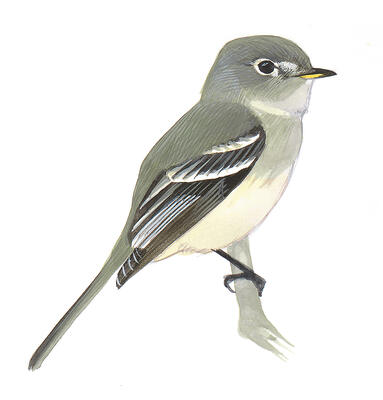
Heard a pewee. This, it seems to me, is the first true pewee day, though they have been here some time.

What is that cress-like weed in and on the edge of the river opposite Prescott Barrett's? A fresher and more luxuriant growth of green leaf than I have seen yet; as if it had grown in winter.

I do not perceive any fresh additions to the stone-heaps, though perhaps I did not examine carefully enough.

Went forth just after sunset.

A storm gathering, an April-like storm. I hear now in the dusk only the song sparrow along the fences and a few hylas at a distance. And now the rattling drops compel me to return.

H. D. Thoreau, Journal, March 26, 1853

There is a large specimen of what I take to be the common alder by the poplar at Egg Rock. See December 30, 1855 ("For a few days I have noticed the snow sprinkled with alder and birch scales. I go now through the birch meadow southwest of the Rock. The high wind is scattering them over the snow there. ")

Saw about 10 A. M. a gaggle of geese, forty-three in number, in a very perfect harrow flying northeasterly. See March 24, 1859 (" C. sees geese go over again this afternoon."); March 25, 1853 ("A Lincoln man heard a flock of geese, he thinks it was day before yesterday."); March 27, 1857 ("Farmer says that he heard geese go over two or three nights ago."); March 27 and 28, 1860 (" Louis Minor tells me he saw some geese about the 23d."); March 28, 1859 ("I suspect it will be found that there is really some advantage in large birds of passage flying in the wedge form and cleaving their way through the air, — that they really do overcome its resistance best in this way, — and perchance the direction and strength of the wind determine the comparative length of the two sides . . .Undoubtedly the geese fly more numerously over rivers which, like ours, flow northeasterly, — are more at home with the water under them.") See also A Book of the Seasons, by Henry Thoreau, Signs of Spring, Geese Overhead

Everywhere are hovering over the river and floating, wrecked and struggling, on its surface, a miller-like insect . . the degree and kind of warmth to bring them forth. See March 7, 1859 ("Their appearance is a regular early spring, or late winter, phenomenon"); April 25, 1854 ("Many shad-flies in the air and alighting on my clothes. The summer approaches by almost insensibly increasing lieferungs of heat,  . . Each creature awaits with confidence its proper degree of heat.") See also A Book of the Seasons, by Henry Thoreau, Insect Hatches in Spring (millers, perla, shad-flies or ephemera)

Up the Assabet, scared from his perch a stout hawk, -- the red-tailed undoubtedly See March 6, 1858 ("I see the first hen-hawk, or hawk of any kind, methinks, since the beginning of winter. Its scream, even, is inspiring as the voice of a spring bird."); . March 2, 1855 ("Hear two hawks scream. There is something truly March-like in it, like a prolonged blast or whistling of the wind through a crevice in the sky. which, like a cracked blue saucer, overlaps the woods. Such are the first rude notes which prelude the summer’s quire, learned of the whistling March wind") See also A Book of the Seasons, by Henry Thoreau, Signs of the Spring: the Hawks of March

The first true pewee day, though they have been here some time. See March 16, 1854.  ("The first phoebe near the water is heard.");  April 2, 1852 ("For a long distance, as we paddle up the river, we hear the two-stanza'd lay of the pewee on the shore, - pee-wet, pee-wee, etc. Those are the two obvious facts to eye and ear, the river and the pewee.") See also A Book of the Seasons,  by Henry Thoreau, the Eastern Phoebe

I do not perceive any fresh additions to the stone-heaps
, See April 19, 1854 ("Yesterday, as I was returning down the Assabet, . . . I was surprised to find the river so full of sawdust from the pail-factory and Barrett's mill that I could not easily distinguish if the stone-heaps had been repaired"); May 3, 1855 ("Sitting on the bank near the stone-heaps, I see large suckers rise to catch insects,—sometimes leap."): June 11, 1858 (""Examine the stone-heaps. One is now a foot above water and quite sharp. They contain, apparently freshly piled up, from a wheelbarrow to a cartload of stones; but I can find no ova in them. "); July 31, 1859 ("A man fishing at the Ox-Bow said without hesitation that the stone-heaps were made by the sucker,")


Monday, June 11, 2018

A very earnest and pressing business.

June 11

P. M. — To Assabet Bath. 

The fertile Salix alba is conspicuous now at a distance, in fruit, being yellowish and drooping. 

Hear the parti-colored warbler. 


Sylvia Americana
[Sylvia Americana [or "parti-colored warbler,"]:
 J J. Audubon's blue yellow-backed warbler,
 now Northern Parula warbler (Setophaga americana )]

Examine the stone-heaps. One is now a foot above water and quite sharp. They contain, apparently freshly piled up, from a wheelbarrow to a cartload of stones; but I can find no ova in them. 

I see a musquash dive head foremost (as he is swimming) in the usual way, being scared by me, but without making any noise.

Saw a painted turtle on the gravelly bank just south of the bath-place, west side, and suspected that she had just laid (it was mid-afternoon). So, examining the ground, I found the surface covered with loose lichens, etc., about one foot behind her, and digging, found five eggs just laid one and a half or two inches deep, under one side. It is remarkable how firmly they are packed in the soil, rather hard to extract, though but just buried. 

I notice that turtles which have just commenced digging will void considerable water when you take them up. This they appear to have carried up to wet the ground with. 

Saw half a dozen Emys insculpta preparing to dig now at mid-afternoon, and one or two had begun at the most gravelly spot there; but they would not proceed while I watched, though I waited nearly half an hour, but either rested perfectly still with heads drawn partly in, or, when a little further off, stood warily looking about with their necks stretched out, turning their dark and anxious-looking heads about. 

It seems a very earnest and pressing business they are upon. They have but a short season to do it in, and they run many risks. 

Having succeeded in finding the E. picta’s eggs, I thought I would look for the E. insculpta's at Abel Hosmer's rye-field. So, looking carefully to see where the ground had been recently disturbed, I dug with my hand and could directly feel the passage to the eggs, and so discovered two or three nests with their large and long eggs, – five eggs in one of them. It seems, then, that if you look carefully soon after the eggs are laid in such a place, you can find the nests, though rain or even a dewy night might conceal the spot. I saw half a dozen E. insculpta digging at mid-afternoon. 

Near a wall thereabouts, saw a little woodchuck, about a third grown, resting still on the grass within a rod of me, as gray as the oldest are, but it soon ran into the wall. 

Edward Hoar has seen the triosteum out, and Euphorbia Cyparissias (how long?), and a Raphanus Rapha nistrum, the last at Waltham; also Eriophorum polystachyon.

H. D. Thoreau, Journal, June 11, 1858

The fertile Salix alba is conspicuous now at a distance, in fruit, being yellowish and drooping. See  May 10, 1854 ("I perceive the sweetness of the willows on the causeway."); May 10, 1858 ("For some days the Salix alba have shown their yellow wreaths here and there, suggesting the coming of the yellowbird, and now they are alive with them"); May 10, 1860 ("Salix alba flower in prime and resounding with the hum of bees.>".May 12, 1855 ("I perceive the fragrance of the Salix alba, now in bloom, more than an eighth of a mile distant. They now adorn the causeways with their yellow blossoms and resound with the hum of bumblebees,"); May 14, 1852 ("Going over the Corner causeway, the willow blossoms fill the air with a sweet fragrance, and I am ready to sing,")

The parti-colored warbler. See June 13, 1858 ("I hear and see the parti-colored warbler, blue yellow-backed, here on the spruce trees. It probably breeds here. [Ledum Swamp]"); June 22, 1856 ("The woods still resound with the note of my tweezer-bird, or Sylvia Americana.") See also A Book of the Seasons,  by Henry Thoreau, the parti-colored warbler (Sylvia Americana)

Examine the stone-heaps . . . but I can find no ova in them. See May 4, 1858 ("I asked [a fisherman] if he knew what fish made the stone-heaps in the river. He said the lamprey eel.”) May 8, 1858 ("Mr. Wright . . . an old fisherman, remembers the lamprey eels well, which he used to see in the Assabet there, but thinks that there have been none in the river for a dozen years and that the stone-heaps are not made by them . . .I saw one apparently just formed yesterday . . . I cannot detect any ova or young fishes or eels in the heap "); May 12, 1858 ("George, the carpenter, says that he used to see a great many stone-heaps in the Saco in Bartlett, near the White Mountains, like those in the Assabet, and that there were no lampreys there and they called them “snake-heaps.”)

I see a musquash dive head foremost (as he is swimming) in the usual way, being scared by me, but without making any noise. See August 13, 1853 ("Now and then a muskrat made the water boil , which dove or came up near by. They will move so suddenly in the water when alarmed as to make quite a report."); April 23, 1856 ("When near the Dove Rock saw a musquash crossing in front. He dived without noise in the middle of the river, and I saw by a bubble or two where he was crossing my course, a few feet before my boat. ") See also A Book of the Seasons, by Henry Thoreau, the Musquash

Saw a painted turtle on the gravelly bank just south of the bath-place, west side, and suspected that she had just laid. 
See June 10, 1858 ("A painted turtle digging her nest in the road at 5.45 P. M") See also A Book of the Seasons, by Henry Thoreau, The Painted Turtle

I thought I would look for the E. insculpta's at Abel Hosmer's rye-field. See June 10, 1858 ("One E. insculpta is digging there about 7 P. M. Another great place for the last-named turtle to lay her eggs is that rye-field of Abel Hosmer's just north of the stone bridge . . . Apparently the E. insculpta are in the very midst of their laying now. ") See also A Book of the Seasons, by Henry Thoreau The Wood Turtlw (Emys insculpta)

Saturday, May 12, 2018

They use this wood for coffins.

May 12
May 12, 2018

Chimney swallows. 

P. M. – Up Assabet. - 

On the 8th I noticed a little pickerel recently dead in the river with a slit in its upper lip three quarters of an inch long, apparently where a hook had pulled out. There was a white fuzzy swelling at the end of the snout accordingly, and this apparently had killed it. 

It rained last night, and now I see the elm seed or samarae generally fallen or falling. It not only strews the street but the surface of the river, floating off in green patches to plant other shores. The rain evidently hastened its fall. 

This must be the earliest of trees and shrubs to go to seed or drop its seed. The white maple keys have not fallen. The elm seed floats off down the stream and over the meadows, and thus these trees are found bordering on the stream. 

By the way, I notice that birches near meadows, where there is an exceedingly gentle inclination, grow in more or less parallel lines a foot or two apart, parallel with the shore, apparently the seed having been dropped there either by a freshet or else lodged in the parallel waving hollows of the snow. 

It clears off in the forenoon and promises to be warm in the afternoon, though it at last becomes cool. 

I see now, as I go forth on the river, the first summer shower coming up in the northwest, a dark and well defined cloud with rain falling sheaf-like from it, but fortunately moving off northeast along the horizon, or down the river. The peculiarity seems to be that the sky is not generally overcast, but elsewhere, south and northeast, is a fair-weather sky with only innocent cumuli, etc., in it. 

The thunder-cloud is like the ovary of a perfect flower. Other showers are merely staminiferous or barren. There are twenty barren to one fertile. It is not commonly till thus late in the season that the fertile are seen. In the thunder-cloud, so distinct and condensed, there is a positive energy, and I notice the first as the bursting of the pollen-cells in the flower of the sky. 

Waded through the west-of-rock, or Wheeler, meadow," but I find no frog-spawn there!! I do not even notice tadpoles. Beside that those places are now half full of grass, some pools where was spawn are about dried up (!), as that in Stow's land by railroad. Where are the tadpoles? 

There is much less water there than a month ago. Where, then, do the Rana palustris lay their spawn? I think in the river, because it is there I hear them, but I cannot see any. Perhaps they choose pretty deep water, now it is so warm. 

Now and for a week I have noticed a few pads with wrinkled edges blown up by the wind. 

Already the coarse grass along the meadow shore, or where it is wettest, is a luxuriant green, answering in its deep, dark color to the thunder-cloud, – both summer phenomena, – as if it too had some lightning in its bosom. 

Some early brakes at the Island woods are a foot high and already spread three or four inches. 

The Polygonatum pubescens is strongly budded. 

The Salix lucida above Assabet Spring will not open for several days. 

The early form of the cinquefoil is now apparently in prime and very pretty, spotting the banks with its clear bright yellow. 

See apparently young toad tadpoles now, -- judging from their blackness, -- now quite free from the eggs or spawn. If I remember rightly, the toad is colored and spotted more like a frog at this season when it is found in the water. 

Observed an Emys insculpta, as often before, with the rear edge on one side of its shell broken off for a couple of inches, as if nibbled by some animal. Do not foxes or musquash do this? In this case the under jaw was quite nervy. 

Found a large water adder by the edge of Farmer’s large mud-hole, which abounds with tadpoles and frogs, on which probably it was feeding. It was sunning on the bank and would face me and dart its head toward me when I tried to drive it from the water. It is barred above, but indistinctly when out of water, so that it then appears almost uniformly dark-brown, but in the water broad reddish-brown bars are seen, very distinctly alternating with very dark brown ones. 

The head was very flat and suddenly broader than the neck behind. Beneath it was whitish and red dish flesh-color.  It was about two inches in diameter at the thickest part. They are the biggest and most formidable-looking snakes that we have. The inside of its mouth and throat was pink. It was awful to see it wind along the bottom of the ditch at last, raising wreaths of mud, amid the tadpoles, to which it must be a very sea-serpent. 

I afterward saw another running under Sam Barrett’s grist-mill the same after noon. He said that he saw a water snake, which he distinguished from a black snake, in an apple tree near by, last year, with a young robin in its mouth, having taken it from the nest. There was a cleft or fork in the tree which enabled it to ascend. 

Find the Viola Muhlenbergii abundantly out (how long?), in the meadow southwest of Farmer's Spring. 

The cinnamon and interrupted ferns are both about two feet high in some places. The first is more uniformly woolly down the stem, the other, though very woolly at top, being partly bare on the stem. The wool of the last is coarser. 

George, the carpenter, says that he used to see a great many stone-heaps in the Saco in Bartlett, near the White Mountains, like those in the Assabet, and that there were no lampreys there and they called them “snake-heaps.” 

Saw some unusually broad chestnut planks, just sawed, at the mill. Barrett said that they came from Lincoln; whereupon I said that I guessed I knew where they came from, judging by their size alone, and it turned out that I was right. I had often gathered the nuts of those very trees and had observed within a year that they were cut down. 

So it appears that we have come to this, that if I see any peculiarly large chestnuts at the sawmill, I can guess where they came from, even know them in the log. These planks were quite shaky, and the heart had fallen out of one. Barrett said that it was apt to be the case with large chestnut. 

They use this wood for coffins, instead of black walnut.

H. D. Thoreau, Journal, May 12, 1858

George, the carpenter, says that he used to see a great many stone-heaps in the Saco and that there were no lampreys there and they called them “snake-heaps.” See May 8, 1858 ("Mr. Wright , an old fisherman, thinks the stone-heaps are not made by lamprey. May 4, 1858 ("I asked [a fisherman] if he knew what fish made the stone-heaps in the river. He said the lamprey eel.”)

Find the Viola Muhlenbergii abundantly out (how long?), in the meadow southwest of Farmer's Spring. See May 22, 1856 ("Viola Muhlenbergii is abundantly out; how long?"); May 16, 1857 ("Viola Muhlenbergii abundantly out, how long?”)


Tuesday, May 8, 2018

The mystery of the stone heaps.

May 8

P. M. — To stone-heaps.

Mr. Wright of the factory village, with whom I talked yesterday, an old fisherman, remembers the lamprey eels well, which he used to see in the Assabet there, but thinks that there have been none in the river for a dozen years and that the stone-heaps are not made by them. 

I saw one apparently just formed yesterday. Could find none April 15th. This afternoon I overhaul two new ones in the river opposite Prescott Barrett's, and get up more than a peck of stones. The nests are quite large and very high, rising to within a foot of the surface where the water is some three feet deep.

I cannot detect any ova or young fishes or eels in the heap, but a great many insects, pashas with two tails, and, I think, some little leeches only. The larger stones are a little larger than a hen's egg, but the greater part of the heap is merely a coarse gravel. 

I see a great deal of the oat spawn, generally just flatted out, in that long pokelogan by the Assabet Bath-Place. It is over the coarse, weedy (pontederia and yellow lily stubble), and not the grassy bottom, commonly where there is more or less water all summer. 

The herb-of-St.-Barbara. 

Broke off a twig of Prichard's Canada plum in the evening, from which I judge that it may have opened to-day.

H. D. Thoreau, Journal, May 8, 1858

Mr. Wright , an old fisherman, thinks the stone-heaps are not made by lamprey . See May 4, 1858 ("I asked him if he knew what fish made the stone-heaps in the river. He said the lamprey eel.")

The herb-of-St.-Barbara.   See May 14, 1857 ("Herb-of-St.-Barbara, how long?")

I judge that Prichard's Canada plum may have opened to-day. See note to May 10, 1856 (“Mr. Prichard’s Canada plum will open as soon as it is fair weather.”)

Sunday, May 3, 2015

Early leaf-out: tchevet

May 3

P. M. -— To  Bath.

Empidonax minimus
Small pewee; tchevet, with a jerk of the head. 

Hardhack leafed two or maybe three days in one place. Early pyrus leafed yesterday or day before, if I have not named it. 

The skull of a horse, —not a mare, for I did not see the two small canine teeth in the upper jaw, nor in the under,—six molars on each side, above and below, and six incisors to each jaw. 

I first observe the stillness of birds, etc., at noon, with the increasing warmth, on the 23d of April. 

Sitting on the bank near the stone-heaps, I see large suckers rise to catch insects,—sometimes leap. 

A butterfly one inch in alar extent, dark velvety brown with slate colored tips, on dry leaves. 

On the north of Groton Turnpike beyond Abel Hosmer’s, three distinct terraces to river; first annually overflowed, say twenty-five or thirty rods wide, second seven or eight feet higher and forty or sixty wide, third forty feet higher still. 

Sweet-fern opened apparently yesterday. 

Vaccinium Pennsylvanicum began to leaf yesterday.

Young red maple leaf to-morrow; also some white birch, and perhaps sugar maple.

H. D. Thoreau, Journal, May 3, 1855

Small pewee.  (probably the least flycatcher)  See:
  • May 7, 1852 ("The first small pewee sings now che-vet, or rather chirrups chevet, tche-vet — a rather delicate bird with a large head and two white bars on wings. The first summer yellow- birds on the willow causeway. The birds I have lately mentioned come not singly, as the earliest, but all at once, i. e. many yellowbirds all over town. Now I remember the yellowbird comes when the willows begin to leave out. (And the small pewee on the willows also.)")
  • May 2, 1853 "(Summer yellowbird on the opening Salix alba. Chimney swallows and the bank or else cliff ditto. Small pewee?")
  • May 3, 1854 ("What I have called the small pewee on the willow by my boat, — quite small, uttering a short tchevet from time to time.")
  • April 29, 1856 ("I hear the small pewee’s tche-vet’ repeatedly.")
  • May 7, 1857 ("Small pewee.")
  • May 5, 1858 ("Saw and heard the small pewee yesterday. The aspen leaves at Island to-day appear as big as a nine pence suddenly.")
  • May 2, 1859 ("Small pewee and young lackey caterpillars.")
  • May 8, 1860 ("The small pewee, how long.")
See also A Book of the Seasons: the "Small Pewee"

Sweet-fern opened apparently yesterday. See  April 27, 1854 ("The meadow-sweet and sweet-fern are beginning to leaf")  May 3, 1858 ("Comptonia well out, how long?") May 4, 1855 ('Sweet-fern, and early thorn begin to leaf to-day.") See also A Book of the Seasons,  by Henry Thoreau, The Sweet-Fern 

Friday, April 18, 2014

Snipes' crazy flight

April 18.

P. M. — To stone-heaps by boat. 

Scared up snipes on the meadow's edge, which go off with their strange zigzag, crazy flight and a distressed sound, — craik craik or cr-r-ack cr-r-rack. One booms now at 3 p. m. They circle round and round, and zig zag high over the meadow, and finally alight again, descending abruptly from that height.

Was surprised to see a wagtail thrush, the golden-crowned, at the Assabet Spring, which inquisitively followed me along the shore over the snow, hopping quite near. I should say this was the golden-crowned thrush without doubt, though I saw none of the gold, if this and several more which I saw had not kept close to the water. May possibly be the aquaticus. Have a jerk of the forked tail.

Saw another warbler about the same size, in the same localities, somewhat creeper-like, very restless, more like the Tennessee warbler than any, methinks. Light-slate or bluish-slate head and shoulders, yellowish backward, all white beneath, and a distinct white spot on the wing; a harsh grating note[?]. 

H. D. Thoreau, Journal, April 18, 1854

One booms now at 3 p. m. See April 18, 1856 ("This evening I hear the snipes generally and peeping of hylas from the door. "); April 18, 1860 ("Melvin says he has heard snipe some days, but thinks them scarce."). See also A Book of Seasons, by Henry Thoreau, The Snipe

Was surprised to see a wagtail thrush. See April 25, 1854 ("Saw my thrush of the 18th by the pond."); April 24, 1856 ("See a brown bird flit, and behold my hermit thrush, with one companion, flitting silently through the birches. I saw the fox-color on his tail-coverts, as well as the brown streaks on the breast. Both kept up a constant jerking of the tail as they sat on their perches. ")

Popular Posts Last 30 Days.

The week ahead in Henry’s journal

The week ahead in Henry’s journal
A journal, a book that shall contain a record of all your joy.
"A stone fruit. Each one yields me a thought." ~ H. D. Thoreau, March 28, 1859


I sit on this rock
wrestling with the melody
that possesses me.