March 17.
Channing says he saw blackbirds yesterday; F. C. Brown, that they were getting ice out of Loring's Pond yesterday.
P. M . – Rode to Lexington with Brown.
Saw, on the corner of a wall by a house about three quarters of a mile from the monument on the Bedford road, a stone apparently worn by water into the form of a rude bird-like idol, which I thought, as I rode by, to be the work of the Indians. It was probably discovered and used by them.
It was as near as nature might come by accident to an eagle, with a very regular pedestal such as busts have, on which it stood — in all about two and a half feet high. Whitewashed as well as the wall. Found not near water. It is one of those stones which Schoolcraft describes as found among the Chippeways.
The ways are mostly settled, frozen dry.
H. D. Thoreau, Journal, March 17, 1853
Channing says he saw blackbirds yesterday. See March 11, 1852 ("I believe that I saw blackbirds yesterday."); March 17, 1858 ("Now I hear, when passing the south side of the hill, or first when threading the maple swamp far west of it, the tchuck tchuck of a blackbird, and after, a distinct conqueree. So it is a red-wing? Thus these four species of birds have all come in one day, no doubt to almost all parts of the town.") See also note to March 17, 1860 ("How handsome a flock of red-wings,").
It is one of those stones which Schoolcraft describes as found among the Chippeways. Henry Rowe Schoolcraft (March 28, 1793 – December 10, 1864) was an American ethnologist noted for his early studies of Native American cultures, as well as for his 1832 expedition to the source of the Mississippi River. He is also noted for his major six-volume study of Native Americans published in the 1850s. ~Wikipedia
The ways are mostly settled, frozen dry. See March 15, 1860 ("Though it is pretty dry and settled travelling on open roads, it is very muddy still in some roads through woods"); March 19, 1860 ("The road and paths are perfectly dry and settled in the village, except a very little frost still coming out on the south side the street."); March 21, 1858 ("This first spring rain . . .helps take the remaining frost out and settles the ways.")
Showing posts with label Loring's Pond. Show all posts
Showing posts with label Loring's Pond. Show all posts
Tuesday, March 17, 2020


Wednesday, July 6, 2016
At the railroad meadow this side the Brooks Crossing.
July 5.
A. M. — To Loring’s Pond.

Young partridges (with the old bird), as big as robins, make haste into the woods from off the railroad.
Plucked some large luscious purple pyrus berries. Lactuca some days out.
Borrowed Witherell’s boat and paddled over Loring’s Pond. A kingbird’s nest in fork of a buttonbush five feet high on shore (not saddled on); three young just hatched and one egg.
Much of this pond is now very shallow and muddy and crowded with pads, etc. I can hardly push through them. Yet I can see no more white lily pads shaped as that appears to have been which I found here a few weeks since.
Many pickerel dart away from amidst the pads, and in one place I see one or two great snap-turtles.
I notice two varieties (?), perhaps, of Asclepias Cornuti now out, one on the railroad meadow this side the Brooks Crossing, the other beyond the first mile-post above. The last has broader leaves and blunter and more decidedly mucronate, and pedicels and peduncles quite downy, the former little more than twice the length of the petals. The other has narrower and more pointed leaves, peduncles and pedicels but little downy comparatively, the latter more than three times the length of the petals and not so numerous as in the other. Vide their pods, if spiny, by and by.
The Spergularia rubra was not open in the morning when I passed up, at 8 or 9 A. M., but was opened when I returned at noon, but closed again at 5 P. M.
The notes of barn swallows, perhaps with their young, are particularly loud now and almost metallic, like that of a mackerel gull.
The large evening-primrose below the foot of our garden does not open till some time between 6.30 and 8 P. M. or sundown. It was not open when I went to bathe, but freshly out in the cool of the evening at sun down, as if enjoying the serenity of the hour.
Pink-colored yarrow. See August 27, 1859 ("I often see yarrow with a delicate pink tint, very distinct from the common pure-white ones. ")
H. D. Thoreau, Journal, July 5, 1856
Young partridges (with the old bird), as big as robins, make haste . . . See July 5, 1857 ("Partridges big as quails."); June 26, 1857( See a pack of partridges as big as robins at least.); July 1, 1860 (I see young partridges not bigger than robins . . .”) and note to August 24, 1855 ("Scare up a pack of grouse."). Also A Book of Seasons, by Henry Thoreau, the Partridge.
Young partridges (with the old bird), as big as robins, make haste . . . See July 5, 1857 ("Partridges big as quails."); June 26, 1857( See a pack of partridges as big as robins at least.); July 1, 1860 (I see young partridges not bigger than robins . . .”) and note to August 24, 1855 ("Scare up a pack of grouse."). Also A Book of Seasons, by Henry Thoreau, the Partridge.
A kingbird’s nest in fork of a buttonbush five feet high. See July 9, 1859 ("See young kingbirds which have lately flown perched in a family on the willows, — the airy bird, lively, twittering"); See also A Book of the Seasons, by Henry Thoreau, the Eastern Kingbird
Pink-colored yarrow. See August 27, 1859 ("I often see yarrow with a delicate pink tint, very distinct from the common pure-white ones. ")
Saturday, June 4, 2016
Near Loring pond four houses and families now gone.
June 4.
Surveying for J. Hosmer. Very warm.
While running a line on the west edge of Loring’s Pond, south of the brook, found, on a hummock in the open swamp, in the midst of bushes, at the foot of a pitch pine, a nest about ten inches over, made of dry sedge and moss.
I think it must have been a duck’s nest. This pond and its islets, half flooded and inaccessible, afford excellent places.
Anthony Wright says that he used to get slippery elm bark from a place southwest of Wetherbee’s Mill, about ten rods south of the brook.
He says there was once a house at head of hollow next beyond Clamshell.
He pointed out the site of “Perch” Hosmer’s house in the small field south of road this side of Cozzens’s; all smooth now. Dr. Heywood worked over him a fortnight, while the perch was dissolving in his throat. He got little compassion generally, and the nickname “Perch” into the bargain. Think of going to sleep for fourteen nights with a perch, his fins set and his scales (!), dissolving in your throat! ! What dreams! What waking thoughts!
Also showed where one Shaw, whom he could just remember, used to live, in the low field north of Dennis’s barn, and also another family in another house by him.
English hawthorn from Poplar Hill blossoms in house.
H. D. Thoreau, Journal, June 4, 1856
“Perch” Hosmer. See November 18, 1851("Deacon Brown told me to-day of a tall, raw-boned fellow by the name of Hosmer who used to help draw the seine behind the Jones house, who once, when he had hauled it without getting a single shad, held up a little perch in sport above his face, to show what he had got. At that moment the perch wiggled and dropped right down his throat head foremost, and nearly suffocated him; and it was only after considerable time, during which the man suffered much, that he was extracted or forced down. He was in a worse predicament than a fish hawk would have been.”)
Surveying for J. Hosmer. Very warm.
While running a line on the west edge of Loring’s Pond, south of the brook, found, on a hummock in the open swamp, in the midst of bushes, at the foot of a pitch pine, a nest about ten inches over, made of dry sedge and moss.
I think it must have been a duck’s nest. This pond and its islets, half flooded and inaccessible, afford excellent places.
Anthony Wright says that he used to get slippery elm bark from a place southwest of Wetherbee’s Mill, about ten rods south of the brook.
He says there was once a house at head of hollow next beyond Clamshell.
He pointed out the site of “Perch” Hosmer’s house in the small field south of road this side of Cozzens’s; all smooth now. Dr. Heywood worked over him a fortnight, while the perch was dissolving in his throat. He got little compassion generally, and the nickname “Perch” into the bargain. Think of going to sleep for fourteen nights with a perch, his fins set and his scales (!), dissolving in your throat! ! What dreams! What waking thoughts!
Also showed where one Shaw, whom he could just remember, used to live, in the low field north of Dennis’s barn, and also another family in another house by him.
English hawthorn from Poplar Hill blossoms in house.
H. D. Thoreau, Journal, June 4, 1856
“Perch” Hosmer. See November 18, 1851("Deacon Brown told me to-day of a tall, raw-boned fellow by the name of Hosmer who used to help draw the seine behind the Jones house, who once, when he had hauled it without getting a single shad, held up a little perch in sport above his face, to show what he had got. At that moment the perch wiggled and dropped right down his throat head foremost, and nearly suffocated him; and it was only after considerable time, during which the man suffered much, that he was extracted or forced down. He was in a worse predicament than a fish hawk would have been.”)
Friday, June 3, 2016
A chickadee nest with seven eggs, each a perfect oval, five eighths inch long,
June 3.
Surveying for John Hosmer beyond pail-factory.
Hosmer says that seedling white birches do not grow larger than your arm, but cut them down and they spring up again and grow larger.
R. Hoar, I believe, bought that (formerly) pine lot of Loring’s which is now coming up shrub oak. Hosmer says that he will not see any decent wood there as long as he lives. H. says he had a lot of pine in Sudbury, which being cut, shrub oak came up. He cut and burned and raised rye, and the next year (it being surrounded by pine woods on three sides) a dense growth of pine sprang up.
As I have said before, it seems to me that the squirrels, etc., disperse the acorns, etc., amid the pines, they being a covert for them to lurk in, and when the pines are cut the fuzzy shrub oaks, etc., have the start. If you cut the shrub oak soon, probably pines or birches, maples, or other trees which have light seeds will spring next, because squirrels, etc., will not be likely to carry acorns into open land.
If the pine wood had been surrounded by white oak, probably that would have come up after the pine.
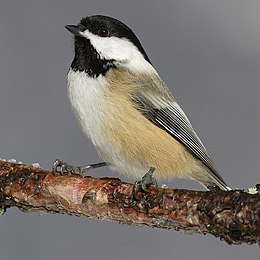 While running a line in the woods, close to the water, on the southwest side of Loring’s Pond, I observe a chickadee sitting quietly within a few feet. Suspecting a nest, I look and find it in a small hollow maple stump about five inches in diameter and two feet high. I look down about a foot and can just discern the eggs.
Breaking off a little, I manage to get my hand in and take out some eggs. There are seven, making by their number an unusual figure as they lay in the nest, a sort of egg rosette, a circle around with one (or more) in the middle.
The eggs are a perfect oval, five eighths inch long, white with small reddish-brown or rusty spots, especially about larger end, partly developed.
In the meanwhile the bird sits silent, though rather restless, within three feet. The nest is very thick and warm, of average depth, and made of the bluish-slate rabbit’s (?) fur.
The bird sat on the remaining eggs next day. I called off the boy in another direction that he might not find it.
Plucked a white lily pad with rounded sinus and lobes in Loring’s Pond, a variety.
Picked up a young wood tortoise, about an inch and a half long, but very orbicular. Its scales very distinct, and as usual very finely and distinctly sculptured, but there was no orange on it, only buff or leather-color on the sides beneath. So the one of similar rounded form and size and with distinct scales but faint yellow spots on back must have been a young spotted turtle, I think, after all.
H. D. Thoreau, Journal, June 3, 1856
A chickadee nest in a small hollow maple stump made of the bluish-slate rabbit’s fur.. See January 21, 1855 ("Saw in an old white pine stump, about fifteen inches from the ground, a hole peeked about an inch and a half in diameter. It was about six inches deep downward in the rotten stump and was bottomed with hypnum, rabbit’s fur, and hair, and a little dry grass. Was it a mouse-nest? or a nuthatch’s, creeper’s, or chickadee’s nest?") Compare December 12, 1859 ("The roosting-place of a chickadee")
That (formerly) pine lot of Loring’s which is now coming up shrub oak. . . .See April 28, 1856 ("George Hubbard remarked that if they were cut down oaks would spring up, and sure enough, looking across the road to where Loring’s white pines recently stood so densely, the ground was all covered with young oaks.”); May 13, 1856 ("I suspect that I can throw a little light on the fact that when a dense pine wood is cut down oaks, etc., may take its place. . . .There is a good example at Loring’s lot.”)
Surveying for John Hosmer beyond pail-factory.
Hosmer says that seedling white birches do not grow larger than your arm, but cut them down and they spring up again and grow larger.
R. Hoar, I believe, bought that (formerly) pine lot of Loring’s which is now coming up shrub oak. Hosmer says that he will not see any decent wood there as long as he lives. H. says he had a lot of pine in Sudbury, which being cut, shrub oak came up. He cut and burned and raised rye, and the next year (it being surrounded by pine woods on three sides) a dense growth of pine sprang up.
As I have said before, it seems to me that the squirrels, etc., disperse the acorns, etc., amid the pines, they being a covert for them to lurk in, and when the pines are cut the fuzzy shrub oaks, etc., have the start. If you cut the shrub oak soon, probably pines or birches, maples, or other trees which have light seeds will spring next, because squirrels, etc., will not be likely to carry acorns into open land.
If the pine wood had been surrounded by white oak, probably that would have come up after the pine.
Breaking off a little, I manage to get my hand in and take out some eggs. There are seven, making by their number an unusual figure as they lay in the nest, a sort of egg rosette, a circle around with one (or more) in the middle.
The eggs are a perfect oval, five eighths inch long, white with small reddish-brown or rusty spots, especially about larger end, partly developed.
In the meanwhile the bird sits silent, though rather restless, within three feet. The nest is very thick and warm, of average depth, and made of the bluish-slate rabbit’s (?) fur.
The bird sat on the remaining eggs next day. I called off the boy in another direction that he might not find it.
Plucked a white lily pad with rounded sinus and lobes in Loring’s Pond, a variety.
Picked up a young wood tortoise, about an inch and a half long, but very orbicular. Its scales very distinct, and as usual very finely and distinctly sculptured, but there was no orange on it, only buff or leather-color on the sides beneath. So the one of similar rounded form and size and with distinct scales but faint yellow spots on back must have been a young spotted turtle, I think, after all.
H. D. Thoreau, Journal, June 3, 1856
That (formerly) pine lot of Loring’s which is now coming up shrub oak. . . .See April 28, 1856 ("George Hubbard remarked that if they were cut down oaks would spring up, and sure enough, looking across the road to where Loring’s white pines recently stood so densely, the ground was all covered with young oaks.”); May 13, 1856 ("I suspect that I can throw a little light on the fact that when a dense pine wood is cut down oaks, etc., may take its place. . . .There is a good example at Loring’s lot.”)
Tuesday, December 18, 2012
This the first skating.

December 18, 2022

Very cold, windy day. The crust of the slight snow covered in some woods with the scales (bird-shaped) of the birch, and their seeds.
Loring's Pond beautifully frozen. So polished a surface, I mistook many parts of it for water. Cracked into large squares like the faces of a reflector, it was so exquisitely polished that the sky and scudding dun-colored clouds, with mother-o'-pearl tints, were reflected in it as in the calmest water. I slid over it with a little misgiving, mistaking the ice before me for water. This is the first skating.
Still the little ruby-crowned birds about.
Loring's Pond beautifully frozen. See December 14, 1850 ("I walk on Loring's Pond to three or four islands there which I have never visited.")
This is the first skating. See December 6, 1854 ("I see thick ice and boys skating all the way to Providence, but know not when it froze, I have been so busy writing my lecture."); December 6, 1856 ("Skating is fairly begun. The river is generally frozen over, though it will bear quite across in very few places."); December 7, 1856 ("Take my first skate to Fair Haven Pond. “); December 14. 1851 ("The boys have been skating for a week, but I have had no time to skate for surveying. I have hardly realized that there was ice, though I have walked over it about this business."); December 19, 1854 ("Skated a half-mile up Assabet and then to foot of Fair Haven Hill. This is the first tolerable skating.”); December 20, 1854 ( P. M. — Skate to Fair Haven.”)
H. D. Thoreau, Journal, December 18, 1852
Snow covered in some woods with the scales (bird-shaped) of the birch. See December 4, 1854 (“Already the bird-like birch scales dot the snow. ”); December 4 1856 ("I see where the pretty brown bird-like birch scales and winged seeds have been blown into the numerous hollows of the thin crusted snow. So bountiful a table is spread for the birds. For how many thousand miles this grain is scattered over the earth."); December 6, 1859 ("No sooner has the snow fallen than, in the woods, it is seen to be dotted almost everywhere with the fine seeds and scales of birches and alders, — no doubt an ever-accessible food to numerous birds and perhaps mice"); December 30, 1855 (“For a few days I have noticed the snow sprinkled with alder and birch scales.”)
Snow covered in some woods with the scales (bird-shaped) of the birch. See December 4, 1854 (“Already the bird-like birch scales dot the snow. ”); December 4 1856 ("I see where the pretty brown bird-like birch scales and winged seeds have been blown into the numerous hollows of the thin crusted snow. So bountiful a table is spread for the birds. For how many thousand miles this grain is scattered over the earth."); December 6, 1859 ("No sooner has the snow fallen than, in the woods, it is seen to be dotted almost everywhere with the fine seeds and scales of birches and alders, — no doubt an ever-accessible food to numerous birds and perhaps mice"); December 30, 1855 (“For a few days I have noticed the snow sprinkled with alder and birch scales.”)
Loring's Pond beautifully frozen. See December 14, 1850 ("I walk on Loring's Pond to three or four islands there which I have never visited.")
This is the first skating. See December 6, 1854 ("I see thick ice and boys skating all the way to Providence, but know not when it froze, I have been so busy writing my lecture."); December 6, 1856 ("Skating is fairly begun. The river is generally frozen over, though it will bear quite across in very few places."); December 7, 1856 ("Take my first skate to Fair Haven Pond. “); December 14. 1851 ("The boys have been skating for a week, but I have had no time to skate for surveying. I have hardly realized that there was ice, though I have walked over it about this business."); December 19, 1854 ("Skated a half-mile up Assabet and then to foot of Fair Haven Hill. This is the first tolerable skating.”); December 20, 1854 ( P. M. — Skate to Fair Haven.”)
Still the little ruby-crowned birds about. The Lesser Redpoll, Fringilla linaria. See November 13, 1852 ("Saw a flock of little passenger birds by Walden, busily pecking at the white birch catkins; about the size of a chickadee; distinct white bar on wings; most with dark pencilled breast, some with whitish ; forked tail ; bright chestnut or crimson (?) frontlet; yellowish shoulders or sack. When startled, they went off with a jingling sound somewhat like emptying a bag of coin. Is it the yellow redpoll? ");November 21, 1852 ("The commonest bird I see and hear nowadays is that little red crowned or fronted bird I described the 13th. I hear now more music from them. They have a mewing note which reminds me of a canary-bird. They make very good forerunners of winter. Is it not the ruby-crowned wren?"); December 2, 1852 ("the ruby-crowned wren (?) flies and mews over."); December 9, 1852 ("Those little ruby-crowned wrens (?) 1 still about. They suddenly dash away from this side to that in flocks, with a tumultuous note, half jingle, half rattle, like nuts shaken in a bag, or a bushel of nutshells, soon returning to the tree they had forsaken on some alarm. They are oftenest seen on the white birch, apparently feeding on its seeds, scattering the scales about."); January 2, 1853 ("Brown thinks my ruby wren may be the lesser redpoll linnet."); March 5, 1853 (“They have a sharp bill, black legs and claws, and a bright-crimson crown or frontlet, in the male reaching to the base of the bill, with, in his case, a delicate rose or carmine on the breast and rump. Though this is described by Nuttall as an occasional visitor in the winter, it has been the prevailing bird here this winter. ”) See also A Book of the Seasons, by Henry Thoreau, The Lesser Redpoll
December 18. See A Book of the Seasons, by Henry Thoreau, December 18
December 18. See A Book of the Seasons, by Henry Thoreau, December 18
Surface so polished
I mistake it for water –
this the first skating.
A Book of the Seasons, by Henry Thoreau, This the first skating.
A Book of the Seasons, by Henry Thoreau,
"A book, each page written in its own season,
out-of-doors, in its own locality.”
~edited, assembled and rewritten by zphx © 2009-2024
https://tinyurl.com/hdt-521218
Thursday, May 17, 2012
To Loring's Pond
May 17.
Decidedly fair weather at last; a bright, breezy, flowing, washing day.
The different color of the water at different times. To-day it is full of light and life, the breeze presenting many surfaces to the sun. There is a sparkling shimmer on it. It is a deep, dark blue, as the sky is clear. The air everywhere is, as it were, full of the rippling of waves.

This pond is the more interesting for the islands in it. The water is seen running behind them. It is pleasant to know that it penetrates quite behind and isolates the land you see, and to see it flowing out from behind an island with shining ripples.
The sun on the young foliage of birches, alders, etc., on the opposite side of the pond has an enchanting effect. The sunshine has a double effect. The new leaves abet it, so fresh and tender, not apprehending their insect foes. Do I smell the young birch leaves at a distance ?
Most trees are beautiful when leafing out, but especially the birch. After a storm at this season, the sun comes out and lights up the tender expanding leaves, and all nature is full of light and fragrance, and the birds sing without ceasing, and the earth is a fairyland. The birch leaves are so small that you see the landscape through the tree, and they are like silvery and green spangles in the sun, fluttering about the tree.
I see dark pines in the distance in the sunshine, contrasting with the light fresh green of the deciduous trees.
Now the sun has come out after the May storm, how bright, how full of freshness and tender promise and fragrance is the new world! The woods putting forth new leaves; it is a memorable season. So hopeful! These young leaves have the beauty of flowers.
There is life in these fresh and varied colors, life in the motion of the wind and the waves; all make it a flowing, washing day. It is a good day to saunter.
Does not summer begin after the May storm?
H. D. Thoreau, Journal, May 17, 1852
This pond is the more interesting for the islands in it. See September 12, 1851 ("I love to gaze at the low island in the pond, — at any island or inaccessible land."); December 14, 1850 ("I walk on Loring's Pond to three or four islands there which I have never visited.")
The birch leaves are so small that you see the landscape through the tree, and they are like silvery and green spangles in the sun, fluttering about the tree.... See May 17, 1854 ("the wooded shore is all lit up with the tender, bright green of birches fluttering in the wind and shining in the light, ...")
Now the sun has come out after the May storm, how bright, how full of freshness and tender promise and fragrance is the new world! May 24, 1860 ("How perfectly new and fresh the world is seen to be, when we behold a myriad sparkles of brilliant white sunlight on a rippled stream.")
Does not summer begin after the May storm? See May 11, 1854 (" I suspect that summer weather may be always ushered in in a similar manner, — thunder-shower, rainbow, smooth water, and warm night.")
Decidedly fair weather at last; a bright, breezy, flowing, washing day.
The different color of the water at different times. To-day it is full of light and life, the breeze presenting many surfaces to the sun. There is a sparkling shimmer on it. It is a deep, dark blue, as the sky is clear. The air everywhere is, as it were, full of the rippling of waves.

This pond is the more interesting for the islands in it. The water is seen running behind them. It is pleasant to know that it penetrates quite behind and isolates the land you see, and to see it flowing out from behind an island with shining ripples.
The sun on the young foliage of birches, alders, etc., on the opposite side of the pond has an enchanting effect. The sunshine has a double effect. The new leaves abet it, so fresh and tender, not apprehending their insect foes. Do I smell the young birch leaves at a distance ?
Most trees are beautiful when leafing out, but especially the birch. After a storm at this season, the sun comes out and lights up the tender expanding leaves, and all nature is full of light and fragrance, and the birds sing without ceasing, and the earth is a fairyland. The birch leaves are so small that you see the landscape through the tree, and they are like silvery and green spangles in the sun, fluttering about the tree.
I see dark pines in the distance in the sunshine, contrasting with the light fresh green of the deciduous trees.
Now the sun has come out after the May storm, how bright, how full of freshness and tender promise and fragrance is the new world! The woods putting forth new leaves; it is a memorable season. So hopeful! These young leaves have the beauty of flowers.
There is life in these fresh and varied colors, life in the motion of the wind and the waves; all make it a flowing, washing day. It is a good day to saunter.
Does not summer begin after the May storm?
H. D. Thoreau, Journal, May 17, 1852
This pond is the more interesting for the islands in it. See September 12, 1851 ("I love to gaze at the low island in the pond, — at any island or inaccessible land."); December 14, 1850 ("I walk on Loring's Pond to three or four islands there which I have never visited.")
The birch leaves are so small that you see the landscape through the tree, and they are like silvery and green spangles in the sun, fluttering about the tree.... See May 17, 1854 ("the wooded shore is all lit up with the tender, bright green of birches fluttering in the wind and shining in the light, ...")
Now the sun has come out after the May storm, how bright, how full of freshness and tender promise and fragrance is the new world! May 24, 1860 ("How perfectly new and fresh the world is seen to be, when we behold a myriad sparkles of brilliant white sunlight on a rippled stream.")
Does not summer begin after the May storm? See May 11, 1854 (" I suspect that summer weather may be always ushered in in a similar manner, — thunder-shower, rainbow, smooth water, and warm night.")
Tuesday, December 14, 2010
Myrica Island.
I walk on Loring's Pond to three or four islands there which I have never visited, not having a boat in the summer.
On one containing an acre or two, I find a low, branching shrub frozen into the edge of the ice, with a fine spicy scent somewhat like sweet-fern and a handsome imbricate bud. When I rub the dry-looking fruit in my hands, it feels greasy and stains them a permanent yellow, which I cannot wash out.
It lasts several days, and my fingers smell medicinal. I conclude that it is sweetgale, and we name the island Myrica Island.
On those unfrequented islands, too, I notice the red osier or willow, that common hard-berried plant with small red buds, apparently two kinds of swamp-pink buds, some yellow, some reddish, a brittle , rough yellow ish bush with handsome pinkish shoots; in one place in the meadow the greatest quantity of wild rose hips of various forms that I ever saw, now slightly withered; they are as thick as winterberries .
I notice a bush covered with cocoons which are artfully concealed by two leaves wrapped round them, one still hanging by its stem, so that they look like a few withered leaves left dangling.
The worm, having first encased itself in another leaf for greater protection, folded more loosely around itself one of the leaves of the plant, taking care, however, to encase the leaf-stalk and the twig with a thick and strong web of silk, so far from depending on the strength of the stalk, which is now quite brittle. The strongest fingers cannot break it, and the cocoon can only be got off by slipping it up and off the twig.
There they hang themselves secure for the winter, proof against cold and the birds, ready to become butterflies when new leaves push forth.
H. D. Thoreau, Journal, December 14, 1850
I walk on Loring's Pond to three or four islands there which I have never visited, not having a boat in the summer. See December 14. 1851 ("I have had no time to skate for surveying. I have hardly realized that there was ice, though I have walked over it about this business."); December 18, 1852 ("Loring's Pond beautifully frozen. So polished a surface, I mistook many parts of it for water.");May 17, 1852 ("This pond is the more interesting for the islands in it. ") See also December 6, 1854 ("I see thick ice and boys skating all the way to Providence, but know not when it froze, I have been so busy writing my lecture."); December 7, 1856 ("Take my first skate to Fair Haven Pond. ") December 13, 1859 ("My first true winter walk is perhaps that which I take on the river, or where I cannot go in the summer. . . . Now that the river is frozen we have a sky under our feet also."); December 15, 1855 ("The boys have skated. a little within two or three days, but it has not been thick enough to bear a man yet."); December 19, 1854 (" Last night was so cold that the river closed up almost everywhere, and made good skating where there had been no ice to catch the snow of the night before. . . ."); December 20, 1854 ( P. M. — Skate to Fair Haven.”)
I find a low, branching shrub frozen into the edge of the ice, with a fine spicy scent. See April 13, 1860 (“It distinctly occurred to me that, perhaps, if I came against my will, as it were, to look at the sweet-gale as a matter of business, I might discover something else interesting.”)
Subscribe to:
Comments (Atom)
Popular Posts Last 30 Days.
-
February 27 P. M. — Up Assabet. Am surprised to see how the ice lasts on the river. It but just begins to be open for a foot or two ...
-
No mortal is alert enough to be present at the first dawn of the spring. Henry Thoreau, March 17, 1857 Suddenly black dots in the sky – ex...
-
Beyond the lone graveyard, his footsteps shining like silver between me and the moon. I see a promise or sign of spring in the way th...
-
 March 8 10 A. M. Rode to Saxonville with F. Brown to look at a small place for sale, via Wayland. Return by Sudbury. On wheels in snow. A s...


The week ahead in Henry’s journal

A journal, a book that shall contain a record of all your joy.