Showing posts with label march 27. Show all posts

Monday, March 27, 2023

A Book of the Seasons: the Lark in Early Spring


For the first time I perceive this spring
that the year is a circle.  
I would make a chart of our life, 
know why just this circle of creatures completes the world.
Henry Thoreau, April 18, 1852


The lark sings – perched on 
the top of an apple tree – 
quite sweet and plaintive.
March 26, 1855

The turtle and frog 
peep stealthily out and see
first larks go over.
March 27, 1857 


March 11. E. Hosmer says that a man told him that he had seen my uncle Charles take a twelve-foot ladder, set it up straight, and then run up and down the other side, kicking it from behind him as he went down. E. H. told of seeing him often at the tavern toss his hat to the ceiling, twirling it over, and catch it on his head every time.      Large flocks of blackbirds to-day in the elm-tops and other trees. These are the first conspicuous large flocks of birds. J. Farmer says he saw ducks this morning and has seen larks some days. Channing saw geese to-day. March 11, 1859 [Uncle Charles died March 27, 1856, about midnight, aged seventy-six.]

March 12. Now I see and hear the lark sitting with head erect, neck outstretched, in the middle of a pasture, and I hear another far off singing. Sing when they first come. March 12, 1854

March 13. Excepting a few bluebirds and larks, no spring birds have come, apparently. The woods are still. March 13, 1853

March 13. Going down railroad, listening intentionally, I hear, far through the notes of song sparrows (which are very numerous), the song of one or two larks. Also hearing a coarse chuck, I look up and see four black birds, whose size and long tails betray them crow blackbirds. Also I hear, I am pretty sure, the cackle of a pigeon woodpecker. The bright catkins of the willow are the springing most generally observed. March 13, 1859

March 16. See larks about, though I have heard of them in the winter. March 16, 1860

March 18. The bluebird and song sparrow sing immediately on their arrival , and hence deserve to enjoy some preeminence. They give expression to the joy which the season inspires. But the robin and blackbird only peep and chuck at first, commonly, and the lark is silent and flitting. March 18, 1853

March 21. Hear a lark far off in the meadow. March 21, 1855

March 22. Already I hear from the rail road the plaintive strain of a lark or two. They sit now conspicuous on the bare russet ground. March 22, 1853

March 25. This sound [the dark-eyed junco] advances me furthest toward summer, unless it be the note of the lark, who, by the way, is the most steady singer at present. Notwithstanding the raw and windy mornings, it will sit on a low twig or tussock or pile of manure in the meadow and sing for hours, as sweetly and plaintively as in summer. March 25, 1853

March 26. The lark sings, perched on the top of an apple tree, quite sweet and plaintive, contrasting with the cheerless season and the bleak meadow. March 26, 1855

March 27, 2020

March 27. Hear a lark in that meadow. Twitters over it on quivering wing and awakes the slumbering life of the meadow. The turtle and frog peep stealthily out and see the first lark go over. March 27, 1857

March 28. The first lark of the 23d sailed through the meadow with that peculiar prolonged chipping or twittering sound, perhaps sharp clucking. March 28, 1858

March 30. The pewee [phoebe] is heard, and the lark. March 30, 1851

March 30. You see a few blackbirds, robins, bluebirds, tree sparrows, larks, etc., but the song sparrow chiefly is heard these days. March 30, 1855

April 2. The sun is up. The water on the meadows is perfectly smooth and placid, reflecting the hills and clouds and trees. The air is full of the notes of birds, - song sparrows, red-wings, robins (singing a strain), bluebirds, - and I hear also a lark, - as if all the earth had burst forth into song. The influence of this April morning has reached them, for they live out-of-doors all the night, and there is no danger that they will oversleep themselves such a morning. April 2, 1852

April 6. The robin is the singer at present, such is its power and universality, being found both in garden and wood. Morning and evening it does not fail, perched on some elm or the like, and in rainy days it is one long morning or evening. The song sparrow is still more universal but not so powerful. The lark, too, is equally constant, morning and evening, but confined to certain localities, as is the blackbird to some extent. The bluebird, with feebler but not less sweet warbling, helps fill the air, and the pheobe does her part . . . I cannot describe the lark's song. I used these syllables in the morning to remember it by, -- heetar-su-e-oo.  April 6, 1853

April 9. I hear the note of a lark amid the other birds on the meadow. April 9, 1856

April 13. The larks are not yet in sufficient numbers or sufficiently musical. The robin is the prime singer as yet. April 13, 1852

April 14. Going down the railroad at 9 A. M., I hear the lark singing from over the snow. This for steady singing comes next to the robin now. It will come up very sweet from the meadows ere long.    I do not hear those peculiar tender die-away notes from the pewee yet. Is it another pewee, or a later note? April 14, 1852

April 21. The robins sing through the ceaseless rain, and the song sparrows, and I hear a lark’s plaintive strain. April 21, 1852

April 23. The lark sings morning and evening. April 23, 1854

April 26. The lark on the top of an apple tree sings a tchea te che, then perhaps tche tchea, only a plaintive clear round note.

*****

The lark sings a note 
which belongs to New England
summer evenings.

See also:

A Book of the Seasons,  by Henry Thoreau, March 27

A Book of the Seasons,  by Henry Thoreau
 "A book, each page written in its own season, 
out-of-doors, in its own locality."
 ~edited, assembled and rewritten by zphx ©  2009-2023

https://tinyurl.com/HDTlark

A Book of the Seasons: March 27 (ice-out, unnoticed March flowers – alder aspen hazel and maple, waterfowl, turtles and frogs, birdsong)


The year is but a succession of days,
and I see that I could assign some office to each day
which, summed up, would be the history of the year.
Henry Thoreau, August 24, 1852

 March 27

The hazel is out 
at this cold leafless season 
greeting of the spring. 

March 27, 2022

Uncle Charles died this morning, about midnight, aged seventy-six . . .  The river is now open in reaches of twenty or thirty rods, where the ice has disappeared by melting. March 27, 1856

Walden is two-thirds broken up. It will probably be quite open by to-morrow night. March 27, 1851

The ducks sleep these nights in the shallowest water which does not freeze, and there may be found early in the morning. March 27, 1855


We land and steal over the hill through the woods, expecting to find them under Lee's Cliff, as indeed we do, having crawled over the hill through the woods on our stomachs; and there we watched various water-fowl for an hour. March 27, 1858

Scare up a flock of sheldrakes just off Fair Haven Hill, the conspicuous white ducks, sailing straight hither and thither. At first they fly low up the stream, but, having risen, come back half-way to us, then wheel and go up-stream. Soon after we scare up a flock of black ducks. March 27, 1858

Among them, or near by, I at length detect three or four whistlers, by their wanting the red bill, being considerably smaller and less white, having a white spot on the head, a black back, and altogether less white, and also keeping more or less apart and not diving when the rest do.  March 27, 1858

Louis Minor tells me he saw some geese about the 23d. March 27 and 28, 1860

Farmer says that he heard geese go over two or three nights ago. March 27, 1857

Am surprised to see the cowslip so forward, showing so much green, in E. Hubbard’s Swamp, in the brook, where it is sheltered from the winds. The already expanded leaves rise above the water. If this is a spring growth, it is the most forward herb I have seen.  March 27, 1855 

There is an abundance of low willows whose catkins are now conspicuous, rising four to six or seven feet above the water, thickly placed on long wand-like osiers. They look, when you look from the sun, like dead gray twigs or branches (whose wood is exposed) of bushes in the light, but, nearer, are recognized for the pretty bright buttons of the willow. We sail by masses of these silvery buttons two or three rods long, rising above the water. March 27, 1859

By their color they have relation to the white clouds and the sky and to the snow and ice still lingering in a few localities. In order to see these silvery buttons in the greatest profusion, you must sail amid them on some flooded meadow or swamp like this. March 27, 1859

The hazel is fully out. The 23d was perhaps full early to date them. It is in some respects the most interesting flower yet, though so minute that only an observer of nature, or one who looked for them, would notice it. It is the highest and richest colored yet, –– ten or a dozen little rays at the end of the buds which are at the ends and along the sides of the bare stems. Some of the flowers are a light, some a dark crimson. The high color of this minute, unobserved flower, at this cold, leafless, and almost flowerless season! It is a beautiful greeting of the spring, when the catkins are scarcely relaxed and there are no signs of life in the bush. March 27, 1853

Twenty rods off, masses of alder in bloom look like masses of bare brown twigs, last year's twigs, and would be taken for such. March 27, 1859

Our whole course, as we wind about in this bay, is lined also with the alder, whose pretty tassels, now many of them in full bloom, are hanging straight down, suggesting in a peculiar manner the influence of gravity, or are regularly blown one side. It is remarkable how modest and unobtrusive these early flowers are. The musquash and duck hunter or the farmer might and do commonly pass by them without perceiving them. They steal into the air and light of spring without being noticed for the most part. The sportsman seems to see a mass of weather-stained dead twigs showing their wood and partly covered with gray lichens and moss, and the flowers of the alder, now partly in bloom, maybe half, make the impression at a little distance of a collection of the brown twigs of winter — also are of the same color with many withered leaves. March 27, 1859

 Of our seven indigenous flowers which begin to bloom in March, four, i. e. the two alders, the aspen, and the hazel, are not generally noticed so early, if at all, and most do not observe the flower of a fifth, the maple. The first four are yellowish or reddish brown at a little distance, like the banks and sward moistened by the spring rain. March 27, 1859

The browns are the prevailing shades as yet, as in the withered grass and sedge and the surface of the earth, the withered leaves, and these brown flowers.  March 27, 1859

Saw a hawk – probably marsh hawk – by meadow. March 27, 1854

See my frog hawk. (C. saw it about a week ago.) It is the hen-barrier, i.e. marsh hawk, male. Slate-colored; beating the bush; black tips to wings and white rump.  March 27, 1855

Tried to see the faint-croaking frogs at J. P. Brown's Pond in the woods. They are remarkably timid and shy; had their noses and eyes out, croaking, but all ceased, dove, and concealed themselves, before I got within a rod of the shore. Stood perfectly still amid the bushes on the shore, before one showed himself; finally five or six, and all eyed me, gradually approached me within three feet to reconnoitre, and, though I waited about half an hour, would not utter a sound nor take their eyes off me, – were plainly affected by curiosity. March 27, 1853

Pickerel begin to dart in shallows. March 27, 1857

I see but one tortoise (Emys guttata) in Nut Meadow Brook now; the weather is too raw and gusty. March 27, 1853

See a wood tortoise in the brook. March 27, 1855

As I go up the Assabet, I see two Emys insculpta on the bank in the sun, and one picta. They are all rather sluggish, and I can paddle up and take them up. March 27, 1857
 
Hear a lark in that meadow. Twitters over it on quivering wing and awakes the slumbering life of the meadow. The turtle and frog peep stealthily out and see the first lark go over. March 27, 1857

But now chiefly there comes borne on the breeze the tinkle of the song sparrow along the riverside, and I push out into wind and current.  March 27, 1857

*****
A Book of the Seasons,  by Henry Thoreau,    The Alders
A Book of the Seasons,  by Henry Thoreau: the Hazel
A Book of the Seasons,  by Henry Thoreau, the Aspens

*****

March 26, 1855 ("The lark sings, perched on the top of an apple tree, quite sweet and plaintive, contrasting with the cheerless season and the bleak meadow.")
March 26, 1857 ("The buds of the cowslip are very yellow, and the plant is not observed a rod off, it lies so low and close to the surface of the water in the meadow. It may bloom and wither there several times before villagers discover or suspect it")
March 26, 1860 ("The yellow sands of a lonely brook seen through the rippling water, with the shadows of the ripples like films passing over it.")

March 28, 1852 (" A yellow-spotted tortoise by the causeway side in the meadow near Hubbard's Bridge. ")
March 28, 1853 ("As near as I can make out, the hawks or falcons I am likely to see here are the American sparrow hawk, the fish hawk, the goshawk, the short-winged buzzard (if this is the same with Brown's stuffed sharp-shinned or slate-colored hawk, — not slate in his specimen; (is not this the common small hawk that soars ?), the red- tailed hawk (have we the red-shouldered hawk, about the same size and aspect with the last ?),the hen-harrier. (I suppose it is the adult of this with the slate-color over meadows.)
March 28, 1853 ("Saw eleven black ducks near the bathing-place on the Assabet, flying up the stream. . . . This is a raw, cloudy, and disagreeable day. Yet I think you are most likely to see wild fowl this weather")
March 28, 1855 ("A yellow-spotted tortoise in a still ditch, which has a little ice also. It at first glance reminds me of a bright freckled leaf, skunk-cabbage scape, perhaps. They are generally quite still at this season, or only slowly put their heads out (of their shells).")
March 26, 1857 (" As I go through the woods by Andromeda Ponds, though it is rather cool and windy in exposed places, I hear a faint, stertorous croak from a frog in the open swamp; at first one faint note only, which I could not be sure that I had heard, but, after listening long, one or two more suddenly croaked in confirmation of my faith, and all was silent again.")
March 28, 1857 ("The Emys guttata is found in brooks and ditches. I passed three to-day, lying cunningly quite motionless, with heads and feet drawn in, on the bank of a little grassy ditch, close to a stump, in the sun.")
March 28, 1858 ("After a cloudy morning, a warm and pleasant afternoon. I hear that a few geese were seen this morning.")
March 28, 1858 ("I look toward Fair Haven Pond, now quite smooth. There is not a duck nor a gull to be seen on it. I can hardly believe that it was so alive with them yesterday. Apparently they improve this warm and pleasant day, with little or no wind, to continue their journey northward. The strong and cold northwest wind of about a week past has probably detained them. Knowing that the meadows and ponds were swarming with ducks yesterday, you go forth this particularly pleasant and still day to see them at your leisure, but find that they are all gone. No doubt there are some left, and many more will soon come with the April rains. It is a wildlife that is associated with stormy and blustering weather.")
March 28, 1858 ("I hear the croaking frogs in the pool on the south side of Hubbard’s Grove. It is sufficiently warm for them at last. ")
March 28, 1859 ("The black, sheldrake, etc., move their wings rapidly, and remind you of paddle-wheel steamers . . . The meadows, which are still covered far and wide, are quite alive with black ducks . . . If you scan the horizon at this season of the year you are very likely to detect a small flock of dark ducks moving with rapid wing athwart the sky, or see the undulating line of migrating geese against the sky.")


March 27, 2020

If you make the least correct 
observation of nature this year,
 you will have occasion to repeat it
 with illustrations the next, 
and the season and life itself is prolonged.

March 26 <<<<< March 27 >>>>>  March 28   

A Book of the Seasons,  by Henry Thoreau, March 27
A Book of the Seasons,  by Henry Thoreau
 "A book, each page written in its own season, 
out-of-doors, in its own locality."
 ~edited, assembled and rewritten by zphx ©  2009-2024

tinyurl.com/HDT27March

Saturday, March 27, 2021

March 27. The hazel is out at this cold leafless season greeting the spring.


Walden is two-thirds broken up. Journal, March 27, 1851


It will probably be quite open by to-morrow night. See note to March 14, 1860 (" I am surprised to find Walden open. No sooner has the ice of Walden melted than the wind begins to play in dark ripples over the surface of the virgin water. Ice dissolved is the next moment as perfect water as if melted a million years.") See also  April 18, 1856 ("Walden is open entirely to-day for the first time, owing to the rain of yesterday and evening. I have observed its breaking up of different years commencing in ’45, and the average date has been April 4th.") and  A Book of the Seasons, by Henry Thoreau, Ice-out In Thoreau’s records, March 14th was the earliest ice out; April 18th was the latest. From 1995 to 2015, ice out ranged from Jan. 29 (!) to April 12 with the median ice out date March 21.


The hazel is fully out, Journal , March 27, 1853


The hazel is fully out., though so minute that only an observer of nature, or one who looked for them, would notice it.See March 27, 1859 ("Of our seven indigenous flowers which begin to bloom in March, four, i. e. the two alders, the aspen, and the hazel, are not generally noticed so early, if at all."); March 31, 1853 ("The catkins of the hazel are now trembling in the wind and much lengthened, showing yellowish and beginning to shed pollen.”); April 13, 1855 ("The common hazel just out. It is perhaps the prettiest flower of the shrubs that have opened. A little bunch of (in this case) half a dozen catkins, one and three quarters inches long, trembling in the wind, shedding golden pollen on the hand, and, close by, as many minute, but clear crystalline crimson stars at the end of a bare and seemingly dead twig. For two or three days in my walks, I had given the hazel catkins a fillip with my finger under their chins to see if they were in bloom, but in vain; but here, on the warm south side of a wood, I find one bunch fully out and completely relaxed. They know when to trust themselves to the weather.”) May 7, 1854 ("Flowers are self-registering indicators of fair weather. I remember how I waited for the hazel catkins to become relaxed and shed their pollen, but they delayed, till at last there came a pleasanter and warmer day and I took off my greatcoat while surveying in the woods, and then, when I went to dinner at noon, hazel catkins in full flower were dangling from the banks by the roadside and yellowed my clothes with their pollen. If man is thankful for the serene and warm day, much more are the flowers.”). See also A Book of the Seasons,  by Henry Thoreau, the Hazel


 My Aunt Maria . . . was heard through the partition shouting to my Aunt Jane, who is deaf, "Think of it! He stood half an hour to-day to hear the frogs croak, and he wouldn't read the life of Chalmers." 
See April 8, 1852( "To-day I hear the croak of frogs in small pond-holes in the woods, and see dimples on the surface, which I suppose that they make, for when I approach they are silent and the dimples are no longer seen."); May 9, 1860:  (“We sit by the shore of Goose Pond. … After sitting there a little while, I count noses of twenty frogs. It is a still, cloudy, thoughtful day.”); See also July 17, 1854: ("I watch them [white lillies] for an hour and a half.")


A hawk by meadow, Journal, March 27, 1854


Saw a hawk -- probably marsh hawk -- by meadow. See March 27, 1855 ("See my frog hawk. . . . It is the hen-harrier, i.e. marsh hawk, male. Slate-colored; beating the bush; black tips to wings and white rump"); March 17, 1860 (" Was not that a marsh hawk, a slate-colored one which I saw flying over Walden Wood with long, slender, curving wings, with a diving, zigzag flight? "); March 21, 1859 ("I see a female marsh hawk sailing and hunting over Potter's Swamp. I not only see the white rump but the very peculiar crescent-shaped curve of its wings."); Marsh 24, 1860 (". I see a male frog hawk beating a hedge, scarcely rising more than two feet from the ground for half a mile."); March 29, 1853 (" I believe I saw the slate-colored marsh hawk to-day. "); March 29, 1854 ("See two marsh hawks, white on rump.") See also A Book of the Seasons, by Henry Thoreau, the Marsh Hawk (Northern Harrier)


The river is now open, Journal, March 27, 1856


The river is now open in reaches of twenty or thirty rods, where the ice has disappeared by melting. Elijah Wood does not remember that the river was ever frozen so long. See March 20, 1856 ("The river has just begun to open at Hubbard’s Bend. It has been closed there since January 7th, i. e. ten weeks and a half"); March 24, 1856 ("Go everywhere on the North Branch — it is all solid Yet last year I paddled my boat to Fair Haven Pond on the 19th of March! "); April 2, 1856.(" I returned down the middle of the river to near the Hubbard Bridge without seeing any opening. "); April 7, 1856 ("Launched my boat, through three rods of ice on the riverside, . . . . Surprised to find the river not broken up just above [Hubbard] bridge and as far as we can see, probably through Fair Haven Pond. Probably in some places you can cross the river still on the ice. . "); April 8, 1856 (" the pond and river still frozen over for the most part as far down as Cardinal Shore. "). See also A Book of the Seasons, by Henry Thoreau, A Book of the Seasons: Ice out


I do not know at first what it is that charms me, Journal, March 27, 1857


I would fain make two reports in my Journal,. . . The men and things of to-day are wont to lie fairer and truer in to-morrow’s memory. See notes to March 24, 1857 ("If you are describing any occurrence, or a man, make two or more distinct reports at different times.");  and March 28, 1857 ("Often I can give the truest and most interesting account of any adventure I have had after years have elapsed, for then I am not confused, only the most significant facts surviving in my memory. Indeed, all that continues to interest me after such a lapse of time is sure to be pertinent, and I may safely record all that I remember. ")


Having crawled over the hill through the woods on our stomachs we watch various water-fowl for an hour, Journal, March 27,1858

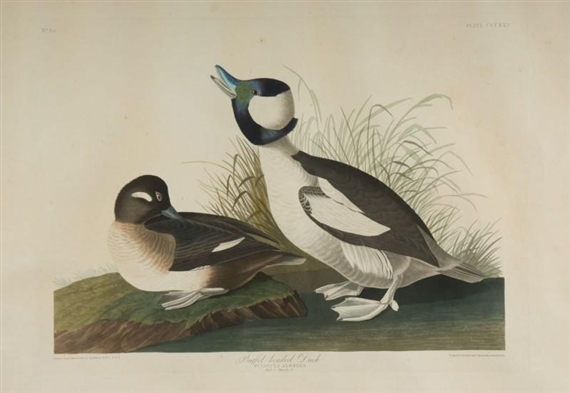
J J Audubon Fuligula albeola Buffle-headed Duck:"
The bufflehead, being known in different districts by the names of
Spirit Duck, Butter-box, Marrionette, Dipper, and Die-dipper, "

Sheldrakes. See March 22, 1858 ("I see two of these very far off on a bright-blue bay where the waves are running high. They are two intensely white specks, which yet you might mistake for the foaming crest of waves. Now one disappears, but soon is seen again, and then its companion is lost in like manner, having dived."); March 5, 1857 ("I scare up six male sheldrakes, with their black heads, in the Assabet,—the first ducks I have seen"); March 16, 1855 ("Scare up two large ducks . . . I think it the goosander or sheldrake."); March 16, 1854 ("I see ducks afar, sailing on the meadow, leaving a long furrow in the water behind them.”) See also A Book of the Seasons, by Henry Thoreau, The Sheldrake (Merganser, Goosander)

Can this be the Fuligula albeola, and have I commonly seen only the female? Or is it a grebe? See January 15, 1858 ("At Natural History Rooms, Boston. Looked at the little grebe. Its feet are not webbed with lobes on the side like the coot, and it is quite white beneath."); December 26, 1857 ("The little dipper must, therefore, be different from a coot. Is it not a grebe?); April 19, 1855 ("A little duck, asleep with its head in its back, exactly in the middle of the pond. It has a moderate-sized black head and neck, a white breast, and seems dark-brown above, with a white spot on the side of the head, not reaching to the out side, from base of mandibles, and another, perhaps, on the end of the wing, with some black there. . . .I think it is the smallest duck I ever saw. Floating buoyantly asleep on the middle of Walden Pond. Is it not a female of the buffle-headed or spirit duck?"); December 26, 1853 ("Saw in it a small diver, probably a grebe or dobchick, dipper, or what-not, with the markings, as far as I saw, of the crested grebe, but smaller. It had a black head, a white ring about its neck, a white breast, black back, and apparently no tail.”); September 27, 1860 (" I see a little dipper in the middle of the river.. . .It has a dark bill and considerable white on the sides of the head or neck, with black between it, no tufts, and no observable white on back or tail.") See also A Book of the Seasons, by Henry Thoreau, The Little Dipper

They must begin to die late in the winter. See note to March 28, 1857 ("Every spring there are many dead suckers floating belly upward on the meadows. This phenomenon of dead suckers is as constant as the phenomenon of living ones; nay, as a phenomenon it is far more apparent.")

Signs of Spring. Geese overhead, Journal, March 27 and 28, 1860


March 27, 2020


If you scan the horizon at this season of the year
you are very likely to see
the undulating line
of migrating geese against the sky.

March 28, 1859


Louis Minor tells me he saw some geese about the 23d. See  March 23, 1856 ("I spend a considerable portion of my time observing the habits of the wild animals, my brute neighbors. By their various movements and migrations they fetch the year about to me. Very significant are the flight of geese"); March 24, 1859 ("C. sees geese go over again this afternoon. How commonly they are seen in still rainy weather like this! He says that when they had got far off they looked like a black ribbon almost perpendicular waving in the air"); March 27, 1857 (" Farmer says that he heard geese go over two or three nights ago."); March 28, 1858 ("After a cloudy morning, a warm and pleasant afternoon. I hear that a few geese were seen this morning. ") See also A Book of the Seasons, by Henry Thoreau, Signs of Spring, Geese Overhead


The hazel is out
at this cold leafless season
greeting the spring.
A Book of the Seasons, by Henry Thoreau
"A book, each page written in its own season,
out-of-doors, in its own locality.”
~edited, assembled and rewritten by zphx © 2009-2021

Popular Posts Last 30 Days.

The week ahead in Henry’s journal

The week ahead in Henry’s journal
A journal, a book that shall contain a record of all your joy.
"A stone fruit. Each one yields me a thought." ~ H. D. Thoreau, March 28, 1859


I sit on this rock
wrestling with the melody
that possesses me.