Showing posts with label low water. Show all posts

Tuesday, September 27, 2022

Light and shadows along the Concord River.


September 27

Here is a cloudy day, and now the fisherman is out. 

Some tall, many-flowered, bluish-white asters are still abundant by the brook-sides. 

I never found a pitcher-plant without an insect in it. The bristles about the nose of the pitcher all point inward, and insects which enter or fall in appear for this reason unable to get out again. It is some obstacle which our senses cannot appreciate. 

Pitcher-plants more obvious now.

***

2 P. M. Rowed down the river to Ball's Hill.

The maples by the riverside look very green yet, have not begun to blush, nor are the leaves touched by frost.  Not so on the uplands.

The river is so low that, off N. Barrett's shore, some low islands are exposed, covered with a green grass like mildew. 

There are all kinds of boats chained to stumps and trees by the riverside some from Boston and the salt — but I think that none after all is so suitable and convenient as the simple flat-bottomed and light boat that has long been made here by the farmers themselves. They are better adapted to the river than those made in Boston. 

From Ball's Hill the Great Meadows, now smoothly shorn  have a quite imposing appearance, so spacious and level. There is so little of this level land in our midst. 

There is a shadow on the sides of the hills surrounding (a cloudy day), and where the meadow meets them it is darkest. The shadow deepens down the woody hills and is most distinctly dark where they meet the meadow line. 

Now the sun in the west is coming out and lights up the river a mile off, so that it shines with a white light like a burnished silver mirror. 

The poplar tree seems quite important to the scene.

The pastures are so dry that the cows have been turned on to the meadow, but they gradually desert it, all feeding one way. 

The patches of sunlight on the meadow look luridly yellow, as if flames were traversing it. 

It is a day for fishermen. 

The farmers are gathering in their corn. 

The Mikania scandens and the button-bushes and the pickerel-weed are sere and flat with frost. 

We looked down the long reach toward Carlisle Bridge. The river, which is as low as ever, still makes a more than respectable appearance here and is of generous width. 

Rambled over the hills toward Tarbell's. The huckleberry bushes appear to be unusually red this fall, reddening these hills. 

We scared a calf out of the meadow which ran like a ship tossed on the waves, over the hills toward Tarbell's. They run awkwardly , red oblong squares tossing up and down like a vessel in a storm, with great commotion.  We fell into the path, printed by the feet of the calves, with no cows' tracks. 

The note of the yellow-hammer is heard from the edges of the fields. 

The soapwort gentian looks like a flower prematurely killed by the frost. 

The soil of these fields looks as yellowish white as the corn-stalks themselves. 

Tarbell's hip roofed house looked the picture of retirement, - of cottage size, under its noble elm with its heap of apples before the door and the wood coming up within a few rods, it being far off the road. The smoke from his chimney so white and vapor-like, like a winter scene. 

The lower limbs of the willows and maples and button bushes are covered with the black and dry roots of the water-marigold and the ranunculi, plants with filiform, capillary, root-like submerged leaves.


H. D. Thoreau, Journal, September 27, 1851


Pitcher-plants more obvious now. 
See September 11, 1851 ("We have had no rain for a week, and yet the pitcher-plants have water in them. Are they ever quite dry? Are they not replenished by the dews always, and, being shaded by the grass, saved from evaporation?"); September 28, 1851 ("This swamp contains beautiful specimens of the sidesaddle-flower (Sarracenia purpurea), better called pitcher-plant . . .These leaves are of various colors from plain green to a rich striped yellow or deep red. No plants are more richly painted and streaked than the inside of the broad lips of these."). See also 
A Book of the Seasonsby Henry Thoreau, The Purple Pitcher Plant

Here is a cloudy day, and now the fisherman is out. September 25, 1851 ("Both air and water are so transparent that the fisherman tries in vain to deceive the fish with his baits")

There are all kinds of boats chained to stumps and trees by the riverside. See October 15, 1851 ("We comment on the boats of different patterns, – dories (?), punts, bread-troughs, flatirons, etc., etc., — which we pass, the prevailing our genuine dead-river boats, not to be matched by Boston carpenters."); April 22, 1857 (“We pass a dozen boats sunk at their moorings, at least at one end, being moored too low.”).

Cows all feeding one way. See July 5, 1853 ("Such a habit have cows in a pasture of moving forward while feeding that, in surveying on the Great Fields to-day, I was interrupted by a herd of a dozen cows, which successively passed before my line of vision, feeding forward, and I had to watch my opportunity to look between them.")

The farmers are gathering in their corn. See August 27, 1853 ("Topping corn now reveals the yellowing pumpkins."); September 4, 1859 ("Topping the corn, which has been going on some days, now reveals the yellow and yellowing pumpkins."); September 5, 1851 ("A field of ripening corn, now at night, that has been topped, with the stalks stacked up to dry, – an inexpressibly dry, rich, sweet ripening scent."); September 14,1851 ("The corn-stalks standing in stacks, in long rows along the edges of the corn-fields, remind me of stacks of muskets."); September 16, 1852 ("The jay screams; the goldfinch twitters; the barberries are red. The corn is topped"); September 17, 1852 ("The corn-stalks are stacked like muskets along the fields."); October 6, 1858 ("The corn stands bleached and faded — quite white in the twilight");  October 10, 1857 ("See the heaps of apples in the fields and at the cider mill, of pumpkins in the fields, and the stacks of corn stalks and the standing corn. Such is the season.") See also September 27, 1858 ("The farmers digging potatoes on shore pause a moment to watch my sail and bending mast.")

We looked down the long reach toward Carlisle Bridge. See October 6, 1851 ("The reach of the river between Bedford and Carlisle, seen from a distance in the road to-day, as formerly, has a singularly ethereal, celestial, or elysian look.. . . I have often noticed it. I believe I have seen this reach from the hill in the middle of Lincoln."); April 10, 1852 ("This meadow is about two miles long at one view from Carlisle Bridge southward, appearing to wash the base of Pine hill, and it is about as much longer northward and from a third to a half a mile wide."); August 24, 1858 ("I look down a straight reach of water to the hill by Carlisle Bridge, —and this I can do at any season, — the longest reach we have. It is worth the while to come here for this prospect, — to see a part of earth so far away over the water"); July 14, 1859 ("There extends from Tarbell Hill to Skelton Bend what I will call the Straight Reach, a mile and a third long and quite straight. This is the finest water view, making the greatest impression of size, of any that I know on the river.")

The soapwort gentian looks like a flower prematurely killed by the frost.  See September 6, 1857 ("Soapwort gentian, out not long."); September 8, 1852 ("Gentiana saponaria out."); September 19, 1851 ("The soapwort gentian now.");  September 19, 1852 ("The soapwort gentian cheers and surprises, -- solid bulbs of blue from the shade, the stale grown purplish. It abounds along the river, after so much has been mown"); September 22, 1852 ("The soapwort gentian the flower of the river-banks now.") September 25, 1857 ("You notice now the dark-blue dome of the soapwort gentian in cool and shady places under the bank.") See also A Book of the Seasons, by Henry Thoreau, The Soapwort Gentian (Gentiana saponaria)

September 27.  See A Book of the Seasons,  by Henry Thoreau, September 27

Now the sun lights up 
the river so it shines like 
a silver mirror.  
A Book of the Seasons, by Henry Thoreau
"A book, each page written in its own season,
out-of-doors, in its own locality.”
~edited, assembled and rewritten by zphx © 2009-2025


 

Saturday, October 3, 2020

Bay-wings about. Sparrows in flocks.


October 3

See Vanessa Antiopa.

The hard frost of September 28th, 29th, and 30th, and especially of October 1st, has suddenly killed, crisped, and caused to fall a great many leaves of ash, hickory, etc., etc. These ( and the locusts generally ) look shrivelled and hoary, and of course they will not ripen or be bright. They are killed and withered green, — all the more tender leaves. Has killed all the burdock flowers and no doubt many others.

Sam Barrett says that last May he waded across the Assabet River on the old dam in front of his house with out going over his india - rubber boots, which are sixteen and a half inches high. I do not believe you could have done better than this a hundred years ago, or before the canal dam was built.

Bay-wings about.

I have seen and heard sparrows in flocks, more as if flitting by, within a week, or since the frosts began.

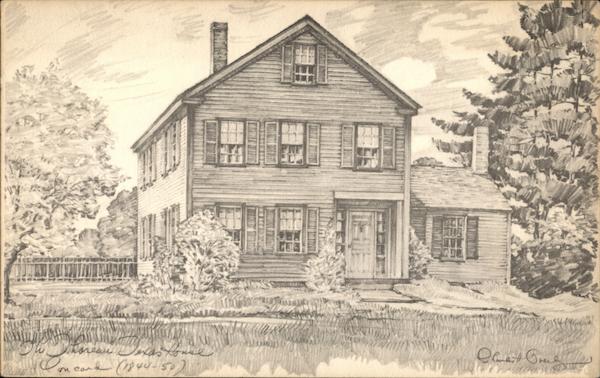
Gathered to-day my apples at the Texas house. I set out the trees, fourteen of them fourteen years ago and five of them several years later, and I now get between ten and eleven barrels of apples from them.

“Texas” House
(Thoreau Family Residence, 1844-1850)

H. D. Thoreau, Journal, October 3, 1860

See Vanessa Antiopa. See . April 17, 1860 (“It is unexpectedly very warm on lee side of hilltop just laid bare and covered with dry leaves and twigs. See my first Vanessa Antiopa”); October 1, 1860.(“C. saw the first Vanessa Antiopa since spring.”) See also A Book of the Seasons,  by Henry Thoreau, the Buff-edged Butterfly

The hard frost of September 28th, 29th, and 30th, and especially of October 1st. See October 1, 1860 ("Remarkable frost and ice this morning . . . I do not remember such cold at this season.").”); Compare October 3, 1856 (“The frost keeps off remarkably .” )

Sam Barrett says that last May he waded across the Assabet River on the old dam. See August 17, 1858 (“Being overtaken by a shower, we took refuge in the basement of Sam Barrett’s sawmill, where we spent an hour, and at length came home with a rainbow over arching the road before us”)

Bay-wings about. See April 15, 1859 (“The bay-wing now sings — the first I have been able to hear — . . . about the Texas house ”); October 9, 1858 (“Bay-wings flit along road.”); October 11, 1856 (“Bay-wing sparrows numerous.”); October 12, 1859 (“ I see scattered flocks of bay-wings amid the weeds and on the fences.”); October 16, 1855 ("I look at a grass-bird on a wall in the dry Great Fields. There is a dirty-white or cream-colored line above the eye and another from the angle of the mouth beneath it and a white ring close about the eye. The breast is streaked with this creamy white and dark brown in streams, as on the cover of a book.") See also A Book of the Seasons, by Henry Thoreau, the Bay-Wing Sparrow

I have seen and heard sparrows in flocks within a week. See September 17, 1858 (“Methinks, too, that there are more sparrows in flocks now about in garden”);  September 23, 1851 ("I scare up large flocks of sparrows in the garden.");September 26, 1858 (“Now is the time, too, when flocks of sparrows begin to scour over the weedy fields,”); September 27, 1858 ("What are those little birds in flocks in the garden and on the peach trees these mornings, about size of chip-birds, without distinct chestnut crowns?”); October 2, 1858 ("The garden is alive with migrating sparrows these mornings."); October 5, 1858 (“I still see large flocks, apparently of chip birds, on the weeds and ground in the yard.”); October 10, 1853 ("There are . . . large flocks of small sparrows,  which make a business of washing and pruning themselves in the puddles in the road, as if cleaning up after a long flight and the wind of yesterday.”)

October 3. See A Book of the Seasons, by Henry Thoreau,  October 3
See sparrows in flocks 
and have heard more flitting by 
since the frosts began.

A Book of the Seasons, by Henry Thoreau
"A book, each page written in its own season,
out-of-doors, in its own locality."
~edited, assembled and rewritten by zphx © 2009-2025
 

Friday, October 2, 2020

I would fain pluck the whole tree and carry it home for a nosegay.


October 2.

P. M.— To Cliffs.

The beggar-ticks (Bidens) now adhere to my clothes. I also find the desmodium sooner thus — as a magnet discovers the steel filings in a heap of ashes — than if I used my eyes alone.

The river is as low, within an inch or two, as when I made my mark.

A very warm day after the frosts, so that I wish — though I am afraid to wear — a thin coat.

From Cliffs the shrub oak plain has now a bright-red ground, perhaps of maples.

How much more beautiful the lakes now, like Fair Haven, surrounded by the autumn-tinted woods and hills, as in an ornamented frame!

Some maples in sprout-lands are of a delicate, pure, clear, unspotted red, inclining to crimson, surpassing most flowers. I would fain pluck the whole tree and carry it home for a nosegay.

The veiny-leaved hawkweed in blossom (again?).

H. D. Thoreau, Journal, October 2, 1852

The beggar-ticks (Bidens) now adhere to my clothes. I also find the desmodium sooner thus than if I used my eyes alone. See August 26, 1856 ("These desmodiums are so fine and inobvious that it is difficult to detect them. I go through a grove in vain, but when I get away, find my coat covered with their pods. They found me, though I did not them.”); September 29, 1856 ("How surely the desmodium, growing on some rough cliff-side, or the bidens, on the edge of a pool, prophesy the coming of the traveller, brute or human, that will transport their seeds on his coat! "); October 12, 1851 ("The seeds of the bidens, or beggar-ticks, with four-barbed awns like hay-hooks, now adhere to your clothes, so that you are all bristling with them."); October 20, 1858 ("Now in low grounds the different species of bidens or beggar’s-ticks adhere to your clothes. These bidents, tridents, quadridents are shot into you by myriads of unnoticed foes."); October 23, 1853 ("I find my clothes all bristling as with a chevaux-de-frise of beggar-ticks, which hold on for many days")

The veiny-leaved hawkweed in blossom (again?) See October 11, 1856 (“Hieracium  venosum still.”)  See also June 23, 1858 ("Veiny-leaved hawkweed, how long?"); June 23, 1859 (Veiny-leaved hawkweed freshly out"") and August 21, 1851 (" I have now found all the hawkweeds. Singular these genera of plants, plants manifestly related yet distinct. They suggest a history to nature, a natural history in a new sense.”) See also A Book of the Seasons,  by Henry Thoreau, The Hawkweeds (hieracium)

Monday, May 11, 2020

Red-wings do not fly in flocks for ten days past


May 11. 

May 11, 2019

The river no lower than yesterday. 

Warbling vireo. 

2 P. M. — 77º. Very warm. To factory village. 

Redstart. 

Red-wings do not fly in flocks for ten days past, I think. 

I see at Damon’s Spring some dandelion seeds all blown away, and other perfectly ripe spheres much more at Clamshell the 13th). It is ripe, then, several days, or say just before elm seed, but the mouse-ear not on the 13th anywhere. 

The senecio shows its yellow. 

The warmth makes us notice the shade of houses and trees (even before the last have leafed) falling on the greened banks, as Harrington’s elm and house. June-like. 

See some large black birch stumps all covered with pink scum from the sap. 

The Ranunculus abortivus well out; say five days? 

Red cherry in bloom, how long? 

Yellow violet, almost; say to-morrow. 

William Brown’s nursery is now white (fine white) with the shepherd’s-purse, some twelve to eighteen inches high, covering it under his small trees, like buck wheat, though not nearly so white as that. I never saw so much. It also has green pods. Say it is in prime. 

E. Hosmer, as a proof that the river has been lower than now, says that his father, who was born about the middle of the last century, used to tell of a time, when he was a boy, when the river just below Derby’s Bridge did not run, and he could cross it dry-shod on the rocks, the water standing in pools when Conant’s mill (where the factory now is) was not running. 

I noticed the place to-day, and, low as the river is for the season, it must be at least a foot and a half deep there.

H. D. Thoreau, Journal, May 11, 1860

 Red-wings do not fly in flocks for ten days past, I think. See April 30, 1855 ("Red-wing blackbirds now fly in large flocks, covering the tops of trees—willows, maples, apples, or oaks—like a black fruit , and keep up an incessant gurgling and whistling");  May 5, 1859 ("Red-wings fly in flocks yet."). May 13, 1860 ("Red wings are evidently busy building their nests.") See also A Book of the Seasons, by Henry Thoreau, the Red-wing in  Early Spring


Dandelion seeds all blown away, and other perfectly ripe spheres. See May 9, 1858 ("A dandelion perfectly gone to seed, a complete globe, a system in itself.")

The senecio shows its yellow. See May 23, 1853 ("I am surprised by the dark orange-yellow of the senecio. At first we had the lighter, paler spring yellows of willows, dandelion, cinquefoil, then the darker and deeper yellow of the buttercup; and then this broad distinction between the buttercup and the senecio, as the seasons revolve toward July.")

Large black birch stumps all covered with pink scum from the sap. See April 26, 1856 ("The white birch at Clamshell, which I tapped long ago, still runs and is partly covered with a pink froth. Is not this the only birch which shows this colored froth?")

The Ranunculus abortivus [Kidneyleaf Crowfoot] well out; say five days? See May 16, 1859 ("Ranunculus abortivus well out (when?), southwest angle of Damon's farm.");May 25, 1858 ("See an abundance of Ranunculus abortivus in the wood-path behind Mr. E.'s house, going to seed and in bloom. The branches are fine and spreading, about eight or ten inches high.")

Yellow violet, almost; say to-morrow. See May 16, 1853 ("Yellow violets  yesterday at least. "); May 18, 1856 ("E. Emerson finds half a dozen yellow violets."); May 25, 1852 ("The large yellow woods violet (V. pubescens) by this brook now out"); 

Friday, May 8, 2020

The simple peep peep of the peetweet.


May 8


A cloudy day. 

The small pewee, how long. 

The night-warbler's note. 

River four and seven eighths inches below summer level. 

Stone-heaps, how long? 

I see a woodchuck in the middle of the field at Assabet Bath. He is a  heavy fellow with a black tip to his tail, poking about almost on his belly, — where there is but little greenness yet, — with a great heavy head. He is very wary, every minute pausing and raising his head, and sometimes sitting erect and looking around. He is evidently nibbling some green thing, maybe clover. He runs at last, with an undulating motion, jerking his lumbering body along, and then stops when near a hole. But on the whole he runs and stops and looks round very much like a cat in the fields. 

The cinquefoil is closed in a cloudy day, and when the sun shines it is turned toward it. 

The simple peep peep of the peetweet, as it flies away from the shore before me, sounds hollow and rather mournful, reminding me of the seashore and its wrecks, and when I smell the fresh odor of our marshes the resemblance is increased. 

How the marsh hawk circles or skims low, round and round over a particular place in a meadow, where, perhaps, it has seen a frog, screaming once or twice, and then alights on a fence-post! How it crosses the causeway between the willows, at a gap in them with which it is familiar, as a hen knows a hole in a fence! I lately saw one flying over the road near our house. 

I see a gray squirrel ascend the dead aspen at the rock, and enter a hole some eighteen feet up it. Just below this, a crack is stuffed with leaves which project. Probably it has a nest within and has filled up this crack. 

Now that the river is so low, the bared bank, often within the button-bushes, is seen to be covered with that fine, short, always green Eleocharis acicularis (?).

C. has seen a brown thrasher and a republican swallow to-day.

H. D. Thoreau, Journal, May 8, 1860


The small pewee, how long. See May 7, 1852 (" The first small pewee sings now che-vet, or rather chirrups chevet, tche-vet — a rather delicate bird with a large head and two white bars on wings."). See also A Book of the Seasons,  by Henry Thoreau,the “Small Pewee"

The night-warbler's note. See May 8, 1852 ("The night-warbler while it is yet pretty light.");  May 28, 1854 ("The night-warbler, after his strain, drops down almost perpendicularly into a tree-top and is lost.”);  According to Emerson the night warbler is "a bird he had never identified, had been in search of twelve years, which always, when he saw it, was in the act of diving down into a tree or bush.” Probably the flight song of the oven-bird. See A Book of the Seasons, by Henry Thoreau, The Oven-bird.

Stone-heaps, how long? See May 4, 1858 ("I asked [a fisherman] if he knew what fish made the stone-heaps in the river. He said the lamprey eel.”) May 8, 1858 ("Mr. Wright . . ., an old fisherman, remembers the lamprey eels well, which he used to see in the Assabet there, but thinks that there have been none in the river for a dozen years and that the stone-heaps are not made by them. "); May 12, 1858 ("George, the carpenter, says that he used to see a great many stone-heaps in the Saco in Bartlett, near the White Mountains, like those in the Assabet, and that there were no lampreys there and they called them “snake-heaps.”); July 31, 1859 ("A man fishing at the Ox-Bow said without hesitation that the stone-heaps were made by the sucker, at any rate that he had seen them made by the sucker in Charles River,")

The cinquefoil is closed in a cloudy day, and when the sun shines it is turned toward it. See May 2, 1860 ("The early potentillas are now quite abundant."); May 17, 1853 ("The early cinquefoil is now in its prime and spots the banks and hillsides and dry meadows with its dazzling yellow. How lively! It is one of the most interesting yellow flowers. ")

The simple peep peep of the peetweet, as it flies away from the shore before me, sounds hollow and rather mournful. See 
 April 30, 1856 (“As I go along the Assabet, a peetweet skims away from the shore.”);  May 2, 1859 ("The river seems really inhabited when the peetweet is back . . . This bird does not return to our stream until the weather is decidedly pleasant and warm . . .Its note peoples the river, like the prattle of children once more in the yard of a house that has stood empty."); May 4, 1856 (“As soon as the rocks begin to be bare the peetweet comes and is seen teetering on them and skimming away from me.”) [Thoreau's Peetweet  is the Spotted Sandpiper  (Actitis macularia)]

How the marsh hawk circles or skims low, round and round over a particular place in a meadow. See May 2, 1855 ("Was that a harrier seen at first skimming low then seating and circling, with a broad whiteness on the wings beneath"); May 2, 1858 (" How patiently they skim the meadows, occasionally alighting, and fluttering "); May 14, 1855 (" See a male hen-harrier skimming low along the side of the river, often within a foot of the muddy shore . . . Occasionally he alights and walks or hops flutteringly a foot or two over the ground")

 C. has seen a brown thrasher and a republican swallow to-day. See  May 7, 1852 ("Beginning, I may say, with robins, song sparrows, chip-birds, bluebirds, etc., I walk through larks, pewees, pigeon woodpeckers, chickadees, towhees, huckleberry-birds, wood thrushes, brown thrasher, jay, catbird, ");May 8, 1857  ("The ring of toads, the note of the yellowbird, the rich warble of the red-wing, the thrasher on the hillside, the robin's evening song, the woodpecker tapping some dead tree across the water")

*****
 I had a minor discovery in the wildflower garden while trimming branches off the ten-year old white pines i had cut there. Deep into the work I suddenly saw that the branches come in whorls of five, just as the white pine needles are in bundles of five. According to my friend Henry your true discoveries are made when you’re doing something else.  Amid the tedium and torment of cutting the little branches into four-foot lengths  I saw they were growing in  whorls of five . . . 5.   5!   5 !   Five whorls. Five needles. May 8, 2020

Saturday, May 2, 2020

A good deal of coolness in the wind, so that I can scarcely find a comfortable seat.


River three and five sixteenths below summer level. 

I observed on the 29th that the clams had not only been moving much, furrowing the sandy bottom near the shore, but generally, or almost invariably, had moved toward the middle of the river. Perhaps it had something to do with the low stage of the water. 

I saw one making his way — or perhaps it had rested since morning-over that sawdust bar just below Turtle Bar, toward the river, the surface of the bar being an inch or two higher than the water. Probably the water, falling, left it thus on dry (moist) land.

I notice this forenoon (11. 30 A. M. ) remarkably round-topped white clouds just like round-topped hills, on all sides of the sky, often a range of such, such as I do not remember to have seen before. There was considerable wind on the surface, from the northeast, and the above clouds were moving west and southwest, -- a generally distributed cumulus.    

What added to the remarkableness of the sight was a very fine, fleecy cirrhus, like smoke, narrow but of indefinite length, driving swiftly eastward beneath the former, proving that there were three currents of air, one above the other.  (The same form of cloud prevailed to some extent the next day.) 

Salix alba apparently yesterday.  

The early potentillas are now quite abundant.

P. M.    – To stone heaps and stone bridge. 

Since (perhaps) the middle of April we have had much easterly (northeast chiefly) wind, and yet no rain, though this wind rarely fails to bring rain in March.  (The same is true till 9th of May at least; i. e., in spite of east winds there is no rain.)

I find no stone heaps made yet, the water being very low. (But since — May 8th-I notice them, and perhaps I overlooked them before.) 

I notice on the east bank by the stone-heaps, amid the bushes, what I supposed to be two woodchucks' holes, with a well-worn path from one to the other, and the young trees close about them, aspen and black cherry, had been gnawed for a foot or more upward for a year or two.  There were some fresh wounds, and also old and extensive scars of last year partially healed. 

The naked viburnum is leafing.

The sedge apparently Carex Pennsylvanica has now been out on low ground a day or two.   

A crowd of men seem to generate vermin even of the human kind.  In great towns there is degradation undreamed of elsewhere, — gamblers, dog-killers, rag pickers.  Some live by robbery or by luck.  There was the Concord muster (of last September).  I see still a well dressed man carefully and methodically searching for money on the muster-fields, far off across the river.  I turn my glass upon him and notice how he proceeds.  (I saw them searching there in the fall till the snow came.) He walks regularly and slowly back and forth over the ground where the soldiers had their tents, — still marked by the straw, — with his head prone, and poking in the straw with a stick, now and then turning back or aside to examine something more closely. He is dressed, methinks, better than an average man whom you meet in the streets. How can he pay for his board thus? He dreams of finding a few coppers, or perchance a half-dime, which have fallen from the soldiers' pockets, and no doubt he will find something of the kind, having dreamed of it, --having knocked, this door will be opened to him.  

Walking over the russet interval, I see the first red-winged grasshoppers. They rise from the still brown sod before me, and I see the redness of their wings as they fly. They are quite shy and hardly let me come within ten feet before they rise again, — often before I have seen them fairly on the ground.   

It was 63° at 2 P. M., and yet a good deal of coolness in the wind, so that I can scarcely find a comfortable seat. (Yet a week later, with thermometer at 60° and but little wind, it seems much warmer.) We have had cool nights of late.

H. D. Thoreau, Journal, May 2, 1860

Salix alba apparently yesterday. See May 2, 1853 (" Summer yellowbird on the opening Salix alba.?"). See also  April 24, 1855 ("The Salix alba begins to leaf. "); April 29, 1855 ("For two or three days the Salix alba, with its catkins (not yet open) and its young leaves, or bracts (?), has made quite a show, before any other tree, —a pyramid of tender yellowish green in the russet landscape."); April 30, 1859 (Salix alba leafing, or stipules a quarter of an inch wide; probably began a day or two.");    May 10, 1858 (" For some days the Salix alba have shown their yellow wreaths here and there, suggesting the coming of the yellowbird, and now they are alive with them.")

The naked viburnum is leafing. See April 30, 1859 ("The viburnum buds are so large and long, like a spear-head, that they are conspicuous the moment their two leafets diverge and they are lit up by the sun.");  May 1, 1854 ("The viburnum (Lentago or nudum) leaves unexpectedly forward at the Cliff Brook and about Miles Swamp. ")

The early potentillas are now quite abundant.
See May 1, 1854 (“At Lee's Cliff find the early cinquefoil”); May 8, 1860 ("The cinquefoil is closed in a cloudy day, and when the sun shines it is turned toward it."); May 17, 1853 ("The early cinquefoil is now in its prime and spots the banks and hillsides and dry meadows with its dazzling yellow. How lively! It is one of the most interesting yellow flowers. ")

Saturday, April 25, 2020

No wonder that they are never made dizzy by high climbing, that were born in the top of a tree.


April 25, 2020

A cold day, so that the people you meet remark upon it, yet the thermometer is 47° at 2 P. M. We should not have remarked upon it in March. It is cold for April, being windy withal. 

I fix a stake on the west side the willows at my boat‘s place, the top of which is at summer level and is about ten and a half inches below the stone wharf there. The river is one and one fourth inches above summer level to-day. That rock northwest of the boat‘s place is about fifteen inches (the top of it) below summer level. Heron Rock top (just above the junction of the rivers) is thirteen inches above summer level. I judge by my eye that the rock on the north side, where the first bridge crossed the river, is about four inches lower than the last.

Mr. Stewart tells me that he has found a gray squirrel‘s nest up the Assabet, in a maple tree. I resolve that I too will find it. 

I do not know within less than a quarter of a mile where to look, nor whether it is in a hollow tree, or in a nest of leaves. I examine the shore first and find where he landed. I then examine the maples in that neighborhood to see what one has been climbed. I soon find one the bark of which has been lately rubbed by the boots of a climber, and, looking up, see a nest. 

It was a large nest made of maple twigs, with a centre of leaves, lined with finer, about twenty feet from the ground, against the leading stem of a large red maple. I noticed no particular entrance. 

When I put in my hand from above and felt the young, they uttered a dull croak-like squeak, and one clung fast to my hand when I took it out through the leaves and twigs with which it was covered. It was yet blind, and could not have been many days old, yet it instinctively clung to my hand with its little claws, as if it knew that there was danger of its falling from a height to the ground which it never saw. The idea of clinging was strongly planted in it.

There was quite a depth of loose sticks, maple twigs, piled on the top of the nest. No wonder that they become skillful climbers who are born high above the ground and begin their lives in a tree, having first of all to descend to reach the earth. They are cradled in a tree-top, in but a loose basket, in helpless infancy, and there slumber when their mother is away. No wonder that they are never made dizzy by high climbing, that were born in the top of a tree, and learn to cling fast to the tree before their eyes are open.

On my way to the Great Meadows I see boys a-fishing, with perch and bream on their string, apparently having good luck, the river is so low. 

The river appears the lower, because now, before the weeds and grass have grown, we can see by the bare shore of mud or sand and the rocks how low it is. At midsummer we might imagine water at the base of the grass where there was none.

I hear the greatest concerts of blackbirds, – red wings and crow blackbirds nowadays, especially of the former (also the 22d and 29th). The maples and willows along the river, and the button-bushes, are all alive with them. They look like a black fruit on the trees, distributed over the top at pretty equal distances.

It is worthwhile to see how slyly they hide at the base of the thick and shaggy button-bushes at this stage of the water. They will suddenly cease their strains and flit away and secrete themselves low amid these bushes till you are past; or you scare up an unexpectedly large flock from such a place, where you had seen none. 

I pass a large quire in full blast on the oaks, etc., on the island in the meadow northwest of Peter‘s. Suddenly they are hushed, and I hear the loud rippling rush made by their wings as they dash away, and, looking up, I see what I take to be a sharp-shinned hawk just alighting on the trees where they were, having failed to catch one. They retreat some forty rods off, to another tree, and renew their concert there. 

The hawk plumes himself, and then flies off, rising gradually and beginning to circle, and soon it joins its mate, and soars with it high in the sky and out of sight, as if the thought of so terrestrial a thing as a blackbird had never entered its head. 

It appeared to have a plain reddish-fawn breast. The size more than anything made me think it a sharp-shin.

When looking into holes in trees to find the squirrel‘s nest, I found a pout partly dried, with its tail gone, in one maple, about a foot above the ground. This was probably left there by a mink. 

Minott says that, being at work in his garden once, he saw a mink coming up from the brook with a pout in her mouth, half-way across his land. The mink, observing him, dropped her pout and stretched up her head, looking warily around, then, taking up the pout again, went onward and went under a rock in the wall by the roadside. He looked there and found the young in their nest, — so young that they were all “red” yet.

H. D. Thoreau, Journal, April 25, 1860

Mr. Stewart tells me that he has found a gray squirrel‘s nest up the Assabet, in a maple tree. See note to June 1, 1860 ("Young Stewart tells me that when he visited again that gray squirrel's nest which I described about one month ago up the Assabet, the squirrels were gone, and he thought that the old ones had moved them, for he saw the old about another nest. . . .This makes three gray squirrels' nests that I have seen and heard of (seen two of them) this year, made thus of leaves and sticks open in the trees. ")

They look like a black fruit on the trees, distributed over the top at pretty equal distances. See March 16, 1860 ("They cover the apple trees like a black fruit."); April 30, 1855 ("Red-wing blackbirds now fly in large flocks, covering the tops of trees—willows, maples, apples, or oaks—like a black fruit , and keep up an incessant gurgling and whistling, — all for some purpose; what is it? ”)


Looking up, I see what I take to be a sharp-shinned hawk. See  April 27, 1860 ("I saw yesterday, and see to-day, a small hawk which I take to be a pigeon hawk. This one skims low along over Grindstone Meadow, close to the edge of the water, and I see the blackbirds rise hurriedly from the buttonbushes and willows before him.") and note to July 21, 1858 ("It was the Falco fuscus, the American brown or slate-colored hawk.") See also A Book of the Seasons, by Henry Thoreau The Sharp-shinned Hawk.

Minott says that, being at work in his garden once, he saw a mink coming up from the brook with a pout in her mouth. See note to April 15, 1858 ("I looked round and saw a mink under the bushes within a few feet.")

Wednesday, April 1, 2020

I hear the first hylodes by chance, but no doubt they have been heard some time.


Sunday. Warm, with the thick haze still concealing the sun. 

Worm-piles abundant this morning. 

Our gooseberry begins to show a little green, but not our currant. 

3 P. M. — Up Assabet in boat. 

There is another fire in the woods this afternoon. It is yet more hazy than before, — about as thick as a fog, and apparently clouds behind it. 

Still warmer than yesterday, — 71 at 3 P. M. 

The river was lowest for March yesterday, viz. just three feet below Hoar's wall. It is so low that the mouths of the musquash-burrows in the banks are exposed with the piles of shells before them. 

Willows about the stump on S. Brown's land are very well out. Are they discolor? 

The red maple buds are considerably expanded, and no doubt make a greater impression of redness. 

A kingfisher seen and heard. 

As we paddle up the Assabet we hear the wood turtles -- the first I have noticed — and painted turtles rustling down the bank into the water, and see where they have travelled over the sand and the mud. This and the previous two days have brought them out in numbers. Also see the sternothærus on the bottom.

The river being so low, we see lines of sawdust perfectly level and parallel to one another on the side of the steep dark bank at the Hemlocks, for thirty rods or more visible at once, reminding you of a coarse chalk line made by snapping a string, not more than half an inch wide much of it, but more true than that would be. The sawdust adheres to the perfectly upright bank and probably marks the standstill or highest water for the time. This level line drawn by Nature is agreeable to behold. 

The large Rana fontinalis sits enjoying the warmth on the muddy shore. I hear the first hylodes by chance, but no doubt they have been heard some time. 

Hear the hum of bees on the maples. 

Rye-fields look green. 

Pickerel dart, and probably have some time. 

The sweet-gale is almost in bloom; say next pleasant day. [It sheds its pollen the same night in my chamber, — from the old mill-site, north side.]

H. D. Thoreau, Journal, April 1, 1860

The red maple buds are considerably expanded, and no doubt make a greater impression of redness. See April 10, 1853 ( "The male red maple buds now show eight or ten (ten counting everything) scales, alternately crosswise, and the pairs successively brighter red or scarlet, which will account for the gradual reddening of their tops. They are about ready to open.")

As we paddle up the Assabet we hear the wood turtles and painted turtles rustling down the bank into the water, This and the previous two days have brought them out in numbers. See  April 1, 1858 ("See wood turtles coupled on their edges at the bottom, where the stream has turned them up.") See also  March 31, 1858 ("The painted and wood turtles have seemed to be out in surprising abundance at an unusually early date this year, but I think I can account for it. The river is remarkably low," ) and A Book of the Seasons, by Henry Thoreau,the Painted Turtle (Emys picta); A Book of the Seasons, by Henry Thoreau, The Wood Turtle (Emys insculpta)

I hear the first hylodes by chance, but no doubt they have been heard some time. See March 23, 1859 ("While reconnoitring there, we hear the peep of one hylodes somewhere in this sheltered recess in the woods."); March 31, 1855 (“I go listening for the croak of the first frog, or peep of a hylodes."); March 31, 1857 (“How gradually and imperceptibly the peep of the hylodes mingles with and swells the volume of sound which makes the voice of awakening nature! If you do not listen carefully for its first note, you probably will not hear it, and, not having heard that, your ears become used to the sound, so that you will hardly notice it at last, however loud and universal."); April 2, 1852 ("I hear a solitary hyla for the first time.")

The river being so low, we see lines of sawdust perfectly level and parallel to one another on the side of the steep dark bank at the Hemlocks. . . .reminding you of a coarse chalk line made by snapping a string, not more than half an inch wide much of it, but more true than that would be. See April 1, 1858 ("The river is at summer level. . . . It is remarkable that the river seems rarely to rise or fall gradually, but rather by fits and starts, and hence the water-lines, as indicated now by the sawdust, are very distinct parallel lines four or five or more inches apart.”) See also November 23, 1853 ("What an engineer this water is! It comes with its unerring level . . . an obvious piece of geometry in nature.") and alao A Book of the Seasons, by Henry Thoreau, at the Leaning Hemlocks.

The large Rana fontinalis sits enjoying the warmth on the muddy shore. See March 22. 1860 ("The yellow-spot turtle and wood turtle, Rana fontinalis, and painted tortoise come forth."); March 24, 1859 ("There sits also on the bank of the ditch a Rana fontinalis, and it is altogether likely they were this species that leaped into a ditch on the 10th. This one is mainly a bronze brown, with a very dark greenish snout, etc., with the raised line down the side of the back. This, methinks, is about the only frog which the marsh hawk could have found hitherto."); April 5, 1858 ("What I call the young bullfrog, about two and a half inches long, — though it has no yellow on throat. It has a bright-golden ring outside of the iris as far as I can see round it. Is this the case with the bullfrog? May it not be a young Rana fontinalis? No yellow to throat.."); See also A Book of Seasons,  by Henry Thoreau, Identifying the Green Frog in Spring.

Hear the hum of bees on the maples. See April 1, 1858 ("The white maples are abundantly out to-day. . . .We hold the boat beneath one, surprised to hear the resounding hum of honey-bees, which are busy about them,"); April 1, 1852 ('' Saw the first bee of the season on the railroad causeway,") See also A Book of the Seasons by Henry Thoreau, White Maple Buds and Flowers

The sweet-gale is almost in bloom; say next pleasant day. See April 22, 1855 ("The blossoms of the sweet-gale are now on fire over the brooks, contorted like caterpillars")

Popular Posts Last 30 Days.

The week ahead in Henry’s journal

The week ahead in Henry’s journal
A journal, a book that shall contain a record of all your joy.
"A stone fruit. Each one yields me a thought." ~ H. D. Thoreau, March 28, 1859


I sit on this rock
wrestling with the melody
that possesses me.