Showing posts with label Mason. Show all posts

Monday, November 30, 2020

There was more light in the water than in the sky.


November 30


8 A. M. To river, to examine roots,

I rake up almost everywhere from the bottom of the river that very fresh and bright green ranunculus, the handsomely divided leaf.

I ascertain this morning that that white root with eyes and slaty-tinged fibres and sharp leaves rolled up, found gnawed off and floating about muskrat-houses, is the root of the great yellow lily. The leaf-stalk is yellow, while that of the white lily is a downy or mildewy blue black. The yellow lily root is, then, a principal item, it would seem, in their vegetable diet. 

I find that those large triangular or rhomboidal or shell-shaped eyes or shoulders on this root are the bases of leaf-stalks which have rotted off, but toward the upper end of the root are still seen decaying.  They are a sort of abutment on which the leaf-stalk rested, and the fine black dots on them are the bases of the fine threads or fibres of the leaf-stalk, which, in the still living leaf-stalk, are distinguished by their purple color.

These eyes, like the leaves, of course, are arranged spirally around the roots in parallel rows, in quincunx order, so that four make a diamond figure,

The slate-tinged fibres spring from the bare white intervals between the bases of the leaves, Closely packed between, and protected by the under leaf stalk, I find already the tender club-shaped yellow flower-bud a quarter of an inch in diameter, with a stem two inches long and wider than the bud. 

I am surprised to find these roots, even within to the bases of the leaves about the buds, infested with white grubs nearly half an inch long and minute, threadlike red dish and speckled worms.

Also on the fibres are transparent elliptical chrysalids, the color of a snail-shell, containing insects apparently just ready to fly,

The white lily roots are more enveloped in down and fibre, a dark-blue or blackish down.

I raked up one dark-brown root somewhat like a white lily, except that it was smooth and the leaf-stalks were very slender and the leaf-buds minute. Perhaps it was the kalmiana lily.

I raked up one live clam in deep water, and could feel them like stones on the bottom.

All these leaves are lightly rolled up in the form of arrowheads, as thus best prepared to pierce whatever obstacles the mud or water may present.

There is a vast amount of decaying vegetable matter at the bottom of the river, and what I draw up on my rake emits a very offensive odor. 


1 P. M. – Down river by boat and inland to the green house beyond Blood's.

A mild and summery afternoon with much russet light on the landscape.

I think it was a flock of low-warbling tree sparrows which I saw amid the weeds beyond the monument, though they looked larger,

I am attracted nowadays by the various withered grasses and sedges, of different shades of straw-color and of various more or less graceful forms.

That which I call fescue grass is quite interesting, gracefully bending to the zephyr, and many others are very perfect and pure.

Wool-grass is one of the largest and most conspicuous. I observe it rising thinly above the water in which it is reflected, two or three feet, and all its narrow rustling leaves stream southeasterly from the stems, though it is now quite calm, proving the prevalence of northwesterly winds.

An abundance of withered sedges and other coarse grasses, which in the summer you scarcely noticed, now cover the low grounds, -- the granary of the winter birds.

A very different end they serve from the flowers which decay so early.

Their rigid culms enable them to withstand the blasts of winter. Though divested of color, fairly bleached, they are not in the least decayed but seasoned and living like the heart-wood.

Now, first since spring, I take notice of the cladonia lichens, which the cool fall rains appear to have started.

The Callitriche verna is perfectly fresh and green, though frozen in, in the pools.

We are going across the Hunt and Mason pastures.

The twigs of young cedars with apparently staminate buds have even a strawberry-like fragrance, and what a heavenly blue have the berries! - a peculiar light blue, whose bloom rubs off, contrasting with the green or purplish-brown leaves.

I do not know so fine a pine grove as that of Mason's. The young second-growth white pines are peculiarly soft, thick, and bushy there. They branch directly at the ground and almost horizontally, for the most part four or five large stems springing from the ground together, as if they had been broken down by cattle originally. But the result is a very dark and dense, almost impenetrable, but peculiarly soft and beautiful grove, which any gentleman might covet on his estate.

We returned by the bridle-road across the pastures.

When I returned to town the other night by the Walden road through the meadows from Brister's Hill to the poorhouse, I fell to musing upon the origin of the meanders in the road; for when I looked straight before or behind me, my eye met the fences at a short distance, and it appeared that the road, instead of being built in a straight line across the meadows, as one might have expected, pursued a succession of curves like a cow-path.  In fact, it was just such a meandering path as an eye of taste requires, and the landscape-gardener consciously aims to make, and the wonder is that a body of laborers left to themselves, without instruments or geometry, and perchance intending to make a straight road, — in short, that circumstances ordinarily, — will so commonly make just such a meandering road as the eye requires.

A man advances in his walk somewhat as a river does, meanderingly, and such, too, is the progress of the race.

The law that plants the rushes in waving lines along the edge of a pond, and that curves the pond shore itself, incessantly beats against the straight fences and highways of men and makes them conform to the line of beauty which is most agreeable to the eye at last.
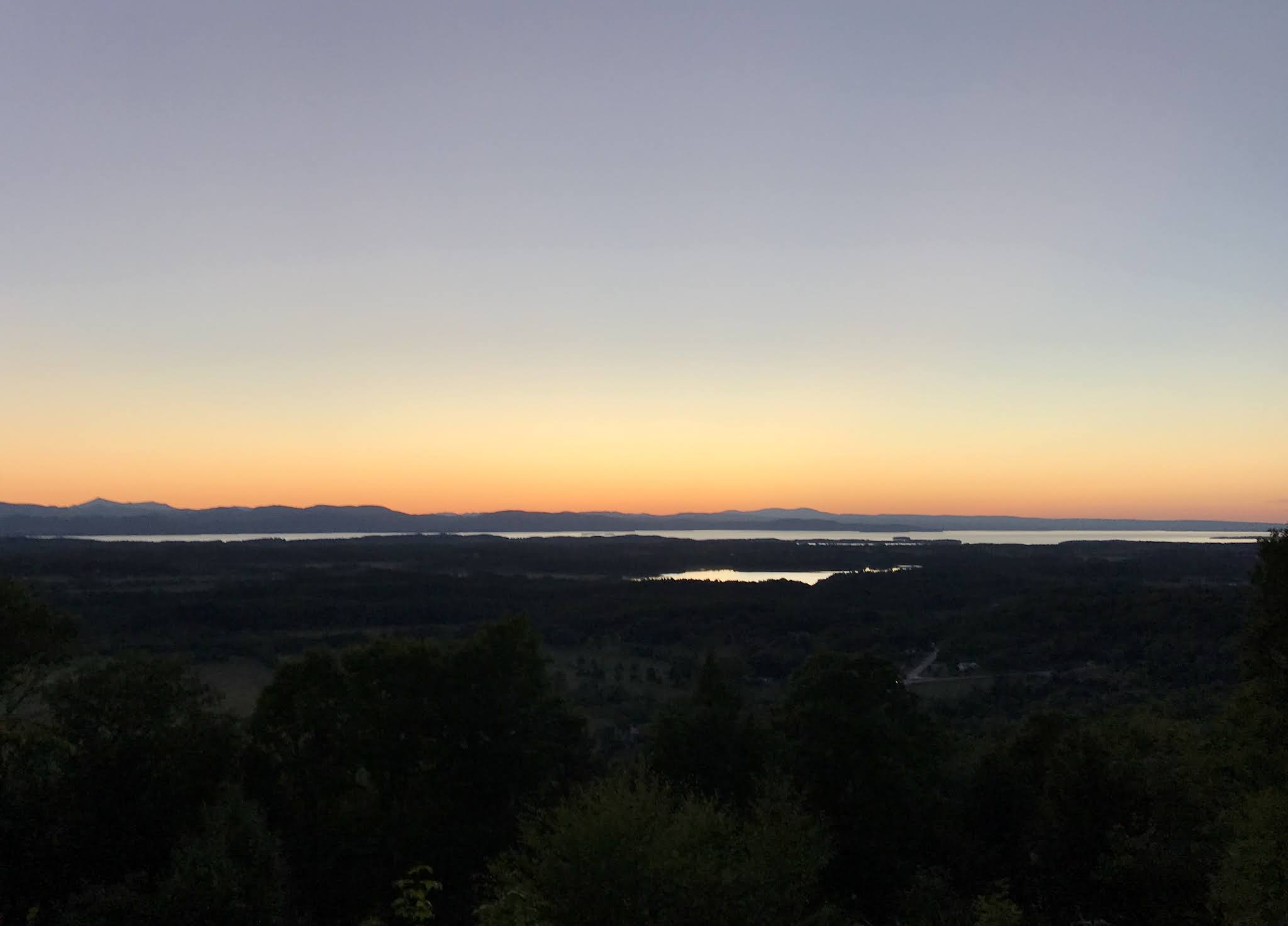

There was more light in
 the water than in the sky
as we paddled home.

But to return to the walk of the day.

Though there were some clouds in the west, there was a bright silver twilight before we reached our boat.

C. remarked it descending into the hollows immediately after sunset,

A red house could hardly be distinguished at a distance, but a white one appeared to reflect light on the landscape. 

At first we saw no redness in the sky, but only some peculiar dark wisp-like clouds in the west, but on rising a hill I saw a few red stains like veins of red quartz on a ground of feldspar.

The river was perfectly smooth except the upwelling of its tide, and as we paddled home westward, the dusky yellowing sky was all reflected in it, together with the dun-colored clouds and the trees, and there was more light in the water than in the sky.

The reflections of the trees and bushes on the banks were wonderfully dark and distinct, for though frequently we could not see the real bush in the twilight against the dark bank, in the water it appeared against the sky.  We were thus often enabled to steer clear of the overhanging bushes. 

It was an evening for the muskrats to be abroad, and we saw one, which dove as he was swimming rapidly, turning over like a wheel.

H. D. Thoreau, Journal, November 30, 1853


A flock of low-warbling tree sparrows.
See December 3, 1853 ("Saw two tree sparrows on Monroe's larch by the waterside. Larger than chip-birds, with more bay above and a distinct white bar on wings, not to mention bright-chestnut crown and obscure spot on breast; all beneath pale-ash. . . . uttering from time to time a faint, tinkling chip")

.I do not know so fine a pine grove as that of Mason's. See November 30, 1851 ("My eye wanders across the valley to the pine woods which fringe the opposite side, and in their aspect my eye finds something which addresses itself to my nature.. . .I experienced a transient gladness, at any rate, at something which I saw. I am sure that my eye rested with pleasure on the white pines, now reflecting a silvery light, the infinite stories of their boughs, tier above tier, a sort of basaltic structure, a crumbling precipice of pine horizontally stratified. Each pine is like a great green feather stuck in the ground. A myriad white pine boughs extend themselves horizontally, one above and behind another, each bearing its burden of silvery sunlight, ")

Though frequently we could not see the real bush in the twilight against the dark bank, in the water it appeared against the sky. See November 2, 1857 ("In the reflection the tree is black against the clear whitish sky, though as I see it against the opposite woods it is a warm greenish yellow. But the river sees it against the bright sky, and hence the reflection is like ink. The water tells me how it looks to it seen from below.");
 November 23, 1853 ("What lifts and lightens and makes heaven of the earth is the fact that you see the reflections of the humblest weeds against the sky, but you cannot put your head low enough to see the substance so. The reflection enchants us, just as an echo does.") See also A Book of the Seasons,  by Henry Thoreau, Reflections

It was an evening for the muskrats to be abroad, and we saw one, which dove as he was swimming rapidly, turning over like a wheel. See December 2, 1852 ("There goes a muskrat. He leaves so long a ripple behind that in this light you cannot tell where his body ends, and think him longer than he is.") See also A Book of the Seasons by Henry Thoreau, the Musquash

November 30. See A Book of the Seasons, by Henry Thoreau, November 30

There was more light in
 the water than in the sky
as we paddled home.


A Book of the Seasons
,  by Henry Thoreau
 "A book, each page written in its own season, 
out-of-doors, in its own locality."
 ~edited, assembled and rewritten by zphx ©  2009-2024

https://tinyurl.com/hdt-531130


Monday, October 21, 2019

The breath of winter

October 21

 P. M. — To Mason's pasture. 

The brook between John Flint's house and the river is half frozen over. 

The clump of mountain laurel in Mason's pasture is of a triangular form, about six rods long by a base of two and a third rods, — or seven or eight square rods, — beside some separate clumps. 

It is very cold and blustering to-day. It is the breath of winter, which is encamped not far off to the north. 

A great many shrub oak acorns hold on, and are a darker brown than ever.

H. D. Thoreau, Journal, October 21, 1859

The brook between John Flint's house and the river is half frozen over. 
See October 21, 1857 ("First ice that I’ve seen or heard of, a tenth of an inch thick in yard, and the ground is slightly frozen."); See also November 1, 1858 ("The reflection of Flint’s white house in the river, prolonged by a slight ripple so as to reach the reflected cloud, was a very distinct and luminous light blue.")

The clump of mountain laurel in Mason's pasture is of a triangular form, about six rods long by a base of two and a third rods. See December 13, 1851 ("While surveying to-day, saw much mountain laurel for this neighborhood in Mason's pasture, just over the line in Carlisle. Its bright yellowish-green shoots are agreeable to my eye.")

It is very cold and blustering to-day. See October 15, 1859 ("Standing on this hilltop this cold and blustering day, when dark and slate-colored clouds are flitting over the sky, the beauty of the scenery is enhanced by the contrast in the short intervals of sunshine.")

A great many shrub oak acorns hold on, and are a darker brown than ever. See August 28, 1853 ("The acorns show now on the shrub oaks."); September 13, 1859 ("I see some shrub oak acorns turned dark on the bushes and showing their meridian lines, but generally acorns of all kinds are green yet. "); September 30, 1859 ("Most shrub oak acorns browned."); October 1, 1859 ("The shrub oaks on this hill are now at their height, both with respect to their tints and their fruit. The . . .pretty fruit, varying in size, pointedness, and downiness, being now generally turned brown, with light, converging meridional lines. . . .Now is the time for shrub oak acorns."); October 14, 1859 ("The shrub oak acorns are now all fallen, — only one or two left on,")

October 21.  See A Book of the Seasons, by Henry Thoreau, October 21

Cold and blustering –
it is the breath of winter
encamped not far north.

A Book of the Seasons,  by Henry Thoreau
"A book, each page written in its own season,
out-of-doors, in its own locality.”
~edited, assembled and rewritten by zphx © 2009-2025

https://tinyurl.com/hdt-591021


Wednesday, September 3, 2014

Yellow butterflies in the damp road.

September 3.

September 3, 2023

Fair weather and a clear atmosphere after two days of mizzling, cloudy, and rainy weather and some smart showers at daylight and in the night. The street is washed hard and white. 

P. M. —- With Minot Pratt into Carlisle.

Woodbine berries purple. 

Even at this season I see some fleets of yellow butterflies in the damp road after the rain, as earlier. 

Pratt showed me a tobacco flower, long and tubular, slightly like a datura. 

In the meadow southwest of Hubbard's Hill saw white Polygala sanguinea, not described.

Close to the left-hand side of bridle-road, about a hundred rods south of the oak, a bayberry bush without fruit, probably a male one. 

It made me realize that this was only a more distant and elevated sea-beach and that we were within reach of marine influences. My thoughts suffered a sea-turn.

North of the oak (four or five rods), on the left of the bridle-road in the pasture next to Mason’s, tried to find the white hardback still out, but it was too late. 

Found the mountain laurel out again, one flower, close sessile on end of this year’s shoot. There were numerous blossom-buds expanding, and they may possibly open this fall.

A white hardback out of bloom by a pile of stones (on which I put another) in Robbins’s field, and a little south of it a clump of red huckleberries.

H. D. Thoreau, Journal, September 3, 1854

Even at this season I see some fleets of yellow butterflies in the damp road after the rain, as earlier. See July 26, 1854 ("Today I see in various parts of the town the yellow butterflies in fleets in the road, on bare damp sand, twenty or more collected within a diameter of five or six inches in many places . . . I do not know what attracts them thus to sit near together , like a fleet in a haven; why they collect in groups.") See also July 14, 1852 ("See to-day for the first time this season fleets of yellow butterflies in compact assembly in the road”); July 16, 1851 ("I see the yellow butterflies now gathered in fleets in the road, and on the flowers of the milkweed"); July 19, 1856 ("Fleets of yellow butterflies on road.");  October 18, 1856 (“I still see a yellow butterfly occasionally zigzagging by the roadside”); October 20, 1858 ("I see yellow butterflies chasing one another, taking no thought for the morrow, but confiding in the sunny day as if it were to be perpetual.") and A Book of the Seasons, by Henry Thoreau, Yellow Butterflies

September 3.  See A Book of the Seasons, by Henry Thoreau, September 3

Again see fleets of 
yellow butterflies in the 
damp road after rain.

A Book of the Seasons,  by Henry Thoreau
 "A book, each page written in its own season,
out-of-doors, in its own locality."
 ~edited, assembled and rewritten by zphx ©  2009-2024

https://tinyurl.com/hdt-540903

Wednesday, June 5, 2013

To Mason's pasture.

The world now full of verdure and fragrance and the air comparatively clear (not yet the constant haze of the dog-days), through which the distant fields are seen, reddened with sorrel, and the meadows wet green, full of fresh grass, and the trees in their first beautiful, bright, untarnished and unspotted green.

May is the bursting into leaf and early flowering, with much coolness and wet and a few decidedly warm days, ushering in summer; June, verdure and growth with not intolerable, but agreeable, heat.


The fresh light green shoots of  the hemlocks have now grown half an inch or an inch, spotting the trees, contrasting with the dark green of last year's foliage. 

The young pitch pines in Mason's pasture are a glorious sight, now most of the shoots grown six inches, so soft and blue-green, nearly as wide as high. It is nature's front yard.


Nature is fair in proportion as the youth is pure. The heavens and the earth are one flower. The earth is the calyx, the heavens the corolla.


H. D. Thoreau, Journal, June 5, 1853

The fresh light green shoots of the hemlocks.
See June 11, 1859 ("Hemlocks are about at height of their beauty, with their fresh growth."); June 26, 1860 ("The hemlocks are too much grown now and are too dark a green to show the handsomest bead-work by contrast..")

The heavens and the earth are one flower. See August 6, 1852 ("We live, as it were, within the calyx of a flower."); May 16, 1854 ("The earth is all fragrant as one flower.”); May 16, 1852 ("The whole earth is fragrant as a bouquet held to your nose.")

Tuesday, December 13, 2011

Travelling locally

December 13, 2014

December 13.


While surveying to-day, saw much mountain laurel for this neighborhood in Mason's pasture, just over the line in Carlisle. Its bright yellowish-green shoots are agreeable to my eye.

We had one hour of almost Indian summer weather in the middle of the day. I felt the influence of the sun. It melted my stoniness a little. The pines looked like old friends again. Cutting a path through a swamp where was much brittle dogwood, etc., etc., I wanted to know the name of every shrub.

This varied employment, to which my necessities compel me, serves instead of foreign travel and the lapse of time. If it makes me forget some things which I ought to remember, it no doubt enables me to forget many things which it is well to forget.

By stepping aside from my chosen path so often, I see myself better and am enabled to criticise myself. Of this nature is the only true lapse of time.


It seems an age since I took walks and wrote in my journal, and when shall I revisit the glimpses of the moon? To be able to see ourselves, not merely as others see us, but as we are?


H. D. Thoreau, Journal, December 13, 1851

This varied employment, to which my necessities compel me, serves instead of foreign travel and the lapse of time. See April 8, 1854 ("A day or two surveying is equal to a journey"); November 18 1851 ("The man who is bent upon his work is frequently in the best attitude to observe what is irrelevant to his work."); November 20, 1851("Hard and steady and engrossing labor with the hands, especially out of doors, is invaluable to the literary man")

Popular Posts Last 30 Days.

The week ahead in Henry’s journal

The week ahead in Henry’s journal
A journal, a book that shall contain a record of all your joy.
"A stone fruit. Each one yields me a thought." ~ H. D. Thoreau, March 28, 1859


I sit on this rock
wrestling with the melody
that possesses me.