Showing posts with label afternoon. Show all posts

Tuesday, April 3, 2018

The Day of the Snoring Frogs, or the Awakening of the Meadows.

April 3. 

Going down-town this morning, I am surprised by the rich strain of the purple finch from the elms. Three or four have arrived and lodged against the elms of our street, which runs east and west across their course, and they are now mingling their loud and rich strains with that of the tree sparrows, robins, bluebirds, etc. 

The hearing of this note implies some improvement in the acoustics of the air. It reminds me of that genial state of the air when the elms are in bloom. 

They sit still over the street and make a business of warbling. They advertise me surely of some additional warmth and serenity. How their note rings over the roofs of the village! You wonder that even the sleepers are not awakened by it to inquire who is there, and yet probably not another than myself in all the town observes their coming, and not half a dozen ever distinguished them in their lives. And yet the very mob of the town know the hard names of Germanians or Swiss families which once sang here or elsewhere. 

About 9 A. M., C. and I paddle down the river. 

It is a remarkably warm and pleasant day. The shore is alive with tree sparrows sweetly warbling, also black birds, etc. The crow blackbirds which I saw last night are hoarsely clucking from time to time. 

Approaching the island, we hear the air full of the hum of bees, which at first we refer to the near trees. It comes from the white maples across the North Branch, fifteen rods off. We hear it from time to time, as we paddle along all day, down to the Bedford line. There is no pause to the hum of the bees all this warm day. It is a very simple but pleasing and soothing sound, this susurrus, thus early in the spring. 

When off the mouth of the Mill Brook, we hear the stertorous tut tut tut of frogs from the meadow, with an occasional faint bullfrog-like er er er intermingled. I land there to reconnoitre. 

The river is remarkably low, quite down to summer level, and there is but very little water anywhere on the meadows. I see some shallow lagoons (west of the brook), whence the sound comes. 

There, too, are countless painted turtles out, around on the banks and hummocks left by the ice. Their black and muddy backs shine afar in the sun, and though now fifteen to twenty rods off, I see through my glass that they are already alarmed, have their necks stretched out and are beginning to slip into the  water, where many heads are seen. 

Resolved to identify this frog, one or two of whose heads I could already see above the surface with my glass, I picked my way to the nearest pool. Close where I landed, an R. halecina lay out on some sedge. In went all the turtles immediately, and soon after the frogs sank to the bottom, and their note was heard only from more distant pools. 

I stood perfectly still, and ere long they began to reappear one by one, and spread themselves out on the surface. They were the R. halecina. I could see very plainly the two very prominent yellow lines along the sides of the head and the large dark ocellated marks, even under water, on the thighs, etc. Gradually they begin to recover their voices, but it is hard to say at first which one of the dozen within twenty feet is speaking. They begin to swim and hop along the surface toward each other. Their note is a hard dry tut tut tut tut, not at all ringing like the toad’s, and produced with very little swelling or motion of the throat, but as much trembling of the whole body; and from time to time one makes that faint somewhat bullfrog-like er er er. Both these sounds, then, are made by one frog, and what I have formerly thought an early bullfrog note was this. 

This, I think, is the first frog sound I have heard from the river meadows or anywhere, except the croaking leaf-pool frogs and the hylodes. They are evidently breeding now like toads, and probably are about the water as exclusively as the toads will soon be. 

This sound we continue to hear all day long, especially from the broad meadows in Bedford. Close at hand a single one does not sound loud, yet it is surprising how far a hundred or thousand croaking ( ? ) at once can be heard. It comes borne on the breeze from north over the Bedford meadows a quarter of a mile off, filling the air. It is like the rattling of a wagon along some highway, or more like a distant train on a railroad, or else of many rills emptying in, or more yet like the sound of a factory, and it comes with an echo which makes it seem yet more distant and universal. At this distance it is a soft and almost purring sound, yet with the above-named bullfrog-like variation in it. 

Sometimes the meadow will be almost still; then they will begin in earnest, and plainly excite one an other into a general snoring or eructation over a quarter of a mile of meadow. It is unusually early to hear them so numerously, and by day, but the water, being so very low and shallow on the meadows, is unusually warm this pleasant day. This might be called the Day of the Snoring Frogs, or the Awakening of the Meadows. 

Probably the frost is out of the meadows very early this year. It is a remarkable spring for reptile life. 

It remains now to detect the note of the palustris, wood frog, and fontinalis. I am not sure but I heard one kind of bullfrog’s note along the river once or twice. I saw several middle-sized frogs with green noses and dark bodies, small, bullfrog-like (? ?), sitting along the shore. 

At what perhaps is called the Holt just below N. Barrett’s, many grackles and red-wings together flit along the willows by our side, or a little ahead, keeping up a great chattering, while countless painted turtles are as steadily rustling and dropping into the water from the willows, etc., just ahead. 

We land at Ball's Hill and eat our dinners. It is so warm we would fain bathe. We seek some shade and cannot easily find it. You wonder that all birds and insects are not out at once in such a heat. We find it delicious to take off our shoes and stockings and wade far through the shallows on the meadow to the Bedford shore, to let our legs drink air. 

How pretty the white fibrous roots of the eriocaulon, floating in tufts on the meadow, like beaded chains! 

In the hazy atmosphere yesterday we could hardly see Garfield's old unpainted farmhouse. It was only betrayed by its elms. This would be the right color for painters to imitate. When the sun went into a cloud we detected the outlines of the windows only. 

When returning, we discovered, on the south side of the river, just at the old crossing-place from the Great Meadows, north of the ludwigia pool, a curious kind of spawn. It was white, each ovum about as big as a robin-shot or larger, with mostly a very minute white core, no black core, and these were agglutinated together in the form of zigzag hollow cylinders, two or three inches in diameter and one or two feet long, looking like a lady's ruff or other muslin work, on the bottom or on roots and twigs of willow and button-bush, where the water was two or three feet deep. The greater part lay on the bottom, looking like a film, these cylinders being somewhat coiled about there. When you took it up, the two sides fell together, and it was flat in your hand like the leg of a stocking. In one place there were a dozen very large red-bellied and brown-backed leeches in it, evidently battening on it. This must be frog or fish spawn. 

If frog-spawn, I think it must be that of the Rana halecina [No. Vide April 5th. Is it not fish-spawn?], the only ones fairly awake along the river; but how are leeches propagated? There was a great abundance of it, many bushels, for at least a dozen rods along the shore, and it must afford food to many creatures. The consistency of a jelly we eat. We saw one perch there. Some on the ruts was quite up to the surface, but most lower. When you had taken up a handful and broken it, on dropping it into the water it recovered its form for the most part. I noticed that the fine willow root-fibres and weeds, potamogeton, etc., there were thickly covered with a whitish film or fuzz, an eighth to a quarter of an inch deep, or long, apparently connected with this spawn, which made them look like plants covered with frost in a winter morning, though it was a duller white; but out of water you did not perceive anything. Probably this was the milt. 

When I have been out thus the whole day and spend the whole afternoon returning, it seems to me pitiful and ineffectual to be out as usual only in the afternoon, – as if you had come late to a feast, after your betters had done. The afternoon seems coarse and reversed, or at best a long twilight, after the fresh and bright forenoon. 

The gregariousness of men is their most contemptible and discouraging aspect. See how they follow each other like sheep, not knowing why. Day & Martin's   blacking was preferred by the last generation, and also is by this. They have not so good a reason for preferring this or that religion as in this case even. Apparently in ancient times several parties were nearly equally matched. They appointed a committee and made a compromise, agreeing to vote or believe so and so, and they still helplessly abide by that. Men are the inveterate foes of all improvement. Generally speaking, they think more of their hen-houses than of any desirable heaven. If you aspire to anything better than politics, expect no cooperation from men. They will not further anything good. You must prevail of your own force, as a plant springs and grows by its own vitality. 

Hear the Rana halecina in the evening also, from my window.
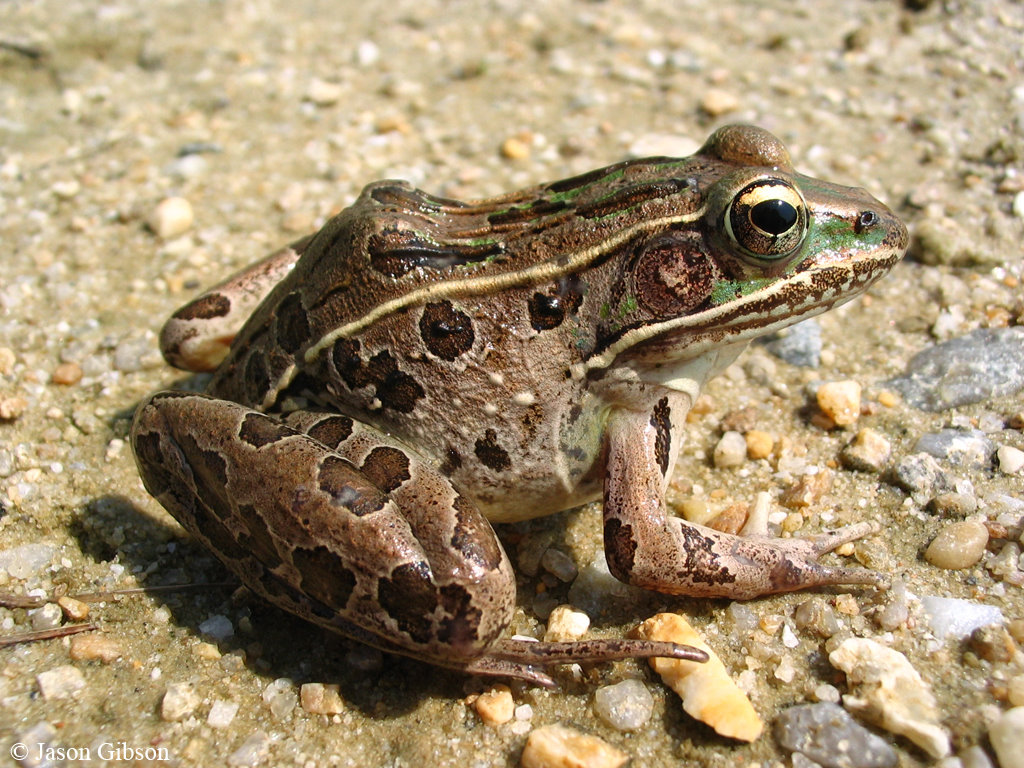

Rana halecina

I could see very plainly the two very prominent yellow lines along the sides of the head
and the large dark ocellated marks, even under water, on the thighs, etc.

H. D. Thoreau, Journal, April 3, 1858

We hear the air full of the hum of bees, which . . .comes from the white maples across the North Branch, fifteen rods off. . .It is a very simple but pleasing and soothing sound, this susurrus, thus early in the spring. See April 6, 1854 ("I am surprised to find so much of the white maples already out. . . . They resound with the hum of honey-bees, heard a dozen rods off, and you see thousands of them about the flowers against the sky. . . .This susurrus carries me forward some months toward summer --"); April 6, 1853 ("Notice a white maple with almost all the staminate flowers above or on the top, most of the stamens now withered, before the red maple has blossomed. Another maple, all or nearly all female. The staminiferous flowers look light yellowish, the female dark crimson”); April 6,1855 ("A very few white maple stamens stand out already loosely enough to blow in the wind.") White maple stamens stand out already loosely enough to blow in the wind.");  April 7, 1861 (" The white maple at the bridge not quite out.”); April 8, 1855 (I find some anthers effete and dark, and others still mealy with pollen. There are many in this condition. The crimson female stigmas also peeping forth. It evidently began to shed pollen yesterday.”); April 9, 1852 ("The maple by the bridge in bloom”);


This might be called the Day of the Snoring Frogs, or the Awakening of the Meadows. See April 5, 1855 ("Hear from one half-flooded meadow that low, general, hard, stuttering tut tut tut of frogs,—the awakening of the meadow.”);   April 5, 1858 ("The woods resound with the one [R. sylvatica], and the meadows day and night with the other [R. halecina], so that it amounts to a general awakening of the pools and meadows. "); April 5, 1860 (" a very faint distant ring of toads.");  April 9, 1853 (“The whole meadow resounds, probably from one end of the river to the other, this evening, with this faint, stertorous breathing. It is the waking up of the meadows."); 

Rana halecina (Lithobates pipiens) – Northern Leopard Frog. See  April 8, 1852 ("To-day I hear the croak of frogs in small pond-holes in the woods"); August 22, 1854 ("There are now hopping all over this meadow small Rana palustris, and also some more beautifully spotted halecina or shad frogs.");April 13, 1855 ("The small croaking frogs are now generally heard in all those stagnant ponds or pools in woods floored with leaves, which are mainly dried up in the summer.");  April 15, 1855 ("That general tut tut tut tut, or snoring, of frogs on the shallow meadow heard first slightly the 5th. There is a very faint er er er now and then mixed with it."); April 13, 1856 ("As I go by the Andromeda Ponds, I hear the tut tut of a few croaking frogs. . ."); June 17, 1856 ("Went to Rev. Horace James’s reptiles (Orthodox). . . . He distinguished the Rana halecina in the alcohol by more squarish (?) spots.");  March 31,1857 ("The dry croaking and tut tut of the frogs"); April 4, 1857 ("Caught a croaking frog in some smooth water in the railroad gutter. Above it was a uniform (perhaps olive?) brown, without green, and a yellowish line along the edge of the lower jaws.. . .What frog can it be?"); September 6, 1857 ("I observe to-day, away at the south end of our dry garden, a moist and handsome Rana halecina. It is the only frog that I ever see in such localities. He is quite a traveller."); April 1, 1858 ("A Rana halecina on the bank"); April 2, 1858 ("I catch a large Rana halecina, which puffs itself up “); April 5, 1858 (“I go to the meadow at the mouth of the Mill Brook to find the spawn of the R. halecina. They are croaking and coupling there by thousands")

We could hardly see Garfield's old unpainted farmhouse. See August 26, 1858 ("A weather-painted house and barn, with an orchard by its side, in midst of a sandy field surrounded by green woods, with a small blue lake on one side. A sympathy between the color of the weather-painted house and that of the lake and sky. . . .The weather-painted house. This is the New England color.")


April 3. See A Book of the Seasons, by Henry Thoreau, April 3

A Book of the Seasons, by Henry Thoreau
"A book, each page written in its own season,
out-of-doors, in its own locality.”
~edited, assembled and rewritten by zphx © 2009-2022


Saturday, July 27, 2013

The Afternoon of the Year

July 26. 

I reckon that about nine tenths of the flowers of the year have now blossomed. 

Dog-days, - sultry, sticky weather, - now when the corn is topped out. Clouds without rain. Rains when it will. Old spring and summer signs fail.

The bobolinks are just beginning to fly in flocks, and I hear their link link. I see the young birds also, just able to get out of my way above the weeds and bushes of the low grounds their tails not grown out to steady them.

Lark, too seen now, four or five together, sing as of yore; also the goldfinch twitters over oftener.

I notice to-day the first purplish aster, a pretty sizable one; may have been out a day or two, near the brook beyond Hubbard's Grove, - A.Radula.

I mark again the sound of crickets or locusts about alders, etc. about this time when the first asters open, which makes you fruitfully meditative, helps condense your thoughts, like the mel dews in the afternoon. This the afternoon of the year.

How apt we are to be reminded of lateness, even before the year is half spent! Such little objects check the diffuse tide of our thoughts and bring it to a head, which thrills us. They are such fruits as music, poetry, love, which humanity bears.

Saw one of the common wild roses (R. lucida?).

The swamp blackberry ripe in open ground. 

The Rhus copallina is not yet quite out, though the glabra is in fruit. 

The smaller purple fringed orchis has not quite filled out its spike. What a surprise to detect under the dark, damp, cavernous copse, where some wild beast might fitly prowl, this splendid flower, silently standing with all its eyes on you! It has a rich fragrance withal. 

July 26, 2013

Rain in the evening.

H. D. Thoreau, Journal, July 26, 1853

Dog-days, - sultry, sticky weather, - now when the corn is topped out . . . when the first asters open, the sound of crickets or locusts that makes you fruitfully meditative. See July 26, 1854 ("The peculiarity of the stream is . . . a dog-day density of shade reflected darkly in the water . . . Almost constantly I hear borne on the wind from far, mingling with the sound of the wind, the z-ing locust, scarcely like a distinct sound"); July 26, 1859 ("Dogdayish.") See also A Book of the Seasons, by Henry Thoreau, Locust, Dogdayish Days

This the afternoon of the year.  See August, 19, 1853 (" The day is an epitome of the year.”);
August 23, 1853 "I am again struck by the perfect correspondence of a day — say an August day — and the year. I think that a perfect parallel may be drawn between the seasons of the day and of the year.”)

The bobolinks are just beginning to fly in flocks, and I hear their link link. I see the young birds also, just able to get out of my way. See July 19, 1855 ("Young bobolinks; one of the first autumnalish notes."); August 15, 1852 ("I see a dense, compact flock of bobolinks going off in the air over a field. They cover the rails and alders, and go rustling off with a brassy, tinkling note as I approach, revealing their yellow breasts and bellies. This is an autumnal sight, that small flock of grown birds in the afternoon sky.") See also A Book of the Seasons, by Henry Thoreau, the Bobolink

I notice to-day the first purplish aster. See July 23, 1859 ("Aster Radula, how long?"); July 25, 1857 {Maine woods} ("Here, among others, were the Aster Radula, just in bloom"); July 28, 1852 ("Aster Radula (?) in J. P. Brown's meadow.")

How apt we are to be reminded of lateness, even before the year is half spent! See July 28, 1854 ("Methinks the season culminated about the middle of this month , — that the year was of indefinite promise before, but that, after the first intense heats , we postponed the fulfillment of many of our hopes for this year, and, having as it were attained the ridge of the summer, commenced to descend the long slope toward winter, the afternoon and down- hill of the year .) See also A Book of the Seasons, by Henry Thoreau, Midsummer midlife blues

Such little objects check the diffuse tide of our thoughts and bring it to a head, which thrills us. See September 3, 1853 ("I will endeavor to separate the tide in my thoughts, or what is due to the influence of the moon, from the current distractions and fluctuations.")

Music, poetry, love . . . See November 30, 1858 ("music, poetry, beauty, and the mystery of life . . .”)

Saw one of the common wild roses (R. lucida?) See July 17, 1854 ("The late rose not fairly begun along the river, now when lucida is leaving off. ") See also A Book of the Seasons, by Henry Thoreau, The Wild Rose

The smaller purple fringed orchis has not quite filled out its spike. See July 21, 1851 ("The small purple orchis, its spikes half opened "); July 24, 1856 ("The small purple fringed orchis, apparently three or four days at least");  July 30, 1853 ("A small purple orchis (Platanthera psycodes), quite small, so that I perceive what I called by this name before must have been the fimbriata."); August 1, 1852 ("Found a long, dense spike of the Orchis psycodes. Much later this than the great orchis. The same, only smaller and denser, not high-colored enough. ") See also A Book of the Seasons, by Henry Thoreau, The Purple Fringed Orchids

July 26. See A Book of the Seasons, by Henry Thoreau, July 26

I notice to-day
the first purplish aster –
Aster Radula 

They are such fruits as 
music, poetry, love, which 
humanity bears.

A Book of the Seasons, by Henry Thoreau
"A book, each page written in its own season,
out-of-doors, in its own locality."
~edited, assembled and rewritten by zphx © 2009-2021

Wednesday, September 7, 2011

The art of life

September 7.

The art of life! Was there ever anything memorable written upon it? I do not remember any page which will tell me how to spend this afternoon.

How to live. How to get the most life. The art of spending a day. Can a youth, a man, do more wisely than to go where his life is to be found? To observe what transpires, not in the street, but in the mind and heart of me!

I do not so much wish to know how to economize time as how to spend it, that the day may not have been in vain. How to extract its honey from the flower of the world. That is my every-day business.

The discoveries which we make abroad are special and particular; those which we make at home are general and significant. The further off, the nearer the surface. The nearer home, the deeper.

We are receiving our portion of the infinite. We are surrounded by a rich and fertile mystery. May we not probe it, pry into it, employ ourselves about it, a little? To watch for, describe, all the divine features which I detect in Nature. 

My profession is to be always on the alert to find God in nature, to know his lurking-places, to attend all the oratorios, the operas, in nature.

H. D. Thoreau, Journal,
 September 7, 1851


The art of life. See  September 2, 1851 ("It is always essential that we love to do what we are doing, do it with a heart."); January 12, 1852 ("Do the things which lie nearest to you – but which are difficult to do.");; April 29, 1852 (“The art of life, of a poet's life, is, not having anything to do, to do something.”); Walden ("To effect the quality of the day, that is the highest of arts.”) and ("In eternity there is indeed something true and sublime. But all these times and places and occasions are now and here. God Himself culminates in the present moment, and will never be more divine in the lapse of all the ages. And we are enabled to apprehend at all what is sublime and noble only by the perpetual instilling and drenching of the reality that surrounds us. The universe constantly and obediently answers to our conceptions; whether we travel fast or slow, the track is laid for us. Let us spend our lives in conceiving then. . . .Let us spend one day as deliberately as Nature, . . .— determined to make a day of it.”);  see also October 18, 1855 (“Pursue some path, however narrow and crooked, in which you can walk with love and reverence.”); November 18, 1857 "Each man's necessary path, though as obscure and apparently uneventful as that of a beetle in the grass, is the way to the deepest joys he is susceptible of . . .”) See also A Book of the Seasons,  by Henry Thoreau, To effect the quality of the day

My profession is to be always on the alert to find God in nature, to know his lurking-places, to attend all the oratorios, the operas, in nature. See August 30, 1856 ("I get my new experiences still, not at the opera listening to the Swedish Nightingale, but at Beck Stow's Swamp listening to the native wood thrush.”)


I don’t remember 
a page to tell me how to 
spend this afternoon.

How to receive our
portion of the infinite.

A Book of the Seasons, by Henry Thoreau 

"A book, each page written in its own season,
out-of-doors, in its own locality.”
~edited, assembled and rewritten by zphx © 2009-2025

https://tinyurl.com/hdt-510907 

***


Sept. 7.

We sometimes experience a mere fullness of life, which does not find any channels to flow into.

We are stimulated, but to no obvious purpose. 


I feel myself uncommonly prepared for some literary work, but I can select no work.

I am prepared not so much for contemplation, as for forceful expression.

I am braced both physically and intellectually.

It is not so much the music as the marching to the music that I feel.

I feel that the juices of the fruits which I have eaten, the melons and apples, have ascended to my brain and are stimulating it.

They give me a heady force.

Now I can write nervously.

Carlyle ' s writing is for the most part of this character.
Miss Martineau ' s last book is not so bad as the timidity which fears its influence.

As if the popularity of this or that book would be so fatal, and man would not still be man in the world. 


Nothing is so much to be feared as fear.

Atheism may comparatively be popular with God himself.

What shall we say of these timid folk who carry the principle of thinking nothing and doing nothing and being nothing to such an extreme?­

As if, in the absence of thought, that vast yearning of their natures for something to fill the vacuum made the least traditionary expression and shadow of a thought to be clung to with instinctive tenacity.

They atone for their producing nothing by a brutish respect for something.

They are as simple as oxen, and as guiltless of thought and reflection.

Their reflections are reflected from other minds.

The creature of institutions, bigoted and a conservatist, can say nothing hearty.

He cannot meet life with life, but only with words.

He rebuts you by avoiding you.

He is shocked like a woman. 


Our ecstatic states, which appear to yield so little fruit, have this value at least : though in the seasons when our genius reigns we may be powerless for expression, yet, in calmer seasons, when our talent is active, the memory of those rarer moods comes to color our picture and is the permanent paint-pot, as it were, into which we dip our brush.

Thus no life or experience goes unreported at last; but if it be not solid gold it is gold-leaf, which gilds the furniture of the mind.

It is an experience of infinite beauty on which we unfailingly draw, which enables us to exaggerate ever truly.

Our moments of inspiration are not lost though we have no particular poem to show for them; for those experiences have left an indelible impression, and we are ever and anon reminded of them.

Their truth subsides, and in cooler moments we can use them as paint to gild and adorn our prose.

When I despair to sing them, I will remember that they will furnish me with paint with which to adorn and preserve the works of talent one day.

They are like a pot of pure ether.

They lend the writer when the moment comes a certain superfluity of wealth, making his expression to overrun and float itself.

It is the difference between our river, now parched and dried up, exposing its unsightly and weedy bottom, and the same when, in the spring, it covers all the meads with a chain of placid lakes, reflecting the forests and the skies.


We are receiving our portion of the infinite.

The art of life! Was there ever anything memorable written upon it?­

By what disciplines to secure the most life, with what care to watch our thoughts.

To observe what transpires, not in the street, but in the mind and heart of me!

I do not remember any page which will tell me how to spend this afternoon.

I do not so much wish to know how to economize time as how to spend it, by what means to grow rich, that the day may not have been in vain.

What if one moon has come and gone with its world of poetry, its weird teachings, its oracular suggestions?­ So divine a creature, freighted with hints for me, and I not use her! One moon gone by unnoticed! ! 


Suppose you attend to the hints, to the suggestions, which the moon makes for one month, — commonly in vain, — will they not be very different from anything in literature or religion or philosophy?­

The scenery, when it is truly seen, reacts on the life of the seer.

How to live.

How to get the most life.

As if you were to teach the young hunter how to entrap his game.

How to extract its honey from the flower of the world.

That is my every-day business.

I am as busy as a bee about it.

I ramble over all fields on that errand, and am never so happy as when I feel myself heavy with honey and wax.

I am like a bee searching the livelong day for the sweets of nature.

Do I not impregnate and intermix the flowers, produce rare and finer varieties by transferring my eyes from one to an other?­

I do as naturally and as joyfully, with my own humming music, seek honey all the day.

With what honeyed thought any experience yields me I take a bee line to my cell.

It is with flowers I would deal.

Where is the flower, there is the honey, — which is perchance the nectareous portion of the fruit, — there is to be the fruit, and no doubt flowers are thus colored and painted to attract and guide the bee.

So by the dawning or radiance of beauty are we advertised where is the honey and the fruit of thought, of discourse, and of action.

We are first attracted by the beauty of the flower, before we discover the honey which is a foretaste of the future fruit.

Did not the young Achilles (?) spend his youth learning how to hunt?­

The art of spending a day.

If it is possible that we may be addressed, it behooves us to be attentive.

If by watching all day and all night I may detect some trace of the Ineffable, then will it not be worth the while to watch?­

Watch and pray without ceasing, but not necessarily in sadness.

Be of good cheer.

Those Jews were too sad: to another people a still deeper revelation may suggest only joy.

Don't I know what gladness is?­

Is it but the reflex of sadness, its back side?­

In the Hebrew gladness, I hear but too distinctly still the sound of sadness retreating.

Give me a gladness which has never given place to sadness.

I am convinced that men are not well employed, that this is not the way to spend a day.

If by patience, if by watching, I can secure one new ray of light, can feel myself elevated for an instant upon Pisgah, the world which was dead prose to me become living and divine, shall I not watch ever? shall I not be a watchman hence forth?­

If by watching a whole year on the city's walls I may obtain a communication from heaven, shall I not do well to shut up my shop and turn a watchman?­

Can a youth, a man, do more wisely than to go where his life is to [be] found?­

As if I had suffered that to be rumor which may be verified.

We are surrounded by a rich and fertile mystery.

May we not probe it, pry into it, employ ourselves about it, a little­?

To devote your life to the discovery of the divinity in nature or to the eating of oysters, would they not be attended with very different results?­

I cannot easily buy a blank-book to write thoughts in; they are all ruled for dollars and cents.

If the wine, the water, which will nourish me grows on the surface of the moon, I will do the best I can to go to the moon for it.

The discoveries which we make abroad are special and particular; those which we make at home are general and significant.

The further off, the nearer the surface.

The nearer home, the deeper.

Go in search of the springs of life, and you will get exercise enough.

Think of a man's swinging dumb-bells for his health, when those springs are bubbling in far-off pastures unsought by him! The seeming necessity of swinging dumb-bells proves that he has lost his way.

To watch for, describe, all the divine features which I detect in Nature.

My profession is to be always on the alert to find God in nature, to know his lurking-places, to attend all the oratorios, the operas, in nature. 


The mind may perchance be persuaded to act, to energize, by the action and energy of the body.

Any kind of liquid will fetch the pump.

We all have our states of fullness and of emptiness, but we overflow at different points.

One overflows through the sensual outlets, another through his heart, another through his head, and another perchance only through the higher part of his head, or his poetic faculty.

It depends on where each is tight and open.

We can, perchance, then direct our nutriment to those organs we specially use.


September 7, 1851


Elevated for an instant upon Pisgah. See January 24, 1852 ("
I feel as if I then received the gifts of the gods with too much indifference . . . Why did I not use my eyes when I stood on Pisgah?")

If it is possible that we may be addressed, it behooves us to be attentive. See  January 1851 ("It is something to know when you are addressed by Divinity and not by a common traveller . . . How many communications may we not lose through inattention!")

Popular Posts Last 30 Days.

The week ahead in Henry’s journal

The week ahead in Henry’s journal
A journal, a book that shall contain a record of all your joy.
"A stone fruit. Each one yields me a thought." ~ H. D. Thoreau, March 28, 1859


I sit on this rock
wrestling with the melody
that possesses me.