Showing posts with label july 20. Show all posts

Tuesday, July 20, 2021

A Book of the Seasons: July 20 (walking at night and by moonlight, the first star, fireflies, starlight and last traces of daylight, thunderstorms)


The year is but a succession of days,
and I see that I could assign some office to each day
which, summed up, would be the history of the year.
Henry Thoreau, August 24, 1852

 July 20.

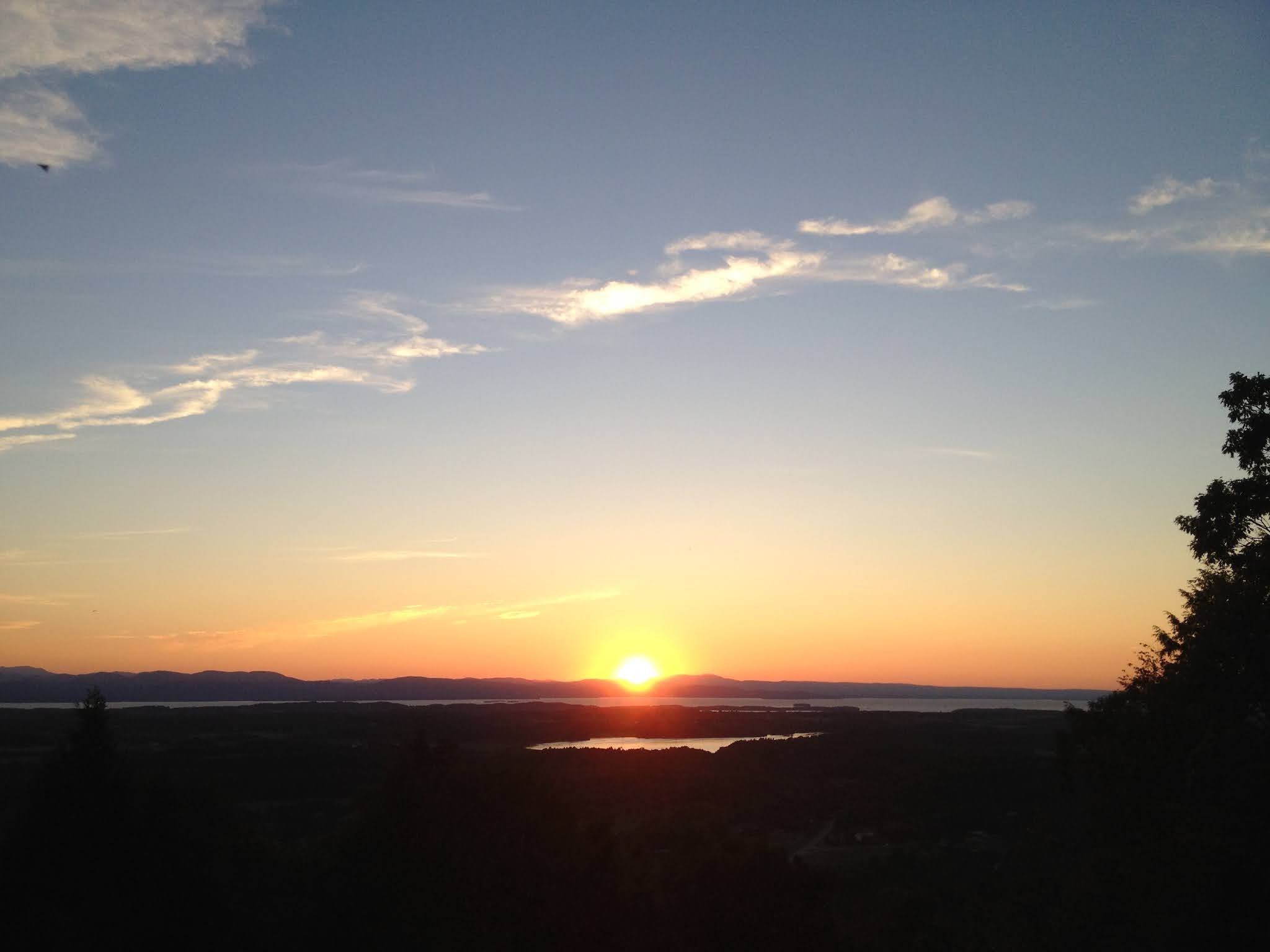
The mountains look like
waves on a blue ocean tossed
up by a stiff gale.

The first whip-poor-will 
sings in the dark pitch pine wood 
on Bear Garden Hill. 

We see the first star 

and know not if we might have

seen it earlier.


Old moon visible
in the arms of the crescent
if we do not look.

As we look, a bird
flies across the disk of the
midsummer night's moon.

Darting forked lightning
and muttering thunder-cloud
drive me home again.

Riding in the cars
is now like sitting in the
flue of a chimney.


July 20, 2020


A thunder-shower in the night. The clap that wakes me is as if some one is moving lumber in an upper apartment, some vast hollow hall, tumbling it down and dragging it over the floor; and ever and anon the lightning fills the damp air with light. July 20, 1851

A very hot day, a bathing day. Warm days about this. Corn in blossom these days. July 20, 1854

The mountains look like waves on a blue ocean tossed up by a stiff gale. July 20, 1851

A muttering thunder-cloud in northwest gradually rising and with its advanced guard hiding in the sun and now and then darting forked lightning.  July 20, 1854

Caught a middle-sized copper-colored devil's-needle (with darker spots on wings), sluggish, on a grass stem, with many dark-colored elliptical eggs packed closely to outside, under its breast. July 20, 1856. 

The clouds, as usual, are arranged with reference to the sunset. The sun is gone. An amber light and golden glow. The horns of the moon only three or four days old look very sharp, still cloud like, in the midst of a blue space, prepared to shine a brief half-hour before it sets. 
July 20, 1852

The redness now begins to fade on eastern clouds, and the western cloudlets glow with burnished copper alloyed with gold. July 20, 1852

Then the cloudlets in the west turn rapidly dark, the shadow of night advances in the east, and the first stars become visible. July 20, 1852

It is starlight. You see the first star in the southwest, and know not how much earlier you might have seen it had you looked. July 20, 1852

We have come round the east side of the hill to see the moon from amid the trees. July 20, 1852 .

The moon was at first eclipsed by a vast black bank of cloud in the east horizon, which seemed to rise faster than it, and threatened to obscure it all the night. July 20, 1853

This is the midsummer night's moon.  July 20, 1853

As we looked, a bird flew across the disk of the moon. 
July 20, 1853 

Saw two skunks carrying their tails about some rocks. Singular that, of all the animated creation, chiefly these skunks should be abroad in this moonlight.  July 20, 1853

There is a mist very generally dispersed, which gives a certain mellowness to the light, a wavingness apparently, a creaminess. Yet the light of the moon is a cold, almost frosty light, white on the ground.  July 20, 1853

Night is seen settling down with mists on Fair Haven Bay. The stars are few and distant; the fireflies fewer still. July 20, 1852

There are a few fireflies about. Green, their light looks sometimes, and crickets are heard. July 20, 1853.

There is a second glow on the few low western cloudlets, when we thought the sun had bid us a final adieu. - Those small clouds, the rearmost guard of day, which were wholly dark, are again lit up for a moment with a dull-yellowish glow and again darken. July 20, 1852

You are pretty sure also to hear some human music, vocal or instrumental, far or near. July 20, 1853

Now the first whip-poor-will sings hollowly in the dark pitch pine wood on Bear Garden Hill. 
July 20, 1852.

And now, when we had thought the day birds gone to roost, the wood thrush takes up the strain. July 20, 1852.

And now the evening redness deepens till all the west or northwest horizon is red; as if . . .as if the Artist of the world had mixed his red paints on the edge of the inverted saucer of the sky. An exhilarating, cheering redness, most wholesome. July 20, 1852

The crescent moon, meanwhile, grows more silvery, and, as it sinks in the west, more yellowish, and the outline of the old moon in its arms is visible if you do not look directly at it. 
July 20, 1852

 Some dusky redness lasts almost till the last traces of daylight disappear, about 10 o'clock, the same time the moon goes downJuly 20, 1852

Delayed by fog in night off coast of Maine. July 20, 1857

July 20, 2018

***

A Book of the Seasons, by Henry Thoreau, Fireflies

July 24, 2014
***** 

May 8, 1852 (“Starlight marks conveniently a stage in the evening, i. e. when the first star can be seen.”)
May 29, 1857 ("The crashing thunder sounds like the overhauling of lumber on heaven's loft.")
June 17, 1852 ("The thunder sounds like moving a pile of boards in the attic."); 
June 20, 1853 (“ The moon full. . . . Saw a little skunk coming up the river-bank in the woods at the White Oak.”)
June 28,1852 ("Now it is starlight; perhaps that dark cloud in the west has concealed the evening star before . . . Starlight! That would be a good way to mark the hour, if we were precise. That is an epoch, when the last traces of daylight have disappeared and the night (nox) has fairly set in.”) 
June 30, 1852 (“It is starlight about half an hour after sunset to-night; i. e. the first stars appear”)
July 12, 1851("Now at least the moon is full, and I walk alone, which is best by night, if not by day always.")
 July 12, 1851 ("I see a skunk on Bear Garden Hill stealing noiselessly away from me, while the moon shines over the pitch pines")
July 12, 1852 (“Now, a quarter after nine, as I walk along the river-bank, long after starlight, and perhaps an hour or more after sunset, I see some of those high-pillared clouds of the day, in the southwest, still reflecting a downy light from the regions of day, they are so high.”)
July 14, 1851 ("If I take the same walk by moonlight an hour later or earlier in the evening, it is as good as a different one.")
July 16, 1850  ("Many men walk by day; few walk by night. It is a very different season. Instead of the sun, there are the moon and stars; instead of the wood thrush, there is the whip-poor-will; instead of butterflies, fireflies, winged sparks of fire!")
July 17, 1854 ("I am surprised to see crossing my course in middle of Fair Haven Pond great yellowish devil's-needles, flying from shore to shore.")


July 21, 1852 ("Do we perceive such a deep Indian red after the first starlight at any other season as now in July?”)
July 21, 1852 ("I see the earliest star fifteen or twenty minutes before the red is deepest in the horizon ")
July 23, 1852 ("About three quarters of an hour after sunset the evening red is deepest.")
July 27, 1852 ("I turn round, and there shines the moon, silvering the small clouds which have gathered; she makes nothing red.")
August 5, 1851 ("As the twilight deepens and the moonlight is more and more bright, I begin to distinguish myself, who I am and where . . . sensible of my own existence, as when a lamp is brought into a dark apartment and I see who the company are.")
August 5, 1851 ("I hear now from Bear Garden Hill — I rarely walk by moonlight without hearing — the sound of a flute, or a horn, or a human voice")
August 8, 1851 (“The moon has not yet quite filled her horns”)
August 8, 1851 ("Starlight! that would be a good way to mark the hour, if we were precise.”)
December 23, 1851 (“I detect, just above the horizon, the narrowest imaginable white sickle of the new moon.”)
December 25, 1858 ("Unless you watch it, you do not know when the sun goes down.")

July 20, 2012

If you make the least correct 
observation of nature this year,
 you will have occasion to repeat it
 with illustrations the next, 
and the season and life itself is prolonged.


July 19 <<<<<<   July 20   >>>>>> July 21

A Book of the Seasons, by Henry Thoreau July 20
A Book of the Seasons,  by Henry Thoreau
 "A book, each page written in its own season, 
out-of-doors, in its own locality."
 ~edited, assembled and rewritten by zphx ©  2009-2022


The midsummer night's moon.


July 20.

 
July 20, 2012

To Nawshawtuct at moonrise with Sophia, by boat.

Moon apparently fulled yesterday.

A low mist in crusts the meadow, -- not so perceptible when we are on the water. Now we row through a thin low mist about as high as one's head, now we come to a place where there is no mist on the river or meadow, apparently where a slight wind stirs.

The gentle susurrus from the leaves of the trees on shore is very enlivening, as if Nature were freshening, awakening to some enterprise. There is but little wind, but its sound, incessantly stirring the leaves at a little distance along the shore, heard not seen, is very inspiriting. It is like an everlasting dawn or awakening of nature to some great purpose.

As we go up the hill we smell the sweet briar.

The trees are now heavy, dark masses without tracery, not as in spring or early in June; but I forgot to say that the moon was at first eclipsed by a vast black bank of cloud in the east horizon, which seemed to rise faster than it, and threatened to obscure it all the night.

But suddenly she rose above it, and when, a few moments after, we thought to look again for the threatening cloud-bank, it had vanished, or a mere filmy outline could be faintly traced beneath her.

It was the eclipse of her light behind it that made this evil look so huge and threatening, but now she had triumphed over it and eclipsed it with her light.

It had vanished, like an ugly dream.

So is it ever with evils triumphed over, which we have put behind us.

What was at first a huge dark cloud in the east which threatened to eclipse the moon the livelong night is now suddenly become a filmy vapor, not easy to be detected in the sky, lit by her rays.

She comes on thus, magnifying her dangers by her light, at first displaying, revealing them in all their hugeness and blackness, exaggerating, then casting them behind her into the light concealed.

She goes on her way triumphing through the clear sky like a moon which was threatened by dark clouds at her rising but rose above them. That black, impenetrable bank which threatened to be the ruin of all our hopes is now a filmy dash of vapor with a faint-purplish tinge, far in the orient sky.

From the hilltop we see a few distant lights in farmhouses down below, hard to tell where they are, yet better revealing where they are than the sun does.  But cottage lights are not conspicuous now as in the autumn.

As we looked, a bird flew across the disk of the moon.

Saw two skunks carrying their tails about some rocks. Singular that, of all the animated creation, chiefly these skunks should be abroad in this moonlight.

This is the midsummer night's moon.

We have come round the east side of the hill to see the moon from amid the trees. I like best to see its light falling far in amid the trees and along the ground before me, while itself is hidden behind them or one side.

It is cool, methinks with a peculiar coolness, as it were from the luxuriance of the foliage, as never in June. At any rate we have had no such sultry nights this month as in June.

There is a greater contrast between night and day now, reminding me that even in Hindostan they freeze ice in shallow vessels at night in summer (?).

There is a mist very generally dispersed, which gives a certain mellowness to the light, a wavingness apparently, a creaminess.

Yet the light of the moon is a cold, almost frosty light, white on the ground.

There are a few fireflies about. Green, their light looks sometimes, and crickets are heard.

You are pretty sure also to hear some human music, vocal or instrumental, far or near.

The masses of the trees and bushes would be called black, if our knowledge that they are leaves did not make us call them dark - green.

Here is the Pycnanthemum lanceolatum near the boat's place, which I scent in the dark. It has been out some days, for some flowers are quite withered.

I hear from the copses or bushes along the shore, returning, a faint everlasting fine song from some small cricket, or rather locust, which it required the stillness of night to reveal.

A bat hovers about us.

How oily smooth the water in this moonlight! And the apparent depth where stars are reflected frightens Sophia.

These Yankee houses and gardens seen rising beyond this oily moonlit water, on whose surface the circling insects are like sparks of fire, are like Italian dwellings on the shores of Italian lakes.

When we have left the boat and the river, we are surprised, looking back from the bank, to see that the water is wholly concealed under a white mist, though it was scarcely perceptible when we were in its midst.

The few bullfrogs are the chief music.

I do not know but walnuts are peculiarly handsome by moonlight, -- seeing the moon rising through them, and the form of their leaves.

I felt some nuts. They have already their size and that bracing, aromatic scent.


H. D. Thoreau, Journal, July 20, 1853

The moon was at first eclipsed by a vast black bank of cloud in the east horizon, which threatened to obscure it all the night  See June 1, 1852 ("The moving clouds are the drama of the moonlight nights")

Singular that, of all the animated creation, chiefly these skunks should be abroad in this moonlight. See June 20, 1853 (“ The moon full. . . . Saw a little skunk coming up the river-bank in the woods at the White Oak.”); July 12, 1851 ("I see a skunk on Bear Garden Hill stealing noiselessly away from me, while the moon shines over the pitch pines")

There are a few fireflies about.
See July 20, 1852 ("The stars are few and distant; the fireflies fewer still.") See also A Book of the Seasons, by Henry Thoreau, Fireflies

You are pretty sure also to hear some human music, vocal or instrumental, far or near. See June 14, 1851 ("How sweet and encouraging it is to hear the sound of some artificial music from the midst of woods or from the top of a hill at night, borne on the breeze from some distant farmhouse, — the human voice or a flute!"); July 12, 1851 ("I hear a human voice,"); August 5, 1851 ("I hear now from Bear Garden Hill — I rarely walk by moonlight without hearing — the sound of a flute, or a horn, or a human voice")

Monday, July 20, 2020

Great numbers of pollywogs have apparently just changed into frogs.


July 20.

2 P. M. – To Walden.

Warm weather, — 86 at 2 P. M. (not so warm for a good while).

Emerson’s lot that was burnt, between the railroad and the pond, has been cut off within the last three months, and I notice that the oak sprouts have commonly met with a check after growing one or two feet, and small reddish leafets have again put forth at the extremity within a week or so, as in the spring.

Some of the oak sprouts are five to six feet high already. On his hill near by, where the wood was cut about two years ago, this second growth of the oaks, especially white oaks, is much more obvious, and commenced longer ago.

The shoots of this year are generally about two feet long, but the first foot consists of large dark green leaves which expanded early, before the shoot met with a check.

This is surmounted by another foot of smaller yellowish-green leaves. This is very generally the case, and produces a marked contrast. Dark green bushes surmounted by a light or yellowish-green growth.

Sometimes, in the first-mentioned sprout-land, you see where the first shoot withered, as if frost-bitten at the end, and often only some large buds have formed there as yet.

Many of these sprouts, the rankest of them, are fated to fall, being but slightly joined to the stump, riddled by ants there; and others are already prostrated.

Bathing on the side of the deep cove, I noticed just below the high-water line (of rubbish) quite a number of little pines which have just sprung up amid the stones and sand and wreck, some with the seed atop.

This, then, is the state of their coming up naturally. They have evidently been either washed up, or have blown across the ice or snow to this shore. If pitch pine, they were probably blown across the pond, for I have often seen them on their way across.

Both Scirpus subterminalis and debilis are now in bloom at the Pout’s Nest, the former the longest time, the water being very low and separated from the pond. The former out for some time, the latter not long.

Great numbers of pollywogs have apparently just changed into frogs.

At the pondlet on Hubbard’s land, now separated from the main pond by a stony bar, hundreds of small frogs are out on the shore, enjoying their new state of existence, masses of them, which, with constant plashing, go hopping into the water a rod or more before me, where they are very swift to conceal themselves in the mud at the bottom. Their bodies may be one and a half inches long or more.

I have rarely seen so many frogs together. Yet I hardly see one pollywog left in this pool.

Yet at the shore against Pout’s Nest I see many pollywogs, and some, with hind legs well grown beside tails tails, lie up close to the shore on the sand with their heads out like frogs, apparently already breathing air before losing their tails. They squat and cower there as I come by, just like frogs.

H. D. Thoreau, Journal, July 20, 1860


Both Scirpus subterminalis [water bulrush]and debilis [weakstalk bulrush]are now in bloom at the Pout’s Nest.
 See July 19, 1859 ("Scirpus subterminalis, river off Hoar's and Cheney's, not long."); August 31,,1858 ("At the Pout’s Nest, Walden, I find the Scirpus debilis, apparently in prime, generally aslant");  September 15, 1858 ("I find, just rising above the target-weed at Pout’s Nest, Scirpus subterminalis, apparently recently out of bloom. The culms two to three feet along, appearing to rise half an inch above the spikes. The long, linear immersed leaves coming off and left below. ")

 "Pout’s Nest": HDT's name for Wyman's Meadow near Walden. See June 7, 1858 and note to July 26, 1860 (I see a bream swimming about in that smaller pool by Walden in Hubbard's Wood. . . So they may be well off in the Wyman meadow or Pout's Nest.") The pout referred to is the Brown Bullhead (Ameiurus nebulosus), also known as Horned Pout, Mud Pout or Mud Cat. See Place Names of Henry David Thoreau in Concord,

Saturday, July 20, 2019

The eddy and wearing away of the bank at the stone bridge.

July 20

The little Holbrook boy showed me an egg which I unhesitatingly pronounced a peetweet's, given him by Joe Smith. The latter, to my surprise, declares it a meadow-hen's; saw the bird and young, and says the latter were quite black and had hen bills. Can it be so? 

Humphrey Buttrick says he finds snipes' nests in our meadows oftener than woodcocks'. 

P. M. — To Eddy Bridge. 

Abel Hosmer says that the Turnpike Company did not fulfill their engagement to build a new bridge over the Assabet in 1807; that the present stone bridge was not built till about the time the Orthodox meeting-house was built. (That was in 1826.) Benjamin says it was built soon after the meeting-house, or perhaps 1827, and was placed some fifty feet higher up-stream than the old wooden one. 

Hosmer says that the eddy and wearing away of the bank has been occasioned wholly by the bridge; that there was only the regular bend there before. He had thought that it was in consequence of the bridge being set askew or diagonally with the stream, so that the abutments turned the water and gave it a slant into the banks. I think that this did not create, only increased, the evil. 

The bank which it has worn away rises some sixteen feet above low water, and, considering the depth of the water, you may say that it has removed the sand to a depth of twenty-five feet over an area of a quarter of an acre, or say to the depth of three feet or a yard over two acres, or 9680 cubic yards or cartloads, which, at twenty-five cents per load, it would have cost $2420 to move in the ordinary manner, or enough to fill the present river for a quarter of a mile, calling it six rods wide and twelve feet deep. 

Beside creating some small islands and bars close by, this sand and gravel has, of course, been distributed along in the river and on the adjacent meadows below. 

Hosmer complains that his interval has accordingly been very much injured by the sand washed on to it below, — "hundreds of dollars" damage done to him. All this within some thirty-five years. 

It may well be asked what has become of all this sand? Of course it has contributed to form sand-bars below, possibly a great way below. 

Jacob Farmer tells me that he remembers that when about twenty-one years old he and Hildreth were bathing in the Assabet at the mouth of the brook above Winn's, and Hildreth swam or waded across to a sand bar (now the island there), but the water was so deep on that bar that he became frightened, and would have been drowned if he had not been dragged out and resuscitated by others. This was directly over where that island is now, and was then only a bar beginning under water. That island, as he said, had been formed within thirty-five years, or since the Eddy Bridge was built; and I suggest that it may have been built mainly of the ruins of that bank. 

It is the only island in the Assabet for two and a half miles. 

There is a perfect standstill in the eddy at Eddy Bridge now, and there is a large raft of grass, weeds, and lumber perfectly at rest there, against Hosmer's bank. The coarser materials — stones as big as a hen's egg — are dropped close by, but the sand must have been carried far down-stream. 

Hosmer says that when he digs down in his millet- field, twenty rods or more from the river, in his interval, at three or four feet depth he comes to coarse stones which look like an old bed of the river. I see them at each of the small wooden bridges, and very likely they underlie the whole of that interval, covered with sand. 

Such is the character of a river-bottom, — the stones from a hen's egg to the size of your head dropped down to one level, the sand being washed away, and now found in one stratum. 

So completely emasculated and demoralized is our river that it is even made to observe the Christian Sabbath, and Hosmer tells me that at this season on a Sunday morning (for then the river runs lowest, owing to the factory and mill gates being shut above) little gravelly islands begin to peep out in the channel below. Not only the operatives make the Sunday a day of rest, but the river too, to some extent, so that the very fishes feel the influence (or want of influence) of man's religion. 

The very rivers run with fuller streams on Monday morning. All nature begins to work with new impetuosity on Monday. 

I see where turtles' eggs are still being dug up!

H. D. Thoreau, Journal, July 20, 1859

The coarser materials — stones as big as a hen's egg — are dropped close by, but the sand must have been carried far down-stream. See July 16, 1859 ("It is remarkable how the stones are separated from the sand at the Eddy Bridge and deposited in a bar or islands by themselves a few rods lower down.")

Thursday, July 20, 2017

Delayed by fog in night off coast of Maine.

July 20 

To Boston on way to Maine Woods. 

At Natural History Library. 

Holbrook makes the Emys terrapin to be found from Rhode Island to Florida and South America. "The only Emys common to North and South America." So did not know it was found at New Bedford. Was not my Freetown turtle (vide April 13th) Holbrook's Kinosternon Pennsylvanicum? In his plate the edges of the scales are of more waving lines than those of the Sternothoerus; it has more brown or reddish yellow both above and below; its tail appears more sharply horny. There is no yellow line on its neck. The sternum is considerably larger (in proportion to carapax) as well as broader behind, and the plates connecting it with the upper shell are much wider. In the generic account the difference from the Sternothoerus is that the jaws are hooked (I see no difference in the plates) and the "sternum sub divided into three sections, anterior and posterior movable ; " and the " supplemental plates very large." Under this species he says the shell is "ecarinate;" "vertebral plates depressed, sub-imbricate." "Length of shell, 3 1/2 inches; breadth of shell, 2 inches 10 lines; elevation, 1 3/4 inches; length of sternum, 3 inches 2 lines." "The living animal has a slight odour of musk that is not disagreeable." Found in Atlantic States from Florida to latitude 41°. Thinks Hitchcock mistook it for Sternothoerus in his Geology. Found in the West, and Say says, high up the Missouri. 

According to De Kay, it is found sparingly in the southern counties of New York, and he says, "It has a strong musky smell." Of the Sternothoerus he says, "There appear to be two varieties, of which one is smooth on the shell, while the other is sub-carinate." Length of shell of Sternothoerus, 2 5/10 inches; height, 1 2/10; of Kinosternon, 4 and 8/10. (Vide April 13th.) 

De Kay does not describe the Cistuda Blandingii as found in New York. 

5 p. m. — Take cars for Portland. 

Very hot and dusty; as much need of a veil in the cars to exclude cinders as in the woods to keep off mosquitoes. Riding in the cars this weather like sitting in the flue of a chimney. 

Take steamer at Portland. Delayed by fog in night off coast of Maine.

H. D.Thoreau, Journal, July 20, 1857

De Kay: . James Dekay (October 12, 1792 – November 21, 1851) was an American zoologist involved with the Geological Survey of New York, wiho published the multi-volume Zoology of New York, or The New-York Fauna covering: mammals, birds, reptiles and amphibians and fish -- the nearly 2,300 animals they estimated to exist in New York. This work was illustrated by  John William Hill. Hill and De Kay used a camera lucia for the rough drafts of the drawings. Hill's drawings of birds represented the first time hand-colored lithographs were used to illustrate a state bird book. De Kay collected the first specimen of a species of small brown snake on Long Island, which was named for him as Storeria dekayi. ~ Wikipedia


Was not my Freetown turtle (vide April 13th) Holbrook's Kinosternon Pennsylvanicum? See April 13, 1857 ("Saw a strange turtle, much like a small snapping turtle or very large Sternothoerus odoratus . . .")

Wednesday, July 20, 2016

A middle-sized copper-colored devil's-needle.

July 20

P. M. — Up Assabet. 

Button-bush, apparently two or three days. 

I suspect that those very variously formed leaves in and about woods which come to naught — like the sium in deep water — are of the nabalus. 

Caught a middle-sized copper-colored devil's-needle (with darker spots on wings), sluggish, on a grass stem, with many dark-colored elliptical eggs packed closely to outside, under its breast.

H. D. Thoreau, Journal, July 20, 1856

A middle-sized copper-colored devil's-needle. See June 13, 1854 ("I float homeward over water almost perfectly smooth, my sail so idle that I count ten devil's-needles resting along it at once."); July 17, 1854 ("I am surprised to see crossing my course in middle of Fair Haven Pond great yellowish devil's-needles, flying from shore to shore."); July 27, 1856 ("A great devil's-needle alights on my paddle...");A Book of the Seasons by Henry Thoreau, the Devil's-needle


Floating homeward, I 
count devil's-needles at rest 
on my idle sail.


Flying shore to shore, 
yellowish devil's-needles 
cross their Atlantic. 


A devil's-needle 
keeps its place on my paddle
against a strong wind.

Sunday, July 20, 2014

Darting forked lightning

July 20.

A very hot day, a bathing day. Warm days about this. 

Corn in blossom these days.

P. M. — To Hubbard Bath. 

July 20, 2020

A muttering thunder-cloud in northwest gradually rising and with its advanced guard hiding in the sun and now and then darting forked lightning. 

The wind rising ominously also drives me home again.

At length down it comes upon the thirsty herbage, beating down the leaves with grateful, tender violence and slightly cooling the air. 

How soon it sweeps over and we see the flash in the southeast!

H. D. Thoreau, Journal, July 20, 1854

A very hot day, a bathing day.  See July 3, 1854 ("What a luxury to bathe now! It is gloriously hot, — the first of this weather."; July 19, 1854 ("The more smothering, furnace-like heats are beginning, and the locust days.") See also A Book of the Seasons, by Henry Thoreau, The Luxury of Bathing

Corn in blossom these days
. See July 12, 1851 ("The earliest corn is beginning to show its tassels now, and I scent it as I walk, — its peculiar dry scent."); July 27, 1852 ("I now perceive the peculiar scent of the corn-fields. The corn is just high enough, and this hour is favorable. I should think the ears had hardly set yet.")

We see the flash in the southeast. See July 20, 1851 (“A thunder-shower in the night . . .the lightning filled the damp air with light, like some vast glow-worm in the fields of ether opening its wings.”) Compare July 23, 1854 ("See a thunder-cloud coming up in northwest, but as I walk and wind in the woods, lose the points of compass and cannot tell whether it is travelling this way or not. At length the sun is obscured by its advance guard, but, as so often, the rain comes, leaving thunder and lightning behind.") See also A Book of the Seasons, by Henry Thoreau, Lightning

Darting forked lightning
wind rising ominously
drives me home again.

A Book of the Seasons, by Henry Thoreau
"A book, each page written in its own season,
out-of-doors, in its own locality."
~edited, assembled and rewritten by zphx © 2009-2024

tinyurl.com/hdt-540720

Friday, July 20, 2012

Redness gradually deepening till the darkness prevails.


July 20.

At evening the eastern clouds, the western clouds, and the atmosphere of the west horizon have one history successively – a fainter glow and redness, gradually and by stages deepening till the darkness prevails.

We see from the hill darkness infolding the village, collected first in the elm-tops. If it were not for the lightcolored barns and white houses, it would already be dark there. The redness of the clouds, or the golden or coppery glow, appears to endure almost till starlight. Then the cloudlets in the west turn rapidly dark, the shadow of night advances in the east, and the first stars become visible. The pitch pine woods are heavy and dark, but the river is full of golden light and more conspicuous than by day.

It is starlight. We see the first star in the southwest, and know not how much earlier we might have seen it had we looked. Now the first whip-poor-will sings hollowly in the dark pitch pine wood on Bear Garden Hill, as if the night had never ceased, and it had never ceased to sing, only now we heard it. Night is seen settling down with mists on Fair Haven Bay. The stars are few and distant; the fireflies fewer still.

Now quite into evening. There is a second glow on the few low western cloudlets, when we thought the sun had bid us a final adieu. - Those small clouds, the rearmost guard of day, which were wholly dark, are again lit up for a moment with a dull-yellowish glow and again darken.

And now the evening redness deepens till all the west or northwest horizon is red; as if the sky were rubbed there with some rich Indian pigment, a permanent dye; as if the Artist of the world had mixed his red paints on the edge of the inverted saucer of the sky. 

An exhilarating, cheering redness, most wholesome. There should be a red race of men. I would look into the west at this hour till my face permanently reflects that red. It is like the stain of some berries crushed along the edge of the sky. 

The crescent moon, meanwhile, grows more silvery, and, as it sinks in the west, more yellowish, and the outline of the old moon in its arms is visible if you do not look directly at it. Some dusky redness lasts almost till the last traces of daylight disappear, about 10 o'clock, the same time the moon goes down.

H. D. Thoreau, Journal, July 20, 1852


The redness of the clouds, or the golden or coppery glow, appears to endure almost till starlight. Then the cloudlets in the west turn rapidly dark, the shadow of night advances in the east, and the first stars become visible. It is starlight. You see the first star in the southwest, and know not how much earlier you might have seen it had you looked. See August 8, 1851 ("Starlight! that would be a good way to mark the hour, if we were precise.”); May 8, 1852 (“Starlight marks conveniently a stage in the evening, i. e. when the first star can be seen. ”); June 28,1852 ("Now it is starlight; perhaps that dark cloud in the west has concealed the evening star before . . .Starlight! That would be a good way to mark the hour, if we were precise. That is an epoch, when the last traces of daylight have disappeared and the night (nox) has fairly set in.”); June 30, 1852 (“It is starlight about half an hour after sunset to-night; i. e. the first stars appear”); July 12, 1852 (“Now, a quarter after nine, as I walk along the river-bank, long after starlight, and perhaps an hour or more after sunset, I see some of those high-pillared clouds of the day, in the southwest, still reflecting a downy light from the regions of day, they are so high.”); July 21, 1852 ("Do we perceive such a deep Indian red after the first starlight at any other season as now in July?”)

The stars are few and distant; the fireflies fewer still.
Compare July 7, 1852 ("I am older than last year; the mornings are further between; the days are fewer.")


The horns of the moon
look sharp, still cloud-like, in the
midst of a blue space.

The darkness that first 
collects in the elm-tops now 
infolds the village.

The shadow of night
advances in the east and the
first stars visible.

We see the first star
and know not if we might have
seen it earlier.

The river is full
of golden light – the pitch pine
woods heavy and dark.

The first whip-poor-will
sings in the dark pitch pine wood
on Bear Garden Hill.

The whip-poor-will sings
like it never ceased – but we
hear it only now.

Quite into evening
the stars are few and distant –
fireflies fewer still.

And now the evening
redness deepens like paint on
the edge of the sky.

Redness gradually 
by stages deepening till 
the darkness prevails.

Old moon visible
in the arms of the crescent –
if we do not look.


A Book of the Seasons
, by Henry Thoreau, 
Redness gradually deepening till the darkness prevails.
A Book of the Seasons, by Henry Thoreau
"A book, each page written in its own season,
out-of-doors, in its own locality."
~edited, assembled and rewritten by zphx © 2009-2024


Wednesday, July 20, 2011

A thunder-shower in the night.

July 20.

A thunder-shower in the night. 

The clap that wakes me is as if some one is moving lumber in an upper apartment, some vast hollow hall, tumbling it down and dragging it over the floor; and ever and anon the lightning fills the damp air with light.

Annursnack. 

The undersides of the leaves, exposed by the breeze, give a light bluish tinge to the woods as I look down on them.

Looking at the woods west of this hill, there is a grateful dark shade under their eastern sides, where they meet the meadows, their cool night side, — a triangular segment of night, to which the sun has set.

The mountains look like waves on a blue ocean tossed up by a stiff gale. 


H. D. Thoreau, Journal, July 20, 1851 


The clap that wakes me is as if some one is moving lumber in an upper apartment. See July 20, 1854 ("A muttering thunder-cloud in northwest gradually rising and with its advanced guard hiding in the sun and now and then darting forked lightning.") See also  June 17, 1852 ("The thunder sounds like moving a pile of boards in the attic."); May 29, 1857 ("The crashing thunder sounds like the overhauling of lumber on heaven's loft.")

The undersides of the leaves, exposed by the breeze, give a light bluish tinge to the woods.  See July 21, 1851 ("A quarter of a mile is distance enough to make the atmosphere look blue now . . . The meadow-grass reflecting the light has a bluish cast also . . . The air grows more and more blue, making pretty effects when one wood is seen from another through a little interval") Compare  February 7, 1856 ("During the rain the air is thick, the distant woods bluish, and the single trees on the hill, under the dull mist-covered sky, remarkably distinct and black"); June 9, 1852 ("The lighter under side of the new leaves are exposed. This is the first half of June."); June 14, 1852 ("There are various new reflections now of the light, viz. from the under sides of leaves (fresh and white) turned up by the wind, and also from the bent blades (horizontal tops) of rank grass in the meadows, — a sort of bluish sheeny light, this last."); June 26, 1854 ("The peculiar agreeable dark shade of June, a clear air, and bluish light on the grass and bright silvery light reflected from fresh green leaves."); July 23, 1860 ("One of the most noticeable phenomena of this green-leaf season is the conspicuous reflection of light in clear breezy days from the silvery under sides of some leaves . . .There is a great deal of life in this landscape. What an airing the leaves get!")

Looking at the woods west of this hill, there is a grateful dark shade.
See July 26,1854 ("The dark smooth Assabet, reflecting the now dark shadows of the woods . . . a dog-day density of shade reflected darkly in the water.")

The mountains look like
waves on a blue ocean tossed
up by a stiff gale.

A Book of the Seasons, by Henry Thoreau, A thunder-shower in the night.
A Book of the Seasons, by Henry Thoreau
"A book, each page written in its own season,
out-of-doors, in its own locality."
~edited, assembled and rewritten by zphx © 2009-2024

Popular Posts Last 30 Days.

The week ahead in Henry’s journal

The week ahead in Henry’s journal
A journal, a book that shall contain a record of all your joy.
"A stone fruit. Each one yields me a thought." ~ H. D. Thoreau, March 28, 1859


I sit on this rock
wrestling with the melody
that possesses me.