Showing posts with label Conantum Cliffs. Show all posts

Friday, September 24, 2021

One milkweed with faith in its seeds.


September 24

Returning over the causeway from Flint's Pond the other evening (22d ), just at sunset, I observed that while the west was of a bright golden color under a bank of clouds, — the sun just setting, — and not a tinge of red was yet visible there, there was a distinct purple tinge in the nearer atmosphere, so that Annursnack Hill, seen through it, had an exceedingly rich empurpled look.

It is rare that we perceive this purple tint in the air, telling of the juice of the wild grape and poke-berries. The empurpled hills! Methinks I have only noticed this in cooler weather.

Last night was exceedingly dark. I could not see the sidewalk in the street, but only felt it with my feet. I was obliged to whistle to warn travellers of my nearness, and then I would suddenly find myself abreast of them without having seen anything or heard their footsteps.

It was cloudy and rainy weather combined with the absence of the moon. So dark a night that, if a farmer who had come in a-shopping had spent but an hour after sunset in some shop, he might find himself a prisoner in the village for the night.

Thick darkness.

8 A. M. — To Lee's Bridge via Conantum.

It is a cool and windy morning, and I have donned a thick coat for a walk.

The wind is from the north, so that the telegraph harp does not sound where I cross.

This windy autumnal weather is very exciting and bracing, clear and cold, after the rain of yesterday, it having cleared off in the night.

I see a small hawk, a pigeon (?) hawk, over the Depot Field, which can hardly fly against the wind.

At Hubbard's Grove the wind roars loudly in the woods.

Grapes are ripe and already shrivelled by frost; barberries also.

It is cattle show day at Lowell.

Yesterday's wind and rain has strewn the ground with leaves, especially under the apple trees. Rain coming after frost seems to loosen the hold of the leaves, making them rot off.

Saw a woodchuck disappearing in his hole.

The river washes up-stream before the wind, with white streaks of foam on its dark surface, diagonally to its course, showing the direction of the wind. Its surface, reflecting the sun, is dazzlingly bright.

The outlines of the hills are remarkably distinct and firm, and their surfaces bare and hard, not clothed with a thick air.

I notice one red tree, a red maple, against the green woodside in Conant's meadow. It is a far brighter red than the blossoms of any tree in summer and more conspicuous.

The huckleberry bushes on Conantum are all turned red.


September 24, 2021

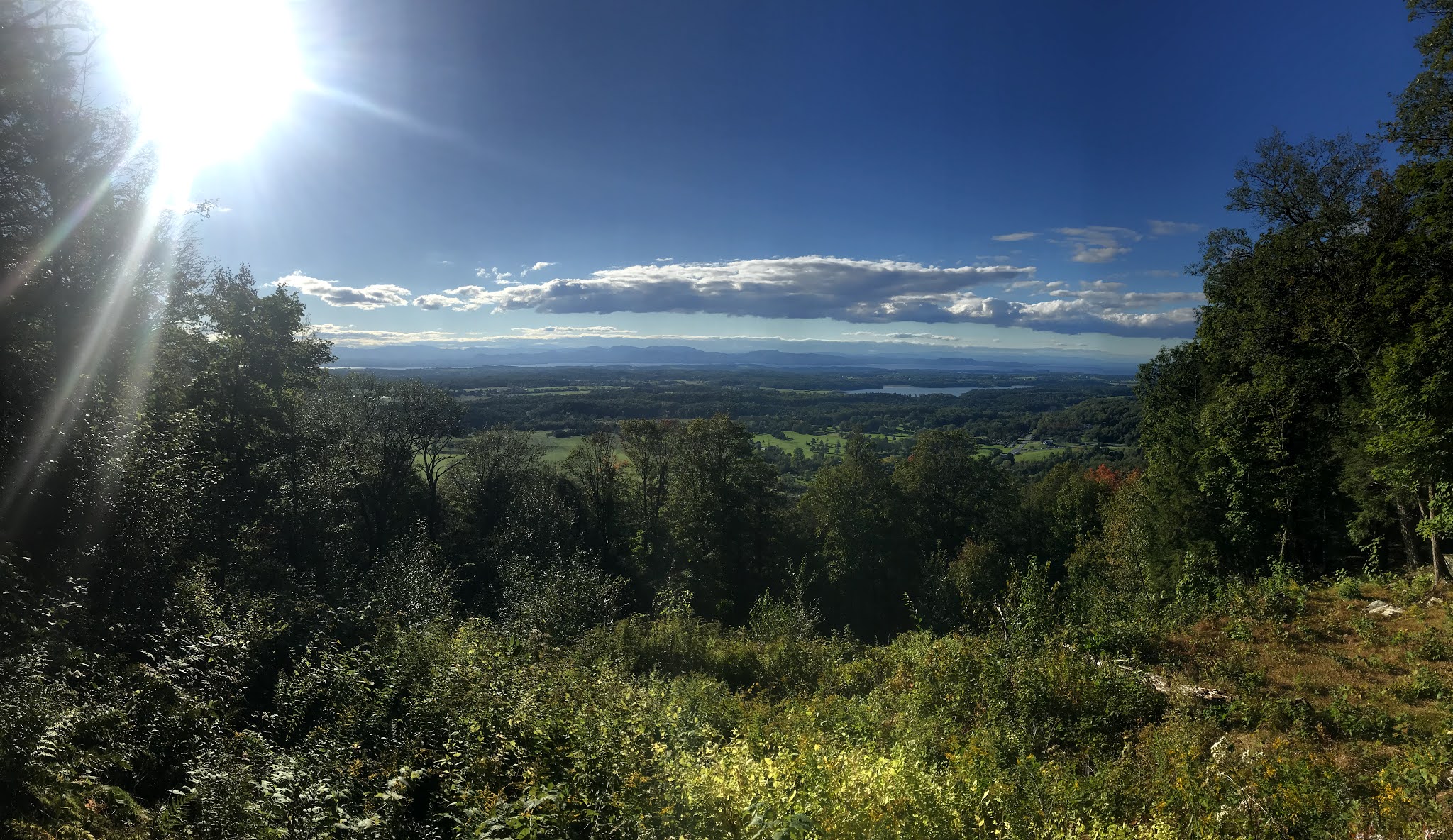
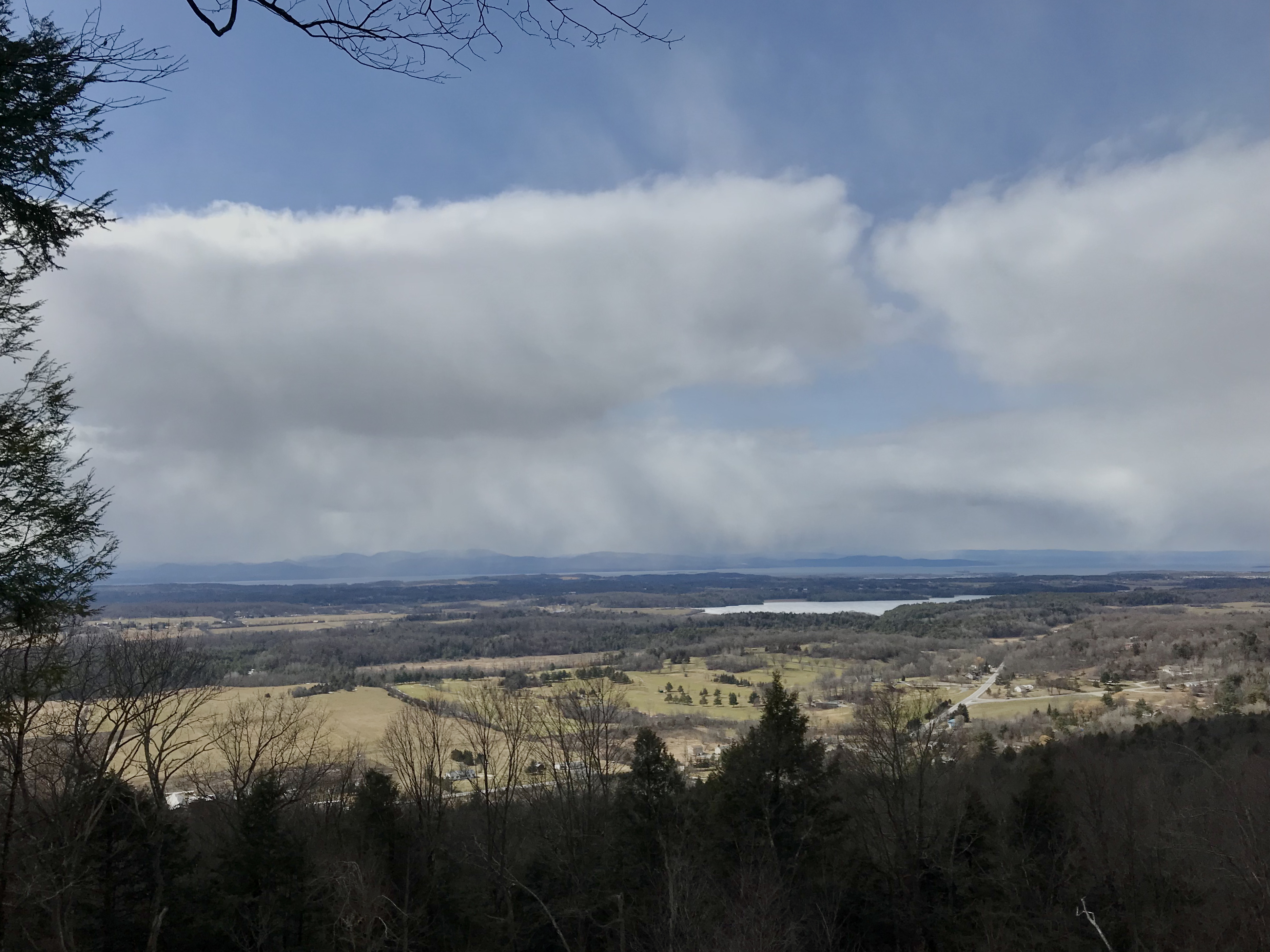
What can be handsomer for a picture than our river scenery now? Take this view from the first Conantum Cliff:
  • First this smoothly shorn meadow on the west side of the stream, with all the swaths distinct, sprinkled with apple trees casting heavy shadows black as ink, such as can be seen only in this clear air, this strong light, one cow wandering restlessly about in it and lowing; 
  • then the blue river, scarcely darker than and not to be distinguished from the sky, its waves driven southward, or up-stream, by the wind, making it appear to flow that way, bordered by willows and button-bushes; 
  • then the narrow meadow beyond, with varied lights and shades from its waving grass, which for some reason has not been cut this year, though so dry, now at length each grass-blade bending south before the wintry blast, as if bending for aid in that direction; 
  • then the hill rising sixty feet to a terrace-like plain covered with shrub oaks, maples, etc., now variously tinted, clad all in a livery of gay colors, every bush a feather in its cap; and
  •  further in the rear the wood crowned Cliff some two hundred feet high, where gray rocks here and there project from amidst the bushes, with its orchard on the slope; 
  • and to the right of the Cliff the distant Lincoln hills in the horizon.
The landscape so handsomely colored, the air so clear and wholesome; and the surface of the earth is so pleasingly varied, that it seems rarely fitted for the abode of man.


In Cohush Swamp the sumach leaves have turned a very deep red, but have not lost their fragrance. I notice wild apples growing luxuriantly in the midst of the swamp, rising red over the colored, painted leaves of the sumach, and reminding me that they were ripened and colored by the same influences, some green, some yellow, some red, like the leaves.

Fell in with a man whose breath smelled of spirit which he had drunk. How could I but feel that it was his own spirit that I smelt? 

Behind Miles's, Darius Miles's, that was, I asked an Irishman how many potatoes he could dig in a day, wishing to know how well they yielded. “Well, I don't keep any account,” he answered; “I scratch away, and let the day's work praise itself.” Aye, there's the difference between the Irish man and the Yankee; the Yankee keeps an account. The simple honesty of the Irish pleases me.

A sparrow hawk, hardly so big as a nighthawk, flew over high above my head, 
 a pretty little graceful fellow, too small and delicate to be rapacious.

Found a grove of young sugar maples (Acer saccharinum ) behind what was Miles's. How silently and yet startlingly the existence of these sugar maples was revealed to me, which I had not thought grew in my immediate neighborhood, — when first I perceived the entire edges of its leaves and their obtuse sinuses.

Such near hills as Nobscot and Nashoba have lost all their azure in this clear air and plainly belong to earth. Give me clearness nevertheless, though my heavens be moved further off to pay for it.

I perceive from the hill behind Lee's that much of the river meadows is not cut, though they have been very dry. The sun-sparkle on the river is dazzlingly bright in this atmosphere, as it has not been, perchance, for many a month.

It is so cold I am glad to sit behind the wall.

Still the great bidens blooms by the causeway side beyond the bridge.


At Clematis Brook I perceive that the pods or follicles of the Asclepias Syriaca now point upward. Did they before all point down? Have they turned up? They are already bursting.

I release some seeds with the long, fine silk attached. The fine threads fly apart at once, open with a spring, and then ray themselves out into a hemispherical form, each thread freeing itself from its neighbor and all reflecting prismatic or rainbow tints. The seeds, besides, are furnished with wings, which plainly keep them steady and prevent their whirling round. I let one go, and it rises slowly and uncertainly at first, now driven this way, then that, by currents which I cannot perceive, and I fear it will make shipwreck against the neighboring wood; but no, as it approaches it, it surely rises above it, and then, feeling the strong north wind, it is borne off rapidly in the opposite direction, ever rising higher and higher and tossing and heaved about with every fluctuation of the air, till, at a hundred feet above the earth and fifty rods off, steering south, I lose sight of it.

How many myriads go sailing away at this season, high over hill and meadow and river, on various tacks until the wind lulls, to plant their race in new localities, who can tell how many miles distant! And for this end these silken streamers have been perfecting all summer, snugly packed in this light chest,
— a perfect adaptation to this end, a prophecy not only of the fall but of future springs.

Who could believe in prophecies of Daniel or of Miller that the world would end this summer, while one milkweed with faith matured its seeds?


On Mt. Misery some very rich yellow leaves — clear yellow — of the Populus grandidentata, which still love to wag, and tremble in my hands. Also canoe birches there.

The river and pond from the side of the sun look comparatively dark.

As I look over the country westward and northwestward, the prospect looks already bleak and wintry. The surface of the earth between the forests is no longer green, but russet and hoary. You see distinctly eight or ten miles the russet earth and even houses, and then its outline is distinctly traced against the further blue mountains, thirty or thirty-five miles distant. You see distinctly perhaps to the height of land between the Nashua and Concord, and then the convexity of the earth conceals the further hills, though high, and your vision leaps a broad valley at once to the mountains.

Get home at noon.

At sundown the wind has all gone down.

H. D. Thoreau, Journal, September 24, 1851


 I observed that while the west was of a bright golden color under a bank of clouds, — the sun just setting, — and not a tinge of red was yet visible there, there was a distinct purple tinge in the nearer atmosphere, so that Annursnack Hill, seen through it, had an exceedingly rich empurpled look. See October 19, 1858 ("The sun just ready to set, I notice that its light on my note-book is quite rosy or purple")

Last night was exceedingly dark. I could not see the sidewalk in the street, but only felt it with my feet. I was obliged to whistle to warn travellers of my nearness. See September 12, 1860 ("A dark and stormy night . . . Where the fence is not painted white I can see nothing, and go whistling for fear I run against some one. . . .You walk with your hands out to feel the fences and trees"); September 18, 1857 ("It was exceedingly dark. I met two persons within a mile, and they were obliged to call out from a rod distant lest we should run against each other. ")

I notice one red tree, a red maple, against the green woodside in Conant's meadow. See September 24, 1855 ("the maples are but just beginning to blush") See also September 25, 1857 ("The whole tree, thus ripening in advance of its fellows, attains a singular preéminence"); September 25, 1857 ("The red maple has fairly begun to blush in some places by the river. I see one, by the canal behind Barrett’s mill, all aglow against the sun."); September 25, 1857 ("A single tree becomes the crowning beauty of some meadowy vale and attracts the attention of the traveller from afar."); September 26, 1854 ("Some single red maples are very splendid now, the whole tree bright-scarlet against the cold green pines; now, when very few trees are changed, a most remarkable object in the landscape; seen a mile off."); September 27, 1855 ("Some single red maples now fairly make a show along the meadow. I see a blaze of red reflected from the troubled water."

At Clematis Brook I perceive that the pods or follicles of the Asclepias Syriaca now point upward. Did they before all point down? Have they turned up? See August 24, 1851 ("The pods of the Asclepias pulchra stand up pointedly like slender vases on a salver, an open salver truly! Those of the Asclepias Syriaca hang down.")

The fine threads fly apart at once, open with a spring, and then ray themselves out into a hemispherical form, each thread freeing itself from its neighbor. . . .a prophecy not only of the fall but of future springs. See September 10, 1860 ("If you sit at an open attic window almost anywhere, about the 20th of September, you will see many a milkweed down go sailing by on a level with you, though commonly it has lost its freight, — notwithstanding that you may not know of any of these plants growing in your neighborhood."); October 23, 1852 ("The milkweed (Syriaca) now rapidly discounting. The lanceolate pods having opened, the seeds spring out on the least jar, or when dried by the sun, and form a little fluctuating white silky mass or tuft, each held by the extremities of the fine threads, until a stronger puff of wind sets them free. It is a pleasant sight to see it dispersing its seeds")

The further blue mountains, thirty or thirty-five miles distant. See June 3, 1850 ("The landscape is a vast amphitheatre rising to its rim in the horizon."); September 12, 1851 ("It is worth the while to see the mountains in the horizon once a day"); August 2, 1852 ("In many moods it is cheering to look across hence to that blue rim of the earth,"); March 31, 1853 ("It is affecting to see a distant mountain-top,. . . still as blue and ethereal to your eyes as is your memory of it.'); September 27, 1853 ("From our native hills we look out easily to the far blue mountains, which seem to preside over them.");October 22, 1857 ("But what a perfect crescent of mountains we have in our northwest horizon! Do we ever give thanks for it? "); November 22, 1860 ("Simply to see to a distant horizon through a clear air, - the fine outline of a distant hill or a blue mountaintop through some new vista, - this is wealth enough for one afternoon.")

Thursday, April 19, 2018

Spend the day hunting for my boat, which was stolen.

April 19

Spend the day hunting for my boat, which was stolen. 

As I go up the riverside, I see a male marsh hawk hunting. He skims along exactly over the edge of the water, on the meadowy side, not more than three or four feet from the ground and winding with the shore, looking for frogs, for in such a tortuous line do the frogs sit. They probably know about what time to expect his visits, being regularly decimated.

Particular hawks farm particular meadows. It must be easy for him to get a breakfast. Far as I can see with a glass, he is still tilting this way and that over the water-line. 

At Fair Haven Pond I see, half a mile off, eight large water-fowl, which I thought at first were large ducks, though their necks appeared long. Studying them patiently with a glass, I found that they had gray backs, black heads and necks with perhaps green reflections, white breasts, dark tips to tails, and a white spot about eyes on each side of bill. At first the whole bird had looked much darker, like black ducks. I did not know but they might be brant or some very large ducks, but at length inclined to the opinion that they were geese. 

At 5.30, being on the Common, I saw a small flock of geese going over northeast. Being reminded of the birds of the morning and their number, I looked again and found that there were eight of them, and probably they were the same I had seen. 

Viola ovata on bank above Lee's Cliff. Edith Emerson found them there yesterday; also columbines and the early potentilla April 13th !!! 

I hear the pine warblers there, and also what I thought a variation of its note, quite different, yet I thought not unfamiliar to me. 

Afterwards, along the wall under the Middle Conantum Cliff, I saw many goldfinches, male and female, the males singing in a very sprightly and varied manner, sitting still on bare trees. Also uttered their watery twitter and their peculiar mewing. 

In the meanwhile I heard a faint thrasher's note, as if faintly but perfectly imitated by some bird twenty or thirty rods off. This surprised me very much. It was equally rich and varied, and yet I did not believe it to be a thrasher. Determined to find out the singer, I sat still with my glass in hand, and at length detected the singer, a goldfinch sitting within gunshot all the while. 

This was the most varied and sprightly performer of any bird I have heard this year, and it is strange that I never heard the strain before. It may be this note which is taken for the thrasher’s before the latter comes. 

P. M. — Down river. 

I find that my Rana halecina spawn in the house is considerably further advanced than that left in the meadows. The latter is not only deeper beneath the surface now, on account of the rain, but has gathered dirt from the water, so that the jelly itself is now plainly seen; and some of it has been killed, probably by frost, being exposed at the surface. I hear the same tut tut tut, probably of the halecina, still there, though not so generally as before. 

See two or three yellow lilies nearly open, showing most of their yellow, beneath the water; say in two or three days. 

Rice tells me of winging a sheldrake once just below Fair Haven Pond, and pursuing it in a boat as it swam down the stream, till it went ashore at Hubbard’s Wood and crawled into a woodchuck’s hole about a rod from the water on a wooded bank. He could see its tail and pulled it out. 

He tells of seeing cartloads of lamprey eels in the spawning season clinging to the - stones at a dam in Saco, and that if you spat on a stone and cast it into the swift water above them they would directly let go and wiggle down the stream and you could hear their tails snap like whips on the surface, as if the spittle was poison to them; but if you did not spit on the stone, they would not let go. 

He thinks that a flock of geese will sometimes stop for a wounded one to get well. 

Hear of bluets found on Saturday, the 17th; how long? 

Hear a toad ring at 9 P. M. Perhaps I first hear them at night, though cooler, because it is still. 

R. W. E. saw an anemone on the 18th.

H.D. Thoreau,  Journal, April 19, 1858

He skims along exactly over the edge of the water, on the meadowy side, not more than three or four feet from the ground and winding with the shore, looking for frogs. See note to April 22, 1856 (“A marsh hawk, in the midst of the rain, is skimming along the shore of the meadow, close to the ground, . . .  It is looking for frogs.”). See also A Book of the Seasons, by Henry Thoreau, the Marsh Hawk (Northern Harrier)

I hear the pine warblers there, and also what I thought a variation of its note, quite different, yet I thought not unfamiliar to me. See April 12, 1858 ("The woods are all alive with pine warblers now. Their note is the music to which I survey"); April 15, 1859 ("Go to a warm pine wood-side on a pleasant day at this season after storm, and hear it ring with the jingle of the pine warbler"); See also A Book of the Seasons, by Henry Thoreau, the Pine Warbler

Along the wall under the Middle Conantum Cliff, I saw many goldfinches, male and female, the males singing in a very sprightly and varied manner, sitting still on bare trees. Also uttered their watery twitter and their peculiar mewing. See April 7, 1855 (“See thirty or forty goldfinches in a dashing flock, in all respects (notes and all) like lesser redpolls, on the trees by Wood’s Causeway and on the railroad bank. There is a general twittering and an occasional mew.”)


In the meanwhile I heard a faint thrasher's note, as if faintly but perfectly imitated by some bird. See April 15, 1859 ("Hear a goldfinch, after a loud mewing on an apple tree, sing in a rich and varied way, as if imitating some other bird. . . . Also a catbird mews? [Could this have been a goldfinch?]"); August 11, 1858 ("The goldfinch is a very fine and powerful singer, and the most successful and remarkable mocking-bird that we have. In the spring I heard it imitate the thrasher exactly, before that bird had arrived, and now it imitates the purple finch.");


Viola ovata on bank above Lee's Cliff. Edith Emerson found them there yesterday. See April 27, 1860 ("Viola ovata common."); April 29, 1855 (“Viola ovata will open to-morrow.”); May 1, 1856 ("Viola ovata on southwest side of hill, high up near pines.”); May 5, 1853 ("The Emerson children found blue and white violets May 1st at Hubbard's Close, probably Viola ovata and blanda; but I have not been able to find any yet.");  May 6, 1855 (“Beyond Clamshell, some white Viola ovata, some with a faint bluish tinge.”); May 9, 1852 (“ That I observed the first of May was a V. ovata, a variety of sagittate. [arrowhead violet]”)

Wednesday, January 17, 2018

Reflections from an owl's feather


January 17

Sunday. P. M. — To Conantum. 

The common birch fungus, which is horizontal and turned downward, splits the bark as it pushes out very simply, thus:


I see a large downy owl's feather adhering to a sweet-fern twig, looking like the down of a plant blowing in the wind. This is near where I have found them before, on Conantum, above first Cliff. They would be very ornamental to a bonnet, so soft and fine with their reflections that the eye hardly rests on the down.

H. D. Thoreau, Journal, January 17, 1858

The common birch fungus, which is horizontal and turned downward, splits the bark as it pushes out very simply. See 
January 26, 1858 ("On the side-hill at the swamp, I see how the common horizontal birch fungus is formed . . .")

Reflections from an owl's feather. See November 2, 1857 ("You must be in an abstract mood to see reflections however distinct"); August 23, 1852 ("The perception of surfaces will always have the effect of miracle.")

Thursday, May 28, 2015

While we sit by the path in the depths of the woods


May 28

P.M. —To Middle Conantum Cliff. 

Yesterday left my boat at the willow opposite this Cliff, the wind northwest. Now it is southeast, and I can sail back. 

May 28, 2025

Our quince open this morning, possibly yesterday; and some others, I believe, much earlier. 

Do I not hear a short snappish, rasping note from a yellow-throat vireo? 

I see a tanager, the most brilliant and tropical-looking bird we have, bright-scarlet with black wings, the scarlet appearing on the rump again between wing-tips. He brings heat, or heat him. A remarkable contrast with the green pines. At this distance he has the aspect and manners of a parrot, with a fullness about the head and throat and beak, indolently inspecting the limbs and twigs —leaning over to it — and sitting still a long time. The female, too, is a neat and handsome bird, with the same indolent ways, but very differently colored from the male; all yellow below with merely dusky wings, and a sort of clay(?)-color on back. 

While we sit by the path in the depths of the woods three quarters of a mile beyond Hayden’s, confessing the influence of almost the first summer warmth, the wood thrush sings steadily for half an hour, now at 2.30 P.M., amid the pines, — loud and clear and sweet. While other birds are warbling betweenwhiles and catching their prey, he alone appears to make a business of singing, like a true minstrel. 

Is that one which I see at last in the path above dusky olive-brown becoming ferruginous on base of tail, eye not very prominent with a white line around it, some dark-colored feathers apparently on outer wing-coverts, very light colored legs, with dashes on breast which I do not see clearly? I should say that it had not the large black eye of the hermit thrush, and I cannot see the yellowish spot on the wings; yet it may have been this. 

I find the feathers apparently of a brown thrasher in the path, plucked since we passed here last night. You can generally find all the tail and quill feathers in such a case. 

The apple bloom is very rich now. 

Fever-bush shoots are now two inches long; say begin to leaf just before late willow. Black ash shoots three inches long; say with late willow. White pine and pitch pine shoots from two to five inches long. 

Rubus triflorus at Miles Swamp will apparently open to-morrow.

Some krigia done some days. Silene Antirrhina. Barberry open (probably two or more days at Lee’s). 

C. says he has seen a green snake. 

Examined my two yellowbirds’ nests of the 25th. Both are destroyed, —pulled down and torn to pieces probably by some bird, — though they  but just begun to lay. 


Large yellow and black butterfly. 

The leaves of kalmiana lily obvious. 

I have seen within three or four days two or three new warblers which I have not identified; one to-day, in the woods, all pure white beneath, with a full breast, and greenish-olive-yellow (?) above, with a duskier head and a slight crest muscicapa-like, on pines, etc., high; very small.(Perhaps young and female redstarts.) Also one all lemon-yellow beneath, except whitish vent, and apparently bluish above.

H. D. Thoreau, Journal, May 28, 1855

Yesterday left my boat at the willow opposite this Cliff, the wind northwest. Now it is southeast, and I can sail back. See August 12, 1854 ("To Conantum by boat. To-day there is an uncommonly strong wind, against which I row, yet in shirt-sleeves, trusting to sail back. It is southwest.); August 24, 1854 ("A strong wind from the south-southwest, which I expect will waft me back.")

Do I not hear a short snappish, rasping note from a yellow-throat vireo?  See   May 11, 1855 ("Hear and see yellow-throat vireo. ");  May 27, 1854 ("I see and hear the yellow-throated vireo. It is somewhat similar (its strain) to that of the red-eye, prelia pre-li-ay, with longer intervals. . .It flits about in the tops of the trees");May 29, 1855 ("Also the yellow-throated vireo — its head and shoulders as well as throat yellow (apparently olive-yellow above), and its strain but little varied and short, not continuous. It has dusky legs and two very distinct white bars on wings (the male)"); See also A Book of the Seasons,  by Henry Thoreau, The Yellow-throated Vireo

I see a tanager . . . A remarkable contrast with the green pines. See May 23, 1853 ("How he enhances the wildness and wealth of the woods! That contrast of a red bird with the green pines and the blue sky!”); 
. May 29, 1853 (" tt appears as if he loved to contrast himself with the green of the forest"); May 24, 1860 ("You can hardly believe that a living creature can wear such colors”) See also A Book of the Seasons,by Henry Thoreau, the Scarlet Tanager

The wood thrush . . . alone appears to make a business of singing, like a true minstrel. 
 May 17, 1853 ("The wood thrush has sung for some time. He touches a depth in me which no other bird's song does. "); June 22, 1853  (“This is the only bird whose note affects me like music, affects the flow and tenor of my thought, my fancy and imagination.”)  See also  A Book of the Seasons
by Henry Thoreau,  The Wood Thrush

Is that one which I see . . . eye not very prominent with a white line around it, . . . with dashes on breast which I do not see clearly? See May 22, 1852 ("The female (and male?) wood thrush spotted the whole length of belly; the hermit thrush not so”) and note to April 24, 1856 ("[S]ee a brown bird flit, and behold my hermit thrush, with one companion, flitting silently through the birches. I saw the fox-color on his tail-coverts, as well as the brown streaks on the breast. ”).

 The apple bloom is very rich now. See May 27, 1857 ("This is blossom week, beginning last Sunday (the 24th).") See also A Book of the Seasons by Henry Thoreau, Apple Blossom Time

Rubus triflorus at Miles Swamp will apparently open to-morrow. See May 21, 1856 ("Rubus triflorus abundantly out at the Saw Mill Brook");  May 29, 1858 ("Rubus triflorus, well out, at Calla Swamp, how long?"); See also A Book of the Seasons,  A Book of the Seasonsby Henry Thoreau, the Raspberry

C. says he has seen a green snakeSee  May 9, 1852 ("See a green snake, twenty or more inches long, on a bush, hanging over a twig with its head held forward six inches into the air, without support and motionless.”); May 19, 1860 (“See a green snake, a very vivid yellow green, of the same color with the tender foliage at present, and as if his colors had been heightened by the rain.”)

Large yellow and black butterfly. See June 3, 1859 ("A large yellow butterfly (somewhat Harris Papilio Asterias like but not black-winged) three and a half to four inches in expanse. Pale-yellow, the front wings crossed by three or four black bars; rear, or outer edge, of all wings widely bordered with black, and some yellow behind it; a short black tail to each hind one, with two blue spots in front of two red-brown ones on the tail. (P. Turnus ?)");   June 14, 1860 ("I see near at hand two of those large yellow (and black) butterflies which I have probably seen nearly a month . They rest on the mud near a brook. Two and three quarters to three inches in alar extent; yellow with a broad black border, outside of which a row of small yellow spots; three or four black marks transversely to the fore wings, and two fine lines parallel with the body on the hinder (?) wings; a small and slender swallow tail with reddish brown and blue at the tail; body black above and yellow along the sides. (C. says it is the Papilio Turnus of Say.)"

Two or three new warblers which I have not identified. See  April 19, 1854 ("Within a few days the warblers have begun to come. They are of every hue. Nature made them to show her colors with. There are as many as there are colors and shades. "); May 6, 1859 ("Hear yellow-throat vireo, and probably some new warblers"); .May 15, 1860 ("Deciduous woods now swarm with migrating warblers, especially about swamps”); May 23, 1857 ("This is the time and place to hear the new-arriving warblers, the first fine days after the May storm. When the leaves generally are just fairly expanding. . . these birds are flitting about in the tree-tops like gnats, catching the insects about the expanding leaf-buds")

May 28. See A Book of the Seasonsby Henry Thoreau, May 28

We sit by the path 
in the depths of the woods while
now the wood thrush sings. 

A Book of the Seasons by Henry Thoreau
"A book, each page written in its own season,
out-of-doors, in its own locality."
 ~edited, assembled and rewritten by zphx ©  2009-2025

https://tinyurl.com/hdt-550528

Wednesday, April 1, 2015

April comes in true.

April 1

The month comes in true to its reputation. We wake, though late, to hear the sound of a strong, steady, and rather warm rain on the roof, and see the puddles shining in the road. 

April 1, 2018

It lasts till the middle of the day, and then is succeeded by a cold northwest wind. This pattering rain and Sabbath morning combined make us all sluggards. 

When I look out the window I see that the grass on the bank on the south side of the house is already much greener than it was yesterday.  
P. M. —— To Conantum End.

At the first Conantum Cliff I am surprised to see how much the columbine leaves have grown in a sheltered cleft; also the cinquefoil, dandelion, yarrow, sorrel, saxifrage, etc., etc. They seem to improve the least warmer ray to advance themselves, and they hold all they get. 

See, resting on the edge of the ice in Fair Haven Pond, a white duck with black head, and a dark one. They take to the water when I appear on the hill a quarter of a mile off, and soon fly down the river rather low over the water. Were they not the same with those of the 16th ult.

H. D. Thoreau, Journal, April 1, 1855

The month comes in true to its reputation . . . a strong, steady, and rather warm rain. See April 1, 1854 ("Sparrows are particularly lively and musical in the yard this rainy and truly April day . . . The robin now begins to sing sweet powerfully . . . April has begun like itself. It is warm and showery”); April 1, 1857 ("It is a true April evening, feeling and looking as if it would rain, and already I hear a robin or two singing their evening song."); April 6, 1860 ("Rainy, more or less, — April weather.");   April 14, 1855 ("An overcast and moist day, but truly April—no sun all day—like such as began methinks on Fast Day, or the 5th. You cannot foretell how it will turn out. "); April 16, 1860 ("In afternoon a true April rain, dripping and soaking into the earth and heard on the roof,"); April 27, 1857 (" It is a true April morning . . . It will surely rain to-day, but when it will begin in earnest and how long it will last, none can tell."); See also  March 8, 1855 ("This sound reminds me of rainy, misty April days in past years. ");  April 2, 1854 ("Sitting on the rail over the brook, I hear something which reminds me of the song of the robin in rainy days in past springs.")

The grass on the bank on the south side of the house is already much greener than it was yesterday.
See March 17, 1854 ("The grass is slightly greened on south bank-sides — on the south side of the house. The first tinge of green appears to be due to moisture more than to direct heat."); March 22, 1860 ("The phenomena of an average March are increasing warmth, melting the snow and ice and . . . some greenness appearing on south bank."); March 24, 1855 ("The earliest signs of spring in vegetation noticed thus far are the . . . grass on south banks."); March 30, 1855 ("There is a very perceptible greenness on our south bank now."); March 30, 1856 ("I can just see a little greening on our bare and dry south bank"). See also March 17, 1857 ("No mortal is alert enough to be present at the first dawn of the spring, but he will presently discover some evidence that vegetation had awaked some days at least before."); April 3, 1856 (" It is surprising how the earth on bare south banks begins to show some greenness in its russet cheeks in this rain and fog, -- a precious emerald-green tinge . . . I revive with Nature; her victory is mine. This is my jewelry.") and A Book of the Seasons, by Henry Thoreau, Signs of the Spring, Greening grasses and sedges

Surprised to see how much the columbine leaves have grown in a sheltered cleft; also the cinquefoil, dandelion, yarrow, sorrel, saxifrage. See March 18,1853 (At Conantum Cliff the columbines have started and the saxifrage even . . . Both these grow there in high and dry chinks in the face of the cliff, where no soil appears, and the sunnier the exposure the more advanced."); April 2, 1856 ("Lee’s Cliff. The crowfoot and saxifrage seem remarkably backward; no growth as yet . . . The columbine, with its purple leaves, has grown five inches, and one is flower-budded, apparently nearer to flower than anything there."); April 3, 1853 ("To my great surprise the saxifrage is in bloom. It was, as it were, by mere accident that I found it.");April 6, 1858 ("On a few small warm shelves under the rocks the saxifrage makes already a pretty white edging along the edge of the grass sod on the rocks; has got up three or four inches, and may have been out four or five days . . .I also notice one columbine, which may bloom in a week if it is pleasant weather."); April 7, 1855 ("At Lee’s Cliff I find the radical leaves of the early saxifrage, columbine, and the tower mustard, etc., much eaten apparently by partridges and perhaps rabbits."); April 7, 1860 ("Early potentilla out, - how long? - on side of Annursnack.");April 8, 1854 ("The columbine shows the most spring growth of any plant."); April 8, 1855 ("The columbine leaves in the clefts of Cliffs are one of the very earliest obvious growths. I noticed it the first of April."): April 10, 1859 ("I hear of a cinquefoil found in bloom on the 8th . . . Herbaceous flowers which I have known to be open before the first of May thus: . . . Rock flowers Saxifrage, crowfoot, columbine, and tower-mustard. . . Pasture flowers Cinquefoil, bluets, mouse-ear, and Viola sagittata."); April 18, 1856 ("Common saxifrage and also early sedge I am surprised to find abundantly out—both—considering their backwardness April 2d. Both must have been out some, i. e. four or five, days half-way down the face of the ledge . . . Columbine, and already eaten by bees. Some with a hole in the side"); April 19, 1858 ("Columbines and the early potentilla April 13th !!! "); April 22, 1860 ("The columbine is hardly yet out."); April 24, 1852 ("Sorrel is well under weigh, and cinquefoil"); April 25, 1852 ("Yarrow is started."); April 25, 1856 ("The cinquefoil well out . . . probably a day or two."); April 25, 1859 ("Also bluets and potentilla are first noticed by me"). See also April 2, 1856 ("t will take you half a lifetime to find out where to look for the earliest flower. . . .It is evident that it depends on the character of the season whether this flower or that is the most forward; whether there is more or less snow or cold or rain, etc.");  April 8, 1855 (“As to which are the earliest flowers, it depends on the character of the season, and ground bare or not, meadows wet or dry, etc., etc., also on the variety of soils and localities within your reach.”);  April 10, 1855 ("These few earliest flowers  . . .are remote and unobserved and often surrounded with snow, and most have not begun to think of flowers yet.") and  A Book of the Seasons, by Henry Thoreau, The Earliest Flower

A white duck with black head, and a dark one. See March 16, 1855 ("Scared up two large ducks just above the bridge . One very large; white beneath, breast and neck; black head and wings and aft . The other much smaller and dark . Apparently male and female .. . . The larger sailed about on the watch , while the smaller , dark one dived repeatedly . . . This male I suspect was too large for the first , and , from its size and its great superiority in size to its companion , I think it the goosander or sheldrake . "). See also A Book of the Seasons, by Henry Thoreau, Signs of the Spring, Ducks Afar, Sailing on the Meadow; A Book of Seasons, by Henry Thoreau, The Sheldrake (Goosander, Merganser)

Warm rain on the roof 
puddles shining in the road –
April comes in true.


A Book of the Seasons
, by Henry Thoreau
"A book, each page written in its own season,
out-of-doors, in its own locality.”
~edited, assembled and rewritten by zphx © 2009-2025

https://tinyurl.com/hdt-550401

Friday, May 16, 2014

The earth is all fragrant as one flower, genial to man

May 16.

The rich crimson leaf-buds of the grape are rapidly unfolding, scattered along the vine; and the various leaves unfolding are flower-like, and taken together are more interesting than any flower.

Quite warm; cows already stand in water in the shade of the bridge.

Look into several red-wing blackbirds' nests which are now being built, but no eggs yet. They are generally hung between two twigs, say of button-bush. I notice at one nest what looks like a tow string securely tied about a twig at each end about six inches apart, left loose in the middle. It was not a string, but I think a strip of milkweed pod, etc., maybe a foot long and very strong. How remarkable that this bird should have found out the strength of this, which I was so slow to find out!

Land at Conantum by the red cherry grove above Arrowhead Field. 


It is a splendid day, so clear and bright and fresh; the warmth of the air and the bright tender verdure putting forth on all sides make an impression of luxuriance and genialness, so perfectly fresh. 

A sweet scent fills the air from the expanding leafets or some other source. 

The sessile-leaved bellwort, with three or four delicate pale-green leaves with reflexed edges, on a tender-looking stalk, the single modest-colored flower gracefully drooping, neat, with a fugacious, richly spiced fragrance, facing the ground . . . When you turn up the drooping flower, its petals make a perfect geometrical figure, a six-pointed star. 

The earth is all fragrant as one flower. And bobolinks tinkle in the air. Nature now is perfectly genial to man.

I notice the dark shadow of Conantum Cliff from the water. Why do I notice it at this season particularly? Is it because a shadow is more grateful to the sight now that warm weather has come? Or is there anything in the contrast between the rich green of the grass and the cool dark shade?

H. D. Thoreau, Journal, May 16, 1854


The earth is all fragrant as one flower . . .  See May 16, 1852 ("The whole earth is fragrant as a bouquet held to your nose. A fine, delicious fragrance, which will come to the senses only when it will.")

Nature now is perfectly genial to man.
See  November 23, 1852 ("There is something genial even in the first snow, and. . . Men, too, are disposed to give thanks for the bounties of the year all over the land.");  November 22, 1860 ("Summer is gone with all its infinite wealth, and still nature is genial to man. Still he beholds the same inaccessible beauty around him."); See also A Book of the Seasons, by Henry Thoreau, Nature is genial to man (the anthropic principle)


So clear bright and fresh
the whole earth is one flower
genial to man.

A Book of the Seasons,  by Henry Thoreau
 "A book, each page written in its own season,
out-of-doors, in its own locality."
 ~edited, assembled and rewritten by zphx ©  2009-2024
https://tinyurl.com/hdt-540516

Monday, March 18, 2013

This is the foreglow of the year.


March 18, 2019


March 18.

The season is so far advanced that the sun, every now and then promising to shine out through this rather warm rain, lighting up transiently with a whiter light the dark day and my dark chamber, affects me as I have not been affected for a long time. I must go forth.


How eagerly the birds of passage penetrate the northern ice, watching for a crack by which to enter! Forthwith the swift ducks will be seen winging their way along the rivers and up the coast. They watch the weather more sedulously than the teamster. All nature is thus forward to move with the revolution of the seasons.

It is decidedly clearing up. At Conantum Cliff the columbines have started and the saxifrage even, the former as conspicuously as any plant, particularly any on dry ground. Both these grow there in high and dry chinks in the face of tire cliff, where no soil appears, and the sunnier the exposure the more advanced. Even if a fallen fragment of the rock is so placed as to reflect the heat upon it, it has the start of its neighbors. These plants waste not a day, not a moment, suitable to their development.


The ice in Fair Haven is more than half melted, and now the woods beyond the pond, reflected in its serene water where there has been opaque ice so long, affect me as they perhaps will not again this year.

The bluebird and song sparrow sing immediately on their arrival and hence deserve to enjoy some preeminence. They give expression to the joy which the season inspires. But the robin and blackbird only peep and chuck at first commonly, and the lark is silent and flitting. 

The bluebird at once fills the air with his sweet warbling, and the song sparrow from the top of a rail pours forth his most joyous strain. Both express their delight at the weather which permits them to return to their favorite haunts. They are the more welcome to man for it.

The sun is now declining, with a warm and bright light on all things, a light which answers to the late afterglow of the year, when, in the fall, wrapping his cloak closer about him, the traveller goes home at night to prepare for winter. This the foreglow of the year, when the walker goes home at eve to dream of summer.

To-day first I smelled the earth.


H. D. Thoreau, Journal, March 18,1853

The ice in Fair Haven is more than half melted. See March 19, 1855 ("I am surprised to find that the river has not yet worn through Fair Haven Pond.”); March 22, 1855 ("I cross Fair Haven Pond, including the river, on the ice, and probably can for three or four days yet.”); March 26, 1857 ("Fair Haven .is open; may have been open several days; there is only a little ice on the southeast shore.”); March 26, 1860 ("Fair Haven Pond may be open by the 20th of March, as this year, or not till April 13 as in '56, or twenty-three days later.”); March 22, 1854 ("Fair Haven still covered and frozen anew in part.”) See also April 1, 1852 ("Each part of the river seen further north shines like silver in the sun, and the little pond in the woods west of this hill is half open water. Cheering , that water with its reflections, compared with this opaque dumb pond.")


This the foreglow of the year, . . .See August, 19, 1853 ("The day is an epitome of the year.”); August 24, 1852 ("The year is but a succession of days, and I see that I could assign some office to each day which, summed up, would be the history of the year."); July 26, 1853 (“This the afternoon of the year.”); August 31, 1852 ("The evening of the year is colored like the sunset.”)

To-day first I smelled the earth. See  note to March 4, 1854  ("I begin to sniff the air and smell the ground.”)

Monday, June 25, 2012

A morning rainbow. A moonlit walk. A flower for every mood of the mind.


Just as the sun rises this morning, under clouds, I see a rainbow in the west horizon, the lower parts quite bright. 


A few moments after, it rains heavily for a half-hour; and it continues cloudy as well as cool most of the day.

I observe that young birds are usually of a duller color and more speckled than old ones, as if for their protection in their tender state. They have not yet the markings (and the beauty) which distinguish their species, and which betray it often, but by their colors are merged in the variety of colors of the season.

To Cliffs, 4 P.M. 


It is cool and cloudy weather in which the crickets, still heard, remind you of the fall, -a clearer ring to their creak. . . .

Sometimes the lambkill flowers form a very even rounded, close cylinder, six inches long and two and a half in diameter, of rich red saucer-like flowers, the counterpart of the latifolia in flowers and flower- buds, but higher colored. I regard it as a beautiful flower neglected. It has a slight but not remarkable scent. 

The Convolvulus sepium, bindweed; morning-glory is the best name. It always refreshes me to see it. Some saw it the 19th. In the morning and cloudy weather, says Gray. I associate it with holiest morning hours. It may preside over my morning walks and thoughts. 

There is a flower for every mood of the mind.

Methinks roses oftenest display their high colors, colors which invariably attract all eyes and betray them, against a dark ground, as the dark green or the shady recesses of the bushes and copses, where they show to best advantage. Their enemies do not spare the open flower for an hour. Hence, if for no other reason, their buds are most beautiful. Their promise of perfect and dazzling beauty, when their buds are just beginning to expand, — beauty which they can hardly contain, — as in most youths, commonly surpasses the fulfillment of their expanded flowers. The color shows fairest and brightest in the bud. The expanded flower has no higher or deeper tint than the swelling bud exposed. This raised a dangerous expectation. 

The season when wild roses are in bloom should have some preeminence, methinks.


Agreeable is this cool cloudy weather, favorable to thought, after the sultry days. 


The air is clear, as if a cool, dewy brush had swept the vales and meadows of all haze. A liquid coolness invests them, as if their midnight aspect were suddenly revealed to midday. 

The mountain outline is remarkably distinct, and the intermediate earth appears more than usually scooped out, like a vast saucer sloping up ward to its sharp mountain rim. The mountains are washed in air. 

The sunshine, now seen far away on fields and hills in the northwest, looks cool and whole some, like the yellow grass in the meadows.

I am too late for the white pine flowers. The cones are half an inch long and greenish, and the male flowers effete.

The sun now comes out bright, though westering, and shines on Fair Haven, rippled by the wind.


8.30 p. m. — To Conantum. 

Moon half full. Fields dusky; the evening star and one other bright one near the moon. It is a cool but pretty still night. 

Methinks I am less thoughtful than I was last year at this time. The flute I now hear from the Depot Field does not find such caverns to echo and resound in in my mind, — no such answering depths. Our minds should echo at least as many times as a Mammoth Cave to every musical sound. It should awaken reflections in us. 

I hear not many crickets. 

Some children calling their kitten home by some endearing name. 

Now his day's work is done, the laborer plays his flute, — only possible at this hour. 

Contrasted with his work, what an accomplishment! Some drink and gamble. He plays some well-known march. But the music is not in the tune; it is in the sound. It does not proceed from the trading nor political world. He practices this ancient art. 

There are light, vaporous clouds overhead; dark, fuscous ones in the north. The trees are turned black. As candles are lit on earth, stars are lit in the heavens. I hear the bullfrog's trump from afar. 

Now I turn down the Corner road. At this quiet hour the evening wind is heard to moan in the hollows of your face, mysterious, spirit-like, conversing with you. It can be heard now only. The whip-poor-will sings. 

I hear a laborer going home, coarsely singing to himself. Though he has scarcely had a thought all day, killing weeds, at this hour he sings or talks to himself. His humble, earthy contentment gets expression. It is kindred in its origin with the notes or music of many creatures. A more fit and natural expression of his mood, this humming, than conversation is wont to be. 

The fireflies appear to be flying, though they may be stationary on the grass stems, for their perch and the nearness of the ground are obscured by the darkness, and now you see one here and then another there, as if it were one in motion. Their light is singularly bright and glowing to proceed from a living creature. Nature loves variety in all things, and so she adds glow-worms to fireflies, though I have not noticed any this year. 

The great story of the night is the moon's adventures with the clouds. What innumerable encounters she has had with them! 

When I enter on the moonlit causeway, where the light is reflected from the glistening alder leaves, and their deep, dark, liquid shade beneath strictly bounds the firm damp road and narrows it, it seems like autumn. The rows of willows completely fence the way and appear to converge in perspective, as I had not noticed by day. 

The bullfrogs are of various tones. Some horse in a distant pasture whinnies; dogs bark; there is that dull, dumping sound of frogs, as if a bubble containing the lifeless sultry air of day burst on the surface, a belching sound. When two or more bullfrogs trump together, it is a ten-pound-ten note. 

In Conant's meadow I hear the gurgling of unwearied water, the trill of a toad, and go through the cool, primordial liquid air that has settled there. As I sit on the great door-step, the loose clapboards on the old house rattle in the wind weirdly, and I seem to hear some wild mice running about on the floor, and sometimes a loud crack from some weary timber trying to change its position. 

On Conantum-top, all white objects like stones are observed, and dark masses of foliage, at a distance even. How distant is day and its associations! 

The light, dry cladonia lichens on the brows of hills reflect the moon light well, looking like rocks. The night wind comes cold and whispering, murmuring weirdly from distant mountain-tops. No need to climb the Andes or Himalayas, for brows of lowest hills are highest mountain-tops in cool moonlight nights. 

Is it a cuckoo's chuckling note I heard? Occasionally there is something enormous and monstrous in the size and distance of objects. A rock, is it? or an elephant asleep? Are these trees on an upland or a lowland? Or do they skirt the brink of a sea-beach? When I get there, shall I look off over the sea? 

The whiteweed is the only obvious flower. I see the tops of the rye wave, and grain-fields are more interesting than by day. The water is dull-colored, hardly more bright than a rye-field. There is dew only in the low grounds. 

What were the firefly's light, if it were not for darkness? The one implies the other. 

You may not suspect that the milk of the cocoanut which is imported from the other side of the world is mixed. So pure do some truths come to us, I trust. 

What a mean and wretched creature is man! By and by some Dr. Morton may be filling your cranium with white mustard seed to learn its internal capacity. Of  all ways invented to come at a knowledge of a living man, this seems to me the worst, as it is the most belated. You would learn more by once paring the toe nails of the living subject. There is nothing out of which the spirit has more completely departed, and in which it has left fewer significant traces.

H. D. Thoreau, Journal, June 25, 1852

The mountain outline is remarkably distinct, the earth appears like a vast saucer sloping upward to its sharp mountain rim. See November 30, 1852 (“The country seems to slope up from the west end of Walden to the mountain.”)

The fireflies appear to be flying . . . now you see one here and then another there, as if it were one in motion. See August 2, 1854 (“A few fireflies in the meadows. I am uncertain whether that so large and bright and high was a firefly or a shooting star.”)

The Convolvulus sepium, bindweed; morning-glory is the best name.
It always refreshes me to see it.") See  June 21, 1853 ("The morning-glory still fresh at 3 P.M.  A fine, large, delicate bell with waved border, some pure white ,some reddened. The buds open perfectly in a vase I find them open when I wake at 4 A .M. Is not this one of the eras or culminating places in the flower season? Not this till the sultry mornings come."); July 19, 1851("The wild morning-glory or bindweed, with its delicate red and white blossoms.")

There is a flower for every mood of the mind. See May 23, 1853 (" Every new flower that opens, no doubt, expresses a new mood of the human mind.”); August 7, 1853 ("The objects I behold correspond to my mood.”); May 6, 1854 ("I can be said to note the flower's fall only when I see in it the symbol of my own change. When I experience this, then the flower appears to me.”); June 6, 1857 (“Each experience reduces itself to a mood of the mind.”) See also A Book of the Seasons, by Henry Thoreau, Moods and Seasons of the Mind.

Roses oftenest display their high colors. . . fairest and brightest in the bud. See A Book of the Seasons, by Henry Thoreau, The Wild Rose

Sometimes the lambkill flowers form a very even rounded, close cylinder . . . of rich red saucer-like flowers. . . I regard it as a beautiful flower neglected. See June 13, 1852 ('Lambkill is out. I remember with what delight I used to discover this flower in dewy mornings."); June 13, 1854 ("How beautiful the solid cylinders of the lamb-kill now just before sunset, — small ten-sided, rosy-crimson basins, about two inches above the recurved, drooping dry capsules of last year"); See also A Book of the Seasons, by Henry Thoreau, Lambkill (Kalmia augustifolia)

Methinks I am less thoughtful than I was last year at this time. See July 7, 1852 "(I am older than last year; the mornings are further between; the days are fewer.")

Dr. Morton filling your cranium with white mustard seed. Samuel George Morton believed that cranial capacity determined intellectual ability, and he used his craniometric evidence in conjunction with his analysis of anthropological literature then available to argue in favor of a racial hierarchy which put Caucasians on the top rung and Africans on the bottom. Morton's "systematic justification" for the separation of races was used by those who favored slavery in the United States.~ wikipedia

July 25. See A Book of the Seasons,, by Henry Thoreau, June 25

The earth is a vast
saucer sloping upward to
its sharp mountain rim.

Sunshine now seen far
away looks like the yellow
grass in the meadows.

I am too late for
the white pine flowers. -- The cones
are half an inch long.

The sun comes out bright
and shines on Fair Haven Pond,
rippled by the wind.

There is a flower 
for every mood of the mind –
wild roses in bloom. 
June 25, 1852

Why the firefly's light,
if it were not for darkness?
One implies the other.
June 25, 1852

You see one here and
another there as if it
were one in motion.
June 25, 1852


A Book of the Seasons,by Henry Thoreau
"A book, each page written in its own season,
out-of-doors, in its own locality.”
~edited, assembled and rewritten by zphx © 2009-2021

Popular Posts Last 30 Days.

The week ahead in Henry’s journal

The week ahead in Henry’s journal
A journal, a book that shall contain a record of all your joy.
"A stone fruit. Each one yields me a thought." ~ H. D. Thoreau, March 28, 1859


I sit on this rock
wrestling with the melody
that possesses me.