Showing posts with label Assabet Bath. Show all posts

Friday, July 12, 2019

I paddle up the river to see the moonlight

July 12. 

Another hot day. 96° at mid-afternoon.

July 12, 2019


 P. M. — To Assabet Bath. 

The elm avenue above the Wheeler farm is one of the hottest places in the town; the heat is reflected from the dusty road. The grass by the roadside begins to have a dry, hot, dusty look. 

The melted ice is running almost in a stream from the countryman's covered wagon, containing butter, which is to be conveyed hard to Boston market. He stands on the wheel to relieve his horses at each shelf in the ascent of Colburn Hill. 

I think I have distinguished our eriophorums now. There is the E. vaginatum, the earliest, out long ago; the E. polystachyon, well out June 19th; and to-day I see the E. gracile, which apparently has not been out quite so long as the last. Its leaves are channelled triangular. Saw yesterday the E. Virginicum, apparently in bloom, though very little woolly or reddish as yet, — a dense head. 

The taller dark rhynchospora is well out. 

In the evening, the moon being about full, I paddle up the river to see the moonlight and hear the bullfrogs. The toads and the pebbly dont dont are most common. 

There are fireworks in the village, — rockets, blue lights, etc. I am so far off that I do not hear the rush of the rocket till it has reached its highest point, so that it seems to be produced there. So the villagers entertain themselves this warm evening. Such are the aspirations. 

I see at 9.30 p. m. a little brood of four or five barn swallows, which have quite recently left the nest, perched close together for the night on a dead willow twig in the shade of the tree, about four feet above the water. Their tails not yet much grown. When I passed up, the old bird twittered about them in alarm. I now float within four feet, and they do not move or give sign of awaking. I could take them all off with my hand. 

They have been hatched in the nearest barn or elsewhere, and have been led at once to roost here, for coolness and security. There is no cooler nor safer place for them. I observe that they take their broods to the telegraph-wire for an aerial perch, where they teach them to fly. 

H. D. Thoreau, Journal, July 12, 1859

 In the evening, the moon being about full, I paddle up the river to see the moonlight and hear the bullfrogs. See  July 17, 1856 ("Returning after ten, by moonlight, see the bullfrogs lying at full length on the pads where they trump.") ;May 8, 1857 ("The full moon rises, and I paddle by its light. It is an evening for the soft-snoring, purring frogs ");   July 8, 1854 ("The 4th and 5th were the hot bathing days thus far; thermometer at 98 and 96 respectively. 8 p. m. — Full moon . . The moon reflected from the rippled surface like a stream of dollars."); Also July 6, 1851 ("I walked by night last moon, and saw its disk reflected in Walden Pond, the broken disk, now here, now there, a pure and memorable flame unearthly bright.")

Another hot day. 96° at mid-afternoon. See June 21, 1856 ("Very hot day, as was yesterday, -— 98° at 2 P. M., 99° at 3"); June 30, 1855 ("2 P. M. -- Thermometer north side of house, 95°");June 29, 1860 ("At 6 P.M. 91°, the hottest yet."); July 13, 1852 ("The weather has been remarkably warm for a week or ten days, the thermometer at ninety-five degrees, more or less; and we have had no rain"). 


A little brood of four or five barn swallows perched close together for the night on a dead willow twig above the water. I now float within four feet, and they do not move or give sign of awaking.See July 12, 1854 ("Many young barn swallows sit in flocks on the bared dead willows over the water and let me float within four or five feet. Birds do not distinguish a man sitting in a boat.")

They take their broods to the telegraph-wire for an aerial perch, where they teach them to fly. See July 12, 1852 ("I observed this morning a row of several dozen swallows perched on the telegraph-wire by the bridge, and ever and anon a part of them would launch forth as with one consent, circle a few moments over the water or meadow, and return to the wire again.")


July 12. See A Book of the Seasons,  by Henry Thoreau, July 12

A Book of the Seasons,  by Henry Thoreau
"A book, each page written in its own season,
out-of-doors, in its own locality.”
~edited, assembled and rewritten by zphx © 2009-2021

Friday, September 7, 2018

It is an early September afternoon.

September 7

P. M. — To Assabet Bath. 


September 7, 2018
I turn Anthony’s corner. It is an early September afternoon, melting warm and sunny; the thousands of grasshoppers leaping before you reflect gleams of light; a little distance off the field is yellowed with a Xerxean army of Solidago nemoralis between me and the sun; the earth-song of the cricket comes up through all; and ever and anon the hot z-ing of the locust is heard. (Poultry is now fattening on grasshoppers.) The dry deserted fields are one mass of yellow, like a color shoved to one side on Nature’s palette. You literally wade in yellow flowers knee-deep, and now the moist banks and low hollows are beginning to be abundantly sugared with Aster Tradescantia.

J. Farmer calls those Rubus sempervirens berries, now abundant, “snake blackberries.” 

Looking for my Maryland yellow-throat’s nest, I find that apparently a snake has made it the portico to his dwelling, there being a hole descending into the earth through it! 

In Shad-bush Meadow the prevailing grasses (not sedges) now are the slender Panicum clandestinum, whose seeds are generally dropped now, Panicum virgatum, in large tufts, and blue-joint, the last, of course, long since done. These are all the grasses that I notice there. 

What a contrast to sink your head so as to cover your ears with water, and hear only the confused noise of the rushing river, and then to raise your ears above water and hear the steady creaking of crickets in the aerial universe! 

While dressing, I see two small hawks, probably partridge hawks, soaring and circling about one hundred feet above the river. Suddenly one drops down from that height almost perfectly perpendicularly after some prey, till it is lost behind the bushes. 

Near the little bridge at the foot of Turtle Bank, Eragrostis capillaris in small but dense patches, apparently in prime (the Poa capillaris of Bigelow). What I have thus called in press is E. pectinacea (P. hirsuta of Bigelow). 

On the flat hill south of Abel Hosmer, Agrostis scabra, hair grass, flyaway grass, tickle grass, out of bloom; branches purplish. That of September 5th was the A. perennans, in lower ground. 

On the railroad between tracks above Red House, hardly yet out; forked aristida, or poverty grass. 

Storrow Higginson brings from Deerfield this evening some eggs to show me, — among others apparently that of the Virginian rail. It agrees in color, size, etc., according to Wilson, and is like (except, perhaps, in form) to one which E. Bartlett brought me a week or ten days ago, which dropped from a load of hay carried to Stow’s barn! So perhaps it breeds here. [Yes. Vide Sept. 9th. Vide Sept. 21st and Dec. 7th, and June 1st, 1859]

Also a smaller egg of same form, but dull white with very pale dusky spots, which may be that of the Carolina rail. 

He had also what I think the egg of the Falco fuscatus, it agreeing with MacGillivray’s sparrow hawk’s egg.

H. D. Thoreau, Journal, September 7, 1858

Looking for my Maryland yellow-throat’s nest. See June 10, 1858 (“To Assebet Bath. . .A Maryland yellow-throat's nest near apple tree by the low path beyond the pear tree. Perfectly concealed under the loose withered grass at the base of a clump of birches, with no apparent entrance. ”)

In Shad-bush Meadow the prevailing grasses now are the slender Panicum clandestine, Panicum virgatum,  and blue-joint, the last, of course, long since done. These are all the grasses that I notice there. See August 2, 1858 (“Landed at the Bath-Place and walked the length of Shad-bush Meadow. . . .What I have called the Panicum latifoliumhas now its broad leaves, striped with red, abundant under Turtle Bank, above Bath-Place.”)

Storrow Higginson brings from Deerfield this evening some eggs to show me, — among others apparently that of the Virginian rail. See September 9, 1858 (“My egg (named Sept. 7th) was undoubtedly a meadow-hen’s Rallus Virginiana.”)

Monday, June 11, 2018

A very earnest and pressing business.

June 11

P. M. — To Assabet Bath. 

The fertile Salix alba is conspicuous now at a distance, in fruit, being yellowish and drooping. 

Hear the parti-colored warbler. 


Sylvia Americana
[Sylvia Americana [or "parti-colored warbler,"]:
 J J. Audubon's blue yellow-backed warbler,
 now Northern Parula warbler (Setophaga americana )]

Examine the stone-heaps. One is now a foot above water and quite sharp. They contain, apparently freshly piled up, from a wheelbarrow to a cartload of stones; but I can find no ova in them. 

I see a musquash dive head foremost (as he is swimming) in the usual way, being scared by me, but without making any noise.

Saw a painted turtle on the gravelly bank just south of the bath-place, west side, and suspected that she had just laid (it was mid-afternoon). So, examining the ground, I found the surface covered with loose lichens, etc., about one foot behind her, and digging, found five eggs just laid one and a half or two inches deep, under one side. It is remarkable how firmly they are packed in the soil, rather hard to extract, though but just buried. 

I notice that turtles which have just commenced digging will void considerable water when you take them up. This they appear to have carried up to wet the ground with. 

Saw half a dozen Emys insculpta preparing to dig now at mid-afternoon, and one or two had begun at the most gravelly spot there; but they would not proceed while I watched, though I waited nearly half an hour, but either rested perfectly still with heads drawn partly in, or, when a little further off, stood warily looking about with their necks stretched out, turning their dark and anxious-looking heads about. 

It seems a very earnest and pressing business they are upon. They have but a short season to do it in, and they run many risks. 

Having succeeded in finding the E. picta’s eggs, I thought I would look for the E. insculpta's at Abel Hosmer's rye-field. So, looking carefully to see where the ground had been recently disturbed, I dug with my hand and could directly feel the passage to the eggs, and so discovered two or three nests with their large and long eggs, – five eggs in one of them. It seems, then, that if you look carefully soon after the eggs are laid in such a place, you can find the nests, though rain or even a dewy night might conceal the spot. I saw half a dozen E. insculpta digging at mid-afternoon. 

Near a wall thereabouts, saw a little woodchuck, about a third grown, resting still on the grass within a rod of me, as gray as the oldest are, but it soon ran into the wall. 

Edward Hoar has seen the triosteum out, and Euphorbia Cyparissias (how long?), and a Raphanus Rapha nistrum, the last at Waltham; also Eriophorum polystachyon.

H. D. Thoreau, Journal, June 11, 1858

The fertile Salix alba is conspicuous now at a distance, in fruit, being yellowish and drooping. See  May 10, 1854 ("I perceive the sweetness of the willows on the causeway."); May 10, 1858 ("For some days the Salix alba have shown their yellow wreaths here and there, suggesting the coming of the yellowbird, and now they are alive with them"); May 10, 1860 ("Salix alba flower in prime and resounding with the hum of bees.>".May 12, 1855 ("I perceive the fragrance of the Salix alba, now in bloom, more than an eighth of a mile distant. They now adorn the causeways with their yellow blossoms and resound with the hum of bumblebees,"); May 14, 1852 ("Going over the Corner causeway, the willow blossoms fill the air with a sweet fragrance, and I am ready to sing,")

The parti-colored warbler. See June 13, 1858 ("I hear and see the parti-colored warbler, blue yellow-backed, here on the spruce trees. It probably breeds here. [Ledum Swamp]"); June 22, 1856 ("The woods still resound with the note of my tweezer-bird, or Sylvia Americana.") See also A Book of the Seasons,  by Henry Thoreau, the parti-colored warbler (Sylvia Americana)

Examine the stone-heaps . . . but I can find no ova in them. See May 4, 1858 ("I asked [a fisherman] if he knew what fish made the stone-heaps in the river. He said the lamprey eel.”) May 8, 1858 ("Mr. Wright . . . an old fisherman, remembers the lamprey eels well, which he used to see in the Assabet there, but thinks that there have been none in the river for a dozen years and that the stone-heaps are not made by them . . .I saw one apparently just formed yesterday . . . I cannot detect any ova or young fishes or eels in the heap "); May 12, 1858 ("George, the carpenter, says that he used to see a great many stone-heaps in the Saco in Bartlett, near the White Mountains, like those in the Assabet, and that there were no lampreys there and they called them “snake-heaps.”)

I see a musquash dive head foremost (as he is swimming) in the usual way, being scared by me, but without making any noise. See August 13, 1853 ("Now and then a muskrat made the water boil , which dove or came up near by. They will move so suddenly in the water when alarmed as to make quite a report."); April 23, 1856 ("When near the Dove Rock saw a musquash crossing in front. He dived without noise in the middle of the river, and I saw by a bubble or two where he was crossing my course, a few feet before my boat. ") See also A Book of the Seasons, by Henry Thoreau, the Musquash

Saw a painted turtle on the gravelly bank just south of the bath-place, west side, and suspected that she had just laid. 
See June 10, 1858 ("A painted turtle digging her nest in the road at 5.45 P. M") See also A Book of the Seasons, by Henry Thoreau, The Painted Turtle

I thought I would look for the E. insculpta's at Abel Hosmer's rye-field. See June 10, 1858 ("One E. insculpta is digging there about 7 P. M. Another great place for the last-named turtle to lay her eggs is that rye-field of Abel Hosmer's just north of the stone bridge . . . Apparently the E. insculpta are in the very midst of their laying now. ") See also A Book of the Seasons, by Henry Thoreau The Wood Turtlw (Emys insculpta)

Sunday, June 10, 2018

A Maryland yellow-throat's nest, a painted turtle digging in the road

June 10. 
June 10, 2018

Smilacina racemosa well out, how long? 

Sophia has received the whorled arethusa from Northampton to-day. 

P.M.–To Assabet Bath and return by stone bridge. 

A Maryland yellow-throat's nest near apple tree by the low path beyond the pear tree. Saw a bird flit away low and stealthily through the birches, and was soon invisible. Did not discover the nest till after a long search. Perfectly concealed under the loose withered grass at the base of a clump of birches, with no apparent entrance. The usual small deep nest (but not raised up) of dry leaves, fine grass stubble, and lined with a little hair. Four eggs, white, with brown spots, chiefly at larger end, and some small black specks or scratches. The bird flits out very low and swiftly and does not show herself, so that it is hard to find the nest or to identify the bird. 

See a painted turtle digging her nest in the road at 5.45 P. M. 

At the west bank, by the bathing-place, I see that several turtles’ holes have already been opened and the eggs destroyed by the skunk or other animal. Some of them — I judge by the size of the egg — are Emys insculpta's eggs. (I saw several of them digging here on the 6th.) 

Among the shells at one hole I find one minute egg left unbroken. It is not only very small, but broad in proportion to length. Vide collection. 

One E. insculpta is digging there about 7 P. M. Another great place for the last-named turtle to lay her eggs is that rye-field of Abel Hosmer's just north of the stone bridge, and also the neighboring pitch pine wood. I saw them here on the 6th, and also I do this afternoon, in various parts of the field and in the rye, and two or three crawling up the very steep sand-bank there, some eighteen feet high, steeper than sand will lie, — for this keeps caving. They must often roll to the bottom again. 

Apparently the E. insculpta are in the very midst of their laying now. 

As we entered the north end of this rye field, I saw what I took to be a hawk fly up from the south end, though it may have been a crow. It was soon pursued by small birds. When I got there I found an E. insculpta on its back with its head and feet drawn in and motionless, and what looked like the track of a crow on the sand. Undoubtedly the bird which I saw had been pecking at it, and perhaps they get many of the eggs. [Vide June 11th, 1860.]

Common blue flag, how long?

June 10, 2018

H. D. Thoreau, Journal, June 10, 1858

Smilacina racemosa well out, how long? See June 18, 1857 [Cape Cod] ("The Smilacina racemosa was just out of bloom on the bank. They call it the " wood lily " there. Uncle Sam called it "snake-corn," and said it looked like corn when it first came up"); June 23, 1860 ( Smilacina racemosa, how long?");  September 1, 1856 ("The very dense clusters of the smilacina berries, finely purple-dotted on a pearly ground");  September 18, 1856 ("Smilacina berries of both kinds now commonly ripe"); October 10, 1857 ("I see in the woods some Smilacina racemosa leaves . . . The whole plant gracefully bent almost horizontally with the weight of its dense raceme of bright cherry-red berries at the end.”);See also note to June 19, 1856 ("Looked at a collection of the rarer plants made by Higginson and placed at the Natural History Rooms.) and A Book of the Seasons, by Henry Thoreau, False Solomon's Seal

P.M.–To Assabet Bath and return by stone bridge. See May 14, 1857 (“To Assabet Bath and stone bridge. ”)

The usual small deep nest of dry leaves, fine grass stubble, and lined with a little hair. Four eggs, white, with brown spots, chiefly at larger end, and some small black specks or scratches.  See September 8, 1858 ("Looking for my Maryland yellow-throat’s nest, I find that apparently a snake has made it the portico to his dwelling, there being a hole descending into the earth through it!") See also June 7, 1857 (“A nest well made outside of leaves, then grass, lined with fine grass, very deep and narrow, with thick sides, with four small somewhat cream-colored eggs with small brown and some black spots chiefly toward larger end.”); June 8, 1855 ("What was that little nest on the ridge near by, made of fine grass lined with a few hairs and containing five small eggs ... nearly as broad as long, yet pointed, white with fine dull-brown spots especially on the large end—nearly hatched? The nest in the dry grass under a shrub, remarkably concealed. . . .—It is a Maryland yellow-throat.”); June 12, 1859 ("Maryland yellow-throat four eggs, fresh, in sphagnum in the interior omphalos.")

A painted turtle digging her nest in the road at 5.45 P. M. See June 10, 1856 (“A painted tortoise laying her eggs ten feet from the wheel-track on the Marlborough road. She paused at first, but I sat down within two feet, and she soon resumed her work. ”) See also Book of the Seasons, by Henry Thoreau, The Painted Turtle (Emys Picta)

Common blue flag, how long?
 See June 12, 1852 ("The blue flag (Iris versicolor). Its buds are a dark indigo-blue tip beyond the green calyx. It is rich but hardly delicate and simple enough; a very handsome sword-shaped leaf . . .The blue flag, notwithstanding its rich furniture, its fringed recurved parasols over its anthers, and its variously streaked and colored petals, is loose and coarse in its habit.");  June 14, 1851 ("Saw a blue flag blossom in the meadow while waiting for the stake-driver."); June 14, 1853 ("The blue flag (Iris versicolor) grows in this pure water, rising from the stony bottom all around the shores, and is very beautiful, — not too high-colored, — especially its reflections in the water."); June 15, 1859 ("Blue flag abundant.")June 30,1851 ("The blue flag (Iris versicolor) enlivens the meadow.”); June 30, 1852 ("Is not this period more than any distinguished for flowers, when roses, swamp-pinks, morning-glories, arethusas, pogonias, orchises, blue flags, epilobiums, mountain laurel, and white lilies are all in blossom at once?")

June 10. See A Book of the Seasons, by Henry Thoreau, June 10

a painted turtle
digging her nest in the road
at 5:45

A Book of the Seasons, by Henry Thoreau, a painted turtle digging  in the road
A Book of the Seasons, by Henry Thoreau
"A book, each page written in its own season,
out-of-doors, in its own locality."

  ~edited, assembled and rewritten by zphx ©  2009-2024

Wednesday, June 6, 2018

Tp Painted-Cup Meadow via Assabet Bath.


June 6


June 6, 2018

P. M. – Cornus florida at Island well out, say the 3d. 

I hear of linnaea out in a pitcher and probably (?) in woods. 

Go to Painted-Cup Meadow via Assabet Bath. 

See three or four Emys insculpta about, making their holes in the gravelly bank south of Assabet Bath, and a few holes which must have been made a day or two, probably by the same. 

Golden senecio is not uncommon now. 

Am surprised to find that the buck bean flowers are withered, being killed by the recent frosts. 

Yellow Bethlehem-star.

Edith Emerson has found, in the field (Merriam’s) just south of the Beck Stow pine grove, Lepidium campestre, which may have been out ten days.

H. D. Thoreau, Journal , June 6, 1858

Cornus florida at Island well out, say the 3d. See June 4, 1858 ("I find the Cornus florida out in my pitcher when I get home June 4th, though it was not out on Island May 31st, and it is well out on Island when I look June 6th. I will say, therefore, that it opened June 3d."); See also May 25, 1855 ("Cornus florida, no bloom. Was there year before last? Does it not flower every other year?”); May 22, 1856("The Cornus florida does not bloom this year.")

Golden senecio is not uncommon now. See May 23, 1853 ("I am surprised by the dark orange-yellow of the senecio. At first we had the lighter, paler spring yellows of willows, dandelion, cinquefoil, then the darker and deeper yellow of the buttercup; and then this broad distinction between the buttercup and the senecio, as the seasons revolve toward July."); May 27, 1859 ("Golden senecio, at least to-morrow. ");May 29, 1856 (" Ride to Painted-Cup Meadow. . . . Golden senecio there, a day or two, at least"); June 9, 1853 ("The meadows are now yellow with the golden senecio, a more orange yellow, mingled with the light glossy yellow of the buttercup") See also A Book of the Seasons,  by Henry Thoreau, The Golden Senecio

Yellow Bethlehem-star. See June 5, 1855 ("Yellow Bethlehem-star in prime.")

Edith Emerson has found Lepidium campestre. See note to May 29, 1856 ("Found a painted-cup with more yellow than usual in it, and at length Edith found one perfectly yellow") [ Lepidium campestre--. Cow cress. See June 12, 1859, referring to  Lepidium campestre field.]

Tuesday, May 8, 2018

The mystery of the stone heaps.

May 8

P. M. — To stone-heaps.

Mr. Wright of the factory village, with whom I talked yesterday, an old fisherman, remembers the lamprey eels well, which he used to see in the Assabet there, but thinks that there have been none in the river for a dozen years and that the stone-heaps are not made by them. 

I saw one apparently just formed yesterday. Could find none April 15th. This afternoon I overhaul two new ones in the river opposite Prescott Barrett's, and get up more than a peck of stones. The nests are quite large and very high, rising to within a foot of the surface where the water is some three feet deep.

I cannot detect any ova or young fishes or eels in the heap, but a great many insects, pashas with two tails, and, I think, some little leeches only. The larger stones are a little larger than a hen's egg, but the greater part of the heap is merely a coarse gravel. 

I see a great deal of the oat spawn, generally just flatted out, in that long pokelogan by the Assabet Bath-Place. It is over the coarse, weedy (pontederia and yellow lily stubble), and not the grassy bottom, commonly where there is more or less water all summer. 

The herb-of-St.-Barbara. 

Broke off a twig of Prichard's Canada plum in the evening, from which I judge that it may have opened to-day.

H. D. Thoreau, Journal, May 8, 1858

Mr. Wright , an old fisherman, thinks the stone-heaps are not made by lamprey . See May 4, 1858 ("I asked him if he knew what fish made the stone-heaps in the river. He said the lamprey eel.")

The herb-of-St.-Barbara.   See May 14, 1857 ("Herb-of-St.-Barbara, how long?")

I judge that Prichard's Canada plum may have opened to-day. See note to May 10, 1856 (“Mr. Prichard’s Canada plum will open as soon as it is fair weather.”)

Sunday, May 14, 2017

Thirteen wood tortoises on the grass, at 4 P. M. this cloudy afternoon.

Foamflower
May 14, 2017
May 14

P. M. — To Assabet Bath and stone bridge. 

I hear two thrashers plainly singing in emulation of each other. 

At the temporary brush fence pond, now going down, amid the sprout-land and birches, I see, within a dozen rods along its shore, one to three rods from edge, thirteen wood tortoises on the grass, at 4 P. M. this cloudy afternoon. 

This is apparently a favorite resort for them, — a shallow open pool of half an acre, which dries up entirely a few weeks later, in dryish, mossy ground in an open birch wood, etc., etc. They take refuge in the water and crawl out over the mossy ground. They lie about in various positions, very conspicuous there, at every rod or two. 

They are of various forms and colors: some almost regularly oval or elliptical, even pointed behind, others very broad behind, more or less flaring and turned up on the edge; some a dull lead-color and almost smooth, others brown with dull-yellowish marks. 

I see one with a large dent three eighths of an inch deep and nearly two inches long in the middle of its back, where it was once partially crushed. Hardly one has a perfect shell. 

The males (?), with concave sternums; the females, even or convex. They have their reddish-orange legs stretched out often, listlessly, when you approach, draw in their heads with a hiss when you take them up, commonly taking a bit of stubble with them.

See a pair of marsh hawks, the smaller and lighter-colored male, with black tips to wings, and the large brown female, sailing low over J. Hosmer's sprout-land and screaming, apparently looking for frogs or the like. 

Or have they not a nest near? They hover very near me. 

The female, now so near, sails very grandly, with the outer wing turned or tilted up when it circles, and the bars on its tail when it turns, etc., reminding me of a great brown moth. 

Sometimes alone; and when it approaches its mate it utters a low, grating note like cur-r-r

Suddenly the female holds straight toward me, descending gradually. Steadily she comes on, without swerving, until only two rods off, then wheels. 

I find an old bog-hoe left amid the birches in the low ground, the handle nearly rotted off. 

In the low birch land north of the pear tree the old corn-hills are very plain still, and now each hill is a dry moss-bed, of various species of cladonia. What a complete change from a dusty corn-hill! 

Abel Hosmer tells me that he has collected and sown white pine seed, and that he has found them in the crop of pigeons. (?) 

Salix lucida at bridge; maybe staminate earlier. 

Herb-of-St.-Barbara, how long?

H. D. Thoreau, Journal, May 14, 1857


I hear two thrashers plainly singing in emulation of each other. See May 13, 1855 ("Now, about two hours before sunset, the brown thrashers are particularly musical. One seems to be contending in song with another.")
 
At the temporary brush fence pond . . . thirteen wood tortoises on the grass . . .
 See May 14, 1856 ("Yesterday and to-day I see half a dqzen tortoises on a rail, — their first appearance in numbers.”); May 4, 1855 ("Yesterday a great many spotted and wood tortoises in the Sam Wheeler birch-fence meadow pool, which dries up.. . .”)

See a pair of marsh hawks, the smaller and lighter- colored male, with black tips to wings, and the large brown female, sailing low . . .  and screaming . . . have they not a nest near?  See May 14,1855 (“See a male hen-harrier skimming low along the side of the river, often within a foot of the muddy shore, looking for frogs”). See also  March 27, 1855 (“[M]arsh hawk, male. Slate-colored; beating the bush; black tips to wings and white rump.”); March 29, 1854 ("See two marsh hawks, white on rump. “); April 8, 1856 ("See two marsh hawks this afternoon, circling low over the meadows along the water’s edge. This shows that frogs must be out.”);  April 23, 1855 (" I have seen also for some weeks occasionally a brown hawk with white rump, flying low, which I have thought the frog hawk in a different stage of plumage; but can it be at this season? and is it not the marsh hawk? Yet it is not so heavy nearly as the hen-hawk -- probably female hen-harrier [i. e. marsh hawk]”);   May 2, 1855 ("Was that a harrier seen at first skimming low then seating and circling, with a broad whiteness on the wings beneath?”);  May 20, 1856 (“Two marsh hawks, male and female, flew about me a long time, screaming, the female largest, with ragged wing ,. . . they have, no doubt, a nest thereabouts. ”); May 30, 1858 ("The hawk rises when we approach and circles about over the wood, uttering a note singularly like the common one of the flicker.");     And see A Book of the Seasons, by Henry Thoreau, the Marsh Hawk (Northern Harrier)

Salix lucida at bridge . . . See September 2, 1856 (“[A]t the stone bridge, am surprised to see the Salix lucida, a small tree with very marked and handsome leaves, on the sand, water's edge, at the great eddy. . . .”); May 12, 1858 (“The Salix lucida above Assabet Spring will not open for several days.”)

Sunday, July 10, 2016

A family of screech owls

Eastern Screech Owl
July 10.

Yesterday a heavy rain.

5 p. m. — Up Assabet.

As I bathe under the swamp white oaks at 6 p. m., hear a suppressed sound often repeated -- like perhaps the working of bees through a bung-hole -- which I already suspect to produced by owls. I am uncertain whether it is far or near.

Proceeding a dozen rods up-stream on the south side, toward where a catbird mews incessantly, I find myself suddenly within a rod of a gray screech owl sitting on an alder bough with horns erect, turning its head from side to side and up and down, and peering at me in that same ludicrously solemn and complacent way that I had noticed in one in captivity. 


Another more red, also horned, repeats the same warning sound or call to its young about the same distance off in another direction on an alder.

When they take flight they make some noise with their wings. With their short tails and squat figures they looked very clumsy -- all head and shoulders.

Hearing a fluttering under the alders I draw near and find a young owl a third smaller than the old, all gray without obvious horns --only four or five feet distant. It flits along two rods and I follow it. I see at least two or more young.

All this was close by that thick hemlock grove, and they perched on alders and an apple tree in the thicket there. These birds kept opening their eyes when I moved, as if to get clearer sight of me. The young were very quick to notice any motion of the old, and so betrayed their return by looking in that direction when they returned, though I had not heard it. Though they permitted me to come so near with so much noise, they noticed the coming and going of the old birds, even when I did not.

There were four or five owls in all. I have heard a somewhat similar note, further off and louder, in the night.

H. D. Thoreau, Journal, July 10, 1856


I am uncertain whether it is far or near. See June 2, 1860 ("I soon hear its mournful scream. . . not loud now but, though within twenty or thirty rods, sounding a mile off.”) June 25, 1860 ("At evening up the Assabet hear four or five screech owls on different sides of the river, uttering those peculiar low screwing or working, ventriloquial sounds.”)

. . .peer[s] at me in that same ludicrously solemn and complacent way that I had noticed in one in captivity. See October 28, 1855("catch it in my hand. It is so surprised that it ... only glares at me in mute astonishment with eyes as big as saucers.”) and October 29, 1855 ("There he stood on the grass, at first bewildered, ... His attitude expressed astonishment more than anything.”)

I have heard a somewhat similar note, further off and louder, in the night. See September 23, 1855 ("I hear from my chamber a screech owl about Monroe’s house this bright moonlight night, — a loud, piercing scream, much like the whinny of a colt . . .”)

July 10. See A Book of the Seasons, by Henry Thoreau, July 10

  A Book of the Seasons, by Henry Thoreau
"A book, each page written in its own season,
out-of-doors, in its own locality.”
~edited, assembled and rewritten by zphx © 2009-2021

Sunday, May 3, 2015

Early leaf-out: tchevet

May 3

P. M. -— To  Bath.

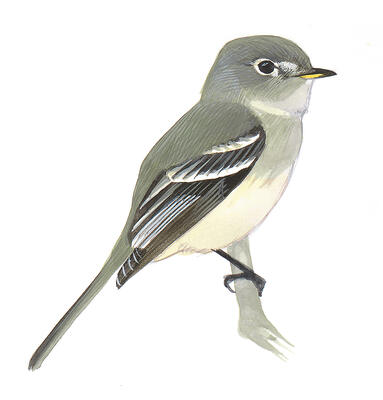
Empidonax minimus
Small pewee; tchevet, with a jerk of the head. 

Hardhack leafed two or maybe three days in one place. Early pyrus leafed yesterday or day before, if I have not named it. 

The skull of a horse, —not a mare, for I did not see the two small canine teeth in the upper jaw, nor in the under,—six molars on each side, above and below, and six incisors to each jaw. 

I first observe the stillness of birds, etc., at noon, with the increasing warmth, on the 23d of April. 

Sitting on the bank near the stone-heaps, I see large suckers rise to catch insects,—sometimes leap. 

A butterfly one inch in alar extent, dark velvety brown with slate colored tips, on dry leaves. 

On the north of Groton Turnpike beyond Abel Hosmer’s, three distinct terraces to river; first annually overflowed, say twenty-five or thirty rods wide, second seven or eight feet higher and forty or sixty wide, third forty feet higher still. 

Sweet-fern opened apparently yesterday. 

Vaccinium Pennsylvanicum began to leaf yesterday.

Young red maple leaf to-morrow; also some white birch, and perhaps sugar maple.

H. D. Thoreau, Journal, May 3, 1855

Small pewee.  (probably the least flycatcher)  See:
  • May 7, 1852 ("The first small pewee sings now che-vet, or rather chirrups chevet, tche-vet — a rather delicate bird with a large head and two white bars on wings. The first summer yellow- birds on the willow causeway. The birds I have lately mentioned come not singly, as the earliest, but all at once, i. e. many yellowbirds all over town. Now I remember the yellowbird comes when the willows begin to leave out. (And the small pewee on the willows also.)")
  • May 2, 1853 "(Summer yellowbird on the opening Salix alba. Chimney swallows and the bank or else cliff ditto. Small pewee?")
  • May 3, 1854 ("What I have called the small pewee on the willow by my boat, — quite small, uttering a short tchevet from time to time.")
  • April 29, 1856 ("I hear the small pewee’s tche-vet’ repeatedly.")
  • May 7, 1857 ("Small pewee.")
  • May 5, 1858 ("Saw and heard the small pewee yesterday. The aspen leaves at Island to-day appear as big as a nine pence suddenly.")
  • May 2, 1859 ("Small pewee and young lackey caterpillars.")
  • May 8, 1860 ("The small pewee, how long.")
See also A Book of the Seasons: the "Small Pewee"

Sweet-fern opened apparently yesterday. See  April 27, 1854 ("The meadow-sweet and sweet-fern are beginning to leaf")  May 3, 1858 ("Comptonia well out, how long?") May 4, 1855 ('Sweet-fern, and early thorn begin to leaf to-day.") See also A Book of the Seasons,  by Henry Thoreau, The Sweet-Fern 

Monday, August 11, 2014

To Assabet Bath.

August 11

I have heard since the 1st of this month the steady creaking cricket. 

Some are digging early potatoes. 

I notice a new growth of red maple sprouts, small reddish leaves surmounting light-green ones, the old being dark-green. Green lice on birches.

Aster Tradescanti, two or three days in low ground; flowers smaller than A. dumosus, densely racemed, with short peduncles or branchlets, calyx-scales narrower and more pointed.


Ammannia humilis (?) (a new plant), perhaps three weeks at northeast end of Wheeler's brush fence meadow, with small wrinkled yellowish petals with a purplish vein.

H. D. Thoreau, Journal, August 11, 1854

I have heard since the 1st of this month the steady creaking cricket. See August 7, 1853 (" I think that within a week I have heard the alder cricket, . . .The year is in the grasp of the crickets, and they are hurling it round swiftly on its axle."); August 7, 1854 ("The cool nocturnal creak of the crickets is heard in the mid-afternoon."); See also A Book of the Seasons, by Henry Thoreau, the Cricket in August

Aster tradescanti and dumosus. See August 14, 1856 ("Aster tradescanti, apparently a day or two."); August 5, 1856 ("Aster dumosus, apparently a day or two, with its large conspicuous flower-buds at the end of the branchlets and linear-spatulate involucral scales.")

August 11.  See A Book of the Seasons, by Henry Thoreau, August 11


A Book of the Seasons,  by Henry Thoreau
"A book, each page written in its own season,
out-of-doors, in its own locality.”
~edited, assembled and rewritten by zphx © 2009-2021

Tuesday, July 22, 2014

Morning fog and melting heat.

July 22.

The hottest night, — the last. It was almost impossible to pursue any work out-of- doors yesterday. There were but few men to be seen out. You were prompted often, if working in the sun, to step into the shade to avoid a sunstroke. 

Fogs almost every morning now. Now clouds have begun to hang about all day, which do not promise rain, as it were the morning fogs elevated but little above the earth and floating through the air all day.

P. M. -- To Assabet Bath. 

There is a cool wind from the east, which makes it cool walking that way while it is melting hot walking westward. 

Gerardia flava, apparently two or three days, Lupine Hillside up railroad, near fence.

Solidago odora, a day or two, Lupine Hillside, and what I will call S. puberula, to-morrow. S. altissima on railroad, a day or two.

H. D. Thoreau, Journal, July 22, 1854


The hottest night, — the last . . . There is a cool wind from the east, which makes it cool walking that way while it is melting hot walking westward.
See July 22, 1852 ("A strong west wind, saving us from intolerable heat, accompanied by a blue haze, making the mountains invisible. We have more of the furnace-like heat to-day, after all."); July 22, 1855 (''Dog day weather begins.") See also
A Book of the Seasons
, by Henry Thoreau, Locust, Dogdayish Days

There were but few men to be seen out. See July 22, 1853 (" I enjoy walking in the fields less at this season than at any other; there are so many men in the fields haying now.")

Fogs almost every morning now. See July 22, 1851 ("The season of morning fogs has arrived.”); See also July 18, 1852 ("Now the fogs have begun, in midsummer and mid-haying time "); July 19, 1853 ("This morning a fog and cool.")

Lupine Hillside.  See July 12, 1857 ("It is always pleasant to go over the bare brow of Lupine Hill and see the river and meadows thence.")

Gerardia flava, apparently two or three days. See July 28, 1853 ("The Gerardia flava in the hickory grove behind Lee's Cliff."); July 28, 1856 (Gerardia flava, apparently several days.) [Gerardia flava now know as Aureolaria flava (smooth false foxglove)]

Solidago. See July 17, 1853 ("Rank weeds begin to block up low wood-paths, — goldenrods, asters, etc."); July 18, 1854 ("Methinks the asters and goldenrods begin, like the early ripening leaves, with midsummer heats."); July 19, 1851 ("Beyond the bridge there is a goldenrod partially blossomed."); July 24, 1856 ("In the low Flint's Pond Path, beyond Britton's, the tall rough goldenrod makes a thicket higher than my head."); July 28, 1852 ("Solidago altissima (?) beyond the Corner Bridge, out some days at least . . . Goldenrod and asters have fairly begun."); August 14, 1856 ("Solidago odora abundantly out.")

July 22. See A Book of the Seasons, by Henry Thoreau, July 22

Fogs every morning. 
Now clouds hang about all day
but it does not rain.

A Book of the Seasons, by Henry Thoreau,  Melting Heat
A Book of the Seasons, by Henry Thoreau
"A book, each page written in its own season,
out-of-doors, in its own locality."
~edited, assembled and rewritten by zphx © 2009-2024

https://tinyurl.com/hdt-540722

[At dusk we hike to the view without headlamps on, arriving to a spectacular light show of constant lightning flashes and bolts to the northwest — so far  away we only occasionally  hear the thunder.  we water the dogs and  linger as long as we dare. Loki watches the light show.   my water bottle has dropped somewhere on the trail so we walk back the same route. Little Acorn is on an elastic leach strapped to my waist, her first outing since her surgery 10 day ago. A short hike.  It has been a 90 degree day and two fans so loud  in the family room we do not hear when the deluge hits home a little later.  ~ zphx 20160722]

Popular Posts Last 30 Days.

The week ahead in Henry’s journal

The week ahead in Henry’s journal
A journal, a book that shall contain a record of all your joy.
"A stone fruit. Each one yields me a thought." ~ H. D. Thoreau, March 28, 1859


I sit on this rock
wrestling with the melody
that possesses me.