Showing posts with label night sounds. Show all posts

Sunday, January 21, 2018

I wish to hear the silence of the night.


January 21.


January 21, 2018

A fine, still, warm moonlight evening. We have had one or two already. Moon not yet full.

To the woods by the Deep Cut at 9 o'clock.

The blueness of the sky at night — the color it wears by day — is an everlasting surprise to me, suggesting the constant presence and prevalence of light in the firmament, that we see through the veil of night to the constant blue, as by day. The night is not black when the air is clear, but blue still. The great ocean of light and ether is unaffected by our partial night. Night is not universal. At midnight I see into the universal day. Walking at that hour, unless it is cloudy, still the blue sky o'erarches me.

I am somewhat oppressed and saddened by the sameness and apparent poverty of the heavens, — that these irregular and few geometrical figures which the constellations make are no other than those seen by the Chaldean shepherds. The same simplicity and unchangeableness which commonly impresses me by wealth sometimes affects me as barrenness. I pine for a new world in the heavens as well as on the earth, and though it is some consolation to hear of the wilderness of stars and systems invisible to the naked eye, yet the sky does not make that impression of variety and wildness that even the forest does, as it ought. It makes an impression, rather, of simplicity and unchangeableness, as of eternal laws; this being the same constellation which the shepherds saw, and obedient still to the same law. 

It does not affect me as that unhandselled wilderness which the forest is. I seem to see it pierced with visual rays from a thousand observatories.

It is more the domain of science than of poetry. But it is the stars as not known to science that I would know, the stars which the lonely traveller knows. The Chaldean shepherds saw not the same stars which I see, and if I am elevated in the least toward the heavens, I do not accept their classification of them. I am not to be distracted by the names which they have imposed. The sun which I know is not Apollo, nor is the evening star Venus. The heavens should be as new, at least, as the world is new.

This classification of the stars is old and musty; it is as if a mildew had taken place in the heavens, as if the stars so closely packed had heated and moulded there. If they appear fixed, it is because that hitherto men have been thus necessitated to see them. I see not merely old but new testaments in the skies. Do not I stand as near the stars as the Chaldean shepherds? The heavens commonly look as dry and meagre as our astronomies are, — mere troops, as the latter are catalogues, of stars. The Milky Way yields no milk. A few good anecdotes is our science, with a few imposing statements respecting distance and size, and little or nothing about the stars as they concern man; teaching how he may survey a country or sail a ship, and not how he may steer his life.

Astrology contained the germ of a higher truth than this. It may happen that the stars are more significant and truly celestial to the teamster than to the astronomer. Nobody sees the stars now. They study astronomy at the district school, and learn that the sun is ninety-five millions distant, and the like, — a statement which never made any impression on me, because I never walked it, and which I cannot be said to believe.

But the sun shines nevertheless. Though observatories are multiplied, the heavens receive very little attention. The naked eye may easily see farther than the armed. It depends on who looks through it. No superior telescope to this has been invented. In those big ones the recoil is equal to the force of the discharge. The poet's eye in a fine frenzy rolling ranges from earth to heaven, but this the astronomer's does not often do. It does not see far beyond the dome of the observatory. Compared with the visible phenomena of the heavens, the anecdotes of science affect me as trivial and petty.

Man's eye is the true star-finder, the comet-seeker. As I sat looking out the window the other evening just after dark, I saw the lamp of a freight-train, and, near by, just over the train, a bright star, which looked exactly like the former, as if it belonged to a different part of the same train. It was difficult to realize that the one was a feeble oil lamp, the other a world. 


As I walk the railroad causeway I am, as the last two months, disturbed by the sound of my steps on the frozen ground. I wish to hear the silence of the night, for the silence is something positive and to be heard. I cannot walk with my ears covered. I must stand still and listen with open ears, far from the noises of the village, that the night may make its impression on me. A fertile and eloquent silence. Sometimes the silence is merely negative, an arid and barren waste in which I shudder, where no ambrosia grows. I must hear the whispering of a myriad voices.

Silence alone is worthy to be heard. Silence is of various depth and fertility, like soil. Now it is a mere Sahara, where men perish of hunger and thirst, now a fertile bottom, or prairie, of the West. As I leave the village, drawing nearer to the woods, I listen from time to time to hear the hounds of Silence baying the Moon, — to know if they are on the track of any game. If there 's no Diana in the night, what is it worth? I hark the goddess Diana.

The silence rings; it is musical and thrills me. A night in which the silence was audible. I hear the unspeakable. I easily read the moral of my dreams. 


Yesterday I was influenced with the rottenness of human relations. They appeared full of death and decay, and offended the nostrils. In the night I dreamed of delving amid the graves of the dead, and soiled my fingers with their rank mould. It was sanitarily, morally, and physically true.

If night is the mere negation of day, I hear nothing but my own steps in it. Death is with me, and life far away. If the elements are not human, if the winds do not sing or sigh, as the stars twinkle, my life runs shallow. I measure the depth of my own being. I walk with vast alliances. I am the allied powers, the holy alliance, absorbing the European potentates.

I do not get much from the blue sky, these twinkling stars, and bright snow-fields reflecting an almost rosaceous light. But when I enter the woods I am fed by the variety, — the forms of the trees above against the blue, with the stars seen through the pines like the lamps hung on them in an illumination, the somewhat in distinct and misty fineness of the pine-tops, and the finely divided spray of the oaks, etc., and the shadows of all these on the snow.

The first shadow I came to I thought was a black place where the woodchoppers had had a fire. These myriad shadows checker the white ground and enhance the brightness of the enlightened portions. See the shadows of these young oaks which have lost half their leaves, more beautiful than themselves, like the shadow of a chandelier, and motionless as if they were fallen leaves on the snow, — but shake the tree, and all is in motion.

In this stillness and at this distance, I hear the nine-o'clock bell in Bedford five miles off, which I might never hear in the village, but here its music surmounts the village din and has something very sweet and noble and inspiring in it, associated, in fact, with the hooting of owls.

Returning, I thought I heard the creaking of a wagon just starting from Hubbard's door, and rarely musical it sounded. It was the telegraph harp. It began to sound but at one spot only. It is very fitful, and only sounds when it is in the mood. You may go by twenty times, both when the wind is high and when it is low and let it blow which way it will, and yet hear no strain from it, but another time, at a particular spot, you may hear a strain rising and swelling on the string, which may at last ripen to something glorious. The wire will perhaps labor long with it before it attains to melody. Even the creaking of a wagon in a frosty night has music in it which allies it to the highest and purest strain of the muse.

I think it was January 20th that I saw that which I think an otter track in path under the Cliffs, — a deep trail in the snow, six or seven inches wide and two or three deep in the middle, as if a log had been drawn along, similar to a muskrat's only much larger, and the legs evidently short and the steps short, sinking three or four inches deeper still, as if it had waddled along. It finally turned into my old tracks and went toward the river and Fair Haven Pond. One was killed there last spring.

Minott says his mother told him she had seen a deer come down the hill behind her house, where I. Moore's now is, and cross the road and the meadow in front; thinks it may have been eighty years ago.

Otter are very rare here now. I have not heard of any killed here abouts for twenty or thirty years till, within two years, two or three of them. In Sudbury and at Fair Haven Pond. Israel Rice tells of one shot within the year in a ditch near White Pond; probably the same [as made the track of January 20.]

H. D Thoreau, Journal, January 21, 1853

Moon not yet full.To the woods by the Deep Cut at 9 o'clock
. See July 16, 1850 ("Many men walk by day; few walk by night.); July 12, 1851 ("The moon is full, and I walk alone.")

The blueness of the sky at night — the color it wears by day — is an everlasting surprise to me. See September 9, 1851 (" Even by night the sky is blue and not black, for we see through the veil of night into the distant atmosphere of day");  February 3, 1852 ("Is not the sky unusually blue to-night? dark blue? Is it not always bluer when the ground is covered with snow in the winter than in summer?"); February 4, 1852 ("Coming home through the village by this full moonlight, . . . the sky is the most glorious blue I ever beheld, even a light blue on some sides, as if I actually saw into day."); February 5, 1852 ("The sky last night was a deeper, more cerulean blue than the far lighter and whiter sky of to-day."); May 11, 1853 ("The sky is blue by night as well as by day, because it knows no night.")

As I sat looking out the window the other evening just after dark, I saw the lamp of a freight-train, and, near by, just over the train, a bright star, which looked exactly like the former, as if it belonged to a different part of the same train. Compare Wordsworth, according to DeQuincey (""Just now … . . .t the very instant when I raised my head from the ground . . .at the very instant when the organs of attention were all at once relaxing from their tension, the bright star hanging in the air above those outlines of massy blackness, fell suddenly upon my eye, and penetrated my capacity of apprehension with a pathos and a sense of the Infinite, that would not have arrested me 
under other circumstances.")

I hear the nine- o'clock bell in Bedford five miles off. See August 8, 1851 (“I hear the nine o'clock bell ringing in Bedford. ”)

She had seen a deer eighty years ago.
See March 23, 1856 ("I consider that the nobler animals have been exterminated here, — the cougar, panther, lynx, wolverene, wolf, bear, moose, deer, the beaver, the turkey, etc., etc., — I cannot but feel as if I lived in a tamed, and, as it were, emasculated country.”)

I think it was January 20th that I saw that which I think an otter track in path under the Cliffs.
See note to March 6, 1856 ("On the rock this side the Leaning Hemlocks, is the track of an otter. He has left some scentless jelly-like substance").

Otter are very rare here now. See December 10, 1840. (" I discover a strange track in the snow, and learn that some migrating otter has made across from the river to the wood, by my yard and the smith's shop, in the silence of the night . . . though his tracks are now crosswise to mine, our courses are not divergent, but we shall meet at last."); March 14, 1853 ("The blacksmith of Sudbury has two otter skins taken in that town."); December 31, 1853 ("Saw probably an otter's track, very broad and deep, as if a log had been drawn along. . . .This animal probably I should never see the least trace of, were it not for the snow, the great revealer."); January 30, 1854 ("How retired an otter manages to live! He grows to be four feet long without any mortal getting a glimpse of him,"); February 20, 1855 (among the quadrupeds of Concord, the otter is "very rare."); April 6, 1855 ("it reminds me of an otter, which however I have never seen."); ; March 31, 1857 ("The existence of the otter, our largest wild animal, is not betrayed to any of our senses (or at least not to more than one in a thousand)!");and the Natural History of Massachusetts (1842) ("The bear, wolf, lynx, wildcat, deer, beaver, and marten have disappeared ; the otter is rarely if ever seen here at present; and the mink is less common than formerly.")

http://tinyurl.com/hdt530121

Friday, April 15, 2016

A warm, moist night, the moon partially obscured by misty clouds, all the village asleep.


April 15.

6.30 A. M. —To Hill. 

It is warmer and quite still; somewhat cloudy in the east. The water quite smooth, — April smooth waters. 

I hear very distinctly Barrett’s sawmill at my landing.

The purple finch is singing on the elms about the house, together with the robins, whose strain its resembles, ending with a loud, shrill, ringing chili chilt chilt chilt


I push across the meadow and ascend the hill. The white-bellied swallows are circling about and twittering above the apple trees and walnuts on the hillside. 

Not till I gain the hilltop do I hear the note of the Fringilla juncorum (huckleberry-bird) from the plains beyond. 

Returned again toward my boat, I hear the rich watery note of the martin, making haste over the edge of the flood. A warm morning, over smooth water, before the wind rises, is the time to hear it.

Near the water are many recent skunk probings, as if a drove of pigs had passed along last night, death to many beetles and grubs. 

pale moon, April 15, 2016

From amid the willows and alders along the wall there, I hear a bird sing, a-chitter chitter chitter chitter chitter chitter, che che che che, with increasing intensity and rapidity, and the yellow redpoll hops in sight. 

A grackle goes over (with two females), and I hear from him a sound like a watchman’s rattle, — but little more musical. 

What I think the Alnus serrulata (?) will shed pollen to-day on the edge of Catbird Meadow. Is that one at Brister’s Spring and at Depot Brook crossing? Also grows on the west edge of Trillium Wood. 

Coming up from the riverside, I hear the harsh rasping char-r char-r of the crow blackbird, like a very coarsely vibrating metal, and, looking up, see three flying over. 

Some of the early willow catkins have opened in my window. As they open, they curve backwards, exposing their breasts to the light. 

By 9 A. M. the wind has risen, the water is ruffled, the sun seems more permanently obscured, and the character of the day is changed. It continues more or less cloudy and rain-threatening all day. 

First salmon and shad at Haverhill to-day. 

Ed. Emerson saw a toad in his garden to-day, and, coming home from his house at 11 P. M., a still and rather warm night, I am surprised to hear the first loud, clear, prolonged ring of a toad, when I am near Charles Davis’s house. The same, or another, rings again on a different key. I hear not more than two, perhaps only one. 

I had only thought of them as commencing in the warmest part of some day, but it would seem that they may first be heard in the night. Or perhaps this one may have piped in the day and his voice been drowned by day’s sounds. Yet I think that this night is warmer than the day has been. While all the hillside else, perhaps, is asleep, this toad has just awaked to a new year. 

It is a rather warm, moist night, the moon partially obscured by misty clouds, all the village asleep, only a few lights to be seen in some Windows, when, as I pass along under the warm hillside, I hear a clear, shrill, prolonged ringing note from a toad, the first toad of the year, sufficiently countenanced by its Maker in the night and the solitude, and then again I hear it (before I am out of hearing, i.e. it is deadened by intervening buildings), on a little higher key. 

At the same time, I hear a part of the hovering note of my first snipe, circling over some distant meadow, a mere waif, and all is still again. A-lulling the watery meadows, fanning the air like a spirit over some far meadow’s bay. 

And now for vernal sounds there is only the low sound of my feet on the Mill-Dam sidewalks.

H. D. Thoreau, Journal, April 15, 1856

The purple finch is singing on the elms . See April 15, 1854 ("The arrival of the purple finches appears to be coincident with the blossoming of the elm, on whose blossom it feeds.") See also 
A Book of the Seasons
 by Henry Thoreau, Elms and the Purple Finch

The white-bellied swallows are circling.  See  April 15, 1855 (" Many martins (with white—bellied swallows) are skimming and twittering above the water, perhaps catching the small fuzzy gnats with which the air is filled"); April 15, 1859 ("I see and hear white-bellied swallows as they are zigzagging through the air with their loud and lively notes."); See also April 8, 1856 ("Another very pleasant and warm day. The white bellied swallows have paid us twittering visits the last three mornings. You must rush out quickly to see them, for they are at once gone again.") and A Book of the Seasons, by Henry Thoreau, The White-bellied Swallow

I hear the rich watery note of the martin, making haste over the edge of the flood. A warm morning, over smooth water, before the wind rises, is the time to hear it. See April 15, 1855 ("Many martins (with white—bellied swallows) are skimming and twittering above the water, perhaps catching the small fuzzy gnats."); See also A Book of the Seasons,  by Henry Thoreau, Martins in Early Spring

Near the water are many recent skunk probings . . . death to many beetles and grubs. See April 4, 1859 ("For a fortnight past, or since the frost began to come out, I have noticed the funnel-shaped holes of the skunk in a great many places and their little mincing tracks in the sand. Many a grub and beetle meets its fate in their stomachs.") See also A Book of the Seasons,  by Henry Thoreau, The Skunk

The yellow redpoll hops in sight. See April 15, 1854 ("The yellow redpoll hops along the limbs within four or five feet of me."). See also April 21, 1855 ("I see yellow redpolls on the bushes near the water, — handsome birds, -— but hear no note."); April 23, 1856 ("Hear the yellow redpoll sing on the maples below Dove Rock, —a peculiar though not very interesting strain, or jingle.”) and 
A Book of the Seasons,  by Henry Thoreau, The Yellow Redpoll ( Palm) Warbler

What I think the Alnus serrulata (?) will shed pollen to-day on the edge of Catbird Meadow. See April 13, 1855 ("The Alnus incana blossoms begin generally to show. The serrulata will undoubtedly blossom to-morrow in some places."); April 13, 1856   ("There were alders out at Well Meadow Head, as large bushes as any. Can they be A. serrulata?"): April 16, 1852  ("I think that the tassels of the Alnus incana are rather earlier, longer, and more yellow, with smaller scales, than those of the A. serrulata, which are not yellow but green, mixed with the purplish or reddish brown scales."): See also A Book of the Seasons,  by Henry Thoreau,  The Alders

Some of the early willow catkins have opened in my window.  See  April 15, 1852 ("I think that the largest early-catkined willow in large bushes in sand by water now blossoming -- the fertile catkins with paler blossoms, the sterile covered with pollen, a pleasant lively bright yellow -- is the brightest flower I have seen thus far");  See also April 9, 1856  ("[Willow catkins] will perhaps blossom by day after tomorrow.");  April 12, 1852 ("See the first blossoms (bright-yellow stamens or pistils) on the willow catkins to-day . . . this earliest, perhaps swamp, willow with its bright-yellow blossoms on one side of the ament. It is fit that this almost earliest spring flower should be yellow, the color of the sun.")

By 9 A. M. the wind has risen, the water is ruffled, the sun seems more permanently obscured, and the character of the day is changed. See August 25, 1852 ("What a salad to my spirits is this cooler, darker day!”); February 5, 1855 ("In a journal it is important in a few words to describe the weather, or character of the day, as it affects our feelings."); February 18, 1860 ("Sometimes, when I go forth at 2 P.M. there is scarcely a cloud in the sky, but soon one will appear in the west and steadily advance and expand itself, and so change the whole character of the afternoon and of my thoughts.")

First salmon and shad at Haverhill to-day . . . I am surprised to hear the first loud, clear, prolonged ring of a toad. See April 13, 1853 ("First hear toads . . . a loud, ringing sound filling the air, which yet few notice. First shad caught at Haverhill to-day."). See also A Book of the Seasons, by Henry Thoreau, The Ring of Toads.

April 15.  See A Book of the Seasons,  by Henry Thoreau, April 15

The village asleep . . .
a clear, shrill, prolonged ringing –
 first toad of the year.

A Book of the Seasons, by Henry Thoreau
 "A book, each page written in its own season,
out-of-doors, in its own locality."
 ~edited, assembled and rewritten by zphx ©  2009-2026

https://tinyurl.com/hdt-560415

Monday, February 2, 2015

The sounds of skating in the dark.


February 2

Quite clear and colder, yet it could not refrain from snowing half an inch more in the night, whitening the ground now, as well as the ice. 

Brown is again filling his ice-house, which he commenced to do some weeks ago. 

I got another skate this afternoon, in spite of the thin coating of snow. This  then, is the fourth day of this rare skating, though since yesterday noon the slight whitening of snow has hurt it somewhat. 

The river at 4 P. M. has fallen some eight or ten inches. In some places there are thin flakes of ice standing on their edges within an inch or two of each other over more than a quarter of an acre, either ice blown into that position (which in this case is not likely, since there is a great deal too much for that surface) or crystallized so while the water suddenly ran off below. 

There are large tracts of thin white ice, where the water ran off before it had time to freeze hard enough to bear. This last half-inch of snow, which fell in the night, is just enough to track animals on the ice by. 

All about the Hill and Rock I see the tracks of rabbits which have run back and forth close to the shore repeatedly since the night. . . .

Snowed again half an inch more in the evening, after which, at ten o'clock, the moon still obscured, I skated on the river and meadows. The water falling, the ice on the meadow occasionally settles with a crack under our weight. It is pleasant to feel these. swells and valleys occasioned by the subsidence of the water, in some cases pretty abrupt. 

Also to hear the hollow, rumbling sound in such rolling places on the meadow where there is an empty chamber beneath, the water being entirely run out  Our skates make but little sound in this coating of snow about an inch thick, as if we had on woollen skates  and we can easily see our tracks in the night. 

We seem thus to go faster than before by day, not only because we do not see (but feel and imagine) our rapidity, but because of the impression which the mysterious muffled sound of our feet makes. 

In the meanwhile we hear the distant note of a hooting owl, and the distant rumbling of approaching or retreating cars sounds like a constant waterfall. 

Now and then we skated into some chippy, crackling white ice, where a superficial puddle had run dry before freezing hard, and got a tumble. 

H. D. Thoreau, Journal, February 2, 1855

Brown is again filling his ice-house, which he commenced to do some weeks ago. See January 23, 1856 ("Brown is filling his ice-house. The clear ice is only from one and a half to four inches thick; all the rest, or nearly a foot, is snow ice, "); January 27, 1854 ("Cut this afternoon a cake of ice out of Walden and brought it home in a pail, another from the river, and got a third, a piece of last year's ice from Sam Barrett's Pond, at Brown's ice-house, and placed them side by side . . .”);  February 8, 1858 ("The ice which J. Brown is now getting for his ice house from S. Barrett’s is from eight to nine plus inches thick, but I am surprised to find that Walden ice is only six inches thick."); February 23, 1855 ("See at Walden this afternoon that the grayish ice formed over the large square where ice has been taken out for Brown’s ice-house has a decided pink or rosaceous tinge.")

The moon still obscured, I skated on the river and meadows. See February 3, 1852 ("The landscape covered with snow two feet thick, seen by moonlight from these Cliffs, gleaming in the moon and of spotless white."); February 3, 1855 ("This will deserve to be called the winter of skating.") See also 
A Book of the Seasons
,
  by Henry Thoreau, February Moonlight  and A Book of the Seasons,  by Henry Thoreau, The Winter of Skating

Now and then we skated into some chippy, crackling white ice . . . and got a tumble. See January 15, 1855 ("Skate into a crack, and slide on my side twenty-five feet. The river-channel dark and rough with fragments of old ice")

In the meanwhile we hear the distant note of a hooting owl, and the distant rumbling of approaching or retreating cars sounds like a constant waterfall.
See February 3, 1852 ("
I hear my old acquaintance, the owl . . . Floundering through snow, sometimes up to my middle, my owl sounds hoo hoo hoo, ho-O."); January 4, 1859 ("When it grew late . . . I mistook the distant sound of the locomotive whistle for the hoot of an owl. It was quite like it.");  December 9, 1856 ("I hear only the strokes of a lingering woodchopper at a distance, and the melodious hooting of an owl, which is as common and marked a sound as the axe or the locomotive whistle."); December 15, 1856 ("The melodious hooting of the owl, heard at the same time with the yet more distant whistle of a locomotive."); See also A Book of Seasons, by Henry Thoreau, The Voice of the Barred Owl

February 2. See A Book of the Seasons, by Henry Thoreau, February 2

This coating of snow
mysterious muffled sounds
the moon still obscured. 

Friday, June 1, 2012

Moonlit clouds

June 1

Evening. -To the Lee place, the moon about full.

The sounds I hear by the bridge: the midsummer frog (I think it is not the toad), the nighthawk, crickets, the peetweet (it is early), the hum of dor-bugs, and the whip-poor-will.

The moving clouds are the drama of the moonlight nights, and never-failing entertainment of nightly travellers. You can never foretell the fate of the moon, -- whether she will prevail over or be obscured by the clouds half an hour hence. The traveller's sympathy with the moon makes the drama of the shifting clouds interesting. 

H. D. Thoreau, Journal, June 1, 1852

The moving clouds are the drama of the moonlight nights
. See August 12, 1851 ("The traveller’s whole employment is to calculate what cloud will obscure the moon and what she will triumph over.")

Saturday, May 5, 2012

The vast wild earth.

May 3

5 a. m. — To Cliffs. A great brassy moon going down in the west.

A flock of neat sparrows, small, striped-throated, whitish over eye, on an apple tree by J. Potter's. At Hayden's orchard, quite a concert from some small sparrows, forked-tailed, many jingling together like canaries. Their note still somewhat like the chip-sparrow's. Can it be this?

Fair Haven. How cheering and glorious any landscape viewed from an eminence! For every one has its horizon and sky. It is so easy to take wide views. Snow on the mountains. 

The wood thrush reminds me of cool mountain springs and morning walks. 

That oven-birdish note which I heard here on May 1st I now find to have been uttered by the black and white warbler or creeper. He has a habit of looking under the branches. 

The towhee finch is the loudest singer here now.

Looking from the Cliff, now, about 6 A.M.  the landscape is as if seen in a mirage, the Cliff being both in shadow and in the fresh and dewy sunshine (not much dew yet). Cool sunlight. The landscape lies in a fresh morning light; the earth and water smell fresh and new; the,   water is marked by a few smooth streaks. 

The white pine is beautiful in the morning light--the early sun light and the dew on it -- before the water is rippled and the morning song of the birds is quenched.


Evening.--The moon is full. The air is filled with a certain luminous, liquid, white light. You can see the moonlight, as it were, reflected from the atmosphere,- which some might mistake for a haze, - a glow of mellow light,  as if the air were a very thin but transparent liquid, not dry, as in winter, nor gross, as in summer.  The sky has depth, and not merely distance.  The sky is not so withdrawn, clear, tight, and cold as last moon.

I go along the side of Fair Haven Hill. The clock strikes distinctly, showing the wind is easterly. There is a grand, rich, musical echo trembling on the air long after the clock has ceased to strike, like a vast organ, filling the air with a trembling music like a flower of sound. Nature adopts it. Beautiful is sound. 

From the Hill the river is a broad blue stream exactly the color of the heavens which it reflects. Sit on the Cliff with comfort, in greatcoat.  All the tawny and russet earth--for no green is seen on the ground at this hour--  sending only this faint multitudinous sound (of frogs) to heaven. The vast, wild earth.

Summer is coming apace. Within three or four days the birds have come so fast I can hardly keep the run of them  - much faster than the flowers. I did not watch for the very earliest, however. 

The little peeping frogs make a background of sound in the horizon, which you do not hear unless you attend. The little peeper prefers a pool on the edge of a wood, which mostly dries up at midsummer, whose shore is covered with leaves and [where] twigs lie in the water, as where choppers have worked. Theirs is a clear, sharp, earpiercing peep, not shrill, - sometimes a squeak from one whose pipe is out of order, frequently a quavering, curving (?) trill, as if of alarm (?). My little peepers when they slept, the pulsation in their throats stopped. There was a wrinkled bag there. They begin to peep in earnest at or before sundown, and they keep it up now at 10 P. M. But I rarely hear any numbers in the morning, when they probably sleep. 

H. D. Thoreau, Journal, May 3, 1852 

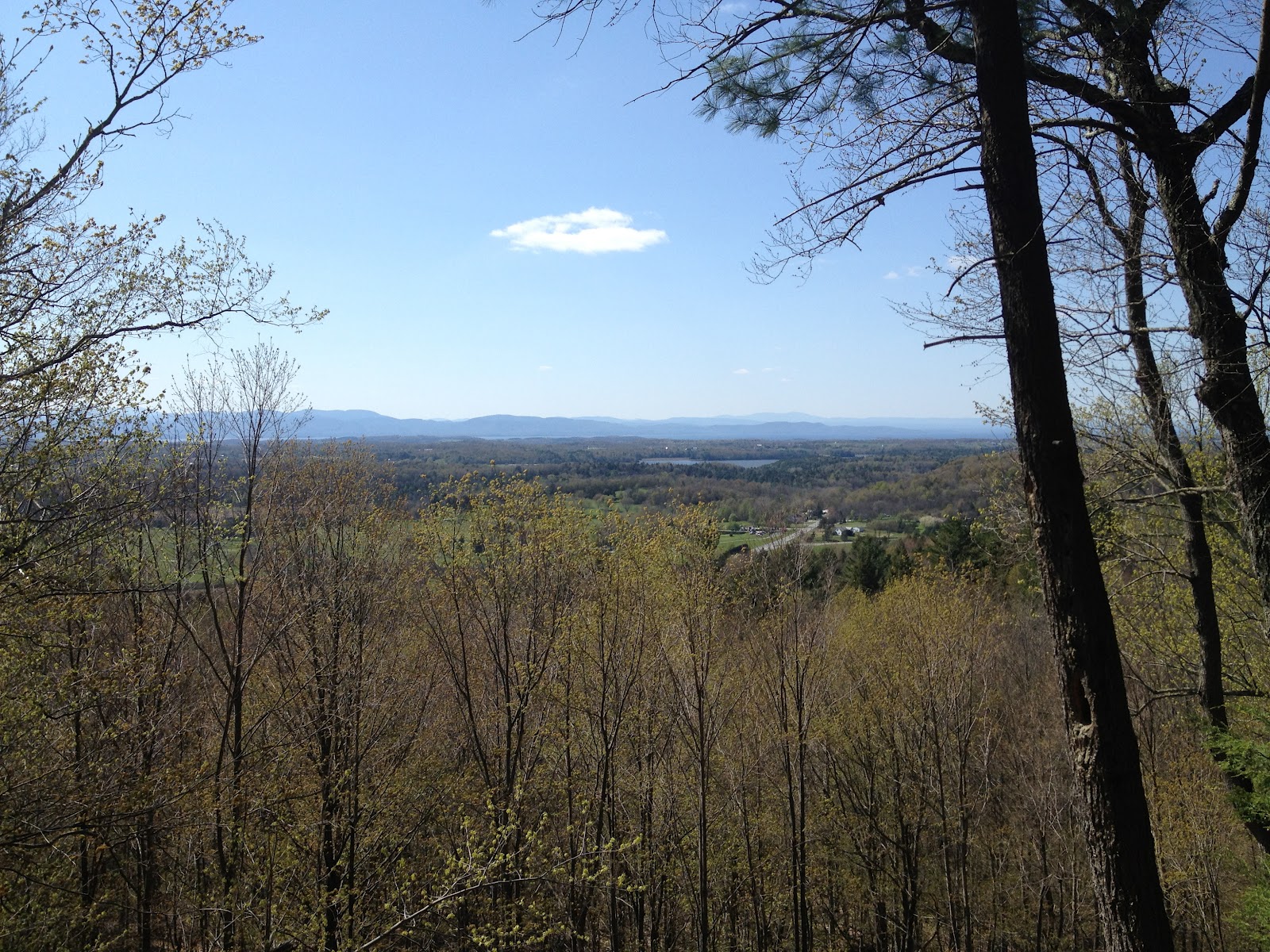
How cheering and glorious any landscape viewed from an eminence!
See A Book of the Seasons, by Henry Thoreau, Seen from a Hillside

That oven-birdish note which I heard here on May 1st I now find to have been uttered by the black and white warbler or creeper. See May 1, 1852 ("I think I heard an oven-bird just now, wicher wicher whicher wich."); May 3, 1858 ("Heard the black and white creeper April 25th. I hear it and see it well to-day."); See also April 28, 1856 ("I hear to-day frequently the seezer seezer seezer of the black and white creeper, . . .”); May 4, 1858 ("I hear the weese wese wese of the creeper continually from the swamp. It is the prevailing note there.") See also A Book of the Seasons  by Henry Thoreau, The Black and White Creeper


The clock strikes distinctly, showing the wind is easterly.
See August 8, 1851 ("I hear the nine o'clock bell ringing in Bedford. Pleasantly sounds the voice of one village to another."); January 21, 1853 ("I hear the nine-o'clock bell in Bedford five miles off, which I might never hear in the village, but here its music surmounts the village din and has something very sweet and noble and inspiring in it, associated, in fact, with the hooting of owls"); April 18, 1852 ("An east wind. I hear the clock strike plainly ten or eleven P.M."); October 21, 1855 ("The wind must be east, for I hear the church bell very plainly.") and An East Wind. See also A Book of the Seasons, by Henry Thoreau, Bells and Whistles and April 5, 1855 ("[W]e on the water hear the loud and musical sound of bells ringing for church in the surrounding towns."); April 15, 1855 ("The sound of church bells sounds very sweet to us on the water this still day. It is the song of the villages."); September 13, 1851 ("The Bedford sunrise bell rings sweetly and musically at this hour, when there is no bustle in the village to drown it. Bedford deserves a vote of thanks from Concord for it. It is a great good at these still and sacred hours, when towns can hear each other. ")

Within three or four days the birds have come so fast.
See May 7, 1852 (" The birds I have lately mentioned come not singly, as the earliest, but all at once, i.e. many yellowbirds all over town.")

The little peeping frogs make a background of sound in the horizon, which you do not hear unless you attend.   See  May 3, 1857 ("A hylodes or two were heard close about me, but not one was seen. The nearest seemed to have his residence in my ear alone. It took such possession of my ear that I was unable to appreciate the source whence it came. ") See also March 31, 1857  ("How gradually and imperceptibly the peep of the hylodes mingles with and swells the volume of sound which makes the voice of awakening nature! If you do not listen carefully for its first note, you probably will not hear it, and, not having heard that, your ears become used to the sound, so that you will hardly notice it at last, however loud and universal.")

Thursday, July 14, 2011

Crickets

July 14.

If I take the same walk by moonlight an hour later or earlier in the evening, it is as good as a different one. I love the night for its novelty; it is less prophaned than the day.

The creaking of the crickets seems at the very foundation of all sound. At last I cannot tell it from a ringing in my ears. It is a sound from within, not without.

You cannot dispose of it by listening to it. In proportion as I am stilled I hear it. It reminds me that I am a denizen of the earth.     


H. D. Thoreau,  Journal,  July 14, 1851

I love the night for its novelty. See June 11, 1851 ("Hardly two nights are alike."); October 26, 1857.(My moods are thus periodical, not two days in my year alike.)

Monday, June 13, 2011

Earth-song.

June 13.

Walk to Walden at night (moon not quite full) by railroad and upland wood-path, returning by Wayland road. The different frogs mark the seasons pretty well,- the peeping hyla, the dreaming frog, and the bullfrog. I believe that all may be heard at last occasionally together. The bullfrog belongs to summer. The tree-toad's, too, is a summer sound.

I hear partridges drumming to-night as late as 9 o'clock . What singularly space penetrating and filling sound! Why am I never nearer to its source?

I hear, just as the night sets in, faint notes from time to time from some sparrow falling asleep, - a vesper hymn - and later, in the woods, the chuckling, rattling sound of some unseen bird on the near trees.

As I climb the hill again toward my old bean-field I hear my old musical, simple-noted owl. Then, hearing at first some distinct chirps, I listen to the ancient, familiar, immortal, dear cricket sound under all others, and as these cease I become aware of the general earth-song.


H. D. Thoreau, Journal, June 13, 1851


The different frogs mark the seasons pretty well,- the peeping hyla, the dreaming frog, and the bullfrog. See June 9, 1853 ("So there is an evening for the toads and another for the bullfrogs.")
I become aware of the general earth-song. See June 1, 1856 (“Was soothed and cheered by I knew not what at first, but soon detected the now more general creak of crickets”); June 4, 1854 (“These warm and dry days, which put spring far behind, the sound of the cricket at noon has a new value and significance, so serene and cool . . ..”); June 17, 1852 (“The earth-song of the cricket! Before Christianity was, it is. Health! health! health! is the burden of its song. ”) See also note to June 4, 1857 ("One thing that chiefly distinguishes this season from three weeks ago is that fine serene undertone or earth-song as we go by sunny banks and hillsides, the creak of crickets, which affects our thoughts so favorably, imparting its own serenity.")

June 13. See A Book of the Seasons, by Henry Thoreau, June 13

The bullfrog belongs 
to summer – the tree-toad's, too, 
is a summer sound.
A Book of the Seasons,  by Henry Thoreau
"A book, each page written in its own season,
out-of-doors, in its own locality.”
~edited, assembled and rewritten by zphx © 2009-2024

Popular Posts Last 30 Days.

The week ahead in Henry’s journal

The week ahead in Henry’s journal
A journal, a book that shall contain a record of all your joy.
"A stone fruit. Each one yields me a thought." ~ H. D. Thoreau, March 28, 1859


I sit on this rock
wrestling with the melody
that possesses me.