Showing posts with label golden-crowned thrush. Show all posts

Thursday, August 23, 2018

I sometimes remember something which I have told another as worth telling to myself.

August 23. 

Cooler than ever. Some must have fires, and I close my window. 

P. M. —Britton’s camp via Hubbard’s Close. 

The rhexia in the field west of Clintonia Swamp makes a great show now, though a little past prime. 

I go through the swamp, wading through the luxuriant cinnamon fern, which has complete possession of the swamp floor. Its great fronds, curving this way and that, remind me [of] a tropical vegetation. They are as high as my head and about a foot wide; may stand higher than my head without being stretched out. They grow in tufts of a dozen, so close that their fronds interlace and form one green waving mass. There in the swamp cellar under the maples. A forest of maples rises from a forest of ferns. My clothes are covered with the pale-brown wool which I have rubbed off their stems.

See an abundance of pine-sap on the right of Pine-sap Path. It is almost all erect, some eight to nine inches high, and all effete there. Some stems are reddish. It lifts the leaves with it like the Indian-pipe, but is not so delicate as that. The Indian-pipe is still pushing up.

Everywhere in woods and swamps I am already reminded of the fall. 

I see the spotted sarsaparilla leaves and brakes, and, in swamps, the withering and blackened skunk-cabbage and hellebore, and, by the river, the already blackening pontederias and pipes. 

There is no plateau on which Nature rests at midsummer, but she instantly commences the descent to winter.

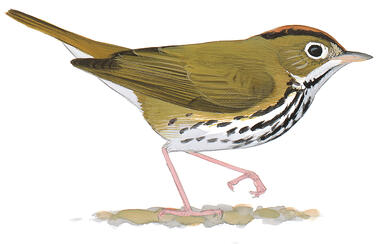
I see a golden-crowned thrush, but it is silent except a chip; sitting low on a twig near the main stem of a tree, in these deep woods.

High blackberries now in their prime, their great racemes of shining black fruit, mixed with red and green, bent over amid the sweet-fern and sumach on sunny hill sides, or growing more rankly with larger fruit by rich roadsides and in lower ground. 

The chewink note of a chewink (not common), also a cuckoo’s note.

Smooth sumach berries all turned crimson. This fruit is now erect spear-heads, rising from the ample dark-green, unspotted leaves, pointing in various directions. 

I see dense patches of the pearly everlasting, maintaining their ground in the midst of dense green sweet-fern, a striking contrast of snow-white and green. 

Viburnum nudum berries, apparently but a day or two. 

Epilobium angustifolium is abundantly shedding its downy seed, — wands of white and pink. 

Emerson says that he and Agassiz and Company broke some dozens of ale-bottles, one after another, with their bullets, in the Adirondack country, using them for marks! It sounds rather Cockneyish. He says that he shot a peetweet for Agassiz, and this, I think he said, was the first game he ever bagged. He carried a double-barrelled gun, —rifle and shotgun, — which he bought for the purpose, which he says received much commendation, — all parties thought it a very pretty piece. 

Think of Emerson shooting a peetweet (with shot) for Agassiz, and cracking an ale-bottle (after emptying it) with his rifle at six rods! They cut several pounds of lead out of the tree. It is just what Mike Saunders, the merchant’s clerk, did when he was there.  

The writer needs the suggestion and correction that a correspondent or companion is. I sometimes remember something which I have told another as worth telling to myself, i.e. writing in my Journal. 

Channing, thinking of walks and life in the country, says, “You don’t want to discover anything new, but to discover something old,” i.e. be reminded that such things still are.

H. D. Thoreau, Journal, August 23, 1858

There is no plateau on which Nature rests at midsummer, but she instantly commences the descent to winter. See August 5, 1854 ("It is one long acclivity from winter to midsummer and another long declivity from midsummer to winter."); August 19, 1851("Nature rests no longer at her culminating point than at any other. If you are not out at the right instant, the summer may go by and you not see it.”); August 23. 1853 ("Observing the blackness of the foliage, especially between me and the light, I am reminded that it begins in the spring, the dewy dawn of the year, with a silvery hoary downiness, changing to a yellowish or light green, — the saffron-robed morn, — then to a pure, spotless, glossy green with light under sides reflecting the light, — the forenoon, — and now the dark green, or early afternoon, when shadows begin to increase, and next it will turn yellow or red, — the sunset sky, — and finally sere brown and black, when the night of the year sets in.")

High blackberries now in their prime. See August 23, 1856 ("Now for high blackberries"); and note to August 31, 1857 ("An abundance of fine high blackberries behind Britton's old camp on the Lincoln road, now in their prime there, which have been overlooked. Is it not our richest fruit?")

I see dense patches of the pearly everlasting, maintaining their ground in the midst of dense green sweet-fern, a striking contrast of snow-white and green. See August 23, 1856 ("I see a bed of Antennaria margaritacea, now in its prime, by the railroad, and very handsome. . . . dense pearly masses of flowers covered with bees and butterflies")

Everywhere in woods 
and swamps I am already 
reminded of fall. 

Tuesday, May 9, 2017

Who saw the otter?

May 9. 

Another fine day. 

6 a. m. — On water. 

Maryland yellow-throat. Aspen leaves one inch over.

Hear stake-driver. Black and white creeper's fine note. Er-te-ter-twee, or evergreen-forest note. Golden-crowned thrush note. Kingbird. 

P. M. To Gilson's Mill, Littleton. 

George Brooks points to an old house of which one half the roof only has been shingled, etc., etc., and says he guessed it to be a widow's dower from this, and on inquiry found it so. 

Went to Gilson's tumble-down mill and house. He appeared, licking his chaps after dinner, in a mealy coat, and suddenly asked in the midst of a sentence, with a shrug of his shoulders, 
"Isn't there something painted on my back ?" 
There were some marks in red chalk they used to chalk the bags with, and he said he thought he had felt his son at the mill chalking his back. He feared he was making an exhibition before strangers. 

The boy speared fishes, chiefly suckers, pouts, etc. A fire in a hand-crate carried along the bank of the brook (Stony Brook). He had lately speared a sucker weighing five and a quarter pounds, which he sold; went back and forth some twenty-five rods and found the suckers less shy at last than at first. 

Saw otter there. 

I saw many perch at the foot of the falls. 

He said that they and trout could get up five or six feet over the rocks there into the pond, it being a much broken fall.

H. D. Thoreau, Journal, May 9, 1857


Hear stake-driver. See May 9, 1853 ("At sundown paddled up the river. The pump-like note of a stake-driver from the fenny place across the Lee meadow."); April 24, 1854 ("I hear the loud and distinct pump-a-gor of a stake-driver. Thus he announces himself."); May 12, 1855 ("A distant stake-driver"); May 20, 1856 ("See and hear a stake-driver in the swamp. It took one short pull at its pump and stopped.")

Saw otter there. Consider. Did Thoreau, while visiting the falls at Littleton, see an otter? Or is he recounting a second-hand story about Gilson the miller's son? See March 31, 1857 ("The existence of the otter, our largest wild animal, is not betrayed to any of our senses (or at least not to more than one in a thousand)!"); April 6, 1855 ("it reminds me of an otter, which however I have never seen."); February 20, 1855 (among the quadrupeds of Concord, the otter is "very rare."); January 30, 1854 ("How retired an otter manages to live! He grows to be four feet long without any mortal getting a glimpse of him,");  January 21, 1853 ("Otter are very rare here now.”); and the Natural History of Massachusetts (1842) ("The bear, wolf, lynx, wildcat, deer, beaver, and marten have disappeared ; the otter is rarely if ever seen here at present; and the mink is less common than formerly..")

Sunday, September 25, 2016

The haws of the common thorn are now very good eating and handsome


September 25

The river has risen again considerably (this I believe the fourth time), owing to the late copious rains. This before the farmers have succeeded in their late attempt to get their meadow-hay after all. It had not got down before this last rain but to within some eighteen inches, at least, of the usual level in September. 

P. M. — To Harrington road. 

A golden-crowned thrush runs off, a few feet at a time, on hillside on Harrington road, as if she had a nest still! 

The haws of the common thorn are now very good eating and handsome. Some of the Crataegus Crus-Galli on the old fence line between Tarbell and T. Wheeler beyond brook are smaller, stale, and not good at all. 

The urtica just beyond Widow Hosmer's barn appears the same with that I called U. gracilis (?) in Brattleboro.


H. D. Thoreau, Journal, September 25, 1856


The river has risen again . . . before the farmers have succeeded in their late attempt to get their meadow-hay . . . See August 24, 1856 ("The river meadows probably will not be mown this year. I can hardly get under the stone bridge without striking my boat.”)

A golden-crowned thrush runs off . . . as if she had a nest still! See June 18, 1854 ("Observe in two places golden-crowned thrushes, near whose nests I must have been.”); August 6, 1852 (“With the goldenrod comes the goldfinch. About the time his cool twitter is heard, does not the . . . oven-bird, etc . cease?”); August 23, 1858 ("I see a golden-crowned thrush, but it is silent except a chip; sitting low on a twig near the main stem of a tree, in these deep woods ") See also A Book of the Seasons, by Henry Thoreau,  The Oven-bird

The haws of the common thorn are now very good eating and handsome. See September 23, 1852 ("I gathered some haws very good to eat to-day."); September 24, 1859 ("Those thorns by Shattuck's barn, now nearly leafless, have hard green fruit as usual.")

Crataegus Crus-Galli on the old fence line. [Crataegus crus-galli (cockspur thorn) is a species of hawthorn.]  See  
May 29, 1853 ("The Cratægus Crus-Galli this side the Holden place on left, probably yesterday, thorns three inches long, flowers with anthers not conspicuously red.");June 10, 1856 ("The Crataegus Crus-Galli is out of bloom”); March 16, 1855 ("At the woodchuck’s hole just beyond the cockspur thorn”).

The urtica just beyond Widow Hosmer's barn appears the same with that I called U. gracilis (?) [
Slender Stinging Nettle] in Brattleboro. See September 21, 1856 ("Such is the advantage of going abroad, — to enable to detect your own plants. I detected them first abroad, because there I was looking for the strange.")

September 25. See A Book of the Seasons,  by Henry Thoreau, September 25

A golden-crowned thrush 
runs off a few feet as if 
she had a nest still.


 A Book of the Seasons, by Henry Thoreau
"A book, each page written in its own season,
out-of-doors, in its own locality."
 ~edited, assembled and rewritten by zphx ©  2009-2026

https://tinyurl.com/hdt-560925


Wednesday, June 18, 2014

Another round red sun of dry and dusty weather – Stawberries in season.


June 18.

The Rosa lucida is pale and low on dry sunny banks like that by Hosmer's pines. 


There are many strawberries this season, in meadows now, just fairly begun there. The meadows, like this Nut Meadow, are now full of the taller grasses, just beginning to flower.


Ovenbird
Observe in two places golden-crowned thrushes, near whose nests I must have been, hopping on the lower branches and in the underwood, — a somewhat sparrow-like bird, with its golden-brown crest and white circle about eye, carrying the tail somewhat like a wren, and inclined to run along the branches. Each had a worm in its bill, no doubt intended for its young. That is the chief employment of the birds now, gathering food for their young. I think I heard the anxious peep of a robin whose young have just left the nest.

Small grasshoppers very abundant in some dry grass. 

Another round red sun of dry and dusty weather to-night, — a red or red-purple helianthus. Every year men talk about the dry weather which has now begun as if it were something new and not to be expected.

H. D. Thoreau, Journal, June 18, 1854

And more today on slavery:
My advice to the State is simply this: to dissolve her union with the slaveholder instantly. ... And to each inhabitant of Massachusetts, to dissolve his union with the State, as long as she hesitates to do her duty.
See May 29, 1854 , June 9, 1854, June 16, 1854, June 17, 1854 and ""Slavery in Massachusetts.

The Rosa lucida is pale and low on dry sunny banks. See June 13, 1854 ("Is not the rose-pink Rosa lucida paler than the R. nitida?"); June 16, 1854 ("The R. lucida, with its broader and duller leaves, but larger and perhaps deeper-colored and more purple petals, perhaps yet higher scented, and its great yellow centre of stamens.") See also A Book of the Seasons, by Henry Thoreau, The Wild Rose

There are many strawberries this season, in meadows now, just fairly begun there. See June 17, 1854 ("Already the season of small fruits has arrived.") See also A Book of the Seasons, by Henry Thoreau: Strawberries

Observe in two places golden-crowned thrushes, near whose nests I must have been . . . See June 10, 1855 ("Oven-bird’s nest with four eggs two thirds hatched, under dry leaves, composed of pine-needles and dry leaves and a hair or two for lining,”)

Another round red sun.  See June 17, 1854 ("The sun goes down red again, like a high-colored flower of summer.")

I think I heard the anxious peep of a robin whose young have just left the nest. See June 10, 1853 ("We hear the cool peep of the robin calling to its young, now learning to fly.") See also May 13, 1853 ("A robin's nest, with young, on the causeway."): May 24, 1855 ("Young robins some time hatched");June 9, 1856 ("A young robin abroad. "); June 15, 1855 ("Robin’s nest in apple tree, twelve feet high — young nearly grown."): June 15, 1852 ("Young robins,speck dark-led,"); June 20, 1855 (" A robin’s nest with young, which was lately, in the great wind, blown down and somehow lodged on the lower part of an evergreen by arbor,—without spilling the young!")

Every year men talk about the dry weather which has now begun as if it were something new and not to be expected. See July 7, 1853 ("Now is that annual drought which is always spoken of as something unprecedented and out of the common course.")

June18. See A Book of the Seasons, by Henry Thoreau, June 18

Many strawberries 
this season in meadows now –
just fairly begun.

A Book of the Seasons, by Henry Thoreau, Strawberries in Season
A Book of the Seasons, by Henry Thoreau
"A book, each page written in its own season,
out-of-doors, in its own locality.”


~edited, assembled and rewritten by zphx © 2009-2024
https://tinyurl.com/hdt-540618

Popular Posts Last 30 Days.

The week ahead in Henry’s journal

The week ahead in Henry’s journal
A journal, a book that shall contain a record of all your joy.
"A stone fruit. Each one yields me a thought." ~ H. D. Thoreau, March 28, 1859


I sit on this rock
wrestling with the melody
that possesses me.