Showing posts with label Boston Harbor. Show all posts

Thursday, November 5, 2020

Sat at the end of Long Wharf.


November 5.

In Boston. — The first Indian-summer day, after an unusually cold October. 

November 5, 2020

Sat at the end of Long Wharf for coolness, but it was very warm, with scarcely a breath of wind, and so thick a haze that I could see but little way down the harbor.


H. D. Thoreau, Journal, November 5, 1859


The first Indian-summer day,
See November 1, 2015 ("A beautiful Indian-summer day, the most remarkable hitherto and equal to any of the kind. "); November 1, 1860 ("A perfect Indian-summer day, and wonderfully warm. 72+ at 1 P. M. and probably warmer at two.");November 6, 1857 ("Thermometer on north of the house 70° at 12 M. Indian summer.") See also A Book of the Seasons, by Henry Thoreau, The world can never be more beautiful than now.

Sat at the end of Long Wharf . See December 25, 1853 ("When I go to Boston, I go naturally straight through the city down to the end of Long Wharf and look off")


Wednesday, December 25, 2019

The pond began to boom or whoop.

December 25

P. M. — Skated to Fair Haven and above. 

At seven this morning the water had already oozed out at the sides of the river and flowed over the ice. It appears to be the result of this bridging of the river in the night and so obstructing the channel or usual outlet. 

About 4 p. m. the sun sunk behind a cloud, and the pond began to boom or whoop. I noticed the same yesterday at the same hour at Flint's. It was perfectly silent before. The weather in both cases clear, cold, and windy. It is a sort of belching, and, as C. said, is somewhat frog-like. I suspect it did not continue to whoop long either night. It is a very pleasing phenomenon, so dependent on the altitude of the sun. 
December 25, 2019

When I go to Boston, I go naturally straight through the city down to the end of Long Wharf and look off, for I have no cousins in the back alleys. The water and the vessels are novel and interesting. 

What are our maritime cities but the shops and dwellings of merchants, about a wharf projecting into the sea, where there is a convenient harbor, on which to land the produce of other climes and at which to load the exports of our own? 

Next in interest to me is the market where the produce of our own country is collected. Boston, New York, Philadelphia, Charleston, New Orleans, and many others are the names of wharves projecting into the sea. They are good places to take in and to discharge a cargo. Everybody in Boston lives at No. so-and-so, Long Wharf. 

I see a great many barrels and fig-drums and piles of wood for umbrella-sticks and blocks of granite and ice, etc., and that is Boston. 

Great piles of goods and the means of packing and conveying them, much wrapping-paper and twine, many crates and hogsheads and trucks, that is Boston. The more barrels, the more Boston. 

The museums and scientific societies and libraries are accidentals. They gather around the barrels, to save carting. 

Apparently the ice is held down on the sides of the river by being frozen to the shore and the weeds, and so is overflowed there, but in the middle it is lifted up and makes room for the tide. 

I saw, just above Fair Haven Pond, two or three places where, just before the last freezing, when the ice was softened and partly covered with sleet, there had been a narrow canal, about eight inches wide, quite across the river from meadow to meadow. I am constrained to believe, from the peculiar character of it on the meadow end, where in one case it divided and crossed itself, that it was made either by muskrats or otters or minks repeatedly crossing there. One end was for some distance like an otter trail in the soft upper part of the ice, not worn through.

H. D. Thoreau, Journal, December 25, 1853

 Skated to Fair Haven and above. See ; December 5, 1853 (" Fair Haven Pond is skimmed completely over."); December 7, 1856 ("Take my first skate to Fair Haven Pond”); December 20, 1854 ( P. M. — Skate to Fair Haven.”); December 24, 1853 ("Skated across Flint's Pond.")

About 4 p. m. the sun sunk behind a cloud, and the pond began to boom or whoop. I noticed the same yesterday at the same hour at Flint's. It is a very pleasing phenomenon, so dependent on the altitude of the sun. See February 12, 1854 ("The pond does not thunder every night, and I do not know its law exactly. I cannot tell surely when to expect its thundering, . . . [y]et it has its law to which it thunders obedience when it should"); December 25, 1858 (“I stayed later to hear the pond crack, but it did not much. ”)

Thursday, January 26, 2017

Boston Harbor frozen over


January 26. 

Another cold morning. None looked early, but about eight it was -14°. 

A. M. — At Cambridge and Boston. 

Saw Boston Harbor frozen over (for some time). Reminded me of, I think, Parry's Winter Harbor, with vessels frozen in. 

Saw thousands on the ice, a stream of men reaching down to Fort Independence, where they were cutting a channel toward the city. Ice said to reach fourteen miles. 

Snow untracked on many decks. [Ice did not finally go out till about Feb. 15th.] 

At 10 p.m., +14°.

H. D. Thoreau, Journal, January 26, 1857

Saw Boston Harbor frozen over . . . 
thousands on the ice, a stream of men reaching down to Fort Independence, where they were cutting a channel. See January 20, 1857 (" I hear that Boston Harbor froze over on the 18th, down to Fort Independence."); Good Morning Gloucester ("In January 1857, the merchants organized a crew, who chopped a channel out of the harbor ice seven miles in length. In that month the thermometer went 16 degrees below zero, and it did not rise above zero for two weeks") See also December 2, 1853 ("A communication to a newspaper, dated Bangor, 28th (November), says of the Penobscot :“The navigation is closed here, the anchor ice with the surface ice making an obstruction of several feet thickness. There are enclosed in the ice from 60 to 80 vessels with full cargoes, besides the steamers. The ice obstruction extends about five miles,")

Thousands on the ice
down to Fort Independence 
cutting a channel.

HDT ~ January 26, 1857

Friday, January 20, 2017

The milkman came with oxen.


January 20. 

There probably is not more than twelve to fifteen inches of snow on a level, yet the drifts are very large. Neither milkman nor butcher got here yesterday, and to-day the milkman came with oxen, partly through the fields. Though the snow is nowhere deep in the middle of the main street, the drifts are very large, especially on the north side, so that, as you look down the street, it appears as uneven as a rolling prairie. 

Heard, in the Dennis swamp by the railroad this afternoon, the peculiar goldfinch-like mew — also like some canaries — of, I think, the lesser redpoll (?). Saw several. Heard the same a week or more ago. 

I hear that Boston Harbor froze over on the 18th, down to Fort Independence. 

The river has been frozen everywhere except at the very few swiftest places since about December 18th, and everywhere since about January 1st. 

At R. W. E.'s this evening, at about 6 p. m., I was called out to see Eddy's cave in the snow. It was a hole about two and a half feet wide and six feet long, into a drift, a little winding, and he had got a lamp at the inner extremity. I observed, as I approached in a course at right angles with the length of the cave, that the mouth of the cave was lit as if the light were close to it, so that I did not suspect its depth. Indeed, the light of this lamp was remarkaoly reflected and distributed. The snowy walls were one universal reflector with countless facets. I think that one lamp would light sufficiently a hall built of this material. The snow about the mouth of the cave within had the yellow color of the flame to one approaching, as if the lamp were close to it. We afterward buried the lamp in a little crypt in this snow drift and walled it in, and found that its light was visible, even in this twilight, through fifteen inches' thickness of snow. The snow was all aglow with it. If it had been darker, probably it would have been visible through a much greater thickness. 

But, what was most surprising to me, when Eddy crawled into the extremity of his cave and shouted at the top of his voice, it sounded ridiculously faint, as if he were a quarter of a mile off, and at first I could not believe that he spoke loud, but we all of us crawled in by turns, and though our heads were only six feet from those outside, our loudest shouting only amused and surprised them. Apparently the porous snow drank up all the sound. The voice was, in fact, muffled by the surrounding snow walls, and I saw that we might lie in that hole screaming for assistance in vain, while travellers were passing along twenty feet distant. It had the effect of ventriloquism. 

So you only need make a snow house in your yard and pass an hour in it, to realize a good deal of Esquimau life.

H. D. Thoreau, Journal, January 20, 1857

I hear that Boston Harbor froze over. See January 26, 1857 ("Saw Boston Harbor frozen over . . . thousands on the ice, a stream of men reaching down to Fort Independence, where they were cutting a channel.") See also  Good Morning Gloucester ("In January 1857, the merchants organized a crew, who chopped a channel out of the harbor ice seven miles in length. In that month the thermometer went 16 degrees below zero, and it did not rise above zero for two weeks")

The river has been frozen everywhere except at the very few swiftest places. See January 19, 1856 ("The only open place in the river between Hunt’s Bridge and the railroad bridge is a small space against Merrick’s pasture just below the Rock.”); January 19, 1860 (“It is evident mere shallowness is not enough to prevent freezing, for that shallowest space of all, in middle of river at Barrett's Bar, has been frozen ever since the winter began. It is the swifter though deeper, but not deep, channels on each side that remain open.”); January 20, 1856 ("The river has been frozen solidly ever since the 7th, and that small open strip of yesterday (about one rod wide and in middle) was probably not more than a day or two old. It is very rarely closed, I suspect, in all places more than two weeks at a time.”)

Heard, in the Dennis swamp by the railroad this afternoon, the peculiar goldfinch-like mew — also like some canaries — of, I think, the lesser redpoll.
See November 21, 1852("The commonest bird I see and hear nowadays is that little red crowned or fronted bird I described the 13th. I hear now more music from them. They have a mewing note which reminds me of a canary-bird. They make very good forerunners of winter. Is it not the {lesser redpoll}?”); March 5, 1853 (“They have a sharp bill, black legs and claws, and a bright-crimson crown or frontlet, in the male reaching to the base of the bill, with, in his case, a delicate rose or carmine on the breast and rump. Though this is described by Nuttall as an occasional visitor in the winter, it has been the prevailing bird here this winter.”); December 11, 1855 ("Standing there, though in this bare November landscape, I am reminded of the incredible phenomenon of small birds in winter ... There is no question about the existence of these delicate creatures, their adaptedness to their circumstances . . .The age of miracles is each moment thus returned. Now it is wild apples, now river reflections, now a flock of lesser redpolls.") See also A Book of the Seasons,  by Henry Thoreau, The Lesser Redpoll

I hear that Boston
Harbor froze over down to
Fort Independence. 
January 20, 1857

Sunday, October 19, 2014

First snow on Wachusett Mountain


October 19

October 19, 2014

To Westminster by cars; thence on foot to Wachusett Mountain, four miles to Foster’s, and two miles thence to mountain-top by road. 

The country above Littleton (plowed ground) more or less sugared with snow, the first I have seen. We find a little on the mountain-top. 

The prevailing tree on this mountain, top and all, is apparently the red oak, which toward and on the top is very low and spreading. On the sides, beside red oak, are rock maple, yellow birch, lever-wood, beech, chestnut, shagbark, hemlock, striped maple, witch-hazel, etc., etc. 

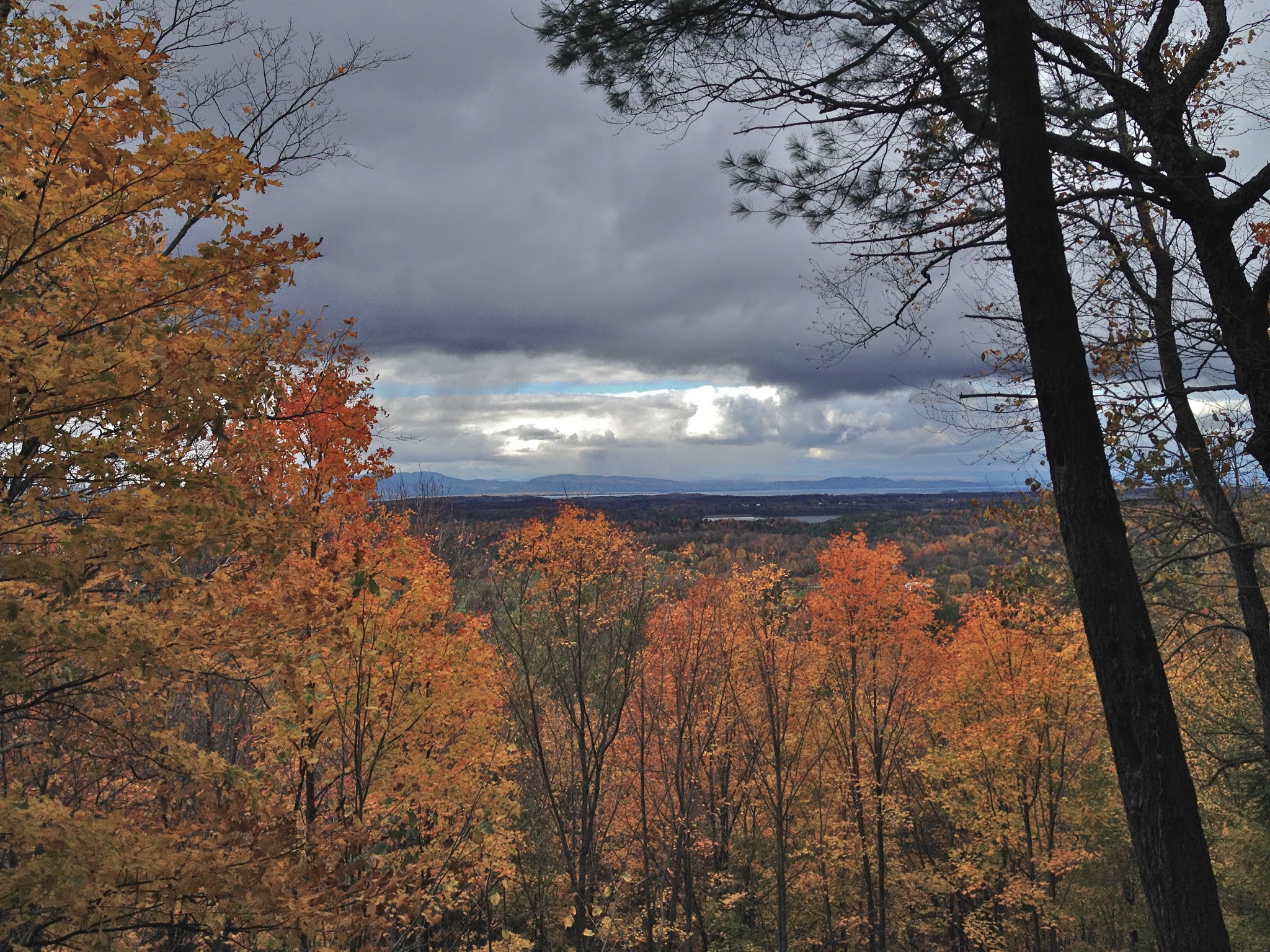
With a glass you can see vessels in Boston Harbor from the summit, just north of the Waltham hills.

H. D. Thoreau, Journal, October 19, 1854

The country above Littleton. See December 16, 1857 ("Plowed grounds show white first.”)


With a glass you can see vessels in Boston Harbor from the summit
See October 19, 1856 ("I return by the west side of Lee's Cliff hill, and sit on a rounded rock there, covered with fresh-fallen pine-needles, amid the woods, whence I see Wachusett.")

Popular Posts Last 30 Days.

The week ahead in Henry’s journal

The week ahead in Henry’s journal
A journal, a book that shall contain a record of all your joy.
"A stone fruit. Each one yields me a thought." ~ H. D. Thoreau, March 28, 1859


I sit on this rock
wrestling with the melody
that possesses me.