Showing posts with label climbing fern. Show all posts

Wednesday, August 14, 2024

Now after sunset the river is full of light in the dark landscape


August 14

No rain, only the dusty road spotted with the few drops which fell last night, — but there is quite a high and cool wind this morning.

Since August came in, we have begun to have considerable wind, as not since May, at least.

The roads nowadays are covered with a light-colored, powdery dust (this yesterday), several inches deep, which also defiles the grass and weeds and bushes, and the traveller is deterred from stepping in it.

The dusty weeds and bushes leave their mark on your clothes.

Mountain-ash berries orange (?), and its leaves half yellowed in some places.


3 P.M. To climbing fern with E. Hoar. 

It takes a good deal of care and patience to unwind this ' fern without injuring it. Sometimes same frond is half leaf, half fruit.  E. talked of sending one such leaf to G. Bradford to remind him that the sun still shone in America.

The uva-ursi berries beginning to turn.

August 14, 2014

6 P.M. To Hubbard Bath and Fair Haven Hill.

I notice now that saw-like grass seed where the mowers have done.

The swamp blackberries are quite small and rather acid.

Though yesterday was quite a hot day, I find by bathing that the river grows steadily cooler, as yet for a fortnight, though we have had no rain here.  Is it owing solely to the cooler air since August came in, both day and night, or have rains in the southwest cooled the stream within a week?


I now, standing on the shore, see that in sailing or floating down a smooth stream at evening it is an advantage to the fancy to be thus slightly separated from the land.

It is to be slightly removed from the common- place of earth.

To float thus on the silver-plated stream is like embarking on a train of thought itself.

You are surrounded by water, which is full of reflections; and you see the earth at a distance, which is very agreeable to the imagination.


I see the blue smoke of a burning meadow.

The clethra must be one of the most conspicuous flowers not yellow at present.

I sit three-quarters up the hill.

The crickets creak strong and loud now after sunset. No word will spell it.  It is a short, strong, regular ringing sound, as of a thousand exactly together, — though further off some alternate, repeated regularly and in rapid time, perhaps twice in a second.

Methinks their quire is much fuller and louder than a fortnight ago.

Ah ! I need solitude.

I have come forth to this hill at sunset to see the forms of the mountains in the horizon, to behold and commune with something grander than man.

Their mere distance and unprofanedness is an infinite encouragement.

It is with infinite yearning and aspiration that I seek solitude, more and more resolved and strong; but with a certain genial weakness that I seek society ever.

I hear the nighthawk squeak and a whip-poor-will sing.

I hear the tremulous squealing scream of a screech owl in the Holden Woods, sounding somewhat like the neighing of a horse, not like the snipe.


Now at 7.45, perhaps a half-hour after sunset, the river is quite distinct and full of light in the dark landscape,  -- 

a silver strip of sky

of the same color and 

brightness with the sky.

As I go home by Hayden's I smell the burning meadow.

I love the scent.

It is my pipe.

I smoke the earth.

H. D. Thoreau, Journal, August 14, 1854

Mountain-ash berries orange (?) See July 28, 1859 ("Young purple finches eating mountain-ash berries (ours). "); August 25, 1859 ("Mountain-ash berries partly turned. Again see, I think, purple finch eating them.")

The uva-ursi berries beginning to turn. See July 16, 1855 ("Uva-ursi berries begin to redden."); September 21, 1856 ("Uva-ursi berries quite ripe.")

I find by bathing that the river grows steadily cooler.
See August 12, 1854 ("I bathe at Hubbard's. The water is rather cool, comparatively."); September 6, 1854 ("Hubbard Bath . . . The water is again warmer than I should have believed; say an average summer warmth, yet not so warm as it has been. It makes me the more surprised that only that day and a half of rain should have made it so very cold when I last bathed here. "); September 12, 1854 ("bathing I find it colder again than on the 2d, so that I stay in but a moment. I fear that it will not again be warm."): September 24, 1854 (" It is now too cold to bathe with comfort."; September 26 1854 ("Took my last bath the 24th . Probably shall not bathe again this year. It was chilling cold.") See also A Book of the Seasons, by Henry Thoreau, The Luxury of Bathing

I have come forth to this hill at sunset to see the forms of the mountains in the horizon, — to behold and commune with something grander than man. See December 27, 1851 ("The man is blessed who every day is permitted to behold anything so pure and serene as the western sky at sunset, while revolutions vex the world.");  June 5, 1854 ("I have come to this hill to see the sun go down, to recover sanity and put myself again in relation with Nature.”); July 24, 1853 ("On Fair Haven a quarter of an hour before sunset .. . .A golden sheen is reflected from the river so brightly, that it dazzles me as much as the sun . The now silver-plated river is burnished gold there,");  January 7, 1857 “This stillness, solitude, wildness of nature is . . . what I go out to seek. It is as if I always met in those places some grand, serene, immortal, infinitely encouraging, though invisible, companion, and walked with him”);  October 7, 1857 ("When I turn round half-way up Fair Haven Hill, by the orchard wall, and look northwest, I am surprised for the thousandth time at the beauty of the landscape, and I sit down to behold it at my leisure. I think that Concord affords no better view.")

August 14. See A Book of the Seasons, by Henry Thoreau, August 14.

Now after sunset 
the river is full of light 
in the dark landscape

A Book of the Seasons, by Henry Thoreau,
"A book, each page written in its own season,
out-of-doors, in its own locality."
~edited, assembled and rewritten by zphx © 2009-2024

https://tinyurl.com/hdt-540814

Wednesday, November 24, 2021

The fauna and flora of Ministerial Swamp.


November 24. 

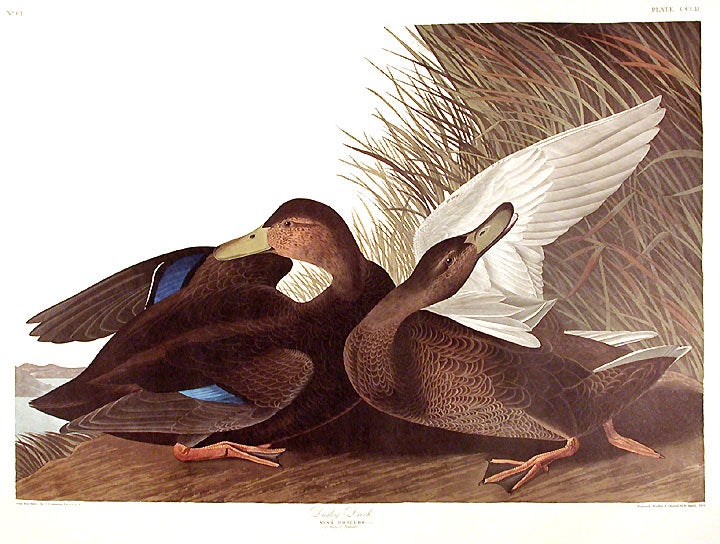
Setting stakes in the swamp (Ministerial). Saw seven black ducks fly out of the peat-hole.

J.J. Audubon (The flight of this Duck, which, in as far as I know, is peculiar to America, is powerful, rapid, and as sustained as that of the Mallard. While travelling by day they may be distinguished from that species by the whiteness of their lower wing-coverts, which form a strong contrast to the deep tints of the rest of their plumage )

Saw there also a tortoise still stirring, the painted tortoise, I believe.

Found on the south side of the swamp the Lygodium palmatum, which Bigelow calls the only climbing fern in our latitude, an evergreen, called (with others) snake tongue, as I find in Loudon.

The Irishman who helped me says, when I ask why his countrymen do not learn trades, — do something but the plainest and hardest work, — they are too old to learn trades when they come here.

H. D. Thoreau, Journal, November 24, 1851


Setting stakes in the swamp (Ministerial). See November 14, 1851 ("Surveying the Ministerial Lot in the southwestern part of the town."); November 18,1851 ("Surveying these days the Ministerial Lot . . .I hear the hooting of an owl . . . Here hawks also circle by day, and chickadees are heard, and rabbits and partridges abound.");  December 21, 1851 (“As I stand by the edge of the swamp (Ministerial), a heavy-winged hawk flies home to it at sundown, just over my head, in silence.”); December 13, 1857 ("I go this afternoon thinking I may find the stakes set for auction lots on the Ministerial Lot in December, '51") See also  July 7, 1854 ("See a pretty large hawk. . . circling over the Ministerial Swamp.") 

Saw seven black ducks fly out of the peat-hole. See September 24, 1855 ("See coming from the south in loose array some twenty apparently black ducks, . . .At first they were in form like a flock of blackbirds, then for a moment assumed the outline of a fluctuating harrow. ); September 29, 1851 ("Scared up three black ducks, which rose with a great noise of their wings, striking the water. "); September 30, 1853 ("Saw a large flock of black ducks flying northwest in the form of a harrow."); November 3, 1852 ("At Andromeda Pond, started nine black (?) ducks just at sunset, as usual they circling far round to look at me."); November 11, 1851 ("In the withered grass at Nut Meadow Brook, two black ducks, . . .rise black between me and the sun, but, when they have circled round to the east, show some silvery sheen on the under side of their wings. "); March 12, 1859 ("See two ducks flying over Ministerial Swamp.") See also  A Book of the Seasons, by Henry Thoreau, the American Black Duck)

Saw a tortoise still stirring, the painted tortoise, I believe. See November 14, 1855 ("A painted tortoise swimming under water and a wood tortoise out on the bank."); November 27, 1856 ("Take a turn down the river. A painted tortoise sinking to the bottom, and apparently tree sparrows along the shore"); December 2, 1857 ("Measuring Little Goose Pond, I observed two painted tortoises moving about under the thin transparent ice"); December 3, 1852 (" In a ditch near by, under ice half an inch thick, I saw a painted tortoise moving about.") See also A Book of the Seasons, by Henry Thoreau, the Painted Turtle (Emys picta)

Found on the south side of the swamp the Lygodium palmatum See November 30, 1851 ("The Lygodium palmatum is quite abundant on that side of the swamp, twining round the goldenrods, etc., etc"); October 2, 1859 (“The climbing fern is perfectly fresh, — and apparently therefore an evergreen, — the more easily found amid the withered cinnamon and flowering ferns.”); May 1, 1859 ("The climbing fern is persistent, i.e. retains its greenness still, though now partly brown and withered.") See also November 24, 1852 ("At this time last year the andromeda in the Ministerial Swamp was red . Now it has not turned from brown."): November 20, 1857 ("I enter the Ministerial Swamp at the road below Tarbell’s. The water andromeda leaves are brown now, except where protected by trees. In some places where many of the bright-crimson shoots of high blueberry are seen together, they have a very pretty effect");  April 29, 1857 ("Sweet-fern at entrance of Ministerial Swamp.");  May 19, 1860 (“At the Ministerial Swamp I see a white lady's-slipper almost out, fully grown, with red ones.”); August 28, 1860 ("The Lycopodium inundatum common by Harrington's mud-hole, Ministerial Swamp.")  

Saturday, November 30, 2019

My eye rested with pleasure on the white pines.


A cold afternoon
windy with some snow not yet
melted on the ground.

My eye wanders as
I sit on an oak stump by
an old cellar-hole.

Where is my home now?
Faint as an old cellar hole,
 is where we have lived.

Methinks that in my 
mood I am asking Nature 
to give me a sign.

Transient gladness.
I do not know what it is –
something that I see:

A recognition
from white pines now reflecting
a silvery light.

And by the old site
I sit on the stump of an
oak which once grew here.

November 30, 2016

Sunday. 

A rather cold and windy afternoon, with some snow not yet melted on the ground. 

Under the south side of the hill between Brown's and Tarbell's, in a warm nook, disturbed three large gray squirrels and some partridges, who had all sought out this bare and warm place. While the squirrels hid themselves in the tree-tops, I sat on an oak stump by an old cellar-hole and mused. 

This squirrel is always an unexpectedly large animal to see frisking about. 

My eye wanders across the valley to the pine woods which fringe the opposite side, and in their aspect my eye finds something which addresses itself to my nature. 

Methinks that in my mood I was asking Nature to give me a sign. 

I do not know exactly what it was that attracted my eye. I experienced a transient gladness, at any rate, at something which I saw. 

I am sure that my eye rested with pleasure on the white pines, now reflecting a silvery light, the infinite stories of their boughs, tier above tier, a sort of basaltic structure, a crumbling precipice of pine horizontally stratified. Each pine is like a great green feather stuck in the ground. A myriad white pine boughs extend themselves horizontally, one above and behind another, each bearing its burden of silvery sunlight, with darker seams between them, as if it were a great crumbling piny precipice thus stratified. 

On this my eyes pastured, while the squirrels were up the trees behind me. That, at any rate, it was that I got by my afternoon walk, a certain recognition from the pine, some congratulation. 

Where is my home? It is indistinct as an old cellar-hole, now a faint indentation merely in a farmer's field, which he has plowed into and rounded off its edges years ago, and I sit by the old site on the stump of an oak which once grew there. 

Such is the nature where we have lived. 

Thick birch groves stand here and there, dark brown (?) now with white lines more or less distinct. 

The Lygodium palmatum is quite abundant on that side of the swamp, twining round the goldenrods, etc., etc.

H. D. Thoreau, Journal, November 30, 1851

My eye rested with pleasure on the white pines, now reflecting a silvery light. See November 11, 1851 ("There is a cold, silvery light on the white pines as I go through J.P. Brown's field near Jenny Dugan’s.”); December 21. 1851(“Sunlight on pine-needles is the phenomenon of a winter day.”); February 4, 1852 ("Now the white pine are a misty blue; anon a lively, silvery light plays on them, and they seem to erect themselves unusually. . . The sun loves to nestle in the boughs of the pine and pass rays through them."); February 5, 1852 ("The boughs, feathery boughs, of the white pines, tier above tier, reflect a silvery light against the darkness of the grove, as if both the silvery-lighted and greenish bough and the shadowy intervals of the shade behind belong to one tree.”); December 8, 1855 ("Yet it is cheering to walk there while the sun is reflected from far through the aisles with a silvery light from the needles of the pine.”); December 3, 1856 (“Tthe pine forest's edge seen against the winter horizon. . . .The silvery needles of the pine straining the light.”).

The Lygodium palmatum twining round the goldenrods. [CLIMBING FERN, or Hartford Fern (Lygodium palmatum) . A species of fern found, rarely, from Massachusetts to Kentucky and southward, remarkable for climbing or twining around weeds and shrubs ~ Wikisource.] See October 2, 1859 (“The climbing fern is perfectly fresh, — and apparently therefore an evergreen, — the more easily found amid the withered cinnamon and flowering ferns.”); May 1, 1859 ("The climbing fern is persistent, i. e. retains its greenness still, though now partly brown and withered.")

November 30. A Book of the Seasons,   by Henry Thoreau, November 30

An old cellar hole.
I sit on the stump of an
oak which once grew here.


A Book of the Seasons
,  by Henry Thoreau, 
"A book, each page written in its own season,
out-of-doors, in its own locality.”
~edited, assembled and rewritten by zphx © 2009-2025


https://tinyurl.com/HDT511130

Wednesday, October 2, 2019

The sour scent of cinnamon ferns decaying.


a fragrance
from the past
almost forgotten

~ Buson

October 2

Rain in the night and cloudy this forenoon. We had all our dog-days in September this year. It was too dry before, even for fungi. Only the last three weeks have we had any fungi to speak of. 

Nowadays I see most of the election-cake fungi, with crickets and slugs eating them. 

I see a cricket feeding on an apple, into which he has eaten so deep that only his posteriors project, but he does not desist a moment though I shake the apple and finally drop it on the ground. 

P. M. — To lygodium. 

One of the large black birches on Tarbell's land is turned completely brownish-yellow and has lost half its leaves; the other is green still. 

I see in the cornfield above this birch, collected about the trunk of an oak, on the ground, fifty to a hundred ears of corn which have been stripped to the cob, evidently by the squirrels. Apparently a great part of the kernels remain on the ground, but in every case the germ has been eaten out. It is apparent that the squirrel prefers this part, for he has not carried off the rest. 


I perceive in various places, in low ground, this afternoon, the sour scent of cinnamon ferns decaying. It is an agreeable phenomenon, reminding me of the season and of past years. 

So many maple and pine and other leaves have now fallen that in the woods, at least, you walk over a carpet of fallen leaves. 

As I sat on an old pigeon-stand, not used this year, on the hill south of the swamp, at the foot of a tree, set up with perches nailed on it, a pigeon hawk, as I take it, came and perched on the tree. As if it had been wont to catch pigeons at such places. 

That large lechea, now so freshly green and some times scarlet, looks as if it would make a pretty edging like box, as has been suggested. 

The Aster undulatus and Solidago coesia and often puberula are particularly prominent now, looking late and bright, attracting bees, etc. 

I see the S. coesia so covered with the little fuzzy gnats as to be whitened by them. 

How bright the S. puberula in sprout-lands, — its yellow wand, — perhaps in the midst of a clump of little scarlet or dark-purple black oaks! 

The A. undulatus looks fairer than ever, now that flowers are more scarce. 

The climbing fern is perfectly fresh, — and apparently therefore an evergreen, — the more easily found amid the withered cinnamon and flowering ferns. 

Acorns generally, as I notice, — swamp white, shrub, black, and white, — are turned brown; but few are still green. Yet few, except of shrub oaks, have fallen. I hear them fall, however, as I stand under the trees. This would be the time to notice them. 

How much pleasanter to go along the edge of the woods, through the field in the rear of the farmhouse, whence you see only its gray roof and its haystacks, than to keep the road by its door! This we think as we return behind Martial Miles's. 

I observed that many pignuts had fallen yesterday, though quite green. 

Some of the Umbelliferoe, now gone to seed, are very pretty to examine. The Cicuta maculata, for instance, the concave umbel is so well spaced, the different um-bellets (?) like so many constellations or separate systems in the firmament. 

Hear a hylodes in the swamp.

H. D. Thoreau, Journal, October 2, 1859


Nowadays I see most of the election-cake fungi, with crickets and slugs eating them. See note to 
September 21, 1859 ("And now at last I see a few toadstools, — the election-cake (the yellowish, glazed over) and the taller, brighter-yellow above. Those shell-less slugs which eat apples eat these also."); October 15, 1857 ("I saw the other day a cricket standing on his head in a chocolate-colored (inside) fungus")

I see a cricket feeding on an apple.
See October 2, 1857 ("Since the cooler weather many crickets are seen clustered on warm banks and by sunny wall-sides."); See also October 11, 1857 ("These are cricket days.")

The sour scent of cinnamon ferns decaying, an agreeable phenomenon, reminding me of the season and of past years. See October 2, 1857 ("In the more open swamp beyond, these ferns, recently killed by the frost and exposed to the sun, fill the air with a very strong sour scent") See also  October 1, 1858 ("The cinnamon ferns are crisp and sour in open grounds");  and note to September 24, 1859 (" Stedman Buttrick's handsome maple and pine swamp is full of cinnamon ferns.") See also 
May 7, 1852 ("How full of reminiscence is any fragrance!"): July 31, 1856 ("Thoughts of autumn occupy my mind, and the memory of past years."); August 18, 1856 (" The alder cricket, clear, loud, and autumnal . . . reminds me of past autumns and the lapse of time . . . a pleasing, thoughtful melancholy, like the sound of the flail.") and A Book of the Seasons,  by Henry Thoreau, The Cinnamon Fern 

 The climbing fern is perfectly fresh, — and apparently therefore an evergreen. See May 1, 1859 ("The climbing fern is persistent, i. e. retains its greenness still, though now partly brown and withered.")

The Cicuta maculata like so many constellations or separate systems in the firmament. See August 30, 1857 ("The flower of Cicuta maculata smells like the leaves of the golden senecio. ")

October 2. See A Book of the Seasons,  by Henry Thoreau,  October 2

The sour scent of 
cinnamon ferns decaying –
the season, past years.
A Book of the Seasons, by Henry Thoreau, 
A Book of the Seasons, by Henry Thoreau
"A book, each page written in its own season,
out-of-doors, in its own locality.”
~edited, assembled and rewritten by zphx © 2009-2024

https://tinyurl.com/hdt-591002

Wednesday, May 1, 2019

As I sat in the woods admiring the beauty of the blue butterfly.

May 1. 

Hear the ruby-crowned wren. 

We accuse savages of worshipping only the bad spirit, or devil, though they may distinguish both a good and a bad; but they regard only that one which they fear and worship the devil only. We too are savages in this, doing precisely the same thing. 

This occurred to me yesterday as I sat in the woods admiring the beauty of the blue butterfly. 

We are not chiefly interested in birds and insects, for example, as they are ornamental to the earth and cheering to man, but we spare the lives of the former only on condition that they eat more grubs than they do cherries, and the only account of the insects which the State encourages is of the "Insects Injurious to Vegetation.” 

We too admit both a good and a bad spirit, but we worship chiefly the bad spirit, whom we fear. We do not think first of the good but of the harm things will do us. 

The catechism says that the chief end of man is to glorify God and enjoy him forever, which of course is applicable mainly to God as seen in his works. Yet the only account of its beautiful insects — butterflies, etc. — which God has made and set before us which the State ever thinks of spending any money on is the account of those which are injurious to vegetation!

This is the way we glorify God and enjoy him forever. Come out here and behold a thousand painted butterflies and other beautiful insects which people the air, then go to the libraries and see what kind of prayer and glorification of God is there recorded. Massachusetts has published her report on "Insects Injurious to Vegetation," and our neighbor the "Noxious Insects of New York.” 

We have attended to the evil and said nothing about the good. This is looking a gift horse in the mouth with a vengeance.

Children are attracted by the beauty of butterflies, but their parents and legislators deem it an idle pursuit. The parents remind me of the devil, but the children of God. Though God may have pronounced his work good, we ask, "Is it not poisonous?” 

Science is inhuman. Things seen with a microscope begin to be insignificant. So described, they are as monstrous as if they should be magnified a thousand diameters. Suppose I should see and describe men and houses and trees and birds as if they were a thousand times larger than they are! With our prying instruments we disturb the balance and harmony of nature.

P. M. — To Second Division. Very warm. 

Looking from Clamshell over Hosmer's meadow, about half covered with water, see hundreds of turtles, chiefly picta, now first lying out in numbers on the brown pieces of meadow which rise above the water. You see their black backs shine on these hummocks left by the ice, fifty to eighty rods off. They would rapidly tumble off if you went much nearer.

This heat and stillness draws them up. It is remarkable how surely they are advertised of the first warm and still days, and in an hour or two are sure to spread themselves over the hummocks. There is to-day a general resurrection of them, and there they bask in the sun. It is their sabbath. 

At this distance, if you are on the lookout, especially with a glass, you can discover what numbers of them there are, but they are shy and will drop into the water on a near approach. All up and down our river meadows their backs are shining in the sun to-day. It is a turtle day. 

As we sat on the steep hillside south of Nut Meadow Brook Crossing, we noticed a remarkable whirlwind on a small scale, which carried up the oak leaves from that Island copse in the meadow. The oak leaves now hang thinly and are very dry and light, and these small whirlwinds, which seem to be occasioned by the sudden hot and calm weather (like whirlpools or dimples in a smooth stream), wrench them off, and up they go, somewhat spirally, in countless flocks like birds, with a rustling sound; and higher and higher into the clear blue deeps they rise above our heads, till they are fairly lost to sight, looking, when last seen, mere light specks against the blue, like stars by day, in fact. I could distinguish some, I have no doubt, five or six hundred feet high at least, but if I looked aside a moment they were lost. The largest oak leaves looked not bigger than a five-cent-piece. These were drifting eastward, — to descend where? Methought that, instead of decaying on the earth or being consumed by fire, these were being translated and would soon be taken in at the windows of heaven. I had never observed this phenomenon so remarkable.

The flight of the leaves. 

This was quite local, and it was comparatively still where we sat a few rods on one side. Thousands went up together in a rustling flock. Many of the last oak leaves hang thus ready to go up. 

I noticed two or more similar whirlwinds in the woods elsewhere this afternoon. One took up small twigs and clusters of leaves from the ground, matted together. I could easily see where it ran along with its nose (or point of its tunnel) close to the ground, stirring up the leaves as it travelled, like the snout of some hunting or rooting animal. 

See and hear chewink. 

See a little snake on the dry twigs and chips in the sun, near the arbutus, uniformly brown (or reddish-brown) above except a yellowish ring on the occiput, the head also lighter than the body; beneath vermilion, with apparently a row of light dots along each side. It is apparently Coluber amamus (?), except that it has the yellowish ring. 

Luzula campestris. Also the Oryzopsis Canadensis by the Major Heywood path-side, say a day, or April 30th, six inches high or more, with fine bristle-like leaves. 

See a thrasher.

What is that rush at Second Division? It now forms a dense and very conspicuous mass some four rods long and one foot high. The top for three inches is red, and the impression at a little distance is like that made by sorrel. Certainly no plant of this character exhibits such a growth now, i. e. in the mass. It surprises you to see it, carries your thoughts on to June. 

The climbing fern is persistent, i. e. retains its greenness still, though now partly brown and withered.

H. D. Thoreau, Journal, May 1, 1859


The only account of the insects which the State encourages is of the "Insects Injurious to Vegetation.” See April 6, 1857 ("To New Bedford Library. . . Take out Emmons’s Report on the insects injurious to vegetation in New York.


See a plate of the Colias Philodice, or common sulphur-yellow butterfly, male and female of different tinge.”)

It is a turtle day.  See August 28, 1856 ("Has not the great world existed for them as much as for you?”) See also A Book of the Seasons, by Henry Thoreau,  The Painted Turtle

A little snake uniformly brown (or reddish-brown) above except a yellowish ring on the occiput, the head also lighter than the body; beneath vermilion, with apparently a row of light dots along each side.  Probably the ring-neck snake (Coluber punctatus) -- slate gray, black or brown back with complete yellow ring just behind the head, bright yellow or rarely orange belly and occasionally small black spots. Snakes of Massachusetts ringneck snake. Compare HDT’s other "Coluber amaenus” snakes, conforming generally to the redbelly snake (Storeria occipitomaculata occipitomaculata):  October 11, 1856 (“It is apparently Coluber amaenus, the red snake. Brown above, light-red beneath, about eight inches long . . . It is a conspicuous light red beneath, then a bluish-gray line along the sides, and above this brown with a line of lighter or yellowish brown down the middle of the back.”); September 9, 1857 ("It was a dark ash-color above, with darker longitudinal lines, light brick-red beneath. There were three triangular buff spots just behind the head, one above and one each side. It is apparently Coluber amaenus”); April 29, 1858 (“A little brown snake with blackish marks along each side of back and a pink belly. Was it not the Coluber amaenus?”)  

The genus Storeria consists of five species, four of which are known as brown snakes, and the other of which is known as the redbelly snake. Most Storeria are a variant of brown in color. They sometimes have a lighter-colored stripe down the center of the back, and small black blotches along the body, and just behind the head. The underside is usually lighter brown-colored, yellow, or in the case of the redbelly snake, reddish in color. They rarely grow beyond 13 inches.

The climbing fern is persistent, i. e. retains its greenness still, though now partly brown and withered. CLIMBING FERN, or Hartford Fern (Lygodium palmatum) . A species of fern found, rarely, from Massachusetts to Kentucky and southward, remarkable for climbing or twining around weeds and shrubs ~ Wikisource. See October 2, 1859 (“The climbing fern is perfectly fresh, — and apparently therefore an evergreen, — the more easily found amid the withered cinnamon and flowering ferns.”); November 30, 1851 (“The Lygodium palmatum is quite abundant on that side of the swamp, twining round the goldenrods”)

I sat in the woods
admiring the beauty of
the blue butterfly. 

Popular Posts Last 30 Days.

The week ahead in Henry’s journal

The week ahead in Henry’s journal
A journal, a book that shall contain a record of all your joy.
"A stone fruit. Each one yields me a thought." ~ H. D. Thoreau, March 28, 1859


I sit on this rock
wrestling with the melody
that possesses me.