Showing posts with label redstarts. Show all posts

Monday, May 11, 2020

Red-wings do not fly in flocks for ten days past


May 11. 

May 11, 2019

The river no lower than yesterday. 

Warbling vireo. 

2 P. M. — 77º. Very warm. To factory village. 

Redstart. 

Red-wings do not fly in flocks for ten days past, I think. 

I see at Damon’s Spring some dandelion seeds all blown away, and other perfectly ripe spheres much more at Clamshell the 13th). It is ripe, then, several days, or say just before elm seed, but the mouse-ear not on the 13th anywhere. 

The senecio shows its yellow. 

The warmth makes us notice the shade of houses and trees (even before the last have leafed) falling on the greened banks, as Harrington’s elm and house. June-like. 

See some large black birch stumps all covered with pink scum from the sap. 

The Ranunculus abortivus well out; say five days? 

Red cherry in bloom, how long? 

Yellow violet, almost; say to-morrow. 

William Brown’s nursery is now white (fine white) with the shepherd’s-purse, some twelve to eighteen inches high, covering it under his small trees, like buck wheat, though not nearly so white as that. I never saw so much. It also has green pods. Say it is in prime. 

E. Hosmer, as a proof that the river has been lower than now, says that his father, who was born about the middle of the last century, used to tell of a time, when he was a boy, when the river just below Derby’s Bridge did not run, and he could cross it dry-shod on the rocks, the water standing in pools when Conant’s mill (where the factory now is) was not running. 

I noticed the place to-day, and, low as the river is for the season, it must be at least a foot and a half deep there.

H. D. Thoreau, Journal, May 11, 1860

 Red-wings do not fly in flocks for ten days past, I think. See April 30, 1855 ("Red-wing blackbirds now fly in large flocks, covering the tops of trees—willows, maples, apples, or oaks—like a black fruit , and keep up an incessant gurgling and whistling");  May 5, 1859 ("Red-wings fly in flocks yet."). May 13, 1860 ("Red wings are evidently busy building their nests.") See also A Book of the Seasons, by Henry Thoreau, the Red-wing in  Early Spring


Dandelion seeds all blown away, and other perfectly ripe spheres. See May 9, 1858 ("A dandelion perfectly gone to seed, a complete globe, a system in itself.")

The senecio shows its yellow. See May 23, 1853 ("I am surprised by the dark orange-yellow of the senecio. At first we had the lighter, paler spring yellows of willows, dandelion, cinquefoil, then the darker and deeper yellow of the buttercup; and then this broad distinction between the buttercup and the senecio, as the seasons revolve toward July.")

Large black birch stumps all covered with pink scum from the sap. See April 26, 1856 ("The white birch at Clamshell, which I tapped long ago, still runs and is partly covered with a pink froth. Is not this the only birch which shows this colored froth?")

The Ranunculus abortivus [Kidneyleaf Crowfoot] well out; say five days? See May 16, 1859 ("Ranunculus abortivus well out (when?), southwest angle of Damon's farm.");May 25, 1858 ("See an abundance of Ranunculus abortivus in the wood-path behind Mr. E.'s house, going to seed and in bloom. The branches are fine and spreading, about eight or ten inches high.")

Yellow violet, almost; say to-morrow. See May 16, 1853 ("Yellow violets  yesterday at least. "); May 18, 1856 ("E. Emerson finds half a dozen yellow violets."); May 25, 1852 ("The large yellow woods violet (V. pubescens) by this brook now out"); 

Tuesday, May 7, 2019

Such is the first hot weather.

May 7 
May  7, 2019

Saturday. Surveying Damon's Acton lot. 

It is hotter still, — 88° or more, as I hear in the afternoon. 

I frequently see pigeons dashing about in small flocks, or three or four at a time, over the woods here. Theirs is a peculiarly swift, dashing flight. 

The mayflower is still sparingly in bloom on what I will call Mayflower Path in this lot. It is almost the prevailing undershrub here. 

I think I hear the redstart. 

To-day and yesterday the sunlight is peculiarly yellow, on account of the smoky haze. I notice its peculiar yellowness, almost orange, even when, coming through a knot-hole in a dark room, it falls on the opposite wall. 

Such is the first hot weather.

H. D. Thoreau, Journal, May 7, 1856

The mayflower is still sparingly in bloom on what I will call Mayflower Path. See May 7, 1854 ("As I ascend Cliff Hill, the two leaves of the Solomon's-seal now spot the forest floor, pushed up amid the dry leaves.")  April 12, 1858 ("Surveying part of William P. Brown's wood-lot in Acton, west of factory . . . I find the mayflower, but not in bloom. It appears to be common thereabouts."); See also A Book of the Seasons, by Henry Thoreau, Two-leaved Solomon's Seal ( Canada mayflower or false lily-of-the-valley)

I think I hear the redstart.
See May 16, 1858 (“See and hear a redstart, the rhythm of whose strain is tse'-tse, tse'-tse, tse', emphasizing the last syllable of all and not ending with the common tsear”); May 17, 1856 (“At the Kalmia Swamp, see and hear the redstart, very lively and restless, flirting and spreading its reddish tail.”) See also  A Book of Seasons,  by Henry Thoreau, The American Redstart

May 7. See A Book of Seasons, by Henry Thoreau, May 7


Sunlight coming through 
a knot-hole in a dark room –
yellow, almost orange. 

A Book of the Seasons,  by Henry Thoreau 
"A book, each page written in its own season,
out-of-doors, in its own locality.”
~edited, assembled and rewritten by zphx © 2009-2025

https://tinyurl.com/hdt-560507

*****

A sunset walk. We walk to the view getting a late start, around 630 At the view there are beacons of light shining at spots all over the landscape through broken clouds. Parts of the lake are illuminated parts of the golf course suddenly bright bright green. 

The maple leaves are now lacy against the sky and probably will be forming shadows. The small maples go straight to leaf but the adult trees still have no leaves. This spring green color of the tree flowers is coloring the valley and the grass is bright green.

It is obviously going to be an incredibly good sunset. Gradually the clouds break up and we see the peachy orange color in the west. The mountains are blue to dark purple. Whiteface is concealed.

We wait until the sun is down and then notice the beam of red light illuminating the clouds behind the Adirondacks like a red fan silhouetting the mountains. Many pictures to document this beautiful evening.

Meanwhile through the hike we hear the hermit thrush,'the wood thrush, the oven bird, the black throated green the sapsuckers tapping and perhaps others. Rose breasted grosbeak –we have been been waiting for it; today it first is heard.

Just as the sun sets the peepers in the lower pond start up in earnest.

  zphx 20190507

Saturday, June 23, 2018

With some boys to Flint's Pond, to see the nests


June 23. 

June 23, 2018

P. M. – With some boys to Flint's Pond, to see the nests mentioned on [June 19]. 

The hermit(?) thrush's nest referred to on last page is a rather shallow nest of loose construction, though sufficiently thick-bottomed, about five inches in diameter and hardly one deep within, externally of rather coarse and loosely arranged stubble, chiefly everlasting stems with the flowers yet emitting some fragrance, some whorled loosestrife with the seed-vessels, etc., etc.; within, finer grass and pine-needles. Yet the grass is as often bent angularly as curved regularly to form the nest. 

The tanager's nest of the 19th is four and a half to five inches wide and an inch or more deep, considerably open to look through; the outside, of many very slender twigs, apparently of hemlock, some umbelled pyrola with seed-vessels, everlasting, etc.; within, quite round and regular, of very slender or fine stems, apparently pinweed or the like, and pine needles; hardly any grass stubble about it. 

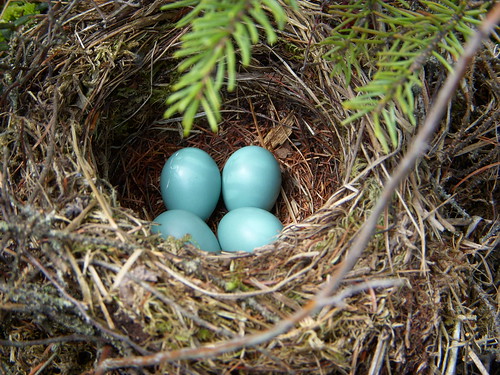
The egg is a regular oval nine tenths of an inch long by twenty seven fortieths, pale-blue, sprinkled with purplish brown spots, thickest on the larger end. To-day there are three rather fresh eggs in this nest. Neither going nor returning do we see anything of the tanager, and conclude it to be deserted, but perhaps she stays away from it long. 

That rather low wood along the path which runs parallel with the shore of Flint's Pond, behind the rock, is evidently a favorite place for veery-nests. I have seen three there. 

One lately emptied I got to day, amid the dry leaves by some withered ferns. It is composed externally of a mass of much withered oak leaves, thick and pretty well stuck together, plastered or stuck down over the rim, is five to six inches in diameter and four high, two and a half wide within, and very deep, more than two inches. Next to the leaves come bark-shreds, apparently maple bark, and the lining is of a little fine grass, pine-needles, apparently a little hypnum root-fibre. A very deep well-shaped and rounded cavity.


Saw another with two eggs in it, one a much lighter blue than the other. This was by the path leading toward the rock, amid some sprouts at the base of a sapling oak, elevated about six inches above the general level (the veery's). It was a deep, firm nest three quarters of an inch thick, outwardly oak and chestnut leaves, then rather coarse bark-shreds, maple or oak, lined with the same and a few dark root-fibers. 

What that empty nest partly of mud, with conspicuous saliva, on a middle-sized maple, against main stem, near wood thrush’s? 

In the case of the hermit (?) thrush, wood thrush, and tanager's, each about fourteen feet high in slender saplings, you had to climb an adjacent tree in order to reach them. 

A male redstart seen, and often heard. What a little fellow! 

Lysimachia quadrifolia, how long? and veiny-leaved hawkweed, how long? 

Get an egg out of a deserted bank swallow's nest, in a bank only about four feet high dug in the spring for a bank wall near Everett's. The nest is flattish and lined abundantly with the small, somewhat downy, naturally curved feathers of poultry. Egg pure white, long, oval, twenty-seven fortieths by eighteen fortieths of an inch. 

Take two eggs out of the oviduct of an E. insculpta, just run over in the road. They have lately cooked a snapping turtle at Mrs. Wetherbee's, eggs and all, and she thinks there were just forty-two of them!

H. D. Thoreau, Journal, June 23, 1858


Veery nests. See June 2, 1852 (“Nest of Wilson's thrush with bluish-green eggs.”); June 18, 1858 ("A little boy brings me an egg of Wilson's thrush, which he found in a nest in a low bush about a foot from the ground.”); June 19, 1853 ("In the middle of the path to Wharf Rock at Flint's Pond, the nest of a Wilson's thrush, five or six inches high, between the green stems of three or four golden rods, made of dried grass or fibres of bark, with dry oak leaves attached loosely, making the whole nine or ten inches wide, to deceive the eye. Two blue eggs. Like an accidental heap. Who taught it to do thus?"); June 19, 1858 (“boys have found this forenoon at Flint’s Pond one or more veery-nests on the ground. ”)

WILSON'S THRUSH or VEERY, Turdus Wilson,The song of this species, although resembling that of the Wood Thrush in a great degree, is less powerful, and is composed of continued trills repeated with different variations, enunciated with great delicacy and mellowness, so as to be extremely pleasing to one listening to them in the dark solitudes where the sylvan songster resides. It now and then tunes its throat in the calm of evening, and is heard sometimes until after the day has closed. J.J. Audubon

The tanager's nest of the 19th ... To-day there are three rather fresh eggs. See June 19, 1858 ("Two fresh eggs in small white oak sapling, some fourteen feet from ground. They saw a tanager near. (I have one egg.) ")See also A Book of the Seasons, by Henry Thoreau, the Scarlet Tanager

You had to climb an adjacent tree in order to reach them. See June 11, 1855("In order to get the deserted tanager’s nest at the top [of] a pitch pine which was too weak to climb, we carried a rope in our pockets and took three rails a quarter of a mile into the woods, and there rigged a derrick, by which I climbed to a level with the nest, . . . Tied the three tops together and spread the bottoms. “)

Veiny-leaved hawkweed, how long? See June 23, 1859 ("Veiny-leaved hawkweed freshly out."); See also August 21, 1851 (" I have now found all the hawkweeds. Singular these genera of plants, plants manifestly related yet distinct. They suggest a history to nature, a natural history in a new sense.”). See also A Book of the Seasons,  by Henry Thoreau, The Hawkweeds (hieracium)

A male redstart seen, and often heard. What a little fellow! See June 23, 1855 ("Probably a redstart’s nest on a white oak sapling, twelve feet up, on forks against stem. Have it. See young redstarts about.”); May 29, 1855 ("females of the redstart, described by Wilson, — very different from the full-plumaged black males. ")  See also A Book of the Seasons,  by Henry Thoreau, The American Redstart

Get an egg out of a deserted bank swallow's nest. See November 20, 1857 ("Some bank swallows’ nests are exposed by the caving of the bank at Clamshell. The very smallest hole is about two and a half inches wide horizontally, by barely one high. All are much wider than high (vertically). . . .The nest is a regular but shallow one made simply of stubble, about five inches in diameter, and three quarters of an inch deep. ")

Wednesday, June 20, 2018

My shoes and hat are covered with the greenish-yellow pollen of the white pines, which is now being shed abundantly.

June 20. 

P. M. – By boat to Holden Swamp. 

I heard that snapping sound against a pad on the surface, and at the same time saw a pad knocked up several inches, and a ripple in the water there as when a pickerel darts away. I should say without doubt some fish had darted there against the pad, perhaps at an insect on the under side. 

Got the marsh hawk's egg, which was addled. I noticed on the 17th that the hawk (my marsh hawk) was off her nest and soaring above the wood late in the afternoon, as I was returning. 

I notice that when turtles are floating dead their necks and legs are stretched out. I have seen them this year of every kind but the meleagris and cistudo, including a snapping turtle with shell some nine inches long, floating or lying dead. What kills them?

I wade about Holden Swamp, looking for birds’ nests. The spruce there are too thin-foliaged for nests, though I hear a pepe expressing anxiety, and also song sparrows. See the redstart and hear many; also hear the blue yellow-backs. 

Walking in the white pine wood there, I find that my shoes and, indeed, my hat are covered with the greenish-yellow pollen of the white pines, which is now being shed abundantly and covers like a fine meal all the plants and shrubs of the forest floor. I never noticed it in such abundance before. My shoes are green-yellow, or yellow-green, even the next day with it.

Dangle-berry well out, how long? 

Potentilla Norvegica, how long? 

What is that sedge with a long beak, some time out of bloom, now two feet high, common just north of new stone bridge? Vide pressed one.

I see that the French have a convenient word, aunaie, also spelt aulnaie and aulnage, etc., signifying a grove of alders. It reminds me of their other convenient word used by Rasle, cabanage.

H. D. Thoreau, Journal, June 20, 1858

I noticed on the 17th that the hawk (my marsh hawk) was off her nest and soaring. See May 30, 1858 ("Edward Emerson shows me the nest which he and another discovered. . . .There are two dirty, or rather dirtied, white eggs left (of four that were),"); June 8, 1858 (“The marsh hawk's eggs are not yet hatched. ”); June 17, 1858 ("P. M. – To hawk's nest. One egg is hatched since the 8th") See also A Book of the Seasons, by Henry Thoreau, The Marsh Hawk


I wade about Holden Swamp, looking for birds’ nests. The spruce there are too thin-foliaged for nests, though I hear a pepe expressing anxiety. See June 10, 1855 ("Nest of the Muscicapa Cooperi, or pe pe, on a white spruce in the Holden Swamp.") See also A Book of the Seasons, by Henry Thoreau, the Olive-sided flycatcher or pe-pe

The greenish-yellow pollen of the white pines is now being shed abundantly and covers like a fine meal all the plants and shrubs of the forest floor. See June 21, 1850 ("The flowers of the white pine are now in their prime, but I see none of their pollen on the pond."); June 21, 1856 ("Much pine pollen is washed up on the northwest side of the pond. Must it not have come from pines at a distance?"); June 22, 1858 (" I notice, after tipping the water out of my boat under the willows, much evidently pine pollen adhering to the inside of the boat along the water-line. Did it fall into it during my excursion to Holden’s Swamp the 20th, or has it floated through the air thus far? "); June 21, 1860 ("The air must be full of this fine dust at this season, that it must be carried to great distances, and its presence might be detected remote from pines by examining the edges of bodies of water ... the lakes detect for us thus the presence of the pine pollen in the atmosphere. They are our pollinometers. "); See also A Book of the Seasons, by Henry Thoreau, The White Pines

Potentilla Norvegica, how long? See June 20, 1856 ("Potentilla Norvegicea; apparently petals blown away.")

Other convenient word used by Rasle. See March 4, 1858 ("Father Rasle’s dictionary of the Abenaki language amounts to a very concentrated and trustworthy natural history of that people.")


June 20. See A Book of the Seasons, by Henry Thoreau, June 20
A Book of the Seasons, by Henry Thoreau
"A book, each page written in its own season,
out-of-doors, in its own locality.”
~edited, assembled and rewritten by zphx © 2009-2021

Wednesday, May 16, 2018

A very large black snake I thought was preparing to strike at me

May 16

A. M. – Up Assabet. 

Aralia nudicaulis at Island. The leaf-stalks are often eaten off, probably by some quadruped. 

The flower-buds of the Cornus florida are five eighths of an inch in diameter. 

The Salix lucida will hardly bloom within two days. The S. Torreyana catkins are so reddish that at a little distance it looks some what like the common black cherry now leafing. 

A hummingbird yesterday came into the next house and was caught. Flew about our parlor to-day and tasted Sophia's flowers. In some lights you saw none of the colors of its throat. In others, in the shade the throat was a clear bright scarlet, but in the sun it glowed with splendid metallic, fiery reflections about the neck and throat. 

It uttered from time to time, as it flew, a faint squeaking chirp or chirrup. The hum sounded more hollow when it approached a flower. Its wings fanned the air so forcibly that you-felt the cool wind they raised a foot off, and nearer it was very remarkable. Does not this very motion of the wings keep a bird cool in hot weather? 

The only indigenous willow I noticed yesterday on the Shawsheen — a mile below Fitch's mill — was the small sericea, such as by Assabet white maple. 

What was that loud but distant note of a bird, apparently in the low land, somewhat like the guinea-hen note, also reminding me a little of the plover about Truro light, but apparently a hawk? 

Got quite a view down the valley of the Shawsheen below the junction of Vine Brook, northeast, from a hill in the extreme northeast of Bedford.

P. M. – To Uvularia perfoliata at Flint's Pond. 

See again the warbler of yesterday. All bright yellow beneath and apparently bluish-slate above, but I do not see it well. Its note, with little variation, is like twit twit, twit twit, twitter twitter twe. It must be the parti-colored warbler.

Sat down in the sun in the path through Wright's wood-lot above Goose Pond, but soon, hearing a slight rustling, I looked round and saw a very large black snake about five feet long on the dry leaves, about a rod off. 

When I moved, it vibrated its tail very rapidly and smartly, which made quite a loud rustling or rattling sound, reminding me of the rattlesnake, as if many snakes obeyed the same instinct as the rattle snake when they vibrate their tails. Once I thought I heard a low hiss. 

It was on the edge of a young wood of oaks and a few white pines from ten to eighteen feet high, the oaks as yet bare of leaves. 

As I moved toward the snake, I thought it would take refuge in some hole, but it appeared that it was out on a scout and did not know of any place of refuge near. Suddenly, as it moved along, it erected itself half its length, and when I thought it was preparing to strike at me, to my surprise it glided up a slender oak sapling about an inch in diameter at the ground and ten feet high. 

It ascended this easily and quickly, at first, I think, slanting its body over the lowest twig of the next tree. There were seven little branches for nine feet, averaging about the size of a pipe-stem. It moved up in a somewhat zig zag manner, availing itself of the branches, yet also in part spirally about the main stem. It finds a rest (or hold if necessary) for its neck or forward part of its body, moving crosswise the small twigs, then draws up the rest of its body. From the top of this little oak it passed into the top of a white pine of the same height an inch and a half in diameter at the ground and two feet off; from this into another oak, fifteen feet high and three feet from the pine; from this to another oak, three feet from the last and about the same height; from this to a large oak about four feet off and three or four inches in diameter, in which it was about fourteen feet from the ground; thence through two more oaks, a little lower, at intervals of four feet, and so into a white pine; and at last into a smaller white pine and thence to the ground. 

The distance in a straight line from where it left the ground to where it descended was about twenty-five feet, and the greatest height it reached, about fourteen feet. It moved quite deliberately for the most part, choosing its course from tree to tree with great skill, and resting from time to time while it watched me, only my approach compelling it to move again. 

It surprised me very much to see it cross from tree to tree exactly like a squirrel, where there appeared little or no support for such a body. It would glide down the proper twig, its body resting at intervals of a foot or two, on the smaller side twigs, perchance, and then would easily cross an interval of two feet, sometimes in an ascending, sometimes a descending, direction. If the latter, its weight at last bent the first twig down nearer to the opposite one. It would extend its neck very much, as I could see by the increased width of the scales exposed, till its neck rested across the opposite twig, hold on all the while tightly to some part of the last twig by the very tip of its tail, which was curled round it just like a monkey's. 

I have hardly seen a squirrel rest on such slight twigs as it would rest on in mid-air, only two or three not bigger than a pipe-stem, while its body stretched clear a foot at least between two trees. It was not at all like creeping over a coarse basket work, but suggested long practice and skill, like the rope dancer's. There were no limbs for it to use comparable for size with its own body, and you hardly noticed the few slight twigs it rested on, as it glided through the air. 

When its neck rested on the opposite twig, it was, as it were, glued to it. It helped itself over or up them as surely as if it grasped with a hand. There were, no doubt, rigid kinks in its body when they were needed for support. It is a sort of endless hook, and, by its ability to bend its body in every direction, it finds some support on every side. Perhaps the edges of its scales give it a hold also. 

It is evident that it can take the young birds out of a sapling of any height, and no twigs are so small and pliant as to prevent it. Pendulous sprays would be the most difficult for it, where the twigs are more nearly parallel with the main one, as well as nearly vertical, but even then it might hold on by its tail while its head hung below. I have no doubt that this snake could have reached many of the oriole-nests which I have seen. 

I noticed that in its anger its rigid neck was very much flattened or compressed vertically. At length it coiled itself upon itself as if to strike, and, I presenting a stick, it struck it smartly and then darted away, running swiftly down the hill toward the pond. 

Yellow butterflies. 

Nabalus leaves are already up and coming up in the wood-paths. 

Also the radical leaves of one variety of Solidago arguta, and apparently of S. altissima, are conspicuously up. 

A golden-crowned thrush hops quite near. It is quite small, about the size of the creeper, with the upper part of its breast thickly and distinctly pencilled with black, a tawny head; and utters now only a sharp cluck for a chip

See and hear a redstart, the rhythm of whose strain is tse'-tse, tse'-tse, tse', emphasizing the last syllable of all and not ending with the common tsear

Hear the night-warbler. 

The Uvularia perfoliata, which did not show itself at all on the 3d, is now conspicuous, and one is open but will not shed pollen before to-morrow. It has shot up about ten inches in one case and bloomed within thirteen days!! 

Ranunculus repens at Brister's Spring; how long? Was that R. repens at the Everett Spring on the 3d? [Yes.]

The whip-poor-will heard. 

E. Hoar detected the other day two ovaries under one scale of a Salix rostrata, and, under another, a stamen and another stamen converted into an ovary.

H. D. Thoreau, Journal, May 16, 1858

To Uvularia perfoliata at Flint's Pond.
 See May 30, 1857 ("By the path near the northeast shore of Flint's Pond. . .  am surprised to find it the Uvularia perfoliata, which I have not found hereabouts before.");  May 3, 1858 ("See no signs of the Uvularia perfoliata yet; apparently will not bloom within ten days") See also A Book of the Seasons,  by Henry Thoreau, the Bellworts

A hummingbird in some lights the shade the throat was a clear bright scarlet, but in the sun it glowed with splendid metallic, fiery reflections. See  May 17, 1856 (" A splendid male hummingbird . . . This golden-green gem. Its burnished back looks as if covered with green scales dusted with gold. . . . turning toward me that splendid ruby on its breast, that glowing ruby.") May 15, 1855("Hear a hummingbird in the garden."); May 16, 1852 ("I hear a hummingbird about the columbines.").

Monday, May 14, 2018

The air is suddenly full of fragrance.

May 14.

 5.30 A. M. — Up railroad. 

Hear and see the red-eye on an oak. The tail is slightly forked and apparently three quarters of an inch beyond wings; all whitish beneath. 

Hear and see a redstart. Methinks I did also on the 10th ? The rhythm a little way off is ah, tche  tche tche'-ar. 

10 A. M. — To Hill. 

A kingbird. 

Saw a young robin dead. 

Saw the Viola palmata, early form, yesterday; how long? 

Look at White Avens Shore. See what I call vernal grass in bloom in many places. 

The Salix sericea, large and small, and the petiolaris or loose-catkinned (so far as I know their staminate flowers) are now out of bloom.The rostrata not quite done. Some of its catkins now three and a half inches long. The alba not quite done. S. pedicellaris by railroad about done, and the Torreyana done. 

Picked up, floating, an Emys picta, hatched last year. It is an inch and one twentieth long in the upper shell and agrees with Agassiz's description at that age. Agassiz says he could never obtain a specimen of the insculpta only one year old, it is so rarely met with, and young Emydidae are so aquatic. I have seen them frequently. 

To-day, for the first time, it appears to me summerlike and a new season. There is a tender green on the meadows and just leafing trees. The blossoms of the cherry, peach, pear, etc., are conspicuous, and the air is suddenly full of fragrance. Houses are seen to stand amid blossoming fruit trees, and the air about them is full of fragrance and the music of birds. 

As I go down the railroad at evening, I hear the incessant evening song of the bay-wing from far over the fields. It suggests pleasant associations. Are they not heard chiefly at this season? 

The fruit of the early aspen is almost as large — its catkins — as those of the early willow. It will soon be ripe. The very common puffed-up yellow ovaries make quite a show, like some normal fruit; even quite pretty. 

I discovered this morning that a large rock three feet in diameter was partially hollow, and broke into it at length with a stone in order to reach some large black crystals which I could partly see. I found that it had been the retreat of a squirrel, and it had left many nuts there. It had entered a small hole bristling with crystals, and there found a chamber or grotto a foot long at least, surrounded on all sides by crystals. They thus explore and carry their nuts into every crevice, even in the rocks. 

Celandine by cemetery. 

One tells me he saw to-day the arum flower.

H. D. Thoreau, Journal, May 14, 1858


Kingbird. See May 14, 1852 (“First kingbird. Its voice and flight relate it to the swallow.”)

The evening song of the bay-wing from far over the fields. It suggests pleasant associations. See May 12, 1857 ("It reminded me of many a summer sunset, of many miles of gray rails, of many a rambling pasture, of the farmhouse far in the fields, its milk-pans and well-sweep, and the cows coming home from pasture.”)

Tuesday, September 12, 2017

A wood frog in hand.

September 12

Saturday. P. M. – To Owl Swamp (Farmer's).


In an open part of the swamp, started a very large wood frog, which gave one leap and squatted still. I put down my finger, and, though it shrank a little at first, it permitted me to stroke it as long as I pleased. Having passed, it occurred to me to return and cultivate its acquaintance. To my surprise, it allowed me to slide my hand under it and lift it up, while it squatted cold and moist on the middle of my palm, panting naturally. I brought it close to my eye and examined it. 

It was very beautiful seen thus nearly, not the dull dead-leaf color which I had imagined, but its back was like burnished bronze armor defined by a varied line on each side, where, as it seemed, the plates of armor united. It had four or five dusky bars which matched exactly when the legs were folded, showing that the painter applied his brush to the animal when in that position, and reddish-orange soles to its delicate feet. There was a conspicuous dark-brown patch along the side of the head, whose upper edge passed directly through the eye horizontally, just above its centre, so that the pupil and all below were dark and the upper portion of the iris golden. 

September 17, 2023
(avesong)

I have since taken up another in the same way.[Indeed they can generally be treated so. Some are reddish, as burnished copper.] 

Round-leaved cornel berries nearly all fallen.

Crossing east through the spruce swamp, I think that I saw a female redstart. 

What is that running herbaceous vine which forms a dense green mat a rod across at the bottom of the swamp northwest of Corallorhiza Rock? [It is chrysosplenium.] It is of the same form, stem and leaves, with the more brown hairy and woolly linnaea. It also grows in the swamp by the beech trees in Lincoln.

H. D. Thoreau, Journal, September 12, 1857

To Owl Swamp (Farmer's). See June 24, 1857 ("Went to Farmer's Swamp to look for the owl's nest Farmer had found.")

Not the dull dead-leaf color which I had imagined, but its back was like burnished bronze armor . . . Compare May 27, 1852 ("Catch a wood frog (Rana sylvatica), the color of a dead leaf. He croaks as I hold him, perfectly frog-like.”)

I think that I saw a female redstart. See May 29, 1855 ("females of the redstart, described by Wilson, — very different from the full-plumaged black males"); April 11, 1853 ("Female dark ashy and fainter marks.") See also A Book of Seasons,  by Henry Thoreau, The American Redstart
"

Corallorhiza Rock.  See August 29, 1857 ("Nearby, north [of Indian Rock, west of the swamp], is a rocky ridge, on the east slope of which the Corallorhiza multiflora is very abundant.")

Saturday, July 8, 2017

Edith Emerson shows me Oldenlandia purpurea.

July 8. 

P. M. — To Laurel Glen. 

A chewink's nest with four young just hatched, at the bottom of the pyrola hollow and grove, where it is so dry, about seven feet southwest of a white pine. 

Counted the rings of a white pine stump, sawed off last winter at Laurel Glen. It was three and a half feet diameter and has one hundred and twenty-six rings. 

Chimaphila umbellata, apparently a day or two. 

I find the Pyrola secunda only on the point of expanding. 

Hear apparently redstarts there, — so they must have nests near, — also pine warblers and till tilts

Later. — To Gowing's Swamp. 

The Gaylussacia dumosa is now in prime at least. 


The drosera, round and spatulate leafed, is very abundant and handsome on the sphagnum in the open spaces, amid the Andromeda calyculata and polifolia


Pogonia ophioglossoides
(
Portsmouth Public Library)
Find a Pogonia ophioglossoides with a third leaf and second flower an inch above the first flower. 

Edith Emerson shows me Oldenlandia purpurea var. longifolia, which she saw very abundantly in bloom on the Blue Hills (Bigelow's locality) on the 29th of June. Says she has seen the pine-sap this year in Concord.

H. D. Thoreau, Journal, July 8, 1857

A white pine stump . . . was three and a half feet diameter and has one hundred and twenty-six rings. See November 18, 1852 ("Measured a stick of round timber, probably white pine, on the cars this afternoon, -- ninety-five feet long, nine and ten-twelfths in circumference at butt. . .. From Vermont.”); November 1, 1860 ("Measure some pine stumps on Tommy Wheeler's land [cut] four years ago. One, having 164 rings, sprang up at least one hundred and sixty-eight years ago, or about the year 1692, or fifty-seven years after the settlement, 1635.”)

I find the Pyrola secunda only on the point of expanding. See March 7, 1855 ("The Pyrola secunda is a perfect evergreen. It has lost none of its color or freshness, with its thin ovate finely serrate leaves, revealed now the snow is gone.”)

Hear apparently redstarts there, — so they must have nests near . . . See July 13, 1856 (“Saw and heard two or three redstarts at Redstart Woods, where they probably have nests. ”); June 23, 1855 ("Probably a redstart’s nest on a white oak sapling, twelve feet up, on forks against stem. Have it. See young redstarts about.”)
 
The drosera, round and spatulate leafed, is very abundant . . .See July 13,, 1856 ("Hubbard's meadow — . . . Drosera longifolia and also rotundifolia, some time.”)

Find a Pogonia ophioglossoides with a third leaf and second flower an inch above the first flower:
  • The snakemouth orchid or rose pogonia is  distinctive orchid, with a pink flower and a single clasping leaf half way up the stem. The specific name (ophioglossoides) refers to the fact that Adder's tongue ferns (Ophioglossum), have a similar single leaf half way up the stem. ~ GoBotany
  •  P. ophioglossoides. Snake-mouthed Arethusa, from which genus it was taken; stem nearly a foot high, with a single flower, nodding and pale-purple, and one oval-lanceolate leaf, and a leafy bract near the flower; lip fimbriate; swamps; July. The flower resembles a snake's head, whence its specific name. ~ Reports on the herbaceous plants and on the quadrupeds of Massachusetts 199(1840).
Oldenlandia purpurea var. longifolia.  Long leaved bluet (Houstonia) ~ Gobotany

Edith Emerson shows me Oldenlandia purpurea var. longifolia . . .See note to May 29, 1856 ("Found a painted-cup with more yellow than usual in it, and at length Edith found one perfectly yellow. . . ")

Tuesday, May 23, 2017

This is the time and place to hear the new-arriving warblers, the first fine days after the May storm.

May 23
May 23, 2017
(avesong)
P. M. — To Holden Swamp by boat. 

River still high generally over the meadows. Can sail across the Hubbard meadow. 

Off Staples wood-lot, hear the ah tche tche chit-i-vet of the redstart. 

Tortoises out again abundantly. Each particularly warm and sunny day brings them out on to every floating rail and stump. I count a dozen within three or four feet on a rail. It is a tortoise day. 

I hear one regular bullfrog trump, and as I approach the edge of the Holden Swamp, the tree-toads. 

Hear the pepe there, and the redstarts, and the chestnut-sided warbler. It appears striped slate and black above, white beneath, yellow-crowned with black side-head, two yellow bars on wing, white side-head below the black, black bill, and long chestnut streak on side. Its song lively and rather long, about as the summer yellowbird, but not in two bars; tse tse tse \ te tsah tsah tsah \ te sak yer se is the rhythm. 

Kalmia glauca yesterday. Rhodora, on shore there, a little before it. 

Nemopanthes, a day or two. 

This is the time and place to hear the new-arriving warblers, the first fine days after the May storm. When the leaves generally are just fairly expanding, and the deciduous trees are hoary with them, — a silvery hoari-ness, — then, about the edges of the swamps in the woods, these birds are flitting about in the tree-tops like gnats, catching the insects about the expanding leaf-buds. 

I wade in the swamp for the kalmia, amid the water andromeda and the sphagnum, scratching my legs with the first and sinking deep in the last. The water is now gratefully cool to my legs, so far from being poisoned in the strong water of the swamp. It is a sort of baptism for which I had waited. 

At Miles Swamp, the carpinus sterile catkins, apparently a day or two, but I see no fertile ones, unless that is one (pressed) at the southeast edge of swamp near grafted apple, and its catkins are effete! 

Hear the first veery strain. 

The small twigs of the carpinus are singularly tough, as I find when I try to break off the flowers. They bend without breaking. 

Sand cherry at Lupine Bank, possibly a day. Sassafras, a day or two. Fringed polygala, I hear of.

The first goldfinch twitters over, and at evening I hear the spark of a nighthawk.

H. D. Thoreau, Journal, May 23, 1857

Off Staples wood-lot, hear the ah tche tche chit-i-vet of the redstart. See May 29, 1855 (“But what is that bird I hear much like the first part of the yellowbird’s strain, only two thirds as long and varied at end, and not so loud, — a-che che che, che-a, or tche tche tche, tche-a, or ah tche tche tche, chit-i-vet? ”); June 4, 1855 ("Redstarts still very common in the Trillium Woods (yesterday on Assabet also). Note tche, tche, tche vit, etc.”); June 6, 1855 ("On the Island I hear still the redstart—tsip tsip tsip tsip, tsit-i-yet, or sometimes tsip tsip tsip tsip, tse vet. A young male.”)  See also A Book of Seasons,  by Henry Thoreau, The American Redstart

The chestnut-sided warbler. See May 20, 1856 ("I now see distinctly the chestnut-sided warbler (of the 18th and 17th), by Beck Stow’s. It is very lively on the maples, birches, etc., over the edge of the swamp. Sings eech eech eech | wichy wichy | tchea or itch itch itch | witty witty | tchea  ");  May 24, 1854 ("In woods the chestnut-sided warbler, with clear yellow crown and yellow on wings and chestnut sides. It is exploring low trees and bushes, often along stems about young leaves, and frequently or after short pauses utters its somewhat summer-yellowbird like note, say, tchip tchip, chip chip (quick), tche tche ter tchéa, —— sprayey and rasping and faint.")

Kalmia glauca yesterday. Rhodora, on shore there, a little before it. See May 27, 1856 ("Kalmia in prime, and rhodora. . . ."); May 26, 1855 ("To my surprise the Kalmia glauca almost all out; perhaps began with rhodora. A very fine flower, the more interesting for being early."); January 9, 1855 ("Make a splendid discovery this afternoon. Walking through Holden’s white spruce swamp, I see peeping above the snow-crust some slender delicate evergreen shoots . . . the Kalmia glauca var.rosmarinifolia.") Note: the Kalmia glauca var. rosmarinifolia is known as rosemary-leaf laurel or alpine bog laurel (Andromeda Polifolia) H. Peter Loewer, Thoreau's Garden: Native Plants for the American Landscape 32-33

This is the time and place to hear the new-arriving warblers. See note to May 18, 1856  ("The swamp is all alive with warblers about the hoary expanding buds of oaks, maples, etc., and amid the pine and spruce. They swarm like gnats now. They fill the air with their little tshree tshree sprayey notes.")

I wade in the swamp for the kalmia, . . . a sort of baptism for which I had waited. Compare May 13, 1860 ("The swamp is so dry that I walk about it in my shoes").

The first goldfinch twitters over. See May 4, 1856 ("Hear and see a goldfinch, on the ground."); May 5, 1854 ("Hear what I should call the twitter and mew of a goldfinch and see the bird go over with ricochet flight"); May 13, 1854 ("Goldfinch heard pretty often."); May 17, 1856 ("A goldfinch twitters over. ")

See A Book of the Seasons, by Henry Thoreau May 23

A Book of the Seasons, by Henry Thoreau\
"A book, each page written in its own season,
out-of-doors, in its own locality.”

~edited, assembled and rewritten by zphx © 2009-2021

Popular Posts Last 30 Days.

The week ahead in Henry’s journal

The week ahead in Henry’s journal
A journal, a book that shall contain a record of all your joy.
"A stone fruit. Each one yields me a thought." ~ H. D. Thoreau, March 28, 1859


I sit on this rock
wrestling with the melody
that possesses me.