Showing posts with label clover. Show all posts

Friday, July 3, 2020

The oven-bird's nest in Laurel Glen is near the edge of an open pine wood


July 3


July 3, 2013

Elder is now in its prime.

Buttercups are almost gone.

Clover is blackened.

The umbelled pyrola, apparently yesterday, as well as the P. rotundifolia and the P. elliptica, or shin-leaf.

The P. secunda, or one-sided pyrola, is already out of bloom.

The oven-bird's nest in Laurel Glen is near the edge of an open pine wood, under a fallen pine twig and a heap of dry oak leaves. Within these, on the ground, is the nest, with a dome-like top and an arched entrance of the whole height and width on one side. Lined within with dry pine-needles.

Mountain laurel lingers in the woods still.

The chestnut behind my old house site is fully out, and apparently has been partly so for several days.

There are no flowers on bass trees commonly this year.

Smooth sumach just opening and already resounding with bees.

The water-target appears to be in its prime, its flowers rising above the water. Remarkable for the thick jelly on its leaves and stem.

A smaller potamogeton is in flower there, — the small globose white flower. Why is it so often already torn up by the roots?


Poke a day or two in favorable places.

Dogsbane and Jersey tea are among the prevailing flowers now.

The Utricularia vulgaris now yellows low muddy water, as near the Lincoln bound by Walden.

The Vaccinium vacillans a day or two ripe.


Black huckleberries. 

Tansy on the causeway.

The Canada thistle.

The pinweeds have a reddish look, as if in flower. 

H. D. Thoreau, Journal, July 3, 1853

The oven-bird's nest in Laurel Glen is near the edge of an open pine wood. See June 7, 1853 ("The oven-bird runs from her covered nest, so close to the ground under the lowest twigs and leaves, even the loose leaves on the ground, like a mouse, that I can not get a fair view of her. "); June 10, 1855 ("Oven-bird’s nest with four eggs two thirds hatched, under dry leaves, composed of pine-needles and dry leaves and a hair or two for lining, about six feet south west of a white oak") See also A Book of the Seasons,  by Henry Thoreau, The Oven-bird

There are no flowers on bass trees commonly this year.  See June 3, 1857 (“The bass at the Island will not bloom this year. (?)”);  See also  June 21, 1853 (There are no flowers nor flower-buds on the bass this year, though it was so full last year."");June 30, 1852 ("The bass tree is budded"); July 4, 1853 ("The bass appears now — or a few trees — to have bloomed here and there prematurely.");  July 9, 1857 (“I see no flowers on the bass trees by this river this year, nor at Conantum.”)  and  A Book of Seasons, by Henry Thoreau, The Basswood

Dogsbane and Jersey tea are among the prevailing flowers now. See June 29, 1853 ("Jersey tea, just beginning.") and note to June 27, 1853 ("The dogsbane is one of the more interesting little flowers") see also 
A Book of the Seasons, by Henry Thoreau, Dogsbane and Indian hemp

Friday, May 10, 2019

For some reason I now remember the autumn

May 10

This Monday the streets are full of cattle being driven up-country, — cows and calves and colts. 

The rain is making the grass grow apace. It appears to stand upright, — its blades, — and you can almost see it grow.

For some reason I now remember the autumn, — the succory and the goldenrod. We remember autumn to best advantage in the spring; the finest aroma of it reaches us then. 

Are those the young keys of sugar maples that I see? 

The Canada (?) (N. Brooks's) plum in bloom, and a cherry tree. 

How closely the flower follows upon, if it does not precede, the leaf! The leaves are but calyx and escort to the flower. 

Some beds of clover wave. 

Some look out only for the main chance, and do not regard appearances nor manners; others — others regard these mainly. It is an immense difference. I feel it frequently. It is a theme I must dwell upon. 

There is an aurora borealis to-night, and I hear a snoring, praying sound from frogs in the river, baser and less ringing and sonorous than the dreamers.

H. D. Thoreau, Journal, May 10, 1852

The streets are full of cattle being driven up-country, See April 30, 1860 ("Cattle begin to go up-country."); May 4, 1853 ("Cattle are going up country."); May 6, 1855 ("Road full of cattle going up country.”); May 7, 1856 ("For a week the road has been full of cattle going up country. "); May 8, 1854 ("I hear the voices of farmers driving their cows past to their up-country pastures now.");

We remember autumn to best advantage in the spring; the finest aroma of it reaches us then. See May 7, 1852 ("How full of reminiscence is any fragrance!"). Compare July 1, 1856 ("The air filled with a decaying musty scent and the z-ing of small locusts, I hear the distant sound of a flail, and thoughts of autumn occupy my mind, and the memory of past years.") July 19, 1851 ("Yesterday it was spring, and to-morrow it will be autumn. Where is the summer then?"); October 26, 1853 ("It is surprising how any reminiscence of a different season of the year affects us."); 

Are those the young keys of sugar maples that I see? See May 1, 1860 ("The sugar maple keys (or buds?) hang down one inch, quite."); May 29, 1854 (“The white maple keys have begun to fall and float down the stream like the wings of great insects.”)

The Canada (?) (N. Brooks's) plum in bloom, and a cherry tree. See May 10, 1855 ("Canada plum opens petals to-day and leafs. Domestic plum only leafs.”) and note to May 10, 1856 ("Mr. Prichard’s Canada plum will open as soon as it is fair weather. "); May 10, 1857 ("Cultivated cherry out. "); May 10, 1858 ("The northern wild red cherry by Everett's, apparently to-morrow.")

How closely the flower follows upon, if it does not precede, the leaf! See April 28, 1852 ("The spring flowers wait not to perfect their leaves before they expand their blossoms. The blossom in so many cases precedes the leaf; so with poetry? They flash out.") 

I hear a snoring, praying sound from frogs in the river, baser and less ringing and sonorous than the dreamers. See May 25, 1851 (“Now, at 8.30 o'clock P.M., I hear the dreaming of the frogs.”); June 13, 1851 ("The different frogs mark the seasons pretty well,- the peeping hyla, the dreaming frog, and the bullfrog." Also April 3, 1858 (“Sometimes the meadow will be almost still; then they will begin in earnest, and plainly excite one an other into a general snoring or eructation over a quarter of a mile of meadow.”); April 11, 1854 (“Hear a slight snoring of frogs on the bared meadows. Is it not the R. palustris? ”); April 15, 1855 ("That general tut tut tut tut, or snoring, of frogs on the shallow meadow heard first slightly the 5th.."); May 8, 1857 ("It is an evening for the soft-snoring, purring frogs (which I suspect to be Rana palustris)."); May 6, 1858 ("About 9 P. M. I went to the edge of the river to hear the frogs. It was a warm and moist, rather foggy evening, and the air full of the ring of the toad, the peep of the hylodes, and the low growling croak or stertoration of the Rana palustris. . . . There was a universal snoring of the R. palustris all up and down the river on each side, . . . It is a hard, dry, unmusical, fine watchman’s-rattle-like stertoration, swelling to a speedy conclusion.”)

May 10.  See A Book of the Seasonsby Henry Thoreau, May 10

A Book of the Seasons,  by Henry Thoreau
"A book, each page written in its own season,
out-of-doors, in its own locality."
 ~edited, assembled and rewritten by zphx ©  2009-2021

Monday, September 18, 2017

Coming home through the street in a thunder-shower


September 18.
 
September 18, 2017

Friday. P. M. – Round Walden with C. 

We find the water cold for bathing. 

Coming out on to the Lincoln road at Bartlett's path, we found an abundance of haws by the roadside, just fit to eat, quite an agreeable subacid fruit. We were glad to see anything that could be eaten so abundant. They must be a supply depended on by some creatures. These bushes bear a profusion of fruit, rather crimson than scarlet when ripe. 

I hear that “Uncle Ned” of the Island told of walking along the shore of a pond where the “shells” of the mosquitoes were washed up in winrows. 

As I was going through the Cut, on my way, I saw what I thought a rare high-colored flower in the sun on the sandy bank. It was a Trifolium arvense whose narrow leaves were turned a bright crimson, enhanced by the sun shining through it and lighting it up. 

Going along the low path under Bartlett's Cliff, the Aster laevis flowers, when seen toward the sun, are very handsome, having a purple or lilac tint. 

We started a pack of grouse, which went off with a whir like cannon-balls. C. said he did not see but they were round still and preserved the same relation to the wind and other elements that they held twenty years ago. I suggested that they were birds of the season. 

Coming home through the street in a thunder-shower at ten o’clock this night, it was exceedingly dark. I met two persons within a mile, and they were obliged to call out from a rod distant lest we should run against each other. 

When the lightning lit up the street, almost as plain as day, I saw that it was the same green light that the glow-worm emits. Has the moisture something to do with it in both cases?

H. D. Thoreau, Journal, September 18, 1857

A Trifolium arvense whose narrow leaves were turned a bright crimson, enhanced by the sun shining through it and lighting it up. Compare April 19 1852 ("That phenomenon of the andromeda seen against the sun cheers me exceedingly.") and note to May 5, 1855.

We started a pack of grouse, which went off with a whir like cannon-balls. See September 18, 1852 ("The partridges, grown up, oftener burst away.") and note to August 24, 1855 ("Scare up a pack of grouse.")

Coming home through the street in a thunder-shower at ten o’clock this night, it was exceedingly dark. . . See September 12, 1860 ("A dark and stormy night . . . Where the fence is not painted white I can see nothing, and go whistling for fear I run against some one.").

Sunday, May 29, 2016

Where you find a rare flower, expect to find more . . .


May 29

P. M. — Ride to Painted-Cup Meadow. 


Dragon mouth
 (Arethusa bulbosa) orchid
Two Arethusa bulbosa at Hubbard’s Close apparently a day or two.

Golden senecio there, a day or two, at least. White clover. Ranunculus repens (sepals not recurved and leaves a spotted look), apparently a day. Geum rivale, well out. Common crataegus, apparently some days. Juniperus communis, a day or two at least, probably more. 

To return to Painted-Cup Meadow, I do not perceive the rank odor of Thalictrum Cornuti expanding leaves to-day. How more than fugacious it is! Evidently this odor is emitted only at particular times. 

A cuckoo’s note, loud and hollow, from a wood-side.

Found a painted-cup with more yellow than usual in it, and at length Edith found one perfectly yellow. 

What a flowery place, a vale of Enna, is that meadow!
Painted Cup, Erigeron bellidifolius, Thalictrum dioicum, Viola Muhlenbergii, fringed polygala, buck-bean, pedicularis, orobanche, etc., etc.

Where you find a rare flower, expect to find more rare ones. 

Saw sanicle well flower-budded. Cherry-birds on the apple trees. Blue-eyed grass, probably to-morrow.

H. D. Thoreau, Journal, May 29, 1856

Ride to Painted-Cup Meadow . . . What a flowery place. See note to June 3, 1853 ("The painted-cup is in its prime. It reddens the meadow, – Painted-Cup Meadow. ")

Arethusa bulbosa at Hubbard’s Close apparently a day or two. . . . See May 28, 1853 ("The bulbous arethusa out a day or two — probably yesterday. Though in a measure prepared for it, still its beauty surprised me; it is by far the highest and richest color yet. Its intense color in the midst of the green meadow made it look twice as large as reality; it looks very foreign in the midst of our plants - its richly speckled, curled, and bearded lip."); May 29, 1858 ("Arethusa bulbosa, well out."); May 30, 1854 ("I am surprised to find arethusas abundantly out in Hubbard's Close, maybe two or three days ... This high-colored plant shoots up suddenly, all flower, in meadows where it is wet walking. A superb flower.”); June 1, 1855 (“Arethusa out at Hubbard’s Close; say two or three days at a venture, there being considerable.“); June 10, 1854 (“The fragrance of the arethusa is like that of the lady's-slipper, or pleasanter.”)

I do not perceive the rank odor of Thalictrum Cornuti. See May 28, 1856 ("I think it was a mass of young Thalictrum Cornuti leaves which had that rank, dog-like scent.")

Found a painted-cup with more yellow than usual in it, and at length Edith found one perfectly yellow. . . . See May 5, 1853  ("The Emerson children found blue and white violets May 1st at Hubbard's Close, . . .  but I have not been able to find any yet.”)  See also June 6, 1858 ("Edith Emerson has found, in the field (Merriam’s) just south of the Beck Stow pine grove, Lepidium campestre"); August 9, 1858 ("Edith Emerson gives me an Asclepias tuberosa from Naushon, which she thinks is now in its prime there.”); July 8, 1857 ("Edith Emerson shows me Oldenlandia purpurea var. longifolia, which she saw very abundantly in bloom on the Blue Hills.”); September 28, 1853 ("The fringed gentian was out before Sunday; was (some of it) withered then, says Edith Emerson.”)

Where you find a rare flower, expect to find more. See April 24, 1854 ("Go to new trees. . . and you hear new birds."); July 2, 1857 (“Having found this in one place, I now find it in another.”); July 31, 1859 ("Where there are rare, wild, rank plants, there too some wild bird will be found.")

May 29. See A Book of the Seasons, by Henry Thoreau, May 29

Painted-Cup Meadow –
where you find a rare flower 
expect to find more.

A Book of the Seasons
,  by Henry Thoreau, 
Where you find a rare flower
 A Book of the Seasons, by Henry Thoreau
"A book, each page written in its own season,
out-of-doors, in its own locality.”
~edited, assembled and rewritten by zphx © 2009-2026

https://tinyurl.com/hdt-560529

Dusk. We go out after the rain to find the Lady's slipper.  The woods are dripping wet, the hemlocks' bright new growth just beginning to show. Along the cliff edge three Lady's slippers bloom.  The hermit thrush sings. 


Lady-slippers bloom 
in the damp evening woods . . .
the hermit thrush sings.

May 29, 2016
zphx


Thursday, November 5, 2015

The brightness of the foliage generally ceased pretty exactly with October

November 5

P. M. --  To foot of Fair Haven Hill via Hubbard’s Grove.

I see the shepherd’s-purse, hedge-mustard, and red clover, — November flowers. 

Crossing the Depot Field Brook, I observe the downy, fuzzy globular tops of the Aster puniceus. They are slightly tinged with yellow, compared with the hoary gray of the goldenrod. 

The distant willow-tops are yellowish like them in the right light.

At Hubbard’s Crossing I see a large male hen-harrier skimming over the meadow, its deep slate somewhat sprinkled or mixed with black; perhaps young. It flaps a little and then sails straight forward, so low it must rise at every fence. But I perceive that it follows the windings of the meadow over many fences.

Walk through Potter’s Swamp.

The brightness of the foliage generally ceased pretty exactly with October. The still bright leaves which I see as I walk along the river edge of this swamp are birches, clear yellow at top; high blueberry, some very bright scarlet red still; some sallows; Viburnum nudum, fresh dark red; alder sprouts, large green leaves. 

Swamp-pink buds now begin to show.

H. D. Thoreau, Journal, November 5, 1855

A large male hen-harrier skimming over the meadow. See A Book of the Seasons, by Henry Thoreau, the Marsh Hawk (Northern Harrier)

I see the shepherd’s-purse, hedge-mustard, and red clover, — November flowers.
 See November 2, 1852 ("Tall buttercups, red clover, houstonias"); November 2, 1853 ("The November flowers, — flowers which survive severe frosts and the fall of the leaf. I see hedge-mustard very fresh."); November 3, 1852 ("Shepherd's-purse abundant still in gardens."); November 10, 1858 ("Look for these late flowers —November flowers — on hills, above frost."); November 9, 1850 ("I found many fresh violets (Viola pedata) to-day (November 9th) in the woods.."); November 23, 1852 ("Among the flowers which may be put down as lasting thus far, as I remember, in the order of their hardiness: yarrow, tansy (these very fresh and common), cerastium, autumnal dandelion, dandelion, and perhaps tall buttercup, etc., the last four scarce. The following seen within a fortnight: a late three-ribbed goldenrod of some kind, blue-stemmed goldenrod (these two perhaps within a week), Potentilla argentea, Aster undulatus, Ranunculus repens, Bidens connata, shepherd's-purse, etc., etc."); December 7, 1852 ("The shepherd's-purse is in full bloom.")

Birches, clear yellow at top. See November 5, 1858 ("The few remaining topmost leaves of the Salix sericea, which were the last to change, are now yellow like those of the birch.") See also  October 28, 1854 ("Birches . . . are still in many places yellow.”); October 22, 1855 ("I see at a distance the scattered birch-tops, like yellow flames amid the pines,"); October 26, 1857 ("Yellowish leaves still adhere to the very tops of the birches.”); October 26, 1860 ("This is the season of birch spangles, when you see afar a few clear-yellow leaves left on the tops of the birches.")

Swamp-pink buds now begin to show. See October 12, 1851 ("The swamp-pink buds begin to show");
October 30, 1853 ("Now, now is the time to look at the buds [of ] the swamp-pink, some yellowish, some, mixed with their oblong seed-vessels, red, etc."); November 8, 1857 ("The swamp-pink's large yellowish buds, too, are conspicuous now."); See also A Book of the Seasons,  by Henry Thoreau, Swamp-pink

I see shepherd’s-purse, 
hedge-mustard, and red clover 
— November flowers.

A Book of Seasons,  by Henry Thoreau
"A book, each page written in its own season,
out-of-doors, in its own locality."
 ~edited, assembled and rewritten by zphx ©  2009-2025

https://tinyurl.com/hdt-18551105

Sunday, June 21, 2015

Peetweets make quite a noise calling to their young with alarm.

June 21.

Saw a white lily in Everett’s Pond. 

Sparrow’s nest, four eggs, deep in the moist bank beyond cherry-bird’s nest (have three), of peculiar color. She deserted the nest after one was taken. Outside of stubble, scantily lined with fibrous roots.

Clams abundant within three feet of shore, and bream-nests. 

The early grass is ripe or browned, and clover is drying. 

Peetweets make quite a noise calling to their young with alarm. 

On an apple at R.W.E.’s a small pewee’s nest, on a horizontal branch, seven feet high, almost wholly of hair, cotton without, not incurved at edge; four eggs, pale cream-color.

H. D. Thoreau, Journal, June 21, 1855

Peetweets ... calling to their young... See July 2, 1860 ("Nowadays hear from my window the constant tittering of young golden robins, and by the river fields the alarm note of the peetweets, concerned about their young"); July 2, 1853  ("The peetweets are quite noisy about the rocks in Merrick's pasture when I approach; have eggs or young there, which they are anxious about").


Friday, June 5, 2015

A sparrow's nest, five eggs.

 June 5.  P. M. — To Clamshell by river.  

Yellow Bethlehem-star in prime. 

Aphyllon, or orobanche, well out apparently several days. 

Nuphar Kalmiana budded above water. Green-briar flower out apparently two or three days. Low blackberry out in low ground. 

That very early (or in winter green radical leaf) plant by ash is the myosotis laxa, open since the 28th of May, say June 1st. 

Ranunculus repens, say two days out, river being very low. Common cress well out along river.

302 Side-flowering Sandwort 303 Flower magnified 
(Gray 1859)

Side-flowering sandwort apparently three days out in Clamshell flat meadow. 

Some oxalis done, say two or three days, on ditch bank. 

Ranunculus repens in prime. 

Yellow clover well out some days. 

Flowering ferns, reddish-green, show on meadows. 

Green oak-balls. 

Walking along the upper edge of the flat Clamshell meadow, a bird, probably a song sparrow (for I saw two chipping about immediately after), flew up from between my feet, and I soon found its nest remarkably concealed. 

It was under the thickest of the dry river wreck, with an entry low on one side, full five inches long and very obscure. On looking close I detected the eggs from above by looking down through some openings in the wreck about as big as sparrows’ eggs, through which I saw the eggs, five in number. I never saw the nest so perfectly concealed. 

I am much interested to see how Nature proceeds to heal the wounds where the turf was stripped off this meadow. There are large patches where nothing remained but pure black mud, nearly level or with slight hollows like a plate in it. This the sun and air had cracked into irregular polygonal figures, a foot, more or less, in diameter. The whole surface of these patches here is now covered with a short, soft, and pretty dense moss-like vegetation springing up and clothing it. 

The little hollows and the cracks are filled with a very dense growth of reddish grass or sedge, about one inch high, the growth in the cracks making pretty regular figures as in a carpet, while the intermediate spaces are very evenly but much more thinly covered with minute sarothra and whitish Gnaphalium uliginosum. Thus the wound is at once scarred over. Apparently the seeds of that grass were heavier and were washed into the hollows and cracks. Is it likely that the owner has sprinkled seed here?

H. D. Thoreau,  Journal, June 5, 1855

Yellow Bethlehem-star in prime.  See June 15, 1851 ("The Hypoxis erecta, yellow Bethlehem-star, where there is a thick, wiry grass in open path; should be called yellow-eyed grass, methinks.") See also A Book of the Seasons, by Henry Thoreau, Yellow Bethlehem-star

Aphyllon, or orobanche, well out apparently several days.
See June 13, 1852 ("
Orobanche uniflora, single-flowered broom-rape (Bigelow), [or] Aphyllon uniflorum, one-flowered cancer-root (Gray). C. found it June 12 at Clematis Brook."); 
June 21, 1852 ("Found the single-flowered broom-rape in Love Lane, under the oak.")

That very early (or in winter green radical leaf) plant by ash is the Myosotis laxa. See June 12, 1852 ("The mouse-ear forget me-not (Myosotis laxa) is one of the most interesting minute flowers. It is the more beautiful for being small and unpretending, for even flowers must be modest.") See also A Book of the Seasons, by Henry Thoreau, the Mouse-ear forget-me-not

Side-flowering sandwort apparently three days out in Clamshell flat meadow. See May 26, 1853 ("Side-flowering sandwort is abundant, for some time, by wall of Lee's field near Garfield's."); June 3, 1859 ("Arenaria lateriflora well out, how long? "); June 6, 1852 ("The side-flowering sandwort, an inconspicuous white flower like a chickweed."); June 10, 1856 ("Side-flowering sandwort abundantly out this side of Dugan Spring."); June 13, 1858 ("Arenaria lateriflora, how long?")

Ranunculus repens in prime. See May 19, 1858 ("R. repens . . . the earliest ranunculus. It is a dense bed of yellow now. I am struck by the light spot in the sinuses of the leaves. "); See also A Book of the Seasons, by Henry Thoreau, Ranunculus Repens

Some oxalis done. See June 3, 1860 ("These are the clear breezy days of early June, when the leaves are young and few and the sorrel not yet in its prime.");  June 6, 1857 ("Now I am ice, now I am sorrel. Each experience reduces itself to a mood of the mind.");See also A Book of the Seasons,  by Henry Thoreau, Wood Sorrel (Oxalis)

Yellow clover well out some days. See May 24, 1852 (" Found in College Yard Trifolium procumbens, or yellow clover."); May 30, 1856 ("Yellow clover abundantly out, though the heads are small yet. Are they quite open?")

A sparrow's nest remarkably concealed . . .  the eggs, five in number. See June 9, 1855 ("A song sparrow’s nest low in Wheeler’s meadow, with five eggs, made of grass lined with hair.");  June 14, 1855 ("A song sparrow’s nest in ditch bank under Clamshell, of coarse grass lined with fine, and five eggs nearly hatched and a peculiar dark end to them."); see also A Book of the Seasons, by Henry Thoreau, the Song Sparrow (Fringilla melodia)

Whitish Gnaphalium uliginosum [(Marsh Cudweed] See June 24, 1853 ("The Gnaphalium uliginosum seems to be almost in blossom."); July 11, 1853 ("Gnaphalium uliginosum now."):  July 17, 1852 ("Gnaphalium uliginosum by the roadside,"); July 24, 1856 ("Some Gnaphalium uliginosum going to seed; how long?")

I am much interested to see how Nature proceeds to heal the wounds where the turf was stripped off this meadow. See March 28, 1855 ("Over a great many acres, the meadows have been cut up into great squares and other figures by the ice of February, as if ready to be removed"); February 28, 1855 ("This is a powerful agent at work.")

June 5. See A Book of the Seasons, by Henry Thoreau, June 5

A bird flies up from 
between my feet and I soon 
find its concealed nest. 

A Book of the Seasons, by Henry Thoreau
"A book, each page written in its own season,
out-of-doors, in its own locality.”
~edited, assembled and rewritten by zphx © 2009-2025

https://tinyurl.com/hdt-550605

Thursday, June 4, 2015

A new season has commenced.

June 4.

P. M. ——To Hubbard’s Close. 

Clears up in forenoon. White clover out probably some days, also red as long. 

It has just cleared off after this first rain of consequence for a long time, and now I observe the shadows of massive clouds still floating here and there in the peculiarly blue sky; which dark shadows on field and wood are the more remarkable by contrast with the light yellow-green foliage now, and when they rest on evergreens they are doubly dark, like dark rings about the eyes of June. 

June 4, 2020

Great white-bosomed clouds, darker beneath, float through the cleared sky and are seen against the deliciously blue sky, such a sky as we have not had before. 

Thus it is after the first important rain at this season. The song of birds is more lively and seems to have a new character; a new season has commenced. 

In the woods I hear the tanager and chewink and red-eye. It is fairly summer, and mosquitoes begin to sting in earnest. 


I see the dandelions now generally gone to seed amid the grass —their downy spheres.

There are now many potentillas ascendant, and the Erigeron bellidifolius is sixteen inches high and quite handsome, by the railroad this side of turn-off.

Redstarts still very common in the Trillium Woods (yesterday on Assabet also). Note tche, tche, tche vit, etc. I see some dark on the breast. 

The Lycopodium dendroideum now shows fresh green tips like the hemlock. Greenish puffs on panicled andromedas. 

Lint comes off on to clothes from the tender leaves, but it is clean dirt and all gone when you get home; and now the crimson velvety leafets of the black oak, showing also a crimson edge on the downy under sides, are beautiful as a flower, and the more salmon white oak. 

The Linnaea borealis has grown an inch. But are not the flowers winter-killed? I see dead and blackened flower-buds. Perhaps it should have opened before. 

Wintergreen has grown two inches. 

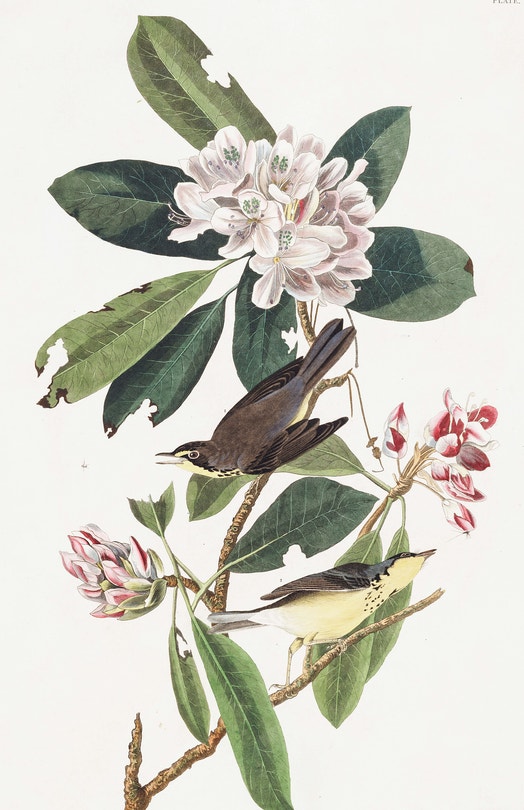
See a warbler much like the black and white creeper, but perched warbler-like on trees; streaked slate, white, and black, with a large white and black mark on wing, crown divided by a white line and then chestnut (?) or slate or dark, and then white above and below eye, breast and throat streaked downward with dark, rest beneath white. Can it be the common black and white creeper? Its note hardly reminds me of that. It is somewhat like pse pse pse pse, psa psa, weese weese weese, or longer. It did not occur to me that it was the same till I could not find any other like this in the book. 


Canada Warbler
(Sylvia pardalina /
Cardellina canadensis)
In the clintonia swamp I hear a smart, brisk, loud and clear whistling warble, quite novel and remarkable, something like te chit a wit, te chit a wit, tchit a wit, tche tche. It is all bright yellow or ochreous orange (?) below except vent, and a dark or black crescent on breast, with a white line about eye. Above it appears a nearly uniform dark blue slate, legs light, bill dark (?), tail long and forked. I think it must be the Canada warbler, seen in ’37, though that seems short for this.
 
It is quite different from the warbler of May 30. 


The recent high winds have turned the edges of young leaves by beating and killing them. 

H. D. Thoreau, Journal, June 4, 1855

The shadows of massive clouds still floating here and there in the peculiarly blue sky. See May 30, 1852 (A day for shadows, even of moving clouds, over fields in which the grass is beginning to wave."); June 3, 1858 ("The shadows of clouds flitting over the landscape are a never-failing source of amusement . . . to see one man’s farm in the shadow of a cloud, — which perhaps he thought covered all the Northern States, — while his neighbor’s farm was in sunshine."); June 9, 1856 ("There are some large cumuli with glowing downy cheeks floating about"); June 11, 1856 ("Great cumuli are slowly drifting in the intensely blue sky, with glowing white borders”). June 24, 1852 ("The drifting white downy clouds are objects of a large, diffusive interest. . . among the most glorious objects in nature. ");  July 1, 1854 ("The clouds are separate glowing masses or blocks floating in the sky, not threatening rain. I see from this hill their great shadows pass slowly here and there over the top of the green forest. ")

In the woods I hear the tanager and chewink and red-eye. See July 10, 1854 ("The singing birds at present are . . . Red-eye, tanager, wood thrush, chewink, veery, oven-bird, — all even at midday.")

I see the dandelions now generally gone to seed amid the grass —their downy spheres.
See June 4, 1852 (“The dandelions are now almost all gone to seed, and children may now see if "your mother wants you."”); 
 May 9, 1858 ("A dandelion perfectly gone to seed, a complete globe, a system in itself.") See also A Book of the Seasons,  by Henry Thoreau, The Dandelion in Spring

Redstarts still very common . . . Note tche, tche, tche vit, etc. See.May 26, 1855 ("Saw a redstart . . . black with a sort of brick red on sides [of] breast, spot on wing  and under root of tail. Note heard once next day, at Kalmia Swamp, somewhat like aveet aveet aveet aveet.");   June 6, 1855  ("On the Island I hear still the redstart—tsip tsip tsip tsip, tsit-i-yet, or sometimes tsip tsip tsip tsip, tse vet . . . It repeats this at regular intervals for a long time") See also  A Book of the Seasons, by Henry Thoreau,  The American Redstart

The Linnaea borealis has grown an inch. See 
   June 1, 1855 ("I find the Linnaea borealis growing near the end of the ridge in this lot toward the meadow, near a large white pine stump recently cut."); See also  A Book of the Seasons, by Henry Thoreau, Linnaea borealis (Twinflower)

Can it be the common black and white creeper? Its note hardly reminds me of that. It is somewhat like pse pse pse pse, psa psa, weese weese weese, or longer.  See April 28, 1856 (" I hear to-day frequently the seezer seezer seezer of the black and white creeper, or what I have referred to that”); May 11, 1856 ("The black and white creeper also is descending the oaks, etc., and uttering from time to time his seeser seeser seeser.”);  May 12, 1855 ("A very neat and active bird, exploring the limbs on all sides and looking three or four ways almost at once for insects. Now and then it raises its head a little, opens its bill, and, without closing it, utters its faint seeser seeser seeser.") See alsoA Book of the Seasons  by Henry Thoreau, The Black and White Creeper

I think it must be the Canada Warbler? See May 23, 1860 ("I get sight for a moment of a large warbler on a young oak, – only the under side, which is a clear bright lemon-yellow, all beneath, with a sort of crescent of black spots on the breast. Is it not the Sylvia pardalina?"); May 28, 1860 ("Sylvia pardalina. It is a bright yellow beneath, with a broad black stripe along each side of the throat, becoming longish black marks crescent-wise on the fore part of the breast, leaving a distinct clear bright-yellow throat, and all the rest beneath bright-yellow; a distinct bright-yellow ring around eye; a dark bluish brown apparently all above; yellowish legs. Not shy; on the birches.")
 See also A Book of the Seasons, by Henry Thoreau, The Canada Warbler

The warbler of May 30. See May 30, 1855 ("A familiar warbler not recognized for some years")

The recent high winds. See May 30, 1855  ("A strong west wind "); June 1, 1855 ("A very windy day, the third, drowning the notes of birds."); June 2, 1855 ("Still windier than before.")

June 4.  See A Book of the Seasons, by Henry Thoreau, June 4

The dandelions
        now gone to seed – downy spheres
seen amid the grass.
A Book of the Seasons, by Henry Thoreau
"A book, each page written in its own season,
out-of-doors, in its own locality.”
~edited, assembled and rewritten by zphx © 2009-2025

Popular Posts Last 30 Days.

The week ahead in Henry’s journal

The week ahead in Henry’s journal
A journal, a book that shall contain a record of all your joy.
"A stone fruit. Each one yields me a thought." ~ H. D. Thoreau, March 28, 1859


I sit on this rock
wrestling with the melody
that possesses me.