Showing posts with label salix rostrata. Show all posts

Tuesday, May 28, 2019

A black snake at home in the trees.

May 28

Saturday. P. M. — To Cliffs. 

Some Salix rostrata seed begins to fly. 

Low blackberry in bloom on railroad bank. 

Also S. Torreyana seed, just begun to fly. S. pedicellaris long out of bloom there. 

At the extreme east side of Trillium Wood, come upon a black snake, which at first keeps still prudently, thinking I may not see him, — in the grass in open land, — then glides to the edge of the wood and darts swiftly up into the top of some slender shrubs there — Viburnum dentatum and alder — and lies stretched out, eying me, in horizontal loops eight feet high. The biggest shrub was not over one inch thick at the ground. At first I thought its neck was its chief member, — as if it drew itself up by it, — but again I thought that it rather (when I watched it ascending) extended its neck and a great part of its body upward, while the lower extremity was more or less coiled and rigid on the twigs from a point d'appui. Thus it lifted itself quickly to higher forks. When it moved along more horizontally, it extended its neck far, and placed it successively between the slender forks. 

This snake, some four feet long, rested there at length twelve feet high, on twigs, not one so big as a pipe-stem, in the top of a shad-bush; yet this one's tail was broken off where a third of an inch thick, and it could not cling with that. It was quick as thought in its motions there, and perfectly at home in the trees, so far was it from making the impression of a snake in an awkward position. 

Cinnamon fern pollen [sic]. 

Lady's-slipper pollen. These grow under pines even in swamps, as at Ledum Swamp. 

The lint from leaves sticks to your clothes now. 

Hear a rose-breasted grosbeak. 

Methinks every tree and shrub is started, or more, now, but the Vaccinium dumosum, which has not burst.

H. D.Thoreau, Journal, May 28, 1859

Some Salix rostrata seed begins to fly. See June 6, 1856 ("That willow, male and female, opposite to Trillium Woods on the railroad, I find to be the Salix rostrata, or long-beaked willow, one of the ochre-flowered.")

This snake, some four feet long, perfectly at home in the trees. See May 16, 2018 ("It surprised me very much to see it cross from tree to tree exactly like a squirrel, where there appeared little or no support for such a body."); May 30, 1855 ("See a small black snake run along securely through thin bushes (alders and willows) three or four feet from the ground, passing intervals of two feet easily,—very readily and gracefully, —ascending or descending")

The Vaccinium dumosum. See  August 30, 1856 (“I noticed also a few small peculiar-looking huckleberries hanging on bushes amid the sphagnum, and, tasting, perceived that they were hispid, a new kind to me. Gaylussacia dumosa var. hirtella . . .. Has a small black hairy or hispid berry, shining but insipid and inedible, with a tough, hairy skin left in the mouth.”); July 2, 1857 (“The Gaylussacia dumosa var. hirtella, not yet quite in prime. . . . not to be mistaken for the edible huckleberry or blueberry blossom.”); August 8, 1858 (“the Gaylussacia dumosa var. hiriella . . . the only inedible species of  Vaccinieoe that I know in this town”)


May 28. SeeA Book of the Seasons,, by Henry Thoreau, May 28

A Book of the Seasons,  by Henry Thoreau
"A book, each page written in its own season,
out-of-doors, in its own locality."
 ~edited, assembled and rewritten by zphx ©  2009-2021

Thursday, May 2, 2019

I am surprised by the tender yellowish green of the aspen leaf just expanded suddenly,

May 2. 
May 2, 2019
Small pewee and young lackey caterpillars. 

I see on the Salix rostrata by railroad many honey bees laden with large and peculiarly orange-colored pellets of its pollen. 

P. M. — Up Assabet. 

Those swarms of small miller-like insects which fly low over the surface of the river, sometimes constantly falling to and touching the surface and then rising again. When at rest they are seen to be blackish-winged, but flying they look light-colored. They flutter low and continuously over the same place. Theirs is a sort of dance. 

A peetweet and its mate at Mantatuket Rock. The river seems really inhabited when the peetweet is back and those little light-winged millers (?). This bird does not return to our stream until the weather is decidedly pleasant and warm. He is perched on the accustomed rock. Its note peoples the river, like the prattle of children once more in the yard of a house that has stood empty. 

I am surprised by the tender yellowish green of the aspen leaf just expanded suddenly, even like a fire, seen in the sun, against the dark-brown twigs of the wood, though these leafets are yet but thinly dispersed. It is very enlivening. 

I heard yesterday, and perhaps for several days, the soft purring sound of what I take to be the Rana palustris, breeding, though I did not this time see the frog. 

I feel no desire to go to California or Pike's Peak, but I often think at night with inexpressible satisfaction and yearning of the arrowheadiferous sands of Concord. I have often spent whole afternoons, especially in the spring, pacing back and forth over a sandy field, looking for these relics of a race. This is the gold which our sands yield. 

The soil of that rocky spot on Simon Brown's land is quite ash-colored — now that the sod is turned up — by Indian fires, with numerous pieces of coal in it. There is a great deal of this ash-colored soil in the country. We do literally plow up the hearths of a people and plant in their ashes. The ashes of their fires color much of our soil.

H. D. Thoreau, Journal, May 2, 1859

Small pewee. See April 30, 1856 (“I hear the small pewee’s tche-vet’ repeatedly.”);  May 3, 1854 (“What I have called the small pewee on the willow by my boat, — quite small, uttering a short tchevet from time to time); May 3, 1855 “Small pewee; tchevet, with a jerk of the head.”); May 5, 1858 ("Saw and heard the small pewee yesterday.”); May 7, 1852 (“he first small pewee sings now che-vet, or rather chirrups chevet, tche-vet — a rather delicate bird with a large head and two white bars on wings. . . . Now I remember the yellowbird comes when the willows begin to leave out. (And the small pewee on the willows also.) ”) See also A Book of the Seasons, by Henry Thoreau, The Small Pewee

I see on the Salix rostrata by railroad many honey bees laden with large and peculiarly orange-colored pellets of its pollen. See  May 6, 1858 (“The Salix rostrata staminate flowers are of very peculiar yellow, — a bright, what you might call yellow yellow.”) See also A Book of the Seasons, by Henry Thoreau, Willows on the Causeway

Swarms of small miller-like insects which fly low over the surface of the river. Compare May 1, 1854 ("The water is strewn with myriads of wrecked shad-flies, erect on the surface, with their wings up like so many schooners all headed one way. . . .”); May 1, 1858 (“Ephemerae quite common over the water.”); May 4, 1856 ("Shad-flies on the water, schooner-like.”)

The tender yellowish green of the aspen leaf just expanded suddenly. See May 2, 1855 ("The young aspens are the first of indigenous trees conspicuously leafed”); May 4, 1856 ("The aspen there [the Island]just begun to leaf."); May 5, 1858 ("The aspen leaves at Island to-day appear as big as a nine pence suddenly"); May 17, 1860 ("Standing in the meadow near the early aspen at the island, I hear the first fluttering of leaves, - a peculiar sound, at first unaccountable to me”) See also A Book of the Seasons,  by Henry Thoreau the Aspens.

A peetweet and its mate at Mantatuket Rock. See May 2, 1858 (“Peetweet on a rock”); April 30, 1856 (“As I go along the Assabet, a peetweet skims away from the shore.”); May 4, 1856 (“See a peetweet on Dove Rock, which just peeps out. As soon as the rocks begin to be bare the peetweet comes and is seen teetering on them and skimming away from me.”)

Monday, May 14, 2018

The air is suddenly full of fragrance.

May 14.

 5.30 A. M. — Up railroad. 

Hear and see the red-eye on an oak. The tail is slightly forked and apparently three quarters of an inch beyond wings; all whitish beneath. 

Hear and see a redstart. Methinks I did also on the 10th ? The rhythm a little way off is ah, tche  tche tche'-ar. 

10 A. M. — To Hill. 

A kingbird. 

Saw a young robin dead. 

Saw the Viola palmata, early form, yesterday; how long? 

Look at White Avens Shore. See what I call vernal grass in bloom in many places. 

The Salix sericea, large and small, and the petiolaris or loose-catkinned (so far as I know their staminate flowers) are now out of bloom.The rostrata not quite done. Some of its catkins now three and a half inches long. The alba not quite done. S. pedicellaris by railroad about done, and the Torreyana done. 

Picked up, floating, an Emys picta, hatched last year. It is an inch and one twentieth long in the upper shell and agrees with Agassiz's description at that age. Agassiz says he could never obtain a specimen of the insculpta only one year old, it is so rarely met with, and young Emydidae are so aquatic. I have seen them frequently. 

To-day, for the first time, it appears to me summerlike and a new season. There is a tender green on the meadows and just leafing trees. The blossoms of the cherry, peach, pear, etc., are conspicuous, and the air is suddenly full of fragrance. Houses are seen to stand amid blossoming fruit trees, and the air about them is full of fragrance and the music of birds. 

As I go down the railroad at evening, I hear the incessant evening song of the bay-wing from far over the fields. It suggests pleasant associations. Are they not heard chiefly at this season? 

The fruit of the early aspen is almost as large — its catkins — as those of the early willow. It will soon be ripe. The very common puffed-up yellow ovaries make quite a show, like some normal fruit; even quite pretty. 

I discovered this morning that a large rock three feet in diameter was partially hollow, and broke into it at length with a stone in order to reach some large black crystals which I could partly see. I found that it had been the retreat of a squirrel, and it had left many nuts there. It had entered a small hole bristling with crystals, and there found a chamber or grotto a foot long at least, surrounded on all sides by crystals. They thus explore and carry their nuts into every crevice, even in the rocks. 

Celandine by cemetery. 

One tells me he saw to-day the arum flower.

H. D. Thoreau, Journal, May 14, 1858


Kingbird. See May 14, 1852 (“First kingbird. Its voice and flight relate it to the swallow.”)

The evening song of the bay-wing from far over the fields. It suggests pleasant associations. See May 12, 1857 ("It reminded me of many a summer sunset, of many miles of gray rails, of many a rambling pasture, of the farmhouse far in the fields, its milk-pans and well-sweep, and the cows coming home from pasture.”)

Sunday, May 6, 2018

Thermometers, hygrometers, and barometers. Frogs of Massachusetts

May 6 

I heard from time to time a new note from my Rana palustris in the firkin in my chamber. It was that strong vibratory purr or prr-r-r-a-a-a, as if it began with a p, lasting two or three seconds and sometimes longer. In the firkin near my bed, it sounded just like a vibrating sliver which struck hard and rapidly against the rail [it] belonged to, – dry, like a fine and steady watchman's rattle sounding but little while. I recognized it as a sound I hear along the riverside. It was like the tut tut tut more sharply and very rapidly or closely sounded perchance; perhaps even like the tapping of a woodpecker. Yes, quite like it thus close by. 

This morning that spawn laid night before last has expanded to three and a half inches in diameter. 

P. M. — To Trillium Wood. 

It is a muggy and louring afternoon, and I go looking for toad spawn and for frogs. 

In all cases in which I have noticed frogs coupled this year, — the sylvatica, halecina, and palustris, - the female has been considerably the largest. 

The most common frog that I get sight of along the brooks and ditches this afternoon, and indeed for some weeks in similar localities and even in some parts of the river shore, is what I have called the young R. pipiens, with commonly a dull-green head and sides of head, sometimes bright green, and back dusky-spotted. Can this be the bull frog? Is it not the fontinalis with less bright green and a white throat? Sometimes it is yellow-throated. 

I saw lately in the river a full-grown bullfrog, with, I think, a white throat. I see a Rana sylvatica by a ditch in Stow’s meadow, fifteen rods from the (Trillium) Wood. 

The Salix rostrata staminate flowers are of very peculiar yellow, — a bright, what you might call yellow yellow. 

A boy brings me to-day an Attacus Cecropia moth which has come out of a cocoon in his trunk. It is, I think, the male, a dark brown above, and considerably larger than mine. It must be about seven inches in alar extent. 

Minott remembers the Rana palustris, or yellow legged one, as “ the one that stinks so,” as if that scent were peculiar to it. I suppose it is. He says that the white-legged one (the halecina) was preferred for invalids, i. e. their legs, as being sweeter. He says that there used to be a great many more bullfrogs than there are now, and what has got them he does not know. 

About 9 P. M. I went to the edge of the river to hear the frogs. It was a warm and moist, rather foggy evening, and the air full of the ring of the toad, the peep of the hylodes, and the low growling croak or stertoration of the Rana palustris. Just there, however, I did not hear much of the toad, but rather from the road, but I heard the steady peeping of innumerable hylodes for a background to the palustris snoring, further over the meadow. 

There was a universal snoring of the R. palustris all up and down the river on each side, the very sounds that mine made in my chamber last night, and probably it began in earnest last evening on the river. It is a hard, dry, unmusical, fine watchman’s-rattle-like stertoration, swelling to a speedy conclusion, lasting say some four or five seconds usually. The rhythm of it is like that of the toads’ ring, but not the sound. This is considerably like that of the tree-toad, when you think of it critically, after all, but is not so musical or sonorous as that even. There is an occasional more articulate, querulous, or rather quivering, alarm note such as I have described (May 2d). 

Each shore of the river now for its whole length is all alive with this stertorous purring. It is such a sound as I make in my throat when I imitate the growling of wild animals. I have heard a little of it at intervals for a week, in the warmest days, but now at night it [is] universal all along the river. If the note of the R. halecina, April 3d, was the first awakening of the river meadows, this is the second, —considering the hylodes and toads less (?) peculiarly of the river meadows. Yet how few distinguished this sound at all, and I know not one who can tell what frog makes it, though it is almost as universal as the breeze itself. 

The sounds of those three reptiles now fill the air, especially at night. The toads are most regardless of the light, and regard less a cold day than the R. palustris does. In the mornings now, I hear no R. palustris and no hylodes, but a few toads still, but now, at night, all ring together, the toads ringing through the day, the hylodes beginning in earnest toward night and the palustris at evening. I think that the different epochs in the revolution of the seasons may perhaps be best marked by the notes of reptiles. They express, as it were, the very feelings of the earth or nature. They are perfect thermometers, hygrometers, and barometers. 

One of our cherries opens. 

I heard a myrtle-bird's tull-lull yesterday, and that somebody else heard it four or five days ago. 

Many are catching pouts this louring afternoon, in the little meadow by Walden. 

May 6, 2017


The thinker, he who is serene and self-possessed, is the brave, not the desperate soldier. He who can deal with his thoughts as a material, building them into poems in which future generations will delight, he is the man of the greatest and rarest vigor, not sturdy diggers and lusty polygamists. He is the man of energy, in whom subtle and poetic thoughts are bred. Common men can enjoy partially; they can go a-fishing rainy days; they can read poems perchance, but they have not the vigor to beget poems. They can enjoy feebly, but they cannot create. Men talk of freedom! How many are free to think? free from fear, from perturbation, from prejudice? Nine hundred and ninety-nine in a thousand are perfect slaves. How many can exercise the highest human faculties? He is the man truly — courageous, wise, ingenious - who can use his thoughts and ecstasies as the material of fair and durable creations. One man shall derive from the fisherman’s story more than the fisher has got who tells it. The mass of men do not know how to cultivate the fields they traverse. The mass glean only a scanty pittance where the thinker reaps an abundant harvest. What is all your building, if you do not build with thoughts? No exercise implies more real manhood and vigor than joining thought to thought. How few men can tell what they have thought! I hardly know half a dozen who are not too lazy for this. They cannot get over some difficulty, and therefore they are on the long way round. You conquer fate by thought. If you think the fatal thought of men and institutions, you need never pull the trigger. The consequences of thinking inevitably follow. There is no more Herculean task than to think a thought about this life and then get it expressed. - Horticulturalists think that they make flower-gardens, though in their thoughts they are barren and flowerless, but to the poet the earth is a flower-garden wherever he goes, or thinks. Most men can keep a horse or keep up a certain fashionable style of living, but few indeed can keep up great expectations. They justly think very meanly of themselves.

H. D. Thoreau, Journal, May 6, 1858

The Salix rostrata staminate flowers are of very peculiar yellow, — a bright, what you might call yellow yellow. See May 5, 1857 ("Staminate Salix rostrata, possibly yesterday.”); June 6, 1856 ("That willow, male and female, opposite to Trillium Woods on the railroad, I find to be the Salix rostrata, or long-beaked willow, one of the ochre-flowered . . . willows”); May 2, 1859 (“I see on the Salix rostrata by railroad many honey bees laden with large and peculiarly orange-colored pellets of its pollen.”)

A boy brings me to-day an Attacus Cecropia moth . . . considerably larger than mine. See June 2, 1855 (“I gave it ether and so saved it in a perfect state. As it lies, not spread to the utmost, it is five and nine tenths inches by two and a quarter.”)

I heard a myrtle-bird's tull-lull yesterday, and that somebody else heard it four or five days ago. See May 5, 1857 (“Hear the tull-lull of a myrtle-bird (very commonly heard for three or four days after).”); May 6, 1855 (“Myrtle-birds very numerous just beyond Second Division. They sing like an instrument, teee teee te, t t t, t t t, on very various keys . . . Many white-throated sparrows there.”

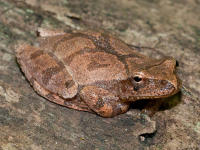
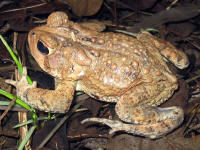
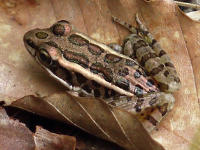
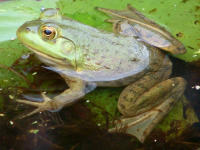
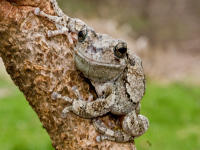
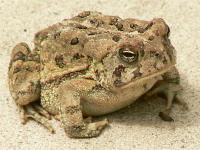
In all cases in which I have noticed frogs coupled this year, — the sylvatica, halecina, and palustris, - the female has been considerably the largest. . .The young R. pipiens, with commonly a dull-green head and sides of head, sometimes bright green, and back dusky-spotted. Can this be the bull frog? Is it not the fontinalis with less bright green and a white throat? Sometimes it is yellow-throated. I saw lately in the river a full-grown bullfrog, with, I think, a white throat. . . .the air full of the ring of the toad, the peep of the hylodes, and the low growling croak or stertoration of the Rana palustris. . . .The rhythm of it is like that of the toads’ ring, but not the sound. This is considerably like that of the tree-toad.  See The 10 frog species in Massachusetts. (Mass Audubon) (HDT’s halecina is the northern leopard frog, his fontinalis is the green frog, his hylodes the peeper):

Spring peeper (Pseudacris crucifer)[hylodes]


Wood frog (Lithobates sylvaticus)[Rana 
sylvatica]


American toad (Anaxyrus americanus)


Green frog (Lithobates clamitans)[
Rana pipiens]


Northern leopard frog (Lithobates pipiens)[Rana halecina]


Pickerel frog (Lithobates palustris)[Rana palustris]


American bullfrog (Lithobates catesbeianus)


Gray treefrog (Hyla versicolor)[tree-toad ]


Eastern spadefoot (Scaphiopus holbrookii)


Fowler's toad (Anaxyrus fowleri)

Sunday, June 4, 2017

It is time now to bring our philosophy out of doors.

June 4

P. M. — To Bare Hill. 

The early potentilla is now erect in the June grass. 

Salix tristis is going to seed, showing some cotton; also some S. rostrate. 

I am surprised to see some kind of fish dart away in Collier's veronica ditch, for it about dries up and has no outlet. 

I observed yesterday, the first time this year, the lint on the smooth surface of the Assabet at the Hemlocks, giving the water a stagnant look. It is an agreeable phenomenon to me, as connected with the season and suggesting warm weather. I suppose it to be the down from the new leaves which so rapidly become smooth. There may be a little pitch pine pollen with it now. The current is hardly enough to make a clear streak in it here and there. The stagnant-looking surface, where the water slowly circles round in that great eddy, has the appearance of having been dusted over. This lint now covers my clothes as I go through the sprout- lands, but it gets off remarkably before long. Each under side of a leaf you strike leaves the mark of its lint on your clothes, but it is clean dirt and soon wears off. 

One thing that chiefly distinguishes this season from three weeks ago is that fine serene undertone or earth-song as we go by sunny banks and hillsides, the creak of crickets, which affects our thoughts so favorably, imparting its own serenity. It is time now to bring our philosophy out of doors. Our thoughts pillow themselves unconsciously in the troughs of this serene, rippling sea of sound. Now first we begin to be peripatetics. No longer our ears come in contact with the bold echoing earth, but everywhere recline on the spring cushion of a cricket's chirp. These rills that ripple from every hillside become at length a universal sea of sound, nourishing our ears when we are most unconscious. 

In that first apple tree at Wyman's an apparent hairy woodpecker's nest (from the size of the bird), about ten feet from ground. The bird darts away with a shrill, loud chirping of alarm, incessantly repeated, long before I get there, and keeps it up as long as I stay in the neighborhood. The young keep up an in cessant fine, breathing peep which can be heard across the road and is much increased when they hear you approach the hole, they evidently expecting the old bird. 

I perceive no offensive odor. I saw the bird fly out of this hole, May 1st, and probably the eggs were laid about that time. Vide it next year. 

In the high pasture behind Jacob Baker's, soon after coming out of the wood, I scare up a bay-wing. She runs several rods close to the ground through the thin grass, and then lurks behind tussocks, etc. The nest has four eggs, dull pinkish-white with brown spots; nest low in ground, of stubble lined with white horse hair. 

Carya glabra [Carya glabra – pignut hickory], apparently a day at least. 

Oldenlandia on Bare Hill, along above wall opposite the oak, a rod or more off and westerly. Apparently several days at least, but it appears not to do well. It has a dry, tufted look, somewhat like young savory- leaved aster, on the bare rocky hill and in the clear spaces between the huckleberry bushes. Reminds me of a heath. Does not blossom so full as once I saw it. 

Arethusa. 

Crimson fungus (?) on black birch leaves, as if bespattered with blood.

H. D. Thoreau, Journal, June 4, 1857

The early potentilla is now erect in the June grass. See June 4, 1855 (“There are now many potentillas ascendant.”)

Each under side of a leaf you strike leaves the mark of its lint on your clothes, but it is clean dirt and soon wears off. See June 4, 1855 (“Lint comes off on to clothes from the tender leaves, but it is clean dirt and all gone when you get home. . .”); June 4, 1854 (“ The surface of the still water nowadays looking like dust at a little distance. Is it the down of the leaves blown off? . . .”)

That fine serene undertone or earth-song . . . imparting its own serenity. See June 4, 1854 (“These warm and dry days, which put spring far behind, the sound of the cricket at noon has a new value and significance, so serene and cool . . ..”) ;May 12, 1857 (“The spirit of its earth-song, of its serene and true philosophy, was breathed into me, and I saw the world as through a glass, as it lies eternally”);; May 22, 1854 (“The song suggests lateness, but only as we come to a knowledge of eternity after some acquaintance with time. . . . . Only in their saner moments do men hear the crickets. . . .A quire has begun which pauses not for any news, for it knows only the eternal.”); June 1, 1856 (“Was soothed and cheered by I knew not what at first, but soon detected the now more general creak of crickets”); June 13, 1851 ("I listen to the ancient, familiar, immortal, dear cricket sound under all others, and as these cease I become aware of the general earth-song.”)  June 17, 1852 (“The earth-song of the cricket! Before Christianity was, it is. Health! health! health! is the burden of its song. ”); July 14, 1851 (“It is a sound from within, not without.You cannot dispose of it by listening to it. In proportion as I am stilled I hear it. It reminds me that I am a denizen of the earth.”);

The [peep of the young] is much increased when they hear you approach the hole, they evidently expecting the old bird. I perceive no offensive odor. See June 10, 1856 ("They utter their squeaking hiss whenever I cover the hole with my hand, apparently taking it for the approach of the mother. A strong, rank fetid smell issues from the hole.?”)  

A bay-wing . . .  The nest has four eggs, dull pinkish-white with brown spots. . . .See May 18, 1855 ("At Clamshell a bay-wing sparrow’s nest, four eggs (young half hatched) -- some black-spotted, others not.”); May 27, 1856 ("Fringilla melodia’s nest in midst of swamp, with four eggs . . . with very dark blotches"); May 31, 1856 (“A ground-bird’s nest (melodia or graminea.), with six of those oblong narrow gray eggs speckled with much brown at end. . . .The bird would steal out through the grass when I came within a rod, and then, after running a rod or two, take to wing.”)

Oldenlandia on Bare Hill . . . See July 8, 1857 ("Edith Emerson shows me Oldenlandia purpurea var. longifolia, which she saw very abundantly in bloom on the Blue Hills . . .”)

Friday, May 5, 2017

The tull-lull of a myrtle-bird.


May 5

Tuesday. Building fence east of house. 

Hear the tull-lull of a myrtle-bird (very commonly heard for three or four days after). 

Have dug up in the garden this season half a dozen of those great leather-colored pupae (with the tongue-case bent round to breast like a long urn-handle) of the sphinx moth. 

First potato-worm. 

Staminate Salix rostrata, possibly yesterday.

H. D. Thoreau, Journal, May 5, 1857

Hear the tull-lull. .See April 19,1855 ("Hear the tull-lull of the white-throated sparrow in street”); May 4, 1855 ("Myrtle-birds numerous, and sing their tea lee, tea lee in morning. White-throated sparrows here, and numerous”); May 2, 1856 ("The tea lee of the yellow-rump warbler in the street, at the end of a cool, rainy day.”)

Staminate Salix rostrata. See  May 10, 1856 ("I see an apparently native willow, a shrub, with greenish bark and conspicuous yellow catkins, now in full bloom, apparently a little earlier than the Salix alba, but its leafets or bracts much less advanced and conspicuous."); June 6, 1856 ("That willow, male and female, opposite to Trillium Woods on the railroad, I find to be the Salix rostrata, or long-beaked willow, one of the ochre-flowered . . . willows . . .”); May 6, 1858 (“The Salix rostrata staminate flowers are of very peculiar yellow, — a bright, what you might call yellow yellow.”)

Monday, June 6, 2016

To rescue a star-nosed mole.

June 6, 2016
June 6 

P. M. — To Andromeda Ponds. 

Cold mizzling weather. 


In the large circular hole or cellar at the turntable on the railroad, which they are repairing, I see a star-nosed mole endeavoring in vain to bury himself in the sandy and gravelly bottom. 

Some inhuman fellow has cut off his tail. 


It is blue-black with much fur, a very thick, plump animal, apparently some four inches long, but he occasionally shortens himself a third or more. Looks as fat as a fat hog. His fore feet are large and set sidewise or on their edges, and with these he shovels the earth aside, while his large, long, starred snout is feeling the way and breaking ground. I see deep indentations in his fur where his eyes are situated, and once I saw distinctly his eye open, a dull blue (?) black head, not so very small, and he very plainly noticed my movements two feet off. He was using his eye as plainly as any creature that I ever saw. Yet Emmons says it is a question whether their eyes are not merely rudimentary. I suppose this was the Condylura macroma, since that is most common, but only an inch of its tail was left, and that was quite stout. 

I carry him along to plowed ground, where he buries himself in a minute or two. 

Still see cherry-birds in flocks of five or six. 

A catbird nest on shore of Andromeda and in shrub oak, three feet high, twigs and bark shreds lined with root-fibres; three eggs. 

Those nests in the andromeda are blackbird’s. Many sound the alarm while I am wading through the swamp. Noticed one with three eggs. 

Salix bebbiana (Wikipedia)


That willow, male and female, opposite to Trillium Woods on the railroad, I find to be the Salix rostrata, or long-beaked willow, one of the ochre-flowered (I had remarked the peculiar yellow of its flowers) willows (fulvae) of Barratt. It is now just beginning to open its long beaks. The S. cordata is another of the ochre-flowered ones. 

How well suited the lining of a bird’s nest, not only for the comfort of the young, but to keep the eggs from breaking! Fine elastic grass stems or root-fibres, pine needles, or hair, or the like. These tender and brittle things which you can hardly carry in cotton lie there without harm. 

J. Hosmer, who is prosecuting Warner for flowing his land, says that the trees are not only broken off when young by weight of ice, but, being rubbed and barked by it, become warty or bulge out there.

H. D. Thoreau, Journal, June 6, 1856

I see a star-nosed mole . . . blue-black with much fur, a very thick, plump animal, apparently some four inches long. . . fore feet are large and set sidewise or on their edges, and with these he shovels the earth aside, while his large, long, starred snout is feeling the way.   See note to February 20, 1852 ("We . . . rarely see these animals, though their tracks are so common. "); February 8, 1856  ("Puffer saw a star - nosed mole yesterday in the road.  Its track was  dog-like ."); September 12, 1859 ("I saw a star-nosed mole dead in the path on Conantum yesterday, with no obvious wound.") See also Animal Diversity Web, Condylura cristata

I carry him along to plowed ground, where he buries himself in a minute or two. See July 23, 1856 ("Saw . . . a small bullfrog in the act of swallowing a young but pretty sizable apparently Rana palustris, . . . I sprang to make him disgorge, but it was too late to save him. "); April 22, 1857 (“Near Tall's Island, rescue a little pale or yellowish brown snake that was coiled round a willow half a dozen rods from the shore and was apparently chilled by the cold.”); August 28, 1854 (“The meadow is drier than ever, and new pools are dried up. The breams, from one to two and a half inches long, lying on the sides and quirking from time to time. . . — pretty green jewels, dying in the sun. I saved a dozen or more by putting them in deeper pools.”); April 12, 1858 (“We came upon a partridge standing on the track, between the rails over which the cars had just passed. She had evidently been run down, but. . . was apparently more disturbed in mind than body. I took her up and carried her one side to a safer place.”)

Still see cherry-birds in flocks of five or six.  See  June 2, 1853 ("Cherry-birds are the only ones I see in flocks now. I can tell them afar by their peculiar fine springy note.") See also A Book of the Seasons,  by Henry Thoreau, The Cherry-Bird (cedar waxwing)

A catbird nest on shore of Andromeda and in shrub oak. See June 6, 1855  ("Two catbirds’ nests in the thickest part of the thicket on the edge of Wheeler’s meadow near Island."); See also A Book of the Seasons, by Henry Thoreau,  Catbird nests

Those nests in the andromeda are blackbird’s. See  May 25, 1855 ("Red-wing’s nest with four eggs — white, very faintly tinged with (perhaps) green and curiously and neatly marked with brown-black spots and lines on the large end.") See also  A Book of the Seasons,  by Henry Thoreau, the Red-wing in Spring

That willow, male and female, opposite to Trillium Woods on the railroad . .. Salix rostrata, or long-beaked willow, See May 10, 1856 {"On the railroad causeway against Trillium Wood, I see an apparently native willow, a shrub, with greenish bark and conspicuous yellow catkins, now in full bloom, apparently a little earlier than the Salix alba, but its leafets or bracts much less advanced and conspicuous. Another on the Walden road. What is it?"); May 6, 1858 (“The Salix rostrata staminate flowers are of very peculiar yellow, — a bright, what you might call yellow yellow.”)

The S. cordata is another of the ochre-flowered ones. See June 6, 1855 ("The Salix cordata (which apparently blossomed some days after the S. sericea) is very common on Prichard’s shore and also Whiting’s.")

J. Hosmer . . . is prosecuting Warner for flowing his land. See June 3, 1856 ("Surveying for John Hosmer beyond pail-factory”); June 4, 1856 (“Surveying for J. Hosmer . . . running a line on the west edge of Loring’s Pond, south of the brook.”).; May 19, 1858 ("Surveying for Warner the meadow surveyed for John Hosmer in June, ’56.") 

June 6. See  A Book of the Seasons, by Henry Thoreau, June 6

The long-beaked willow, 
one of the ochre-flowered, 
now just beginning . . .

A Book of the Seasons,  by Henry Thoreau
"A book, each page written in its own season,
out-of-doors, in its own locality."
 ~edited, assembled and rewritten by zphx ©  2009-2026

https://tinyurl.com/hdt-560606

Popular Posts Last 30 Days.

The week ahead in Henry’s journal

The week ahead in Henry’s journal
A journal, a book that shall contain a record of all your joy.
"A stone fruit. Each one yields me a thought." ~ H. D. Thoreau, March 28, 1859


I sit on this rock
wrestling with the melody
that possesses me.