Showing posts with label rosa lucida. Show all posts

Thursday, June 20, 2024

I see where the crickets are eating the wild strawberries.


June 20. 

 Tuesday. 

June 20, 2014

Motherwort to-morrow. 

Elder. 

A cloud of minute black pollywogs in a muddy pool. I see where the crickets are eating the wild strawberries. 

P. M. - To Shadbush Meadow. 

Heard a new bird –– chut-cheeter-varrer-chutter-wit ––on the low bushes, about the size of Wilson's thrush apparently. Apparently olivaceous (?) above, most so on head, yellow front, dark bill, dark wings with two white bars, all yellow or yellowish breast and beneath. Perhaps never heard it before. 

Cow-wheat, apparently two or three days.

A three-leaved Lysimachia stricta apparently, with reddish flower-buds, not open. 

Shad-berries almost, but scarce. 

There seems to be much variety in the Rosa lucida, some to have stouter hooked prickles than the R. Carolina.  

Upland haying begun, or beginning. 

Common nettle.

H. D Thoreau, Journal, June 20, 1854


Motherwort to-morrow. See June 29, 1852 ("Leonurus Cardiaca, motherwort, a nettle-like plant by the street-side.")

Elder. See June 21, 1852 ("Elder is blossoming; flowers opening now where black berries will be by and by.")

A cloud of minute black pollywogs in a muddy pool..See June 15, 1852 ("This half-stagnant pond-hole, drying up and leaving bare mud, with the pollywogs and turtles making off in it, is agreeable and encouraging to behold, as if it contained the seeds of life, the liquor rather, boiled down. The foulest water will bubble purely.");  See also June 15, 1851 ("The pollywogs in the pond are now fulltailed"); June 15, 1855 ("Many pollywogs an inch long.") and note to May 19, 1857 ("See myriads of minute pollywogs, recently hatched, in the water of Moore's Swamp.")

I see where the crickets are eating the wild strawberries. See June 22, 1851 ("Only in the quiet of evening do I so far recover my senses as to hear the cricket, which in fact has been chirping all day.") See also A Book of the Seasons, by Henry Thoreau, The Cricket in Spring and A Book of the Seasons, by Henry Thoreau: Strawberries

Cow-wheat, apparently two or three days. See June 14, 1859 ("Cow-wheat, how long ?"); June 16, 1856 ("Cow-wheat numerously out."); June 19, 1853 ("Cow-wheat out"); August 6, 1851("After how few steps, how little exertion, the student stands in pine woods above the Solomon's-seal and the cow-wheat, in a place still unaccountably strange and wild to him, and to all civilization!") [Cow-wheat is a native annual hemiparasite (partially parasitic), using specialized root structures to invade the roots of its host and steal nutrients, while also performing photosynthesis. Its hosts may be several species of pine (Pinus) and poplar (Populus) ~ GoBotany].

Shad-berries almost, but scarce. See June 25, 1853. ("An unusual quantity of amelanchier berries, – I think of the two common kinds . . . Both these are now in their prime. These are the first berries after strawberries. . .I  never saw nearly so many before. It is a very agreeable surprise."); June 25, 1854 ("Shad-berry ripe.") 

The Rosa lucida . . . have stouter hooked prickles than the R. Carolina.
See June 21, 1852 (" I observe a rose (called by some moss rose), with a bristly reddish stem; another, with a smooth red stem and but a few prickles; another, with many prickles and bristles."); July 24, 1853 ("The late rose, -- R. Carolina, swamp rose,-- I think has larger and longer leaves; at any rate they are duller above (light beneath). and the bushes higher.") See also A Book of the Seasons, by Henry Thoreau, The Wild Rose
Upland haying begun.
 See June 21, 1853 ("The farmers have commenced haying. With this the summer culminates.") See also A Book of the Seasons, by Henry Thoreau, 
Haymaking

July 20. See A Book of the Seasons, by Henry Thoreau, June 20

Rosa lucida –
stouter hooked prickles than the
R. Carolina.


A Book of the Seasons
, by Henry Thoreau
"A book, each page written in its own season,
out-of-doors, in its own locality."
~edited, assembled and rewritten by zphx © 2009-2024
https://tinyurl.com/hdt-540620

Wednesday, September 8, 2021

Fall flowers, second Spring

September 8 

Roses, apparently R. lucida, abundantly out on a warm bank on Great Fields by Moore's Swamp, with Viola pedata.

H. D. Thoreau, Journal, September 8, 1853

See September 8, 1851 ("Plants commonly soon cease to grow for the year, unless they may have a fall growth, which is a kind of second spring.")

Roses, apparently R. lucida, abundantly out. See June 15, 1851 (“See the first wild rose to-day on the west side of the railroad causeway”); June 15, 1853 (“Here are many wild roses northeast of Trillium Woods. It is the pride of June. I bring home the buds ready to expand, put them in a pitcher of water, and the next morning they open and fill my chamber with fragrance.”); June 18, 1854 (“The Rosa lucida is pale and low on dry sunny banks like that by Hosmer's pines.”); September 25, 1852 ("A rose again, apparently lucida (?). This is always unexpected."); September 28, 1852 ("This is the commencement, then, of the second spring. Violets, Potentilla Canadensis, lambkill, wild rose, yellow lily, etc., etc., begin again") See also A Book of the Seasons,  by Henry Thoreau, The Wild Rose

Viola pedata. See August 12, 1858 (“Saw a Viola pedata blooming again.”); August 31, 1853 ("Viola pedata out again.") September 4, 1856 ("Viola pedata again."); September 28, 1852 (" I find the hood-leaved violet quite abundant in a meadow, and the pedata in the Boulder Field. I have now seen all but the blanda, palmata, and pubescens blooming again .. . This is the commencement, then, of the second spring."); October 22, 1859 (" In the wood-path below the Cliffs I see perfectly fresh and fair Viola pedata flowers, as in the spring, though but few together. No flower by its second blooming more perfectly brings back the spring to us"); October 23, 1853 ("The Viola pedata looking up from so low in the wood-path makes a singular impression. "); November 9, 1850 ("I found many fresh violets (Viola pedata) to-day (November 9th) in the woods.”) See also A Book of the Seasons, by Henry Thoreau, the Violets

Friday, September 25, 2020

The scarlet of the dogwood is the most conspicuous and interesting of the autumnal colors at present.


September 25


September 25, 2020

Polygonum dumetorum, climbing false-buck wheat, still; also dodder.

The fall dandelions are a prevailing flower on low turfy grounds, especially near the river.

Ranunculus reptans still.

The small galium (trifidum).

A rose again, apparently lucida (?). This is always unexpected.

The scarlet of the dogwood is the most conspicuous and interesting of the autumnal colors at present. You can now easily detect them at a distance; every one in the swamps you overlook is revealed.

The smooth sumach and the mountain is a darker, deeper, bloodier red.

Found the Bidens Beckii (?) September 1st, and the fringed gentian November 7th, last year.

H. D. Thoreau, Journal, September 25, 1852


The scarlet of the dogwood is the most conspicuous and interesting of the autumnal colors at present. See September 23, 1853 ("I observe the rounded tops of the dogwood bushes, scarlet in the distance, on the edge of the meadow . . . more full and bright than any flower."); see also August 30, 1854 (“Dogwood leaves have fairly begun to turn”); August 31, 1853 ("I see the first dogwood turned scarlet in the swamp"): October 28, 1858 ("The dogwood on the island is perhaps in its prime, — a distinct scarlet, with half of the leaves green in this case."); November 11, 1858 ("The flowering dogwood, though still leafy, is uninteresting and partly withered.")

A rose again, apparently lucida (?). This is always unexpected. See June 12, 1854 ("Rosa lucida, probably yesterday, the 11th . . . A bud in pitcher the 13th.”); June 18, 1854 (“The Rosa lucida is pale and low on dry sunny banks like that by Hosmer's pines.”);  July 26, 1853 ("Saw one of the common wild roses (R. lucida?)."); September 8, 1853 ("Roses, apparently R. lucida, abundantly out on a warm bank on Great Fields by Moore's Swamp.") See also A Book of the Seasons,  by Henry Thoreau, The Wild Rose

Wednesday, June 18, 2014

Another round red sun of dry and dusty weather – Stawberries in season.


June 18.

The Rosa lucida is pale and low on dry sunny banks like that by Hosmer's pines. 


There are many strawberries this season, in meadows now, just fairly begun there. The meadows, like this Nut Meadow, are now full of the taller grasses, just beginning to flower.


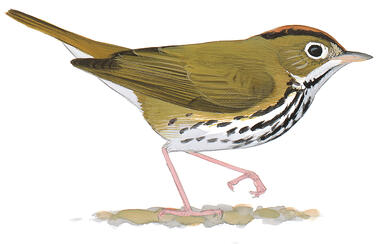
Ovenbird
Observe in two places golden-crowned thrushes, near whose nests I must have been, hopping on the lower branches and in the underwood, — a somewhat sparrow-like bird, with its golden-brown crest and white circle about eye, carrying the tail somewhat like a wren, and inclined to run along the branches. Each had a worm in its bill, no doubt intended for its young. That is the chief employment of the birds now, gathering food for their young. I think I heard the anxious peep of a robin whose young have just left the nest.

Small grasshoppers very abundant in some dry grass. 

Another round red sun of dry and dusty weather to-night, — a red or red-purple helianthus. Every year men talk about the dry weather which has now begun as if it were something new and not to be expected.

H. D. Thoreau, Journal, June 18, 1854

And more today on slavery:
My advice to the State is simply this: to dissolve her union with the slaveholder instantly. ... And to each inhabitant of Massachusetts, to dissolve his union with the State, as long as she hesitates to do her duty.
See May 29, 1854 , June 9, 1854, June 16, 1854, June 17, 1854 and ""Slavery in Massachusetts.

The Rosa lucida is pale and low on dry sunny banks. See June 13, 1854 ("Is not the rose-pink Rosa lucida paler than the R. nitida?"); June 16, 1854 ("The R. lucida, with its broader and duller leaves, but larger and perhaps deeper-colored and more purple petals, perhaps yet higher scented, and its great yellow centre of stamens.") See also A Book of the Seasons, by Henry Thoreau, The Wild Rose

There are many strawberries this season, in meadows now, just fairly begun there. See June 17, 1854 ("Already the season of small fruits has arrived.") See also A Book of the Seasons, by Henry Thoreau: Strawberries

Observe in two places golden-crowned thrushes, near whose nests I must have been . . . See June 10, 1855 ("Oven-bird’s nest with four eggs two thirds hatched, under dry leaves, composed of pine-needles and dry leaves and a hair or two for lining,”)

Another round red sun.  See June 17, 1854 ("The sun goes down red again, like a high-colored flower of summer.")

I think I heard the anxious peep of a robin whose young have just left the nest. See June 10, 1853 ("We hear the cool peep of the robin calling to its young, now learning to fly.") See also May 13, 1853 ("A robin's nest, with young, on the causeway."): May 24, 1855 ("Young robins some time hatched");June 9, 1856 ("A young robin abroad. "); June 15, 1855 ("Robin’s nest in apple tree, twelve feet high — young nearly grown."): June 15, 1852 ("Young robins,speck dark-led,"); June 20, 1855 (" A robin’s nest with young, which was lately, in the great wind, blown down and somehow lodged on the lower part of an evergreen by arbor,—without spilling the young!")

Every year men talk about the dry weather which has now begun as if it were something new and not to be expected. See July 7, 1853 ("Now is that annual drought which is always spoken of as something unprecedented and out of the common course.")

June18. See A Book of the Seasons, by Henry Thoreau, June 18

Many strawberries 
this season in meadows now –
just fairly begun.

A Book of the Seasons, by Henry Thoreau, Strawberries in Season
A Book of the Seasons, by Henry Thoreau
"A book, each page written in its own season,
out-of-doors, in its own locality.”


~edited, assembled and rewritten by zphx © 2009-2024
https://tinyurl.com/hdt-540618

Popular Posts Last 30 Days.

The week ahead in Henry’s journal

The week ahead in Henry’s journal
A journal, a book that shall contain a record of all your joy.
"A stone fruit. Each one yields me a thought." ~ H. D. Thoreau, March 28, 1859


I sit on this rock
wrestling with the melody
that possesses me.