Showing posts with label oak gall. Show all posts

Tuesday, December 25, 2018

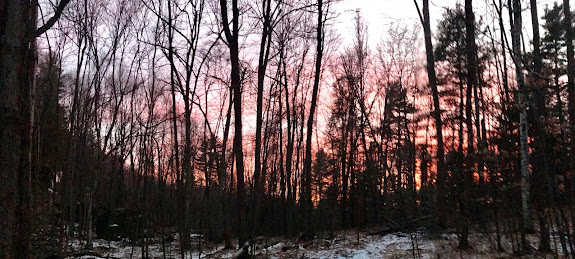
Now after sunset the light of the western sky – the outlines of pines.


December 25

December 25, 2018

P. M. —Up river on ice to Fair Haven Pond and across to Walden. 

The ground is still for the most part bare. Such a December is at least as hard a month to get through as November. You come near eating your heart now.

There is a good deal of brown or straw-color in the landscape now, especially in the meadows, where the ranker grasses, many of them uncut, still stand. They are bleached a shade or two lighter. Looking from the sun, there is a good deal of warm sunlight in them. 

I see where one farmer has been getting this withered sedge on the ice within a day or two for litter, in a meadow which had not been cut. Of course he could not cut very close. 

The ice on the river is about half covered with light snow, it being drifted thus, as usual, by the wind. (On Walden, however, which is more sheltered, the ice is uniformly covered and white.) I go running and sliding from one such snow-patch to another. It is easiest walking on the snow, which gives a hold to my feet, but I walk feebly on the ice. It is so rough that it is but poor sliding withal. 

I see, in the thin snow along by the button-bushes and willows just this side of the Hubbard bridge, a new track to me, looking even somewhat as if made by a row of large rain-drops, but it is the track of some small animal. The separate tracks are at most five eighths of an inch in diameter, nearly round, and one and three quarters to two inches apart, varying perhaps half an inch from a straight line. Sometimes they are three or four inches apart. The size is but little larger than that of a mouse, but it is never like a mouse. Goodwin, to whom I described it, did not know what it could be. 

The sun getting low now, say at 3.30, I see the ice green, southeast. 

Goodwin says that he once had a partridge strike a twig or limb in the woods as she flew, so that she fell and he secured her. 

Going across to Walden, I see that the fuzzy purple wool-grass is now bleached to a dark straw-color with out any purple. 

I notice that a fox has taken pretty much my own course along the Andromeda Ponds. 

The sedge which grows in tufts eighteen or twenty inches high there is generally recurving. 

I see that the shiners which Goodwin is using for bait to-day have no longitudinal dark bar or line on their sides, such as those minnows of the 11th and 18th had. Yet I thought that by the position of their fins, etc., the latter could not be the banded minnow. 

Walden at length skimmed over last night, i. e. the two holes that remained open. One was very near the middle and deepest part, the other between that and the railroad. 

Now that the sun is setting, all its light seems to glance over the snow-clad pond and strike the rocky shore under the pitch pines at the northeast end. Though the bare rocky shore there is only a foot or a foot and a half high as I look, it reflects so much light that the rocks are singularly distinct, as if the pond showed its teeth. 

I stayed later to hear the pond crack, but it did not much. 
December 25, 2019
How full of soft, pure light the western sky now, after sunset! I love to see the outlines of the pines against it. Unless you watch it, you do not know when the sun goes down. It is like a candle extinguished without smoke. A moment ago you saw that glittering orb amid the dry oak leaves in the horizon, and now you can detect no trace of it. In a pensive mood I enjoy the complexion of the winter sky at this hour.

Those small sphagnous mountains in the Andromeda Ponds are grotesque things. Being frozen, they bear me up like moss-clad rocks and make it easy getting through the water-brush. 

But for all voice in that serene hour I hear an owl hoot. How glad I am to hear him rather than the most eloquent man of the age! 

I saw a few days ago the ground under a swamp white oak in the river meadow quite strewn with brown dry galls about as big as a pea and quite round, like a small fruit which had fallen from it.

H. D. Thoreau, Journal, December 25, 1858

As hard a month to get through as November. You come near eating your heart now.
See November 27, 1853 ("Now a man will eat his heart, if ever, now while the earth is bare, barren and cheerless, and we have the coldness of winter without the variety of ice and snow"); November 25, 1857 (“November Eatheart, — is that the name of it? “)

Looking from the sun, there is a good deal of warm sunlight in them. See January 4, 1858 (“It is surprising how much sunny light a little straw that survives the winter will reflect . . .
That bright and warm reflection of sunlight from the insignificant edging of stubble”)

I notice that a fox has taken pretty much my own course along the Andromeda Ponds. See December 13, 1859 ("I see that the fox too has already taken the same walk before me, just along the edge of the button-bushes, where not even he can go in the summer.”)

The shiners which Goodwin is using for bait to-day have no longitudinal dark bar or line on their sides. See March 29, 1854 ("poised over the sand on invisible fins, the outlines of a shiner. . . distinct longitudinal light-colored line midway along their sides and a darker line below it”); July 16, 1856 ("I see many young shiners (?) (they have the longitudinal bar)"): July 17, 1856 (“They have . . . a broad, distinct black band along sides (which methinks marks the shiner)"); December 11, 1858 (“a minnow — apparently a young shiner, but it has a dark longitudinal line along side ”); December 18, 1858 (“They are little shiners with the dark longitudinal stripe”)

The sun getting low now, say at 3.30, I see the ice green, southeast. See January 7, 1856 (“Returning just before sunset, the few little patches of ice look green as I go from the sun . . .It is probably a constant phenomenon in cold weather when the ground is covered with snow and the sun is low, morning or evening, and you are looking from it.”); February 12, 1860 ("Returning just before sunset, I see the ice beginning to be green.”)

Walden at length skimmed over last night, i. e. the two holes that remained open. See note to December 20, 1858 (“Walden is frozen over, except two small spots, less than half an acre in all, in middle.”); 
December 22, 1858 (“The pond is no more frozen than on the 20th.”); December 24, 1858 ("Those two places in middle of Walden not frozen over yet, though it was quite cold last night! "); December 28, 1858 (“The ice is about six inches thick.”) See also December 25, 1859 ("The last our coldest night, as yet. No doubt Walden froze over last night entirely.") and A Book of the Seasons, by Henry Thoreau, Annual ice-in at Walden

Now that the sun is setting, all its light seems to glance over the snow-clad pond and strike the rocky shore under the pitch pines at the northeast end.
See December 25, 1858 ("That rocky shore under the pitch pines which so reflects the light, is only three feet wide by one foot high")

Unless you watch it, you do not know when the sun goes down.  See December 25, 1851 (“I go forth to see the sun set. Who knows how it will set, even half an hour beforehand ?”); See also July 20, 1852 (“We see the first star in the southwest, and know not how much earlier we might have seen it had we looked.”)

How full of soft, pure light the western sky now, after sunset! I love to see the outlines of the pines against it.
Full of soft pure light
western sky after sunset –
the outlines of pines.


See December 3, 1856   ("The pine forest's edge seen against the winter horizon"); December 12, 1859 ("The night comes on early these days, and I soon see the pine tree tops distinctly outlined against the dun (or amber) but cold western sky."); December 20, 1851 (In the west the sun goes down apace behind glowing pines, and golden clouds like mountains skirt the horizon."); January 5, 1853 ("A fine rosy sky in the west after sunset; and later an amber-colored horizon, in which a single tree-top showed finely."); January 9, 1859 ("It is worth the while to stand here at this hour and look into the soft western sky, over the pines whose outlines are so rich and distinct against the clear sky."); January 19, 1859 ("It occurs to me that I know of no more agreeable object to bound our view . . . than the pyramidal tops of a white pine forest in the horizon.");  See also October 20, 1858 ("There is one advantage in walking eastward these afternoons, at least, that in returning you may have the western sky before you.");   December 8, 1854 (“There is a glorious clear sunset sky, soft and delicate and warm”); December 9, 1859 (“I observe at mid-afternoon that peculiarly softened western sky . . . giving it a slight greenish tinge.”); December 11, 1854 ("I see the sun setting far through the woods, and there is that peculiar clear vitreous greenish sky in the west, as it were a molten gem.The day is short; it seems to be composed of two twilights merely"); December 18, 1853 (“The western hills, these bordering it, seen through the clear, cold air, have a hard, distinct edge against the sunset sky.”); January 17, 1852 (“In proportion as I have celestial thoughts, is the necessity for me to be out and behold the western sky sunset these winter days")

Clear yellow light of
the western sky reflected
from the smooth water.

Night comes on early.  
Pine tree tops outlined against
the cold western sky,

To look over pines
so rich and distinct into
the soft western sky.
January 9, 1859

The unclouded mind,
serene, pure, ineffable
like the western sky.

See also A Book of the Seasons,  by Henry Thoreau, the Western Sky

I hear an owl hoot. How glad I am to hear him. See November 18, 1851 ("I rejoice that there are owls. . . . This sound faintly suggests the infinite roominess of nature”); January 7, 1854 (“It is a sound which the wood or horizon makes”) See also A Book of Seasons, by Henry Thoreau, The Voice of the Barred Owl

December 25.  See A Book of the Seasons,  by Henry Thoreau, December 25


Now after sunset
the light of the western sky –
the outlines of pines.

I hear an owl hoot.
How glad I am to hear him
in this serene hour.


A Book of the Seasons
,  by Henry Thoreau, 
"A book, each page written in its own season,
out-of-doors, in its own locality.”
~edited, assembled and rewritten by zphx © 2009-2024

https://tinyurl.com/hdt-581225

Saturday, September 3, 2016

Viburnum nudum berries.

September 3  P. M. — To Hubbard's Swamp for Viburnum nudum berries. 

September 3
The river smooth, though full, with the autumn sheen on it, as on the leaves. 

I see painted tortoises with their entire backs covered with perfectly fresh clean black scales, such as no rubbing nor varnishing can produce, contrasting advantageously with brown and muddy ones. One little one floats past on a drifting pad which he partly sinks. 

I find one sassafras berry, dark-blue in its crimson cup, club-shaped. It is chiefly stone, and its taste is like that of tar (!), methinks, far from palatable. 

So many plants, the indigenous and the bewildering variety of exotics, you see in conservatories and nurserymen's catalogues, or read of in English books, and the Royal Society did not make one of them, and knows no more about them than you! All truly indigenous and wild on this earth. I know of no mark that betrays an introduced plant, as none but the gardener can tell what flower has strayed from its parterre; but where the seed will germinate and the plant spring and grow, there it is at home. 

Weeds are uncultivated herbaceous plants which do not bear handsome flowers. 

Polygala sanguinea is now as abundant, at least, as at any time, and perhaps more conspicuous in the meadows where I look for fringed gentian. 

Gather four or five quarts of Viburnum nudum berries, now in their prime, attracted more by the beauty of the cymes than the flavor of the fruit. The berries, which are of various sizes and forms, — elliptical, oblong, or globular, — are in different stages of maturity on the same cyme, and so of different colors, — green or white, rose-colored, and dark purple or black, — i. e. three or four very distinct and marked colors, side by side. 

If gathered when rose-colored, they soon turn dark purple and are soft and edible, though before bitter. They add a new and variegated wildness to the swampy sprout-lands. Remarkable for passing through so many stages of color before they arrive at maturity. 

A singular and pleasing contrast, also, do the different kinds of viburnum and cornel berries present when compared with each other. The white berries of the panicled cornel, soon and apparently prematurely dropping from its pretty fingers, are very bitter. So also are those of the C. sericea. 

One carrion-flower berry is turning blue in its dense spherical cluster. 

Castile-soap galls are crowding the more legitimate acorn on the shrub oak.

H. D. Thoreau, Journal, September 3, 1856

Gather four or five quarts of Viburnum nudum berries, now in their prime . . . in different stages of maturity on the same cyme, and so of different colors, — green or white, rose-colored, and dark purple or black, — i. e. three or four very distinct and marked colors, side by side. See August  28, 1856  ("Viburnum nudum berries are beginning; I already see a few shrivelled purple ones amid the light green.");  August 31, 1856 ("The Viburnum nudum berries are now in prime, a handsome rose-purple . . and the next morning thirty were turned dark purple."); September 27,  1856 ("Viburnum nudum berries are soon gone. I noticed none to speak of in Hubbard's Swamp, September 15th.") See also A Book of the Seasons,  by Henry Thoreau, The Viburnums

The river smooth . . . with the autumn sheen on it. 
See September 2, 1856 ("Clear bright days of late, with a peculiar sheen on the leaves.”)

Attracted more by the beauty of the cymes than the flavor of the fruit. See  September 3, 1853 ("Now is the season for those comparatively rare but beautiful wild berries which are not food for man.. . . It behooves me to go a-berrying in this sense once a year at least. “)

Polygala sanguinea is now as abundant, at least, as at any time. See September 3, 1854 ("In the meadow southwest of Hubbard's Hill saw white Polygala sanguinea, not described.") See also A Book of the Seasons,  by Henry Thoreau, The Polygala

I find one sassafras berry, dark-blue in its crimson cup, club-shaped. . . methinks, far from palatable. See September 24, 1854 ("On the large sassafras trees on the hill I see many of the handsome red club-shaped pedicels left, with their empty cups.”)

Painted tortoises with . . . fresh clean black scales.  See August 31, 1856 ("A painted tortoise shedding its scales.”); 
 September 15, 1855 ("See many painted tortoise scales being shed, half erect on their backs.") See also A Book of the Seasons, by Henry Thoreau, The Painted Turtle (Emys picta)

Castile-soap galls. September 4, 1854 (“In the wood-paths I find a great many of the Castile-soap galls, more or less fresh.”)

September 3.  See A Book of the Seasons,  by Henry Thoreau,  September 3

Various berries
sizes forms – elliptical
oblong, globular –
many stages of color.
Viburnum nudum.


A Book of the Seasons
,  by Henry Thoreau
 "A book, each page written in its own season,
out-of-doors, in its own locality."
 ~edited, assembled and rewritten by zphx ©  2009-2026

https://tinyurl.com/HDT-560903

Tuesday, August 23, 2016

Dense pearly masses of flowers covered with bees and butterflies.

August 23

P. M. — To Walden. 


I see a bed of Antennaria margaritacea, now in its prime, by the railroad, and very handsome. It has fallen outward on all sides ray-wise, and rests on the ground, forming perfectly regular circle, four feet in diameter and fifteen inches high, with a dark ash-colored centre, twenty inches in diameter, composed of the stems, then a wide circumference, one foot or more broad, of dense pearly masses of flowers covered with bees and butterflies. This is as regular as a wheel. So fair and pure and abundant. 

Elder-berries, now looking purple, are weighing down the bushes along fences by their abundance. 

White goldenrod, not long commonly. 

Decodon getting stale at Second Andromeda Pond. Often the end has rooted itself, and the whole forms a loop four feet long and twenty or more inches high in the middle, with numerous branches, making it rather troublesome to wade through. Where the stems bend down and rest on the water, they swell to several times their usual size and acquire that thick, soft bark, and put forth numerous roots; not the extreme point, but a space just short of it, while that starts up again. 

On R. W. E.'s hillside by railroad, burnt over by the engine in the spring, the erechthites has shot up abundantly, very tall and straight, some six or seven feet high. 

Those singular crowded and wrinkled dry galls, red and cream-color mingled, on white oak shrubs, with their grubs in them.

On the west side of Emerson's Cliff, I notice many Gerardia pedicularia out. A bee is hovering about one bush. The flowers are not yet open, and if they were, perhaps he could not enter. He proceeds at once, head downwards, to the base of the tube, extracts the sweet there, and departs. Examining, I find that every flower has a small hole pierced through the tube, commonly through calyx and all, opposite the nectary. This does not hinder its opening. 

The Rape of the Flower! The bee knew where the sweet lay, and was unscrupulous in his mode of obtaining it. A certain violence tolerated by nature. 

Now for high blackberries, though the low are gone. At the Lincoln bound hollow, Walden, there is a dense bed of the Rubus hispidus, matting the ground seven or eight inches deep, and full of the small black fruit, now in its prime. It is especially abundant where the vines lie over a stump. Has a peculiar, hardly agreeable acid. 

On this Lespedeza Stuvei, a green locust an inch and three quarters long. 

The scent of decaying fungi in woods is quite offensive now in many places, like carrion even. I see many red ones eaten more or less in the paths, nibbled out on the edges. 

7 p. m. — The river has risen four inches since last night and now is one inch above the wall, and there is a little current there. Probably, then, the Assabet has begun to fall, — if this has not risen higher than that. 

J. Farmer says that he found that the gummed twig of a chimney swallow's nest, though it burned when held in a flame, went out immediately when taken out of it, and he thinks it owing to a peculiarity in the gum, rendering the twig partly fire-proof, so that they cannot be ignited by the sparks in a chimney. I suggested that these swallows had originally built in hollow trees, but it would be interesting to ascertain whether they constructed their nests in the same way and of the same material then.

H. D. Thoreau, Journal, August 23, 1856

I see a bed of Antennaria margaritacea, now in its prime, by the railroad, and very handsome
. See August 23, 1858 (“I see dense patches of the pearly everlasting, maintaining their ground in the midst of dense green sweet-fern, a striking contrast of snow-white and green.”); See alsso July 17, 1852 ("The Antennaria margaritacea, pearly everlasting, is out")

Elder-berries, now looking purple, are weighing down the bushes See August 22, 1852 ("The elder bushes are weighed down with fruit partially turned, and are still in bloom at the extremities of their twigs.");  August 29, 1854 ("The cymes of elder-berries, black with fruit, are now conspicuous."); August 29, 1859 ("Elder-berry clusters swell and become heavy and therefore droop, bending the bushes down, just in proportion as they ripen. Hence you see the green cymes perfectly erect, the half-ripe drooping, and the perfectly ripe hanging straight down on the same bush.") See also A Book of the Seasons, by Henry Thoreau, Elder-berries

White goldenrod, not long commonly. See August 12, 1852 ("Solidago bicolor, white goldenrod, apparently in good season"); August 21, 1856 ("The bicolor, just begun in some places. "); September 21, 1856 ("[On top of Cliff, behind the big stump] is a great place for white goldenrod, now in its prime and swarming with honey-bees."); October 11, 1856 ("The white goldenrod is still common here, and covered with bees.")

Gerardia pedicularia out. A bee is hovering about one bush
. See August 12, 1856 ("Gerardia pedicularia, how long?"); August 17, 1852 ("Bushy gerardia, almost ready. "); August 24, 1858 ("Climbing the hill at the bend, I find Gerardia Pedicularia, apparently several days, or how long?")

The Rape of the Flower! See October 19, 1852 ("I see that the bees have gnawed round holes in [fringed gentian] sides to come at the nectar.")

Now for high blackberries. See August 23, 1858 ("High blackberries now in their prime, their great racemes of shining black fruit, mixed with red and green, bent over amid the sweet-fern and sumach on sunny hill sides,"); See also  August 17, 1853 ("The high blackberries are now in their prime; the richest berry we have.");  August 22, 1852  ("Is not the high blackberry our finest berry?") 
 August 24, 1852 (" Surely the high blackberry is the finest berry, – not by dusty roadsides, but when now the season is rather late, and you find them in some rocky sprout-land, far from any road, fully ripe, having escaped the pickers, weighing down their stems and half hidden amid the green leaves of other plants, black and shiny, ready to drop, with a spirited juice. Who will pretend that, plucked and eaten there, they are the same with those offered at the tea table? ") and A Book of the Seasons,  by Henry Thoreau, Blackberries

A green locust an inch and three quarters long. See August 21, 1853 ("Saw one of those light-green locusts about three quarters of an inch long on a currant leaf in the garden. "); August 27, 1860 ("See one of the shrilling green alder locusts on the under side of a grape leaf. Its body is about three quarters of an inch or less in length; antennae and all, two inches. “); September 6, 1857 ("I see one of those peculiarly green locusts with long and slender legs on a grass stem, which are often concealed by their color.")

The scent of decaying fungi in woods is quite offensive now. See August 14, 1853 ("T
here are countless great fungi of various forms and colors, the produce of the warm rains and muggy weather . . . and for most of my walk the air is tainted with a musty, carrion like odor, in some places very offensive"); August 16, 1853 ("Yesterday also in the Marlborough woods, perceived everywhere that offensive mustiness of decaying fungi."); September 10, 1854 ("Last year, for the last three weeks of August, the woods were filled with the strong musty scent of decaying fungi, but this year I have seen very few fungi and have not noticed that odor at all.")

The gummed twig of a chimney swallow's nest. See July 29, 1856 ("Pratt gave me a chimney swallow's nest . . . firmly fastened together by a very conspicuous whitish semi-transparent glue."

August 23. See A Book of the Seasons, by Henry Thoreau, August 23

A wheel of flowers
pearly masses covered with
bees and butterflies.

A Book of the Seasons, by Henry Thoreau
"A book, each page written in its own season,
out-of-doors, in its own locality.”
~edited, assembled and rewritten by zphx © 2009-2026

https://tinyurl.com/hdt-560823

Wednesday, May 27, 2015

How important the dark evergreens now; how interesting the huckleberries.


P. M. —To Fair Haven Pond, taking boat opposite Puffer’s. 

Still a very strong wind from northerly, and hazy and rather cool for season. 

The fields now begin to wear the aspect of June, their grass just beginning to wave; the light-colored withered grass seen between the blades, foliage thickening and casting darker shadows over the meadows, elm-tree-tops thick in distance, deciduous trees rapidly investing evergreens, haze with the strong wind. How important the dark evergreens now seen through the haze in the distance  and contrasting with the gauze-like, as yet thin-clad deciduous trees! They are like solid protuberances of earth. 

A thrasher’s nest on the bare open ground with four eggs which were seen three days ago. The nest is as open and exposed as it well can be, lined with roots, on a slight ridge where a rail fence has been, some rods from any bush. 

Saw the yellow-legs on one side flying over the meadow against the strong wind and at first mistook it for a hawk. It appeared now quite brown, with its white rump; and, excepting for its bill and head, I should have taken it for a hawk; between the size of male harrier and the male pigeon hawk, or say the size of a dove. It alighted on the shore. And now again I think it must be the large one. 

The blue yellow-back or parti-colored warbler still, with the chestnut crescent on breast, near my Kalmia Swamp nest. 

See a painted turtle on a hill forty or fifty feet above river, probably laying eggs. 

Some mountain sumach has grown one inch, some not started; some button-bush three inches, some not started. The first must be put after the last. 

Myosotis stricta under Cliffs, how long? 

The meadow fragrance to-day. 

How interesting the huckleberries now generally in blossom on the knoll below the Cliff — countless wholesome red bells, beneath the fresh yellow green foliage! The berry-bearing vaccinium! It is a rich sight. 

Geranium at Bittern Cliff, apparently several days, -and Arabis rhomboidea there in meadow, apparently still longer — say seven or eight days; but I am doubtful about the “slender style tipped with a conspicuous stigma.” 

Carrion-flower a foot high. Crimson gall on a shrub oak. 

A loose-spiked sedge at Bittern Cliff Meadow, — forgot to bring, — a foot high.


May 27, 2015

H. D. Thoreau, Journal, May 27, 1855


The fields now begin to wear the aspect of June, their grass just beginning to wave. . . foliage thickening and casting darker shadows over the meadows, elm-tree-tops thick in distance, deciduous trees rapidly investing evergreens. See May 27, 1853 ("A new season has commenced - summer - leafy June. The elms begin to droop and are heavy with shade."); May 22, 1855 ("The deciduous trees leafing begin to clothe or invest the evergreens.");  May 18, 1852 ("They are now being invested with the light, sunny, yellowish-green of the deciduous trees.").  See also May 19, 1860 ("The grass, especially the meadow-grasses, are seen to wave distinctly, and the shadows of the bright fair-weather cumuli are sweeping over them."); May 26, 1854 (At sight of this deep and dense field all vibrating with motion and light, winter recedes many degrees in my memory. . . . The season of grass, now everywhere green and luxuriant.”); May 28, 1858 (“These various shades of grass remind me of June.”); May 30, 1852 (Now is the summer come. . . . A day for shadows, even of moving clouds, over fields in which the grass is beginning to wave."); June 30, 1860 ("The foliage of deciduous trees is now so nearly as dark as evergreens that I am not struck by the contrast. The shadows under the edge of woods are less noticed now because the woods themselves are darker.")  See also note to June 6, 1855 ("The dark eye and shade of June").

A thrasher’s nest on the bare open ground with four eggs which were seen three days ago. See May 23, 1858 ("Brown thrasher's nest on ground, under a small tree, with four eggs"); May 28, 1855 ("I find the feathers apparently of a brown thrasher in the path, plucked since we passed here last night."); June 5, 1856 (" A brown thrasher’s nest with four eggs considerably developed, under a small white pine on the old north edge of the desert, lined with root-fibres.") See also 
A Book of the Seasons, by Henry Thoreau, The Brown Thrasher

My Kalmia Swamp nest.  See May 26, 1855 ("What that neat song-sparrow-like nest of grass merely, in the wet sphagnum under the andromeda there, with three eggs, -- in that very secluded place, surrounded by the watery swamp and andromeda?")

How interesting the huckleberries now generally in blossom.  See May 26, 1859 ("Tall swamp huckleberry just budded to bloom."); May 28, 1854 ('' huckleberries . . . now generally in blossom, their rich clear red contrasting with the light-green leaves; frequented by honey-bees, full of promise for the summer."). See also December 30, 1860 ("the whortleberry family")

May 27. See A Book of the Seasons, by Henry Thoreau, May 27

The fields now begin
to wear the aspect of June –
their grass just waving.

Now seen through the haze
dark evergreens contrast with 
deciduous trees.

A Book of the Seasons, by Henry Thoreau
"A book, each page written in its own season,
out-of-doors, in its own locality.”.
~edited, assembled and rewritten by zphx © 2009-2025

https://tinyurl.com/hdt-550527

Thursday, September 4, 2014

The artist changes the direction of Nature and makes her grow according to his idea.


Aster multiflorus.

Observed the under sides of a shrub willow by the river, lit by the rays of the rising sun, shining like silver or dewdrops.
September 4, 2018

Yet, when I stood nearer and looked down on them at a different angle, they were quite dull.


I have provided my little snapping turtle with a tub of water and mud, and it is surprising how fast he learns to use his limbs and this world. He actually runs, with the yolk still trailing from him, as if he had got new vigor from contact with the mud.

The insensibility and toughness of his infancy make our life, with its disease and low spirits, ridiculous.

He impresses me as the rudiment of a man worthy to inhabit the earth. He is born with a shell. That is symbolical of his toughness.

His shell being so rounded and sharp on the back at this age, he can turn over without trouble.

P. M. – To climbing fern.  Polygonum articulatum, apparently three or four days.

In the wood-paths I find a great many of the Castile-soap galls, more or less fresh. Some are saddled on the twigs. They are now dropping from the shrub oaks.


September 4, 2018

Is not Art itself a gall? Nature is stung by God and the seed of man planted in her.

The artist changes the direction of Nature and makes her grow according to his idea.  If the gall was anticipated when the oak was made, so was the canoe when the birch was made.

Genius stings Nature, and she grows according to its idea.


7.30.– To Fair Haven Pond by boat.

Full moon; bats flying about; skaters and water bugs (?) like sparks of fire on the surface between us and the moon.

The high shore above the railroad bridge was very simple and grand, — first the bluish sky with the moon and a few brighter stars, then the near high level bank like a distant mountain ridge or a dark cloud in the eastern horizon, then its reflection in the water, making it double, and finally the glassy water and the sheen in one spot on the white lily pads.

Some willows for relief in the distance on the right.

It was Ossianic.

I noticed this afternoon that bubbles would not readily form on the water, and soon burst, probably on account of the late rains, which have changed its quality.

There is probably less stagnation and scum. It is less adhesive.

A fine transparent mist.

Lily Bay seemed as wide as a lake.

You referred the shore back to the Clamshell Hills. The mere edge which a flat shore presents makes no distinct impression on the eye and, if seen at all, appears as the base of the distant hills.

Commonly a slight mist yet more conceals it.

The dim low shore, but a few rods distant, is seen as the base of the distant hills whose distance you know. The low shore, if not entirely concealed by the low mist, is seen against the distant hills and passes for their immediate base. For the same reason hills near the water appear much more steep than they are.

We hear a faint metallic chip from a sparrow on the button-bushes or willows now and then.

Rowse was struck by the simplicity of nature now, — the sky the greater part, then a little dab of earth, and after some water near you.

Looking up the reach beyond Clamshell, the moon on our east quarter, its sheen was reflected for half a mile from the pads and the rippled water next them on that side, while the willows lined the shore in indistinct black masses like trees made with India ink (without distinct branches), and it looked like a sort of Broadway with the sun reflected from its pavements.

Such willows might be made with soot or smoke merely, lumpish with fine edges.

Meanwhile Fair Haven Hill, seen blue through the transparent mist, was as large and imposing as Wachusett, and we seemed to be approaching the Highlands of the river, a mountain pass, where the river had burst through mountains. A high mountain would be no more imposing.

Now I began to hear owls, screech (?) owls, at a distance up-stream; but we hardly got nearer to them, as if they retreated before us. At length, when off Wheeler's grape and cranberry meadow, we heard one near at hand.

The rhythm of it was pe-pe-ou; this once or twice repeated, but more of a squeal and somewhat human. Or do not all strange sounds thrill us as human, till we have learned to refer them to their proper source? 

They appeared to answer one another half a mile apart; could be heard from far woods a mile off.

The wind has risen and the echo is poor; it does not reverberate up and down the river.

No sound of a bullfrog, but steadily the cricket-like Rana palustris alongshore.

Rowse heard a whip-poor-will at Sleepy Hollow to night.

No scent of muskrats.


H. D. Thoreau, Journal, September 4, 1854


Nature is stung by God and the seed of man planted in her. See July 30, 1853 (“It suggests that Nature is a kind of gall, that the Creator stung her and man is the grub she is destined to house and feed.”). See also
A Book of the Seasons, by Henry Thoreau, Nature is genial to man (the anthropic principle)

The gall was anticipated when the oak was made.  See January 3, 1852 ("Oak-apples are a winter fruit . . . Do they not suggest that all vegetable fruit is but the albumen about young animal life?") 

The artist changes the direction of Nature and makes her grow according to his idea.
See Walden ("There was an artist in the city of Kouroo who was disposed to strive after perfection."); Walden ("To effect the quality of the day, that is the highest of arts"); December 11, 1855 ("The winter . . .is as it was designed and made to be, for the artist has had leisure to add beauty.") 

The artist cannot 
be hurried – time stands still while 
art is created

September 4. See A Book of the Seasons, by Henry Thoreau, September 4

As God stung Nature
and planted the seed of man

the artist changes
the direction of Nature –
Art itself a gall.


A Book of the Seasons, by Henry Thoreau
"A book, each page written in its own season,
out-of-doors, in its own locality."
~edited, assembled and rewritten by zphx © 2009-2024

https://tinyurl.com/hdt-540904


Popular Posts Last 30 Days.

The week ahead in Henry’s journal

The week ahead in Henry’s journal
A journal, a book that shall contain a record of all your joy.
"A stone fruit. Each one yields me a thought." ~ H. D. Thoreau, March 28, 1859


I sit on this rock
wrestling with the melody
that possesses me.