Showing posts with label vanessa. Show all posts

Wednesday, October 1, 2025

A Book of the Seasons: The Buff-edged Butterfly (Vanessa Antiopa.)


I would make a chart of our life,
know how its shores trend,
 that butterflies reappear and when, 
know why just this circle of creatures 
completes the world.
Henry Thoreau, April 18, 1852

The same warm and placid day 
calls out men and butterflies.
March 28, 1858


That early black-winged
buff edged butterfly is the 
V. Antiopa.


March 20.   On the warm, dry cliff, looking south over Beaver Pond, I was surprised to see a large butterfly, black with buff-edged wings, so tender a creature to be out so early, and, when alighted, opening and shutting its wings. What does it do these frosty nights? Its chrysalis must have hung in some sunny nook of the rocks. Born to be food for some early bird. March 20, 1853

March 21. Saw two more of those large black and buff butterflies. The same degree of heat brings them out everywhere. March 21, 1853

March 22.   The phenomena of an average March are increasing warmth, melting the snow and ice and, gradually, the frost in the ground . . . Many insects and worms come forth and are active . . . Vanessa Antiopa out 29th. March 22, 1860


March 28.  At Lee's Cliff and this side, I see half a dozen buff-edged butterflies (Vanessa Antiopa) and pick up three dead or dying, two together, the edges of their wings gone. Several are fluttering over the dry rock debris under the cliff, in whose crevices probably they have wintered. Two of the three I pick up are not dead, though they will not fly. Verily their day is a short one. What has checked their frail life? Within, the buff edge is black with bright sky-blue spots, and the main part within is a purplish brown. Those little oblong spots on the black ground are light as you look directly down on them, but from one side they vary through violet to a crystalline rose-purple . . . The broad buff edge of the Vanessa Antiopa's wings harmonizes with the russet ground it flutters over, and as it stands concealed in the winter, with its wings folded above its back, in a cleft in the rocks, the gray-brown under side of its wings prevents its being distinguished from the rocks themselves. March 28, 1857

March 28. In the sunny epigaea wood I start up two Vanessa Antiopa, which flutter about over the dry leaves before, and are evidently attracted toward me, settling at last within a few feet. The same warm and placid day calls out men and butterflies. March 28, 1858

April 1 See the first bee of the season on the railroad causeway, also a small red butterfly and, later, a large dark one with buff-edged wings.  April 1, 1852

April 2.   I am tempted to stretch myself on the bare ground above the Cliff, to feel its warmth in my back, and smell the earth and the dry leaves. I see and hear flies and bees about. A large buff-edged butterfly flutters by along the edge of the Cliff, — Vanessa antiopa. Though so little of the earth is bared, this frail creature has been warmed to life again. April 2, 1856

April 5.  As we ride along to Green's, we see many of the large butterfly, dark with buff-edged wings, and also small reddish ones, in the dry sprout-lands. The same warm and pleasant weather brings them out to flutter along the roadside in sprout-lands, that does the hawks to sail along the meadow-side and over the wood . . . You may see anything now — the buff-edged butterfly and many hawks — along the meadow; and hark! while I write down this field note, the shrill peep of the hylodes is borne to me from afar through the woods.  April 5, 1854

April 8.  The great buff-edged butterfly flutters across the river. Afterward I see a small red one over the shore. April 8, 1855

April 9. You see the buff-edged . . . in warm, sunny southern exposures on the edge of woods or sides of rocky hills and cliffs, above dry leaves and twigs, where the wood has been lately cut and there are many dry leaves and twigs about. April 9, 1853

April 9.   The great butterflies, black with buff-edged wings, are fluttering about, and flies are buzzing over this rock. April 9, 1856

April 11Dr. Harris says that that early black-winged, buff-edged butterfly is the Vanessa Antiopa, and is introduced from Europe, and is sometimes found in this state alive in winter. April 11, 1853

April 16. The orange-copper vanessa, middle-sized, is out, and a great many of the large buff-edged are fluttering over the leaves in wood-paths this warm afternoon. I am obliged to carry my great coat on my arm.  April 16, 1855

April 17.  It is unexpectedly very warm on lee side of hilltop just laid bare and covered with dry leaves and twigs. See my first Vanessa Antiopa April 17, 1860

April 21.  See the Vanessa Antiopa. C. has seen it a week or so. April 21, 1859

May 4. From time to time have seen the large Vanessa Antiopa resting on the black willows, like a leaf still adhering. May 4, 1858.

June 14. I see a black caterpillar on the black willows nowadays with red spots. June 14, 1854


 July 5. For some days I have seen great numbers of blackish spiny caterpillars stripping the black willows, some full-grown on June 30th and some now not more than three quarters of an inch long. When looking at a blackbird's nest I pricked my hand smartly on them several times; in fact the nest was pretty well protected by this chevaux-de-frise. Are they the caterpillars of the Vanessa Antiopa? Yes; according to Harris's description, they are. July 5, 1857

October 1. Water was prepared for ice, and C. saw the first Vanessa Antiopa since spring. October 1, 1860.

October 3.  See Vanessa Antiopa. October 3, 1860
 
November 1A perfect Indian-summer day, and wonderfully warm. 72+ at 1 P. M. and probably warmer at two. The butterflies are out again, - probably some new broods. I see the common yellow and two Vanessa Antiopa, and yellow-winged grasshoppers with blackish edges. November 1, 1860


A Book of Seasons,  by Henry Thoreau
"A book, each page written in its own season,
out-of-doors, in its own locality."
 ~edited, assembled and rewritten by zphx ©  2009-2025


Sunday, April 11, 2021

I hear the clear, loud whistle of a purple finch.


April 11

I hear the clear, loud whistle of a purple finch, somewhat like and nearly as loud as the robin, from the elm by Whiting's.

The maple which I think is a red one, just this side of Wheildon's, is just out this morning.

9 A. M. – To Haverhill via Cambridge and Boston.

Dr. Harris says that that early black-winged, buff edged butterfly is the Vanessa Antiopa, and is introduced from Europe, and is sometimes found in this state alive in winter.

The orange-brown one with scalloped wings, and smaller somewhat, is Vanessa Progne.

The early pestle-shaped bug or beetle is a cicindela, of which there are three species, one of them named from a semicolon-like mark on it.

Vide Hassley on spiders in Boston Journal of Natural History.

At Natural History Rooms, saw the female red-wing, striped white and ash; female cow-bird, ashy-brown.

First.

The swamp sparrow is ferruginous-brown (spotted with black) and ash above about neck; brownish-white beneath; undivided chestnut crown.

Second.

The grass-bird, grayish-brown, mingled with ashy-whitish above; light, pencilled with dark brown beneath; no marked crown; outer tail feathers whitish, perhaps a faint bar on wing.

Third.

Field sparrow, smaller than either; marked like first, with less black, and less distinct ash on neck, and less ferruginous and no distinct crown.

Fourth.

Savannah sparrow, much like second, with more black, but not noticeable white in tail, and a little more brown; no crown marked.

Emberiza miliaria Gmel* (What is it in Nuttall?) appears to be my young of purple finch.

One Maryland yellow-throat, probably female, has no black on side head, and is like a summer yellow bird except that the latter has ends of the wings and tail black.

The yellow-rump warbler (what is it in Nuttall?) is bluish-gray, with two white bars on wings, a bright yellow crown, side breasts, and rump. Female less distinct.

Blackburnian is orange-throated.

American redstart, male, is black forward, coppery orange beneath and stripe on wings and near base of tail. Female dark ashy and fainter marks.
American Redstart


J. E. Cabot thought my small hawk might be Cooper's hawk.

Says that Gould, an Englishman, is the best authority on birds.

H. D. Thoreau, Journal, April 11, 1853

I hear the clear, loud whistle of a purple finch from the elm by Whiting's. See April 15, 1854 ("The arrival of the purple finches appears to be coincident with the blossoming of the elm, on whose blossom it feeds"); See also A Book of the Seasons, by Henry Thoreau, Elms and the Purple Finch and note to April 10, 1861 ("Purple finch.")

The maple which I think is a red one, just this side of Wheildon's, is just out this morning. See April 10, 1853 (''The male red maple buds now show eight or ten (ten counting everything) scales, alternately crosswise, and the pairs successively brighter red or scarlet, which will account for the gradual reddening of their tops. They are about ready to open.");

Dr. Harris says that that early black-winged, buff edged butterfly is the Vanessa Antiopa. See  A Book of the Seasons, by Henry Thoreau, the Buff-edged Butterfly

The orange-brown one with scalloped wings, and smaller somewhat, is Vanessa Progne. See April 9, 1853 ("A middling-sized orange-copper butterfly on the mill road, at the clearing, with deeply scalloped wings. You see the buff-edged and this, etc., in warm, sunny southern exposures on the edge of woods or sides of rocky hills and cliffs, above dry leaves and twigs, where the wood has been lately cut and there are many dry leaves and twigs about.")

The grass-bird, grayish-brown, mingled with ashy-whitish above; light, pencilled with dark brown beneath; no marked crown; outer tail feathers whitish, perhaps a faint bar on wing.  [The Vesper Sparrow (Pooecetes gramineus).] See October 16, 1855 ("I look at a grass-bird on a wall in the dry Great Fields. There is a dirty-white or cream-colored line above the eye and another from the angle of the mouth beneath it and a white ring close about the eye. The breast is streaked with this creamy white and dark brown in streams, as on the cover of a book"); April 13, 1855 ("See a sparrow without marks on throat or breast, running peculiarly in the dry grass in the open field beyond, and hear its song, and then see its white feathers in tail; the bay-wing."); April 29, 1855 ("The bay on its wings is not obvious except when it opens them. The white circle about the eye is visible afar. . . . It is rather . . .concealed by its color . . . with its chestnut crown and light breast.") See also A Book of the Seasons, by Henry Thoreau, the Bay-Wing Sparrow

Field sparrow, . . . marked like [swamp sparrow], with less  black, and less distinct ash on neck, and less ferruginous and no distinct crown. See  April 8, 1853 ("Heard the field sparrow again"); April 27, 1852 ("Heard the field or rush sparrow this morning (Fringilla juncorum), George Minott's "huckleberry-bird." ") See also A Book of the Seasons, by Henry Thoreau, the Field Sparrow

Savannah sparrow, much like [grass-bird], with more black, but not noticeable white in tail, and a little more brown; no crown marked. According to Guide to Thoreau’s Birds "Thoreau frequently called the Savannah Sparrow Passerculus sandwichensis the seringo or seringo-bird, but he also applied the name to other small birds."  See June 10, 1854 ("The bay-wing sparrow apparently is not my seringo, after all. What is the seringo? I see some with clear, dirty-yellow breasts, but others, as to-day, with white breasts, dark-streaked. Both have the yellow over eye and the white line on crown, and agree in size, but I have seen only one with distinct yellow on wings. Both the last, i. e. except only the bay-wing, utter the seringo note. Are they both yellow-winged sparrows? or is the white-breasted with streaks the Savannah sparrow?"); June 12, 1854 ("Do I not see two birds with the seringo note, — the Savannah (?) sparrow, larger with not so bright a yellow over eye, none on wing, and white breast, and beneath former streaked with dark and perhaps a dark spot, and the smaller yellow-winged, with spot on wing also and ochreous breast and throat ?"); July 16, 1854 ("Is it the yellow-winged or Savannah sparrow with yellow alternating with dark streaks on throat, as well as yellow over eye, reddish flesh-colored legs, and two light bars on wings?“); April 22, 1856 ("The seringo also sits on a post, with a very distinct yellow line over the eye,"); June 26, 1856 ("According to Audubon’s and Wilson’s plates, . . .the Savannah sparrow [has] no conspicuous yellow on shoulder, a yellow brow, and white crown line. . . .saw, apparently, the F. Savanna. . . Distinctly yellow-browed and spotted breast."); December 7, 1858  ("Dr. Bryant calls my seringo (i. e. the faint-noted bird) Savannah sparrow.”); April 27, 1859 (“Hear and see the seringo in fields next the shore. No noticeable yellow shoulder, pure whitish beneath, dashed throat and a dark-brown line of dashes along the sides of the body.”) 

One Maryland yellow-throat, probably female, has no black on side head, and is like a summer yellow bird. See May 18, 1856 ("I see. . .what you would call a Maryland yellow-throat, but less chubby, yellow throat, beneath, and vent, and dark under tail, black side; but hear no note."); May 17, 1860; ("I see a female Maryland yellow-throat busily seeking its food amid the dangling fruit of the early aspen, in the top of the tree.")
  
The yellow-rump warbler (what is it in Nuttall?) is bluish-gray, with two white bars on wings, a bright yellow crown, side breasts, and rump.  See October 28, 1853 ("Little sparrow-sized birds flitting about amid the dry corn stalks and the weeds, — one, quite slaty with black streaks and a bright-yellow crown and rump, which I think is the yellow-crowned warbler,"); April 23, 1854 ("The myrtle-bird, –yellow-rumped warbler . . . on the willows, alders, and the wall by Hubbard's Bridge, slate and white spotted with yellow. Its note is a fine, rapid, somewhat hissing or whistling se se se se se ser riddler se, somewhat like the common yellowbird's.");  September 23, 1855 (“A little wren-like (or female goldfinch) bird on a.willow at Hubbard’s Causeway, eating a miller: with bright-yellow rump when wings open, and white on tail. Could it have been a yellow-rump warbler?”); October 14, 1855 ("Black bill and feet, yellow rump, brown above, yellowish-brown on head, cream-colored chin, two white bars on wings, tail black, edged with white, — the yellow-rump warbler or myrtle-bird without doubt.");  September 29, 1858 ("One or two myrtle-birds in their fall dress, with brown head and shoulders, two whitish bars on wings, and bright-yellow rump.") See also Thomas Nuttall, A Manual of the Ornithology of the United States and of Canada 31  (1832) (naming it "Yellow-Crowned Warbler or Myrtle-Bird (Sylvia coronet)")

Female [redstart] dark ashy and fainter marks. See May 29, 1855 ("females of the redstart, described by Wilson, — very different from the full-plumaged black males."); September 12, 1857 ("Crossing east through the spruce swamp, I think that I saw a female redstart.")  See also A Book of Seasons,  by Henry Thoreau, The American Redstart

Cabot thought my small hawk might be Cooper's hawk. See April 7, 1853 ("A hawk above Ball’s Hill which, though with a distinct white rump, I think was not the harrier but sharp-shinned, from its broadish, mothlike form, light and slightly spotted beneath, with head bent downward, watching for prey");April 10, 1853 ("What was that smaller, broader-winged hawk with white rump of April 7th ? For, after all, I do not find it described."); December 7, 1858 ("Dr. Bryant . . . says Cooper’s hawk is just like the sharp-shinned, only a little larger commonly. He could not tell them apart.")

Saturday, October 3, 2020

Bay-wings about. Sparrows in flocks.


October 3

See Vanessa Antiopa.

The hard frost of September 28th, 29th, and 30th, and especially of October 1st, has suddenly killed, crisped, and caused to fall a great many leaves of ash, hickory, etc., etc. These ( and the locusts generally ) look shrivelled and hoary, and of course they will not ripen or be bright. They are killed and withered green, — all the more tender leaves. Has killed all the burdock flowers and no doubt many others.

Sam Barrett says that last May he waded across the Assabet River on the old dam in front of his house with out going over his india - rubber boots, which are sixteen and a half inches high. I do not believe you could have done better than this a hundred years ago, or before the canal dam was built.

Bay-wings about.

I have seen and heard sparrows in flocks, more as if flitting by, within a week, or since the frosts began.

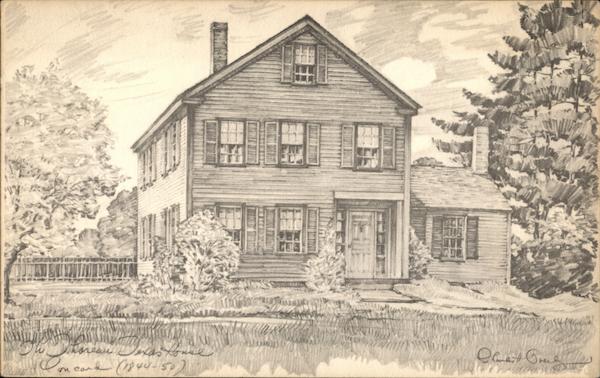
Gathered to-day my apples at the Texas house. I set out the trees, fourteen of them fourteen years ago and five of them several years later, and I now get between ten and eleven barrels of apples from them.

“Texas” House
(Thoreau Family Residence, 1844-1850)

H. D. Thoreau, Journal, October 3, 1860

See Vanessa Antiopa. See . April 17, 1860 (“It is unexpectedly very warm on lee side of hilltop just laid bare and covered with dry leaves and twigs. See my first Vanessa Antiopa”); October 1, 1860.(“C. saw the first Vanessa Antiopa since spring.”) See also A Book of the Seasons,  by Henry Thoreau, the Buff-edged Butterfly

The hard frost of September 28th, 29th, and 30th, and especially of October 1st. See October 1, 1860 ("Remarkable frost and ice this morning . . . I do not remember such cold at this season.").”); Compare October 3, 1856 (“The frost keeps off remarkably .” )

Sam Barrett says that last May he waded across the Assabet River on the old dam. See August 17, 1858 (“Being overtaken by a shower, we took refuge in the basement of Sam Barrett’s sawmill, where we spent an hour, and at length came home with a rainbow over arching the road before us”)

Bay-wings about. See April 15, 1859 (“The bay-wing now sings — the first I have been able to hear — . . . about the Texas house ”); October 9, 1858 (“Bay-wings flit along road.”); October 11, 1856 (“Bay-wing sparrows numerous.”); October 12, 1859 (“ I see scattered flocks of bay-wings amid the weeds and on the fences.”); October 16, 1855 ("I look at a grass-bird on a wall in the dry Great Fields. There is a dirty-white or cream-colored line above the eye and another from the angle of the mouth beneath it and a white ring close about the eye. The breast is streaked with this creamy white and dark brown in streams, as on the cover of a book.") See also A Book of the Seasons, by Henry Thoreau, the Bay-Wing Sparrow

I have seen and heard sparrows in flocks within a week. See September 17, 1858 (“Methinks, too, that there are more sparrows in flocks now about in garden”);  September 23, 1851 ("I scare up large flocks of sparrows in the garden.");September 26, 1858 (“Now is the time, too, when flocks of sparrows begin to scour over the weedy fields,”); September 27, 1858 ("What are those little birds in flocks in the garden and on the peach trees these mornings, about size of chip-birds, without distinct chestnut crowns?”); October 2, 1858 ("The garden is alive with migrating sparrows these mornings."); October 5, 1858 (“I still see large flocks, apparently of chip birds, on the weeds and ground in the yard.”); October 10, 1853 ("There are . . . large flocks of small sparrows,  which make a business of washing and pruning themselves in the puddles in the road, as if cleaning up after a long flight and the wind of yesterday.”)

October 3. See A Book of the Seasons, by Henry Thoreau,  October 3
See sparrows in flocks 
and have heard more flitting by 
since the frosts began.

A Book of the Seasons, by Henry Thoreau
"A book, each page written in its own season,
out-of-doors, in its own locality."
~edited, assembled and rewritten by zphx © 2009-2025
 

Friday, April 17, 2020

It invites us to walk in the yard and inspect the springing plants.


I hear this forenoon the soothing and simple, though monotonous, notes of the chip-bird, telling us better than our thermometers what degree of summer warmth is reached; adds its humble but very pleasant contribution to the steadily increasing quire of the spring. It perches on a cherry tree, perchance, near the house, and unseen, by its steady che-che-che-che-che che, affecting us often without our distinctly hearing it, it blends all the other and previous sounds of the season together. It invites us to walk in the yard and inspect the springing plants.

The evenings are very considerably shortened. We begin to be more out of doors, the less housed, think less, stir about more, are fuller of affairs and chores, come in chiefly to eat and to sleep.

The amelanchier flower-buds are conspicuously swollen.

Willows (Salix alba) probably (did not four or five days ago).

P. M. – Sail to Ball’s Hill.

It is quite warm — 67 at 2 P. M. — and hazy, though rather strong and gusty northwest wind.

We land at the Holt and walk a little inland. It is unexpectedly very warm on lee side of hilltop just laid bare and covered with dry leaves and twigs. See my first Vanessa Antiopa


Looking off on to the river meadow, I noticed, as I thought, a stout stake aslant in the meadow, three or more rods off, sharp at the top and rather light-colored on one side, as is often the case; yet, at the same time, it occurred to me that a stake-driver often resembled a stake very much, but I thought, nevertheless, that there was no doubt about this being a stake. I took out my glass to look for ducks, and my companion, seeing what I had, and asking if it was not a stake-driver, I suffered my glass at last to rest on it, and I was much surprised to find that it was a stake-driver after all. The bird stood in shallow water near a tussock, perfectly still, with its long bill pointed upwards in the same direction with its body and neck, so as perfectly to resemble a stake aslant. If the bill had made an angle with the neck it would have been betrayed at once.

Its resource evidently was to rely on its form and color and immobility solely for its concealment. This was its instinct, whether it implies any conscious artifice or not.

I watched it for fifteen minutes, and at length it relaxed its muscles and changed its attitude, and I observed a slight motion; and soon after, when I moved toward it, it flew. It resembled more a piece of a rail than anything else, — more than anything that would have been seen here before the white man came.

It is a question whether the bird consciously coöperates in each instance with its Maker, who contrived this concealment. I can never believe that this resemblance is a mere coincidence, not designed to answer this very end — which it does answer so perfectly and usefully.


The meadows are alive with purring frogs.

J. Brown says that he saw martins on his box on the 13th and 14th, and that his son saw one the 8th(?).

I notice now and of late holes recently dug, — woodchuck? or fox?

Lake grass was very long — a foot or two — and handsome, the 15th.

Heard a pigeon woodpecker on the 16th.

H. D. Thoreau, Journal, April 17, 1860


The soothing and simple, though monotonous, notes of the chip-bird, telling us better than our thermometers what degree of summer warmth is reached. See April 17, 1856 ("Hear a chip-bird high on an elm this morning,. . . You would not be apt to distinguish the note of the earliest."). See also  April 9, 1853 ("The chipping sparrow, with its ashy-white breast and white streak over eye and undivided chestnut crown, holds up its head and pours forth its che che che che che che.");   April 27, 1852  ("Heard also a chipping sparrow (F. socialis).") See also A Book of the Seasons,  by Henry Thoreau, The Chipping Sparrow (Fringilla socialis ).

The amelanchier flower-buds are conspicuously swollen. See April 13, 1856  ("Also the amelanchier flower-buds are bursting."); April 18, 1855 ("The shad-bush flower-buds, beginning to expand, look like leaf-buds bursting now.")

Willows (Salix alba) probably. See April 29, 1855 ("For two or three days the Salix alba, with its catkins (not yet open) and its young leaves, or bracts (?), has made quite a show, before any other tree, —a pyramid of tender yellowish green in the russet landscape.")


It is unexpectedly very warm on lee side of hilltop just laid bare and covered with dry leaves and twigs. See my first Vanessa Antiopa. See March 21, 1853 ("On the warm, dry cliff, looking south over Beaver Pond, I am surprised to see a large butterfly, black with buff-edged wings, so tender a creature to be out so early ."); March 28, 1857 ("The broad buff edge of the Vanessa Antiopa's wings harmonizes with the russet ground it flutters over,");   April 9, 1853 ("You see the buff-edged . . . in warm, sunny southern exposures on the edge of woods or sides of rocky hills and cliffs, above dry leaves and twigs."); April 16, 1855 ("A great many of the large buff-edged are fluttering over the leaves in wood-paths this warm afternoon."). See also A Book of the Seasons,  by Henry Thoreau, the Buff-edged Butterfly


It was a stake-driver after all.
See October 26, 1858 ("[Minott] says that some call the stake-driver “'belcher squelcher,” and some, “wollerkertoot. ” I used to call them “pump-er-gor’. ” Some say “slug-toot.”) See also A Book of the Seasons, by Henry Thoreau, American Bittern (the Stake-Diver)

It is a question whether the bird consciously coöperates in each instance with its Maker, who contrived this concealment. See February 19, 1854 (''Each and all such disguises and other resources remind us that not some poor worm's instinct merely, as we call it, but the mind of the universe rather, which we share, has been intended upon each particular object. All the wit in the world was brought to bear on each case to secure its end. ")


The meadows are alive with purring frogs. See  April 17, 1855 ("To-day I see a Rana palustris — I think the first."  Rana palustris. Pickerel frog (Lithobates palustris) See also April 11, 1854 ("Hear a slight snoring of frogs on the bared meadows. Is it not the R. palustris? This the first moon to walk by.”)April 30, 1858 ('It is some what more softly purring, with frequently a low quivering, chuckling, or inquisitive croak, . . . I suspect it is the R. palustris, now breeding."); May 2, 1859  ("I heard yesterday, and perhaps for several days, the soft purring sound of what I take to be the Rana palustris, breeding, though I did not this time see the frog."); May 3, 1857 ("I hear the soft, purring, stertorous croak of frogs on the meadow. "); May 8. 1857 ("It is an evening for the soft-snoring, purring frogs (which I suspect to be Rana palustris). . . . Their croak is very fine or rapid, and has a soft, purring sound at a little distance."); May 8, 1857 ("The full moon rises, and I paddle by its light. It is an evening for the soft-snoring, purring frogs "); June 16, 1860 ("It appears to me that these phenomena occur simultaneously, say June 12th, viz.: -• Heat about. 85° at 2 P.M.• Hylodes cease to peep.• Purring frogs (Rana palustris) cease.")

J. Brown says that he saw martins on his box on the 13th and 14th, and that his son saw one the 8th(?). See April 17, 1854 ("Every shopkeeper makes a record of the arrival of the first martin or bluebird to his box. . . .: John Brown, merchant, tells me this morning that the martins first came to his box on the 13th, he "made a minute of it." Beside so many entries in their day-books and ledgers, they record these things")

I notice now and of late holes recently dug. See April 17, 1855 ("See a woodchuck. His deep reddish-brown rear, somewhat grizzled about, looked like a ripe fruit mellowed by winter. . . .They have several holes under Lee’s Cliff.")")

Heard a pigeon woodpecker on the 16th. Compare March 17, 1858 ("Ah! there is the note of the first flicker, a prolonged, monotonous wick-wick-wick-wick-wick-wick, etc.,); April 8, 1855 ("Hear and see a pigeon woodpecker, something like week-up week-up."); April 12. 1860 ("Hear a pigeon woodpecker' s prolonged cackle."); April 14, 1856 ("Hear the flicker’s cackle on the old aspen, and his tapping sounds afar over the water.") See also A Book of the Seasons, by Henry Thoreau, The Pigeon Woodpecker (flicker).


Sunday, April 1, 2018

The river is at summer level

April 1
April 1, 2018

White-bellied swallows. 

P. M. — Paddle up Assabet. 

The river is at summer level; has not been up this spring, and has fallen to this. The lowermost willow at my boat is bare. 

The white maples are abundantly out to-day. Probably the very first bloomed on the 29th. We hold the boat beneath one, surprised to hear the resounding hum of honey-bees, which are busy about them. It reminds me of the bass and its bees. The trees are conspicuous with dense clusters of light colored stamens. 

The alders above the Hemlocks do not yet shed pollen. 

What I called yellow wasps, which built over my window last year, have come, and are about the old nest; numbers have settled on it.

I observed night before last, as often before, when geese were passing over in the twilight quite near, though the whole heavens were still light and I knew which way to look by the honking, I could not distinguish them. It takes but a little obscurity to hide a. bird in the air. How difficult, even in broadest daylight, to discover again a hawk at a distance in the sky when you have once turned your eyes away! 

Pleasant it is to see again the red bark of the Cornus sericea shining in the warm sun at the hill swamp, above the spring. 

Walking through the maple there, I see a squirrel's nest twenty-three or twenty-four feet high in a large maple, and, climbing to it, —for it was so peculiar, having a basketwork of twigs about it, that I did not know but it was a hawk's nest, — I found that it was a very perfect (probably) red squirrel's nest, made entirely of the now very dark or blackish green moss such as grows on the button-bush and on the swampy ground, – a dense mass of it about one foot through, matted together, — with an inobvious hole on the east side and a tuft of loose moss blowing up above it, which seemed to answer for a door or porch covering. The cavity within was quite small, but very snug and warm, where one or two squirrels might lie warmly in the severest storm, the dense moss walls being about three inches thick or more. But what was most peculiar was that this nest, though placed over the centre of the tree, where it divided into four or five branches, was regularly and elaborately hedged about and supported by a basketwork of strong twigs stretched across from bough to bough, which twigs I perceived had been gnawed green from the maple itself, the stub ends remaining visible all around. Near by I saw another much smaller and less per fect nest of the same kind, which had fallen to the ground. This had been made in a birch, and the birch twigs had been gnawed off, but in this case I noticed a little fine broken grass within it, mixed with the moss. 

I notice large water-bugs. 

It is remarkable that the river seems rarely to rise or fall gradually, but rather by fits and starts, and hence the water-lines, as indicated now by the sawdust, are very distinct parallel lines four or five or more inches apart. It is true the wind has something to do with it, and might waft to a certain place much more dust than was left on another where the water stood much longer at the same level. 

Surely the saw-miller’s is a trade which cannot be carried on in secret. Not only this sawdust betrays him, but at night, especially, when the water is high, I hear the tearing sound of his saw a mile or more off, borne down the stream. 

I see six Sternothaerus odoratus in the river thus early. Two are fairly out sunning. One has crawled up a willow. It is evident, then, that they may be earlier in other places or towns than I had supposed, where they are not concealed by such freshets as we have. I took up and smelt of five of these, and they emitted none of their peculiar scent! It would seem, then, that this may be connected with their breeding, or at least with their period of greatest activity. They are quite sluggish now. 

At Hemlock Brook, a dozen or more rods from the river, I see on the wet mud a little snapping turtle evidently hatched last year. It does not open its eyes nor mouth while I hold it. Its eyes appear as if sealed up by its long sleep. In our ability to contend with the elements what feeble infants we are to this one. Talk of great heads, look at this one! Talk of Hercules’ feats in the cradle, what sort of cradle and nursing has this infant had? It totters forth confident and victorious when it can hardly carry its shield. It looked so much like the mud or a wet muddy leaf, it was a wonder I saw it.

I start, under the hemlocks there, a butterfly (call it the tawny-orange single-white-spotted) about the size of Vanessa Antiopa, tawny-orange, with black spots or eyes, and pale-brown about them, a white spot near the corner of each front wing, a dark line near the edge behind, a small sharp projecting angle to the hind wings, a green-yellow back to body.

See wood turtles coupled on their edges at the bottom, where the stream has turned them up. 

Far up in still shallows, disturb pickerel and perch, etc. They apparently touch the muddy bottom as they dart out, muddying the water here and there. 

A Rana halecina on the bank. 

When I started to walk that suddenly pleasant after noon, the 28th of March, I crossed the path of the two brothers R., who were walking direct to the depot as if they had special business there that Sunday, the queer short-legged dog running ahead. I talked with them an hour there in the hope that the one who is not a stranger to me would let something escape from his wise head. But he was very moderate; all I got out of him to be remembered was that in some town up-country where he lived when young, they called the woodchuck -“squash-belly,”—with reference to his form I suggested, but so far he had not advanced. This he communicated very seriously, as an important piece of information with which he labored. The other told me how to raise a dog's dander, — any the gentlest dog's, — by looking sternly in his face and making a peculiar sound with your mouth. I then broke short the conference, continued my walk, while these gentlemen wheeled directly about and walked straight back again. 

It is evident that the date of the first general revival of the turtles, excepting such as are generally seen in ditches, i. e. the yellow-spotted, depends on the state of the river, whether it is high or low in the spring.

H. D. Thoreau, Journal, April 1, 1858

The white maples are abundantly out to-day. Probably the very first bloomed on the 29th. See A Book of the Seasons by Henry Thoreau, White Maple Buds and Flowers
Yellow wasps, which built over my window last year. See June 28, 1857 ("under the peak of our roof, just over my chamber windows.”)

I knew which way to look by the honking but could not distinguish them.See April 8, 1855 (This evening, about 9 P.M., I hear geese go over, now there in the south, now southeast, now east, now northeast, low over the village, but not seen. The first I have heard. )

Pleasant it is to see again the red bark of the Cornus sericea shining in the warm sun at the hill swamp, above the spring. See January 4, 1858 (“The Cornus sericea and some quite young willow shoots are the red-barked twigs so conspicuous now along the riversides”)

I see six Sternothaerus odoratus in the river thus early. Two are fairly out sunning. One has crawled up a willow. . . . They are quite sluggish now. See July 3, 1856 ("They appear much more sluggish than the other kinds now, though they were active enough in the spring.") See also A Book of the Seasons, by Henry Thoreau, the Musk Turtle (Sternothaerus odoratus )

I see on the wet mud a little snapping turtle evidently hatched last year. See August 26, 1854 (“Open one of my snapping turtle's eggs. Its eyes are open. It puts out its head, stretches forth its claws, and liberates its tail. With its great head it has already the ugliness of the full-grown, and is already a hieroglyphic of snappishness.”)


We are heading to the view  with empty backpacks to collect stuff that is accumulated over the years. Stepping out of the gate she spots a phoebe on the top of our roof. It flys away and does not sing. First phoebe April . Most of the snow is off the trails especially those that are now running like brooks. But also the new trail straight up to the view. Running water everywhere sparkling in the sun. Noisy too. A raven croaks and flies across the clearing. Yesterday it was a couple of dozen turkeys.  The day is blustery strong winds at the view so that we try to find a warmer spot. The sun is in and out of clouds and we see probable snow clouds dipping over the lake with blue sky above. In fact that is how the day starts with a brief pellet snow flurry and sun in the a yard with the first phoebe on the roof.

A brief pellet snow 
with sun in the yard and a 
phoebe on the roof.

20180401 zphx

Wednesday, March 28, 2018

When one kind of life goes, another comes. The same warm and placid day calls out men and butterflies.

March 28
P. M. — To Cliffs.

After a cloudy morning, a warm and pleasant afternoon. I hear that a few geese were seen this morning.

Israel Rice says that he heard two brown thrashers sing this morning! Is sure because he has kept the bird in a cage. I can’t believe it.

I go down the railroad, turning off in the cut. I notice the hazel stigmas in the warm hollow on the right there, just beginning to peep forth. This is an unobserved but very pretty and interesting evidence of the progress of the season. I should not have noticed it if I had not carefully examined the fertile buds. It is like a crimson star first dimly detected in the twilight. The warmth of the day, in this sunny hollow above the withered sedge, has caused the stigmas to show their lips through their scaly shield. They do not project more than the thirtieth of an inch, some not the sixtieth. The staminate catkins are also considerably loosened. Just as the turtles put forth their heads, so these put forth their stigmas in the spring. How many accurate thermometers there are on every hill and in every valley: Measure the length of the hazel stigmas, and you can tell how much warmth there has been this spring. How fitly and exactly any season of the year may be described by indicating the condition of some flower! 

I go by the springs toward the epigaea. 

It is a fine warm day with a slight haziness. It is pleasant to sit outdoors now, and, it being Sunday, neighbors walk about or stand talking in the sun, looking at and scratching the dry earth, which they are glad to see and smell again. 

In the sunny epigaea wood I start up two Vanessa Antiopa, which flutter about over the dry leaves be fore, and are evidently attracted toward me, settling at last within a few feet. The same warm and placid day calls out men and butterflies. 

It is surprising that men can be divided into those who lead an indoor and those who lead an outdoor life, as if birds and quadrupeds were to be divided into those that lived a within nest or burrow life and [those] that lived without their nests and holes chiefly. How many of our troubles are house-bred! He lives an out door life; i.e., he is not squatted behind the shield of a door, he does not keep himself tubbed. It is such a questionable phrase as an “honest man,” or the “naked eye,” as if the eye which is not covered with a spy glass should properly be called naked.

From Wheeler's plowed field on the top of Fair Haven Hill, I look toward Fair Haven Pond, now quite smooth. There is not a duck nor a gull to be seen on it. I can hardly believe that it was so alive with them yesterday. Apparently they improve this warm and pleasant day, with little or no wind, to continue their journey northward. The strong and cold northwest wind of about a week past has probably detained them. Knowing that the meadows and ponds were swarming with ducks yesterday, you go forth this particularly pleasant and still day to see them at your leisure, but find that they are all gone. No doubt there are some left, and many more will soon come with the April rains. It is a wild life that is associated with stormy and blustering weather. When the invalid comes forth on his cane, and misses improve the pleasant air to look for signs of vegetation, that wild life has withdrawn itself. 

But when one kind of life goes, another comes. This plowed land on the top of the hill — and all other fields as far as I observe — is covered with cobwebs, which every few inches are stretched from root to root or clod to clod, gleaming and waving in the sun, the light flashing along them as they wave in the wind. How much insect life and activity connected with this peculiar state of the atmosphere these imply! Yet I do not notice a spider. Small cottony films are continually settling down or blown along through the air. [A gossamer day. I see them also for a week after.] Does not this gossamer answer to that of the fall? They must have sprung to with one consent last night or this morning and bent new cables to the clods and stubble all over this part of the world. 

The little fuzzy gnats, too, are in swarms in the air, peopling that uncrowded space. They are not confined by any fence. Already the distant forest is streaked with lines of thicker and whiter haze over the successive valleys. 

Walden is open. When? On the 20th it was pretty solid. C. sees a very little ice in it to-day, but probably it gets entirely free to-night.

Fair Haven Pond is open.

[This and Flint's and Walden all open together this year, the latter was so thinly frozen! (For C. says Flint's and Walden were each a third open on the 25th.)]

Sitting on the top of the Cliffs, I look through my glass at the smooth river and see the long forked ripple made by a musquash swimming along over the  meadow. While I sit on these warm rocks, turning my glass toward the mountains, I can see the sun reflected from the rocks on Monadnock, and I know that it would be pleasant to be there too to-day as well as here. I see, too, warm and cosy seats on the rocks, where the flies are buzzing, and probably some walker is enjoying the prospect. 

From this hilltop I overlook, again bare of snow, putting on a warm, hazy spring face, this seemingly concave circle of earth, in the midst of which I was born and dwell, which in the northwest and southeast has a more distant blue rim to it, as it were of more costly manufacture. On ascending the hill next his home, every man finds that he dwells in a shallow concavity whose sheltering walls are the convex surface of the earth, beyond which he cannot see. I see those familiar features, that large type, with which all my life is associated, unchanged. 

Cleaning out the spring on the west side of Fair Haven Hill, I find a small frog, apparently a bullfrog, just come forth, which must have wintered in the mud there. There is very little mud, however, and the rill never runs more than four or five rods before it is soaked up, and the whole spring often dries up in the summer. It seems, then, that two or three frogs, the sole inhabitants of so small a spring, will bury them selves at its head. A few frogs will be buried at the puniest spring-head. 

Coming home, I hear the croaking frogs in the pool on the south side of Hubbard’s Grove. It is sufficiently warm for them at last. 

Near the sand path above Potter's mud-hole I find what I should call twenty and more mud turtles’ eggs close together, which appear to have been dug from a hole close by last year. They are all broken or cracked and more or less indented and depressed, and they look remarkably like my pigeon's egg fungi, a dirty white covered thickly with a pure white roughness, which through a glass is seen to be oftenest in the form of minute but regular rosettes of a very pure white substance. If these are turtles' eggs, –and there is no stem mark of a fungus, – it is remarkable that they should thus come to resemble so closely another natural product, the fungus.

The first lark of the 23d sailed through the meadow with that peculiar prolonged chipping or twittering sound, perhaps sharp clucking.

H. D. Thoreau, Journal, March 28, 1858

I start up two Vanessa Antiopa, which flutter about over the dry leaves before, and are evidently attracted toward me, settling at last within a few feet. See March 28, 1857 ("The broad buff edge of the Vanessa Antiopa’s wings harmonizes with the russet ground it flutters over, and as it stands concealed in the winter, with its wings folded above its back, in a cleft in the rocks, the gray brown under side of its wings prevents its being distinguished from the rocks themselves.") See also A Book of the Seasons,  by Henry Thoreau, the Buff-edged Butterfly

Coming home, I hear the croaking frogs in the pool on the south side of Hubbard’s Grove. It is sufficiently warm for them at last. See March 26, 1860 ("The wood frog may be heard March 15, as this year, or not till April 13, as in’56, — twenty-nine days."); March 15, 1860 ("Am surprised to hear, from the pool behind Lee's Cliff, the croaking of the wood frog. . . . How suddenly they awake! yesterday, as it were, asleep and dormant, to-day as lively as ever they are. The awakening of the leafy woodland pools.."); March 23, 1859 ("I hear a single croak from a wood frog. . . . Thus we sit on that rock, hear the first wood frog's croak"); March 24, 1859 (" Can you ever be sure that you have heard the very first wood frog in the township croak? "); March 26, 1857 ("As I go through the woods by Andromeda Ponds, though it is rather cool and windy in exposed places, I hear a faint, stertorous croak from a frog in the open swamp; at first one faint note only, which I could not be sure that I had heard, but, after listening long, one or two more suddenly croaked in confirmation of my faith, and all was silent again"); March 27, 1853 ("Tried to see the faint-croaking frogs at J. P. Brown's Pond in the woods. They are remarkably timid and shy; had their noses and eyes out, croaking, but all ceased, dove, and concealed themselves, before I got within a rod of the shore."); March 30, 1858 ("Later, in a pool behind Lee's Cliff, I hear them, – the waking up of the leafy pools. . . . I do not remember that I ever hear this frog in the river or ponds. They seem to be an early frog, peculiar to pools and small ponds in the woods and fields.")

Monday, November 1, 2010

To Tommy Wheeler wood-lot.

November 1

A perfect Indian-summer day, and wonderfully warm. 72+ at 1 P. M. and probably warmer at two.

The butterflies are out again, - probably some new broods. I see the common yellow and two Vanessa Antiopa, and yellow-winged grasshoppers with blackish edges.

A striped snake basks in the sun amid dry leaves.

Gossamer on the withered grass is shimmering in the fields, and flocks of it are sailing in the air.

Measure some pine stumps on Tommy Wheeler's land, about that now frosty hollow, cut as I judge from sprouts four years ago.  No. 6, having 164 rings and having been cut four years, sprang up at least one hundred and sixty-eight years ago, or about the year 1692, or fifty-seven years after the settlement, 1635. 


H. D. Thoreau, Journal, November 1, 1860 

A perfect Indian-summer day, and wonderfully warm. 72+ at 1 P. M.
See November 1, 2015 ("A beautiful Indian-summer day, the most remarkable hitherto and equal to any of the kind. ")

Gossamer on the withered grass is shimmering in the fields, and flocks of it are sailing in the air. See November 1, 1851 ("It is a remarkable day for fine gossamer cobwebs. Here in the causeway, as I walk toward the sun, I perceive that the air is full of them streaming from off the willows and spanning the road, all stretching across the road, and yet I cannot see them in any other direction, and feel not one. . . .Why should this day be so distinguished?"); See also November 7, 1855 ("Looking west over Wheeler’s meadow, I see that there has been much gossamer on the grass, and it is now revealed by the dewy mist which has collected on it.”) and note to November 3, 1857 ("Looking westward now, at 4 P.M., I see against the sunlight, where the twigs of a maple and black birch intermingle, a little gossamer or fine cobwebs, but much more the twigs, especially of the birch, waving slightly, reflect the light like cobwebs. It is a phenomenon peculiar to this season, when the twigs are bare and the air is clear. I cannot easily tell what is cobweb and what twig,")  See also A Book of the Seasons, by Henry Thoreau, Gossamer Days

Measure some pine stumps on Tommy Wheeler's land cut four years ago. SeeJuly 8, 1857 (“Counted the rings of a white pine stump, sawed off last winter at Laurel Glen. It was three and a half feet diameter and has one hundred and twenty-six rings.”); See also October 20, 1860 ("I examine Ebby Hubbard's old oak and pine wood. The trees may be a hundred years old.”)

Popular Posts Last 30 Days.

The week ahead in Henry’s journal

The week ahead in Henry’s journal
A journal, a book that shall contain a record of all your joy.
"A stone fruit. Each one yields me a thought." ~ H. D. Thoreau, March 28, 1859


I sit on this rock
wrestling with the melody
that possesses me.