Showing posts with label grebe. Show all posts

Thursday, June 21, 2018

In the Natural History Rooms talking of the myrtle-bird.

June 21
June 21, 2018
Vide at Cambridge, apparently in prime, Silene inflata; also, in a rich grass-field on Sacramento Street, what may be Turritis glabra (?), also in prime, the last three or four feet high. Both pressed. 

Talked with Mr. Bryant at the Natural History Rooms. He agrees with Kneeland in thinking that what I call the myrtle-bird’s is the white-throat sparrow’s note. Bryant killed one Down East in summer of ’56. He has lived the last fifteen years at Cohasset, and also knows the birds of Cambridge, but talks of several birds as rare which are common in Concord, such as the stake-driver, marsh hawk (have neither of their eggs in the collection), Savannah sparrow, the passerina much rarer, and I think purple finch, etc. Never heard the tea-lee note of myrtle-bird ( ?) in this State. 

Their large hawk is the red-shouldered, not hen-hawk. 

He thinks that the sheldrake of the Maine lakes is the merganser, the serrator belonging rather to the sea coast. 

Of the two little dippers or grebes, he thought the white-breasted one would be the commonest, which has also a slender bill, while the other has a brownish breast and a much thicker bill. 

The egg of the Turdus solitarius in the collection is longer, but marked very much like the tanager’s, only paler-brown. They have also the egg of the T. brunneus, the other hermit thrush, not common here.

H. D. Thoreau, Journal, June 21, 1858

Mr. Bryant at the Natural History Rooms agrees with Kneeland in thinking that what I call the myrtle-bird’s is the white-throat sparrow’s note. See January 15, 1858 ("At Natural History Rooms, Boston. . . . Talked with Dr. Kneeland. . . . Speaking to him of my night warbler, he asked if it uttered such a note, making the note of the myrtle-bird, ah, te-te-te te-te-te te-te-te, exactly, and said that that was the note of the white throated sparrow, which he heard at Lake Superior, at night as well as by day.”)

The egg of the Turdus solitarius in the collection. See June 12, 1857 (“The egg of the Turdus solitarius is lettered "Swamp Robin."”)

Tuesday, March 27, 2018

Having crawled over the hill through the woods on our stomachs we watch various water-fowl for an hour. .

March 27. 

P. M. — Sail to Bittern Cliff. 

Scare up a flock of sheldrakes just off Fair Haven Hill, the conspicuous white ducks, sailing straight hither and thither. At first they fly low up the stream, but, having risen, come back half-way to us, then wheel and go up-stream. 

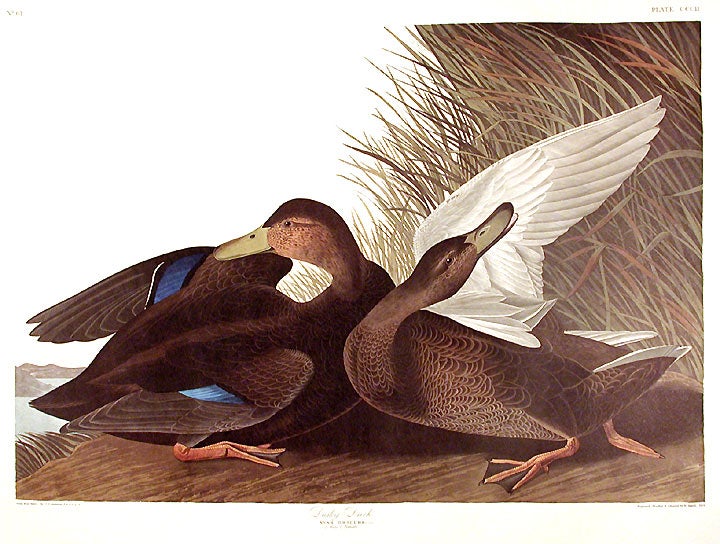
Soon after we scare up a flock of black ducks. 

J.J. Audubon (The flight of this Duck, which, in as far as I know, is peculiar to America, is powerful, rapid, and as sustained as that of the Mallard. While travelling by day they may be distinguished from that species by the whiteness of their lower wing-coverts, which form a strong contrast to the deep tints of the rest of their plumage See  A Book of the Seasons,  by Henry Thoreau, the American Black Duck)

We land and steal over the hill through the woods, expecting to find them under Lee's Cliff, as indeed we do, having crawled over the hill through the woods on our stomachs; and there we watched various water-fowl for an hour.

There are a dozen sheldrakes (or goosanders) and among them four or five females. They are now pairing. I should say one or two pairs are made. At first we see only a male and female quite on the alert, some way out on the pond, tacking back and forth and looking every way. They keep close together, headed one way, and when one turns the other also turns quickly. The male appears to take the lead. Soon the rest appear, sailing out from the shore into sight. 

We hear a squeaking note, as if made by a pump, and presently see four or five great herring gulls wheeling about. Sometimes they make a sound like the scream of a hen-hawk. They are shaped somewhat like a very thick white rolling-pin, sharpened at both ends. At length they alight near the ducks. 

The sheldrakes at length acquire confidence, come close inshore and go to preening themselves, or it may be they are troubled with lice. They are all busy about it at once, continually thrusting their bills into their backs, still sailing slowly along back and forth offshore. Sometimes they are in two or three straight lines. Now they will all seem to be crossing the pond, but presently you see that they have tacked and are all heading this way again. 

Among them, or near by, I at length detect three or four whistlers, by their wanting the red bill, being considerably smaller and less white, having a white spot on the head, a black back, and altogether less white, and also keeping more or less apart and not diving when the rest do. 

Now one half the sheldrakes sail off southward and suddenly go to diving as with one consent. Seven or eight or the whole of the party will be under water and lost at once. In the mean while, coming up, they chase one another, scooting over the surface and making the water fly, sometimes three or four making a rush toward one. 

At length I detect two little dippers, as I have called them, though I am not sure that I have ever seen the male before. They are male and female close together, the common size of what I have called the little dipper. They are incessantly diving close to the button-bushes.

 [Rice says that the little dipper has a hen bill and is not lobe footed. He and his brother Israel also speak of another water-fowl of the river with a hen bill and some bluish feathers on the wings.]

The female is apparently uniformly black, or rather dark brown, but the male has a conspicuous crest, with, apparently, white on the hindhead, a white breast, and white line on the lower side of the neck; i. e., the head and breast are black and white conspicuously. 


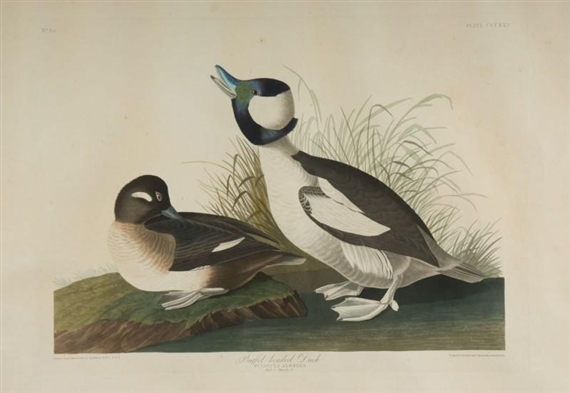
J J Audubon Fuligula albeola Buffle-headed Duck:" The bufflehead, being known in different districts by the names of Spirit Duck, Butter-box, Marrionette, Dipper, and Die-dipper, generally returns from the far north, where it is said to breed, about the beginning of September."
Can this be the Fuligula albeola, and have I commonly seen only the female? Or is it a grebe?

Fair Haven Pond four fifths clear. 

C. saw a phoebe, i e. pewee, the 25th. - 

The sheldrake has a peculiar long clipper look, often moving rapidly straight forward over the water. It sinks to very various depths in the water sometimes, as when apparently alarmed, showing only its head and neck and the upper part of its back, and at others, when at ease, floating buoyantly on the surface, as if it had taken in more air, showing all its white breast and the white along its sides. Sometimes it lifts itself up on the surface and flaps its wings, revealing its whole rosaceous breast and its lower parts, and looking in form like a penguin. 

When I first saw them fly up-stream I suspected that they had gone to Fair Haven Pond and would alight under the lee of the Cliff. So, creeping slowly down through the woods four or five rods, I was enabled to get a fair sight of them, and finally we sat exposed on the rocks within twenty five rods. They appear not to observe a person so high above them. 

It was a pretty sight to see a pair of them tacking about, always within a foot or two of each other and heading the same way, now on this short tack, now on that, the male taking the lead, sinking deep and looking every way. When the whole twelve had come together they would soon break up again, and were continually changing their ground, though not diving, now sailing slowly this way a dozen rods, and now that, and now coming in near the shore. Then they would all go to preening themselves, thrusting their bills into their backs and keeping up such a brisk motion that you could not get a fair sight of one’s head.

From time to time you heard a slight titter, not of alarm, but perhaps a breeding-note, for they were evidently selecting their mates. I saw one scratch its ear or head with its foot. 

Then it was surprising to see how, briskly sailing off one side, they went to diving, as if they had suddenly come across a school of minnows. A whole company would disappear at once, never rising high as before. Now for nearly a minute there is not a feather to be seen, and the next minute you see a party of half a dozen there, chasing one another and making the water fly far and wide.

When returning, we saw, near the outlet of the pond, seven or eight sheldrakes standing still in a line on the edge of the ice, and others swimming close by. They evidently love to stand on the ice for a change.

I saw on the 22d a sucker which apparently had been dead a week or two at least. Therefore they must begin to die late in the winter.

H. D. Thoreau, Journal, March 27,1858


Sheldrakes. See March 22, 1858 ("I see two of these very far off on a bright-blue bay where the waves are running high. They are two intensely white specks, which yet you might mistake for the foaming crest of waves. Now one disappears, but soon is seen again, and then its companion is lost in like manner, having dived."); March 5, 1857 ("I scare up six male sheldrakes, with their black heads, in the Assabet,—the first ducks I have seen"); March 16, 1855 ("Scare up two large ducks . . . I think it the goosander or sheldrake."); March 16, 1854 ("I see ducks afar, sailing on the meadow, leaving a long furrow in the water behind them.”) See also A Book of the Seasons, by Henry Thoreau, The Sheldrake (Merganser, Goosander)

Can this be the Fuligula albeola, and have I commonly seen only the female? Or is it a grebe? See January 15, 1858 ("At Natural History Rooms, Boston. Looked at the little grebe. Its feet are not webbed with lobes on the side like the coot, and it is quite white beneath."); December 26, 1857 ("The little dipper must, therefore, be different from a coot. Is it not a grebe?); April 19, 1855 ("A little duck, asleep with its head in its back, exactly in the middle of the pond. It has a moderate-sized black head and neck, a white breast, and seems dark-brown above, with a white spot on the side of the head, not reaching to the out side, from base of mandibles, and another, perhaps, on the end of the wing, with some black there. . . .I think it is the smallest duck I ever saw. Floating buoyantly asleep on the middle of Walden Pond. Is it not a female of the buffle-headed or spirit duck?"); December 26, 1853 ("Saw in it a small diver, probably a grebe or dobchick, dipper, or what-not, with the markings, as far as I saw, of the crested grebe, but smaller. It had a black head, a white ring about its neck, a white breast, black back, and apparently no tail.”); September 27, 1860 (" I see a little dipper in the middle of the river.. . .It has a dark bill and considerable white on the sides of the head or neck, with black between it, no tufts, and no observable white on back or tail.");April 22, 1861 (" [Mann] obtained to-day the buffle-headed duck, diving in the river near the Nine-Acre Corner bridge. I identify it at sight as my bird seen on Walden. ")  See also A Book of the Seasons, by Henry Thoreau, The Little Dipper

They must begin to die late in the winter. See note to March 28, 1857 ("Every spring there are many dead suckers floating belly upward on the meadows. This phenomenon of dead suckers is as constant as the phenomenon of living ones; nay, as a phenomenon it is far more apparent.")

Monday, January 15, 2018

At Natural History Rooms, Boston.

January 15.


January 15, 2018

At Natural History Rooms, Boston. 

Looked at the little grebe. Its feet are not webbed with lobes on the side like the coot, and it is quite white beneath. 

Saw the good-sized duck—velvet duck, with white spot on wing — which is commonly called “coot” on salt water. 

They have a living young bald eagle in the cellar. 

Talked with Dr. Kneeland. They have a golden eagle from Lexington, which K. obtained two or three years since, the first Dr. Cabot has heard of in Massachusetts. 

Speaking to him of my night warbler, he asked if it uttered such a note, making the note of the myrtle-bird, ah, te-te-te te-te-te te-te-te, exactly, and said that that was the note of the white throated sparrow, which he heard at Lake Superior, at night as well as by day. Vide his report, July 15, 1857. 

Same afternoon, saw Dr. Durkee in Howard Street. He has not seen the common glow-worm, and called his a variety of Lampyris noctiluca. Showed to Agassiz, Gould, and Jackson, and it was new to them. They thought it a variety of the above. His were luminous throughout, mine only in part of each segment. 

Saw some beautiful painted leaves in a shop window, - maple and oak.

H. D. Thoreau, Journal, January 15, 1858

Looked at the little grebe. Its feet are not webbed with lobes on the side like the coot, and it is quite white beneath. See note to December 26, 1857 ("The little dipper must, therefore, be different from a coot. Is it not a grebe?”) Also November 27, 1857 (“Mr. Wesson . . . appears not to know a coot, and did not recognize the lobed feet when I drew them.”); April 24, 1856 (“Goodwin shot, about 6 P. M., and brought to me a cinereous coot . . .Lobes chiefly on the inner side of the toes.”); June 17, 1856 (“Went to Rev. Horace James’s reptiles (Orthodox). He had, set up, . . .a large lobe-footed bird which I think must have been a large grebe, killed in Fitchburg. ”);  December 26, 1853 ("Saw in it a small diver, probably a grebe or dobchick, dipper, or what-not, with the markings, as far as I saw, of the crested grebe, but smaller. It had a black head, a white ring about its neck, a white breast, black back, and apparently no tail.”)


Speaking to him of my night warbler.
According to Emerson,  the night warbler is "a bird he had never identified, had been in search of twelve years, which always, when he saw it, was in the act of diving down into a tree or bush.” See May 9, 1852 “Heard the night warbler.”); May 9, 1853 ("Again I think I heard the night-warbler.”); May 10, 1854("Heard the night-warbler. “); May 28, 1854 ("The night-warbler, after his strain, drops down almost perpendicularly into a tree-top and is lost.”); May 19, 1858 ("Heard the night-warbler begin his strain just like an oven-bird! I have noticed that when it drops down into the woods it darts suddenly one side to a perch when low.” See also May 12, 1855 (“We sit about half an hour, and it is surprising what various distinct sounds we hear there deep in the wood, as if the aisles of the wood were so many ear trumpets,-- the cawing of crows, the peeping of hylas in the swamp and perhaps the croaking of a tree-toad, the oven-bird, the yorrick of Wilson’s thrush, a distant stake-driver, the night-warbler and black and white creeper, the lowing of cows, the late supper horn, the voices of boys, the singing of girls, -- not all together but separately, distinctly, and musically, from where the partridge and the red-tailed hawk and the screech owl sit on their nests.”)

His glowworms were luminous throughout, mine only in part of each segment. See September 16, 1857 (“Watson gave me three glow-worms which he found by the roadside in Lincoln last night. They exhibit a greenish light, only under the caudal extremity, and intermittingly, or at will. As often as I touch one in a dark morning, it stretches and shows its light for a moment, only under the last segment.”) Also August 8, 1857 (“B. M. Watson sent me from Plymouth, July 20th, six glow-worms, . . . Knapp, in “Journal of a Naturalist,” speaks of “the luminous caudal spot” of the Lampyris noctiluca")

Tuesday, December 26, 2017

First snow of any consequence.

December 26. 

Snows all day, — first snow of any consequence, three or four inches in all. 


At the double-chair December 26, 2017
Humphrey Buttrick tells me that he has shot little dippers. He also saw the bird which Melvin shot last summer (a coot), but he never saw one of them before. The little dipper must, therefore, be different from a coot. Is it not a grebe?

H. D. Thoreau, Journal, December 26, 1857

Snows all day, — first snow of any consequence, three or four inches in all. See December 26, 1853 ("The first snow of any consequence thus far. It is about three inches deep.”) See also note to November 29, 1856 ("This is the first snow.”)

The little dipper must be different from a coot. Is it not a grebe?  See November 27, 1857 ("Mr. Wesson says . . .that the little dipper is not a coot. . - but he appears not to know a coot”); April 24, 1856 ("Goodwin shot, about 6 P. M., and brought to me a cinereous coot (Fulica Americana) . . .”) See also December 26, 1853  ("Saw in [Walden] a small diver, probably a grebe or dobchick, dipper, or what-not, ... It had a black head, a white ring about its neck, a white breast, black back, and apparently no tail.”)

***

The day after Christmas in the late afternoon we walk to the double-chair via the view, stopping there only briefly because of the strong northwest wind and cold.

Near the junction we hear a raven, turn and see it fly overhead. On the walk we also hear chickadees and downy or hairy woodpecker
Deep in winter woods
we turn to see the raven
soaring overhead.

At the view low clouds are illuminated by the westering sun–- brighter than the landscape below.

I  bushwhack up the mountain  and come across an area that has been trampled down by deer. There are deer bed is all around and she is calling me from above with the same news. As we hike up there are dozens and dozens of deer beds —More than I’ve ever seen in one place.

I use their tracks to find the easiest way up.

When we get to the double-chair, clear the chairs of ice and sit -- there is the first quarter moon in a clear sky. It is 16°.

As we come down the mountain trail, cross the ice on  middle pond and skid  down over the cliff trail, I am thinking what a gift to have this land and these walks together all these years.


What a gift to have 
this land our dogs and these walks--
these years together.

zphz 20171226

Friday, June 17, 2016

The cedar swamp, source of Assabet.

June 17
(avesong)
June 17

Go to Blake’s. Indigo-bird on his trees. 

A. M. — Ride with him and Brown and Sophia round a part of Quinsigamond Pond into Shrewsbury. 

The southerly end of the pond covered for a great distance with pads of yellow and white lily. Measured one of the last: nine and seven eighths inches long by nine and six eighths, with sharp lobes, etc., and a. reddish petiole. Small primrose well out; how long?

The cedar swamp, source of Assabet, must be partly in Grafton, as well as Westboro near railroad, according to a farmer in Shrewsbury. 

P. M. —Went to Rev. Horace James’s reptiles (Orthodox). He had, set up, a barred owl, without horns and a little less than the cat owl. Also a large lobe-footed bird which I think must have been a large grebe, killed in Fitchburg. 

He distinguished the Rana halecina in the alcohol by more squarish (?) spots. Showed me the horned frog (?), (or toad ?); also alive in bottle, with moss and water, the violet-colored salamander (S. venenosa) with yellow spots (five or six inches long), probably same I found in stump at Walden; and, in spirits, smaller, the S. erythronota, with a conspicuous red back. What looked like mine, or the common one in springs here, was Triton niger. I think he said Holbrook made the water ones tritons and land ones salamanders. Another small one, all red, with spots; another with a line of red spots on each side; and others. 

He finds a variety of Emys guttata with striated scales (mentioned by Holbrook and Storer). Saw a common box turtle shell with initials in sternum. One thought that what ever was cut in the scale was renewed in the new scale. Saw, in spirits, the Heterodon platyrhinus from Smithfield, R. I., flat-snouted, somewhat like a striped snake; and a very small brown snake. James gave me some of the spawn of a shellfish from a string of them a foot long.

At Natural History Rooms, a great cone from a southern pine and a monstrous nutshell from the East Indies (?); seed of the Lodoicea Sechellarum, Seychelles Islands.

H. D. Thoreau, Journal, June 17, 1856

Thursday, December 26, 2013

Trackless snow

December 26.

This forenoon it snows pretty hard for some hours, the first snow of any consequence thus far. It is about three inches deep. I go out at 2.30, just as it ceases. Now is the time, before the wind rises or the sun has shone, to go forth and see the snow on the trees. 

It has fallen so gently that it forms an upright wall on the slenderest twig. And every twig thus laden is as still as the hillside itself. 


December 26, 2013
The sight of the pure and trackless road up Brister's Hill, with branches and trees supporting snowy burdens bending over it on each side, would tempt us to begin life again. 

The ice is covered up, and skating gone. The bare hills are so white that I cannot see their outlines against the misty sky. The snow lies handsomely on the shrub oaks, like a coarse braiding in the air. They have so many small and zigzag twigs that it comes near to filling up with a light snow to that depth. 

The hunters are already out with dogs to follow the first beast that makes a track. 

Saw a small flock of tree sparrows in the sprout- lands under Bartlett's Cliff. Their metallic chip is much like the lisp of the chickadee. 

All weeds, with their seeds, rising dark above the snow, are now remarkably conspicuous, which before were not observed against the dark earth. 

I passed by the pitch pine that was struck by lightning. I was impressed with awe on looking up and seeing that broad, distinct spiral mark, more distinct even than when made eight years ago, as one might groove a walking-stick, — mark of an invisible and in tangible power, a thunderbolt, mark where a terrific and resistless bolt came down from heaven, out of the harmless sky, eight years ago. It seemed a sacred spot. 

I felt that we had not learned much since the days of Tullus Hostilius. It at length shows the effect of the shock, and the woodpeckers have begun to bore it on one side. 

Walden still open. Saw in it a small diver, probably a grebe or dobchick, dipper, or what-not, with the markings, as far as I saw, of the crested grebe, but smaller. It had a black head, a white ring about its neck, a white breast, black back, and apparently no tail. It dove and swam a few rods under water, and, when on the surface, kept turning round and round warily and nodding its head the while. This being the only pond hereabouts that is open.

H. D. Thoreau, Journal, December 26, 1853


The first snow of any consequence thus far. It is about three inches deep. See December 26, 1857 ("Snows all day, — first snow of any consequence, three or four inches in all.").See also note to November 29, 1856 ("This is the first snow.”)

It has fallen so gently that it forms an upright wall on the slenderest twig. See November 24, 1858 (“Being very moist, it had lodged on every twig, and every one had its counterpart in a light downy white one, twice or thrice its own depth, resting on it."): December 24, 1856 ("The snow collects and is piled up in little columns like down about every twig and stem, and this is only seen in perfection, complete to the last flake, while it is snowing, as now.”); February 21, 1854 ("You cannot walk too early in new-fallen snow to get the sense of purity, novelty, and unexploredness.”); January 14, 1853 ("White walls of snow rest on the boughs of trees, in height two or three times their thickness.”)

Begin life again: See January 23, 1860 ("Walking on the ice by the side of the river this very pleasant morning, I recommence life.”)

All weeds, with their seeds, rising dark above the snow, are now remarkably conspicuous, which before were not observed against the dark earth.  See December 26, 1855 ("But the low and spreading weeds in the fields and the wood-paths are the most interesting.”); See also November 18, 1855 ("Now first mark the stubble and numerous withered weeds rising above the snow. They have suddenly acquired a new character. “)

Walden still open. Saw in it a small diver, probably a grebe or dobchick, dipper, or what-not, ... It had a black head, a white ring about its neck, a white breast, black back, and apparently no tail....This being the only pond hereabouts that is open. See December 27, 1852 (“Not a particle of ice in Walden to-day. ... A black and white duck on it, Flint's and Fair Haven being frozen up.”) See also A Book of the Seasons, by Henry Thoreau, The Little Dipper and A Book of the Seasons, by Henry Thoreau, Annual ice-in at Walden

It has snowed for hours
and, as it ceases, we go out
to see the new snow.

Gently fallen snow
has formed an upright wall on
the slenderest twig.

And every twig
thus laden is as still as
the hillside itself.

All weeds with their seeds,
rising dark above the snow,
now conspicuous.

The branches and trees
supporting snowy burdens
bend over the road.

This pure and trackless
road up Brister's Hill  tempts us
to start life again.

tinyurl.com/hdt531226

Popular Posts Last 30 Days.

The week ahead in Henry’s journal

The week ahead in Henry’s journal
A journal, a book that shall contain a record of all your joy.
"A stone fruit. Each one yields me a thought." ~ H. D. Thoreau, March 28, 1859


I sit on this rock
wrestling with the melody
that possesses me.