Showing posts with label juniper. Show all posts

Tuesday, November 17, 2020

The growth of very old trees is feebler at last than when in middle age.


November 17

P. M .-- To Blood's woods. 


November 17, 2018

Sawed off a branch of creeping juniper two inches diameter with fifteen rings.

On one square of nine rods in Blood's wood, which seemed more dense than the average, are thirteen sizable trees. This would give about two hundred and thirty to an acre, but probably there are not more than one hundred and eighty to an acre, take the wood through.

This is but little more than one to a square rod. Yet this is a quite dense wood.

That very solid white oak stump recently sawed in this wood was evidently a seedling, the growth was so extremely slow at first. If I found the case to be the same with the other oaks here, I should feel sure that these were all seedlings and therefore had been preceded by pines or at least some dense evergreens, or possibly birches.

When I find a dense oak wood, whether sprouts or seedlings, I affirm that evergreens once stood [there] and, if man does not prevent, will grow again. This I must believe until I find a dense oak wood planted under itself or in open land.

Minot Pratt's elm is sixteen and a quarter feet circumference at three feet.

These tawny-white oaks are thus by their color and character the lions among trees, or rather, not to compare them with a foreign animal, they are the cougars or panthers – the American lions — among the trees, for nearly such is that of the cougar which walks beneath and amid or springs upon them. There is plainly this harmony between the color of our chief wild beast of the cat kind and our chief tree.

How they do things in West Acton.

As we were walking through West Acton the other afternoon, a few rods only west of the centre, on the main road, the Harvard turnpike, we saw a rock larger than a man could lift, lying in the road, exactly in the wheel-track, and were puzzled to tell how it came there, but supposed it had slipped off a drag, -- yet we noticed that it was peculiarly black.

Returning the same way in the twilight, when we had got within four or five rods of this very spot, looking up, we saw a man in the field, three or four rods on one side of that spot, running off as fast as he could.

By the time he had got out of sight over the hill it occurred to us that he was blasting rocks and had just touched one off; so, at the eleventh hour, we turned about and ran the other way, and when we had gone a few rods, off went two blasts, but fortunately none of the rocks struck us. Some time after we passed we saw the men returning. 
They looked out for themselves, but for nobody else.


This is the way they do things in West Acton. We now understood that the big stone was blackened by powder.

Silas Hosmer tells me how [they]sold the Heywood lot between the railroad and Fair Haven. They lotted it off in triangles, and, carrying plenty of liquor, they first treated all round, and then proceeded to sell at auction, but the purchasers, excited with liquor, were not aware when the stakes were pointed out that the lots were not as broad in the rear as in front, and the wood standing cost them as much as it should have done delivered at the door.

I frequently see the heads of teasel, called fuller's thistle, floating on our river, having come from factories above, and thus the factories which use it may distribute its seeds by means of the streams which turn their machinery, from one to another. The one who first cultivated the teasel extensively in this town is said to have obtained the seed when it was not to be purchased 
— the culture being monopolized — by sweeping a wagon which he had loaned to a teasel-raiser.


The growth of very old trees, as appears by calculating the bulk of wood formed, is feebler at last than when in middle age, or say in pitch pine at one hundred and sixty than at forty or fifty, especially when you consider the increased number of leaves, and this, together with the fact that old stumps send up no shoots, shows that trees are not indefinitely long-lived.

I have a section of a chestnut sprout — and not at all a rank one which has 6 rings in the first inch, or 4 rings in five eighths of an inch, but a section of a chestnut seedling has 10 rings in five eighths of an inch.

A section of a white oak sprout, far from rank, has 4 rings in first five eighths of an inch; of a seedling ditto, 16 or 17 in first five eighths of an inch; of a seed ling ditto, 8 in first five eighths of an inch; of a very slow-grown sprout, 6 – in first five eighths of an inch.

Or in the white oaks the proportion is as five to twelve.

The first seedling oak has the rough and tawny light brown bark of an old tree, while the first sprout is quite smooth-barked.

A seedling white birch has 10 rings in first seven eighths of an inch. A sprout white birch has 5 rings in first seven eighths of an inch.
The first has the white bark of an old tree; the second, a smooth and reddish bark.

When a stump is sound to the pith I can commonly tell whether it was a seedling or a sprout by the rapidity of the growth at first. A seedling, it is true, may have died down many times till it is fifteen or twenty years old, and so at last send up a more vigorous shoot than at first, but generally the difference is very marked.


H. D. Thoreau, Journal, November 17, 1860

Sawed off a branch of creeping juniper. See September 4, 1853 ("The creeping juniper berries are now a hoary green but full-grown."); October 19, 1859 ("The dark-blue, or ripe, creeping juniper berries are chiefly on the lower part of the branches,")


To Blood's woods. See November 5, 1860 ("Blood's oak lot may contain about a dozen acres. It consists of red, black, white, and swamp white oaks, and a very little maple. This is quite a dense wood-lot, . . . a hundred to a hundred and sixty years old.")

These tawny-white oaks are thus by their color and character the lions among trees. See November 16, 1860 ("There is . . .a difference between most of the white oaks within Blood's wood and the pasture oaks without, — the former having a very finely divided and comparatively soft tawnyish bark, and the latter a very coarse rugged and dark - colored bark. . . . White oaks within a wood commonly, at Wetherbee's and Blood's woods, have lost the outside rough and rugged bark near the base, like a jacket or vest cast off, revealing that peculiar smooth tawny - white inner garment or shirt.")

The one who first cultivated the teasel extensively in this town is said to have obtained the seed by sweeping a wagon which he had loaned to a teasel-raiser. See September 16, 1856 ("William Monroe is said to have been the first who raised teasels about here. He was very sly about it, and fearful lest he should have competitors. At length he lent his wagon to a neighbor, who discovered some teasel seed on the bottom, which he carefully saved and planted, and so competed with Monroe.")

Saturday, January 11, 2020

This man is continually drinking cider.


January 11 and January 12.

Surveying for John L. 

He says that he saw blackbirds about a week ago.

He says that the most snow we have had this winter (it has not been more than one inch deep) has been only a " robin snow," as it is called, i. e. a snow which does not drive off the robins. 

By a bound of his wood-lot in Carlisle, observed a peculiar oak, very smooth and light-colored bark, which his brother, who knows them in Wayland, calls a chestnut oak. I am not quite sure. I did not see a chestnut oak leaf at any rate. Vide again. Says they will split like chestnut and are easy to cut. 

J. says they have both red and white huckleberries near his house. 

Described an "old fort," about the size and shape of a cellar, which he saw in 1816 perhaps across the river near Heywood's sawmill. 

This man is continually drinking cider; thinks it corrects some mistake in him; wishes he had a barrel of it in the woods; if he had known he was to be out so long would have brought a jugful; will dun Captain Hutchinson for a drink on his way home. This, or rum, runs in his head, if not in his throat, all the time. 

Is interested in juniper berries, goose berries, currants, etc., whether they will make wine; has recipes for this. Eats the juniper berries raw as he walks. 

Tobacco is another staff of life with him. 

Thinks, with others, that he has metals on his farm which the divining-rod might find, but is convertible on this point.

H. D. Thoreau, Journal, January 11 & 12, 1853


A Book of the Seasons,  by Henry Thoreau, January 11
A Book of the Seasons,  by Henry Thoreau
 "A book, each page written in its own season, 
out-of-doors, in its own locality."
 ~edited, assembled and rewritten by zphx ©  2009-2023


Saturday, October 19, 2019

Lycopodium dendroideum is just shedding pollen.


October 19.

October 19,2 019

C. says that he saw a loon at Walden the 15th. 


P. M.— To Lee's Cliff. 

The tupelo berries have all fallen; how long? 

Alternate cornel about bare. 

Hardhack half bare. 

Many witch-hazel nuts are not yet open. The bushes just bare. 

The slippery elm is nearly bare, like the common near it. 

Cedar berries, how long? 14th at least; probably by the time they lost their leaves. There is one sizable tree west by north of Lee's Cliff, near the wall. 

Lycopodium dendroideum (not variety) is just shedding pollen near this cedar. 

I see asparagus in the woods there near the cedar, four or five feet high! 

Find the seedling archangelica grown about two feet high and still quite green and growing, though the full-grown plants are long since dead, root and stalk. This suggests that no doubt much of the radical spring greenness is of this character, — seedlings of biennials, and perhaps more of them a persistent or late growth from a perennial root, as crowfoot, whiteweed, five-finger, etc. 

The scent of the archangelica root is not agreeable to me. The scent of my fingers after having handled it reminds me strongly of the musquash and woodchuck, though the root itself does not; so its odor must be allied to theirs. 

I find at Lee's Cliff, on the shelves and sides of the rocks, a new fern, apparently Cystopteris fragilis, more than half decayed or withered, though some fresher and shorter fronds at the base of the others are still quite green. It curls up so in my hat that I have difficulty in examining it. It is abundant thereabouts. 

Paddling up the river the other day, those (probably canoe) birches on Mt. Misery on the edge of the hill a mile in front looked like little dark clouds, for I could not distinguish their white trunks against the sky. 

Though the dark-blue, or ripe, creeping juniper berries are chiefly on the lower part of the branches, I see fresh green ones on old wood as big as a pipe-stem and often directly opposite to purple ones (!). They are strangely mixed up. I am not sure but some of this year's berries are already ripe. 

See a black and rusty hedgehog (?) caterpillar in the path.

H. D. Thoreau, Journal, October 19, 1859

The tupelo berries have all fallen. See September 30, 1854 ("I find a fine tupelo near Sam Barrett’s now all turned scarlet. I find that it has borne much fruit — small oval bluish berries, . . .."); October 6, 1858 (“The tupelo at Wharf Rock is completely scarlet, with blue berries amid its leaves”)

Lycopodium dendroideum (not variety) is just shedding pollen near this cedar.  See September 24, 1857 ("I find the Lycopodium dendroideum, not quite out, just northwest of this pine grove, in the grass. It is not the variety obscurum, which grows at Trillium Wood, is more upright-branched and branches round."); October 12, 1859 ("Now for lycopodiums (the dendroideum not yet apparently in bloom), the dendroideum and lucidulum, etc., — how vivid a green ! — lifting their heads above the moist fallen leaves.") October 17, 1857 ("The Lycopodium lucidulum looks suddenly greener amid the withered leaves."); November 11, 1859 ("The flat variety of Lycopodium dendroideum shed pollen on the 25th of October."); November 17, 1858 ("It would seem that these lycopodiums, at least, which have their habitat on the forest floor and but lately attracted my attention there (since the withered leaves fell around them and revealed them by the contrast of their color and they emerged from obscurity), —it would seem that they at the same time attained to their prime, their flowering season. "); November 7, 1858 ("I see Lycopodium dendroideum which has not yet shed pollen."); November 11, 1859 ("The flat variety of Lycopodium dendroideum shed pollen on the 25th of October."); November 15, 1858 ("The Lycopodium dendroideum var. obscurum appears to be just in bloom in the swamp about the Hemlocks (the regular one (not variety) is apparently earlier)."); November 17, 1858 ("Lycopodium dendroideum . . .was apparently in its prime yesterday); December 7, 1853 ("In the latter part of November and now, before the snow, I am attracted by the numerous small evergreens on the forest floor, now most conspicuous, especially the very beautiful Lycopodium dendroideum, somewhat cylindrical") See also A Book of the Seasons,  by Henry Thoreau, The Lycopodiums

Lycopodium dendroideum,  (now 

C. says that he saw a loon at Walden the 15th. See October 8, 1852 ("As I was paddling along the north shore, after having looked in vain over the pond for a loon, suddenly a loon, sailing toward the middle, a few rods in front, set up his wild laugh")

Many witch-hazel nuts are not yet open. The bushes just bare. See October 19, 1856 ("Witch-hazel is in prime, or probably a little past, though some buds are not yet open. Their leaves are all gone.")

Find the seedling archangelica grown about two feet high and still quite green and growing, though the full-grown plants are long since dead. See September 4, 1856 ("Measured an archangelica stem (now of course dry) in Corner Spring Swamp, eight feet eight inches high, and seven and a quarter inches in circumference at ground. It is a somewhat zigzag stem with few joints and a broad umbelliferous top, so that it makes a great show. One of those plants that have their fall early")

Sunday, May 26, 2019

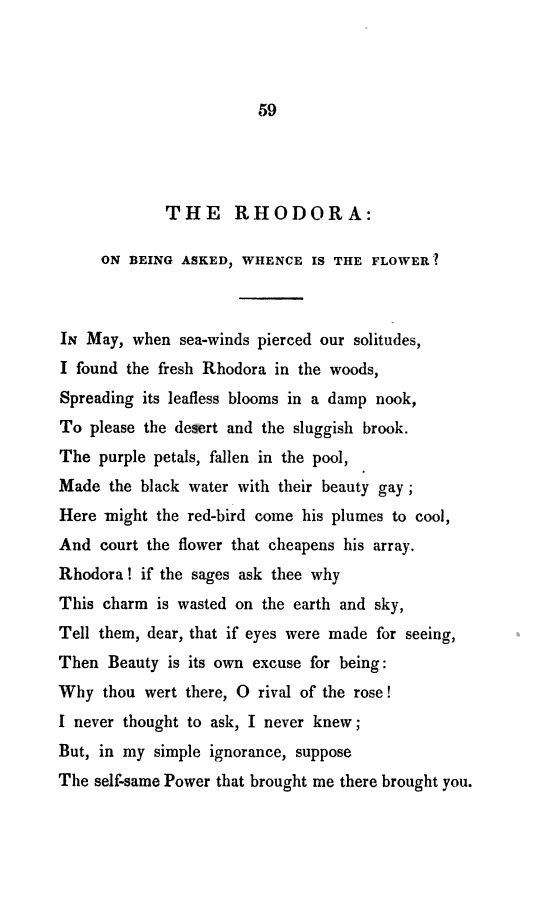
The rhodora at Ledum Swamp is now in its perfection, brilliant islands of color..

May 26. 
RWE 1847


Thursday. P. M. — To Ledum Swamp and Lee's Cliff.

Eleocharis tenuis in bloom, apparently the earliest eleocharis. 

The rhodora at Ledum Swamp is now in its perfection, brilliant islands of color. 

Eriophorum vaginatum, how long? 

Ledum out apparently two or three days. 

Andromeda Polifolia out, how long? 

Tall swamp huckleberry just budded to bloom. 

Do I not hear the nuthatch note in the swamp? 

Do not detect the scheuchzeria there yet.

The air is full of terebinthine odors to-day, — the scent of the sweet-fern, etc. 


May 26, 2019
Moss Ledge
The reddish leaves (and calyx) of the Vaccinium vacillans, just leafed, are interesting and peculiar now, perhaps more or less crimson. 

See a flock of cowbirds, the first I have seen. 

Cows in water, so warm has it got to be. 

Geranium (how long?), behind Bittern Cliff, and wild pink. 

Pitch pine pollen at Lee's. 

Cherry-birds. 

Ascendant potentilla abundant, how long? 

Juniperus repens pollen, how long ? 

Interrupted fern pollen [sic]. 

The dicksonia fern is one foot high, but not fairly unfolded. 

The tender white-downy stems of the meadow saxifrage, seen toward the westering sun, are very conspicuous and thick in the meadows now. 

A purple finch's nest in one of our firs.

H. D. Thoreau, Journal, May 26, 1859

The rhodora at Ledum Swamp is now in its perfection, brilliant islands of color.   See May 17, 1853 (“The rhodora is peculiar for being, like the peach, a profusion of pink blossoms on a leafless stem. This shrub is, then, a late one to leaf out.”);  May 17, 1858 ("Rhodora at Clamshell well out.”); May 18, 1853 ("The rhodora is one of the very latest leafing shrubs, for its leaf-buds are but just expanding, making scarcely any show yet, but quite leafless amid the blossoms."); May 18, 1855 ("Rhodora; probably some yesterday."); May 18, 1856 ("The rhodora there [Kalmia Swamp] maybe to-morrow. Elsewhere I find it (on Hubbard’s meadow) to-day. "); May 18, 1857 ("Pratt says he saw the first rhodora . . . out yesterday");  May 19, 1854 ("The rhodora is late, and is naked flowering."); May 27, 2016 (“Kalmia in prime, and rhodora.”); May 31, 1857 (“Rhodora now in its prime.”).

See a flock of cowbirds, the first I have seen. See September 6, 1858  (“To Ledum Swamp. Going over Clamshell Plain, I see a very large flock of a hundred or more cowbirds about some cows.”); August 25, 1855 (“They keep close to the cow’s head and feet, and she does not mind them; but when all go off . . .at my approach, the cow (about whom they were all gathered) looks off after them for some time, as if she felt deserted.”).

Cows in water, so warm has it got to be. See July 12, 1857 (“It is exceedingly sultry this afternoon, and few men are abroad. The cows stand up to their bellies in the river, lashing their sides with their tails from time to time.”).

May 26. See  A Book of the Seasons, by Henry Thoreau, May 26

Tuesday, May 31, 2016

The Telegraph says it Snowed in Bangor To-day.

May 31

P. M. — To Clintonia Swamp (Hubbard’s) Grove. 

A ground-bird’s nest (melodia or graminea), with six of those oblong narrow gray eggs speckled with much brown at end. When I looked again half an hour after, one egg was hatched. The bird would steal out through the grass when I came within a rod, and then, after running a rod or two, take to wing. 

May 31, 2016

Tied a string about a low pyrus a rod or so to right of entrance to Hubbard’s Pyrus Swamp and two feet west of a pitch pine stump, and pressed a twig of it.

Clintonia. 

Nuphar advena first noticed; may have been out some time in some places, but just out in river. 

Pink, common wild, maybe two or three days.

Sundown—To Hill and Island. 

Have noticed within a week, from time to time, the water-line on the bushes along the shore — the water going down — unusually distinct, for while the exposed parts have leaved out, the lower are quite bare and black. 

Hemlock and creeping juniper, where had not bloomed the 22d, are now entirely out of bloom on the hill. How short their flower lasts! 

Ranunculus Purshii, probably earlier in some places, but water high. 


That little cerastium on the rock at the Island, noticed the 22d, which probably opened about  that time, is now out of bloom. It is about three inches high and has long pods, more than twice the length of the calyx, which turn upward. I have seen no petals. It seems to be the C. nutans (?), from size, erectness, and form of pods and leaves. It has viscid hairs or with glands at end. 

The red oak is so forward, compared with the rest, that it is more difficult to get a sprig in flower small enough (its leaves) to press. 

As I return in the dusk, many nighthawks, with their great spotted wings, are circling low over the river, as the swallows were when I went out. They skim within a rod of me. After dusk these greater swallows come forth, and circle and play about over the water like those lesser ones, or perhaps making a larger circuit, also uttering a louder note. It would not be safe for such great birds to fly so near and familiarly by day. 

It has been very cold for two or three days, and to-night a frost is feared. The telegraph says it snowed in Bangor to-day. 

The hickory leaves are blackened by blowing in the cold wind.

H. D. Thoreau, Journal, May 31, 1856


A ground-bird’s nest (melodia or graminea.), with six of those oblong narrow gray eggs speckled with much brown at end. See May 18, 1855 ("A bay-wing sparrow’s nest, four eggs (young half hatched) -- some black-spotted, others not”); 
May 27, 1856 ("Fringilla melodia’s nest in midst of swamp, with four eggs . . . with very dark blotches."); June 4, 1857 (“I scare up a bay-wing. She runs several rods close to the ground through the thin grass, and then lurks behind tussocks, etc. The nest has four eggs, dull pinkish-white with brown spots; nest low in ground, of stubble lined with white horse hair. ”). See also  A Book of the Seasons,  by Henry Thoreau, the Song Sparrow (Fringilla melodia) and A Book of the Seasons, by Henry Thoreau, the Bay-Wing [Vesper] Sparrow (Fringilla graminea)

Clintonia. See June 2, 1853 ("Clintonia borealis, a day or two. This is perhaps the most interesting and neatest of what I may call the liliaceous (?) plants we have. Its beauty at present consists chiefly in its commonly three very handsome, rich, clear dark-green leaves . . . arching over from a centre at the ground, sometimes very symmetrically disposed in a triangular fashion; and from their midst rises the scape [ a ] foot high, with one or more umbels of “green bell-shaped flowers,” yellowish- green, nodding or bent downward")

Nuphar advena first noticed . . . just out in river. See May 30, 1858 ("I saw the Nuphar advena above water and yellow in Shrewsbury the 23d.")

Pink, common wild, maybe two or three days. See May 29, 1852 (" Barberry in bloom, wild pinks, and blue-eyed grass."); June 5, 1850 ("The first of June, when the lady’s-slipper and the wild pink have come out in sunny places on the hillsides, then the summer is begun according to the clock of the seasons.”);  June 19, 1852 ("Is not this the carnival of the year, when the swamp rose and wild pink are in bloom,  the last stage before blueberries come?")

Ranunculus Purshii, probably earlier in some places, but water high. See May 26, 1855 ("The Ranunculus Purshii in that large pool in the Holden Swamp Woods makes quite a show at a little distance now."); May 28, 1858 ("The Ranunculus Purshii is now abundant and conspicuous in river."): June 6, 1857 ('The Ranunculus Purshii is in some places abundantly out now and quite showy. It must be our largest ranunculus (flower).”)

That little cerastium on the rock at the Island, noticed the 22d . . . seems to be the C. nutans [nodding chickweed]. See  May 6, 1856 ("Cerastium out there under the bank"); May 22, 1856 ("A little clammy hairy cerastium (?) (like a Cerastium viscosum, slender and erect), about three inches high, will open in a day or two on the rock near the bass."); June 5, 1856 ("I must call that cerastium of May 22d C. nutans (?), at least for the present, though . . .Thompson’s “History of Vermont,” says it is not found in New England out of that State.") See also  May 31, 1853 (" The fact that a rare and beautiful flower which we never saw, perhaps never heard of, for which therefore there was no place in our thoughts, may at length be found in our immediate neighborhood, is very suggestive.  The boundaries of the actual are no more fixed and rigid than the elasticity of our imaginations.")

[Thoreau's herbarium includes a physical specimen from "Island Rock” with the label “Cerastium nutans'’ in his own handwriting. See Richard J. Eaton,  A Flora of Concord, 114  ("Very rare. The only known specimen to have been collected in New England east of the Connecticut River except in Connecticut.")]

The red oak is so forward . . .it is more difficult to get a sprig in flower small enough (its leaves) to press. See May 18, 1851 ("The oak leaves of all colors are just expanding, and are more beautiful than most flowers");  May 20, 1852 ("The red oak leaves are very pretty and finely cut, about an inch and three quarters long. Like most young leaves, they are turned  back around the twig, parasol-like."); May 23, 1860 ("The quarter-grown red oak leaves between you and the sun, how yellow-green!")

As I return in the dusk, many nighthawks, with their great spotted wings, are circling low over the river, as the swallows were when I went out. See   June 5, 1854 ("Now, just before sundown, a nighthawk is circling, imp-like, with undulating, irregular flight over the sprout-land on the Cliff Hill, with an occasional squeak and showing the spots on his wings. He does not circle away from this place, and I associate him with two gray eggs somewhere on the ground beneath and a mate there sitting.") June 21, 1856 ("Nighthawks numerously squeak at 5 P. M. and boom  Saw them fly low and touch the water like swallows over Walden. ")

The telegraph says it snowed in Bangor to-day. See August 26, 1854 ("Hear by telegraph that it rains in Portland and New York."); See also November 13, 1851 ("The cattle-train came down last night from Vermont with snow nearly a foot thick upon it. It is as if, in the fall of the year, a swift traveller should come out of the north with snow upon his coat.")  

The hickory leaves are blackened by blowing in the cold wind.
See May 31, 1858 ("There were severe frosts on the nights of the 28th and 29th, and now I see the hickories turned quite black")


May 31. See A Book of the Seasons,  by Henry Thoreau, May 31

Six narrow gray eggs speckled with brown at the end in a ground-bird’s nest.

That cerastium
on the rock at the Island . . .
another rare plant.

A Book of the Seasons, by Henry Thoreau
"A book, each page written in its own season,
out-of-doors, in its own locality.”
~edited, assembled and rewritten by zphx © 2009-2026

https://tinyurl.com/hdt-560531


Sunday, May 29, 2016

Where you find a rare flower, expect to find more . . .


May 29

P. M. — Ride to Painted-Cup Meadow. 


Dragon mouth
 (Arethusa bulbosa) orchid
Two Arethusa bulbosa at Hubbard’s Close apparently a day or two.

Golden senecio there, a day or two, at least. White clover. Ranunculus repens (sepals not recurved and leaves a spotted look), apparently a day. Geum rivale, well out. Common crataegus, apparently some days. Juniperus communis, a day or two at least, probably more. 

To return to Painted-Cup Meadow, I do not perceive the rank odor of Thalictrum Cornuti expanding leaves to-day. How more than fugacious it is! Evidently this odor is emitted only at particular times. 

A cuckoo’s note, loud and hollow, from a wood-side.

Found a painted-cup with more yellow than usual in it, and at length Edith found one perfectly yellow. 

What a flowery place, a vale of Enna, is that meadow!
Painted Cup, Erigeron bellidifolius, Thalictrum dioicum, Viola Muhlenbergii, fringed polygala, buck-bean, pedicularis, orobanche, etc., etc.

Where you find a rare flower, expect to find more rare ones. 

Saw sanicle well flower-budded. Cherry-birds on the apple trees. Blue-eyed grass, probably to-morrow.

H. D. Thoreau, Journal, May 29, 1856

Ride to Painted-Cup Meadow . . . What a flowery place. See note to June 3, 1853 ("The painted-cup is in its prime. It reddens the meadow, – Painted-Cup Meadow. ")

Arethusa bulbosa at Hubbard’s Close apparently a day or two. . . . See May 28, 1853 ("The bulbous arethusa out a day or two — probably yesterday. Though in a measure prepared for it, still its beauty surprised me; it is by far the highest and richest color yet. Its intense color in the midst of the green meadow made it look twice as large as reality; it looks very foreign in the midst of our plants - its richly speckled, curled, and bearded lip."); May 29, 1858 ("Arethusa bulbosa, well out."); May 30, 1854 ("I am surprised to find arethusas abundantly out in Hubbard's Close, maybe two or three days ... This high-colored plant shoots up suddenly, all flower, in meadows where it is wet walking. A superb flower.”); June 1, 1855 (“Arethusa out at Hubbard’s Close; say two or three days at a venture, there being considerable.“); June 10, 1854 (“The fragrance of the arethusa is like that of the lady's-slipper, or pleasanter.”)

I do not perceive the rank odor of Thalictrum Cornuti. See May 28, 1856 ("I think it was a mass of young Thalictrum Cornuti leaves which had that rank, dog-like scent.")

Found a painted-cup with more yellow than usual in it, and at length Edith found one perfectly yellow. . . . See May 5, 1853  ("The Emerson children found blue and white violets May 1st at Hubbard's Close, . . .  but I have not been able to find any yet.”)  See also June 6, 1858 ("Edith Emerson has found, in the field (Merriam’s) just south of the Beck Stow pine grove, Lepidium campestre"); August 9, 1858 ("Edith Emerson gives me an Asclepias tuberosa from Naushon, which she thinks is now in its prime there.”); July 8, 1857 ("Edith Emerson shows me Oldenlandia purpurea var. longifolia, which she saw very abundantly in bloom on the Blue Hills.”); September 28, 1853 ("The fringed gentian was out before Sunday; was (some of it) withered then, says Edith Emerson.”)

Where you find a rare flower, expect to find more. See April 24, 1854 ("Go to new trees. . . and you hear new birds."); July 2, 1857 (“Having found this in one place, I now find it in another.”); July 31, 1859 ("Where there are rare, wild, rank plants, there too some wild bird will be found.")

May 29. See A Book of the Seasons, by Henry Thoreau, May 29

Painted-Cup Meadow –
where you find a rare flower 
expect to find more.

A Book of the Seasons
,  by Henry Thoreau, 
Where you find a rare flower
 A Book of the Seasons, by Henry Thoreau
"A book, each page written in its own season,
out-of-doors, in its own locality.”
~edited, assembled and rewritten by zphx © 2009-2026

https://tinyurl.com/hdt-560529

Dusk. We go out after the rain to find the Lady's slipper.  The woods are dripping wet, the hemlocks' bright new growth just beginning to show. Along the cliff edge three Lady's slippers bloom.  The hermit thrush sings. 


Lady-slippers bloom 
in the damp evening woods . . .
the hermit thrush sings.

May 29, 2016
zphx


Monday, May 11, 2015

It is most impressive when you first detect the presence of the bird by its shadow.

May 11

A. M. —To Island. 

Only the lower limbs of bass begin to leaf yet, -- yesterday. 

A crow blackbird’s nest, about eight feet up a white maple over water, -- a large, loose nest without, some eight inches high, between a small twig and main trunk, composed of coarse bark shreds and dried last year’s grass, without mud; within deep and size of robin’s nest; with four pale-green eggs, streaked and blotched with black and brown. Took one. Young bird not begun to form. 

Hear and see yellow-throat vireo. 

See oat-seed spawn — a mass as big as fist —- on bottom; of brown jelly composed of smaller globules, each with a fish-like tadpole, color of a seed.

May 11, 2025

P. M. — To Andromeda Polifolia

Some young elms begin to leaf. Butternut leafs apparently to-morrow. Larger rock maples not yet begun to leaf, -- later considerably than large white maples, and somewhat than large red. 

Apparently andromeda will not open before the 15th or 16th, and the buck-bean, now just budded above the water, not before the 20th. 

Juniperus repens will not open, apparently, before the 14th or 15th. 

Canoe birch just sheds pollen. Very handsome drooping golden catkins, sometimes two or three together, some five and a quarter inches long. The leaves of some young sprouts already three-quarters inch over, but of the trees not started. 

The second amelanchier just sheds pollen, in a swamp. 

I trod on a large black snake, which, as soon as I stepped again, went off swiftly down the hill toward the swamp, with head erect like a racer. Looking closely, I found another left behind, partly concealed by the dry leaves. They were lying amid the leaves in this open wood east of Beck Stow’s, amid the sweet fem and huckleberry bushes. The remaining one ran out its tongue at me, and vibrated its tail swiftly, making quite a noise on the leaves; then darted forward, passed round an oak, and whipped itself straight down into a hole at its base one and a half inches over. After its head had entered, its tail was not long in following. 

You can hardly walk in a thick pine wood now, especially a swamp, but presently you will have a crow or two over your head, either silently flitting over, to spy what you would be at and if its nest is in danger, or angrily cawing. It is most impressive when, looking for their nests, you first detect the presence of the bird by its shadow. 

Was not that a bay-wing which I heard sing, — ah, twar twe twar, twit twit twit twit, twe?

Viola pedata sheds pollen,-- the first I have chanced to see. 

I hear some kind of owl partially hooting now at 4 P.M., I know not whether far off or near.

H. D. Thoreau, Journal, May 11, 1855

 Only the lower limbs of bass begin to leaf yet, -- yesterday. See May 13, 1854 ("The bass suddenly expanding its little round leaves."); May 13, 1855 ("The large bass trees now begin to leaf. ") See also  A Book of the Seasons, by Henry Thoreau, The Basswood

Hear and see yellow-throat vireo. See May 6, 1860 ('Hear probably a yellow-throated vireo in the woods."); May 6, 1859 ("Hear yellow-throat vireo, and probably some new warblers."); May 19, 1856 ("a yellow-throated vireo, . . . singing indolently, ullia — eelya, and sometimes varied to eelyee.”); May 27, 1854 ("I see and hear the yellow-throated vireo. It is somewhat similar (its strain) to that of the red eye, prelia pre-li-ay, with longer intervals."); May 29, 1855 ("Also the yellow-throated vireo—its head and shoulders as well as throat yellow (apparently olive-yellow above), and its strain but little varied and short, not continuous. It has dusky legs and two very distinct white bars on wings (the male) "); s. June 9, 1854 ("How prominent a place the vireos hold! It is probably the yellow-throated vireo I hear now . . .with its prelia — prelioit . . . invisible in the tops of the tree") See also A Book of the Seasons,  by Henry Thoreau, The Yellow-throated Vireo

It is most impressive when, looking for their nests, you first detect the presence of the bird by its shadow. See September 16, 1852("I detect the transit of the first [hawk] by his shadow on the rock, and look toward the sun for him. Though he is made light beneath to conceal him, his shadow betrays him.") See also May 5, 1855 ("A crow . . . directly over my head within thirty-five feet, caws angrily.") and note to  May 11, 1855 ("You can hardly walk in a thick pine wood now, especially a swamp, but presently you will have a crow or two over your head, either silently flitting over, to spy what you would be at and if its nest is in danger, or angrily cawing.")

Was not that a bay-wing which I heard sing.  See. April 13, 1855 (" See a sparrow without marks on throat or breast, running peculiarly in the dry grass in the open field beyond, and hear its song, and then see its white feathers in tail; the bay-wing"); May 12, 1857 ("I hear from across the fields the note of the bay-wing, Come here here there there quick quick quick or I'm gone. . .   As the bay-wing sang many a thousand years ago, so sang he to-night . . . [S]uddenly, in some fortunate moment, the voice of eternal wisdom reaches me even, in the strain of the sparrow, and liberates me, whets and clarifies my senses, makes me a competent witness.")

Viola pedata sheds pollen,-- the first I have chanced to see. See May 5, 1852 ("The Viola pedata budded, ready to blossom."); May 6, 1859 ("Viola pedata begins to be common about white pine woods there."); May 9, 1852 ("The first Viola pedata "); May 10, 1858 ("How much expression there is in the Viola pedata! I do not know on the whole but it is the handsomest of them all, it is so large and grows in such large masses."); May 17, 1853 ("The greatest array of blue of any flower as yet. The flowers are so raised above their leaves, and so close together, that they make a more indelible impression of blue on the eye; it is almost dazzling. I blink as I look at them, they seem to reflect the blue rays so forcibly, with a slight tinge of lilac."); May 18, 1854 ("The V. pedata beginning to be abundant."). May 20, 1852 ("the V. pedata is smooth and pale-blue, delicately tinged with purple reflections").  See also A Book of the Seasons, by Henry Thoreau, the Violets


Looking for nests, you
detect the presence of the
bird by its shadow.

                                     A Book of the Seasons, by Henry Thoreau
"A book, each page written in its own season,
out-of-doors, in its own locality.”
~edited, assembled and rewritten by zphx © 2009-2025

https://tinyurl.com/hdt-550511

Thursday, April 30, 2015

The scream of a hawk over Holden woods and swamp.

April 30.

Another, more still, cloudy, almost drizzling day, in which, as the last three, I wear a greatcoat. 


P. M. — To Lee’s Cliff. 

Privet begins to leaf. (Viburnum nudum and Lentago yesterday.) 

I observed yesterday that the barn swallows confined themselves to one place, about fifteen rods in diameter, in Willow Bay, about the sharp rock. They kept circling about and flying up the stream (the wind easterly), about six inches above the water, — it was cloudy and almost raining, — yet I could not perceive any insects there. 

Those myriads of little fuzzy gnats mentioned on the 21st and 28th must afford an abundance of food to insectivorous birds. Many new birds should have arrived about the 21st. There were plenty of myrtle-birds and yellow redpolls where the gnats were

The swallows were confined to this space when I passed up, and were still there when I returned, an hour and a half later. I saw them nowhere else. 

They uttered only a slight twitter from time to time and when they turned out for each other on meeting. Getting their meal seemed to be made a social affair. Pray, how long will they continue to circle thus without resting? 

The early willow by Hubbard’s Bridge has not begun to leaf. This would make it a different species from that by railroad, which has. 

Hear a short, rasping note, somewhat tweezer-bird like, I think from a yellow redpoll. Yellow dor bug. 

I hear from far the scream of a hawk circling over the Holden woods and swamp. This accounts for those two men with guns just entering it. What a dry, shrill, angry scream! I see the bird with my glass resting upon the topmost plume of a tall white pine. Its back, reflecting the light, looks white in patches; and now it circles again. 

It is a red-tailed hawk. The tips of its wings are curved upward as it sails. How it scolds at the men beneath! I see its open bill. It must have a nest there. 

Hark! there goes a gun, and down it tumbles from a rod or two above the wood. So I thought, but was mistaken. In the meanwhile, I learn that there is a nest there, and the gunners killed one this morning, which I examined. They are now getting the young. 

Above it was brown, but not at all reddish— brown except about head. Above perhaps I should thickly barred with darker, and also wings beneath. The tail of twelve reddish feathers, once black-barred near the end. The feet pale-yellow and very stout, with strong, sharp black claws. The head and neck were remarkably stout, and the beak short and curved from the base. Powerful neck and legs. The claws pricked me as I handled it. 

It measured one yard and three eighths plus from tip to tip, i.e. four feet and two inches. Some ferruginous on the neck; ends of wings nearly black. 

Columbine just out; one anther sheds. Also turritis will to-morrow apparently; many probably, if they had not been eaten. Crowfoot and saxifrage are now in prime at Lee’s; they yellow and whiten the ground.

I see a great many little piles of dirt made by the worms on Conantum pastures. 

The woodchuck has not so much what I should call a musky scent, but exactly that peculiar rank scent which I perceive in a menagerie. The musky at length becomes the regular wild-beast scent. 

Red-wing blackbirds now fly in large flocks, covering the tops of trees—willows, maples, apples, or oaks—like a black fruit, and keep up an incessant gurgling and whistling, — all for some purpose; what is it? 

White pines now show the effects of last year’s drought in our yard and on the Cliffs, the needles faded and turning red to an alarming extent. 

I now see many Juniperus repens berries of a handsome light blue above, being still green beneath, with three hoary pouting lips. 

The Garfields had found a burrow of young foxes. How old? 

I see the black feathers of a blackbird by the Miles Swamp side, and this single bright-scarlet one shows that it belonged to a red wing, which some hawk or quadruped devoured.

H. D. Thoreau, Journal, April 30, 1855

It is a red-tailed hawk. See May 1, 1855 ("He [Garfield] climbed the tree when I was there yesterday afternoon, the tallest white pine or other tree in its neighborhood, over a swamp, and found two young, which he thought not more than a fortnight old,—with only down, at least no feathers,—and one addled egg, also three or four white-bellied or deer mouse (Mus leucopus), a perch, and a sucker, and a gray rabbit’s skin. . . . I found the remains of a partridge under the tree.”). See also March 2, 1856 ("I can hardly believe that hen-hawks may be beginning to build their nests now, yet their young were a fortnight old the last of April last year.”); March 15, 1860 ("These hawks, as usual, began to be common about the first of March, showing that they were returning from their winter quarters. . . . An easily recognized figure anywhere.”); March 23, 1859 (“. . .we saw a hen-hawk perch on the topmost plume of one of the tall pines at the head of the meadow. Soon another appeared, probably its mate, but we looked in vain for a nest there. It was a fine sight, their soaring above our heads, presenting a perfect outline and, as they came round, showing their rust-colored tails with a whitish rump, or, as they sailed away from us, that slight teetering or quivering motion of their dark-tipped wings seen edgewise, now on this side, now that, by which they balanced and directed themselves.”);  April 22, 1860 ("See now hen-hawks, a pair, soaring high as for pleasure, circling ever further and further away, as if it were midsummer. . . . I do not see it soar in this serene and leisurely manner very early in the season, methinks"); April 30, 1857 ("a pretty large hawk alighted on an oak close by us. It probably has a nest near by and was concerned for its young.”);  May 4, 1855 ("Red tail hawk young fourteen days old.").  See also A Book of the Seasons,  by Henry Thoreau ,The hen-hawk


Red-wing blackbirds now fly in large flocks, covering the tops of trees—willows, maples, apples, or oaks—like a black fruit. 
See March 16, 1860 ("They cover the apple trees like a black fruit.”); May 5, 1859 (" Red-wings fly in flocks yet.");  see also A Book of the Seasons, by Henry Thoreau, the Red-wing in Early Spring

Popular Posts Last 30 Days.

The week ahead in Henry’s journal

The week ahead in Henry’s journal
A journal, a book that shall contain a record of all your joy.
"A stone fruit. Each one yields me a thought." ~ H. D. Thoreau, March 28, 1859


I sit on this rock
wrestling with the melody
that possesses me.