Showing posts with label susurrus. Show all posts

Tuesday, July 20, 2021

The midsummer night's moon.


July 20.

 
July 20, 2012

To Nawshawtuct at moonrise with Sophia, by boat.

Moon apparently fulled yesterday.

A low mist in crusts the meadow, -- not so perceptible when we are on the water. Now we row through a thin low mist about as high as one's head, now we come to a place where there is no mist on the river or meadow, apparently where a slight wind stirs.

The gentle susurrus from the leaves of the trees on shore is very enlivening, as if Nature were freshening, awakening to some enterprise. There is but little wind, but its sound, incessantly stirring the leaves at a little distance along the shore, heard not seen, is very inspiriting. It is like an everlasting dawn or awakening of nature to some great purpose.

As we go up the hill we smell the sweet briar.

The trees are now heavy, dark masses without tracery, not as in spring or early in June; but I forgot to say that the moon was at first eclipsed by a vast black bank of cloud in the east horizon, which seemed to rise faster than it, and threatened to obscure it all the night.

But suddenly she rose above it, and when, a few moments after, we thought to look again for the threatening cloud-bank, it had vanished, or a mere filmy outline could be faintly traced beneath her.

It was the eclipse of her light behind it that made this evil look so huge and threatening, but now she had triumphed over it and eclipsed it with her light.

It had vanished, like an ugly dream.

So is it ever with evils triumphed over, which we have put behind us.

What was at first a huge dark cloud in the east which threatened to eclipse the moon the livelong night is now suddenly become a filmy vapor, not easy to be detected in the sky, lit by her rays.

She comes on thus, magnifying her dangers by her light, at first displaying, revealing them in all their hugeness and blackness, exaggerating, then casting them behind her into the light concealed.

She goes on her way triumphing through the clear sky like a moon which was threatened by dark clouds at her rising but rose above them. That black, impenetrable bank which threatened to be the ruin of all our hopes is now a filmy dash of vapor with a faint-purplish tinge, far in the orient sky.

From the hilltop we see a few distant lights in farmhouses down below, hard to tell where they are, yet better revealing where they are than the sun does.  But cottage lights are not conspicuous now as in the autumn.

As we looked, a bird flew across the disk of the moon.

Saw two skunks carrying their tails about some rocks. Singular that, of all the animated creation, chiefly these skunks should be abroad in this moonlight.

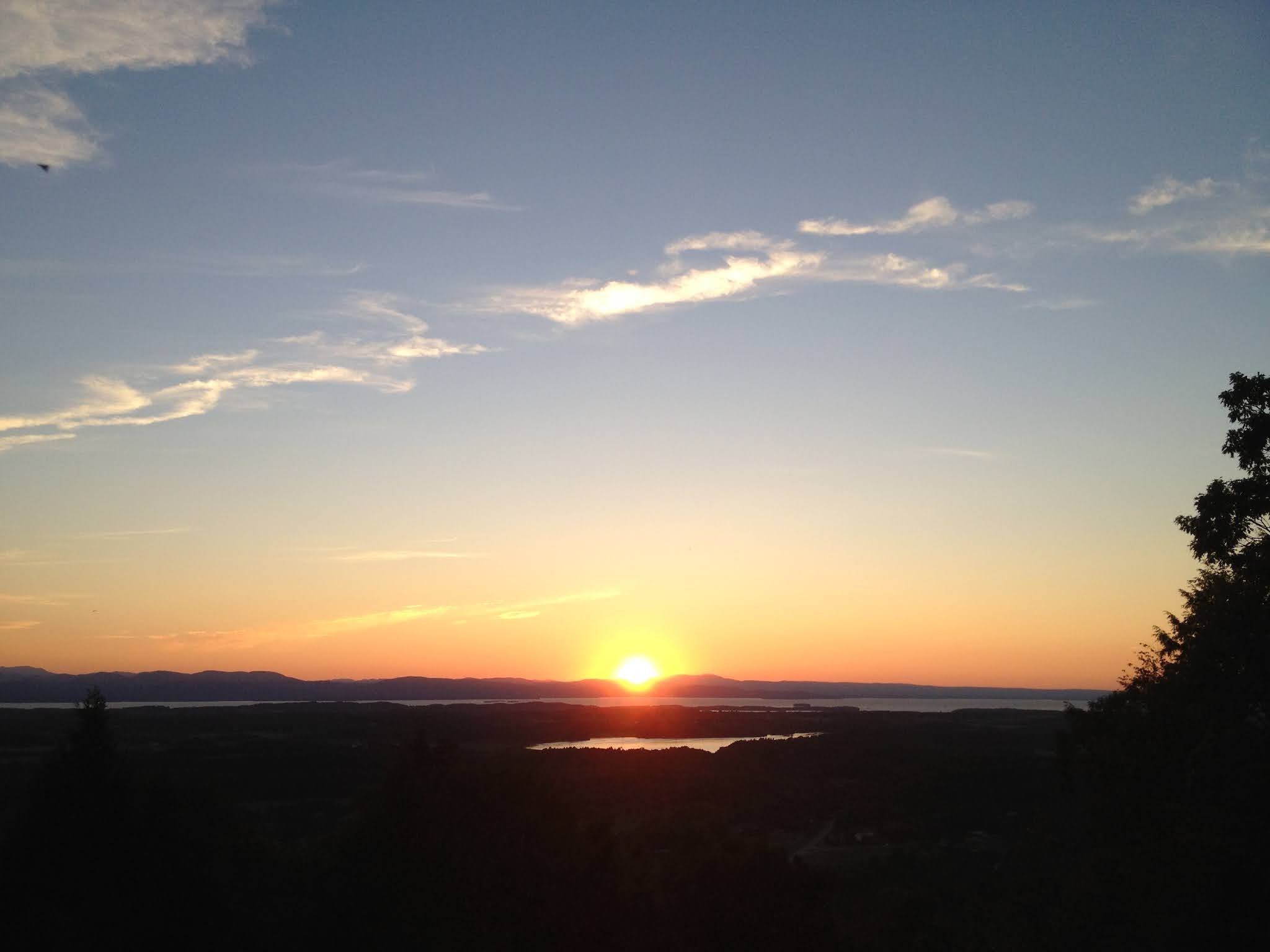
This is the midsummer night's moon.

We have come round the east side of the hill to see the moon from amid the trees. I like best to see its light falling far in amid the trees and along the ground before me, while itself is hidden behind them or one side.

It is cool, methinks with a peculiar coolness, as it were from the luxuriance of the foliage, as never in June. At any rate we have had no such sultry nights this month as in June.

There is a greater contrast between night and day now, reminding me that even in Hindostan they freeze ice in shallow vessels at night in summer (?).

There is a mist very generally dispersed, which gives a certain mellowness to the light, a wavingness apparently, a creaminess.

Yet the light of the moon is a cold, almost frosty light, white on the ground.

There are a few fireflies about. Green, their light looks sometimes, and crickets are heard.

You are pretty sure also to hear some human music, vocal or instrumental, far or near.

The masses of the trees and bushes would be called black, if our knowledge that they are leaves did not make us call them dark - green.

Here is the Pycnanthemum lanceolatum near the boat's place, which I scent in the dark. It has been out some days, for some flowers are quite withered.

I hear from the copses or bushes along the shore, returning, a faint everlasting fine song from some small cricket, or rather locust, which it required the stillness of night to reveal.

A bat hovers about us.

How oily smooth the water in this moonlight! And the apparent depth where stars are reflected frightens Sophia.

These Yankee houses and gardens seen rising beyond this oily moonlit water, on whose surface the circling insects are like sparks of fire, are like Italian dwellings on the shores of Italian lakes.

When we have left the boat and the river, we are surprised, looking back from the bank, to see that the water is wholly concealed under a white mist, though it was scarcely perceptible when we were in its midst.

The few bullfrogs are the chief music.

I do not know but walnuts are peculiarly handsome by moonlight, -- seeing the moon rising through them, and the form of their leaves.

I felt some nuts. They have already their size and that bracing, aromatic scent.


H. D. Thoreau, Journal, July 20, 1853

The moon was at first eclipsed by a vast black bank of cloud in the east horizon, which threatened to obscure it all the night  See June 1, 1852 ("The moving clouds are the drama of the moonlight nights")

Singular that, of all the animated creation, chiefly these skunks should be abroad in this moonlight. See June 20, 1853 (“ The moon full. . . . Saw a little skunk coming up the river-bank in the woods at the White Oak.”); July 12, 1851 ("I see a skunk on Bear Garden Hill stealing noiselessly away from me, while the moon shines over the pitch pines")

There are a few fireflies about.
See July 20, 1852 ("The stars are few and distant; the fireflies fewer still.") See also A Book of the Seasons, by Henry Thoreau, Fireflies

You are pretty sure also to hear some human music, vocal or instrumental, far or near. See June 14, 1851 ("How sweet and encouraging it is to hear the sound of some artificial music from the midst of woods or from the top of a hill at night, borne on the breeze from some distant farmhouse, — the human voice or a flute!"); July 12, 1851 ("I hear a human voice,"); August 5, 1851 ("I hear now from Bear Garden Hill — I rarely walk by moonlight without hearing — the sound of a flute, or a horn, or a human voice")

Tuesday, March 31, 2020

Prelude of the toad.


Surveying again for Ed. Hoar the wood land adjoining his farm. 

A yet warmer day. A very thick haze, concealing mountains and all distant objects like a smoke, with a strong but warm southwest wind. Your outside coat is soon left on the ground in the woods, where it first becomes quite intolerable. 

The small red butterfly in the wood-paths and sprout-lands, and I hear at midafternoon a very faint but positive ringing sound rising above the susurrus of the pines, — of the breeze, — which I think is the note of a distant and perhaps solitary toad; not loud and ringing, as it will be. 

Toward night I hear it more distinctly, and am more confident about it. I hear this faint first reptilian sound added to the sound of the winds thus each year a little in advance of the unquestionable note of the toad. Of constant sounds in the warmer parts of warm days there now begins to be added to the rustling or crashing, waterfall-like sound of the wind this faintest imaginable prelude of the toad. 

I often draw my companion's attention to it, and he fails to hear it at all, it is so slight a departure from the previous monotony of March. This morning you walked in the warm sprout-land, the strong but warm southwest wind blowing, and you heard no sound but the dry and mechanical susurrus of the wood; now there is mingled with or added to it, to be detected only by the sharpest ears, this first and faintest imaginable voice. 

I heard this under Mt. Misery. Probably they come forth earlier under the warm slopes of that hill. 

The pewee sings in earnest, the first I have heard; and at even I hear the first real robin's song. 

I hear that there has been a great fire in the woods this afternoon near the factory. Some say a thousand acres have been burned over. This is the dangerous time, —between the drying of the earth, or say when dust begins to fly, and the general leafing of the trees, when it is shaded again. These fires are a perfectly regular phenomenon of this season. 

Many refer to them this thick haze, but, though in the evening I smell the smoke (no doubt) of the Concord fire, I think that the haze generally is owing to the warm southwest wind having its vapor condensed by our cooler air. 

An engine sent from town and a crowd of boys; and I hear that one man had to swim across a pond to escape being burnt. 

One tells me he found the saxifrage out at Lee's Cliff this afternoon, and another, Ellen Emerson, saw a yellow or little brown snake, evidently either the Coluber ordinatus or else amænus, probably the first.

Sit without fire.

H. D. Thoreau, Journal, March 31, 1860

 
The small red butterfly in the wood-paths and sprout-lands. See  March 31, 1858 (“In the wood-paths now I see many small red butterflies”); April 8, 1855 (“Afterward I see a small red one over the shore.”); See also A Book of the Seasons  by Henry Thoreau, The Small Red Butterfly


Your outside coat is soon left on the ground in the woods, where it first becomes quite intolerable. See  March 31, 1855 ("I am uncomfortably warm, gradually unbutton both my coats, and wish that I had left the outside one at home.") See also  March 15, 1852 ("This afternoon I throw off my outside coat. A mild spring day.. . .My life partakes of infinity."); April 5, 1854 ("Whatever year it may be, I am surveying, perhaps, in the woods; I have taken off my outside coat, perhaps for the first time, and hung it on a tree; . . .; when I hear a single, short, well- known stertorous croak from some pool half filled with dry leaves.")

I hear this faint first reptilian sound added to the sound of the winds thus each year a little in advance of the unquestionable note of the toad. See  April 5, 1860 (" I hear, or think that I hear, a very faint distant ring of toads, which, though I walk and walk all the afternoon, I never come nearer to. . . .It merely gives a slightly more ringing or sonorous sound to the general rustling of inanimate nature. "); April 13, 1853 ("First hear toads (and take off coat), a loud, ringing sound filling the air, which yet few notice."); April 13, 1858 ("Hear the first toad in the rather cool rain, 10 A. M."); April 15, 1856 (" I hear a clear, shrill, prolonged ringing note from a toad, the first toad of the year"); May 1, 1857 ("There is a cool and breezy south wind, and the ring of the first toad leaks into the general stream of sound, unnoticed by most.") See also A Book of the Seasons, by Henry Thoreau, The Ring of Toads.

The pewee sings in earnest, the first I have heard. See  March 16, 1854 ("The first phoebe near the water is heard. ");  March 29, 1858 ("Hear a phoebe early in the morning over the street.");  March 30, 1851 ("Spring is already upon us.  . . . The pewee is heard, and the lark. "); April  1, 1857. (" Up Assabet . . .Hear a phoebe"); April 1, 1859("At the Pokelogan up the Assabet, I see my first phoebe, the mild bird. It flirts its tail and sings pre vit, pre vit, pre vit, pre vit incessantly, as it sits over the water, and then at last, rising on the last syllable, says pre-VEE, as if insisting on that with peculiar emphasis.") See also A Book of the Seasons,  by Henry Thoreau, the Eastern Phoebe

At even I hear the first real robin's song. See  March 31, 1852 ("The robins sing at the very earliest dawn. I wake with their note ringing in my ear.");  See also March 12, 1854 ("I hear my first robin peep distinctly at a distance. No singing yet. "); April  1, 1857.  ("Already I hear a robin or two singing their evening song."); April 1, 1852 ("I hear a robin singing in the woods south of Hosmer's, just before sunset. It is a sound associated with New England village life. It brings to my thoughts summer evenings when the children are playing in the yards before the doors and their parents conversing at the open windows. It foretells all this now, before those summer hours are come.") and A Book of the Seasons, by Henry Thoreau, Robins in Spring

A yellow or little brown snake, evidently either the Coluber ordinatus or else amænus, probably the first. See October 18, 1858 (“Noticed a little snake, eight or nine inches long, in the rut in the road in the Lincoln woods. It was brown above with a paler-brown dorsal stripe, which was bounded on each side by a row of dark-brown or blackish dots one eighth inch apart, the opposite rows alternating; beneath, light cream-color or yellowish white. Evidently Storer’s Coluber ordinatus.”); October 29, 1857 (“I see evidently what Storer calls the little brown snake (Coluber ordinatus). . . . Above it is pale-brown, with a still lighter brown stripe running down the middle of the back”); October 11, 1856 (“It is apparently Coluber amaenus, the red snake. Brown above, light-red beneath, about eight inches long . . . It is a conspicuous light red beneath, then a bluish-gray line along the sides, and above this brown with a line of lighter or yellowish brown down the middle of the back.”); September 9, 1857 ("It was a dark ash-color above, with darker longitudinal lines, light brick-red beneath. There were three triangular buff spots just behind the head, one above and one each side. It is apparently Coluber amaenus”); April 29, 1858 (“A little brown snake with blackish marks along each side of back and a pink belly. Was it not the Coluber amaenus?”)  

Some say a thousand acres have been burned over. See April 2, 1860 ("Walked to the Mayflower Path and to see the great burning of the 31st. I smelled the burnt ground a quarter of a mile off. It was a very severe burn, the ground as black as a chimney-back. The fire is said to have begun by an Irishman burning brush near Wild' s house in the south part of Acton, and ran north and northeast some two miles before the southwest wind, crossing Fort Pond Brook. I walked more than a mile along it and could not see to either end, and crossed it in two places. A thousand acres must have been burned.")

These fires are a perfectly regular phenomenon of this season. See March 29, 1858 ("I saw, on the hillside far across the meadow by Holbrook's clearing, what I at first took for a red flag or handkerchief carried along on a pole, just above the woods. It was a fire in the woods, and I saw the top of the flashing flames above the tree-tops. The woods are in a state of tinder, and the smoker and sportsman and the burner must be careful now."); April 4, 1856 ("Already I hear of a small fire in the woods in Emerson’s lot, set by the engine, the leaves that are bare are so dry."); April 9, 1856 ("Now look out for fires in the woods, for the leaves are never so dry and ready to burn as now. The snow is no sooner gone, —nay, it may still cover the north and west sides of hills, — when a day or two’s sun and wind will prepare the leaves to catch at the least spark."); April 21, 1859 ("Put out a fire in the woods, the Brister lot.");April 5, 1860  ("We heard of fires in the woods in various towns, and more or less distant, on the same days that they occurred here, — the last of March and first of April. The newspapers reported many. The same cause everywhere produced the same effect.") See also February 8, 1858 ("Two or three-acres were burned over, set probably by the engine. Such a burning as commonly occurs in the spring.")

One tells me he found the saxifrage out at Lee's Cliff this afternoon. See April 3, 1853("To my great surprise the saxifrage is in bloom. It was, as it were, by mere accident that I found it.. . . under a projecting rock in a little nook on the south side of a stump, I spied one little plant which had opened three or four blossoms high up the Cliff. "); April 27, 1852 ("On Conantum Cliffs I find to-day for the first time the early saxifrage (Saxifraga vernalis) in blossom, growing high and dry in the narrow seams, where there is no soil for it but a little green moss. It is one of the first flowers, not only in the spring of the year, but in the spring of the world.") See also A Book of the Seasons, by Henry Thoreau, Saxifrage in Spring (Saxifraga vernalis)

Sit without fire. See April 30, 1859 (" The warmest afternoon yet. Sat in sun without fire this forenoon."); May 2, 1858 ("Sit without fire to-day and yesterday."); May 3, 1857 ("To-day we sit without fire.")

Wednesday, December 11, 2019

The sound of the snowflakes falling on the dry oak leaves.

December 11

At 2 p. m. begins to snow, and snows till night. Still, normal storm, large flakes, warm enough, lodging.

See one sheldrake in Walden. 

As I stand on the railroad at Walden, at R. W. E.'s crossing, the sound of the snowflakes falling on the dry oak leaves (which hold on) is exactly like a rustling produced by a steady but slight breeze. But there is no wind. It is a gentle and uninterrupted susurrus. 

This light snow, which has been falling for an hour, resting on the horizontal spray of the hemlocks, produces the effect of so many crosses, or checker or lattice work.

H. D. Thoreau, Journal, December 11, 1859


Still, normal storm, large flakes, warm enough, lodging. December 14, 1859 ("Snow-storms might be classified. . . .That of the 11th was a still storm, of large flakes falling gently in the quiet air, like so many white feathers descending in different directions when seen against a wood-side, — the regular snow-storm such as is painted. A myriad falling flakes weaving a coarse garment by which the eye is amused. The snow was a little moist and the weather rather mild."); December 20, 1859 ("December. 11th was a lodging snow, it being mild and still, like to-day (only it was not so moist). Was succeeded next day noon by a strong and cold northwest wind.")

A gentle and uninterrupted susurrus. See April 18, 1855 ("I hear a susurrus in the shrub oak leaves"); November 1, 1857 ("When I enter the woods I notice the drier crispier rustle of withered leaves on the oak trees, – a sharper susurrus.")

Saturday, April 18, 2015

Overtaken by a sudden sun-shower.

April 18.

6 A. M. —See and hear tree sparrows, and hear hyemalis still. 

Rained last evening and was very dark. Fair this morning and warm. White-bellied swallows and martins twitter now at 9 A. M. 

P. M. — To Cliffs and Walden and Hubbard’s Close. 

Almost did without a fire this morning. Coming out, I find it very warm, warmer than yesterday or any day yet. It is a reminiscence of past summers. 

It is perfectly still and almost sultry, with wet-looking clouds hanging about, and from time to time hiding the sun. First weather of this kind. 

And as I sit on Fair Haven Hill-side, the sun actually burns my cheek; yet I left some fire in the house, not knowing behind a window how warm it was. 

The hillside and especially low bank-sides are now conspicuously green. The flooded meadows and river are smooth, and just enough in shadow for reflections. 

The rush sparrows tinkle now at 3 P. M. far over the bushes, and hylodes are peeping in a distant pool. Robins are singing and peeping, and jays are screaming. 

I see one or two smokes in the horizon. I can still see the mountains slightly spotted with snow. The frost is out enough for plowing probably in most open ground. 

When I reach the top of the hill, I see suddenly all the southern horizon (east or south from Bear Hill in Waltham to the river) full of a mist, like a dust, already concealing the Lincoln hills and producing distinct wreaths of vapor, the rest of the horizon being clear. Evidently a sea-turn, — a wind from over the sea, condensing the moisture in our warm atmosphere and putting another aspect on the face of things. 

All this I see and say long before I feel the change, while still sweltering on the rocks, for the heat is oppressive. 

Nature cannot abide this sudden heat, but calls for her fan. In ten minutes I hear a susurrus in the shrub oak leaves at a distance, and soon an agreeable fresh air washes these warm rocks, and some mist surrounds me. 

A low blackberry on the rocks is now expanding its leaves just after the gooseberry. A little sallow, about two feet high and apparently intermediate between tristis and the next, with reddish anthers not yet burst, will bloom to-morrow in Well Meadow Path. 

The shad-bush flower-buds, beginning to expand, look like leaf-buds bursting now.  

Am overtaken by a sudden sun-shower, after which a rainbow. In the evening hear far and wide the ring of toads, and a thunder-shower with its lightning is seen and heard in the west.

H. D. Thoreau, Journal, April 18, 1855


The rush sparrows tinkle now at 3 P. M. far over the bushes, and hylodes are peeping in a distant pool. 
See April 18, 1857 ("Hear the huckleberry-bird”); .April 18, 1859 ("Hear a field sparrow."); April 18, 1856 ("This evening I hear the snipes generally and peeping of hylas from the door."); April 9, 1856 (“This degree of heat, then, brings the Fringilla juncorum and pine warbler and awakes the hyla.”) See also A Book of the Seasons, by Henry Thoreau, the Field Sparrow(Fringilla juncorum)

Am overtaken by a sudden sun-shower, after which a rainbow. See  March 13, 1855 ("Rainbow in east this morning."); April 9, 1855 ("With April showers, me thinks, come rainbows. Why are they so rare in the winter?");May 11, 1854 ("A rainbow on the brow of summer.")

In the evening hear far and wide the ring of toads. See A Book of the Seasons, by Henry Thoreau, The ring of toads

Friday, July 18, 2014

Midsummer's deepened shade; a sultry, languid debauched look.

July 18


July 18, 2014

A hot midsummer day with a sultry mistiness in the air and shadows on land and water beginning to have a peculiar distinctness and solidity. The river, smooth and still, with a deepened shade of the elms on it, like midnight suddenly revealed, its bed-curtains shoved aside, has a sultry languid look.

The atmosphere now imparts a bluish or glaucous tinge to the distant trees. A certain debauched look. This a crisis in the season. 

After this the foliage of some trees is almost black at a distance. 

I do not know why the water should be so remarkably clear and the sun shine through to the bottom of the river, making it so plain. Methinks the air is not clearer nor the sun brighter, yet the bottom is unusually distinct and obvious in the sun. There seems to be no concealment for the fishes. On all sides, as I float along, the recesses of the water and the bottom are unusually revealed, and I see the fishes and weeds and shells. I look down into the sunny water. 

We have very few bass trees in Concord, but walk near them at this season and they will be betrayed, though several rods off, by the wonderful susurrus of the bees, etc., which their flowers attract. It is worth going a long way to hear. I am warned that I am passing one in two instances on the river, —only two I pass, — by this remarkable sound. At a little distance it is like the sound of a waterfall or of the cars; close at hand like a factory full of looms. They are chiefly humblebees, and the great globose tree is all alive with them. I hear the murmur distinctly fifteen rods off. You will know if you pass within a few rods of a bass tree at this season in any part of the town, by this loud murmur, like a water fall, which proceeds from it.

H. D. Thoreau, Journal, July 18, 1854

A certain debauched look: See June 16, 1852 ("The earth looks like a debauchee after the sultry night") and July 24, 1851 ("Nature is like a hen panting with open mouth, in the grass, as the morning after a debauch.")

After this the foliage of some trees is almost black at a distance. See July 27, 1859 ("Now observe the darker shades, and especially the apple trees, square and round, in the northwest landscape. Dogdayish.")

Bass tree susurrus:  See July 16, 1852 ("The air is full of sweetness. The tree is full of poetry."); July 17, 1856 ("Hear at distance the hum of bees from the bass with its drooping flowers at the Island,. . . It sounds like the rumbling of a distant train of cars."
) See also A Book of the Seasons, by Henry Thoreau, The Basswood

I look down into the sunny water. See July 27, 1860 ("The water has begun to be clear and sunny, revealing the fishes and countless minnows of all sizes and colors”). July 28, 1859 ("The season has now arrived when I begin to see further into the water.");  July 30, 1856 ("The water is suddenly clear.”); August 8, 1859 ("The river, now that it is so clear and sunny, is better than any aquarium. ")


July 18. See A Book of Seasons, by Henry Thoreau, Children of the sun and A Book of Seasons, by Henry Thoreau, July 18
.
Hot midsummer day
a crisis in the season
a deepened black shade

like midnight revealed
by bed-curtains shoved aside.

A Book of Seasons, by Henry Thoreau
"A book, each page written in its own season,
out-of-doors, in its own locality."
 ~edited, assembled and rewritten by zphx © 2009-2024

tinyurl.com/hdt-540718a

Sunday, April 6, 2014

A reverie

April 6.

April 6, 2019

A still warmer day than yesterday — a warm, moist rain-smelling west wind. 

Up Assabet. I am surprised to find so much of the white maples already out. The light-colored stamens show to some rods. They resound with the hum of honey-bees, heard a dozen rods off, and you see thousands of them about the flowers against the sky. They know where to look for the white maple and when. 

This susurrus carries me forward some months toward summer -- to those still warm summer noons when the breams' nests are left dry, and the fishes retreat from the shallows into the cooler depths, and the cows stand up to their bellies in the river. The reminiscence comes over me like a summer's dream.

Hear the snipe over the meadows this evening.

H. D. Thoreau, Journal, April 6, 1854

They resound with the hum of honey-bees
. See April 6, 1853 ("The air resounds with the hum of honey-bees, attracted by the flower of the skunk cabbage.") See also  April 1, 1852 ('' Saw the first bee of the season on the railroad causeway,"); April 1, 1858 ("The white maples are abundantly out to-day. . . .surprised to hear the resounding hum of honey-bees, which are busy about them,"); April 1, 1860 ("Hear the hum of bees on the maples.") See also A Book of the Seasons, by Henry Thoreau, Bees

They know where to look for the white maple and when. See September 30, 1852 ("How well they know the woods and fields and the haunt of every flower! If there are any sweet flowers still lingering on the hillside, it is known to the bees both of the forest and the village."); March 18, 1860 ("There is but one flower in bloom in the town, and this insect knows where to find it."); April 6, 1853 ("Notice a white maple with almost all the staminate flowers above or on the top, most of the stamens now withered, before the red maple has blossomed.): April 6, 1855 ( "A very few white maple stamens stand out already loosely enough to blow in the wind.").  See also A Book of the Seasons,  by Henry Thoreau, White maple buds and flowers

This susurrus carries me forward some months toward summer. See April 3, 1858 ("
There is no pause to the hum of the bees all this warm day. It is a very simple but pleasing and soothing sound, this susurrus, thus early in the spring.");  April 17, 1859 ("In the lee of this bush, and your charmed ears may hear this faint susurrus weaving the web of summer."); July 16, 1852 ("The tree resounds with the hum of bees . . . a perfect susurrus, a sound unlike any other in nature, not like the wind, as that is like the sea.")

Hear the snipe over the meadows this evening. See April 9, 1858 (" I hear the booming of snipe this evening, and Sophia says she heard them on the 6th. The meadows having been bare so long, they may have begun yet earlier. Persons walking up or down our village street in still evenings at this season hear this singular winnowing sound in the sky over the meadows and know not what it is") See also A Book of the Seasons,  by Henry Thoreau, the Snipe.

April 6. See A Book of the Seasons, by Henry Thoreau, April 6

A still warmer day
than yesterday — a warm, moist
rain-smelling west wind

white maples resound 
with the hum of honey-bees 
like a summer dream.

they know where
to look for the white maple
and when.

A Book of the Seasons, by Henry Thoreau
"A book, each page written in its own season,
out-of-doors, in its own locality.”
~edited, assembled and rewritten by zphx © 2009-2024

https://tinyurl.com/hdt54-0406

Thursday, April 3, 2014

The sough of the wind in the pines.

April 3.

See from window with glass seven ducks on meadow-water, — only one or two conspicuously white, — these, black heads, white throats and breasts and along sides, — the rest of the ducks, brownish, probably young males and females. Probably the golden-eye. Jardine says it is rare to see more than one full-plumaged male in a flock.

P.M. — To Cliffs by boat. The water has gone down so much that I have to steer carefully to avoid the thick hummocks left here and there on the meadow by the ice. I see the deep holes they were taken out of. 


The wind is southeasterly. This is methinks the first hazy day, and the sough of the wind in the pines sounds warmer, whispering of summer.

I think I may say that Flint's broke up entirely on the first wet day after the cold spell, — i.e. the 31st of March, — though I have not been there lately. Fair Haven will last some days yet.

H. D. Thoreau, Journal, April 3, 1854


I think I may say that Flint's broke up entirely on . . .the 31st of March.
 See ); March 23, 1853 ("The ice went out ...of Flint's Pond day before yesterday, I have no doubt." ); March 24, 1854 (" Flint's has perhaps fifteen or twenty acres of ice yet about shores. Can hardly tell when it is open this year."); M arch 29, 1855 ("Flint’s Pond is entirely open; may have been a day or two.") March 31, 1858 ("Flint's, Fair Haven, and Walden Ponds broke up just about the same time, or March 28th, this year. ");  April 1, 1852 ("I am surprised to find Flint's Pond frozen still, which should have been open a week ago" See also A Book of the Seasons, by Henry Thoreau, Ice-Out

Monday, July 16, 2012

A perfect susurrus.


July 16.

The bass on Conantum is a very rich sight now, a solid mass of verdure and of flowers with its massed and rounded outline.  Its twigs are drooping, weighed down with pendulous flowers.  When you stand directly under it and look up, you see one mass of flowers, a flowery canopy.  Its conspicuous leaf-like bracts, too, have the effect of flowers. The tree resounds with the hum of bees, -- bumblebees and honey-bees; rose-bugs and butterflies, also, are here,-- a perfect susurrus, a sound unlike any other in nature, not like the wind, as that is like the sea.

This is a still thoughtful day, the air full of vapors which shade the earth, preparing rain for the morrow. The air is full of sweetness. The tree is full of poetry.

H. D.  Thoreau, Journal, July 16, 1852

The tree resounds with the hum of bees, . . . a perfect susurrus, a sound unlike any other in nature See July 11, 1852; ("The bass on Conantum is now well in blossom. It probably commenced about the 9th. Its flowers are conspicuous for a tree, and a rather agreeable odor fills the air. The tree resounds with the hum of bees on the flowers. On the whole it is a rich sight.”);  July 17, 1854 (" I was surprised by the loud humming of bees, etc., etc., in the bass tree; thought it was a wind rising at first. Methinks none of our trees attract so many.") July 17, 1856 ("Hear at distance the hum of bees from the bass with its drooping flowers at the Island, a few minutes only before sunset. It sounds like the rumbling of a distant train of cars.”); July 18, 1854 ("At a little distance it is like the sound of a waterfall or of the cars; close at hand like a factory full of looms. . . .You will know if you pass within a few rods of a bass tree at this season in any part of the town, by this loud murmur, like a water fall, which proceeds from it.”) See also A Book of the Seasons, by Henry Thoreau, The Basswood;


Popular Posts Last 30 Days.

The week ahead in Henry’s journal

The week ahead in Henry’s journal
A journal, a book that shall contain a record of all your joy.
"A stone fruit. Each one yields me a thought." ~ H. D. Thoreau, March 28, 1859


I sit on this rock
wrestling with the melody
that possesses me.