Showing posts with label poa. Show all posts

Monday, July 8, 2019

In a freshet the water rises higher as you go down the river.

July 8. 

Friday. 

I see an emperor moth (Attacus Cecropia), which came out the 6th. 

P. M. — To Clamshell by river. 

The Carex Muhlenbergii is common on Clamshell slope, just beyond the ravine. 

Thimble-berries have begun. 

The islands of the river, below the Assabet especially, — as Hosmer's, and the one just below French's Rock, — are now covered with 

  • canary grass, which has almost entirely done and closed up; 
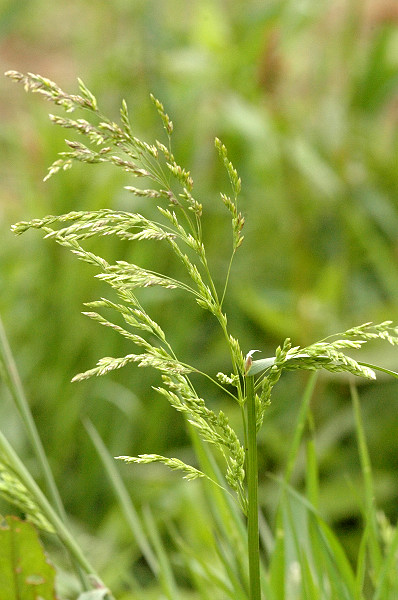
  • fowl-meadow (Poa serotina), now fairly begun to bloom (first noticed the middle of June its slender green panicles shaped like a green red-top);
  • Glyceria fluitans, going out of bloom; also
  •  the sensitive fern (the "hand leaf" of haymakers); 
  • pipes; 
  • (and sedges, which might be named as soon as any, as the crinita which overhangs the water). 

I judge that in a freshet the water rises higher as you go down the river, both from the height to which it rose last March, as shown me at several bridges, and from the height of the bridges themselves, which the builders have been gradually compelled to raise, for the most part just above high-water mark.

H. D. Thoreau, Journal, July 8, 1859

I see an emperor moth (Attacus Cecropia), which came out the 6th. See May 6, 1858 ("A boy brings me to-day an Attacus Cecropia moth . . ., the male, a dark brown above, and considerably larger than mine. It must be about seven inches in alar extent."); June 2, 1855 ("It was surprising to see the creature unfold and expand before our eyes, the wings gradually elongating, . . .at dusk, when apparently it was waving its wings preparatory to its evening flight, I gave it ether and so saved it in a perfect state.");June 18, 1857 ("They brought me an Attacus Cecropia . . . Its body was large like the one I have preserved"); June 22, 1857 ("It seems that Sophia found an Attacus Cecropia out in my chamber last Monday, or the 15th. It soon went to laying eggs on the window-sill, ")

Thimble-berries have begun.  See July 13, 1856 ("Thimble-berries are now fairly ripe and abundant");  July 17, 1856 ("On Linnaea Hill many thimble-berries and some raspberries."); July 18, 1854 ("As I go along the Joe Smith road, every bush and bramble bears its fruit; the sides of the road are a fruit garden; blackberries, huckleberries, thimble-berries, fresh and abundant, no signs of drought; all fruits in abundance; the earth teems. "); July 21, 1856 ("Low blackberries thick enough to pick in some places, three or four days. Thimble-berries about the 12th, and V. Pennsylvanicum much longer.").

The sensitive fern (the "hand leaf" of haymakers.)
See September 6, 1856 ("The sensitiveness of the sensitive fern. If you take a tender plant by the stem, the warmth of your hand will cause the leaves to curl."); August 19, 1854 ("The very light yellowish-green of the sensitive fern which the mowers have left.")

Tuesday, June 4, 2019

Alternate leaf dogwood.

June 4. 

P. M. — To Flint's Pond. 

Cornus alternifolia well out, apparently three or four days. 

Yellow-eyed grass, how long? 


Canada Bluegrass

Poa compressa not quite out.

H. D. Thoreau, Journal, June 4, 1859

Cornus alternifolia well out. See June 10, 1856 ("Cornus alternifolia a day or two, up railroad; maybe longer elsewhere.")

Poa compressa .  The Canada bluegrass or flattened meadow-grass, is a perennial flattened meadow grass, similar to common meadow-grass,  native to Europe  found nearly worldwide as an introduced species. ~ Wikipedia . Specimen in Thoreau herbarium collected on June 14, 1859 at the railroad  causeway. Two other specimens collected at Britton’s Shanty and Great Road on June 2 and 4, 1859, which are in neighboring Lincoln, Massachusetts . The only Journal reference with a specific Concord locale is on June 23, 1860, the railroad at Walden Pond, likely the same locale as his June 14, 1859 collection. ~ Vascular Flora of Concord, Massachusetts. See June 23, 1860 ("Poa compressa may fairly begin on the railroad at Walden").

Sunday, May 5, 2019

Yellow birches in bloom.


May 5. 

Thursday. P.M. — To Melvin's Preserve.

             May 5, 2018                                                               May 5, 2019
 

Red-wings fly in flocks yet. 


Near the oak beyond Jarvis land, a yellow butterfly, — how hot! this meteor dancing through the air. 


Also see a scalloped-edge dark- colored butterfly resting on the trunk of a tree, where, both by its form and color, its wings being closed, it resembles a bit of bark, or rather a lichen. Evidently their forms and colors, especially of the under sides of their wings, are designed to conceal them when at rest with their wings closed. 


Am surprised to find the Viola Muhlenbergii quite abundant beyond the bayberry and near the wall. According to my observation this year, it now stands thus with the violets : the V. ovata is the commonest, but not abundant in one spot; the V. Muhlenbergii is most abundant in particular spots, coloring the hummocks with its small pale flowers; the V. blanda and cucullata are, equally, less abundant than the former, or rather rare; V. pedata and lanceolata rarer yet, or not seen. 

I noticed lately where middle-sized ants, half black and half sorrel, had completely removed the pine-needles from the crown of their large hills, leaving them bare like a mountain-top. 


Am struck by the beauty of the yellow birches, now fairly begun to be in bloom, at Yellow Birch, or Borychium, Swamp. It is perhaps the handsomest tree or shrub yet in bloom (apparently opened yesterday), of similar character to the alders and poplars, but larger and of higher color. You see a great tree all hung with long yellow or golden tassels at the end of its slender, drooping spray, in clusters at intervals of a few inches or a foot. These are all dangling and incessantly waving in the wind, — a great display of lively blossoms (lively both by their color and motion) without a particle of leaf. 


Yet they are dense enough to reveal the outline of the tree, seen against the bare twigs of itself and other trees. The tassels of this one in bloom are elongated to two or three times the length of those of another not in bloom by its side. These dancing tassels have the effect of the leaves of the tremble. Those not quite open have a rich, dark, speckled or braided look, almost equally handsome. Golden tassels all trembling in the gentlest breeze, the only signs of life on the trees. A careless observer might not notice them at all. 


The reawakened springy life of the swamp, the product of its golden veins. These graceful pendants, not in too heavy or dense masses, but thinly dispersed with a noble moderation. Great vegetable chandeliers they stand in the swamps. The unopened catkins, some more golden, others brown or coppery, are like living worms ready to assume a winged life. These trees, which cannot stir their stumps, thus annually assume this lively color and motion. 


I see and am bitten by little black flies, — I should say the same with those of Maine, — here on the Melvin Preserve. One eighth of an inch long. 


Brakes are five inches high. 


Poa annua (small and flat spreading in Pratt's garden), say a week. 

May 5, 2023

The sun sets red (first time), followed by a very hot and hazy day. 


The wilderness, in the eyes of our forefathers, was a vast and howling place or space, where a man might roam naked of house and most other defense, exposed to wild beasts and wilder men. They who went to war with the Indians and French were said to have been "out," and the wounded and missing who at length returned after a fight were said to have "got in," to Berwick or Saco, as the case might be. 


Veronica peregrina, Pratt's garden.


H. D. Thoreau, Journal, May 5, 1859


Near the oak beyond Jarvis land, 
a yellow butterfly,
 — how hot! this meteor 
dancing through the air. 

See May 5, 1860 ("Yellow butterflies."). and Buson:

     Butterfly
sleeping
                 on the temple bell.

See also  May 22, 1856 (“A yellow butterfly over the middle of the flooded meadow.”); May 25, 1852 (“Yellow butterflies one at a time. The large yellow woods violet (V. pubescens) by this brook now out.”); September 19, 1859 ("One flutters across between the horse and the wagon safely enough, though it looks as if it would be run down.") See also A Book of the Seasons,  by Henry Thoreau, Yellow Butterflies
Am surprised to find the Viola Muhlenbergii quite abundant beyond the bayberry and near the wall. See May 12, 1858 ("Find the Viola Muhlenbergii abundantly out (how long?), in the meadow southwest of Farmer's Spring.”); May 18, 1857 (“Viola Muhlenbergii abundantly out, how long?”); May 22, 1856 (“Viola Muhlenbergii, which is abundantly out; how long? A small pale-blue flower growing in dense bunches, but in spots a little drier than the V. cucullata and blanda”); May 29, 1856 ("What a flowery place, a vale of Enna, is that [Painted Cup] meadow! Painted Cup, Erigeron bellidifolius, Thalictrum dioicum, Viola Muhlenbergii, fringed polygala, buck-bean, pedicularis, orobanche, etc., etc. Where you find a rare flower, expect to find more rare ones”)
The yellow birches, now fairly begun to be in bloom, at Yellow Birch, or Borychium, Swamp. See May 17, 1857 ("The yellow birch catkins, now fully out or a little past prime, are very handsome now, numerous clusters of rich golden catkins hanging straight down at a height from the ground on the end of the pendulous branches, amid the just expanding leaf-buds. It is like some great chandelier hung high over the underwood.”)

The sun sets red (first time), followed by a very hot and hazy day. See May 5, 1860 ("Sun goes down red."); May 4, 1860 (“The sun sets red, shorn of its beams.”); August 25, 1854 ("The sun is shorn of his beams by the haze before 5 o'clock P.M., round and red, and is soon completely concealed, apparently by the haze alone.”)

Veronica peregrina, Pratt's garden. See May 5, 1860 ("Veronica serpyllifolia, say yesterday.."). See also See May 22, 1856 ("Veronica peregrina, apparently several days.”);May 25, 1855 ("Veronica peregrina in Mackay’s strawberries, how long? “)

Wednesday, June 23, 2010

The first half of June is cooler than the last half of May.

June 23. 

River at 7 a.m. fifteen inches above summer level, having fallen. 

A sparrow's nest with three fresh eggs in a hollow of a willow, two and a half feet from ground, at my boat's place. The bird has the usual marks, except perhaps the spot on the breast is more obvious, and the lines over the eyes more white and distinct. The eggs have a much bluer-white ground than those I have, and beside are but slightly spotted with brown except toward the larger end. The chip of the bird is metallic, not the hoarse chip of the spring song sparrow. Vide eggs in collection. 

2 p. m. — To Bare Hill road. 

This is a decidedly dogdayish day,* foretold by the red moon of last evening. The sunlight, even this fore noon, was peculiarly yellow, passing through misty clouds, and this afternoon the atmosphere is decidedly blue. 

I see it in the street within thirty rods, and perceive a distinct musty odor. First bluish, musty dog-day, and sultry. Thermometer at two only 85°, however, and wind comes easterly soon and rather cool.

The foliage is now thick and for the most part dark, and this kind of weather is probably the result of this amount of shadow; but it grows cooler with easterly wind before night.

I suspect that it may be true, as said, that the first half of June is cooler than the last half of May, on this account.

Smilacina racemosa, how long? 

Agrostis scabra, pond path at east end of Walden.

Poa compressa may fairly begin on the railroad at Walden; also piper grass just begun. 

I see a young Rana sylvatica in the woods, only five eighths of an inch long. Or is it a hylodes ? — for I see a faint cross-like mark on the back and yet the black dash on the sides of the face. 

At 7 p. m. the river is fifteen and three fourths inches above summer level. It rained hard on the 20th and part of the following night, — two and one eighth inches of rain in all, there being no drought, — raising the river from some two or three inches above summer level to seven and a half inches above summer level at 7 a. m. of the 21st. 


At 7 p. m. of the 21st, 11 inches above summer level. 
At 7 p. m. of the 23rd, 15 3/4 inches above summer level. 


Thus two and one eighth inches of rain at this season, falling in one day, with little or no wind, raises the river while it is falling some four inches; on the next day it rises four more; the next night it rises seven sixteenths inch more; the next day (second after the rain) it rises three and three sixteenths inches ; the next night it falls one eighth of an inch; it rises again three fourths of an inch, or five eighths absolutely; i. e., it rises still the third day after the rain. 

That is, after a remarkably heavy rain of one day it does not rise as much in a night as it ordinarily falls in a day at this season.

H. D. Thoreau,  Journal, June 23, 1860

A sparrow's nest with three fresh eggs in a hollow of a willow, two and a half feet from groundThe eggs have a much bluer-white ground than those I have, and beside are but slightly spotted with brown except toward the larger end. See May 21, 1852 ("A song sparrow's nest and eggs so placed in a bank that none could tread on it; bluish-white, speckled."); June 13, 1858 ("I see a song sparrow's nest here in a little spruce . . . Some of the eggs have quite a blue ground."); June 14, 1855 ("A song sparrow’s nest in ditch bank under Clamshell, of coarse grass lined with fine, and five eggs nearly hatched and a peculiar dark end to them.") See also  A Book of the Seasons,  by Henry Thoreau, The Song Sparrow

This is a decidedly dogdayish day, See June 23, 1853 ("Looking down on it through the woods in middle of this sultry dogdayish afternoon, the water is a misty bluish-green. "); June 23, 1859 ("A foggy, Cape-Cod day, with an easterly wind.")

I see a young Rana sylvatica in the woods, only five eighths of an inch long. Or is it a hylodes ? — for I see a faint cross-like mark on the back and yet the black dash on the sides of the face.  Compare  August 10, 1858 ("I notice several of the hylodes hopping through the woods like wood frogs,. . . They are probably common in the woods, but not noticed, on account of their size, or not distinguished from the wood frog. I also saw a young wood frog, with the dark line through the eye, no bigger than the others. One hylodes which I bring home has a perfect cross on its back"). See September 12, 1857 ("There was a conspicuous dark-brown patch along the side of the [wood frog's] head, whose upper edge passed directly through the eye horizontally, just above its centre, so that the pupil and all below were dark and the upper portion of the iris golden") See also A Book of the Seasons,  by Henry Thoreau, The  Wood Frog (Rana sylvatica)

Popular Posts Last 30 Days.

The week ahead in Henry’s journal

The week ahead in Henry’s journal
A journal, a book that shall contain a record of all your joy.
"A stone fruit. Each one yields me a thought." ~ H. D. Thoreau, March 28, 1859


I sit on this rock
wrestling with the melody
that possesses me.