Showing posts with label Colburn Farm. Show all posts

Wednesday, November 27, 2019

I am pretty sure to scare up partridges in a wood-lot of this size


November 27.

P. M. — To Colburn Farm wood-lot north of C. Hill.
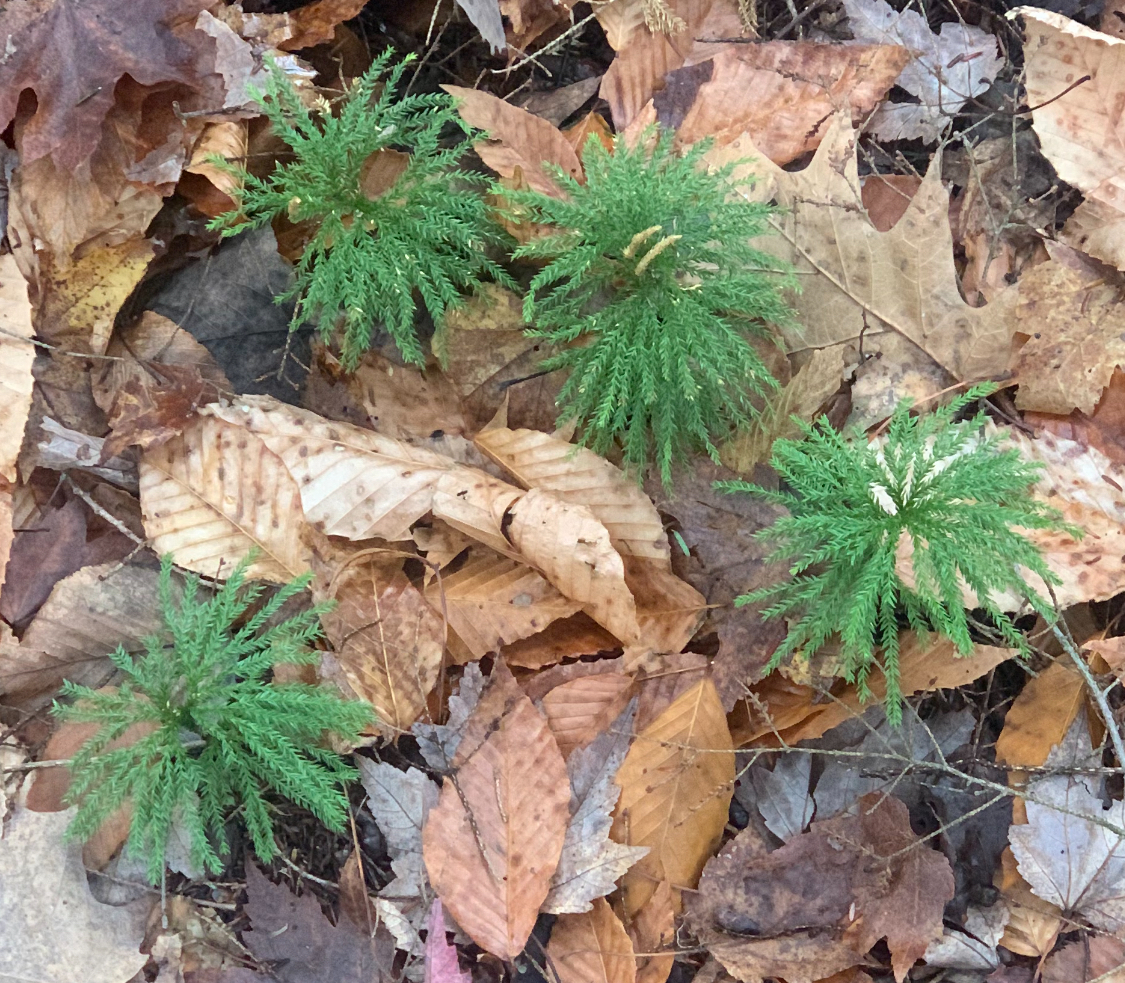
 
Lychopodium, November 27, 2024

I traverse this wood-lot back and forth by the lines cut by those who have lotted it off. Thus I scare up the partridges in it. A dozen long lines four rods apart are cut through it. Walking through these, I am pretty sure to scare up what partridges there are in it, and there are few wood-lots of this size which have not some in them at present. 


Come upon a large ant-hill in the midst of the wood, but no ants on it. It has made an open and bare spot in the woods, ten or twelve feet in diameter. Its mound is partly grassed over, as usual, and trees have been prevented from springing up by the labors of the ants beneath. As this wood is about thirty years old, it may prove that the ant-hill is of the same age! 

On the 22d the ground was white with snow for a few hours only. Yet, though you saw no more of it generally the latter part of that day, I still see some of it in cold, wet, shaded places, as amid andromeda and cranberry vines. 

November 27, 2024

This wood-lot, especially at the northwest base of the hill, is extensively carpeted with the Lycopodium complanatum and also much dendroideum and Chimaphila umbellata. 

The former, methinks, abounds especially in shady and rather moist, and I think old, or rather diseased, and cold(?), woods. It covers the earth densely, even under the thickest white pine groves, and equally grows under birches. It surprises you as if the trees stood in green grass where you commonly see only withered leaves. 

The Greeks and Romans made much of honey be cause they had no sugar; olive oil also was very important. Our poets(?) still sing of honey, though we have sugar, and oil, though we do not produce and scarcely use it. 

The principal flight of geese is said to have been a few days before the 24th. I have seen none.

H D. Thoreau, Journal, November 27, 1859


This wood-lot, especially at the northwest base of the hill, is extensively carpeted with the Lycopodium complanatum and also much dendroideum. See November 27, 1853 (" I observe the Lycopodium lucidulum still of .a fresh, shining green. ");October 16, 1859 ("All the Lycopodium complanatum I see to-day has shed its pollen.");November 11, 1859 ("The flat variety of Lycopodium dendroideum shed pollen on the 25th of October."); November 15, 1858 ("The Lycopodium dendroideum var. obscurum appears to be just in bloom in the swamp about the Hemlocks (the regular one (not variety) is apparently earlier)");  November 16, 1858 ("the lycopodium dendroideum, complanatum, and lucidulum, and the terminal shield fern are also very interesting."); November 17, 1858 ("Lycopodium dendroideum . . .was apparently in its prime yesterday); November 17, 1858 ("It would seem that these lycopodiums, at least, which have their habitat on the forest floor and but lately attracted my attention there (since the withered leaves fell around them and revealed them by the contrast of their color and they emerged from obscurity), —it would seem that they at the same time attained to their prime, their flowering season. ");  December 7, 1853 ("I In the latter part of November and now, before the snow, I am attracted by the numerous small evergreens on the forest floor, now most conspicuous, especially the very beautiful Lycopodium dendroideum, somewhat cylindrical, and also, in this grove, the variety obscurum of various forms, . . .like looking down on evergreen trees. And the L. lucidulum of the swamps, forming broad, thick patches of a clear liquid green,. . . not to mention the spreading openwork umbrellas of the L. complanatum, or flat club-moss, all with spikes still. Also the liquid wet glossy leaves of the Chimaphila (winter or snow-loving) umbellata, with its dry fruit.") See also A Book of the Seasons, by Henry Thoreau, The Lycopodiums

Chimaphila umbellata. [what HDT calls pipsissewa, or “wintergreen.”]   See November 16, 1858 (“Methinks the wintergreen, pipsissewa, is our handsomest evergreen, so liquid glossy green and dispersed almost all over the woods.”); November 19, 1850 ("Now that the grass is withered and the leaves are withered or fallen, it begins to appear what is evergreen the partridge-berry and checkerberry, and winter-green leaves even, are more conspicuous.”)  See also  November 27, 1853 (Checkerberries and partridge-berries are both numerous and obvious now")

The principal flight of geese is said to have been a few days before the 24th.  See November 20, 1853 ("Methinks the geese are wont to go south just before a storm, and, in the spring, to go north just after one, say at the end of a long April storm.”); November 24, 1855 ("Geese went over on the 13th and 14th, on the 17th the first snow fell, and the 19th it began to be cold and blustering.”); November 25, 1852 ("At Walden. — I hear at sundown . . . a flock of wild geese going south."); November 30, 1857 ("The air is full of geese. I saw five flocks within an hour, about 10 A. M., containing from thirty to fifty each, and afterward two more flocks, making in all from two hundred and fifty to three hundred at least”)


November 27. See A Book of the Seasons,  by Henry Thoreau,  November 27


A Book of the Seasons,  by Henry Thoreau,  
A Book of the Seasons,  by Henry Thoreau
 "A book, each page written in its own season, 
out-of-doors, in its own locality."
 ~edited, assembled and rewritten by zphx ©  2009-2025

Friday, March 2, 2018

A large flock of snow buntings, the white birds of the winter, rejoicing in the snow..

March 2  

Snowed last night and this morning, about seven inches deep, much more than during the winter, the first truly wintry-looking day so far as snow is concerned; but the snow is quite soft or damp, lodging in perpendicular walls on the limbs, white on black. But it is as yet neither wheeling nor sleighing, the ground being muddy. 

I remember to have seen these wood-lots being cut this winter: a little on the southwest edge of R. W. E.’s Pinnacle; Stow’s, up to east end of cold pool; northwest corner of Gowing’s, next Great Fields and Moore; an acre or more of the southwest part of the Dennis swamp by railroad; Cyrus Hosmer’s, southwest of Desert; and west of Marlborough road; except north part of last. 

I walk through the Colburn farm pine woods by railroad and thence to rear of John Hosmer’s. 

See a large flock of snow buntings, the white birds of the winter, rejoicing in the snow. I stand near a flock in an open field. They are trotting about briskly over the snow amid the weeds, —apparently pigweed and Roman wormwood, —as it were to keep their toes warm, hopping up to the weeds. 

Then they restlessly take to wing again, and as they wheel about one, it is a very rich sight to see them dressed in black and white uniforms, alternate black and white, very distinct and regular. Perhaps no colors would be more effective above the snow, black tips (considerably more) to wings, then clear white between this and the back, which is black or very dark again. 

One wonders if they are aware what a pleasing uniform appearance they make when they show their backs thus. They alight again equally near. Their track is much like a small crow’s track, showing a long heel and furrowing the snow between with their toes. 

The last new journal thinks that it is very liberal, nay, bold, but it dares not publish a child’s thought on important subjects, such as life and death and good books. It requires the sanction of the divines just as surely as the tamest journal does. If it had been published at the time of the famous dispute between Christ and the doctors, it would have published only the opinions of the doctors and suppressed Christ’s. 

There is no need of a law to check the license of the press. It is law enough, and more than enough, to itself. 

Virtually, the community have come together and agreed what things shall be uttered, have agreed on a platform and to excommunicate him who departs from it, and not one in a thousand dares utter anything else. There are plenty of journals brave enough to say what they think about the government, this being a free one; but I know of none, widely circulated or well conducted, that dares say what it thinks about the Sunday or the Bible. They have been bribed to keep dark. They are in the service of hypocrisy.

H. D. Thoreau, Journal, March 2, 1858

Snowed last night and this morning, about seven inches deep.
See March 2, 1857 ("An inch or two of snow falls, — all day about it, — and strangely blown away."); March 2, 1856 ("Has snowed three or four inches —very damp snow — in the night;")

I remember to have seen these wood-lots being cut this winter. See March 6, 1855 ("There is hardly a wood lot of any consequence left but the chopper’s axe has been heard in it this season. They have even infringed fatally on White Pond, on the south of Fair Haven Pond, shaved ofl’ the topknot of the Cliffs, the Colburn farm, Beck Stow’s, etc., etc.")

A large flock of snow buntings, the white birds of the winter, rejoicing in the snow.. See March 3, 1859 ("looking up, saw about fifteen snow buntings . . . sitting so still and quite white, seen against the white cloudy sky, they did not look like birds but the ghosts of birds. . .These were almost as white as snow balls"): March 20, 1852 ("As to the winter birds, — those which came here in the winter, - I saw . . .  in midwinter, the snow bunting, the white snowbird, sweeping low like snowflakes from field to field over the walls and fences."); See also A Book of the Seasons, by Henry Thoreau, the Snow Bunting


March 2. SeeA Book of the Seasons, by Henry Thoreau, March 2

 Flock of snow buntings
the white birds of the winter
 rejoicing in snow. 

A Book of the Seasons,  by Henry Thoreau,  A large flock of snow buntings rejoicing in the snow.

A Book of the Seasons
,  by Henry Thoreau
 "A book, each page written in its own season,
out-of-doors, in its own locality."
 ~edited, assembled and rewritten by zphx ©  2009-2025

***


Friday. It snows. We have 3 to 4 inches. We walk to the view taking a shortcut at the junction. As usual she gets ahead and I go straight to the chairs. It is too windy to sit and we continue on towards the Middle Pond. There’s a new Hemlock snapped in half in the little valley. It blocks where we spent all that time clearing the beech tree there.  The middle pond is open water for yard or so along the shore but eventually I hop onto the ice and cross. We are able to go down the cliff because the snow is perfect for walking then we take the Cliff Trail under the pine tree

 I hop onto ice
over open water and 
cross the middle pond.
zphx 20180302

Friday, March 6, 2015

This the third day of wind.

March 6

March 6, 2015
Still stronger wind, shaking the house, and rather cool. This the third day of wind.

Our woods are now so reduced that the chopping of this Winter has been a cutting to the quick. At least we walkers feel it as such. There is hardly a wood lot of any consequence left but the chopper’s axe has been heard in it this season. They have even infringed fatally on White Pond, on the south of Fair Haven Pond, shaved ofl’ the topknot of the Cliffs, the Colburn farm, Beck Stow’s, etc., etc.

Observed a mouse or mole's nest in the Second Division Meadow, where it had been made under the snow, —a nice warm globular nest some five inches in diameter, amid the sphagnum and cranberry vines, etc., — made of dried grass and lined with a still finer grass. The hole was on one side, and the bottom was near two inches thick. There were many small paths or galleries in the meadow leading to this from the brook some rod or more distant.

H. D. Thoreau, Journal, March 6, 1855

 Still stronger wind, shaking the house, and rather cool. This the third day of wind. See March 4, 1855 ("Though a cold and strong wind, it is very warm in the sun, and we can sit in the sun where sheltered on these rocks with impunity. It is a genial warmth. "); March 5, 1855 ("This strong, warm wind, rustling the leaves on the hillsides, this blue haze, and the russet earth seen through it, remind me that a new season has come.") See also A Book of the Seasons,  by Henry Thoreau, Signs of the Spring, March is famous for its winds

Observed a mouse nest where it had been made under the snow, —a nice warm globular nest some five inches in diameter. See  February 3, 1856 (“Track some mice to a black willow by riverside, just above spring, against the open swamp; and about three feet high, in apparently an old woodpecker’s hole, was probably the mouse-nest, a double handful, consisting, four ninths, of fine shreds of inner bark, perhaps willow or maple; three ninths, the greenish moss, apparently, of button-bush; two ninths, the gray-slate fur, apparently, of rabbits or mice. Half a dozen hog’s bristles might have been brought by some bird to its nest there. These made a very warm and soft nest.”); February 18, 1857 ("Picked up a mouse-nest in the stubble at Hubbard's mountain sumachs, left bare by the melting snow. It is about five inches wide and three or four high, with one, if not two, small round indistinct entrances on the side, not very obvious till you thrust your finger through them and press aside the fine grass that closes them, . . .A very snug and warm nest, where several might have lain very cosily under the snow in the hardest winter.”); March 22,1855  (“A (probably meadow) mouse nest in the low meadow by stone bridge, where it must have been covered with water a month ago; probably made in fall. Low in the grass, a little dome four inches in diameter, with no sign of entrance, it being very low on one side. Made of fine meadow-grass.”) See also A Book of the Seasons,  by Henry Thoreau, The Wild Mouse

March 6. See A Book of the Seasons, by Henry Thoreau, March 6


 A Book of the Seasons, by Henry Thoreau, The third day of wind.

A Book of the Seasons, by Henry Thoreau
"A book, each page written in its own season,
out-of-doors, in its own locality.”
~edited, assembled and rewritten by zphx © 2009-2025

Thursday, November 6, 2014

It is suddenly cold.

November 6

Surveying on Colburn place. 

November 6, 2023

It is suddenly cold. Pools frozen so as to bear, and ground frozen so that it is difficult, if not impossible, to force down a stake in plowed ground. 

Was that a fish hawk I saw flying over the Assabet, or a goshawk? White beneath, with slender wings.

H. D. Thoreau, Journal, November 6, 1854


It is suddenly cold. Pools frozen so as to bear. 
See November 19, 1855 ("A cold, gray day, once spitting snow. Water froze in tubs enough to bear last night."); November 25, 1857 ("Pools under the north sides of hills are frozen pretty thick"); November 28, 1853 ("Boys skating in Cambridgeport, — the first ice to bear. ")

Was that a fish hawk I saw . . . white beneath, with slender wings.
 See November 17, 1854 ( I think it must have been a fish hawk which I saw hovering over the meadow and my boat (a raw cloudy afternoon).  . . Its wings were very long, slender, and curved in outline of front edge. I think there was some white on rump.) See also A Book of Seasons, by Henry Thoreau, the Osprey (Fish Hawk) and April 17, 1852 ("What is that large hawk with a pure white belly and slender long black wings (a goshawk?) [Or fish hawk?] which I see sailing over the Cliffs , – a pair of them looking for prey"); April 29, 1853 ("At Natural History Rooms in Boston . . . . The American goshawk is slate above, gray beneath; the young spotted dark and white beneath, and brown above
. Fish hawk, white beneath."); April 24, 1854 ("Saw a very large hawk, slaty above and white beneath, low over river. Was it not a goshawk?")


November 6. See A Book of the Seasons, by Henry Thoreau, November 6

It is suddenly 
cold – pools frozen so as to 
bear – and ground frozen

A Book of the Seasons, by Henry Thoreau
"A book, each page written in its own season,
out-of-doors, in its own locality."
~edited, assembled and rewritten by zphx © 2009-2024

https://tinyurl.com/hdt-541106

Tuesday, November 4, 2014

The shad-bush buds have expanded into small leaflets already.

November 4.
November 4, 2014
Saw a shrike in an apple tree, with apparently a worm in its mouth. 

The shad-bush buds have expanded into small leaflets already. 


This while surveying on the old Colburn farm.

H. D. Thoreau, Journal, November 4, 1854

Shad-bush buds have expanded into small leaflets ...  See November 1, 1853 (I notice the shad-bush conspicuously leafing out. Those long, narrow, pointed buds, prepared for next spring, have anticipated their time. I noticed some thing similar when surveying the Hunt wood-lot last winter.)

Thursday, November 26, 2009

To Colburn Farm wood-lot.


November 26.

Lotting off a large wood-lot for auction, I find i have been cutting new paths to walk in.

This part of the earth was an open cultivated field some thirty years ago, but, the wood being suffered to spring up, became a covert and concealed place. Nobody has walked here, nobody has penetrated its recesses. The walker habitually goes round it, or follows the single cart-path that winds through it. Its denseness excludes man.

How private and sacred a place a grove thus becomes! Woods, both the primitive and those which are suffered to spring up in cultivated fields, preserve the mystery of nature.


The chickadee is the bird of the wood the most unfailing. When, in a windy, or in any, day, you have penetrated some thick wood like this, you are pretty sure to hear its cheery note therein. At this season it is almost their sole inhabitant.

I see here today one brown creeper busily inspecting the pitch pines. It begins at the base, and creeps rapidly upward by starts, adhering close to the bark and shifting a little from side to side often till near the top, then suddenly darts off downward to the base of another tree, where it repeats the same course.

It is worth the while to have these thickets on various sides of the town, where the rabbit lurks and the jay builds its nest.

H. D. Thoreau, Journal, November 26, 1859


Brown creeper . . .suddenly darts off downward to the base of another tree. See May 16, 1860 ("flies across to another bough, or to the base of another tree, and traces that up, zigzag and prying into the crevices.”)

The chickadee is the bird of the wood the most unfailing. . . . At this season it is almost their sole inhabitant. See November 4, 1855 (“The birds are almost all gone. The note of the dee de de sounds now more distinct, prophetic of winter”); November 16, 1860 (“In my two walks I saw only one squirrel and a chickadee. Not a hawk or a jay.”); December 1, 1853 ("I hear their faint, silvery, lisping notes, like tinkling glass, and occasionally a sprightly day-day-day, as they inquisitively hop nearer and nearer to me. They are our most honest and innocent little bird, drawing yet nearer to us as the winter advances, and deserve best of any of the walker.”)

It is worth the while to have these thickets on various sides of the town. . . See January 22, 1852 ("I see, one mile to two miles distant on all sides from my window, the woods, which still encircle our New England towns. . . Where still wild creatures haunt .How long will these last?”); Walking ("A town is saved by the woods and swamps that surround it.”)


Popular Posts Last 30 Days.

The week ahead in Henry’s journal

The week ahead in Henry’s journal
A journal, a book that shall contain a record of all your joy.
"A stone fruit. Each one yields me a thought." ~ H. D. Thoreau, March 28, 1859


I sit on this rock
wrestling with the melody
that possesses me.