Showing posts with label skaters. Show all posts

Saturday, June 15, 2019

Willow gone to seed, its down covers the water – white amid the weeds.

June 15. 


5.30 a. m. — To Island and Hill. 

A young painted tortoise on the surface of the water, as big as a quarter of a dollar, with a reddish or orange sternum. 

I suppose that my skater insect is the hydrometer. 

Found a nest of tortoise eggs, apparently buried last night, which I brought home, ten in all, — one lying wholly on the surface, — and buried in the garden. 

The soil above a dark virgin mould about a stump was unexpectedly hard.

1 P. M. — Up Assabet to Garlic Wall. 

That tall grass opposite the Merrick Swimming-Place is getting up pretty well, and blossoming with a broad and regular spike, for some time. 

June 15, 2024

This is the third afternoon that we have had a rumbling thunder-cloud arise in the east, — not to mention the west, — but all signs have failed hitherto, and I resolve to proceed on my voyage, knowing that I have a tight [roof] in my boat turned up. 

The froth on the alders, andromeda, etc., — not to speak of the aphides, — dirties and apparently spots my clothes, so that it is a serious objection to walking amid these bushes these days. I am covered with this spittle-like froth. 

At the Assabet Spring I must have been near a black and white creeper's nest. It kept up a constant chipping. 
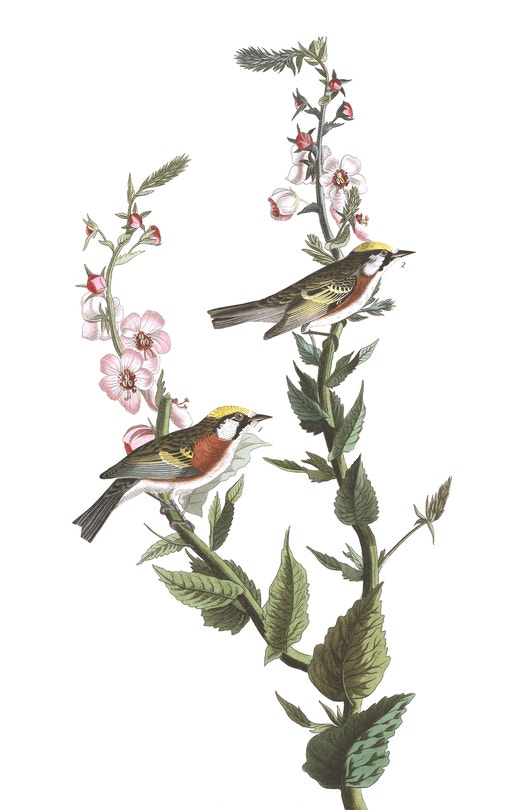


Saw there also, probably, a chestnut-sided warbler. A yellow crown, chestnut stripe on sides, white beneath, and two yellowish bars on wings. 

A red oak there has many large twigs drooping withered, apparently weakened by some insect. May it not be the locust of yesterday? 

Black willow is now gone to seed, and its down covers the water, white amid the weeds. 

The swamp-pink apparently two or even three days in one place. 

Saw a wood tortoise, about two inches and a half, with a black sternum and the skin, which becomes orange, now ochreous merely, or brown. The little painted tortoise of the morning was red beneath. Both these young tortoises have a distinct dorsal ridge. 

The garlic not in flower yet. 

I observed no Nuphar lutea var. Kalmiana on the Assabet. 

7 p. m. — To Cliff by railroad. 

Cranberry. Prinos Icevigatus, apparently two days.

Methinks the birds sing a little feebler nowadays. The note of the bobolink begins to sound somewhat rare. 

The sun has set, or is at least concealed in a low mist. 

As I go up Fair Haven Hill, I feel the leaves in the sprout-land oak, hickory, etc., cold and wet to my hand with the heavy dew that is falling. They look dry, but when I rub them with my hand, they show moist or wet at once. Probably I thus spread minute drops of dew or mist on their surface. It cannot be the warmth of my hand, for when I breathe on them it has no effect. 

I see one or two early blueberries prematurely turning. 

The Amelanchier Botryapium berries are already reddened two thirds over, and are somewhat palatable and soft, — some of them, — not fairly ripe.

H. D. Thoreau, Journal, June 15, 1854

A young painted tortoise . . . as big as a quarter of a dollar
. See April 21, 1855 ("Saw a painted turtle not two inches in diameter. This must be more than one year old."); April 24, 1856 ("A young Emys picta, one and five eighths inches long and one and a half wide. I think it must have been hatched year before last. "); August 28, 1856 ("I open the painted tortoise nest of June 10th, and find a young turtle partly out of his shell . . . The upper shell is fifteen sixteenths of an inch plus by thirteen sixteenths. He is already wonderfully strong and precocious."). See also A Book of the Seasons, by Henry Thoreau, the Painted Turtle (Emys picta)

Found a nest of tortoise eggs. . . which I brought home . . . and buried in the garden. See September 9, 1854 ("This morning I find a little hole, three quarters of an inch or an inch over, above my small tortoise eggs, and find a young tortoise coming out (apparently in the rainy night) just beneath. It is the Sternotherus odoratus"). See also A Book of the Seasons, by Henry Thoreau, the Musk Turtle (Sternothaerus odoratus)

This is the third afternoon that we have had a rumbling thunder-cloud arise in the east. . . I resolve to proceed on my voyage, knowing that I have a tight [roof] in my boat turned up. See June 13, 1854 (''I hear the muttering of thunder and see a dark cloud in the west-southwest horizon; am uncertain how far up-stream I shall get. An opposite cloud rises fast in the east-northeast, and now the lightning crinkles and I hear the heavy thunder. "); June 16, 1854 (" Three days in succession, — the 13th, 14th, and 15th, — thunder-clouds, with thunder and lightning, have risen high in the east, threatening instant rain, and yet each time it has failed to reach us. Thus it is almost invariably, methinks, with thunder-clouds which rise in the east; they do not reach us."). See also June 14, 1855 (" It suddenly begins to rain with great violence, and we in haste draw up our boat on the Clamshell shore, upset it, and get under, sitting on the paddles, and so are quite dry while our friends thought we were being wet to our skins. "); June 15, 1860 ("A thunder-shower in the north goes down the Merrimack. ");June 16, 1860  (" Thunder-showers show themselves about 2 P.M. in the west, but split at sight of Concord and go past on each side")

My skater insect. 
See March 25, 1858 ("Large skaters (Hydrometra) on a ditch"); March 29, 1853 (“Tried several times to catch a skater. Got my hand close to him; grasped at him as quick as possible; was sure I had got him this time; let the water run out between my fingers; hoped I had not crushed him; opened my hand; and lo! he was not there. I never succeeded in catching one.”); September 1, 1852 ("the surface of the pond is perfectly smooth except where the skaters dimple it, for at equal intervals they are scattered over its whole extent, and, looking west, they make a fine sparkle in the sun."); October 11, 1852 ("I could detect the progress of a water-bug over the smooth surface in almost any part of the pond, for they furrow the water slightly,. . . but the skaters slide over it without producing a perceptible ripple. ") See also A Book of the Seasons, by Henry Thoreau, the Water-bug (Gyrinus) and Skaters (Hydrometridae)

Saw probably, a chestnut-sided warbler. A yellow crown, chestnut stripe on sides, white beneath, and two yellowish bars on wings. See May 24, 1854 ("In woods the chestnut-sided warbler, with clear yellow crown and yellow on wings and chestnut sides. It is exploring low trees and bushes, often along stems about young leaves, and frequently or after short pauses utters its somewhat summer-yellowbird like note, say, tchip tchip, chip chip (quick), tche tche ter tchéa, —— sprayey and rasping and faint.”); May 20, 1856 ("I now see distinctly the chestnut-sided warbler (of the 18th and 17th), by Beck Stow’s. It is very lively on the maples, birches, etc., over the edge of the swamp. Sings eech eech eech | wichy wichy | tchea or itch itch itch | witty witty |tchea "); May 23, 1857 (“The chestnut-sided warbler . . .appears striped slate and black above, white beneath, yellow-crowned with black side-head, two yellow bars on wing, white side-head below the black, black bill, and long chestnut streak on side. Its song lively and rather long, about as the summer yellowbird, but not in two bars; tse tse tse \ te tsah tsah tsah \ te sak yer se is the rhythm.”)  See also A Book of the Seasons, by Henry Thoreau, the Chestnut-sided Warbler

Black willow is now gone to seed, and its down covers the water, white amid the weed.   See  June 10, 1853 ("The fuzzy seeds or down of the black (?) willows is filling the air over the river and, falling on the water, covers the surface.");   June 29, 1857  (""The river is now whitened with the down of the black willow, and I am surprised to see a minute plant abundantly springing from its midst and greening it,. . ., — like grass growing in cotton in a tumbler."); July 9, 1857 ("There is now but little black willow down left on the trees. . . . I think I see how this tree is propagated by its seeds." )See also A Book of the Seasons, by Henry Thoreau, the Propogation of the Willow.

The swamp-pink apparently two or even three days in one place. June 19, 1852 ("Is not this the carnival of the year when the swamp rose and wild pink are in bloom the last stage before blueberries come?") See also A Book of the Seasons, by Henry Thoreau, Swamp-pink

Methinks the birds sing a little feebler nowadays. See June 25, 1854 (“Through June the song of the birds is gradually growing fainter.”)

The note of the bobolink begins to sound somewhat rare.
See May 12, 1856 ("How much life the note of the bobolink imparts to the meadow! "); June 19, 1853 ("The strain of the bobolink now begins to sound a little rare. It never again fills the air as the first week after its arrival.") A Book of the Seasons,  by Henry Thoreau, the Bobolink

I see one or two early blueberries prematurely turning. The Amelanchier Botryapium berries are already red. See May 17, 1853 (“The petals have already fallen from the Amelanchier Botryapium, and young berries are plainly forming.”); May 30, 1854 (" I see now green high blueberries, and gooseberries in Hubbard's Close, as well as shad-bush berries and strawberries. "); June 7, 1854 ("I am surprised at the size of green berries. It is but a step from flowers to fruit.")

June 15. See A Book of the Seasons, by Henry Thoreau, June 15

Willow gone to seed
its down covers the water –
white amid the weeds.

A Book of the Seasons,  by Henry Thoreau 
 "A book, each page written in its own season, 
out-of-doors, in its own locality."
 ~edited, assembled and rewritten by zphx ©  2009-2024
https://tinyurl.com/hdt-540615

Saturday, March 30, 2019

Singing and whistling at the same time.

March 30

March 30, 2016

6 a.m. — To Hill (across water). 

Hear a red squirrel chirrup at me by the hemlocks (running up a hemlock), all for my benefit; not that he is excited by fear, I think, but so full is he of animal spirits that he makes a great ado about the least event. 

At first he scratches on the bark very rapidly with his hind feet without moving the fore feet. He makes so many queer sounds, and so different from one another, that you would think they came from half a dozen creatures. I hear now two sounds from him of a very distinct character, — a low or base inward, worming, screwing, or brewing, kind of sound (very like that, by the way, which an anxious partridge mother makes) and at the same time a very sharp and shrill bark, and clear, on a very high key, totally distinct from the last, — while his tail is flashing incessantly. 

You might say that he successfully accomplished the difficult feat of singing and whistling at the same time. 

P. M. — To Walden via Hubbard's Close. 

The green-bodied flies out on sheds, and probably nearly as long as the other; the same size as the house-fly. 

I see numerous large skaters on a ditch. This may be the Gerris lacustris, but its belly is not white, only whitish in certain lights. It has six legs, two feelers (the two foremost legs being directed forward), a stout-ish body, and brown above. The belly looks whitish when you look at it edgewise, but turned quite over (on its back), it is brown. 

A very small brown grasshopper hops into the water. 

I notice again (in the spring-holes in Hubbard's Close) that water purslane, being covered with water, is an evergreen, — though it is reddish. 

Little pollywogs two inches long are lively there. 

See on Walden two sheldrakes, male and female, as is common. So they have for some time paired. They are a hundred rods off. The male the larger, with his black head and white breast, the female with a red head. With my glass I see the long red bills of both. They swim at first one way near together, then tack and swim the other, looking around incessantly, never quite at their ease, wary and watchful for foes. A man cannot walk down to the shore or stand out on a hill overlooking the pond without disturbing them. They will have an eye upon him. 

The locomotive-whistle makes every wild duck start that is floating within the limits of the town. I see that these ducks are not here for protection alone, for at last they both dive, and remain beneath about forty pulse-beats, — and again, and again. I think they are looking for fishes. Perhaps, therefore, these divers are more likely to alight in Walden than the black ducks are. 

Hear the hovering note of a snipe.

H. D. Thoreau, Journal, March 30, 1859

Hear a red squirrel chirrup at me by the hemlocks (running up a hemlock), all for my benefit; not that he is excited by fear, I think, but so full is he of animal spirits that he makes a great ado about the least event. See October 5, 1857 (“I hear the alarum of a small red squirrel. . . .  It is evident that all this ado does not proceed from fear. There is at the bottom, no doubt, an excess of inquisitiveness and caution, but the greater part is make-believe and a love of the marvellous.) See also A Book of Seasons, by Henry Thoreau, The Red Squirrel

I see numerous large skaters on a ditch. See March 29, 1853 ("Tried several times to catch a skater. Got my hand close to him; grasped at him as quick as possible; was sure I had got him this time; let the water run out between my fingers; hoped I had not crushed him; opened my hand; and lo! he was not there. I never succeeded in catching one.”) See also A Book of Seasons, by Henry Thoreau, the Water-bug (Gyrinus) and  Skaters (Hydrometridae)


See on Walden two sheldrakes, male and female, as is common. . .  They swim at first one way near together, then tack and swim the other, looking around incessantly, never quite at their ease, wary and watchful for foes. See March 30, 1858 ("The full plumaged males, conspicuously black and white and often swimming in pairs, appeared to be the most wary, keeping furthest out. ").See also March 27, 1858 ("They are now pairing. . . .At first we see only a male and female quite on the alert, some way out on the pond, tacking back and forth and looking every way."); April 7, 1855 ("But they will let you come only within some sixty rods ordinarily. I observe that they are uneasy at sight of me and begin to sail away in different directions."). Also see A Book of Seasons, by Henry Thoreau, The Sheldrake (Goosander, Merganser)

Hear the hovering note of a snipe. See March 29, 1858 ("At the first pool I also scared up a snipe. It rises with a single cra-a-ckand goes off with its zigzag flight, with its bill presented to the earth, ready to charge bayonets against the inhabitants of the mud.”); April 1, 1853 ("Now, at early starlight, I hear the Snipe’s hovering note as he circles over Nawshawtuct Meadow. . . . It sounds very much like a winnowing-machine increasing rapidly in intensity for a few seconds.”) See also A Book of Seasons, by Henry Thoreau, The Snipe

A pair of ravens 
now crossing in front of us
in erratic flight.
March 30, 2019

Saturday, March 9, 2019

It is worthwhile to hear the wind roar in the woods to-day.

March 9

P. M. — To Lee's Cliff with C. 

C. says that he heard and saw a bluebird on the 7th, and R. W. E. the same. This was the day on which they were generally observed. I am doubtful about one having been seen on the 20th of February by a boy, as stated February 23d. 

C. also saw a skater-insect on the 7th, and a single blackbird flying over Cassandra Ponds, which he thought a grackle. 

A true spring day, not a cloud in the sky. The earth shines, its icy armor reflecting the sun, and the rills of melting snow in the ruts shine, too, and water, where exposed in the right light on the river, is a remarkably living blue, just as the osiers appear brighter. 

Yet it is cool and raw and very windy. 

The ice over the channel of the river, when not quite melted, is now generally mackerelled (the water representing the blue portions) with parallel openings, riddling it or leaving a sort of network of ice over it, answering to the ridges of the waves. You can best observe them from bridges. In some cases the snow upon the ice, having lain in successive drifts, might also assist or modify this phenomenon. 

The rain of yesterday has been filling the meadows again, flowing up under the dry ice of the winter freshet, which for the most part rested on the ground, and so this rise is at first the less observed until it shows itself beyond the edge of the ice. At Corner Spring Brook the water reaches up to the crossing and stands over the ice there, the brook being open and some space on each side of it.

When I look, from forty or fifty rods off, at the yellowish water covering the ice about a foot here, it is decidedly purple (though, when close by and looking down on it, it is yellowish merely), while the water of the brook-channel and a rod on each side of it, where there is no ice beneath, is a beautiful very dark blue. 

These colors are very distinct, the line of separation being the edge of the ice on the bottom, and this apparent juxtaposi tion of different kinds of water is a very singular and pleasing sight. You see a light-purple flood, about the color of a red grape, and a broad channel of dark-purple water, as dark as a common blue-purple grape, sharply distinct across its middle. 

I see at Lee's the long, narrow radical leaves of the Turritis striata just beginning to push their shoots, — the most forward-looking plant there. 

We cross Fair Haven Pond on the ice, though it is difficult getting on and off, it being melted about the edges, as well as overflowed there. 

It is worthwhile to hear the wind roar in the woods to-day. It sounds further off than it is.

Came across a stout and handsome woodchopper with a full dark or black beard, but that on his upper lip was a distinct sandy color. It was a very pleasing contrast, suggesting a sympathy with the centre of light and intelligence nearer to which it grew.

H. D. Thoreau, Journal, March 9, 1859

This was the day on which they were generally observed. See March 9, 1852 (“I hear and see bluebirds, come with the warm wind.”); March 9, 1856 (“[T]his is about the date that bluebirds arrive commonly.”)

A true spring day, not a cloud in the sky. The earth shines, its icy armor reflecting the sun, and the rills of melting snow in the ruts shine, too. See March 8, 1853 ("The melting snow, running and sparkling down-hill in the ruts, was quite springlike."):

It is worthwhile to hear the wind roar in the woods to-day. It sounds further off than it is. See March 9, 1852 (“These March winds, which make the woods roar and fill the world with life and bustle, appear to wake up the trees out of their winter sleep and excite the sap to flow.”);   March 9, 1860 ("You incline to walk now along the south side of hills which will shelter you from the blustering northwest and north winds");  See also  March 18, 1858 ("The rather warm but strong wind now roars in the wood — as in the maple swamp — with a novel sound.”);

Listen to the wind
roaring in the woods today,
it sounds further off.


Thursday, October 11, 2018

Now it is true autumn; all things are crisp and ripe.

October 11

Monday.


October 11, 2018

Most leaves are already somewhat faded and withered. Their tints are not so bright. The chestnut leaves already rustle with a great noise as you walk through the woods, as they lie light, firm, and crisp.

Now the chestnuts are rattling out. The burs are gaping and showing the plump nuts. They fill the ruts in the road, and are abundant amid the fallen leaves in the midst of the wood. 

The jays scream, and the red squirrels scold, while you are clubbing and shaking the trees. Now it is true autumn; all things are crisp and ripe. 

I observed the other day (October 8) that those insects whose ripple I could see from the Peak were water-bugs. I could detect the progress of a water-bug over the smooth surface in almost any part of the pond, for they furrow the water slightly, making a conspicuous ripple bounded by two diverging lines, but the skaters slide over it without producing a perceptible ripple. In this clear air and with this glassy surface the motion of every water-bug, ceaselessly progressing over the pond, was perceptible. Here and there amid the skaters.

H. D. Thoreau, Journal, October 11, 1852

Now it is true autumn; all things are crisp and ripe. See September 16, 1852 ("The jay screams; the goldfinch twitters; the barberries are red. The corn is topped.")

The skaters slide over it without producing a perceptible ripple. See October 12, 1852 ("I can discern no skaters nor water-bugs on the surface of the pond, which is now rippled. Do they, then, glide forth to the middle in calm days only, by short impulses, till they have completely covered it? ") See also A Book of the Seasons,  by Henry Thoreau, the Water-bug (Gyrinus) and  Skaters (Hydrometridae)

Monday, April 16, 2018

Fish embryos suddenly hatched


April 16

My fish ova in a tumbler has gradually expanded till it is some three sixteenths of an inch in diameter, and for more than a week the embryos have been conspicuously active, hardly still enough to be observed with a microscope. Their tails, eyes, pectoral fins, etc., were early developed and conspicuous. They keep up a regular jerking motion as they lie curved in the egg, and so develop themselves. 

This morning I set them in the sun, and, looking again soon after, found that they were suddenly hatched, and more than half of them were free of the egg. They were nearly a quarter of an inch long, or longer than the diameter of a perfect egg. The substance of the egg-shell seemed to have expanded and softened, and the embryo by its incessant quirking elongated it so that it was able to extend itself at full length. It then almost incessantly kept up a vibratory motion of its tail and its pectoral fins, and every few moments it bunted against the side of the egg, wearing it away and extending it, till it broke through. Sometimes it got its head out first and then struggled many minutes before it escaped completely. 

It was a pretty sight to see them all rising immediately to the surface by means of the tail and pectoral fins, the first vibrating from one twentieth to one thirtieth of an inch, at an angle of about forty-five degrees, and then, ceasing their motions, they steadily settled down again. Think of the myriads of these minnows set free of a warm morning, and rising and falling in this wise in their native element!!

(Some are still in the egg on the 18th.) 

The incessant activity of these minnows, and apparent vigor, are surprising. Already they dart swiftly an inch one side like little pickerel, tender as they are, carrying the yolk with them, which gradually diminishes, as I notice, in a day or two after. They have no snouts yet, or only blunt and rounded ones. I have not detected any general resting even at night, though they often rest on the bottom day or night. 

They are remarkably aroused when placed in the morning sun. This sets them all in motion. Looking at them through a jar between you and the sun, a hundred at once, they reflect the colors of the rainbow, — some purple, others violet, green, etc., etc. It is a wonder how they survive the accidents of their condition. 

By what instinct do they keep together in a school? I think that the spawn could not have been laid long when I found it April 3d, it was so perfect and the embryo so slightly, if at all, developed. That was a sudden very warm day. In that case, they may be hatched in a fortnight. That appeared to have been a general breeding-place for this species of fish. I looked a good while on the 14th, but could find none near home. 

My hylodes in the tumbler will always hop to the side toward the window as fast as I turn it. 

We may think these days of the myriads of fishes just hatched which come rising to the surface. The water swarms with them as with the mosquito.

P. M. — To Conantum. 

The Rana sylvatica spawn at Hubbard's Grove begins to kick free. This is early. I put some in a bottle, which being shaken in my walk, I find the embryos all separated from the ova when I get home. These are now regular little pollywogs and wiggle about in a lively manner when the water is shaken. 

They are chiefly tail and head. They look like the samara of the ash, and in both cases this winged or feather-like tail it is that transports them. I can already see their little feet or fins. 

The bodkin-like bulb, considerably grown, in my tumbler and elsewhere, is probably the water-purslane. I see it floating free and sending out many rootlets, on pools and ditches. In this way it spreads itself. 

The earliest red maple I can see in this walk is well out, on the Hubbard Bridge causeway. Probably some was yesterday. 

I sat a long time by the little pool behind Lee's, to see the hylodes. Not one was heard there; only the skater insects were slightly rippling the surface, pursuing one another and breeding amid the grass. The bottom is covered with pretty proserpinaca. 

At length I see one hylodes with heels up, burying itself at the bottom. How wary they are! After nearly half an hour I see one sitting out on a blade of the floating purple grass, but down he goes again. They see or hear you three or four rods off. They are more active toward night.

H. D. Thoreau,  Journal, April 16, 1858


I think that the spawn could not have been laid long when I found it April 3d, it was so perfect and the embryo so slightly, if at all, developed. For more than a week the embryos have been conspicuously active, as they lie curved in the egg. This morning I  found that they were suddenly hatched, and more than half of them were free of the egg.
See April 3, 1858 (“When returning, we discovered, on the south side of the river, just at the old crossing-place from the Great Meadows, north of the ludwigia pool, a curious kind of spawn. It was white, each ovum about as big as a robin-shot or larger, with mostly a very minute white core, no black core, and these were agglutinated together in the form of zigzag hollow cylinders, two or three inches in diameter and one or two feet long, looking like a lady's ruff or other muslin work, on the bottom or on roots and twigs of willow and button-bush, where the water was two or three feet deep. The greater part lay on the bottom, looking like a film, these cylinders being somewhat coiled about there. When you took it up, the two sides fell together, and it was flat in your hand like the leg of a stocking. In one place there were a dozen very large red-bellied and brown-backed leeches in it, evidently battening on it. ); April 7, 1858 ("I brought home t... two kinds of spawn in a pail. ... The other (probably fish) spawn is seen to be arranged in perfect hexagons; i. e., the ova so impinge on each other; but where there is a vent or free side, it is a regular arc of a circle. Is not this the form that spheres pressing on each other equally on all sides assume? I see the embryo, already fish-like (?), curved round the yolk, with a microscope.”); April 14, 1858 (“My Rana halecina spawn in tumbler is now flatted out and begins to betray the pollywog form. I had already noticed a little motion in it from time to time, but nothing like the incessant activity of the embryo fishes. . . .At Ed. Hoar's in the evening.. . .. with his microscope I see the heart beating in the embryo fish and the circulations distinctly along the body.”); April 22, 1858 (“The spawn of April 18th is gone! It was fresh there and apparently some creature has eaten it.”)April 24, 1858 (“I find that my fish ova were not all killed some weeks ago in the firkin, as I supposed, for many that were accidentally left in it have hatched, and they bore the cold of last night better than those hatched earlier and kept in the larger vessel (tub), which froze but thinly, while the firkin froze a quarter of an inch thick last night.”); April 27, 1858 (“I noticed yesterday that again the newly laid spawn at the cold pool on Hubbard's land was all gone, and that in the larger pool south of it was much diminished. What creature devours it? ”); April 27, 1858 (“My young fishes had the pectoral fins and tail very early developing, but not yet can I detect any other fins with my glass. They had mouths, which I saw them open as soon as hatched, and more and more a perch-like head. I think that with Hoar's microscope I detected two dorsal fins such as the perch have. ”); April 30, 2018 ("I carry the rest of my little fishes, fifteen or twenty, to the cold pool in Hubbard's ground. They are about a quarter-inch long still, and have scarcely increased in length.”); June 16, 1858 ("Looking into Hubbard's Pool, I at length see one of the minims which I put into it. I brought the last here April 30th. It is now a little perch about an inch and a quarter long; it was then about a quarter of an inch long. I can now see the transverse bars a rod off. It is swimming actively round and round the pool, but avoids the quite shallow water of the edges, so it does not get landlocked or lost in the weedy overflowed edges. I put twenty or thirty into this pool in all. They grow very fast, then, at last.”)

The earliest red maple I can see in this walk is well out. See April 24, 1854 ("The first red maple blossoms — so very red over the water — are very interesting");. April 26, 1855 ("The blossoms of the red maple (some a yellowish green) are now most generally conspicuous and handsome scarlet crescents over the swamps.") See also A Book of the Seasons, by Henry Thoreau, The Red Maple

I sat a long time by the little pool behind Lee's, to see the hylodes. Not one was heard there; . . How wary they are! See March 31, 1857 (" If you do not listen carefully for its first note, you probably will not hear it, and, not having heard that, your ears become used to the sound, so that you will hardly notice it at last, however loud and universal.. . . The shrill peeping of the hylodes locates itself nowhere in particular.")

My hylodes in the tumbler will always hop to the side toward the window as fast as I turn it. See  April 15, 1858 ("Catch a peeper at Hayden’s Pool. I suspect it may have been a female . . . It was a pale fawn-color out of water, nine tenths of an inch long, marked with dusky like this though not so distinctly. It could easily climb up the side of a tumbler, and jumped eighteen inches at once.")

Sunday, March 25, 2018

A poet away from home.

March 25. 

P. M. – To bank of Great Meadows by Peter’s. 

Cold northwest wind as yesterday and day before. Large skaters (Hydrometra) on a ditch. 

Going across A. Clark's field behind Garfield’s, I see many fox-colored sparrows flitting past in a straggling manner into the birch and pitch pine woods on the left, and hear a sweet warble there from time to time. They are busily scratching like hens amid the dry leaves of that wood (not swampy), from time to time the rearmost moving forward, one or two at a time, while a few are perched here and there on the lower branches of a birch or other tree; and I hear a very clear and sweet whistling strain, commonly half finished, from one every two or three minutes. It is too irregular to be readily caught, but methinks begins like ar tohe tohe tchear, te tche tchear, etc., etc., but is more clear than these words would indicate. The whole flock is moving along pretty steadily. 

There are so many sportsmen out that the ducks have no rest on the Great Meadows, which are not half covered with water. They sit uneasy on the water, looking about, without feeding, and I see one man endeavor to approach a flock crouchingly through the meadow for half a mile, with india-rubber boots on, where the water is often a foot deep. This has been going on, on these meadows, ever since the town was settled, and will go on as long as ducks settle here. 

You might frequently say of a poet away from home that he was as mute as a bird of passage, uttering a mere chip from time to time, but follow him to his true habitat, and you shall not know him, he will sing so melodiously.

H. D. Thoreau, Journal, March 25, 1858

Large skaters (Hydrometra) on a ditch. See March 22, 1853 ("At Nut Meadow Brook, water-bugs and skaters are now plenty."); March 22, 1860 ("The phenomena of an average March . . . Many insects and worms come forth and are active , -and the perla insects still about ice and water , — as tipula , grubs , and fuzzy caterpillars , minute hoppers on grass at springs ; gnats , large and small , dance in air ; the common and the green fly buzz outdoors ; the gyrinus , large and small , on brooks , etc. , and skaters") See also A Book of the Seasons, by Henry Thoreau, the Water-bug (Gyrinus) and Skaters (Hydrometridae)

I hear a very clear and sweet whistling strain. See March 28, 1854 ("The fox-colored sparrow sings sweetly also.”)

The whole flock is moving along pretty steadily. See April 9, 1856 (“A flock of them - rapidly advancing, flying before one another, through the swamp.”) See also A Book of the Seasons,  by Henry Thoreau, the Fox-colored Sparrow.

Cold northwest wind as yesterday and day before . . .There are so many sportsmen out that the ducks have no rest.  See March 25, 1854 ("Too cold and windy almost for ducks. They are in the smoother open water (free from ice) under the lee of hills.") Compare  March 25, 1860 ("See no ducks on Fair Haven Pond .") and see . March 28, 1858 ("There is not a duck nor a gull to be seen on it. I can hardly believe that it was so alive with them yesterday. Apparently they improve this warm and pleasant day, with little or no wind, to continue their journey northward.. . . No doubt there are some left, and many more will soon come with the April rains. It is a wildlife that is associated with stormy and blustering weather"); .March 29, 1858 ("I infer that waterfowl travel in pleasant weather") See also   A Book of the Seasons, by Henry Thoreau, the American Black Duck

Saturday, October 14, 2017

Some aspens are a very fair yellow now, and trembling as in summer.

October. 14. 

October 14, 2022

P. M. — To White Pond. 

Another, the tenth of these memorable days. 

We have had some fog the last two or three nights, and this forenoon it was slow to disperse, dog-day-like, but this afternoon it is warmer even than yesterday. I should like it better if it were not so warm. I am glad to reach the shade of Hubbard’s Grove; the coolness is refreshing. 

It is indeed a golden autumn. 

These ten days are enough to make the reputation of any climate. A tradition of these days might be handed down to posterity. They deserve a notice in history, in the history of Concord. All kinds of crudities have a chance to get ripe this year. Was there ever such an autumn? 

And yet there was never such a panic and hard times in the commercial world. The merchants and banks are suspending and failing all the country over, but not the sand-banks, solid and warm, and streaked with bloody blackberry vines. You may run upon them as much as you please,—even as the crickets do, and find their account in it. They are the stockholders in these banks, and I hear them creaking their content. You may see them on change any warmer hour. In these banks, too, and such as these, are my funds deposited, a fund of health and enjoyment. Their (the crickets) prosperity and happiness and, I trust, mine do not depend on whether the New York banks suspend or no. We do not rely on such slender security as the thin paper of the Suffolk Bank. To put your trust in such a bank is to be swallowed up and undergo suffocation. Invest, I say, in these country banks. Let your capital be simplicity and contentment. Withered goldenrod (Solidago nemoralis) is no failure, like a broken bank, and yet in its most golden season nobody counterfeits it. Nature needs no counterfeit-detector. I have no compassion for, nor sympathy with, this miserable state of things. Banks built of granite, after some Grecian or Roman style, with their porticoes and their safes of iron, are not so permanent, and cannot give me so good security for capital invested in them, as the heads of withered hardhack in the meadow. I do not suspect the solvency of these. I know who is their president and cashier. 

I take all these walks to every point of the compass, and it is always harvest-time with me. I am always gathering my crop from these woods and fields and waters, and no man is in my way or interferes with me. My crop is not their crop. To-day I see them gathering in their beans and corn, and they are a spectacle to me, but are soon out of my sight. I am not gathering beans and corn. Do they think there are no fruits but such as these ? I am a reaper; I am not a gleaner. I go reaping, cutting as broad a swath as I can, and bundling and stacking up and carrying it off from field to field, and no man knows nor cares. My crop is not sorghum nor Davis seedlings. There are other crops than these, whose seed is not distributed by the Patent Office. I go abroad over the land each day to get the best I can find, and that is never carted off even to the last day of November, and I do not go as a gleaner.

The farmer has always come to the field after some material thing; that is not what a philosopher goes there for. 

I see, in Hubbard's Grove, a large black birch at the very height of its change. Its leaves a clear, rich yellow; many strew the ground. 

Near by is a tupelo which is all a distinct yellow with a little green. 

Within a couple of rods a single hyla peeps interruptedly, bird like.

Large oaks appear to be now generally turned or turning. The white, most conspicuous in sunny places, say a reddish salmon; began to change at lower limbs. Black oaks a brownish yellow. These large trees are not brilliant. 

On the causeway I pass by maples here and there which are bare and smoke-like, having lost their brilliant clothing; but there it lies, nearly as bright as ever, on one side on the ground, making neanly as regular a figure as lately on the tree. I should rather say that I first observed the trees thus flat on the ground like a permanent colored and substantial shadow, and they alone suggested to look for the trees that had borne them. They preserve these bright colors on the ground but a short time, a day or so, especially if it rains. 

I see a large flock of grackles, probably young birds, quite near me on William Wheeler's apple trees, pruning themselves and trying to sing. They never succeed; make a sort of musical spluttering. Most, I think, have brownish heads and necks, and some purple reflections from their black bodies. 

There is a very little gossamer, mostly blowing off in large loops from the south side the bridge, the loose end having caught. I also see it here and there stretched across lanes from side to side, as high as my face. 

Sat in the old pasture beyond the Corner Spring Woods to look at that pine wood now at the height of its change, pitch and white. Their change produces a very singular and pleasing effect. They are regularly parti-colored. The last year's leaves, about a foot beneath the extremities of the twigs on all sides, now changed and ready to fall, have their period of brightness as well as broader leaves. They are a clear yellow, contrasting with the fresh and liquid green of the termi nal plumes, or this year's leaves. These two quite distinct colors are thus regularly and equally distributed over the whole tree. You have the warmth of the yellow and the coolness of the green. So it should be with our own maturity, not yellow to the very extremity of our shoots, but youthful and untried green ever putting forth afresh at the extremities, foretelling a maturity as yet unknown. The ripe leaves fall to the ground and become nutriment for the green ones, which still aspire to heaven. In the fall of the leaf, there is no fruit, there is no true maturity, neither in our science and wisdom. 

Some aspens are a very fair yellow now, and trembling as in summer. I think it is they I see a mile off on Bear Garden Hill, amid the oaks and pines. 

There is a very thick haze this afternoon and almost a furnace-like heat. I cannot see far toward the sun through it. 

Approaching White Pond by the path, I see on its perfectly smooth surface what I at first mistake for a large raft of dead and black logs and limbs, but it soon elevates itself in the form of a large flock of black ducks, which go off with a loud quacking. 

This, as other ponds now, when it is still, has a fine sparkle from skaters on it. I go along near the shore in the woods to the hill recently cleared on the east side. The clethra as an under-bush has an exceedingly pale yellow leaf. The nemopanthes on the hill side is like the amelanchier, yellowish with consider able ruddiness; the total effect is russet. 

Looking now toward the north side of the pond, I perceive that the reflection of the hillside seen from an opposite hill is not so broad as the hillside itself appears, owing to the different angle at which it is seen. The reflection exhibits such an aspect of the hill, apparently, as you would get if your eye were placed at that part of the surface of the pond where the reflection seems to be. 

In this instance, too, then, Nature avoids repeating herself. 

Not even reflections in still water are like their substances as seen by us. This, too, accounts for my seeing portions of the sky through the trees in reflections often when none appear in the substance. Is the reflection of a hillside, however, such an aspect of it as can be obtained by the eye directed to the hill itself from any single point of view? It plainly is not such a view as the eye would get looking upward from the immediate base of the hill or water's edge, for there the first rank of bushes on the lower part of the hill would conceal the upper. The reflection of the top appears to be such a view of it as I should get with my eye at the water's edge above the edge of the reflection; but would the lower part of the hill also appear from this point as it does in the reflection? Should I see as much of the undersides of the leaves there? If not, then the reflection is never a true copy or repetition of its substance, but a new composition, and this may be the source of its novelty and attractiveness, and of this nature, too, may be the charm of an echo. 

I doubt if you can ever get Nature to repeat herself exactly. 

The occasional dimples on this pure sheeny surface in which the sky is reflected make you suspect as soon some mote fallen from the sky as risen from beneath, to disturb it. 

Next to the scarlet, methinks the white shrub oaks make, or have made, the most brilliant show at a distance on hillsides. The latter is not very bright, unless seen between you and the sun, but there its abundant inward color is apparent. 

At the head of the path by the pond, I saw a red squirrel, only a rod off in a white pine, eating a toadstool. It was a slightly convex white disk, (then) two inches in diameter. I saw where he had bitten off its white stump within a few feet of the base of the tree. I should not have called it an edible one; but he knows. He held it vertically with a paw on each side and what had been the lower side toward him, and was nibbling off the inside edge very fast, turning it round from time to time and letting some fragments drop, pausing to look at me. As a boy might nibble a biscuit. Are nuts scarce? I think it was not the edible one; was too big. 

Veronica serpyllifolia in bloom.

H. D. Thoreau, Journal, October 14, 1857


The reflection of the top appears to be such a view of it as I should get with my eye at the water's edge. . .See November 23, 1853 ("You see the reflections of the humblest weeds against the sky, but you cannot put your head low enough to see the substance so. The reflection enchants us, just as an echo does.");  December 8, 1853 (“I saw from the peak the entire reflection of large white pines very distinctly against a clear white sky, though the actual tree was completely lost in night against the dark distant hillside.”); December 9, 1856 ("I perceive that more or other things are seen in the reflection than in the substance.");November 2, 1857 ("The water tells me how it looks to it seen from below.”)


The reflection is never a true copy or repetition of its substance, but a new composition, and this may be the source of its novelty and attractiveness, and of this nature, too, may be the charm of an echo.
See October 12, 1851 ("The echo is to some extent an independent sound, and therein is the magic and charm of it.")

I first observed the trees thus flat on the ground like a permanent colored and substantial shadow, and they alone suggested to look for the trees that had borne them. See October 15, 1853 ("They suddenly form thick beds or carpets on the ground . . . just the size and form of the tree above.")

They are regularly parti-colored. The last year's leaves,  are a clear yellow, contrasting with the fresh and liquid green of the terminal plumes, or this year's leaves. See October 14, 1852 (“The pines are now two-colored, green and yellow, - the latter just below the ends of the boughs.”)

https://tinyurl.com/HDT571014

Friday, March 29, 2013

The vastness and strangeness of nature.

March 29

It is a surprising and memorable and, I may add, valuable experience to be lost in the woods, especially at night. 

Sometimes in a snow-storm, even by day, one will come out upon a well-known road and yet find it impossible to tell which way leads to the village. Though your reason tells you that you have travelled it one hundred times, yet no object looks familiar, but it is as strange to you as if it were in Tartary. By night, of course, the perplexity is infinitely greater.

We are constantly steering like pilots by certain well-known beacons and headlands, though we are not conscious of it, and if we go beyond our usual course we still preserve the bearing of some neighboring cape, and not till we are completely lost or turned round, - for a man needs only to be turned round once with his eyes shut in this world to be lost,- do we appreciate the vastness and strangeness of nature. 

Every man has once more to learn the points of compass as often as he awakes, whether from sleep or from any abstraction. In fact, not till we are lost do we begin to realize where we are, and the infinite extent of our relations. 

A pleasant short voyage is that to the Leaning Hemlocks on the Assabet, just round the Island under Nawshawtuct Hill. The river here has in the course of ages gullied into the hill, at a curve, making a high and steep bank, on which a few hemlocks grow and overhang the deep, eddying basin. For as long as I can remember, one or more of these has always been slanting over the stream at various angles, being undermined by it, until one after another, from year to year, they fall in and are swept away.

H. D. Thoreau, Journal, March 29, 1853


To be lost... See Walden, The Village ("Not till we are lost, in other words, not till we have lost the world, do we begin to find ourselves, and realize where we are and the infinite extent of our relations.”)

The mysterious relation between myself and these things: see May 1850 ("It is as sweet a mystery to me as ever, what this world is"); November 21, 1850 ("What are these things?"); February 14, 1851 ("What are these things?");September 7, 1851 ("We are surrounded by a rich and fertile mystery"); August 23, 1852 ("What are these rivers and hills, these hieroglyphics which my eyes behold?"); November 30, 1858 ("I want you to perceive the mystery of the bream");November 22, 1860 ("...and still nature is genial to man. Still he beholds the same inaccessible beauty around him.”)

[N]ot till we are completely lost or turned round . . . do we appreciate the vastness and strangeness of nature. . . . [N]ot till we are lost do we begin to realize where we are, and the infinite extent of our relations. See 1850 (“What shall we make of the fact that you have only to stand on your head a moment to be enchanted with the beauty of the landscape ?”) See also
The Maine Woods ("daily to be shown matter, to come in contact with it-rocks, trees, wind on our cheeks! the solid earth! the actual world! the common sense! Contact! Contact! Who are we? where are we?”)

The Leaning Hemlocks on the Assabet. See  A Book of the Seasons: at the Leaning Hemlocks


March 29. 
See  A Book of the Seasons, by Henry Thoreau, March 29

March 29. 6 A. M. — To Leaning Hemlocks, by boat. 

The sun has just risen, but there is only a now clear saffron belt next the east horizon; all the rest of the sky is covered with clouds, broken into lighter and darker shades. An agreeable yellow sunlight falls on the western fields and the banks of the river. Whence this yellow tinge? Probably a different light would be reflected if there were no dark clouds above. A somewhat milder morning than yesterday, and the river as usual quite smooth. 

From Cheney’s boat-house I hear very distinctly the tapping of a woodpecker at the Island about a quarter of a mile. Undoubtedly could hear it twice as far at least, if still, over the water. At every stroke of my paddle, small silvery bubbles about the size of a pin-head, dashed from the surface, slide or roll over the smooth surface a foot or two. On approaching the Island, I am surprised to hear the scolding, cackle-like note of the pigeon woodpecker, a prolonged loud sound somewhat like one note of the robin. This was the tapper, on the old hollow aspen which the small woodpeckers so much frequent. Unless the latter make exactly the same sound with the former, then the pigeon woodpecker has come! ! But I could not get near enough to distinguish his size and colors. He went up the Assabet, and I heard him cackling and tapping far ahead.

The catkins of the Populus tremuloides are just beginning to open, — to curl over and downward like caterpillars. Yesterday proved too cold, undoubtedly, for the willow to open, and unless I learn better, I shall give the poplar the precedence, dating both, however, from to-day.1 


It would be worth the while to attend more to the different notes of the blackbirds. Methinks I may have seen the female red-wing within a day or two; or what are these purely black ones without the red shoulder? It is pleasant to see them scattered about on the drying meadow. The red-wings will stand close to the water’s edge, looking larger than usual, with their red shoulders very distinct and handsome in that position, and sing 0kolee, or bob-y-lee, or what-not. Others, on the tops of trees over your head, out of a fuzzy beginning spit forth a clear, shrill whistle incessantly, for what purpose I don’t know. Others, on the elms over the water, utter still another note, each time lifting their wings slightly. Others are flying across the stream with a loud char-r, char-r.

Looking at the mouth of a woodchuck-hole and at low places, as on the moss, in the meadows, [I see] that those places are sprinkled with little pellets or sometimes salt-shaped masses of frost some inches apart, apparently like snow. This is one kind of frost. 

There is snow and ice still along the edge of the meadows on the north side of woods; the latter even five or six inches thick in some places.

The female flowers of the white maple, crimson stigmas from the same rounded masses of buds with the male, are now quite abundant. I think they have not come out more than a day or two. I did not notice them the 26th, though I did not look carefully for them. The two sorts of flowers are not only on the same tree and the same twig and sometimes in the same bud, but also sometimes in the same little cup. 


The recent shoot of the white maple is now a yellowish brown, sprinkled with ashy dots. 

I am in some uncertainty about whether I do not confound several kinds under the name of the downy woodpecker. It not only flies volat-u undoso, but you hear, as it passes over you, the strong ripple of its wings. 

Two or three times, when a visitor stayed into evening, and it proved a dark night, I was obliged to conduct him to the cart-path in the rear of my house and then point out to him the direction he was to pursue, and in keeping which he was to be guided rather by his feet than his eyes. 

One very dark night I directed thus on their way two young men who had been fishing in the pond, who would otherwise have been at a loss what course to take. They lived about a mile off, and were quite used to the woods. A day or two after, one of them told me that they wandered about the greater ‘part of the night, close by their own premises, and did not get home till toward morning, by which time, as there were several heavy showers in the course of the night, and the leaves were very wet, they were drenched to their skins. 

I have heard of many going astray, even in the village sheets, when the darkness was so thick that you could cut it with a knife, as the phrase is. Some who lived in the outskirts, having come to town shopping with their wagons, have been obliged to put up for the night, and gentlemen and ladies making a call have gone half a mile out of their way, feeling the sidewalk only and not knowing when they turned, and were obliged to inquire the way at the first house they discovered. Even one of the village doctors was thus lost in the heart of the village on a nocturnal mission, and spent nearly the whole night feeling the fences and the houses, being, as he said, ashamed to inquire. If one with the vision of an owl, or as in broad daylight, could have watched his motions, they would have been ludicrous indeed. 

It is a novel and memorable acquaintance one may make thus with the most familiar objects. 

It is a surprising and memorable and, I may add, valuable experience to be lost in the woods, especially at night. Sometimes in a snow-storm, even by day, one will come out upon a well-known road and yet find it impossible to tell which way leads to the village. Though your reason tells you that you have travelled it one hundred times, yet no object looks familiar, but it is as strange to you as if it were in Tartary. By night, of course, the perplexity is infinitely greater. 

We are constantly steering like pilots by certain well-known beacons and headlands, though we are not conscious of it, and if we go beyond our usual course we still preserve the bearing of some neighboring cape, and not till we are completely lost or turned round,—for a man needs only to be turned round once with his eyes shut in this world to be lost, — do we appreciate the vastness and strangeness of nature. 

Every man has once more to learn the points of compass as often as he awakes, whether from sleep or from any abstraction. In fact, not till we are lost do we begin to realize where we are, and the infinite extent of our relations.

A pleasant short voyage is that to the Leaning Hemlocks on the Assabet, just round the Island under Nawshawtuct Hill. The river here has in the course of ages gullied into the hill, at a curve, making a high and steep bank, on which a few hemlocks grow and overhang the deep, eddying basin. For as long as I can remember, one or more of these has always been slanting over the stream at various angles, being undermined by it, until one after another, from year to year, they fall in and are swept away. This is a favorite voyage for ladies to make, down one stream and up the other, plucking the lilies by the way and landing on the Island, and concluding with a walk on Nawshawtuct Hill.

This which Gilbert White says of the raven is applicable to our crow: “There is a peculiarity belonging 'to ravens that must draw the attention even of the most incurious — they spend all their leisure time in striking and cufling each other on the wing in a kind of playful skirmish.”


P. M. — To early willow behind Martial Miles’s. 


A bright, sunny, but yet rather breezy and cool afternoon. On the railroad I hear the telegraph. This is the lyre that is as old as the world. I put my ear to the post, and the sound seems to be in the core of the post, directly against my ear. This is all of music. The utmost refinements of art, methinks, can go no further. 

This is one of those days divided against itself, when there is a cool wind but a warm sun, when there is little or no coolness proper to this locality, but it is wafted to us probably from the snow-clad northwest, and hence in sheltered places it is very warm. However, the sun is rapidly prevailing over the wind, and it is already warmer than when I came out. 

Four ducks, two by two, are sailing conspicuously on the river. There appear to be two pairs. In each case one two-thirds white and another grayish-brown and, I think, smaller. They are very shy and fly at fifty rods’ distance. Are they whistlers ? The white are much more white than those I saw the other day and at first thought summer ducks.

Would it not be well to carry a spy-glass in order to watch these shy birds such as ducks and hawks? In some respects, methinks, it would be better than a gun. The latter brings them nearer dead, but the former alive. You can identify the species better by killing the bird, because it was a dead specimen that was so minutely described, but you can study the habits and appearance best in the living specimen.

These ducks first flew north, or somewhat against the wind (was it to get under weigh?), then wheeled, flew nearer me, and went south up-stream, where I saw them afterward.

In one of those little holes which I refer to the skunk, I found part of the shell of a reddish beetle or dor-bug. Both hole and beetle looked quite fresh. Saw small ants there active. 

Under the south side of Clamshell Hill, in the sun, the air is filled with those black fuzzy gnats, and I hear a fine hum from them. The first humming of insects — unless of those honey-bees the other day— of the season. 

I can find no honey-bees in the skunk cabbage this pleasant afternoon. 

I find that many of the oak-balls are pierced, and their inhabitants have left them; they have a small round hole in them. The rest have still thirty or forty small white maggots about one twelfth of an inch long. Thus far I have not seen these balls but on the black oak, and some are still full of them, like apples.

Walking along near the edge of the meadow under Lupine Hill, I slumped through the sod into a muskrat’s nest, for the sod was only two inches thick over it, which was enough when it was frozen. I laid it open with my hands. 

There were three or four channels or hollowed paths, a rod or more in length, not merely worn but made in the meadow, and centring at the mouth of this burrow. They were three or four inches deep, and finally became indistinct and were lost amid the cranberry vines and grass toward the river. 

The entrance to the burrow was just at the edge of the upland, here a gently sloping bank, and was probably just beneath the surface of the water six weeks ago. It was about twenty five rods distant from the true bank of the river. From this a straight gallery, about six inches in diameter every way, sloped upward about eight feet into the bank just beneath the turf, so that the end was about a foot higher than the entrance. 

There was a somewhat circular enlargement about one foot in horizontal diameter and the same depth with the gallery; and [in] it was nearly a peek of coarse meadow stubble, showing the marks of the scythe, with which was mixed accidentally a very little of the moss which grew with it. Three short galleries, only two feet long, were continued from this centre somewhat like rays toward the high land, as if they had been prepared in order to be ready for a sudden rise of the water, or had been actually made so far under such an emergency. 

The nest was of course thoroughly wet and, humanly speaking, uncomfortable, though the creature could breathe in it. But it is plain that the muskrat cannot be subject to the toothache. I have no doubt this was made and used last winter, for the grass was as fresh as that in the meadow (except that it was pulled up), and the sand which had been taken out lay partly in a flattened heap in the meadow, and no grass had sprung up through it.

In the course of the above examination I made a very interesting discovery. When I turned up the thin sod from over the damp cavity of the nest, I was surprised to see at this hour of a pleasant day what I took to be beautiful frost crystals of a rare form, — frost bodkins I was in haste to name them, for around the fine white roots of the grass, apparently the herd’s-grass, which were from one to two or more inches long, reaching downward into the dark, damp cavern (though the green blades had scarcely made so much growth above; indeed, the growth was scarcely visible there), appeared to be lingering still into the middle of this warm after noon rare and beautiful frost crystals exactly in the form of a bodkin, about one sixth of an inch wide at base and tapering evenly to the lower end, sometimes the upper part of the core being naked for half an inch, which last gave them a slight resemblance to feathers, though they were not flat but round, and at the abrupt end of the rootlet (as if cut off) a larger, clear drop. On examining them more closely, feeling and tasting them, I found that it was not frost but a clear, crystal line dew in almost invisible drops, concentrated from the dampness of the cavern, and perhaps melted frost still reserving by its fineness its original color, thus regularly arranged around the delicate white fibre; and, looking again, incredulous, I discerned extremely minute white threads or gossamer standing out on all sides from the main rootlet in this form and affording the core for these drops. Yet on those fibres which had lost their dew, none of these minute threads appeared. There they pointed downward somewhat like stalactites, or very narrow caterpillar brushes. 

It impressed me as a wonderful piece of chemistry, that the very grass we trample on and esteem so cheap should be thus wonderfully nourished, that this spring greenness was not produced by coarse and cheap means, but in sod, out of sight, the most delicate and magical processes are going on. 

The half is not shown. The very sod is replete with mechanism far finer than that of a watch, and yet it is cast under our feet to be trampled on. The process that goes on in the sod and the dark, about the minute fibres of the grass, — the chemistry and the mechanics, —before a single green blade can appear above the withered herbage, if it could [be] adequately described, would supplant all other revelations. We are acquainted with but one side of the sod. 

I brought home some tufts of the grass in my pocket, but when I took it out I could not at first find those pearly white fibres and thought that they were lost, for they were shrunk to dry brown threads; and, as for the still finer gossamer which supported the roseid droplets, with few exceptions they were absolutely undiscoverable, — they no longer stood out around the core, — so fine and delicate was their organization. It made me doubt almost if there were not actual, substantial, though invisible cores to the leaflets and veins of the boar frost. And can these almost invisible and tender fibres penetrate the earth where there is no cavern? Or is what we call the solid earth porous and cavernous enough for them? 

A wood tortoise in Nut Meadow Brook. 

I see a little three-spotted sparrow,— apparently the same seen March 18th, —with its mate, not so spotted. The first apparently the female, quite tame. The male sings a regular song sparrow strain, and they must be that, I think. Keep up a faint chip. Apparently thinking of a nest. 

The trout glances like a film from side to side and under the bank. 

Saw a solid mass of green conferva at the bottom of the brook, waved with the sand which had washed into it, which made'it look exactly like a rock partly covered with green lichens. I was surprised when I thrust a stick into it and was undeceived. 

Observe the shadow of water flowing rapidly over a shelving bottom in this brook, producing the appearance of sand washing along. 

Tried several times to catch a skater. Got my hand close to him; grasped at him as quick as possible; was sure I had got him this time; let the water run out between my fingers; hoped I had not crushed him; opened my hand; and Lo! he was not there. I never succeeded in catching one. 

What are those common snails in the mud in ditches, with their feet out, for some time past? 

The early willow will bloom to-morrow. Its catkins have lost many of their scales. The crowded yellow anthers are already bursting out through the silvery down, like the sun of spring through the clouds of winter. How measuredly this plant has advanced, sensitive to the least change of temperature, its expanding not to be foretold, unless you can foretell the weather. This is the earliest willow that I know.  Yet it is on a dry upland. There is a great difference in localities in respect to warmth, and a correspond ing difference in the blossoming of plants of the same species. But can this be the same species with that early one in Miles’s Swamp? Its catkins have been picked off, by what? 

Dugan tells me that three otter were dug out the past winter in Deacon Farrar’s wood-lot, side of the swamp, by Powers and Willis of Sudbury. He has himself seen one in the Second Division woods. 

He saw two pigeons to-day. Prated [sic] for them; they came near and then flew away. He saw a woodchuck yesterday. 

I believe I saw the slate-colored marsh hawk to-day. 

I saw water-worn stones by the gates of three separate houses in Framingham the other day. 

The grass now looks quite green in those places where the water recently stood, in grassy hollows where the melted snow collects. 

Dugan wished to get some guinea-hens to keep off the hawks. 

Those fine webs of the grass fibres stood out as if drawn out and held up by electricity.


Popular Posts Last 30 Days.

The week ahead in Henry’s journal

The week ahead in Henry’s journal
A journal, a book that shall contain a record of all your joy.
"A stone fruit. Each one yields me a thought." ~ H. D. Thoreau, March 28, 1859


I sit on this rock
wrestling with the melody
that possesses me.