Showing posts with label coluber. Show all posts

Saturday, May 11, 2019

Youn fresh-expanding, oak leaves form a leafy mist throughout the forest.

May 11. 

Wednesday. 

Golden robin yesterday.

Fir-balsam well out in the rain; so say 9th. 

P. M. — To Flint's Pond. 

Arum triphyllum out. Almost every one has a little fly or two concealed within. One of the handsomest- formed plants when in flower. 

Sorrel out in rain, apparently a day or two, — say 9th. 

A blue heron flies away from the shore of the pond. 

Scirpus planifolius in bloom on Smith's wooded hill, side of Saw Mill Brook. 

A partridge-nest, with eleven fresh eggs, at foot of a chestnut, one upon another. It is quite a deep cavity amid the leaves, with some feathers of the bird in it.

Young, or fresh-expanding, oak leaves are very handsome now, showing their colors. It is a leafy mist throughout the forest. 
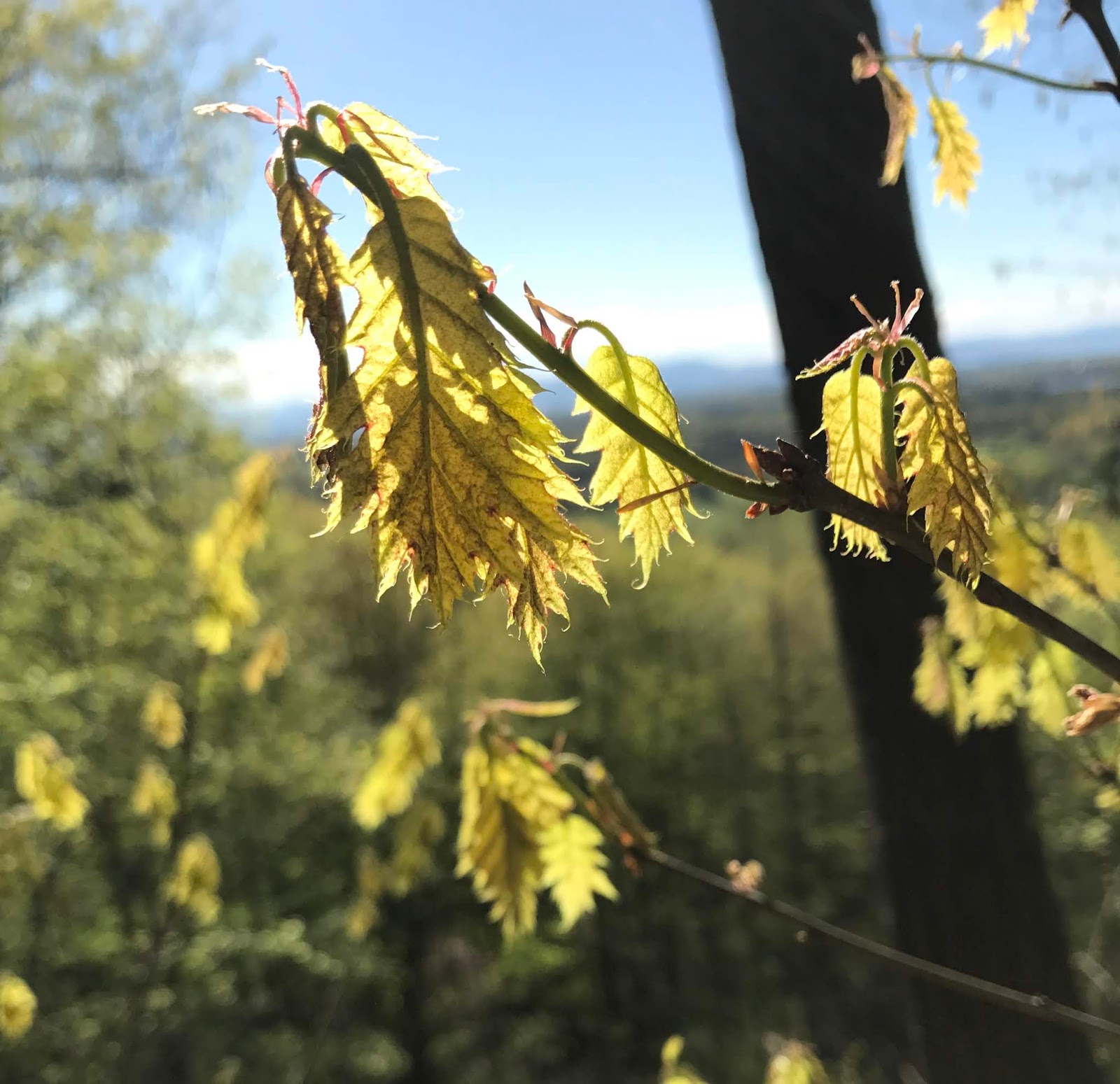

May 12, 2017
Uvularia perfoliata out in rain; say, then, the 9th. Just after plucking it I perceived what I call the meadow fragrance, though in the woods; but I afterward found that this flower was peculiarly fragrant, and its fragrance like that, so it was probably this which I had perceived. S. was reminded of the lily-of-the-valley by it. 

The witch-hazel has one of the broadest leaves now.

In the path in Stow's wood-lot, I find apparently Thaspium aureum (Zizia aurea), which will open the first fair day. Shows quite yellow now. 

Found in the path in the woods by the Mill Brook ditch, Flint's Pond, dead, the Coluber punctatus13 1/4 inches long, but no row of spots in middle of abdomen. The head above blackish with a blackish ring behind the yellow. Tail 3 inches long; breadth of body 5/16 ; plates 162; scales 55. Above, uniform glossy slate-color, with a yellowish-white band across the occiput; the head above blackish, and a blackish band close behind the yellowish one. Beneath, yellow or buff (whitish under head), with a row of small slanting black spots, one on each side of each abdominal plate except the first 3/4 inch behind the head. In the midst of the path in the woods. I admired the iridescence from its glossy belly. It differs from Storer's C. punctatus, for it is not brown above, nor "reddish yellow" beneath, and has no row of spots in middle of the abdomen. 

In that first thunder-shower, the evening of the 9th, the grass evidently erected itself and grew darker, as  it were instantaneously. Was it the effect of electricity in the air? It looked very differently from what it had ten minutes before.

H. D. Thoreau, Journal, May 11, 1859

Golden robin yesterday. See. May 10, 1853 (“Hear higher the clear whistle of the oriole. New days, then, have come, ushered in by the warbling vireo, yellowbird, Maryland yellow-throat, and small pewee, and now made perfect by the twittering of the kingbird and the whistle of the oriole amid the elms, which are but just beginning to leaf out, thinking of his nest there, -. . .The warbling vireo promised warmer days, but the oriole ushers in summer heats.”); May 10, 1858 ("The oriole is seen darting like a bright flash with clear whistle from one tree-top to another over the street.”)

Arum triphyllum out. See May 1, 1857 ("Plucked the Arum triphyllum, three inches high, with its acrid corm.”);  May 19, 1851 ("Find the Arum triphyllum . .   in Conant's Swamp.")

Young, or fresh-expanding, oak leaves are very handsome now, showing their colors. It is a leafy mist throughout the forest.  See May 15, 1854 ("The aspect of oak and other woods at a distance is somewhat like that of a very thick and reddish or yellowish mist about the evergreens. . . . Oak leaves are as big as a mouse's ear.”); May 15, 1860 ("Looking from the Cliffs through the haze, the deciduous trees are a mist of leaflets.”);  May 18, 1851 ("The oak leaves of all colors are just expanding, and are more beautiful than most flowers"); May 23, 1860 ("The quarter-grown red oak leaves between you and the sun, how yellow-green! "); May 26, 1857 ("Very interesting now are the red tents of expanding- oak leaves, as you go through sprout-lands, — the crimson velvet of the black oak and the more pinkish white oak. The salmon and pinkish-red canopies or umbrellas of the white oak")

Uvularia perfoliata out in rain; say, then, the 9th. See September 22, 1852 ("Sophia has in her herbarium and has found in Concord these which I have not seen this summer ...Uvularia perfoliata);  May 30, 1857 ("By the path near the northeast shore of Flint's Pond, just before reaching the wall by the brook, I . . .am surprised to find ... the Uvularia perfoliata, which I have not found hereabouts before.  . . . It is considerably past its prime”); May 3, 1858 ("Ride to Flint's Pond to look for Uvularia perfoliata. ... It apparently will not bloom within ten days”); May 16, 1858 (“The Uvularia perfoliata, which did not show itself at all on the 3d, is now conspicuous, and one is open but will not shed pollen before to-morrow. It has shot up about ten inches in one case and bloomed within thirteen days!!”)

Just after plucking it I perceived what I call the meadow fragrance,  but I afterward found that this flower was peculiarly fragrant. See May 6, 1855 ("that unaccountable fugacious fragrance, as of all flowers,”);  May 15, 1856 ("Perceive some of that delicious meadow fragrance coming over the railroad causeway”); May 27, 1855 ("The meadow fragrance to-day”); May 27, 1856 ("perceived the meadow fragrance”); May 27, 1857 ("I perceived that rare meadow fragrance on the 25th.”); June 3, 1860 ("I perceive the meadow fragrance.”)

The Coluber punctatus [ringneck snake],  uniform glossy slate-color above, with a yellowish-white band across the occiput; the head above blackish, and a blackish band close behind the yellowish one. Beneath, yellow or buff (whitish under head), with a row of small slanting black spots. Nnot brown above, nor "reddish yellow" beneath,. Compare and see note to May 1, 1859 (“a little snake . . . uniformly brown (or reddish-brown) above except a yellowish ring on the occiput, the head also lighter than the body; beneath vermilion, with apparently a row of light dots along each side.”)

Thursday, October 18, 2018

The large sugar maples on the Common are now at the height of their beauty

October 18

October 18, 2018


P. M. — To Smith’s chestnut grove and Saw Mill Brook. 

The large sugar maples on the Common are now at the height of their beauty. One, the earliest to change, is partly bare. This turned so early and so deep a scarlet that some thought that it was surely going to die. 

Also that one at the head of the Turnpike reveals its character now as far as you can see it. Yet about ten days ago all but one of these was quite green, and I thought they would not acquire any bright tints. A delicate but warmer than golden yellow is the prevailing color, with scarlet cheeks. They are great regular oval masses of yellow and scarlet. All the sunny warmth of the season seems to be absorbed in their leaves. 

There is an auction on the Common, but its red flag is hard to be discerned amid this blaze of color. The lowest and inmost leaves next the bole are of the most delicate yellow and green, as usual, like the complexion of young men brought up in the house.

Little did the fathers of the town anticipate this brilliant success when they caused to be imported from further in the country some straight poles with the tops cut off, which they called sugar maple trees, — and a neighboring merchant’s clerk, as I remember, by way of jest planted beans about them. Yet these which were then jestingly called bean-poles are these days far the most beautiful objects noticeable in our streets. They are worth all and more than they have cost, — though one of the selectmen did take the cold which occasioned his death in setting them out, — if only because they have filled the open eyes of children with their rich color so unstintedly so many autumns. 

We will not ask them to yield us sugar in the spring, while they yield us so fair a prospect in the autumn. Wealth may be the inheritance of few in the houses, but it is equally distributed on the Common. All children alike can revel in this golden harvest. These trees, throughout the street, are at least equal to an annual festival and holiday, or a week of such, — not requiring any special police to keep the peace, — and poor indeed must be that New England village’s October which has not the maple in its streets. 

This October festival costs no powder nor ringing of bells, but every tree is a liberty-pole on which a thousand bright flags are run up. Hundreds of children’s eyes are steadily drinking in this color, and by these teachers even the truants are caught and educated the moment they step abroad. It is as if some cheap and innocent gala-day were celebrated in our town every autumn, — a week or two of such days. 

What meant the fathers by establishing this living institution before the church, —this institution which needs no repairing nor repainting, which is continually “enlarged and repaired” by its growth? Surely trees should be set in our streets with a view to their October splendor. 

Do you not think it will make some odds to these children that they were brought up under the maples?  Indeed, neither the truant nor the studious are at present taught colors in the schools. These are instead of the bright colors in apothecary shops and city windows. It is a pity we have not more red maples and some hickories in the streets as well. Our paint-box is very imperfectly filled. Instead of, or besides, supplying paint-boxes, I would supply these natural colors to the young.

I know of one man at least, called an excellent and peculiarly successful farmer, who has thoroughly repaired his house and built a new barn with a barn cellar, such as every farmer seems fated to have, who has not a single tree or shrub of any kind about his house or within a considerable distance of it. 

No annual training or muster of soldiery, no celebration with its scarfs and banners, could import into the town a hundredth part of the annual splendor of our October. We have only to set the trees, or let them stand, and Nature will find the colored drapery, — flags of all her nations, some of whose private signals hardly the botanist can read. Let us have a good many maples and hickories and scarlet oaks, then, I say. Blaze away! Shall that dirty roll of bunting in the gunhouse be all the colors a village can display? 

A village is not complete unless it has these trees to mark the season in it. They are as important as a town clock. Such a village will not be found to work well. It has a screw loose; an essential part is wanting. Let us have willows for spring, elms for summer, maples and walnuts and tupelos for autumn, evergreens for winter, and oaks for all seasons. 

What is a gallery in a house to a gallery in the streets! I think that there is not a picture gallery in the country which would be worth so much to us as is the western view under the elms of our main street. They are the frame to a picture, and we are not in the dilemma of the Irishman who, having bought a costly gilt picture-frame at an auction, found himself obliged to buy a picture at private sale to put into it, for our picture is already painted with each sunset behind it. 

An avenue of elms as large as our largest, and three miles long, would seem to lead to some admirable place, though only Concord were at the end of it. Such a street as I have described Would be to the traveller, especially in October, an ever-changing panorama. 

A village needs these innocent stimulants of bright and cheery prospects to keep off melancholy and superstition. 

October 18, 2018

Show me two villages, one embowered in trees and blazing with all the glories of October, the other a merely trivial and treeless waste, and I shall be sure that in the latter will be found the most desperate and hardest drinkers. What if we were to take half as much pains in protecting them as we do in setting them out,— not stupidly tie our horses to our dahlia stems? They are cheap preachers, permanently settled, which preach their half-century, and century, aye, and century and a half sermons, with continually increasing influence and unction, ministering to many generations of men, and the least we can do is to supply them with suitable colleagues as they grow infirm.  

Children are now everywhere playing with the brown and withered leaves of elms and buttonwoods, which strew the streets and are collected into heaps in the sluiceways. 

In the woods even the little pea-vine turns a delicate yellow and is more conspicuous than ever, and in the now neglected gardens the asparagus-beds, greenish without, glow yellow within, as if a fire were bursting out there. 

As I go down the Turnpike past Clintonia Swamp, I am struck by the magical change which has taken place in the red maple swamps, which just a fortnight ago were splendid masses of scarlet and yellow and crimson, rising amid the yet green trees, — pines and oaks, etc., —like immense flower-beds on one side of the town, visible for miles, attracting the eyes of all travellers; now, —though a few late ones are bright as ever in some places, — all their splendor gone, wafted away, as it were, by a puff of wind, and they are the mere ghosts of trees, unnoticed by any, or, if noticed at all, like the smoke that is seen where a blaze is extinguished, or as the red clouds at evening change suddenly to gray and black,— so suddenly their glory departs, — desolate gray twigs.

The Salix alba is a light and silvery green. 

Since the red maples generally fell, the chestnuts have been yellowing, and the oaks reddening and yellowing. The chestnuts are now in their prime, though many leaves are fallen. The forest, which showed but little ripeness ten days ago, except about its edges and here and there as you looked down on it from a height, is now seen to be generally of a mellow brownish yellow, like perfectly ripe fruit, which we know to be more perfectly ripe for being a little specked.

By the brook, witch-hazel, as an underwood, is in the height of its change, but elsewhere exposed large bushes are bare. Rhus Toxicodendron is fallen. The hornbeam is a greenish yellow, or yellow as it were dusted with green. The maple-leaved viburnum, now at its height, varies, with more or less of shade, from dark crimson through a delicate pale crimson to whitish. The sage willow, a light yellow, in prime, though hardly noticed amid the more conspicuous oaks. Larches have begun to change in water. 

As I come through Hubbard’s Woods I see the wintergreen, conspicuous now above the freshly fallen white pine needles. Their shining green is suddenly revealed above the pale-brown ground. I hail its cool unwithering green, one of the humbler allies by whose aid we are to face the winter. 

Saw, October 14th, a snake at Ball’s Hill, like a striped snake, but apparently yellow-spotted above and with a flatter head? 

Noticed a little snake, eight or nine inches long, in the rut in the road in the Lincoln woods. It was brown above with a paler-brown dorsal stripe, which was bounded on each side by a row of dark-brown or blackish dots one eighth inch apart, the opposite rows alternating; beneath, light cream-color or yellowish white. Evidently Storer’s Coluber ordinatus. It ran along in the deep sandy rut and would probably be run over there. 

See larks, with their white tail-feathers, fluttering low over the meadows these days. 

Minott was sitting outside, as usual, and inquired if I saw any game in my walks these days; since, now that he cannot go abroad himself, he likes to hear from the woods. He tried to detain me to listen to some of his hunting-stories, especially about a slut that belonged to a neighbor by the name of Billings, which was excellent for squirrels, rabbits, and partridges, and would always follow him when he went out, though Billings was “plaguy mad about it;” however, he had only to go by Billings’s to have the dog accompany him. B. afterward carried her up country and gave her away, the news of which almost broke Minott’s heart. He said he could have cried when he heard of it, for he had dreamed of her several nights. She was a plaguy good dog for squirrels, etc., but her pups were none of them equal to herself. It was not time for squirrels now, because the leaves were not off enough. 

He used sometimes to take his old king’s-arm on these excursions. It was heavy, but it was sure. His present gun has a flint lock and has often been repaired, and he said he did n’t suppose it would fetch more than a dollar if put up at auction now. But he would n’t take twenty dollars for it. He didn’t want to part with it. He liked to look at it. As leaves fall along the river and in the woods, the squirrels and musquash make haste to shelter and conceal themselves by constructing nests and cabins..

H. D. Thoreau, Journal, October 18, 1858

Neither the truant nor the studious are at present taught colors in the schools. Compare September 1, 1856 ("When colors come to be taught in the schools, as they should be, both the prism (or the rainbow) and these fungi should be used by way of illustration, and if the pupil does not learn colors, he may learn fungi, which perhaps is better.")


The large sugar maples on the Common are now at the height of their beauty. See October 6, 1858 ("only one of the large maples on the Common is yet on fire. "); October 18, 1856 ("The sugar maples are now in their glory, all aglow with yellow, red, and green.”); October 21, 1858 (“The large sugar maples on the Common are in the midst of their fall to-day.”); October 24, 1855 ("he rich yellow and scarlet leaves of the sugar maple on the Common now thickly cover the grass in great circles about the trees, and, half having fallen, look like the reflection of the trees ")

I am struck by the magical change which has taken place in the red maple swamps like the smoke that is seen where a blaze is extinguished,, — desolate gray twigs. See October 18, 1853 ("The red maples have been bare a good while. In the sun and this clear air, their bare ashy branches even sparkle like silver."); October 18, 1855 ("The maple swamps, bare of leaves, here and there about the meadow, look like smoke blown along the edge of the woods.");  October 16, 1857 ("The red maples are now fairly bare, ")

By the brook, witch-hazel, as an underwood, is in the height of its change, but elsewhere exposed large bushes are bare See October 16, 1857 ("Am surprised to find an abundance of witch-hazel, now at the height of its change,. . .. The tallest bushes are bare, though in bloom, but the lowest are full of leaves, many of them green, but chiefly clear and handsome yellow of various shades, from a pale lemon in the shade or within the bush to a darker and warmer yellow with out. Some are even a hue of crimson; some green, with bright yellow along the veins.")

Noticed a little snake brown above with a paler-brown dorsal stripe. See October 18, 1857 (" Snakes lie out now on sunny banks, amid the dry leaves, now as in spring. They are chiefly striped ones.")

See larks, with their white tail-feathers, fluttering low over the meadows these days. See October 18, 1855 ("I scare up a dozen larks at once. ")

I am struck by the 
magical change taken place 
in red maple swamps

Sunday, April 29, 2018

A little brown snake with blackish marks.

April 29

Storrow Higginson plucked the uva-ursi fully out the 25th; perhaps two or three days, for it was nearly out, he says, the 18th!!! By his account it was on Pine Hill.  

I heard yesterday at Ledum Swamp the lively, sweet, yet somewhat whimsical note of the ruby crowned wren, and had sight of him a moment. Did I not hear it there the 10th? 

Noticed a man killing, on the sidewalk by Minott's, a little brown snake with blackish marks along each side of back and a pink belly. Was it not the Coluber amaenus?

H. D. Thoreau, Journal, April 29, 1858

Heard yesterday at Ledum Swamp the lively, sweet, yet somewhat whimsical note of the ruby crowned wren.  See April 25, 1854 (“A very interesting and active little fellow, darting about amid the tree-tops, and his song quite remarkable and rich and loud for his size. Begins with a very fine note, before its pipes are filled, not audible at a little distance, then woriter weter, etc., etc., winding up with teter teter, all clear and round. (His song is comical and reminds me of the thrasher.)”);  May 6, 1855 ("Hear at a distance a ruby(?)-crowned wren, so robin-like and spirited.  . . . I think this the only Regulus I have ever seen.”); April 30, 1857 (“Hear again the same bird heard at Conantum April 18th, which I think must be the ruby-crowned wren. ”); April 26, 1860 ("Hear the ruby-crowned wren in the morning, near George Heywood’s.”). See also note to April 20, 1859 ("My ruby-crowned or crested wren”) and A Book of the Seasons, by Henry Thoreau: the ruby-crowned or crested wren.

A man killing a little brown snake with blackish marks along each side of back and a pink belly. See October 11, 1856 (“I find a little snake which somebody has killed with his heel. It is apparently Coluber amaenus, the red snake. Brown above, light-red beneath, about eight inches long . . . It is a conspicuous light red beneath, then a bluish-gray line along the sides, and above this brown with a line of lighter or yellowish brown down the middle of the back. ”); September 9, 1857 ("On my way home, caught one of those little red bellied snakes in the road, where it was rather slugish, as usual. Saw another in the road a week or two ago. The whole length was eight inches. . .It was a dark ash-color above, with darker longitudinal lines, light brick-red beneath. There were three triangular buff spots just behind the head, one above and one each side. It is apparently Coluber amaenus”). See also April 26, 1857 ("I have the same objection to killing a snake that I have to the killing of any other animal, yet the most humane man that I know never omits to kill one.”). Compare April 22, 1857 (“Near Tall's Island, rescue a little pale or yellowish brown snake that was coiled round a willow half a dozen rods from the shore and was apparently chilled by the cold. Was it not Storer's "little brown snake?”) ~ rebellied snake or worm snake or both?: Snakes of Massachusetts

Sunday, October 29, 2017

This is the true way to crack the nut of happiness.

October 29

P. M. — Down river in boat. 

Though it did not rain yesterday, as I remember, it was overcast all day, — didn’t clear up, — and this forenoon it has rained again. The sun only comes out once or twice for a moment this afternoon. [This is the fall storm.]

Accordingly, this being the seventh day of cloud and the fourth of rain (skipping yesterday), the river is very high for the season and all over the meadow in front of the house, and still rising. Many are out (as yesterday) shooting musquash. 

I see evidently what Storer calls the little brown snake (Coluber ordinatus), driven out of the grass of the meadow by the flood. Its head is raised to the surface for air, and it appears sluggish and enfeebled by the water. Putting out my paddle, it immediately coils about it and is raised into the boat. 

It has a distinct pale-pink abdomen, slightly bluish forward. Above it is pale-brown, with a still lighter brown stripe running down the middle of the back, on each side of which is a line of dark-brown spots about an eighth of an inch apart, as the two lines are also an eighth of an inch apart. This snake is about one foot long. I hold it in my hand, and it is quite inoffensive. 

The sun comes out once or twice, the water is smooth, and the cocks crow as in spring. 

As I am picking cranberries below Flint's Bridge, they being drifted against the shore together with much loose meadow wreck, I notice many crickets wrecked with them and half drowned, as well as snails’ shells. Spiders, however, are in their element. 

A flock of about eighty crows flies ramblingly over toward the sowing, cawing and loitering and making a great ado, apparently about nothing. 

I meet Goodwin and afterward Melvin. They are musquash shooting. The latter has killed nineteen to-day down stream, thirty-one yesterday up the Assabet. 

He has also a coot, which he calls a little black dipper! It has some clear white under its tail. Is this, then, the name of that dipper? and are the young dippers of Moosehead different? The latter were in flocks and had some white in front, I have said.

Melvin asked if I had seen “Pink-eye,” meaning Goodwin. 

There is a large square-sided black rock, say five or six feet high, eight long, and five wide, on Mrs. Ripley's shore, wedged close between two small elms, and your first thought on seeing it is that it has according to some law occupied that space between the trees, not reflecting that it is more ancient than the trees by a geological period, and that the latter have but recently sprung up under its protection. I thought the rock had been accurately fitted into that space. 

There are some things of which I cannot at once tell whether I have dreamed them or they are real; as if they were just, perchance, establishing, or else losing, a real basis in my world. This is especially the case in the early morning hours, when there is a gradual transition from dreams to waking thoughts, from illusions to actualities, as from darkness, or perchance moon and star light, to sunlight. 

Dreams are real, as is the light of the stars and moon, and theirs is said to be a dreamy light. Such early morning thoughts as I speak of occupy a debatable ground between dreams and waking thoughts. They are a sort of permanent dream in my mind. At least, until we have for some time changed our position from prostrate to erect, and commenced or faced some of the duties of the day, we cannot tell what we have dreamed from what we have actually experienced. 

This morning, for instance, for the twentieth time at least, I thought of that mountain in the easterly part of our town (where no high hill actually is) which once or twice I had ascended, and often allowed my thoughts alone to climb. I now contemplate it in my mind as a familiar thought which I have surely had for many years from time to time, but whether anything could have reminded me of it in the middle of yesterday, whether I ever before remembered it in broad daylight, I doubt. I can now eke out the vision I had of it this morning with my old and yesterday forgotten.

My way up used to lie through a dark and unfrequented wood at its base, - I cannot now tell exactly, it was so long ago, under what circumstances I first ascended, only that I shuddered as I went along (I have an indistinct remembrance of having been out overnight alone), — and then I steadily ascended along a rocky ridge half clad with stinted trees, where wild beasts haunted, till I lost myself quite in the upper air and clouds, seeming to pass an imaginary line which separates a hill, mere earth heaped up, from a mountain, into a superterranean grandeur and sublimity. What distinguishes that summit above the earthy line, is that it is unhandselled, awful, grand. It can never become familiar; you are lost the moment you set foot there. You know no path, but wander, thrilled, over the bare and pathless rock, as if it were solidified air and cloud. That rocky, misty summit, secreted in the clouds, was far more thrillingly awful and sublime than the crater of a volcano spouting fire. 

This is a business we can partly understand. The perfect mountain height is already thoroughly purified. It is as if you trod with awe the face of a god turned up, unwittingly but helplessly, yielding to the laws of gravity. And are there not such mountains, east or west, from which you may look down on Concord in your thought, and on all the world? In dreams I am shown this height from time to time, and I seem to have asked my fellow once to climb there with me, and yet I am constrained to believe that I never actually ascended it. It chances, now I think of it, that which makes it rises in my mind where lies the Burying-Hill. You might go through its gate to enter that dark wood, but that hill and its graves are so concealed and obliterated by the awful mountain that I never thought of them as underlying it. Might not the graveyards of the just always be hills, ways by which we ascend and overlook the plain? 

But my old way down was different, and, indeed, this was another way up, though I never so ascended. I came out, as I descended, breathing the thicker air. I came out the belt of wood into a familiar pasture, and along down by a wall. Often, as I go along the low side of this pasture, I let my thoughts ascend toward the mount, gradually entering the stinted wood (Nature subdued) and the thinner air, and drape them selves with mists. There are ever two ways up: one is through the dark wood, the other through the sunny pasture. That is, I reach and discover the mountain only through the dark wood, but I see to my surprise, when I look ofl’ between the mists from its summit, how it is ever adjacent to my native fields, nay, imminent over them, and accessible through a sunny pasture. Why is it that in the lives of men we hear more of the dark wood than of the sunny pasture? A hard-featured god reposing, whose breath hangs about his forehead. 

Though the pleasure of ascending the mountain is largely mixed with awe, my thoughts are purified and sublimed by it, as if I had been translated. 

I see that men may be well-mannered or conventionally polite toward men, but skeptical toward God. 

Forever in my dream and in my morning thought, Eastward a mount ascends; But when in the sunbeam its hard outline is sought, It all dissolves and ends. The woods that way are gates; the pastures too slope up To an unearthly ground; But when I ask my mates to take the staff and cup, It can no more be found. Perhaps I have no shoes fit for the lofty soil Where my thoughts graze, No properly spun clues, nor well-strained mid-day oil, Or must I mend my ways? It is a promised land which I have not yet earned. I have not made beginning With consecrated hand, nor have I ever learned To lay the underpinning. The mountain sinks by day, as do my lofty thoughts, Because I’m not high-minded. If I could think alway above these hills and warts, I should see it, though blinded. It is a spiral path within the pilgrim’s soul Leads to this mountain's brow; Commencing at his hearth he climbs up to this goal

We see mankind generally either (from ignorance or avarice) toiling too hard and becoming mere machines in order to acquire wealth, or perhaps inheriting it or getting it by other accident, having recourse, for relaxation after excessive toil or as a mere relief to their idle ennui, to artificial amusements, rarely elevating and often debasing. I think that men generally are mistaken with regard to amusements. 

Every one who deserves to be regarded as higher than the brute may be supposed to have an earnest purpose, to accomplish which is the object of his existence, and this is at once his work and his supremest pleasure; and for diversion and relaxation, for suggestion and education and strength, there is offered the never-failing amusement of getting a living, — never-failing, I mean, when temperately indulged in. 

I know of no such amusement, — so wholesome and in every sense profitable, —for instance, as to spend an hour or two in a day picking some berries or other fruits which will be food for the winter, or collecting driftwood from the river for fuel, or cultivating the few beans or potatoes which I want. Theatres and operas, which intoxicate for a season, are as nothing compared to these pursuits. And so it is with all the true arts of life. 

Farming and building and manufacturing and sailing are the greatest and wholesomest amusements that were ever invented (for God invented them), and I suppose that the farmers and mechanics know it, only I think they indulge to excess generally, and so what was meant for a joy becomes the sweat of the brow. Gambling, horse-racing, loafing, and rowdyism generally, after all tempt but few. 

The mass are tempted by those other amusements, of farming, etc. It is a great amusement, and more profitable than I could have invented, to go and spend an afternoon hour picking cranberries. By these various pursuits your experience becomes singularly complete and rounded. 

The novelty and significance of such pursuits are remarkable. Such is the path by which we climb to the heights of our being; and compare the poetry which such simple pursuits have inspired with the unreadable volumes which have been written about art. 

Who is the most profitable companion? He who has been picking cranberries and chopping wood, or he who has been attending the opera all his days? I find when I have been building a fence or surveying a farm, or even collecting simples, that these were the true paths to perception and enjoyment. My being seems to have put forth new roots and to be more strongly planted. This is the true way to crack the nut of happiness. 

If, as a poet or naturalist, you wish to explore a given neighborhood, go and live in it, i. e. get your living in it. Fish in its streams, hunt in its forests, gather fuel from its water, its woods, cultivate the ground, and pluck the wild fruits, etc., etc. This will be the surest and speediest way to those perceptions you covet. No amusement has worn better than farming. It tempts men just as strongly to-day as in the day of Cincinnatus. Healthily and properly pursued, it is not a whit more grave than huckleberrying, and if it takes any airs on itself as superior there's something wrong about it. 

I have aspired to practice in succession all the honest arts of life, that I may gather all their fruits. But then, if you are intemperate, if you toil to raise an unnecessary amount of corn, even the large crop of wheat be comes as a small crop of chaff. 

If our living were once honestly got, then it would be time to invent other amusements. 

After reading Ruskin on the love of Nature, I think, “Drink deep, or taste not the Pierian spring.” He there, to my surprise, expresses the common infidelity of his age and race. He has not implicitly surrendered himself to her. And what does he substitute for that Nature? I do not know, unless it be the Church of England. Questioning whether that relation to Nature was of so much value, after all! It is sour grapes! He does not speak to the condition of foxes that have more spring in their legs. 

The love of Nature and fullest perception of the revelation which she is to man is not compatible with the belief in the peculiar revelation of the Bible which Ruskin entertains.

H. D. Thoreau, Journal, October 29, 1857

A flock of about eighty crows flies ramblingly over toward the sowing, cawing and loitering and making a great ado, apparently about nothing. See October 29,1855 (“As I pass Merrick’s pasture, I see and count about a hundred crows advancing in a great rambling flock from the southeast and crossing the river on high, and cawing.”); November 1, 1853 ("As I return, I notice crows flying southwesterly in a very long straggling flock, of which I see probably neither end.")

Saturday, September 9, 2017

If I could only contract with a family of squirrels.

September 9

Wednesday. P. M. – To the Hill for white pine cones.

Very few trees have any. I can only manage small ones, fifteen or twenty feet high, climbing till I can reach the dangling green pickle-like fruit in my right hand, while I hold to the main stem with my left. 

The cones are now all flowing with pitch, and my hands are soon so covered with it that I cannot easily cast down the cones where I would, they stick to my hands so. I cannot touch the basket, but carry it on my arm; nor can I pick up my coat, which I have taken off, unless with my teeth, or else I kick it up and catch it on my arm. 

Thus I go from tree to tree, from time to time rubbing my hands in brooks and mud-holes, in the hope of finding something that will remove pitch like grease, but in vain. It is the stickiest work I ever did. I do not see how the squirrels that gnaw them off and then open them scale by scale keep their paws and whiskers clean. They must know of, or possess, some remedy for pitch that we know nothing of. 

How fast I could collect cones, if I could only contract with a family of squirrels to cut them off for me! 

Some are already brown and dry and partly open, but these commonly have hollow seeds and are worm-eaten. 

The cones collected in my chamber have a strong spirituous scent, almost rummy, or like a molasses hogshead, agreeable to some. They are far more effectually protected than the chestnut by its bur. 

Going into the low sprout-land north of the Sam Wheeler orchard, where is a potato-field in new ground, I see the effects of the frost of the last two or three nights. The ferns and tall erechthites showing its pappus are drooping and blackened or imbrowned on all sides, also Eupatorium pubescens, tender young Rhus glabra, etc., and the air is full of the rank, sour smell of freshly withering vegetation. It is a great change produced in one frosty night. What a sudden period put to the reign of summer! 

On my way home, caught one of those little red bellied snakes in the road, where it was rather slugish, as usual. Saw another in the road a week or two ago. The whole length was eight inches; tail alone, one and four fifths. The plates about one hundred and nineteen; scales forty and upward. It was a dark ash-color above, with darker longitudinal lines, light brick-red beneath. There were three triangular buff spots just behind the head, one above and one each side. It is apparently Coluber amaenus, and perhaps this is the same with Storer's occipito-maculatus

C. brings me a small red hypopitys. It has a faint sweet, earthy, perhaps checkerberry, scent, like that sweet mildewy fragrance of the earth in spring. 

Aunts have just had their house shingled, and amid the rubbish I see sheets of the paper birch bark, which have lain on the roof so long. The common use of this formerly shows that it must have been abundant here.

H. D. Thoreau, Journal, September 9, 1857

They must know of, or possess, some remedy for pitch that we know nothing of. See April 8, 1857 ("If you got your hands pitched in pine woods, you had only to rub a parcel of these berries between your hands to start the pitch off.")

I can only manage small ones, fifteen or twenty feet high, climbing till I can reach the dangling green pickle-like fruit . . .all flowing with pitch . . . See October 15, 1855 (“Go to look for white pine cones, but see none.”);  November 4, 1855 (" I have failed to find white pine seed this year, though I began to look for it a month ago. The cones were fallen and open. Look the first of September.”); October 8, 1856 (“At length I discover some white pine cones, a few, . . . all open, and the seeds, all the sound ones but one, gone. So September is the time to gather them. The tip of each scale is covered with fresh flowing pitch.”); September 16, 1857 ("I see green and closed cones beneath, which the squirrels have thrown down. On the trees many are already open. Say within a week have begun. In one small wood, all the white pine cones are on the ground, generally unopened, evidently freshly thrown down by the squirrels, and then the greater part have already been stripped.");  September 18, 1859 "There is an abundant crop of cones on the white pines this year, and they are now for the most part brown and open. . . . the winged seeds have fallen or are ready to fall. How little observed are the fruits which we do not use! How few attend to the ripening and dispersion of the pine seed!”); September 18, 1860 ("White pine cones (a small crop), and all open that I see.”).

Caught one of those little red bellied snakes in the road,. . . Saw another in the road a week or two ago. . . .There were three triangular buff spots just behind the head, one above and one each side. It is apparently Coluber amaenus, and perhaps this is the same with Storer's occipito-maculatus.[The northern redbelly snake (Storeria occipitomaculata occipitomaculata)] See October 11, 1856 (“ It is apparently Coluber amaenus, the red snake. Brown above, light-red beneath, about eight inches long,. . .I count some one hundred and twenty-seven plates. It is a conspicuous light red beneath, then a bluish-gray line along the sides, and above this brown with a line of lighter or yellowish brown down the middle of the back. ”)


I see the effects of the frost of the last two or three nights. . . What a sudden period put to the reign of summer! See ; September 23, 1854 ("Many plants fall with the first frosts. This is the crisis when many kinds conclude their summer.”); August 27, 1853 (" September is at hand; the first month (after the summer heat) with a burr to it, month of early frosts.”)

C. brings me a small red hypopitys [pine-sap].  See June 29, 1853 (“American pine-sap, just pushing up, — false beech- drops. Gray says from June to August. It is cream-colored or yellowish under the pines in Hubbard's Wood Path. Some near the fence east of the Close. A plant related to the tobacco-pipe.”);  July 8, 1857 ("Edith Emerson . . .[s]ays she has seen the pine-sap this year in Concord.”);  August 14, 1856 (“Hypopitys, just beyond the last large (two-stemmed) chestnut at Saw Mill Brook, about done. Apparently a fungus like plant. It erects itself in seed.”).  See also A Book of the Seasons,  by Henry Thoreau, Pine-sap and Indian-pipe

Note. The stems of "hairy pine-sap"(Hypopitys lanuginosa ) are often pink or red, distinguishing it  from yellow pine-sap, which has light brown to yellow stems. However, the red, yellow (and other “species”) are often lumped together as Monotropa hypopitys, described generally as a saprophytic, red, pink, lavender, or yellow plant with several vase-like, nodding flowers on a downy, scaly stem; stem and flowers colored alike, with  autumn-flowering plants being red color, and early-flowering plants yellow.  Like Indian-pipe, pine-saps are mycotrophs, receiving nutrients via fungal mycelia rather than through photosynthesis. ~ GoBotany, Wildflower.org

Tuesday, October 11, 2016

A pasture thistle with many fresh flowers and bees on it.


October 11

October 11, 2014


P. M. — To Cliffs. 

The Indian summer continues. Solidagos now generally show woolly heads along the fences and brooks. 

E. Hosmer said yesterday that his father remembered when there was but one store in Concord, and that the little office attached to Dr. Heywood's house, kept by Beatton. I remember the old shutters with names of groceries on them. Perhaps, then, Jones was the only shopkeeper in his day. I was speaking of it to Farrar, the blacksmith, to-day, and he said, yes, he had heard his father speak of Beatton as "the most honestest man that ever was." When a child was sent to his store and he could not make change within half a penny he would stick a row of pins in the child's sleeve, enough to make all square. He said he had only a keg of molasses and a bladder of snuff when he began. 

Farrar thought that the spirit manufactured a century ago was not so adulterated and poisonous as that now made. He could remember when delirium tremens was very rare. There was Luke Dodge; he could remember him a drunkard for more than forty years, yet he was now between eighty and ninety. 


Broad-winged Hawk

Buteo platypterus
(Falco Pennsylvanicus)
Farrar gave me a wing and foot of a hawk which he shot about three weeks ago as he was sitting on a wood pile by the railroad, against R. W. E.'s lot. He called it a partridge hawk; said he was about as big as a partridge and his back of a similar color, and had not a white rump. This foot has a sharp shin and stout claws, but the wing is much larger than that of the Falco fuscus (or sharp-shinned hawk), being, with the shoulder attached, sixteen inches long, which would make the alar extent some thirty-three inches, which is the size of the F. Pennsylvanicus. This wing corresponds in its markings very exactly with the description of that, and I must so consider it. Peabody does not describe any such bird, and Nuttall describes it as very rare, — apparently he has not seen one, — and says that Wilson had seen only two. 

Bay-wing sparrows numerous. 

In the woods I hear the note of the jay, a metallic, clanging sound, some times a mew. Refer any strange note to him. 

The scent of decaying leaves after the wet fall is a very agreeable fragrance on all sides in the woods now, like a garret full of herbs. 

In the path, as I go up the hill beyond the springs, on the edge of Stow's sprout-land, I find a little snake which somebody has killed with his heel. It is apparently Coluber amamus, the red snake. Brown above, light-red beneath, about eight inches long, but the end of its tail is gone (only three quarters of an inch of it left). I count some one hundred and twenty-seven plates. It is a conspicuous light red beneath, then a bluish-gray line along the sides, and above this brown with a line of lighter or yellowish brown down the middle of the back. 

The sprout-land and stubble behind the Cliffs are all alive with restless flocks of sparrows of various species. I distinguish F. hyemalis, song sparrow, apparently F. juncorum or maybe tree sparrows,1 and chip-birds (?). They are continually flitting past and surging upward, two or more in pursuit of each other, in the air, where they break like waves, and pass along with a faint cheep. On the least alarm many will rise from a juniper bush on to a shrub oak above it, and, when all is quiet, return into the juniper, perhaps for its berries. It is often hard to detect them as they sit on the young trees, now beginning to be bare, for they are very nearly the color of the bark and are very cunning to hide behind the leaves. There are apparently two other kinds, one like purple finches, another more like large Savannah sparrows. 

The shrub oak plain is now in the perfection of its coloring, the red of young oaks with the green of spiring birches intermixed. A rich rug. 

It is perfect Indian summer, a thick haze forming wreaths in the near horizon. The sun is almost shorn of its rays now at mid-afternoon, and there is only a sheeny reflection from the river. 


The patches of huckleberries on Conantum are now red. 

Here on the Cliffs are fresh poke flowers and small snapdragon and corydalis. 

The white goldenrod is still common here, and covered with bees.

Hieracium venosum still. 

I see pretty dense spreading radical leaves about the pinweeds, apparently recent.

A cuckoo is heard.

I find that the rough, white, crystalled-surfaced pigeon-egg fungus (one was noticed in report of October 5th) are puffballs. The outer thick white coat peels off first. I see it so now, but not in segments like the stellata. 

A pasture thistle with many fresh flowers and bees on it.

H. D. Thoreau, Journal, October 11, 1856

Bay-wing sparrows numerous. See April 15, 1859 (“The bay-wing now sings — the first I have been able to hear ”); October 9, 1858 (“Bay-wings flit along road.”); ;October 12, 1859 ("I see scattered flocks of bay-wings amid the weeds and on the fences.") October 16, 1855 ("I look at a grass-bird on a wall in the dry Great Fields. There is a dirty-white or cream-colored line above the eye and another from the angle of the mouth beneath it and a white ring close about the eye. The breast is streaked with this creamy white and dark brown in streams, as on the cover of a book.") A Book of the Seasons, by Henry Thoreau, the Bay-Wing Sparrow

Luke Dodge [was] a drunkard for more than forty years, yet he was now between eighty and ninety. See May 4, 1856 ("Was surprised to hear him say, “I am in my eighty-third year.”  . . It is encouraging to know that a man may fish and paddle in this river in his eighty-third year.")

Hieracium venosum still. See October 2, 1852 ("The veiny-leaved hawkweed in blossom (again?)")

A pasture thistle with many fresh flowers and bees on it. See  September 4, 1859 ("Three kinds of thistles are commonly out now, — the pasture, lanceolate, and swamp, — and on them all you are pretty sure to see one or two humblebees. They become more prominent and interesting in the scarcity of purple flowers"); See also A Book of the Seasons,  by Henry Thoreau, The Thistle and Thistle-down

In the woods I hear
a metallic clanging sound –
the note of the jay.


***

Posting the east line this year (2016) in the dark we again lose the connection somewhere between Kendall pond and Clifford Corner but without the emotion. this was two years ago:
 We separate and i go to the saddle trail, again losing the connection.  Jane goes to clifford corner then west to the Moose trail. The dogs roam back and forth between us. Evening comes and i have Loki, and jane has Buda. I get to the view just after sunset. The pond is reflecting saffron light brighter than the sky. I sit with the view and sky for perhaps half an hour until Jane comes with her extra headlamp for me. 20141011

Just after sunset
the pond reflects saffron light
brighter than the sky.

zphx

Wednesday, May 28, 2014

To be serene and successful we must be at one with the universe.


May 28

Sunday. 

May 28, 2014

The F. hyemalis, fox-colored sparrow, rusty grackles, tree sparrows, have all gone by; also the purple finch. The snipe has ceased (?) to boom. I have not heard the phoebe of late, and methinks the bluebird and the robin are not heard so often (the former certainly not ). Those tumultuous morning concerts of sparrows, tree and song, hyemalis, and grackles, like leaves on the trees, are past, and the woodland quire will rather be diminished than increased henceforth. 

But, on the other hand, toads and frogs and insects, especially at night, all through June, betray by the sounds they make their sensitiveness to the increasing temperature, and theirs especially is the music which ushers in the summer. Each warmer night, like this, the toads and frogs sing with increased energy, and already fill the air with sound, though the bullfrogs have not yet begun to trump in earnest. To this add the hum and creak of insects. These still herald or expect the summer. The birds do not foretell that. 

12 M.  By boat to Lee's Cliff.  

The River is still so high that I am obliged to lower my mast at the bridges. Even this spring the arches of the stone bridge were completely concealed by the flood, and yet at midsummer I can sail under them without lowering my mast. 

At the old bridge at the hill, the water being quite smooth, I see a water-bug cross straight from the south to the north side, about six rods, furrowing the water in a waving line, there being no other insects near him on the surface. It takes but about a minute. 

Red clover at Clamshell, a day or two. 

The huckleberries, excepting the late, are now generally in blossom, their rich clear red contrasting with the light-green leaves; frequented by honey-bees, full of promise for the summer. One of the great crops of the year. These are the blossoms of the Vacciniece, or Whortleberry Family, which affords so large a proportion of our berries. 

The crop of oranges, lemons, nuts, and raisins, and figs, quinces, etc., etc., not to mention tobacco and the like, is of no importance to us compared with these. 

The berry-promising flower of the Vacciniece. This crop grows wild all over the country, — wholesome, bountiful, and free, — a real ambrosia — and yet men — the foolish demons that they are — devote themselves to culture of tobacco, inventing slavery and a thousand other curses as the means, — with infinite pains and inhumanity go raise tobacco all their lives. Tobacco is the staple instead of huckleberries.

The huckleberries
now generally in blossom
so full of promise.

Frequented by bees
their rich clear red contrasting
with the light-green leaves.

Wholesome bountiful
and free, this crop grows wild all
over the country.

Finding the low blackberry nearly open, I looked long and at last, where the vine ran over a rock on the south hillside, the reflected heat had caused it [to] open fully its large white blossoms. In such places, apparently yesterday. The high blackberry in similar places, at least to-day. 

At these rocks I hear a sharp peep, methinks of a peetweet dashing away. Four pale-green (?) eggs, finely sprinkled with brown, in a brown thrasher's nest, on the ground (!!) under a barberry bush. 

The night-warbler, after his strain, drops down almost perpendicularly into a tree-top and is lost. 

The crickets, though it is everywhere an oppressively warm day (yesterday I had a fire !! ) and I am compelled to take off my thinnish coat, are heard, particularly amid the rocks at Lee's Cliff. They must love warmth. As if it were already autumn there. 

See that common snake Coluber eximius of De Kay, — checkered adder, etc., etc., — forty-one inches long. A rather light brown above, with large dark-brown, irregularly quadrangular blotches, margined with black, and similar small ones, on the sides; abdomen light salmon-white, — whitest toward the head, — checkered with quadrangular blotches; very light bluish-slate in some lights and dark-slate or black in others. 

I should think from Storer's description that his specimen had lost its proper colors in spirits. He describes not the colors of a living snake, but those which alcohol might impart to it. It is as if you were to describe the white man as very red in the face, having seen a drunkard only.

It would be worth the while to ask ourselves weekly, 
Is our life innocent enough? Do we live inhumanely, toward man or beast, in thought or act?

To be serene and successful we must be at one with the universe. 

The least conscious and needless injury inflicted on any creature is to its extent a suicide. What peace — or life — can a murderer have?The inhumanity of science concerns me, as when I am tempted to kill a rare snake that I may ascertain its species. I feel that this is not the means of acquiring true knowledge.


As I sail down toward the Clamshell Hill about an hour before sunset, the water is smoothed like glass, though the breeze is as strong as before. 

H. D. Thoreau, Journal, May 28, 1854

The woodland quire will rather be diminished than increased henceforth. See April 25, 1854 ("I hear the woods filled with the hum of insects, as if my hearing were affected; and thus the summer's quire begins. The silent spaces have begun to be filled with notes of birds and insects and the peep and croak and snore of frogs,"); June 25, 1854 ("Through June the song of the birds is gradually growing fainter."); August 2, 1854 ("he woodland quire has steadily diminished in volume."): August 20, 1854 ("When the red-eye ceases generally, then I think is a crisis, — the woodland quire is dissolved. That, if I remember, was about a fortnight ago. The concert is over.")

Even this spring the arches of the stone bridge were completely concealed by the flood, and yet at midsummer I can sail under them without lowering my mast. See May 8, 1854 (“The water has fallen a foot or more, but I cannot get under the stone bridge, so haul over the road.”); May 10, 1854 ("I drag and push my boat over the road at Deacon Farrar's brook, carrying a roller with me. . . . I make haste back with a fair wind and umbrella for sail.”); April 17, 1856 (“I make haste to take down my sail at the bridges, but at the stone arches forgot my umbrella, which was un avoidably crushed in part.”); April 22, 1857 (“We have to roll our boat over the road at the stone bridge”)

The huckleberries . . . now generally in blossom, their rich clear red contrasting with the light-green leaves, . . . full of promise for the summer. . . .See May 27, 1855 ("How interesting the huckleberries now generally in blossom . . . — countless wholesome red bells, beneath the fresh yellow green foliage!”)

Blackberries. See  June 16, 1858 ("How agreeable and wholesome the fragrance of the low blackberry blossom, reminding me of all the rosaceous fruit bearing plants, so near and dear to our humanity.") See also A Book of the Seasons, by Henry Thoreau, Blackberries

The night-warbler, after his strain, drops down almost perpendicularly into a tree-top and is lost. See May 29,1854 (" Saw what I thought my night warbler sparrow-like with chestnut stripes on breast white or whitish below and about eyes and perhaps chestnut head."); May 19, 1858 (“Heard the night-warbler begin his strain just like an oven-bird! I have noticed that when it drops down into the woods it darts suddenly one side to a perch when low. ”According to Emerson the night warbler is "a bird he had never identified, had been in search of twelve years, which always, when he saw it, was in the act of diving down into a tree or bush.” See also A Book of the Seasons, by Henry Thoreau, The Oven-bird

The inhumanity of science concerns me, as when I am tempted to kill a rare snake that I may ascertain its species.  See April 26, 1857 ("I have the same objection to killing a snake that I have to the killing of any other animal, yet the most humane man that I know never omits to kill one.”) Cf. Wordsworth, The Tables Turned ("We murder to dissect. Enough of Science and of Art . . . Come forth, and bring with you a heart that watches and receives.")

To be serene and successful we must be at one with the universe. See  February 20, 1857 ("I see that one could not be completely described without describing the other. I am that rock by the pond-side.?) May 12, 1857 (“He is a brother poet, this small gray bird (or bard), whose muse inspires mine. . . .One with the rocks and with us.”)
 
May 28. See A Book of the Seasons, by Henry Thoreau, May 28

To be serene and
successful we must be one
with the universe.

"A book, each page written in its own season,
out-of-doors, in its own locality."
 ~edited, assembled and rewritten by zphx ©  2009-2024
tinyurl.com/hdt-540528

Popular Posts Last 30 Days.

The week ahead in Henry’s journal

The week ahead in Henry’s journal
A journal, a book that shall contain a record of all your joy.
"A stone fruit. Each one yields me a thought." ~ H. D. Thoreau, March 28, 1859


I sit on this rock
wrestling with the melody
that possesses me.