The year is but a succession of days,
and I see that I could assign some office to each day
which, summed up, would be the history of the year.
Henry Thoreau, August 24, 1852
Snow sugars the ground
to reveal a cow-path in
the distant landscape.
Looking from the sun
the andromeda is a
uniform pale brown.
Looking toward the sun,
the andromeda is a
very warm red brown.
Clear and freezing cold
with a strong northerly wind –
the winter begins.
November 24, 1853

November 24, 2020
At this time last year the andromeda in the Ministerial Swamp was red. Now it has not turned from brown. November 24, 1852
Looking toward the sun, the andromeda in front of me is a very warm red brown and on either side of me, a pale silvery brown; looking from the sun, a uniform pale brown. November 24, 1857
The first or northernmost Andromeda Pond. . . is filled with a uniformly dense and level bed of brown andromeda, in which I detect nothing else from the hills except some white cotton-grass waving over it. November 24, 1857
The first or northernmost Andromeda Pond. . . is filled with a uniformly dense and level bed of brown andromeda, in which I detect nothing else from the hills except some white cotton-grass waving over it. November 24, 1857
Between the andromeda and the hills, there is a border, from one to two rods wide, of coarse and now yellowish sedge all the way round, November 24, 1857
On the dry hillside next the water, there is another belt, i.e. of lambkill, pretty dense, running apparently quite round the pond a rod or more in width. . . here it is a thick growth and has relation to the swamp. November 24, 1857
Geese went over on the 13th and 14th, on the 17th the first snow fell, and the 19th it began to be cold and blustering. November 24, 1855
The last three or four days have been quite cold, the sidewalks a glare of ice and very little melting. November 24, 1855
To-day has been exceedingly blustering and disagreeable, as I found while surveying. November 24, 1855
At noon, after a drizzling forenoon, the weather suddenly changes to clear and wintry, freezing cold with strong wind from a northerly quarter. November 24, 1853
Cold Thanksgiving weather again, the pools freezing. November 24, 1857
There is a slight sugaring of snow on the ground. November 24, 1858
When I looked out this morning, the landscape presented a very pretty wintry sight, little snow as there was. Being very moist, it had lodged on every twig, November 24, 1858
That first slight snow has not yet gone off! and very little has been added. November 24, 1855
On grass ground there is much the less, and that is barely perceptible, while plowed ground is quite white, and I can thus distinguish such fields even to the horizon. November 24, 1858
The plowed fields were for a short time whitened. November 24, 1860
I can not only distinguish plowed fields — regular white squares in the midst of russet — but even cart-paths, and foot or cow paths a quarter of a mile long, as I look across to Conantum. November 24, 1858
I can not only distinguish plowed fields — regular white squares in the midst of russet — but even cart-paths, and foot or cow paths a quarter of a mile long, as I look across to Conantum. November 24, 1858
It is pleasant to see thus revealed as a feature, even in the distant landscape, a cow-path leading from far inland down to the river. November 24, 1858
It is dark, drizzling still from time to time, sprinkling or snowing a little. I see more snow in the north and north west horizon November 24, 1858
It is a lichen day, with a little moist snow falling. November 24, 1858
The first spitting of snow — a flurry or squall – from out a gray or slate-colored cloud that came up from the west. November 24, 1860
This consisted almost entirely of pellets an eighth of an inch or less in diameter. November 24, 1860
These drove along almost horizontally, or curving upward like the outline of a breaker, before the strong and chilling wind. November 24, 1860
The hands seek the warmth of the pockets, and fingers are so benumbed that you cannot open your jack-knife. November 24, 1860
The air was so filled with these snow pellets that we could not not see a hill half a mile off for an hour. November 24, 1860
The green moss about the bases of trees was very prettily spotted white with them, and also the large beds of cladonia in the pastures. November 24, 1860
The great green lungwort lichen shows now on the oaks . . . and the fresh bright chestnut fruit of other kinds, glistening with moisture, brings life and immortality to light. November 24, 1858
That side of the trunk on which the lichens are thickest is the side on which the snow lodges in long ridges. November 24, 1858
They come to contrast with the red cockspur lichens on the stumps, which you had not noticed before. November 24, 1860
Striking against the trunks of the trees on the west side they fell and accumulated in a white line at the base. November 24, 1860
Though a slight touch, this was the first wintry scene of the season. November 24, 1860
The rabbits in the swamps enjoy it, as well as you. November 24, 1860
Ice forms in my boat at 5 p. m., and what was mud in the street is fast becoming a rigid roughness. November 24, 1853
Ice has frozen pretty thick in the bottom of my boat. November 24, 1855
Fair Haven Pond is closed still. November 24, 1858
It seems like the beginning of winter. November 24, 1853
The farmers now bring the apples they have engaged (and the cider); it is time to put them in the cellar, and the turnips. November 24, 1855
Under the two white oaks by the second wall south east of my house, on the east side the wall, I am surprised to find a great many sound acorns still, though everyone is sprouted, — frequently . . .with its radicle two inches long penetrated into the earth. November 24, 1860
But many have had their radicle broken or eaten off, and many have it now dead and withered. November 24, 1860
So far as my observation goes there, by far the greatest number of white oak acorns were destroyed by decaying (whether in consequence of frost or wet), both before and soon after falling. November 24, 1860
Not nearly so many have been carried off by squirrels and birds or consumed by grubs, though the number of acorns of all kinds lying under the trees is now comparatively small to what it was early in October. November 24, 1860
It is remarkable that all sound white oak acorns (and many which are not now sound) are sprouted, and that I have noticed no other kind sprouted. November 24, 1860
It will be worth the while to see how many of these sprouted acorns are left and are sound in the spring. November 24, 1860
It will be worth the while to see how many of these sprouted acorns are left and are sound in the spring. November 24, 1860
It is true these two trees are exceptions and I do not find sound ones nearly as numerous under others. Nevertheless, the sound white oak acorns are not so generally and entirely picked up as I supposed. November 24, 1860
The bitter-sweet of a white oak acorn which you nibble in a bleak November walk over the tawny earth is more to me than a slice of imported pineapple. November 24, 1860
I hear a screech owl in Wheeler’s wood by the railroad, and I heard one a few evenings ago at home. November 24, 1858
The Fringilla hyemalis appear to be flitting about in a more lively manner on account of the cold. They go off with a twitter from the low weeds and bushes November 24, 1857
See, on the railroad-slope by the pond, and also some days ago, a flock of goldfinches eating the seed of the Roman wormwood. November 24, 1859
Nowadays birds are so rare I am wont to mistake them at first for a leaf or mote blown off from the trees or bushes. November 24, 1857
Setting stakes in the swamp (Ministerial). Saw seven black ducks fly out of the peat-hole. November 24, 1851
Saw there also a tortoise still stirring, the painted tortoise, I believe. November 24, 1851
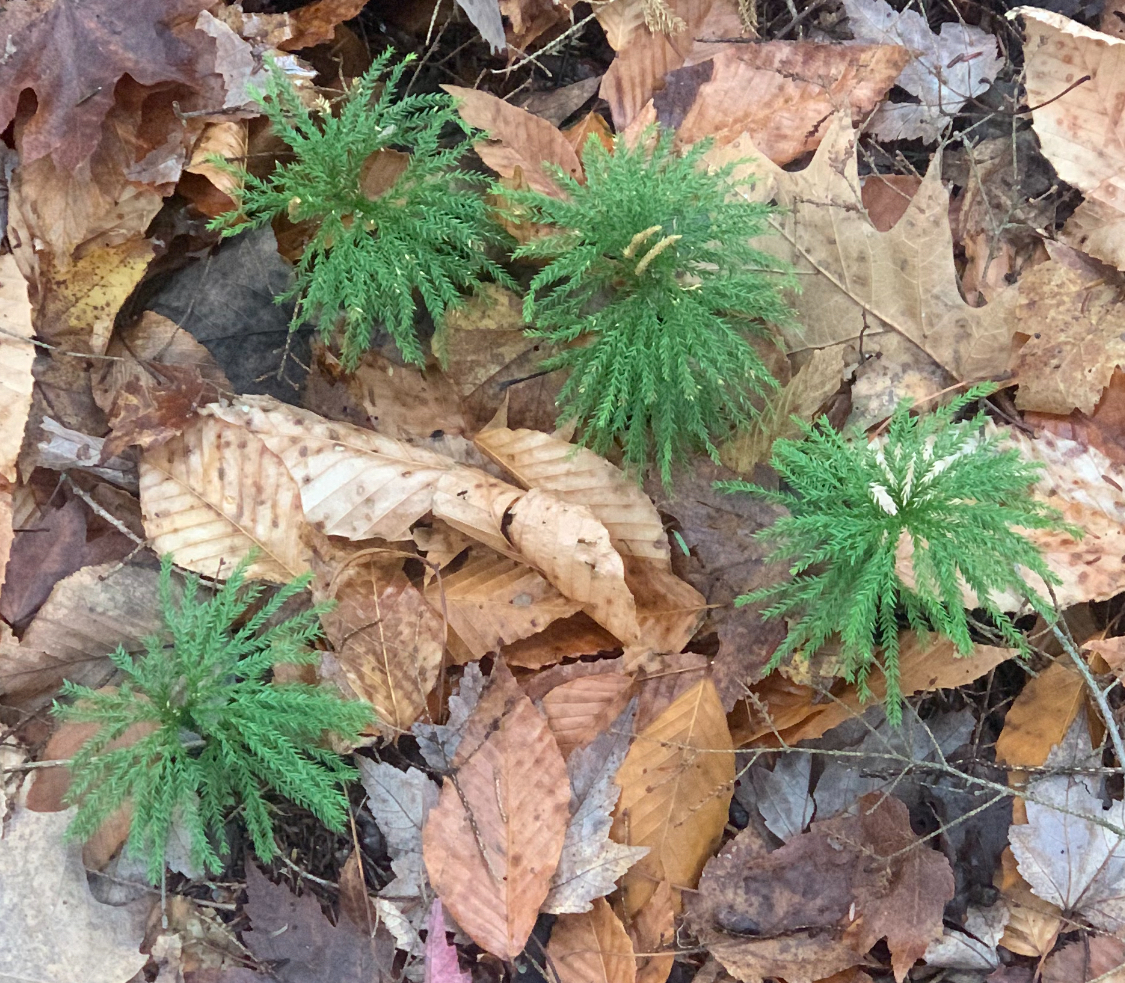
Found on the south side of the swamp the Lygodium palmatum, which Bigelow calls the only climbing fern in our latitude, an evergreen November 24, 1851
Saw there also a tortoise still stirring, the painted tortoise, I believe. November 24, 1851
Found on the south side of the swamp the Lygodium palmatum, which Bigelow calls the only climbing fern in our latitude, an evergreen November 24, 1851
The Rubus hispidus is now very common and conspicuous amid the withered grass and leaves of the swamp, with its green or reddened leaves. November 24, 1858
How pretty amid the downy and cottony fruits of November the heads of the white anemone. November 24, 1859
At Spanish Brook Path, the witch-hazel (one flower) lingers. November 24, 1859
Methinks we have had clear yellow sunsets and afterglows this month, like this to-night (not glowing red ones), with perhaps an inclination to blue and greenish clouds. November 24, 1853
 |
| November 24, 2016 |
A Book of Seasons, by Henry Thoreau, The Andromeda phenomenon
A Book of the Seasons, by Henry Thoreau, Blackberries
A Book of the Seasons, by Henry Thoreau, Lambkill (Kalmia augustifolia)
A Book of the Seasons, by Henry Thoreau, the Lichens and the lichenst studying lichens.
A Book of the Seasons, by Henry Thoreau, the Painted Turtle (Emys picta)
A Book of the Seasons, by Henry Thoreau, the American Black Duck
A Book of the Seasons, by Henry Thoreau, Geese in Autumn
A Book of the Seasons, by Henry Thoreau the Goldfinch
A Book of Seasons, by Henry Thoreau, First Ice
A Book of the Seasons, by Henry Thoreau, November days

November 24, 2018
March 2, 1858 (“ the snow is quite soft or damp, lodging in perpendicular walls on the limbs, white on black.”)
March 12, 1859 ("See two ducks flying over Ministerial Swamp.")
April 29, 1857 ("Sweet-fern at entrance of Ministerial Swamp.")
May 1, 1859 ("The climbing fern is persistent, i.e. retains its greenness still, though now partly brown and withered.") ;
May 19, 1860 (“At the Ministerial Swamp I see a white lady's-slipper almost out, fully grown, with red ones.”)
June 2, 1860 ("I soon hear its mournful scream. . . not loud now but, though within twenty or thirty rods, sounding a mile off.”);
June 25, 1860 ("At evening up the Assabet hear four or five screech owls on different sides of the river, uttering those peculiar low screwing or working, ventriloquial sounds.”)
July 7, 1854 ("See a pretty large hawk. . . circling over the Ministerial Swamp.")
August 14, 1854 (“I hear the tremulous squealing scream of a screech owl in the Holden Woods.”)
August 28, 1860 (" The Lycopodium inundatum common by Harrington's mud-hole, Ministerial Swamp.")
September 23, 1855 (" I hear from my chamber a screech owl about Monroe’s house this bright moonlight night, — a loud, piercing scream, much like the whinny of a colt perchance, a rapid trill, then subdued or smothered a note or two.”)
September 24, 1855 ("See coming from the south in loose array some twenty apparently black ducks, . . .At first they were in form like a flock of blackbirds, then for a moment assumed the outline of a fluctuating harrow. );
September 29, 1851 ("Scared up three black ducks, which rose with a great noise of their wings, striking the water. ");
September 30, 1853 ("Saw a large flock of black ducks flying northwest in the form of a harrow.");
October 2, 1859 (“The climbing fern is perfectly fresh, — and apparently therefore an evergreen, — the more easily found amid the withered cinnamon and flowering ferns.”);
October 8, 1860 ("I find a great many white oak acorns already sprouted, although they are but half fallen, and can easily believe that they sometimes sprout before they fall. It is a good year for them.")
October 11, 1860 ("There is a remarkably abundant crop of white oak acorns this fall.");
October 13, 1860 ("This is a white oak year")
October 14, 1856 (“[F]inger-cold to-day. Your hands instinctively find their way to your pockets”);
October 19, 1854 (“The country above Littleton (plowed ground) more or less sugared with snow,”)
October 19, 1854 (“The country above Littleton (plowed ground) more or less sugared with snow,”)
October 20, 1859 (“It is finger-cold as I come home, and my hands find their way to my pocket.”)
October 23, 1857 ("The ferns which I can see on the bank, apparently all evergreens, are polypody at rock, marginal shield fern, terminal shield fern, and (I think it is) Aspidium spinulosum,. . .The above-named evergreen ferns are so much the more conspicuous on that pale-brown ground. They stand out all at once and are seen to be evergreen; their character appears.”);
October 29, 1860 ("At some of the white oaks visited on the 11th, where the acorns were so thick on the ground and trees, I now find them perhaps nearly half picked up, yet perhaps little more than two thirds spoiled. The good appear to be all sprouted now.")
November 3, 1852 ("At Andromeda Pond, started nine black (?) ducks just at sunset, as usual they circling far round to look at me.")
November 3, 1853 (" I think it was the 27th October I saw a goldfinch. ")
November 3, 1853 (" I think it was the 27th October I saw a goldfinch. ")
November 4, 1855 ("See some large flocks of F. hyemalis, which fly with a clear but faint chinking chirp, and from time to time you hear quite a strain, half warbled, from them. They rise in a body from the ground and fly to the trees as you approach.”)
November 6, 1853 ("It is surprising how little most of us are contented to know about the sparrows which drift about in the air before us just before the first snows. These little sparrows with white in tail, perhaps the prevailing bird of late, have flitted before me so many falls and springs, yet they have been strangers to me. I have not inquired whence they came or whither they were going,")
November 6, 1853 ("It is surprising how little most of us are contented to know about the sparrows which drift about in the air before us just before the first snows. These little sparrows with white in tail, perhaps the prevailing bird of late, have flitted before me so many falls and springs, yet they have been strangers to me. I have not inquired whence they came or whither they were going,")
November 8, 1853 ("The snow begins to whiten the plowed ground now, but it has not overcome the russet of the grass ground.")
November 8, 1853 (“Our first snow,. . . The children greet it with a shout when they come out at recess. ”)November 8, 1858 ("Lichens . . .are the various grays and browns which give November its character.")
November 11, 1851 ("In the withered grass at Nut Meadow Brook, two black ducks, . . .rise black between me and the sun, but, when they have circled round to the east, show some silvery sheen on the under side of their wings. ")
November 11, 1851 (”A bright, but cold day, finger-cold. One must next wear gloves, put his hands in winter quarters.”)
November 11, 1853 ("Bracing cold, and exhilarating sunlight . . .I wear mittens now.”)
; November 11, 1858 (“Coming home I have cold fingers, and must row to get warm.”)
November 13, 1858 (“We looked out the window at 9 P. M. and saw the ground for the most part white with the first sugaring, which at first we could hardly tell from a mild moonlight, — only there was no moon. Thus it comes stealthily in the night and changes the whole aspect of the earth.”)
November 13, 1855 ("Seventy or eighty geese, in three harrows successively smaller, flying southwest—pretty well west—over the house. A completely overcast, occasionally drizzling forenoon.“);
November 13, 1855 ("Seventy or eighty geese, in three harrows successively smaller, flying southwest—pretty well west—over the house. A completely overcast, occasionally drizzling forenoon.“);
November 14, 1851 ("Surveying the Ministerial Lot in the southwestern part of the town.")
November 14, 1855 ("A painted tortoise swimming under water and a wood tortoise out on the bank.")
November 15, 1859 (“About the 23d of October I saw a large flock of goldfinches (judging from their motions and notes) on the tops of the hemlocks up the Assabet, apparently feeding on their seeds, then falling. They were collected in great numbers on the very tops of these trees and flitting from one to another. Rice has since described to me the same phenomenon ”)
November 15, 1859 (“About the 23d of October I saw a large flock of goldfinches (judging from their motions and notes) on the tops of the hemlocks up the Assabet, apparently feeding on their seeds, then falling. They were collected in great numbers on the very tops of these trees and flitting from one to another. Rice has since described to me the same phenomenon ”)
November 17, 1855 ("Just after dark the first snow is falling, after a chilly afternoon with cold gray clouds, when my hands were uncomfortably cold.”)
November 13, 1855 ("Seventy or eighty geese, in three harrows successively smaller, flying southwest—pretty well west—over the house. A completely overcast, occasionally drizzling forenoon.“)November 13, 1851 ("A day when you cannot pluck a flower, cannot dig a parsnip, nor pull a turnip, for the frozen ground! What do the thoughts find to live on?")
November 14, 1855 ("Mr. Rice . . . remembered a similar season fifty-four years ago, and he remembered it because on the 13th of November that year he was engaged in pulling turnips and saw wild geese go over, when one came to tell him that his father was killed by a bridge giving way ")
November 15, 1853 ("Take up a witch-hazel with still some fresh blossoms.")
November 15, 1858 ("I go to look for evergreen ferns before they are covered up. The end of last month and the first part of this is the time.")
November 15, 1858 ("I go to look for evergreen ferns before they are covered up. The end of last month and the first part of this is the time.")
November 17 1856 ("Winter is not all white and sere. . . . a few evergreen ferns scattered about keep up the semblance of summer still")
November 17, 1859 (“How fair and memorable this prospect when you stand opposite to the sun, these November afternoons, and look over the red andromeda swamp”)
November 25, 1857("This is November of the hardest kind, — bare frozen ground covered with pale-brown or straw-colored herbage, a strong, cold, cutting northwest wind which makes me seek to cover my ears, a perfectly clear and cloudless sky. . . . Ditches and pools are fast skimming over, and a few slate-colored snowbirds, with thick, shuffling twitter, and fine-chipping tree sparrows flit from bush to bush in the other wise deserted pastures. This month taxes a walker's resources more than any.")
November 18, 1855 ("About an inch of snow fell last night, but the ground was not at all frozen or prepared for it. A little greener grass and stubble here and there seems to burn its way through it this forenoon.");
November 18,1851 ("Surveying these days the Ministerial Lot . . .I hear the hooting of an owl . . . Here hawks also circle by day, and chickadees are heard, and rabbits and partridges abound.")
November 18, 1858 ("I go along under the east side of Lee’s Cliff, looking at the evergreen ferns.")
November 18, 1858 ("I go along under the east side of Lee’s Cliff, looking at the evergreen ferns.")
November 20, 1857 ("I enter the Ministerial Swamp at the road below Tarbell’s. The water andromeda leaves are brown now, except where protected by trees. In some places where many of the bright-crimson shoots of high blueberry are seen together, they have a very pretty effect")
November 20, 1858 ("Tthe Rubus hispidus leaves last all winter like an evergreen.")
November 20, 1853 ("Methinks the geese are wont to go south just before a storm, and, in the spring, to go north just after one, say at the end of a long April storm.”)
November 20, 1860 ("Decidedly finger cold tonight.")November 20, 1853 ("Methinks the geese are wont to go south just before a storm, and, in the spring, to go north just after one, say at the end of a long April storm.”)
November 21, 1860 ("Another finger-cold evening, which I improve in pulling my turnips”)
November 22, 1853 (“Geese went over yesterday, and to-day also.”)
November 22, 1860 ("Though you are finger-cold toward night, and you cast a stone on to your first ice, and see the unmelted crystals under every bank, it is glorious November weather, and only November fruits are out.”)
November 23, 1850 ("To-day it has been finger-cold. Unexpectedly I found ice by the side of the brooks this afternoon nearly an inch thick. Prudent people get in their barrels of apples to-day. ")
November 23, 1850 ("To-day it has been finger-cold. Unexpectedly I found ice by the side of the brooks this afternoon nearly an inch thick. Prudent people get in their barrels of apples to-day. ")
November 23, 1852 ("There is something genial even in the first snow, and Nature seems to relent a little of her November harshness.")
November 23, 1853 ("At 5 P. M. I saw, flying southwest high overhead, a flock of geese, and heard the faint honking of one or two. They were in the usual harrow form, . . . This is the sixth flock I have seen or heard of since the morning of the 17th , i . e . within a week .") November 23, 1852 ("I am surprised to see Fair Haven entirely skimmed over.")
November 25, 1850 ("I found Fair Haven skimmed entirely over, though the stones which I threw down on it from the high bank on the east broke through. Yet the river was open.")
November 25, 1852 ("At Walden. — I hear at sundown what I mistake for the squawking of a hen. . . but it proved to be a flock of wild geese going south")
November 27, 1856 ("Take a turn down the river. A painted tortoise sinking to the bottom, and apparently tree sparrows along the shore")
November 27, 1852 (“I find acorns which have sent a shoot down into the earth this fall.”)
November 29, 1856 ("This the first snow I have seen, ")
November 29, 1856 ("This the first snow I have seen, ")
November 30, 1851 ("The Lygodium palmatum is quite abundant on that side of the swamp, twining round the goldenrods, etc., etc")
November 30, 1853 ("Now, first since spring, I take notice of the cladonia lichens")December 2, 1854 ("Got up my boat and housed it, ice having formed about it.”)

December 2, 1857 ("Measuring Little Goose Pond, I observed two painted tortoises moving about under the thin transparent ice");
December 3, 1852 (" In a ditch near by, under ice half an inch thick, I saw a painted tortoise moving about.")
December 8, 1850 ("The dear privacy and retirement and solitude which winter makes possible!”)December 9, 1852 ("A few petals of the witch-hazel still hold on")
December 23, 1850 ("I can discern a faint foot or sled path sooner when the ground is covered with snow than when it is bare")
December 21, 1851 (“As I stand by the edge of the swamp (Ministerial), a heavy-winged hawk flies home to it at sundown, just over my head, in silence.”);
December 13, 1857 ("I go this afternoon thinking I may find the stakes set for auction lots on the Ministerial Lot in December, '51")
December 14, 1859 (Snow-storms might be classified. . . .Also there is the pellet or shot snow, which consists of little dry spherical pellets the size of robin-shot. This, I think, belongs to cold weather.")
December 16, 1857 ("Plowed grounds show white first.")
December 22, 1858 ("I see in the cut near the shanty-site quite a flock of F. hyemalis and goldfinches together, on the snow and weeds and ground.")
December 24, 1856 ("The snow collects and is piled up in little columns like down about every twig and stem, and this is only seen in perfection, complete to the last flake, while it is snowing, as now.”)
December 26, 1853 ("It has fallen so gently that it forms an upright wall on the slenderest twig”)
December 26, 1855 ("The scarlet fruit of the cockspur lichen, seen glowing through the more opaque whitish or snowy crust of a stump, is, on close inspection, the richest sight of all ”)
December 31, 1851 ("Nature has a day for each of her creatures, her creations. To-day it is an exhibition of lichens at Forest Hall.”)
January 5, 1860 ("I see where a flock of goldfinches in the morning had settled on a hemlock's top, by the snow strewn with scales, literally blackened or darkened with them for a rod.")
January 7, 1855 (“It is a lichen day. . . . How full of life and of eyes is the damp bark!”)
January 10,1855 ("As I go toward the sun now at 4 P. M., the translucent leaves are lit up by it and appear of a soft red, more or less brown, like cathedral windows, but when I look back from the sun, the whole bed appears merely gray and brown or less reddish.”).
January 14, 1853 ("White walls of snow rest on the boughs of trees, in height two or three times their thickness.”)January 10,1855 ("As I go toward the sun now at 4 P. M., the translucent leaves are lit up by it and appear of a soft red, more or less brown, like cathedral windows, but when I look back from the sun, the whole bed appears merely gray and brown or less reddish.”).
January 26, 1858 (“This is a lichen day. The white lichens, partly encircling aspens and maples, look as if a painter had touched their trunks with his brush as he passed”)
January 26, 1852 ("The lichens look rather bright to-day, . . .The beauty of lichens, with their scalloped leaves, the small attractive fields, the crinkled edge! I could study a single piece of bark for hour.”)
January 30, 1856 ("It has just begun to snow, — those little round dry pellets like shot. Stops snowing before noon, not having amounted to anything.”)
February 5, 1853 ("It is a lichen day. . . . All the world seems a great lichen and to grow like one to-day, - a sudden humid growth.”)
February 16, 1854 ("That Indian trail on the hillside about Walden is revealed with remarkable distinctness to me standing on the middle of the pond, by the slight snow which had lodged on it forming a clear white line unobscured by weeds and twigs. (For snow is a great revealer not only of tracks made in itself, but even in the earth before it fell.) It is quite distinct in many places where you would not have noticed it before. A light snow will often reveal a faint foot or cart track in a field which was hardly discernible before, for it reprints it, as it were, in clear white type, alto-relievo.”)

November 24, 2020
If you make the least correct
observation of nature this year,
you will have occasion to repeat it
with illustrations the next,
and the season and life itself is prolonged.
A Book of the Seasons, by Henry Thoreau, November 24
A Book of the Seasons, by Henry Thoreau
"A book, each page written in its own season,
out-of-doors, in its own locality."
~edited, assembled and rewritten by zphx © 2009-2022
;
.