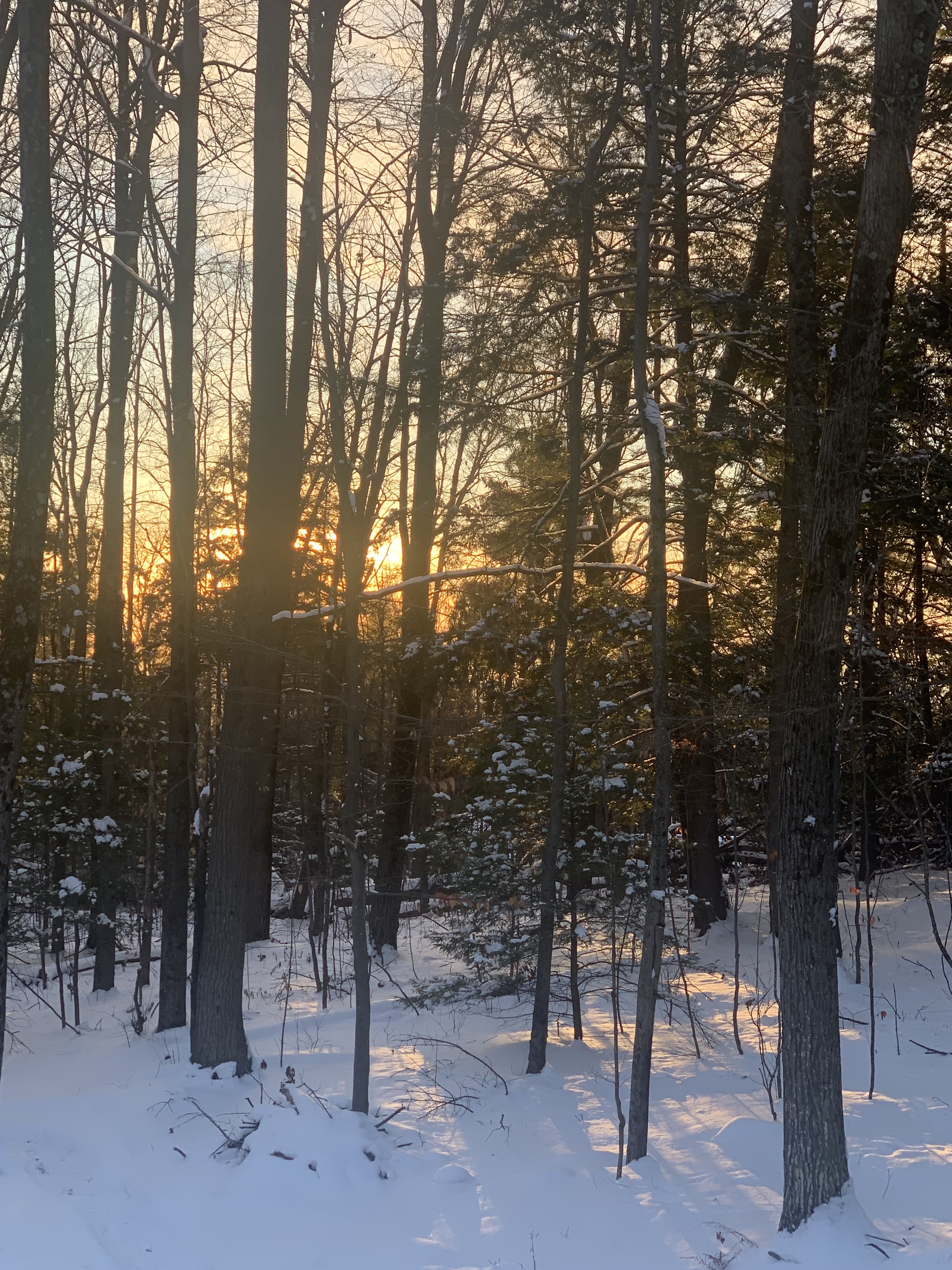
Saturday, January 10, 2015

Translucent leaves lit up like cathedral windows


January 10

January 10, 2025

To Beck Stow’s. The swamp is suddenly frozen up again, and they are carting home the mud which was dug out last fall, in great frozen masses.

The twigs of the Andromeda Polifolia, with its rich leaves turned to a mulberry-color above by the winter, with a bluish bloom and a delicate bluish white, as in summer, beneath, project above the ice, the tallest twigs recurved at top, with the leaves standing up on the upper side like teeth of a rake.

Then there is the Andromeda calyculata, its leaves appressed to the twigs, pale-brown beneath, reddish above, with minute whitish dots. As I go toward the sun now at 4 P. M., the translucent leaves are lit up by it and appear of a soft red, more or less brown, like cathedral windows, but when I look back from the sun, the whole bed appears merely gray and brown or less reddish.

The great buds of the swamp-pink, on the central twig, clustered together, are more or less imbrowned and reddened.

At European Cranberry Swamp, I see great quanities of the seeds of that low three-celled rush or sedge, about the edge of the pool on the ice, black and elliptical, looking like the droppings of mice, so thick in many places that by absorbing the sun’s heat they had melted an inch or more into the ice.

Cold and blustering as it is, the crows are flapping and sailing about and buffeting one another as usual.


H. D. Thoreau, Journal, January 10, 1855


The Andromeda Polifolia, with its rich leaves turned to a mulberry-color above by the winter, with a bluish bloom and a delicate bluish white, as in summer, beneath. See July 14, 1853 (“Saw something blue, or glaucous, in Beck Stow's Swamp to-day; approached and discovered the Andromeda Polifolia, in the midst of the swamp at the north end, not long since out of bloom. This is another instance of a common experience. When I am shown from abroad, or hear of, or in any [way] become interested in, some plant or other thing, I am pretty sure to find it soon.“)

Beck Stow's. See January 10, 1856  ("I love to wade and flounder through the swamp now") See also July 17, 1852 ("Beck Stow's Swamp! What an incredible spot to think of in town or city! . . . deep and impenetrable, where the earth quakes for a rod around you at every step . . . and its verdurous border of woods imbowering it on every side") and A Book of the Seasons, by Henry Thoreau, at Beck Stow's Swamp


As I go toward the sun now at 4 P. M., the translucent leaves are lit up by it and appear of a soft red, more or less brown, like cathedral windows, but when I look back from the sun, the whole bed appears merely gray and brown or less reddish. See April 17, 1852 ("Chancing to turn round, I was surprised to see that all this pond-hole also was filled with the same warm brownish-red-colored andromeda. The fact was I was opposite to the sun, but from every other position I saw only the sun reflected from the surface of the andromeda leaves, which gave the whole a grayish-brown hue tinged with red; but from this position alone I saw, as it were, through the leaves which the opposite sun lit up, giving to the whole this charming warm, what I call Indian, red color, — the mellowest, the ripest, red imbrowned color;. . . that warm, rich red tinge, surpassing cathedral windows”); April 19, 1852 ("These little leaves are the stained windows in the cathedral of my world.") See also A Book of the Seasons, by Henry Thoreau, The Andromeda Phenomenon

The great buds of the swamp-pink
. See January 31, 1854 ("I am always attracted at this season by the buds of the swamp-pink, the poplar, and the sweet- gale"); See also A Book of the Seasons, by Henry Thoreau, Swamp-pink


European Cranberry Swamp.[Gowing's Swamp] See August 30, 1856 ("To Vaccinium Oxycoccus Swamp . . . I have come out this afternoon a-cranberrying, chiefly to gather some of the small cranberry, Vaccinium Oxycoccus, which Emerson says is the common cranberry of the north of Europe.").")

Cold and blustering as it is, the crows are flapping and sailing about and buffeting one another as usual. See November 25, 1860 (“I see a very great collection of crows far and wide on the meadows, evidently gathered by this cold and blustering weather.”) See also 
A Book of the Seasons, by Henry Thoreau, the American Crow

January 10. See A Book of the Seasons,   by Henry Thoreau, January 10

The andromeda  –
translucent leaves lit up like
cathedral windows.

A Book of the Seasons,  by Henry Thoreau. 
"A book, each page written in its own season,
out-of-doors, in its own locality.”
~edited, assembled and rewritten by zphx © 2009-2025

https://tinyurl.com/hdt-550110

* * * * * *
We are up to the ridge again it is colder tonight perhaps 14° snow is slippery there are fox and coyote tracks on the way up and we don't stop at the view because of the cold and on the ridge in back we find a bobcat track that follows the trail along our own tracks up the ridge. For the first time this winter we walk on the ice on the pond and a new tree has fallen across the shortcut right above the driveway. Such a remarkable thing to be out in the cold in the woods with the bobcat this is the single thing to remember about today .

A fresh bobcat track
follows the trail up the ridge
along our old tracks.
Zphx20150110

Friday, January 9, 2015

Bog Laurel!


January 9.

 January 9, 2015

A cloudy day, threatening snow; wet under foot. 

How pretty the evergreen radical shoots of the St. John’s-wort now exposed, partly red or lake, various species of it. Have they not grown since fall? I put a stone at the end of one to try it. A little wreath of green and red lying along on the muddy ground amid the melting snows. 

I am attracted at this season by the fine bright-red buds of the privet andromeda, sleeping couchant along the slender light-brown twigs. They look brightest against a dark ground.

Walk up on the river a piece above the Holden Swamp, though there are very few places where I can get on to it, it has so melted along the shore and on the meadows. The ice over the channel looks dangerously dark and rotten in spots.

This winter I hear the axe in almost every wood of any consequence left standing in the township.

Make a splendid discovery this afternoon. Walking through Holden’s white spruce swamp, I see peeping above the snow-crust some slender delicate evergreen shoots very much like the Andromeda Polifolia, amid sphagnum, lambkill, Andromeda calyculata, blueberry bushes, etc., though there is very little to be seen above the snow. It is, I have little doubt, the Kalmia glauca var. rosmarinifolia.

Very delicate evergreen opposite linear leaves, strongly revolute, somewhat reddish-green above, the blossom-buds quite conspicuous. The whole aspect more tender and yellowish than the Andromeda Polifolia. The pretty little blossom-buds arranged crosswise in the axils of the leaves as you look down on them.

(Sometimes a lost man will be so beside himself that he will not have sense enough to trace back his own tracks in the snow.)

H. D. Thoreau, Journal, January 9, 1855


Andromeda calyculata is the leather-leaf or dwarf Cassandra (Chamaedaphne calculata). The Kalmia glauca var. rosmarinifolia is known as rosemary-leaf laurel  or alpine bog laurel (Andromeda Polifolia) H. Peter Loewer, Thoreau's Garden: Native Plants for the American Landscape 32-33

Make a splendid discovery this afternoon. Walking through Holden’s white spruce swamp, I see peeping above the snow-crust . . ., I have little doubt, the Kalmia glauca var. rosmarinifolia. See  July 14, 1853 (“Saw something blue, or glaucous, in Beck Stow's Swamp to-day; approached and discovered the Andromeda Polifolia, in the midst of the swamp at the north end, not long since out of bloom. "); February 4, 1858 ("Discover the Ledum latifolium, quite abundant over a space about six rods in diameter just east of the small pond-hole, growing with the Andromeda calyculata, Polifolia, Kalmia glauca, etc")

This winter I hear the axe in almost every wood of any consequence left standing in the township. See December 19, 1851 ("In all woods is heard now far and near the sound of the woodchopper's axe, a twilight sound, now in the night of the year, men having come out for fuel to the forests, as if men had stolen forth in the arctic night to get fuel to keep their fires a-going.") January 8, 1852 ("Even as early as 3 o'clock these winter afternoons the axes in the woods sound like nightfall, like the sound of a twilight labor."); January 21, 1852 ("This winter they are cutting down our woods more seriously than ever. . . Thank God, they cannot cut down the clouds!"); February 17, 1852 ("The shortness of the days, when we naturally look to the heavens and make the most of the little light, when we live an arctic life, when the woodchopper's axe reminds us of twilight at 3 o'clock p. m., when the morning and the evening literally make the whole day"); March 11, 1852 (The woods I walked in in my youth are cut off. Is it not time that I ceased to sing?"). 

Thursday, January 8, 2015

The sky reflected in the open river-reach, now perfectly smooth.


January 8

Still warm and cloudy, but with a great crescent of clear sky increasing in the north by west. The streets are washed bare down to the ice. 

January 8, 2023

It is pleasant to see the sky reflected in the open river-reach, now perfectly smooth.

10 A. M. — To Easterbrooks place 'via old mill site. 

It is now a clear warm and sunny day. There is a healthy earthy sound of cock-crowing. I hear a few chickadees near at hand, and hear and see jays further off, and, as yesterday, a crow sitting sentinel on an apple tree. Soon he gives the alarm, and several more take their places near him. Then off they flap with their caw of various hoarseness.

I see various caterpillars and grubs on the snow and in one place a reddish ant about a third of an inch long walking off. 

In the swamps you see the mouths of squirrels’ holes in the snow, with dirt and leaves and perhaps pine scales about them. 

The fever-bush is betrayed by its little spherical buds.

H. D. Thoreau, Journal, January 8, 1855

The sky reflected in the open river-reach, now perfectly smooth. See December 14, 1854 ("The river is open almost its whole length. It is a beautifully smooth mirror within an icy frame . . . distinguished from the surrounding ice only by its reflections."); January 18, 1860 ("The sky in the reflection at the open reach at Hubbard's Bath is more green than in reality, and also darker-blue, and the clouds are blacker and the purple more distinct.")

A crow sitting sentinel on an apple tree. See February 27, 1857 ("I see many crows on the hillside, with their sentinel on a tree") See also A Book of the Seasons, by Henry Thoreau, the American Crow

I see various caterpillars and grubs on the snow.
See December 20, 1854 ("If there is a grub out, you are sure to detect it on the snow or ice. "); January 5, 1858 ("I see one of those fuzzy winter caterpillars, black at the two ends and brown-red in middle, crawling on a rock by the Hunt's Bridge causeway."); January 16, 1855 ("Carried to Harris the worms -- brown, light-striped-and fuzzy black caterpillars (he calls the first also caterpillars); also two black beetles; all which I have found within a week or two on ice and snow; thickest in a thaw"); January 22, 1859 ("Four kinds of caterpillars, and also the glow-worm-like creature so common, grasshoppers, crickets, and many bugs, not to mention the mosquito like insects which the warm weather has called forth (flying feebly just over the ice and snow a foot or two), spiders, and snow-fleas"); January 24, 1859 ("I see an abundance of caterpillars of various kinds on the ice of the meadows . . . Many of them are frozen in yet, some for two thirds their length, yet all are alive.")

The fever-bush is betrayed by its little spherical buds. November 6, 1853 ("The fever bush has small roundish buds, two or three commonly together, probably the blossom-buds.")

The sky reflected 
in the open river-reach
now perfectly smooth.

A Book of the Seasons,  by Henry Thoreau
 "A book, each page written in its own season, 
out-of-doors, in its own locality."
 ~edited, assembled and rewritten by zphx ©  2009-2025


https://tinyurl.com/hdt-550108 

Wednesday, January 7, 2015

January Thaw


January 7

On opening the door I feel a very warm southwesterly wind, contrasting with the cooler air of the house, and find it unexpectedly wet in the street, and the manure is being washed off the ice into the gutter. It is, in fact, a January thaw. 

The channel of the river is quite open in many places, and I hear the pleasant sound of running water. The delicious soft, spring-suggesting air, —how it fills my veins with life! Life becomes again credible to me. A certain dormant life awakes in me, and I begin to love nature again. 

On the slopes the ground is laid bare and radical leaves revealed, crowfoot, shepherd's-purse, clover, etc., a fresh green, and, in the meadow, the skunk-cabbage buds, with a bluish bloom, and the red leaves of the meadow saxifrage; and these and the many withered plants laid bare remind me of spring and of botany. 

Still birds are very rare. Here comes a little flock of titmice, plainly to keep me company, with their black caps and throats making them look top-heavy, restlessly hopping along the alders, with a sharp, clear, lisping note.

I saw what looked like clay-colored snow-fleas on the under side of a stone.

It is a lichen day. The ground is covered with cetrariee, etc., under the pines. How full of life and of eyes is the damp bark! 

It would not be worth the while to die and leave all this life behind one.

H. D. Thoreau, Journal, January 7, 1855

On opening the door I feel a very warm southwesterly wind. . . It is, in fact, a January thaw.
See January 7, 1851 ("January thaw. Take away the snow and it would not be winter but like many days in the fall. ");January 7, 1860 ("A thaw begins, with a southerly wind. ")

Here comes a little flock of titmice. See January 7, 1851 ("The birds acknowledge the difference in the air; the jays are more noisy, and the chickadees are oftener heard.")

It is a lichen day. See February 5, 1853 ("It is a lichen day. . . . All the world seems a great lichen and to grow like one to-day, - a sudden humid growth.”)

January 7. See A Book of the Seasons, by Henry Thoreau, January 7

It would not be worth 
the while to die and leave all 
this life behind one.

A Book of the Seasons,  by Henry Thoreau
"A book, each page written in its own season,
out-of-doors, in its own locality.”
~edited, assembled and rewritten by zphx © 2009-2025

Tuesday, January 6, 2015

Those silver-gray cocoons so securely attached


January 6

6. P. M. – To Great Meadows. 

January 6, 2013

Saw one of those silver-gray cocoons which are so securely attached by the silk being wound round the leaf-stalk and the twig. This was more than a year old and empty and, having been attached to a red maple shoot, a foot or more above the meadow, it had girdled it just as a wire might, it was so unyielding, and the wood had overgrown it on each side. 

What is that small insect with large, slender wings  which I see on the snow or fluttering in the air these days? 

Also some little black beetles on the ice of the meadow, ten rods from shore. 

In many places near the shore the water has over flowed the ice to a great extent and frozen again with water between of a yellowish tinge, in which you see motes moving about as you walķ. 

The skating is for the most part spoiled by a thin, crispy ice on top of the old ice, which is frozen in great crystals and crackles under your feet. This is apparently the puddles produced by the late thaw and rain, which froze thinly while the rest of the water was soaked up.

 A fine snow is falling and drifting before the wind over the ice and lodging in shallow drifts at regular intervals.

I see where a woodpecker has drilled a hole about two inches over in a decayed white maple; quite recently, for the chippings are strewn over the ice beneath and were the first sign that betrayed it. The tree was hollow.  Is it for a nest next season? 

There was an old hole higher up. 

I see that the locust pods are still closed, or but partially open, but they open wider after lying in my chamber.


H. D. Thoreau, Journal, January 6, 1855

Saw one of those silver-gray cocoons which are so securely attached by the silk being wound round the leaf-stalk and the twig. See December 17, 1853 ("While surveying for Daniel Weston in Lincoln to-day, see a great many — maybe a hundred — silvery-brown cocoons"); December 24, 1853 ("In Weston's field I counted thirty-three or four of those large silvery-brown cocoons . . . The bare silvery cocoons would otherwise be too obvious. The worm has evidently said to itself: 'Man or some other creature may come by and see my casket. I will disguise it, will hang a screen before it.'"); January 19, 1854 ("The A. Promethea is the only moth whose cocoon has a fastening wound round the petiole of the leaf, and round the shoot, the leaf partly folded round it . . . not some poor worm's instinct merely, as we call it, but the mind of the universe rather, which we share . . . determined how cocoons had best be suspended");  February 19, 1854 ("The light ash-colored cocoons of the A. Promethea, with the withered and faded leaves wrapped around them so artfully and admirably secured by fine silk wound round the leaf-stalk and the twig."); May 17, 1857 ("Two cocoons of apparently the Attacus Promethea on a small black birch, the silk wound round the leaf stalk.") See also January 14, 1857 ("What kind of understanding was there between the mind that determined that these leaves should hang on during the winter, and that of the worm that fastened a few of these leaves to its cocoon in order to disguise it?”)

January 6. See A Book of the Seasons, by Henry Thoreau, January 6.

Silver-gray cocoons 
attached by the silk wound round 
the leaf-stalk and twig 

A Book of the Seasons, by Henry Thoreau
"A book, each page written in its own season,
out-of-doors, in its own locality.”
~edited, assembled and rewritten by zphx © 2009-2025

https://tinyurl.com/hdt-550106

Friday, January 2, 2015

In the path near Goose Pond

January 2.

In the path near Goose Pond I see where the rabbits have eaten the bark of smooth sumachs and young locusts rising above the snow; also barberry. 

Yesterday we saw the pink light on the snow within a rod of us. The shadow of the bridges, etc., on the snow was a dark indigo blue. 

H. D. Thoreau, Journal, January 2, 1855

See January 2, 1856 (“There are the tracks of many rabbits, both gray and white, which have run about the edges of these swamps since this snow came, amid the alders and shrub oaks, and one white one has crossed it. ”)

A Book of the Seasons,  by Henry Thoreau,  January 2.
A Book of the Seasons,  by Henry Thoreau
 "A book, each page written in its own season, 
out-of-doors, in its own locality."
 ~edited, assembled and rewritten by zphx ©  2009-2023

Thursday, January 1, 2015

Between frozen spew and broken ice


January 1.

P. M. —Skate to Pantry Brook with C. 

All the tolerable skating is a narrow strip, often only two or three feet wide, between the frozen spew and the broken ice of the middle.

We see the pink light on the snow within a rod of us. The shadow of the bridges on the snow is a dark indigo blue.

H. D. Thoreau, Journal, January 1, 1855


Frozen spew. See December 20, 1854 (The river is "uneven like frozen suds, in rounded pan cakes, as when bread spews out in baking.)

Pink light on the snow. See December 20, 1854 ("In some places, where the sun falls on it, the snow has a pinkish tinge"); December 21, 1854 ("The last rays of the sun falling on the Baker Farm reflect a clear pink color. "); December 31, 1854 ("The shadows on the snow are indigo-blue"); January 10, 1859 ("This is one of the phenomena of the winter sunset, this distinct pink light reflected from the brows of snow-clad hills on one side of you as you are facing the sun."); January 15, 1856 ("My shadow is a most celestial blue. This only requires a clear bright day and snow-clad earth, not great cold. "); January 19, 1859 ("Methinks this pink on snow (as well as blue shadows) requires a clear, cold evening.");January 31, 1859 ("the pink light reflected from the low, flat snowy surfaces amid the ice on the meadows, just before sunset, is a constant phenomenon these clear winter days. "); February 10, 1855 (“My shadow is blue. It is especially blue when there is a bright sunlight on pure white snow.”)

January 1. See A Book of the Seasons  by Henry Thoreau, January 1

Pink light on the snow –
the shadow of the bridges
dark indigo blue.

A Book of the Seasons,  by Henry Thoreau
"A book, each page written in its own season,
out-of-doors, in its own locality.”
~edited, assembled and rewritten by zphx © 2009-2025

https://tinyurl.com/hdt-550101


Jan. 1. P. M. —Skated to Pantry Brook with C. All the tolerable skating was a narrow strip, often only two or three feet wide, between the frozen spew and the broken ice of the middle.

Jan. 2. I see, in the path near Goose Pond, where the rabbits have eaten the bark of smooth sumachs and young locusts rising above the snow; also bar berry. Yesterday we saw the pink light on the snow within a rod of us. The shadow of the bridges, etc., on the snow was a dark indigo blue.

Popular Posts Last 30 Days.

The week ahead in Henry’s journal

The week ahead in Henry’s journal
A journal, a book that shall contain a record of all your joy.
"A stone fruit. Each one yields me a thought." ~ H. D. Thoreau, March 28, 1859


I sit on this rock
wrestling with the melody
that possesses me.