Saturday, April 7, 2018

The river is low. The meadows dry.


April 7. 

A cold and gusty, blustering day. We put on greatcoats again. 


April 7, 2018
P. M. — Down the Great Meadows. 

The river is low, even for summer. The ground about the outmost willow at my boat's place is high and dry. I cross the meadows and step across the Mill Brook near Mrs. Ripley's. 

You hear no stertorous sounds of the Rana halecina this cold and blustering day, unless a few when you go close to their breeding places and listen attentively. Scarcely one has his head out of water, though I see many at the bottom. I wear india-rubber boots and wade through the shallow water where they were found. 

In a shallow sheet of water on the meadow, with a grassy bottom, the spawn will commonly all be collected in one or two parcels in the deepest part, if it is generally less than eight or ten inches deep, to be prepared for a further fall. You will also find a little here and there in weedy ditches in the meadow. One of the first-named parcels will consist of even a hundred separate deposits about three or four inches in diameter crowded together. 

The frogs are most numerous to-day about and beneath the spawn. 

Each little mass of ova is pretty firmly attached to the stubble, – not accidentally,  but designedly and effectually, — and when you pull it off, leaves some of the jelly adhering to the stubble. If the mass is large it will run out of your hand this side or that, like a liquid, or as if it had life, — like “sun squall.” It is not injured by any ordinary agitation of the water, but the mass adheres well together. It bears being carried any distance in a pail. When dropped into the water again, it falls wrong side up, showing the white sides of the cores or yolks (?). 

On the Great Meadows, I stand close by two coupled. The male is very much the smallest, an inch, at least, the shortest, and much brighter-colored. The line, or “halo” (?), or margin about its blotches is a distinct yellow or greenish yellow. The female has a distended paunch full of spawn. 

Snipes rise two or three times as I go over the meadow. 

The remarkable spawn of the 3d, just below the Holt (?), does not show its cylindrical form so well as before; appears to have been broken up considerably, perhaps by creatures feeding on it. 

I see the remains of a duck which has died on this meadow, and the southeast edge of the meadow is strewn with the feathers of the water-fowl that plumed themselves here before the water went down. 

There is no water anywhere on these meadows now — except the one or two permanent pools — which I cannot walk through in my boots. 

Where they have been digging mud the past winter in Beck Stow's Swamp, I perceive that the crust, for one foot deep at least, consists chiefly, or perhaps half of it, — the rest mainly sphagnum, - of the dead and fallen stems of water andromeda which have accumulated in course of time. 

I brought home the above two kinds of spawn in a pail. Putting some of the Rana halecina spawn in a tumbler of water, I cannot see the gelatinous part, but only the dark or white cores, which are kept asunder by it at regular intervals. 

The other (probably fish) spawn is seen to be arranged in perfect hexagons; i. e., the ova so impinge on each other; but where there is a vent or free side, it is a regular arc of a circle. Is not this the form that spheres pressing on each other equally on all sides assume? I see the embryo, already fish-like (?), curved round the yolk, with a microscope.

H. D. Thoreau, Journal, April 7, 1858

The river is low, even for summer. See April 6, 1858 ("They with whom I talk do not remember when the river was so low at this season.") Compare April 8, 1856 ("River had risen so since yesterday I could not get under the bridge, but was obliged to find a round stick and roll my boat over the road.”)

You hear no stertorous sounds of the Rana halecina this cold and blustering day. Compare April 3, 1858 (" This might be called the Day of the Snoring Frogs, or the Awakening of the Meadows.") and see note to April 7, 1860 ("This is the Rana halecina day, — awakening of the meadows. — though not very warm.")

I see the embryo, already fish-like (?), curved round the yolk, with a microscope. See April 3, 1858 ("When returning , we discovered , on the south side of the river , just at the old crossing - place from the Great Meadows , north of the ludwigia pool , a curious kind of spawn . It was white , each ovum about as big as a robin - shot or larger , with mostly a very minute white core , no black core , and these were agglutinated together in the form of zigzag hollow cylinders , two or three inches in di ameter and one or two feet long"); April 14, 1858 ("with his microscope I see the heart beating in the embryo fish and the circulations distinctly along the body."); April 16, 1858 ("For more than a week the embryos have been conspicuously active, hardly still enough to be observed with a microscope. Their tails, eyes, pectoral fins, etc., were early developed and conspicuous. They keep up a regular jerking motion as they lie curved in the egg,. . . ( Some are still in the egg on the 18th . )")

Friday, April 6, 2018

How herbaceous and shrubby plants have suffered the past very mild but open winter.

April 6

April 6, 2018

A moist, foggy, and very slightly drizzly morning.

 It has been pretty foggy for several mornings. This makes the banks look suddenly greener, apparently making the green blades more prominent and more vividly green than before, prevailing over the withered ones.

P. M. – Ride to Lee’s Cliff and to Second Division Brook. 

It begins to grow cold about noon, after a week or more of generally warm and pleasant weather. 

They with whom I talk do not remember when the river was so low at this season. The top of the bathing-rock, above the island in the Main Branch, was more than a foot out of water on the 3d, and the river has been falling since.

On examining the buds of the elm at Helianthus Bank, I find it is not the slippery elm, and therefore I know but one. 

At Lee's Cliff I find no saxifrage in bloom above the rock, on account of the ground having been so exposed the past exceedingly mild winter, and no Ranunculus fascicularis anywhere there, but on a few small warm shelves under the rocks the saxifrage makes already a pretty white edging along the edge of the grass sod [?] on the rocks; has got up three or four inches, and may have been out four or five days. 

I also notice one columbine, which may bloom in a week if it is pleasant weather. 

The Ulmus Americana is apparently just out here, or possibly yesterday. The U. fulva not yet, of course. The large rusty blossom-buds of the last have been extensively eaten and mutilated, probably by birds, leaving on the branches which I examine mostly mere shells. 

I see, in [one] or two places in low ground, elder started half an inch, before any other shrub or tree. The Turritis stricta is four to six inches high.

 No mouse-ear there yet.

 I hear hylas in full blast 2.30 P. M.

 It is remarkable how much herbaceous and shrubby plants, some which are decidedly evergreen, have suffered the past very mild but open winter on account of the ground being bare. Accordingly the saxifrage and crowfoot are so backward, notwithstanding the warmth of the last ten days. Perhaps they want more moisture, too. 

The asplenium ferns of both species are very generally perfectly withered and shrivelled, and in exposed places on hills the checkerberry has not proved an evergreen, but is completely withered and a dead-leaf color. I do not remember when it has suffered so much. Such plants require to be covered with snow to protect them.

At Second Division, the Caltha palustris, half a dozen well out. The earliest may have been a day or two. 

The frost is but just coming out in cold wood-paths on the north sides of hills, which makes it very muddy, there only. 

Returned by the Dugan Desert and stopped at the mill there to get the aspen flowers. The very earliest aspens, such as grow in warm exposures on the south sides of hills or woods, have begun to be effete. Others are not yet out. 

Talked a moment with two little Irish (?) boys, eight or ten years old, that were playing in the brook by the mill. Saw one catch a minnow. I asked him if he used a hook. He said no, it was a “dully-chunk,” or some such word. “Dully what?” [I] asked. “Yes, dully,” said he, and he would not venture to repeat the whole word again. It was a small horsehair slip noose at the end of a willow stick four feet long. The horsehair was twisted two or three together. He passed this over the fish slowly and then jerked him out, the noose slipping and holding him. It seems they are sometimes made with wire to catch trout. I asked him to let me see the fish he had caught. It was a little pickerel five inches long, and appeared to me strange, being transversely barred, and reminded me of the Wrentham pond pickerel; but I could not re member surely whether this was the rule or the exception; but when I got home I found that this was the one which Storer does not name nor describe, but only had heard of. Is it not the brook pickerel? Asking what other fish he had caught, he said a pike. “That,” said I, “is a large pickerel.” He said it had “a long, long neb like a duck’s bill.” 

It rapidly grows cold and blustering.

April 6, 1858 (“The asplenium ferns of both species are very generally perfectly withered and shrivelled.”)

H. D. Thoreau, Journal  April 6, 1858

On a few small warm shelves under the rocks the saxifrage may have been out four or five days. See April 7, 1855 ("The saxifrage on the rocks will apparently open in two days; it shows some white. ");  April 10, 1855("As for the saxifrage, when I had given it up for to-day, having, after a long search in the warmest clefts and recesses, found only three or four buds which showed some white, I at length, on a still warmer shelf, found one flower partly expanded, and its common peduncle had shot up an inch."). See also A Book of the Seasons,  by Henry Thoreau,  Saxifrage in Spring (Saxifraga vernalis).

I also notice one columbine, which may bloom in a week if it is pleasant weather. .The Turritis stricta is four to six inches high. The saxifrage and crowfoot are so backward, notwithstanding the warmth of the last ten days.  See April 2, 1856 ("Cross Fair Haven Pond to Lee’s Cliff. The crowfoot and saxifrage seem remarkably backward; no growth as yet. . . .. The columbine, with its purple leaves, has grown five inches, and one is flower-budded, apparently nearer to flower than anything there. Turritis stricta very forward, four inches high.");  April 18, 1856 ("Common saxifrage and also early sedge I am surprised to find abundantly out—both—considering their backwardness April 2d. Both must have been out some, i. e. four or five, days half-way down the face of the ledge. Crowfoot, apparently two or three days. . . . Turritis stricta. Columbine, and already eaten by bees. Some with a hole in the side"); April 19, 1858 ("Viola ovata on bank above Lee's Cliff. Edith Emerson found them there yesterday; also columbines and the early potentilla April 13th !!!")

At Second Division, the Caltha palustris, half a dozen well out. See March 30, 1856 ("[I]n this warm recess at the head of the meadow, though the rest of the meadow is covered with snow a foot or more in depth, I am surprised to see . . . the Caltha palustris bud, which shows yellowish; and the golden saxifrage, green and abundant")

The very earliest aspens have begun to be effete. Others are not yet out. See April 9, 1856 ("Early aspen catkins have curved downward an inch, and began to shed pollen apparently yesterday.”). See also A Book of the Seasons,  by Henry Thoreau, the Aspens

This was the one which Storer does not name nor describe, but only had heard of. Is it not the brook pickerel? See May 27, 1858 ("De Kay describes the Esox fasciatus, which is apparently mine of May 11th."); February 23, 1859 ("I see, just caught in the pond, a brook pickerel which, though it has no transverse bars, but a much finer and slighter reticulation than the common, is very distinct from it in the length and form of the snout. This is much shorter and broader as you look down on it.") See also A Book of the Seasons, by Henry Thoreau, Pickerel

April 6, 2018

Thursday, April 5, 2018

A pair of wood frogs in captivity.

April 5.  
April 5, 2018

What I call the young bullfrog, about two and a half inches long, — though it has no yellow on throat. It has a bright-golden ring outside of the iris as far as I can see round it. Is this the case with the bullfrog? May it not be a young Rana fontinalis? No yellow to throat. I found it on the shore of the Clamshell Hill ditch. Can jump much better than the others, and easily gets out of the deep pan.

Those to whom I showed the two R. sylvatica could not believe that they were one species, but this morning, on taking them out of the water to examine minutely, they changed so rapidly, chameleon-like, that I could only describe their first appearance from memory. The male grew a lighter brown and the female darker, till in ten minutes there was but a slight shade of difference, and their whole aspect, but especially that of the male, seemed altered also, so that it was not easy to distinguish them. Yet they would readily be recognized for rather dark-colored wood frogs, the posterior extremities of both having distinct dark bars. 

The female was two and one tenth inches long, the male one and four fifths inches long. The female was (apparently involuntarily) dropping a little spawn in the pan this morning, and the black core was as big as the head of a pin when it issued from the body. The only difference in color that I now noticed, except that the male was a shade the darkest (both a pale brown), was that there was a very distinct dark mark on the front side at the base of the anterior extremities of the female, while there was but the slightest trace of it in the male. 

Also the female was more green on the flanks and abdomen; also she had some dusky spots beneath. What is described as a yellow line along the lower edge of the dark one through the eyes, i.e. along the upper jaw, and which I observed to be such last spring, was in both these at all times a broad silvery or bright cream-colored line. 

Putting them into the water, after an hour they again acquired distinct colors, but not quite so distinct at first. It is singular that at the breeding-season, at least, though both are immersed in water, they are of a totally different color, -- the male a very dark brown for a frog, darker than the ordinary color of any Massachusetts frog, without distinct bars to his posterior extremities or a distinct dark line along the snout, while the female is a light reddish brown or lively dead-leaf color, — and that, taken out of water, they rapidly approximate each other till there is only a shade of difference if any. 

At their breeding-season, then, the colors of the male are not livelier, as in the case of birds, but darker and more sombre. 

Considering how few of these or of the R. halecina you meet with in the summer, it is surprising how many are now collected in the pools and meadows. The woods resound with the one, and the meadows day and night with the other, so that it amounts to a general awakening of the pools and meadows. 

I hear this morning the seringo sparrow. 

In the proceedings of the Natural History Society for December, 1856, there were presented by Dr. H. R. Storer, “a globular concretion of grass said to have been formed by the action of waves upon the seashore.” Were not these some obtained by the Hoars or Emersons from Flint's Pond?

P. M. – I go to the meadow at the mouth of the Mill Brook to find the spawn of the R. halecina. 

They are croaking and coupling there by thousands, as before, though there is a raw east wind to-day. I see them coupled merely, in a few instances, but no such balls or masses of them about one female as in the case of the R. sylvatica, though this may occur. 

You can easily get close to them and catch them by wading. The first lagoon within the meadow was not a foot deep anywhere, and I found the spawn where it was about eight inches deep, with a grassy and mossy bottom. It was principally in two collections, which were near together and each about a yard in diameter. The separate masses of this were from two to six, or commonly three or four, inches in diameter, and generally looked quite black and dense or fine-egged in the water. But it really on a closer inspection presented quite an interesting variety of appearances. 

The black core is about the size of a pin-head, and one half of it is white. It commonly lies with the black side up, and when you look directly down on it, has a rich, very dark blue-purple appearance. When with the white or wrong side up, it looks like a mass of small silvery points or bubbles, and you do not notice the jelly. But it lies also at all intermediate angles, and so presents a variety of appearances. 

It is attached pretty firmly to the grass and rises just to the surface. There are very fine froth-like bubbles more or less mingled with it. I am not sure that I can distinguish it from that of the R. sylvatica. 

I caught several of the first. The dark blotches on the back were generally more or less roundish with a crenate edge. There were distinct, raised, light bronze colored ridges from the snout along the side-head and body, which were conspicuous at a distance. They were, all that I caught, distinctly yellow-white beneath, and some had green buttocks. 

And now, standing over them, I saw that there were considerable lateral  bubbles formed when they croaked, i. e., the throat was puffed out on each side quite far behind the snout. The tympanum was very convex and prominent. 

At evening I find that the male R. sylvatica couples with or fastens himself to the back of the young bull frog (?)*, or whatever it is, and the latter meanwhile croaks, in short croaks four or five times repeated, much like the R. sylvatica, methinks. 

I hear the hylodes peeping now at evening, being at home, though I have not chanced to hear any during the day. They prefer the evening.

H. D. Thoreau, Journal, April 5, 1858


May it not be a young Rana fontinalis? No yellow to throat. See A Book of Seasons,  by Henry Thoreau, Identifying the Green Frog in Spring (Rana Fontinalis)

The woods resound with the one [R. sylvatica], and the meadows day and night with the other [R. halecina], so that it amounts to a general awakening of the pools and meadows. See April 5, 1855  ("Hear from one half-flooded meadow that low, general, hard, stuttering tut tut tut of frogs,—the awakening of the meadow. "); April 5, 1857 (“I hear the croaking frogs at 9.30 P. M.”); and note to April 3, 1858 (“the Day of the Snoring Frogs, or the Awakening of the Meadows.”) See also A Book of the Seasons,  by Henry Thoreau, The first frogs to begin calling. See also A Book of the Seasons,  by Henry Thoreau, The  Wood Frog (Rana sylvatica) and A Book of the Seasons,  by Henry Thoreau,  the Leopard Frog (Rana Halecina) in Spring 

The black core is about the size of a pin-head, and one half of it is white. See April 4, 1857 ("Caught a croaking frog . . .. Nearby was its spawn, in very handsome spherical masses of transparent jelly. . . consisting of globules. . . with a black or dark centre as big as a large shot."); April 4, 1858 ("There was a good deal of spawn firmly attached to the brush close to the surface, and, as usual, in some lights you could not see the jelly, only the core.")

 I hear the hylodes peeping now at evening,  though I have not chanced to hear any during the day. See note to April 5, 1854 ("Hark! while I write down this field note, the shrill peep of the hylodes is borne to me from afar through the woods"); See also April 1, 1860 ("I hear the first hylodes by chance, but no doubt they have been heard some time.") and A Book of the Seasons, by Henry Thoreau, The Spring Peeper

*According to Maine Department of Inland Fisheries and Wildlife male wood frogs search for a mate by hugging other frogs until they find one who is round enough to be carrying eggs.

The pools and meadows
general awakening –
wood and leopard frogs.

Wednesday, April 4, 2018

Discovery of the male wood frog.

April 4. 
Male Wood Frog (Rana sylvatica) amplexing a female

P. M. —Go to the cold pond-hole south of J. P. Brown’s, to hear the croaking frogs. 

They are in full blast on the southwest side, where there have been some birches, etc., cut the past winter, and there is much brush fallen in the water, whose shelter they evidently like, and there they have dropped their spawn on the twigs. I stand for nearly an hour within ten feet on the bank overlooking them. 

You see them lying spread out, or swimming toward one another, sometimes getting on to the brush above the water, or hopping on to the shore a few feet. I see one or two pairs coupled, now sinking, now rising to the surface. 

The upper one, a male, quite dark brown and considerably smaller than the female, which is reddish--such part of her as I can see--and has quite distinct dark bars on its posterior extremities, while I cannot discern any on the male.

But the greatest commotion comes from a mass of them, five or six inches in diameter, where there are at least a dozen or fifteen clinging to one another and making a queer croaking. From time to time a newcomer adds himself to the mass, turning them over and over. [It was an incessantly struggling mass. You could have taken up a dozen or fifteen in your two hands.]The water is all alive with them for a couple of rods, and from time to time they croak much more generally than at others, evidently exciting one another to it, as do the R. halecina. 

Before I caught any of them I was only struck with the fact that the males were much smaller and very much darker, though I could see only one female partially. At length, when all the rest had been scared to the bottom by nearer approach, I got near to the struggling mass. They were continually dropping off from it, and when at length I reached out to seize it, there were left but two. 

Lifting the female, the male still clung to her with his arms about her body, and I caught them both, and they were perfectly passive while I carried them off in my hand. To my surprise the female was the ordinary light-reddish-brown wood frog (R. sylvatica), with legs distinctly barred with dark, while the male, whose note alone I have heard, methinks, was not only much smaller, but of a totally different color, a dark brown above with dark-slate colored sides, and the yet darker bars on its posterior extremities and the dark line from its snout only to be distinguished [on] a close inspection. Throat and beneath, a cream white, like but clearer than the female. 

In color, a small bullfrog which I had caught [probably R. fontinalis], and any other frog that I know, was more like the female than these males were. I have caught the female in previous years, as last spring in New Bedford, but could find no description of him and suspected it to be an undescribed frog. 

It seems they were all (of this mass) about one female, and I saw only one other in the pool, but apparently only one had possession of her. There was a good deal of spawn firmly attached to the brush close to the surface, and, as usual, in some lights you could not see the jelly, only the core. 

I brought these frogs home and put them in a pan of water.

Sophia has brought home the early large-catkinned willow, well out; probably some yesterday at least.

H. D. Thoreau, 
Journal, April 4, 1858


Go to the cold pond-hole south of J. P. Brown’s, to hear the croaking frogs.See April 13, 1855 ("The small croaking frogs are now generally heard in all those stagnant ponds or pools in woods floored with leaves, which are mainly dried up in the summer. . . . We, hear them at J. P. Brown’s Pond, which is edged with ice still on the north.")

To my surprise the female was the ordinary light-reddish-brown wood frog (R. sylvatica), with legs distinctly barred with dark., while the male, . . .was not only much smaller, but of a totally different color, a dark brown above with dark-slate colored sides.  See April 4, 1857 ("Caught a croaking frog . . . Above it was a uniform (perhaps olive?) brown, without green, and a yellowish line along the edge of the lower jaws."); See also  May 27, 1852 ("Catch a wood frog the color of a dead leaf. "); June 29, 1852 ("The mud turtle is the color of the mud, the wood frog and the hylodes of the dead leaves, the bullfrogs of the pads, the toad of the earth, the tree-toad of the bark."); May 30, 1854 ("Wood frogs skipping over the dead leaves, whose color they resemble."). September 12, 1857 ("I brought it close to my eye and examined it. It was very beautiful seen thus nearly, not the dull dead-leaf color which I had imagined, but its back was like burnished bronze . . . and reddish-orange soles to its delicate feet. There was a conspicuous dark-brown patch along the side of the head,"); October 16, 1857 ("I see a delicate pale brown-bronze wood frog. I think I can always take them up in my hand. They, too, vary in color,") See also A Book of the Seasons, by Henry Thoreau, the Wood Frog (Rana sylvatica)


~ According to Wikipedia female wood frogs are larger than males. Adult wood frogs are usually brown, tan, or rust-colored, and usually have a dark eye mask. The underparts of wood frogs are pale with a yellow or green cast. Individual frogs are capable of varying their color.

Females tended to be redder and bigger than the males, with the males being more brown and smaller. ~A Frog of a Different Color: Sexually Dimorphic Color in Wood Frogs by thelizardlog

Tuesday, April 3, 2018

The Day of the Snoring Frogs, or the Awakening of the Meadows.

April 3. 

Going down-town this morning, I am surprised by the rich strain of the purple finch from the elms. Three or four have arrived and lodged against the elms of our street, which runs east and west across their course, and they are now mingling their loud and rich strains with that of the tree sparrows, robins, bluebirds, etc. 

The hearing of this note implies some improvement in the acoustics of the air. It reminds me of that genial state of the air when the elms are in bloom. 

They sit still over the street and make a business of warbling. They advertise me surely of some additional warmth and serenity. How their note rings over the roofs of the village! You wonder that even the sleepers are not awakened by it to inquire who is there, and yet probably not another than myself in all the town observes their coming, and not half a dozen ever distinguished them in their lives. And yet the very mob of the town know the hard names of Germanians or Swiss families which once sang here or elsewhere. 

About 9 A. M., C. and I paddle down the river. 

It is a remarkably warm and pleasant day. The shore is alive with tree sparrows sweetly warbling, also black birds, etc. The crow blackbirds which I saw last night are hoarsely clucking from time to time. 

Approaching the island, we hear the air full of the hum of bees, which at first we refer to the near trees. It comes from the white maples across the North Branch, fifteen rods off. We hear it from time to time, as we paddle along all day, down to the Bedford line. There is no pause to the hum of the bees all this warm day. It is a very simple but pleasing and soothing sound, this susurrus, thus early in the spring. 

When off the mouth of the Mill Brook, we hear the stertorous tut tut tut of frogs from the meadow, with an occasional faint bullfrog-like er er er intermingled. I land there to reconnoitre. 

The river is remarkably low, quite down to summer level, and there is but very little water anywhere on the meadows. I see some shallow lagoons (west of the brook), whence the sound comes. 

There, too, are countless painted turtles out, around on the banks and hummocks left by the ice. Their black and muddy backs shine afar in the sun, and though now fifteen to twenty rods off, I see through my glass that they are already alarmed, have their necks stretched out and are beginning to slip into the  water, where many heads are seen. 

Resolved to identify this frog, one or two of whose heads I could already see above the surface with my glass, I picked my way to the nearest pool. Close where I landed, an R. halecina lay out on some sedge. In went all the turtles immediately, and soon after the frogs sank to the bottom, and their note was heard only from more distant pools. 

I stood perfectly still, and ere long they began to reappear one by one, and spread themselves out on the surface. They were the R. halecina. I could see very plainly the two very prominent yellow lines along the sides of the head and the large dark ocellated marks, even under water, on the thighs, etc. Gradually they begin to recover their voices, but it is hard to say at first which one of the dozen within twenty feet is speaking. They begin to swim and hop along the surface toward each other. Their note is a hard dry tut tut tut tut, not at all ringing like the toad’s, and produced with very little swelling or motion of the throat, but as much trembling of the whole body; and from time to time one makes that faint somewhat bullfrog-like er er er. Both these sounds, then, are made by one frog, and what I have formerly thought an early bullfrog note was this. 

This, I think, is the first frog sound I have heard from the river meadows or anywhere, except the croaking leaf-pool frogs and the hylodes. They are evidently breeding now like toads, and probably are about the water as exclusively as the toads will soon be. 

This sound we continue to hear all day long, especially from the broad meadows in Bedford. Close at hand a single one does not sound loud, yet it is surprising how far a hundred or thousand croaking ( ? ) at once can be heard. It comes borne on the breeze from north over the Bedford meadows a quarter of a mile off, filling the air. It is like the rattling of a wagon along some highway, or more like a distant train on a railroad, or else of many rills emptying in, or more yet like the sound of a factory, and it comes with an echo which makes it seem yet more distant and universal. At this distance it is a soft and almost purring sound, yet with the above-named bullfrog-like variation in it. 

Sometimes the meadow will be almost still; then they will begin in earnest, and plainly excite one an other into a general snoring or eructation over a quarter of a mile of meadow. It is unusually early to hear them so numerously, and by day, but the water, being so very low and shallow on the meadows, is unusually warm this pleasant day. This might be called the Day of the Snoring Frogs, or the Awakening of the Meadows. 

Probably the frost is out of the meadows very early this year. It is a remarkable spring for reptile life. 

It remains now to detect the note of the palustris, wood frog, and fontinalis. I am not sure but I heard one kind of bullfrog’s note along the river once or twice. I saw several middle-sized frogs with green noses and dark bodies, small, bullfrog-like (? ?), sitting along the shore. 

At what perhaps is called the Holt just below N. Barrett’s, many grackles and red-wings together flit along the willows by our side, or a little ahead, keeping up a great chattering, while countless painted turtles are as steadily rustling and dropping into the water from the willows, etc., just ahead. 

We land at Ball's Hill and eat our dinners. It is so warm we would fain bathe. We seek some shade and cannot easily find it. You wonder that all birds and insects are not out at once in such a heat. We find it delicious to take off our shoes and stockings and wade far through the shallows on the meadow to the Bedford shore, to let our legs drink air. 

How pretty the white fibrous roots of the eriocaulon, floating in tufts on the meadow, like beaded chains! 

In the hazy atmosphere yesterday we could hardly see Garfield's old unpainted farmhouse. It was only betrayed by its elms. This would be the right color for painters to imitate. When the sun went into a cloud we detected the outlines of the windows only. 

When returning, we discovered, on the south side of the river, just at the old crossing-place from the Great Meadows, north of the ludwigia pool, a curious kind of spawn. It was white, each ovum about as big as a robin-shot or larger, with mostly a very minute white core, no black core, and these were agglutinated together in the form of zigzag hollow cylinders, two or three inches in diameter and one or two feet long, looking like a lady's ruff or other muslin work, on the bottom or on roots and twigs of willow and button-bush, where the water was two or three feet deep. The greater part lay on the bottom, looking like a film, these cylinders being somewhat coiled about there. When you took it up, the two sides fell together, and it was flat in your hand like the leg of a stocking. In one place there were a dozen very large red-bellied and brown-backed leeches in it, evidently battening on it. This must be frog or fish spawn. 

If frog-spawn, I think it must be that of the Rana halecina [No. Vide April 5th. Is it not fish-spawn?], the only ones fairly awake along the river; but how are leeches propagated? There was a great abundance of it, many bushels, for at least a dozen rods along the shore, and it must afford food to many creatures. The consistency of a jelly we eat. We saw one perch there. Some on the ruts was quite up to the surface, but most lower. When you had taken up a handful and broken it, on dropping it into the water it recovered its form for the most part. I noticed that the fine willow root-fibres and weeds, potamogeton, etc., there were thickly covered with a whitish film or fuzz, an eighth to a quarter of an inch deep, or long, apparently connected with this spawn, which made them look like plants covered with frost in a winter morning, though it was a duller white; but out of water you did not perceive anything. Probably this was the milt. 

When I have been out thus the whole day and spend the whole afternoon returning, it seems to me pitiful and ineffectual to be out as usual only in the afternoon, – as if you had come late to a feast, after your betters had done. The afternoon seems coarse and reversed, or at best a long twilight, after the fresh and bright forenoon. 

The gregariousness of men is their most contemptible and discouraging aspect. See how they follow each other like sheep, not knowing why. Day & Martin's   blacking was preferred by the last generation, and also is by this. They have not so good a reason for preferring this or that religion as in this case even. Apparently in ancient times several parties were nearly equally matched. They appointed a committee and made a compromise, agreeing to vote or believe so and so, and they still helplessly abide by that. Men are the inveterate foes of all improvement. Generally speaking, they think more of their hen-houses than of any desirable heaven. If you aspire to anything better than politics, expect no cooperation from men. They will not further anything good. You must prevail of your own force, as a plant springs and grows by its own vitality. 

Hear the Rana halecina in the evening also, from my window.


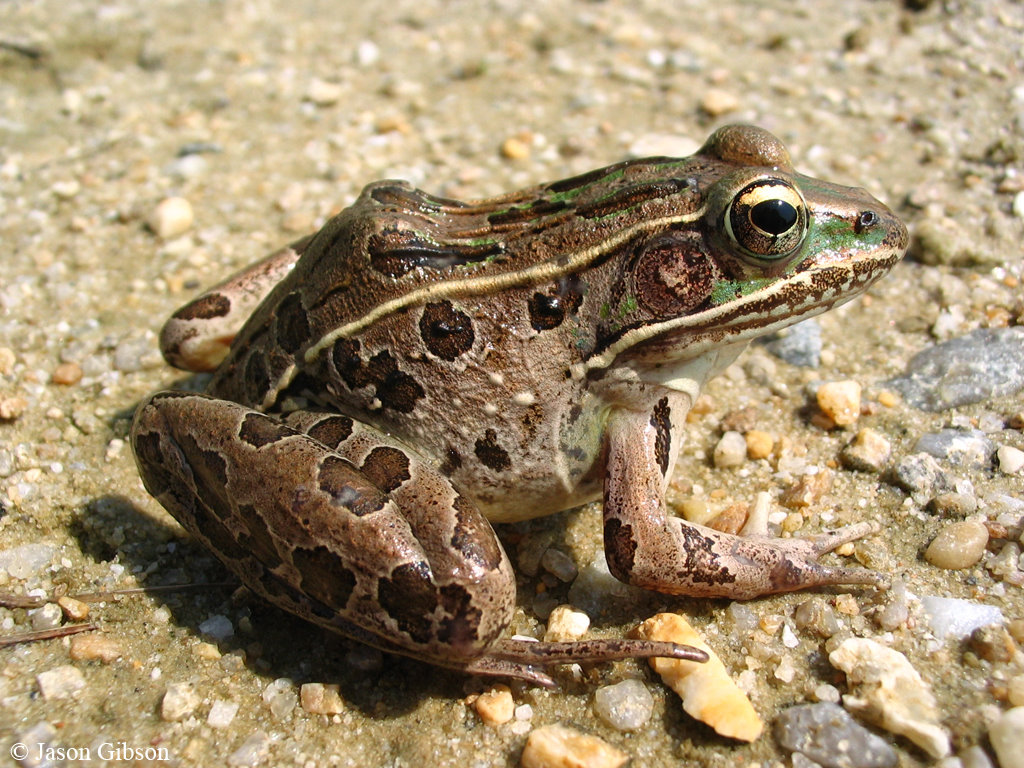
Rana halecina

I could see very plainly the two very prominent yellow lines along the sides of the head
and the large dark ocellated marks, even under water, on the thighs, etc.

H. D. Thoreau, Journal, April 3, 1858

We hear the air full of the hum of bees, which . . .comes from the white maples across the North Branch, fifteen rods off. . .It is a very simple but pleasing and soothing sound, this susurrus, thus early in the spring. See April 6, 1854 ("I am surprised to find so much of the white maples already out. . . . They resound with the hum of honey-bees, heard a dozen rods off, and you see thousands of them about the flowers against the sky. . . .This susurrus carries me forward some months toward summer --"); April 6, 1853 ("Notice a white maple with almost all the staminate flowers above or on the top, most of the stamens now withered, before the red maple has blossomed. Another maple, all or nearly all female. The staminiferous flowers look light yellowish, the female dark crimson”); April 6,1855 ("A very few white maple stamens stand out already loosely enough to blow in the wind.") White maple stamens stand out already loosely enough to blow in the wind.");  April 7, 1861 (" The white maple at the bridge not quite out.”); April 8, 1855 (I find some anthers effete and dark, and others still mealy with pollen. There are many in this condition. The crimson female stigmas also peeping forth. It evidently began to shed pollen yesterday.”); April 9, 1852 ("The maple by the bridge in bloom”);


This might be called the Day of the Snoring Frogs, or the Awakening of the Meadows. See April 5, 1855 ("Hear from one half-flooded meadow that low, general, hard, stuttering tut tut tut of frogs,—the awakening of the meadow.”);   April 5, 1858 ("The woods resound with the one [R. sylvatica], and the meadows day and night with the other [R. halecina], so that it amounts to a general awakening of the pools and meadows. "); April 5, 1860 (" a very faint distant ring of toads.");  April 9, 1853 (“The whole meadow resounds, probably from one end of the river to the other, this evening, with this faint, stertorous breathing. It is the waking up of the meadows."); 

Rana halecina (Lithobates pipiens) – Northern Leopard Frog. See  April 8, 1852 ("To-day I hear the croak of frogs in small pond-holes in the woods"); August 22, 1854 ("There are now hopping all over this meadow small Rana palustris, and also some more beautifully spotted halecina or shad frogs.");April 13, 1855 ("The small croaking frogs are now generally heard in all those stagnant ponds or pools in woods floored with leaves, which are mainly dried up in the summer.");  April 15, 1855 ("That general tut tut tut tut, or snoring, of frogs on the shallow meadow heard first slightly the 5th. There is a very faint er er er now and then mixed with it."); April 13, 1856 ("As I go by the Andromeda Ponds, I hear the tut tut of a few croaking frogs. . ."); June 17, 1856 ("Went to Rev. Horace James’s reptiles (Orthodox). . . . He distinguished the Rana halecina in the alcohol by more squarish (?) spots.");  March 31,1857 ("The dry croaking and tut tut of the frogs"); April 4, 1857 ("Caught a croaking frog in some smooth water in the railroad gutter. Above it was a uniform (perhaps olive?) brown, without green, and a yellowish line along the edge of the lower jaws.. . .What frog can it be?"); September 6, 1857 ("I observe to-day, away at the south end of our dry garden, a moist and handsome Rana halecina. It is the only frog that I ever see in such localities. He is quite a traveller."); April 1, 1858 ("A Rana halecina on the bank"); April 2, 1858 ("I catch a large Rana halecina, which puffs itself up “); April 5, 1858 (“I go to the meadow at the mouth of the Mill Brook to find the spawn of the R. halecina. They are croaking and coupling there by thousands")

We could hardly see Garfield's old unpainted farmhouse. See August 26, 1858 ("A weather-painted house and barn, with an orchard by its side, in midst of a sandy field surrounded by green woods, with a small blue lake on one side. A sympathy between the color of the weather-painted house and that of the lake and sky. . . .The weather-painted house. This is the New England color.")


April 3. See A Book of the Seasons, by Henry Thoreau, April 3

A Book of the Seasons, by Henry Thoreau
"A book, each page written in its own season,
out-of-doors, in its own locality.”
~edited, assembled and rewritten by zphx © 2009-2022


Monday, April 2, 2018

No doubt on almost every such warm bank now you will find a snake lying out.

April 2.

P. M. – To yew and R. W. E.'s Cliff. 

April 2, 2018

At Hubbard’s Grove I see a woodchuck. He waddles to his hole and then puts out his gray nose within thirty feet to reconnoitre.

It is too windy, and the surface of the croaker pool is too much ruffled, for any of the croakers to be lying out, but I notice a large mass of their spawn there well advanced.

At the first little sluiceway just beyond, I catch a large Rana halecina, which puffs itself up considerably, as if it might be full of spawn. I must look there for its spawn. It is rather sluggish; cannot jump much yet. It allows me to stroke it and at length take it up in my hand, squatting still in it.

Who would believe that out of these dry and withered banks will come violets, lupines, etc., in profusion?

At the spring on the west side of Fair Haven Hill, I startle a striped snake. It is a large one with a white stripe down the dorsal ridge between two broad black ones, and on each side the last a buff one, and then blotchy brown sides, darker toward tail; beneath, greenish-yellow. This snake generally has a pinkish cast.

There is another, evidently the same species but not half so large, with its neck lying affectionately across the first, — I may have separated them by my approach, – which, seen by itself, you might have thought a distinct species. The dorsal line in this one is bright-yellow, though not so bright as the lateral ones, and the yellow about the head; also the black is more glossy, and this snake has no pink cast.

No doubt on almost every such warm bank now you will find a snake lying out. The first notice I had of them was a slight rustling in the leaves, as if made by a squirrel, though I did not see them for five minutes after. The biggest at length dropped straight down into a hole, within a foot of where he lay. They allowed me to lift their heads with a stick four or five inches without stirring, nor did they mind the flies that alighted on them, looking steadily at me without the slightest motion of head, body, or eyes, as if they were of marble; and as you looked hard at them, you continually forgot that they were real and not imaginary.

The hazel has just begun to shed pollen here, perhaps yesterday in some other places. This loosening and elongating of its catkins is a sufficiently pleasing sight, in dry and warm hollows on the hillsides. It is an unexpected evidence of life in so dry a shrub.

On the side of Fair Haven Hill I go looking for bay wings, turning my glass to each sparrow on a rock or tree. At last I see one, which flies right up straight from a rock eighty [or] one hundred feet and warbles a peculiar long and pleasant strain, after the manner of the skylark, methinks, and close by I see another, apparently a bay-wing, though I do not see its white in tail, and it utters while sitting the same subdued, rather peculiar strain.

See how those black ducks, swimming in pairs far off on the river, are disturbed by our appearance, swimming away in alarm, and now, when we advance again, they rise and fly up-stream and about, uttering regularly a crack cr-r-rack of alarm, even for five or ten minutes, as they circle about, long after we have lost sight of them. Now we hear it on this side, now on that.

The yew shows its bundles of anthers plainly, as if it might open in four or five days.

Just as I get home, I think I see crow blackbirds about a willow by the river.

It is not important that the poet should say some particular thing, but should speak in harmony with nature. The tone and pitch of his voice is the main thing. It appears to me that the wisest philosophers that I know are as foolish as Sancho Panza dreaming of his Island. Considering the ends they propose and the obstructions in their path, they are even. One philosopher is feeble enough alone, but observe how each multiplies his difficulties, – by how many unnecessary links he allies himself to the existing state of things. He girds himself for his enterprise with fasting and prayer, and then, instead of pressing forward like a light-armed soldier, with the fewest possible hindrances, he at once hooks himself on to some immovable institution, as a family, the very rottenest of them all, and begins to sing and scratch gravel towards his objects. Why, it is as much as the strongest man can do decently to bury his friends and relations without making a new world of it. But if the philosopher is as foolish as Sancho Panza, he is also as wise, and nothing so truly makes a thing so or so as thinking it so.

Approaching the side of a wood on which were some pines, this afternoon, I heard the note of the pine warbler, calling the pines to life, though I did not see it. It has probably been here as long as I said before.

Returning, I saw a sparrow-like bird flit by in an orchard, and, turning my glass upon it, was surprised by its burning yellow. This higher color in birds surprises us like an increase of warmth in the day.

H. D. Thoreau, Journal, April 2, 1858


A woodchuck waddles to his hole and then puts out his gray nose. See April 2, 1856 ("A woodchuck has been out under the Cliff, and patted the sand, cleared out the entrance to his burrow.”)

A bay wing warbles a peculiar long and pleasant strain. Close by I see another, and it utters while sitting the same subdued, rather peculiar strain.
 See  April 13, 1856 (“I hear a bay-wing on the railroad fence sing, the rhythm somewhat like, char char (or here here), che che, chip chip chip (fast), chitter chitter chitter chit (very fast and jingling), tchea tchea (jinglingly). It has another strain, considerably different, but a second also sings the above. Two on different posts are steadily singing the same, as if contending with each other, notwithstanding the cold wind”); See also April 8, 1859 (“ See the first bay-wing hopping and flitting along the railroad bank, but hear no note as yet.”); April 12, 1857 (“I think I hear the bay-wing here.”); April 13, 1855(“See a sparrow without marks on throat or breast, running peculiarly in the dry grass in the open field beyond, and hear its song, and then see its white feathers in tail; the bay-wing”);  April 15, 1859 (“The bay-wing now sings — the first I have been able to hear”). See April 13, 1854 ("Did I see a bay-wing?"); May 12, 1857 ("As the bay-wing sang many thousand years ago, so sang he to-night.") See also A Book of the Seasons, by Henry Thoreau, the Bay-Wing Sparrow

It is not important that the poet should say some particular thing, but should speak in harmony with nature. See  May 23, 1853 (“The poet must bring to Nature the smooth mirror in which she is to be reflected.”)

Approaching the side of a wood on which were some pines, this afternoon, I heard the note of the pine warbler, calling the pines to life, though I did not see it. See April 2, 1853 ("The edge of the wood is not a plane surface, but has depth. Hear and see what I call the pine warbler, --vetter vetter vetter vetter vet, -- the cool woodland sound.”) See also A Book of the Seasons,  by Henry Thoreau, the Pine Warbler

Sunday, April 1, 2018

The river is at summer level

April 1. 
April 1, 2018

White-bellied swallows. 

P. M. — Paddle up Assabet. 

The river is at summer level; has not been up this spring, and has fallen to this. The lowermost willow at my boat is bare. 

The white maples are abundantly out to-day. Probably the very first bloomed on the 29th. We hold the boat beneath one, surprised to hear the resounding hum of honey-bees, which are busy about them. It reminds me of the bass and its bees. The trees are conspicuous with dense clusters of light colored stamens. 

The alders above the Hemlocks do not yet shed pollen. 

What I called yellow wasps, which built over my window last year, have come, and are about the old nest; numbers have settled on it.

I observed night before last, as often before, when geese were passing over in the twilight quite near, though the whole heavens were still light and I knew which way to look by the honking, I could not distinguish them. It takes but a little obscurity to hide a. bird in the air. How difficult, even in broadest daylight, to discover again a hawk at a distance in the sky when you have once turned your eyes away! 

Pleasant it is to see again the red bark of the Cornus sericea shining in the warm sun at the hill swamp, above the spring. 

Walking through the maple there, I see a squirrel's nest twenty-three or twenty-four feet high in a large maple, and, climbing to it, —for it was so peculiar, having a basketwork of twigs about it, that I did not know but it was a hawk's nest, — I found that it was a very perfect (probably) red squirrel's nest, made entirely of the now very dark or blackish green moss such as grows on the button-bush and on the swampy ground, – a dense mass of it about one foot through, matted together, — with an inobvious hole on the east side and a tuft of loose moss blowing up above it, which seemed to answer for a door or porch covering. The cavity within was quite small, but very snug and warm, where one or two squirrels might lie warmly in the severest storm, the dense moss walls being about three inches thick or more. But what was most peculiar was that this nest, though placed over the centre of the tree, where it divided into four or five branches, was regularly and elaborately hedged about and supported by a basketwork of strong twigs stretched across from bough to bough, which twigs I perceived had been gnawed green from the maple itself, the stub ends remaining visible all around. Near by I saw another much smaller and less per fect nest of the same kind, which had fallen to the ground. This had been made in a birch, and the birch twigs had been gnawed off, but in this case I noticed a little fine broken grass within it, mixed with the moss. 

I notice large water-bugs. 

It is remarkable that the river seems rarely to rise or fall gradually, but rather by fits and starts, and hence the water-lines, as indicated now by the sawdust, are very distinct parallel lines four or five or more inches apart. It is true the wind has something to do with it, and might waft to a certain place much more dust than was left on another where the water stood much longer at the same level. 

Surely the saw-miller’s is a trade which cannot be carried on in secret. Not only this sawdust betrays him, but at night, especially, when the water is high, I hear the tearing sound of his saw a mile or more off, borne down the stream. 

I see six Sternothaerus odoratus in the river thus early. Two are fairly out sunning. One has crawled up a willow. It is evident, then, that they may be earlier in other places or towns than I had supposed, where they are not concealed by such freshets as we have. I took up and smelt of five of these, and they emitted none of their peculiar scent! It would seem, then, that this may be connected with their breeding, or at least with their period of greatest activity. They are quite sluggish now. 

At Hemlock Brook, a dozen or more rods from the river, I see on the wet mud a little snapping turtle evidently hatched last year. It does not open its eyes nor mouth while I hold it. Its eyes appear as if sealed up by its long sleep. In our ability to contend with the elements what feeble infants we are to this one. Talk of great heads, look at this one! Talk of Hercules’ feats in the cradle, what sort of cradle and nursing has this infant had? It totters forth confident and victorious when it can hardly carry its shield. It looked so much like the mud or a wet muddy leaf, it was a wonder I saw it.

I start, under the hemlocks there, a butterfly (call it the tawny-orange single-white-spotted) about the size of Vanessa Antiopa, tawny-orange, with black spots or eyes, and pale-brown about them, a white spot near the corner of each front wing, a dark line near the edge behind, a small sharp projecting angle to the hind wings, a green-yellow back to body.

See wood turtles coupled on their edges at the bottom, where the stream has turned them up. 

Far up in still shallows, disturb pickerel and perch, etc. They apparently touch the muddy bottom as they dart out, muddying the water here and there. 

A Rana halecina on the bank. 

When I started to walk that suddenly pleasant after noon, the 28th of March, I crossed the path of the two brothers R., who were walking direct to the depot as if they had special business there that Sunday, the queer short-legged dog running ahead. I talked with them an hour there in the hope that the one who is not a stranger to me would let something escape from his wise head. But he was very moderate; all I got out of him to be remembered was that in some town up-country where he lived when young, they called the woodchuck -“squash-belly,”—with reference to his form I suggested, but so far he had not advanced. This he communicated very seriously, as an important piece of information with which he labored. The other told me how to raise a dog's dander, — any the gentlest dog's, — by looking sternly in his face and making a peculiar sound with your mouth. I then broke short the conference, continued my walk, while these gentlemen wheeled directly about and walked straight back again. 

It is evident that the date of the first general revival of the turtles, excepting such as are generally seen in ditches, i. e. the yellow-spotted, depends on the state of the river, whether it is high or low in the spring.

H. D. Thoreau, Journal, April 1, 1858

The white maples are abundantly out to-day. Probably the very first bloomed on the 29th. See A Book of the Seasons by Henry Thoreau, White Maple Buds and Flowers
Yellow wasps, which built over my window last year. See June 28, 1857 ("under the peak of our roof, just over my chamber windows.”)

I knew which way to look by the honking but could not distinguish them.See April 8, 1855 (This evening, about 9 P.M., I hear geese go over, now there in the south, now southeast, now east, now northeast, low over the village, but not seen. The first I have heard. )

Pleasant it is to see again the red bark of the Cornus sericea shining in the warm sun at the hill swamp, above the spring. See January 4, 1858 (“The Cornus sericea and some quite young willow shoots are the red-barked twigs so conspicuous now along the riversides”)

I see six Sternothaerus odoratus in the river thus early. Two are fairly out sunning. One has crawled up a willow. . . . They are quite sluggish now. See July 3, 1856 ("They appear much more sluggish than the other kinds now, though they were active enough in the spring.") See also A Book of the Seasons, by Henry Thoreau, the Musk Turtle (Sternothaerus odoratus )

I see on the wet mud a little snapping turtle evidently hatched last year. See August 26, 1854 (“Open one of my snapping turtle's eggs. Its eyes are open. It puts out its head, stretches forth its claws, and liberates its tail. With its great head it has already the ugliness of the full-grown, and is already a hieroglyphic of snappishness.”)


We are heading to the view  with empty backpacks to collect stuff that is accumulated over the years. Stepping out of the gate she spots a phoebe on the top of our roof. It flys away and does not sing. First phoebe April . Most of the snow is off the trails especially those that are now running like brooks. But also the new trail straight up to the view. Running water everywhere sparkling in the sun. Noisy too. A raven croaks and flies across the clearing. Yesterday it was a couple of dozen turkeys.  The day is blustery strong winds at the view so that we try to find a warmer spot. The sun is in and out of clouds and we see probable snow clouds dipping over the lake with blue sky above. In fact that is how the day starts with a brief pellet snow flurry and sun in the a yard with the first phoebe on the roof.

A brief pellet snow 
with sun in the yard and a 
phoebe on the roof.

20180401 zphx

Popular Posts Last 30 Days.

The week ahead in Henry’s journal

The week ahead in Henry’s journal
A journal, a book that shall contain a record of all your joy.
"A stone fruit. Each one yields me a thought." ~ H. D. Thoreau, March 28, 1859


I sit on this rock
wrestling with the melody
that possesses me.